Kevin Jacobs: Layered Collages Illustrate Life and Challenges – Genie Davis
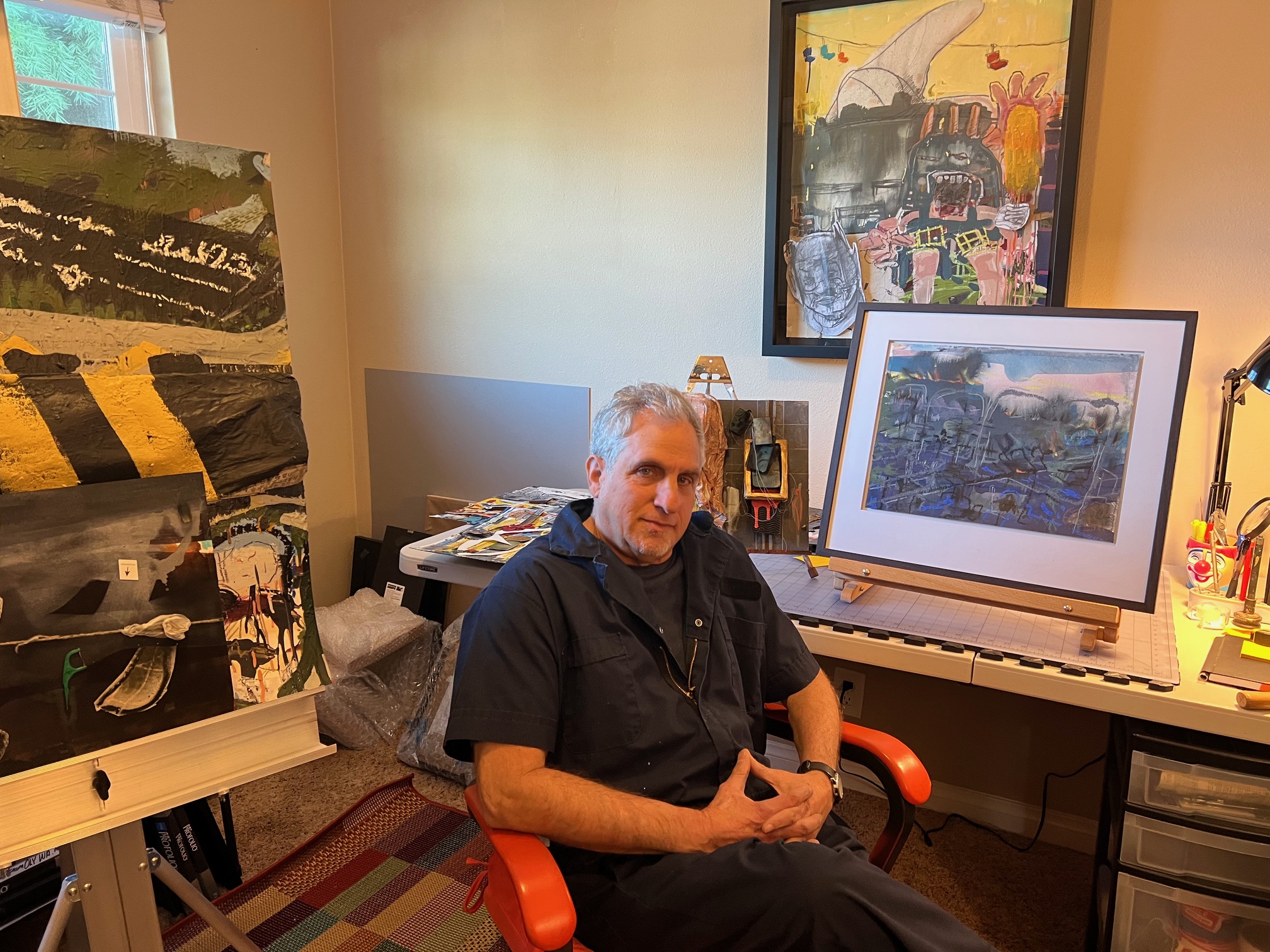
A self-taught graphic artist and fine artist, Kevin Jacobs is the owner of Firestarter Graphics, and a creator of layered, highly nuanced work that takes viewers on a deep dive into rich storytelling and passionate messaging.
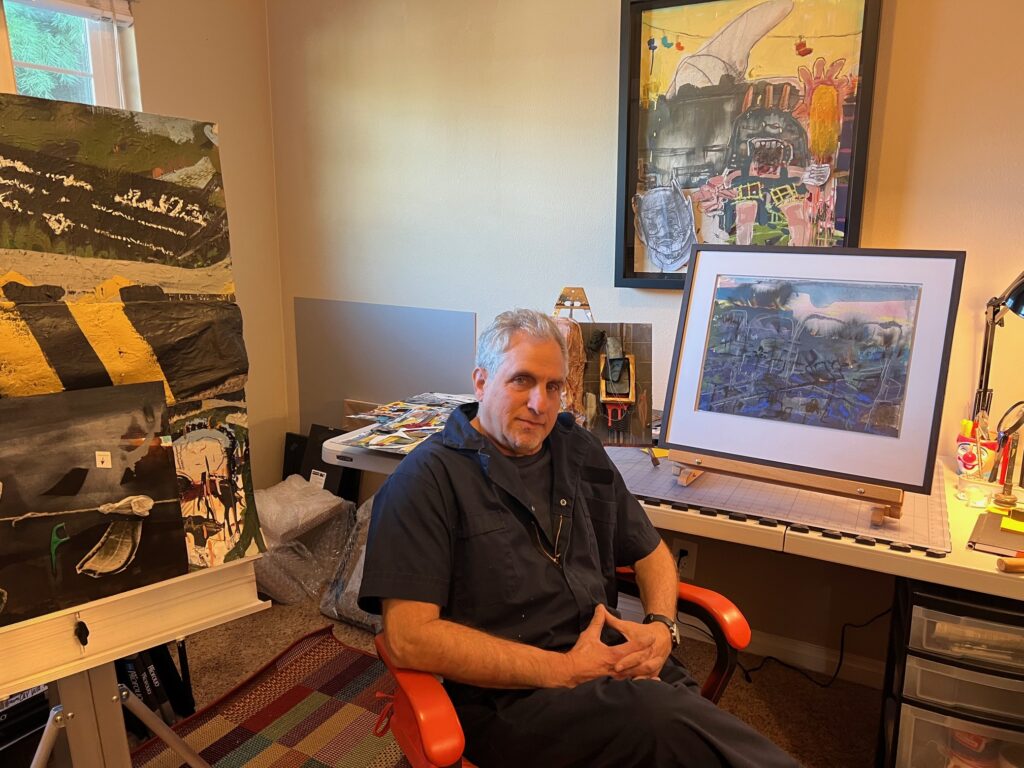
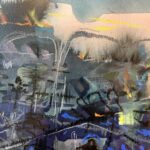
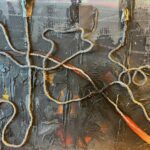
Jacobs uses a wide range of material that add to the visual interest and highly textured surfaces of his art. Working with found objects, paint, pencil, YUPO paper, collaged images, household paint, and both oil and watercolor pastels, he mixes humor and hope with a sense of impending dread in some works, and the yin and yang twists of fate that are a part of every life.
Using a variety of found objects and manipulatable substances gives his art a deliciously outside-the-box ingenuity that adds visual interest and a subtext of rebellion that resonates. The artist often chooses acrylic flat house paint mixed with watercolor paint to create his work, basing specific color choices on paint swatches he collects from home improvement stores. A graphic designer for over 30 years, Jacobs admits he is impatient to get on with his work, and often seeks an exact color using those types of paint without resorting to mixing it himself, which is where the house paint swatches come in handy.
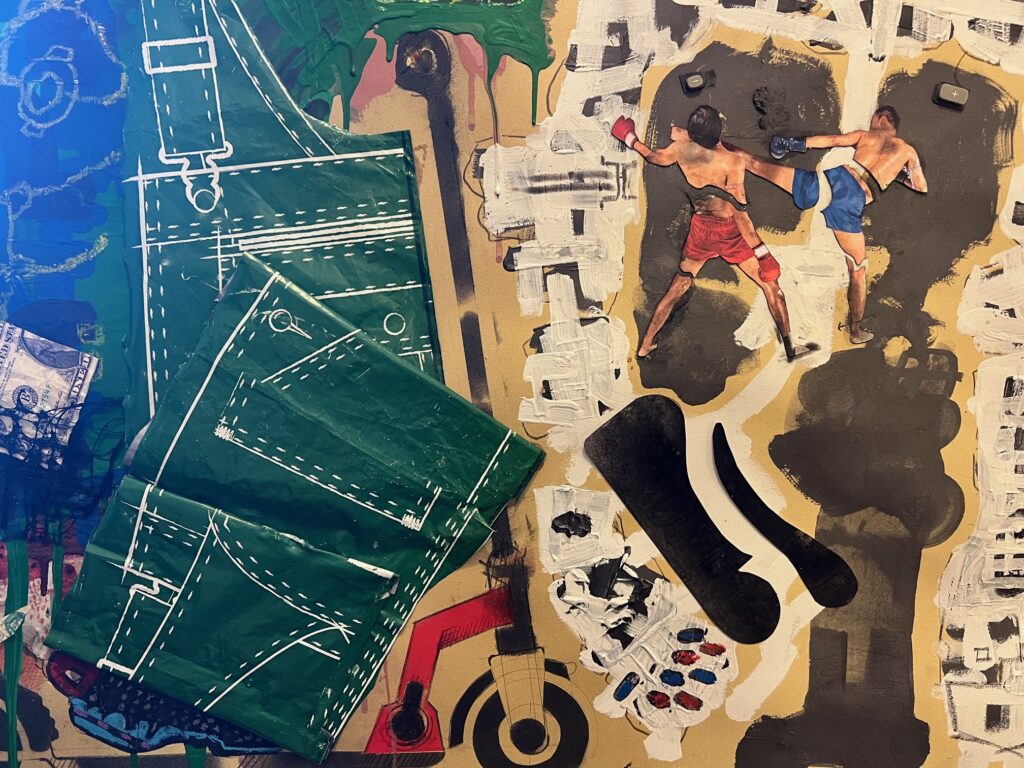
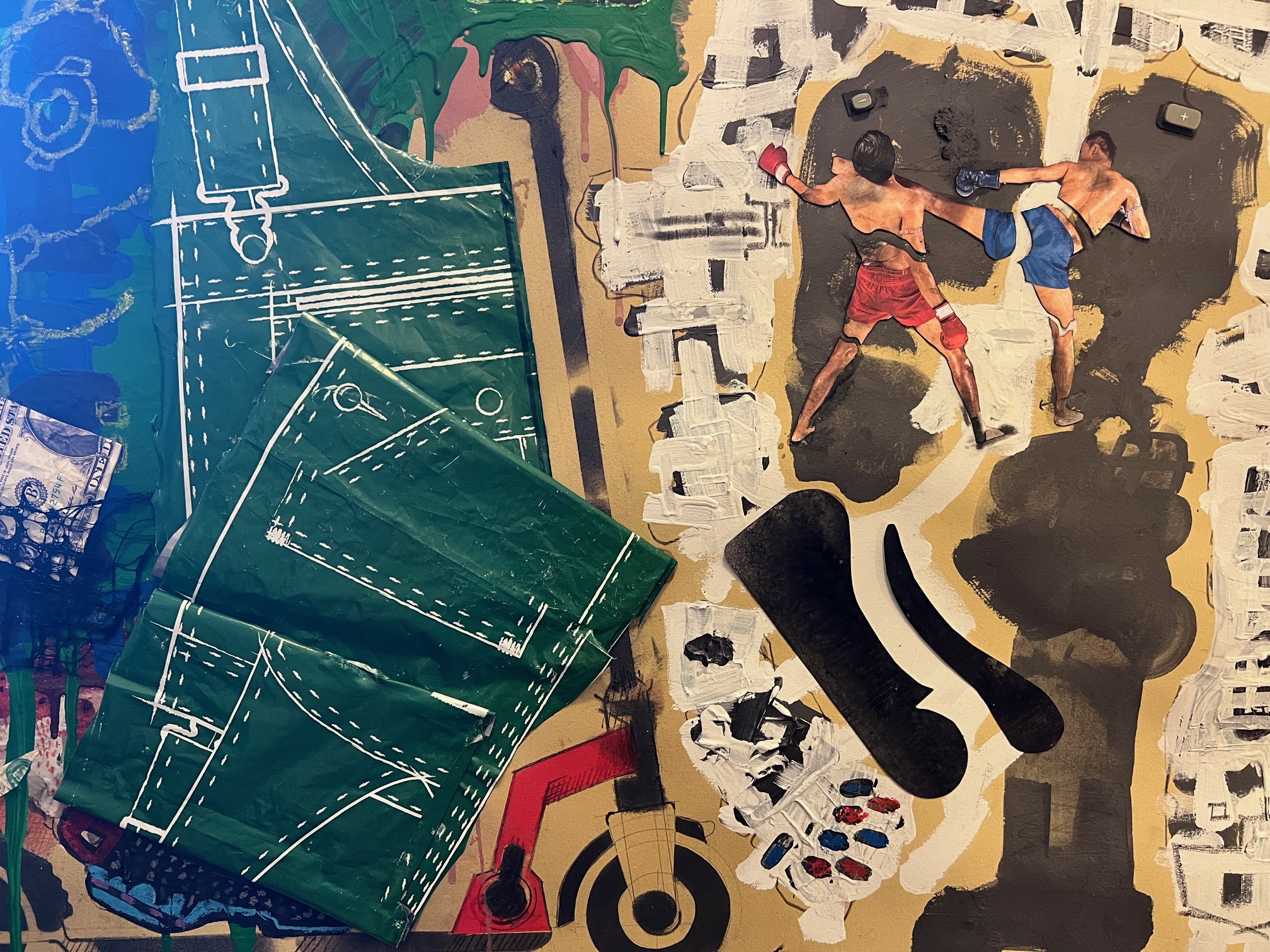
He describes his own work as having an “urban feel, with both the negative and the positive present in any situation.” In his collage “Bullies,” he truly exemplifies the good and the bad, the winner and the loser, the unexpected redemption in the face of fate. His vibrant splashes of painted color and found objects such as a folded green wrapper from men’s coverall packaging shape a work that is as much emotionally laden archeological dig as it is visceral art.
His technique often includes in a graphics design program as a kind of “trial image;” then using his signature mixture of drawing, painting, and found materials, he creates a finished piece, “straight from the heart and mind. I don’t want to spend too much time refining a piece; I want to complete it before my analytic brain ruins it.”
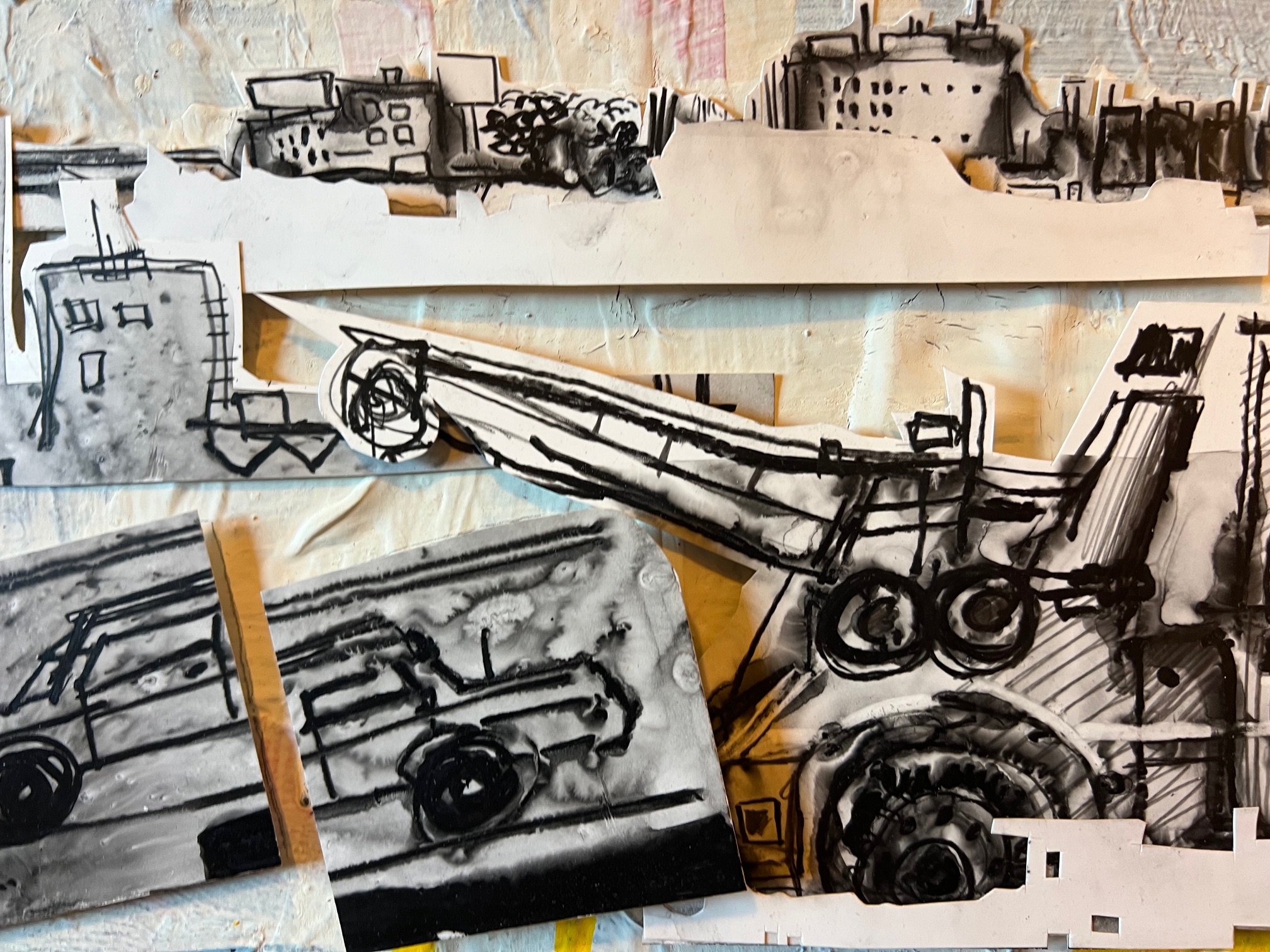
According to Jacobs, each piece “starts with an image in my head, and my poetry brain comes up with the title or there is something that I am thinking about subconsciously that forms a title, and then I work around that.” One of his many techniques involves drawing with water soluble carbon cake on YUPO paper, creating individual small works that he collages into his larger pieces.
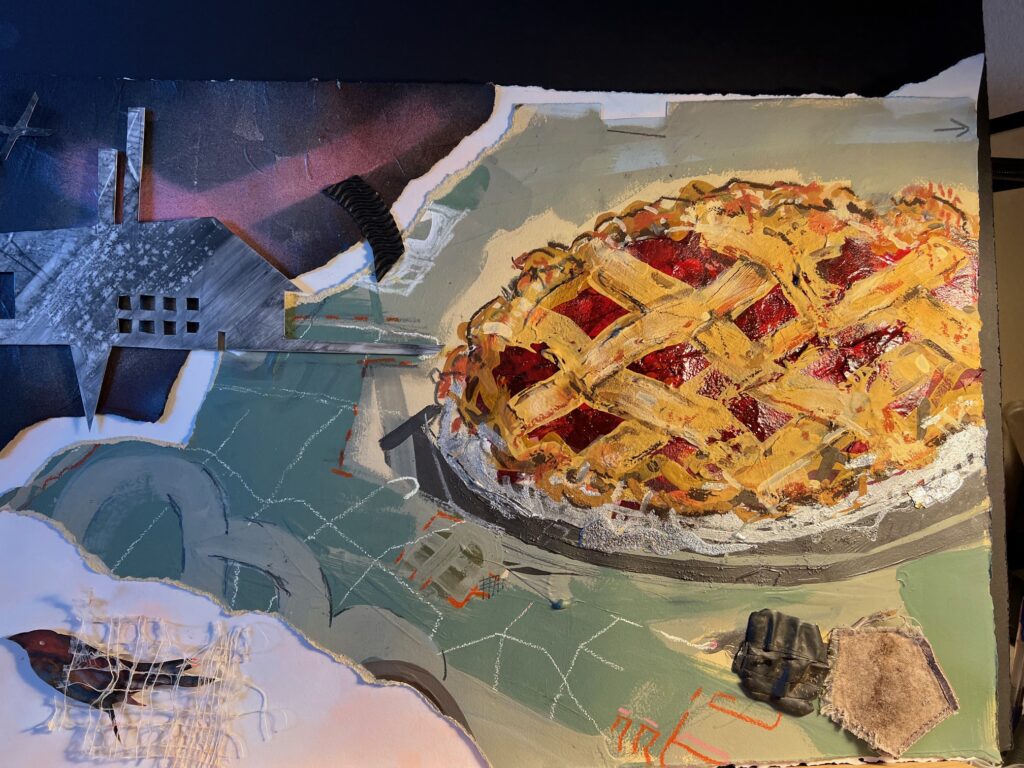
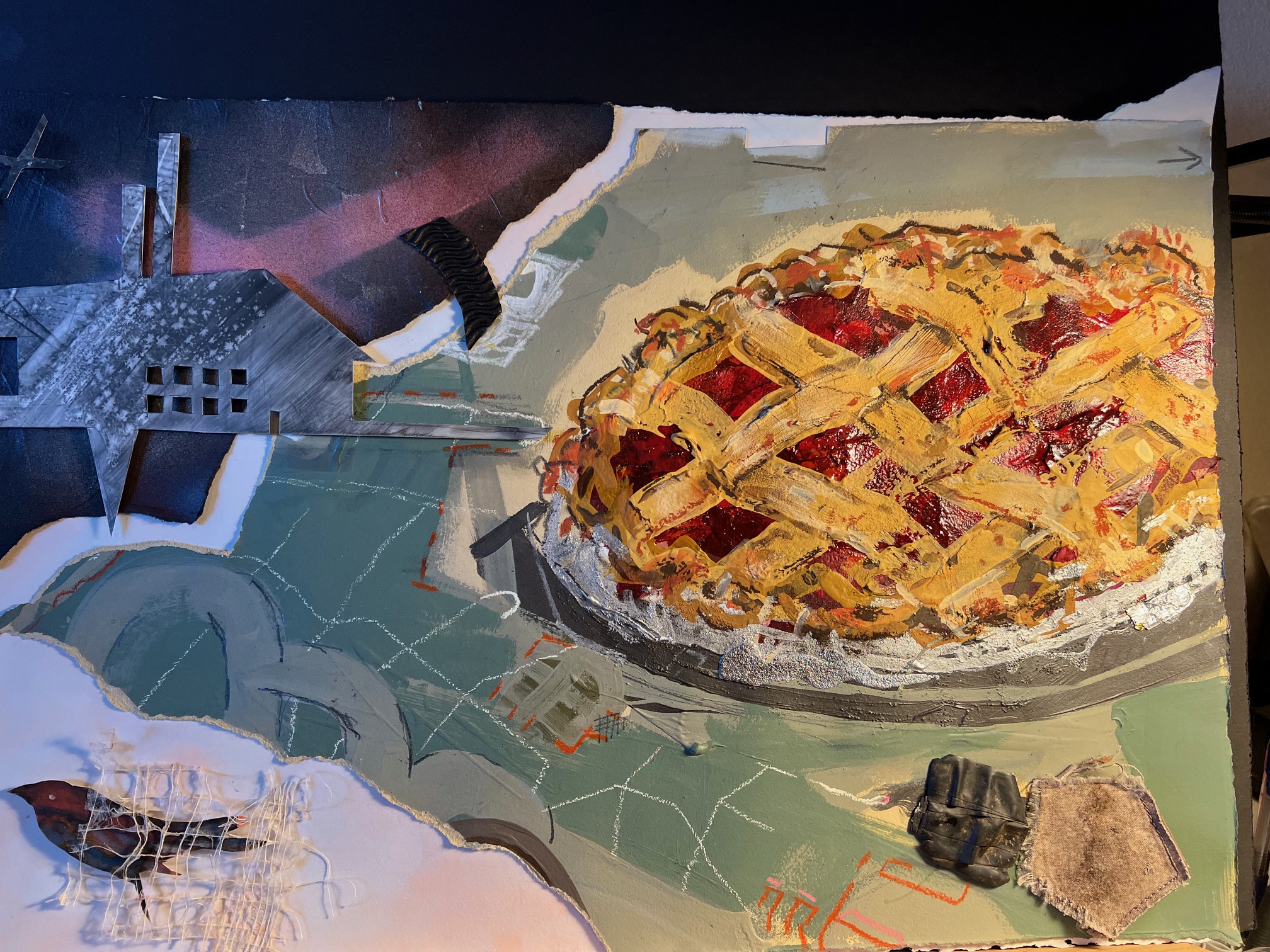
Once recent piece, “Room Temperature” includes a factory building created in this way, a dark, almost ominous structure positioned on one side of a large work that is dominated by a beautiful, luscious looking cherry pie that Jacobs painted traditionally. The idea behind the piece gestated from the artist watching a “documentary about pies made by sweet elderly ladies” and contrasting that with the fact that many pies today are baked in factories and sold commercially.
In the same painting is a perfectly painted bird trapped behind a piece of found netting, which appears to represent a sense of a fractured America, one in which freedom is not so free any more. Curiously the work also includes a small piece of electrical tape in the right corner, another dichotomy with the traditional craft of pie making versus the modern world.
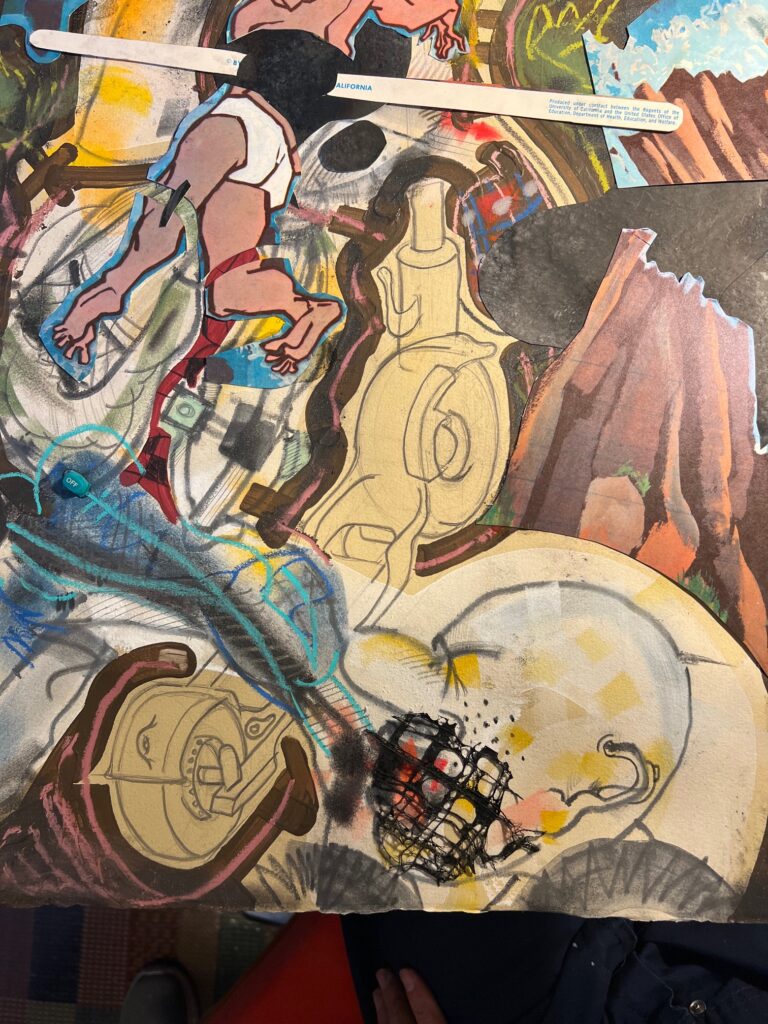
Many of Jacobs’ works involve dichotomy: In “Stolen Scooter,” a mixture of drawn images and collage tells the story of a “bad dude” stealing a scooter in a chaotic, involving work filled with overlapping images and mediums.
Jacobs says he has loved collage his entire life, and “finding random things unexpectedly. I like the sense of surprise and absurdity that can throw me off as well as the viewer.”
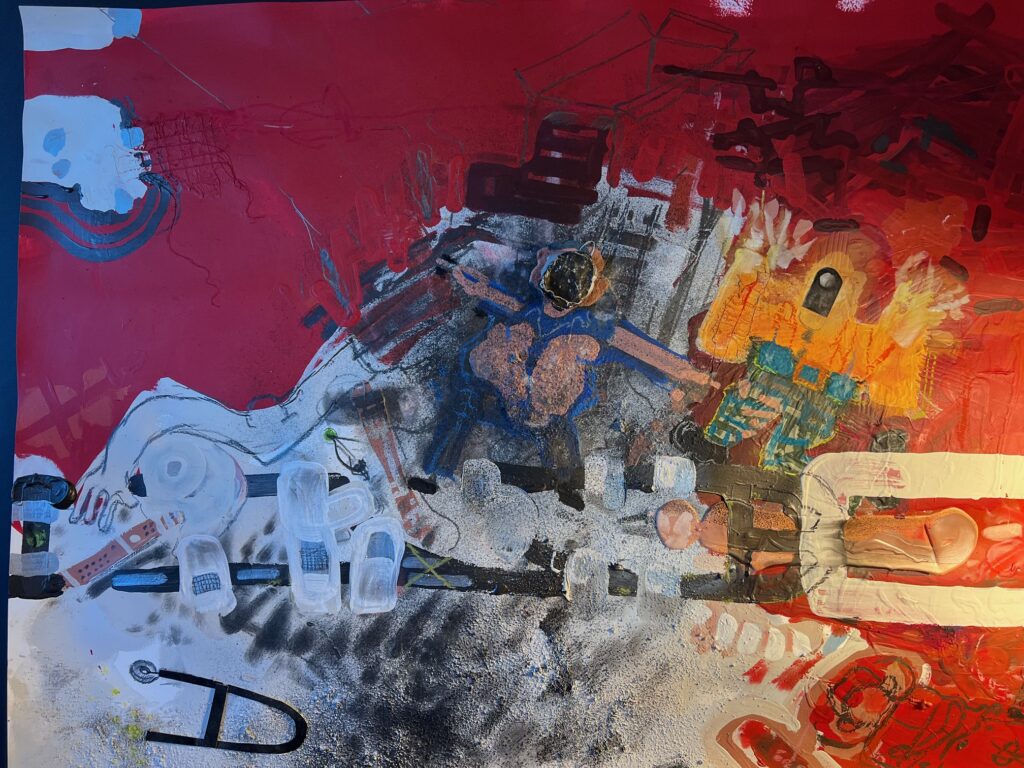
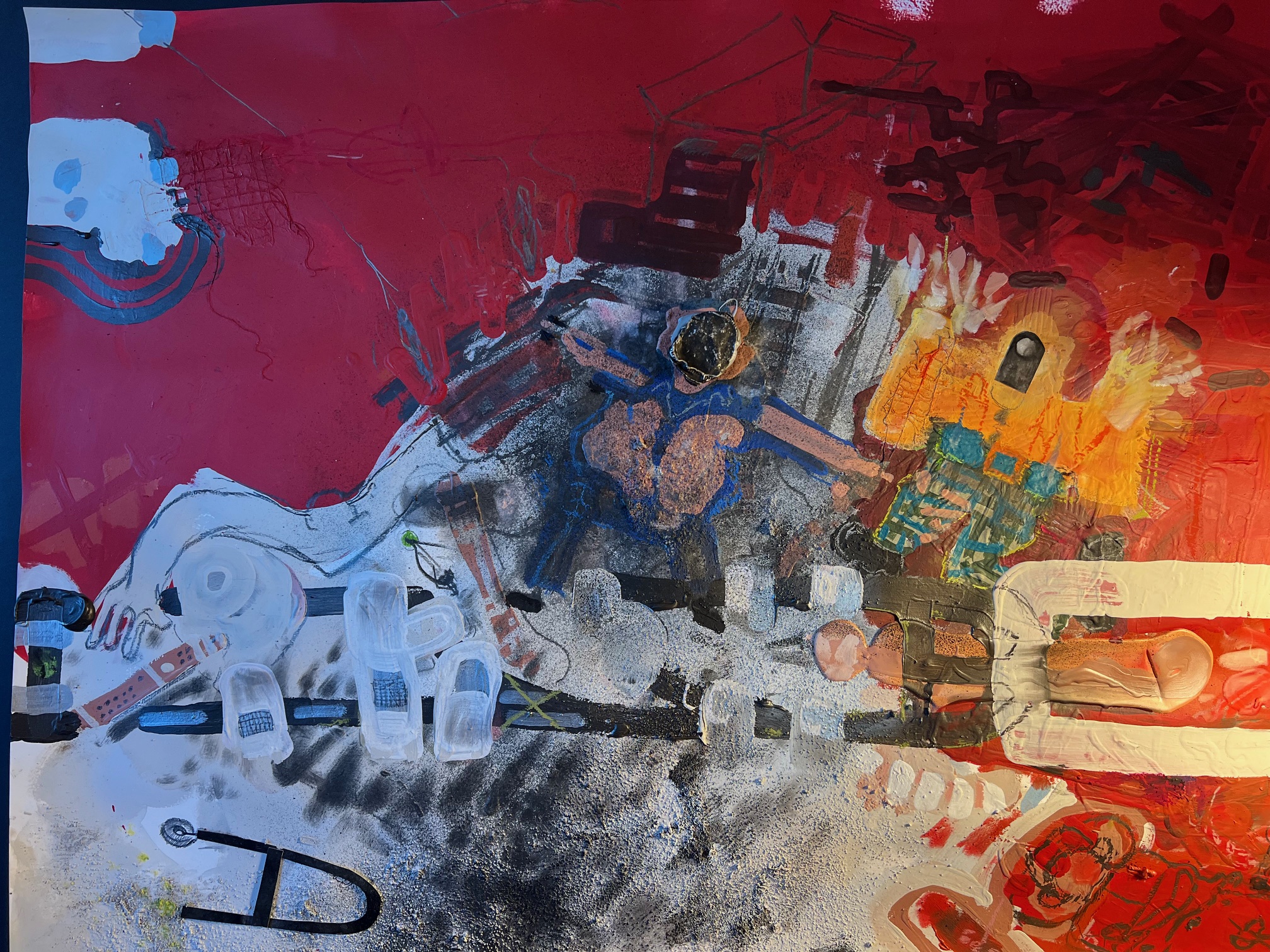
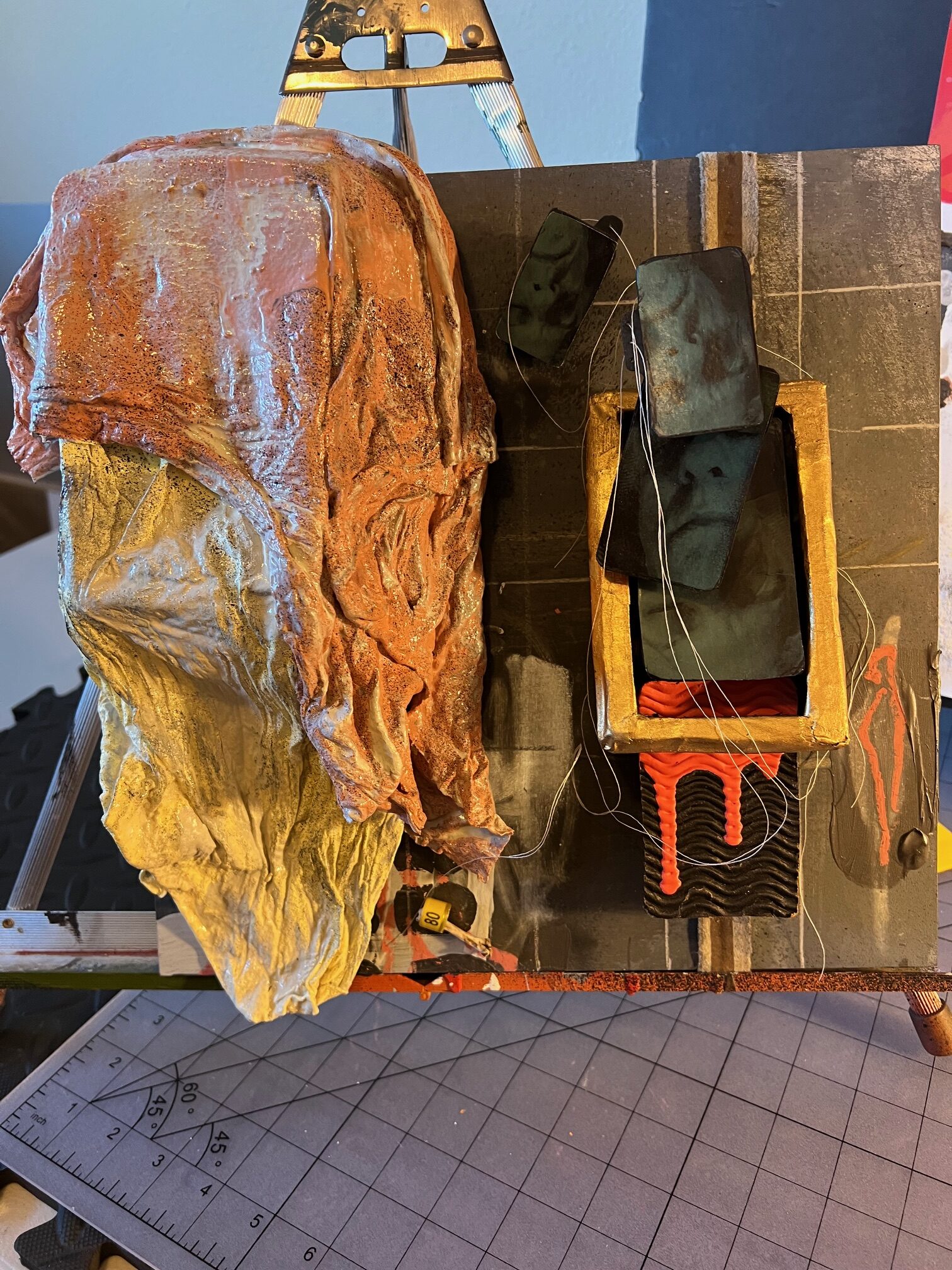
Personally speaking, the artist has had a harsh time in recent years, dealing with his own health problems and the passing of his wife. “Aging” explicitly reveals a sense of “shattered dignity” and a struggle with home health care, the hospital gadgets, the nurse “ghosts” who pass in and out of a haunted existence while recovering from physical ailments. The central figure, the patient, has a face made from a smashed bottle cap.
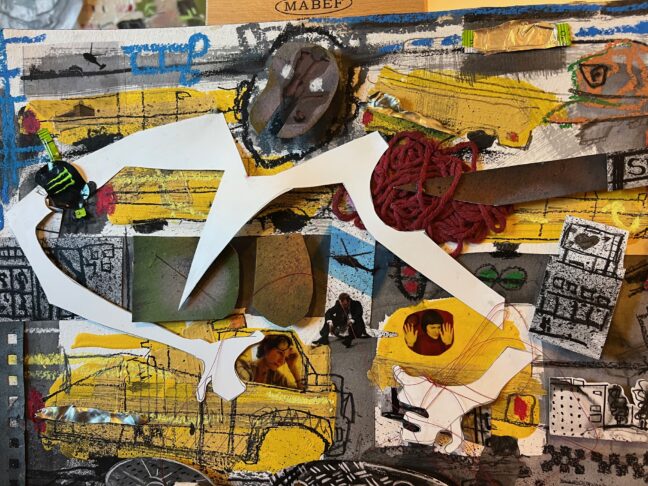
Yet another work, “Red Tape, Red Flags, and Loopholes” takes on invasive technology from drones observing us to other advancing surveillance technology we have no control over. The work has dimensional pull from raised collage elements, which speak to another love of the artist’s: along with collage he has a great fondness for pop-up books, and terms his art “a poor man’s pop-up book” as well as referring to his images as created by a “poor man’s Red Grooms.” While Jacobs may infer this about his work, there is nothing poor about his art excavations for the viewer experiencing his robust visual storytelling.
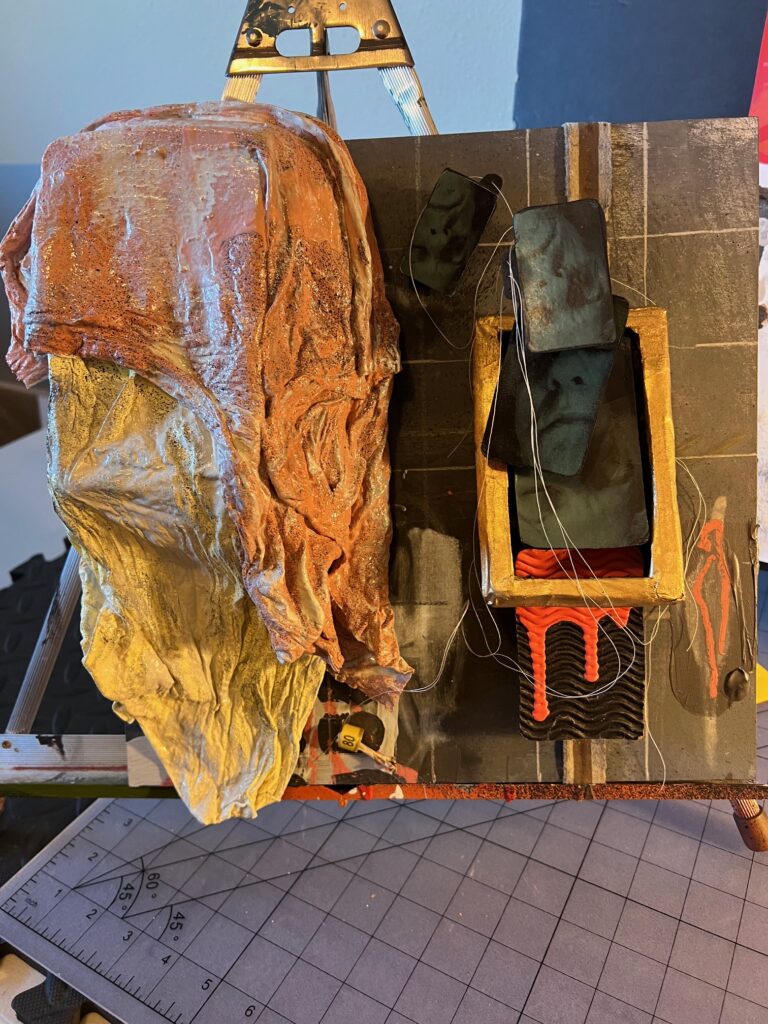
Jacobs’ art also touches on other passions in his life: science fiction and music. Once the guitarist in a traveling rock band that also featured his wife as lead singer, his collages also exude a kind of rhythmic pull. One of his works expressly recalls the “sleazy hotels we had to stay in when we were traveling with the band.” That collage, titled “Encrypted Love” contains a visceral anxiety based on a time when these hotels were “awful, sleazy, feeling unsafe and anxious. You stay where you can when it’s 2 a.m. and the band just finishes playing,” he explains.
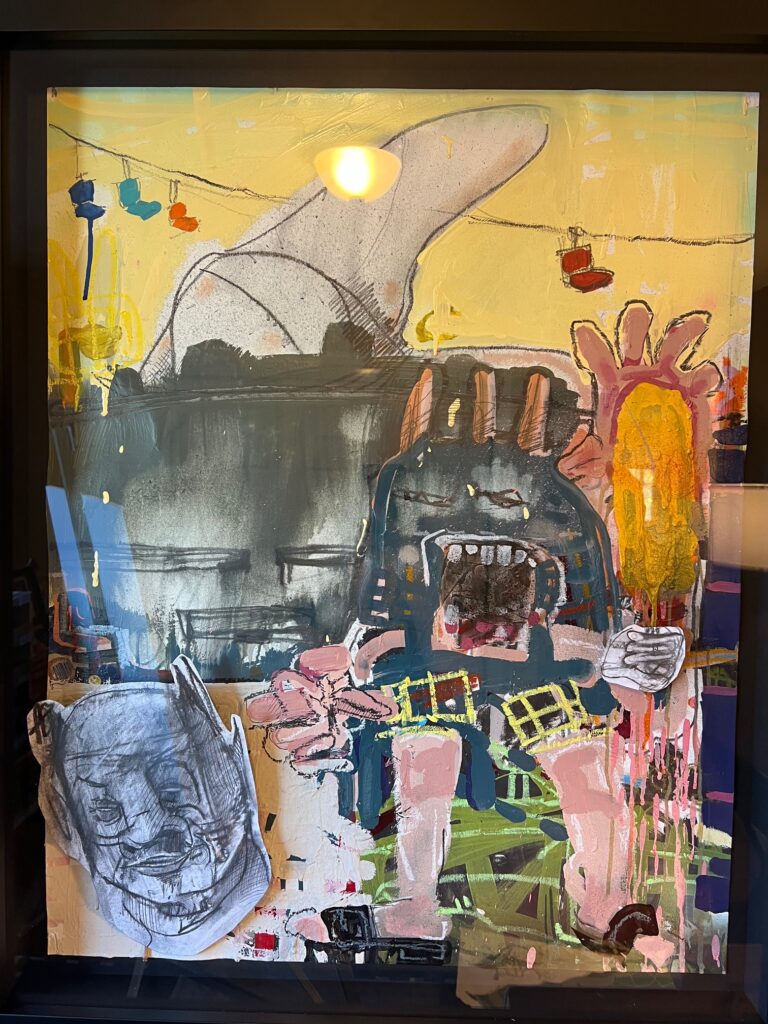
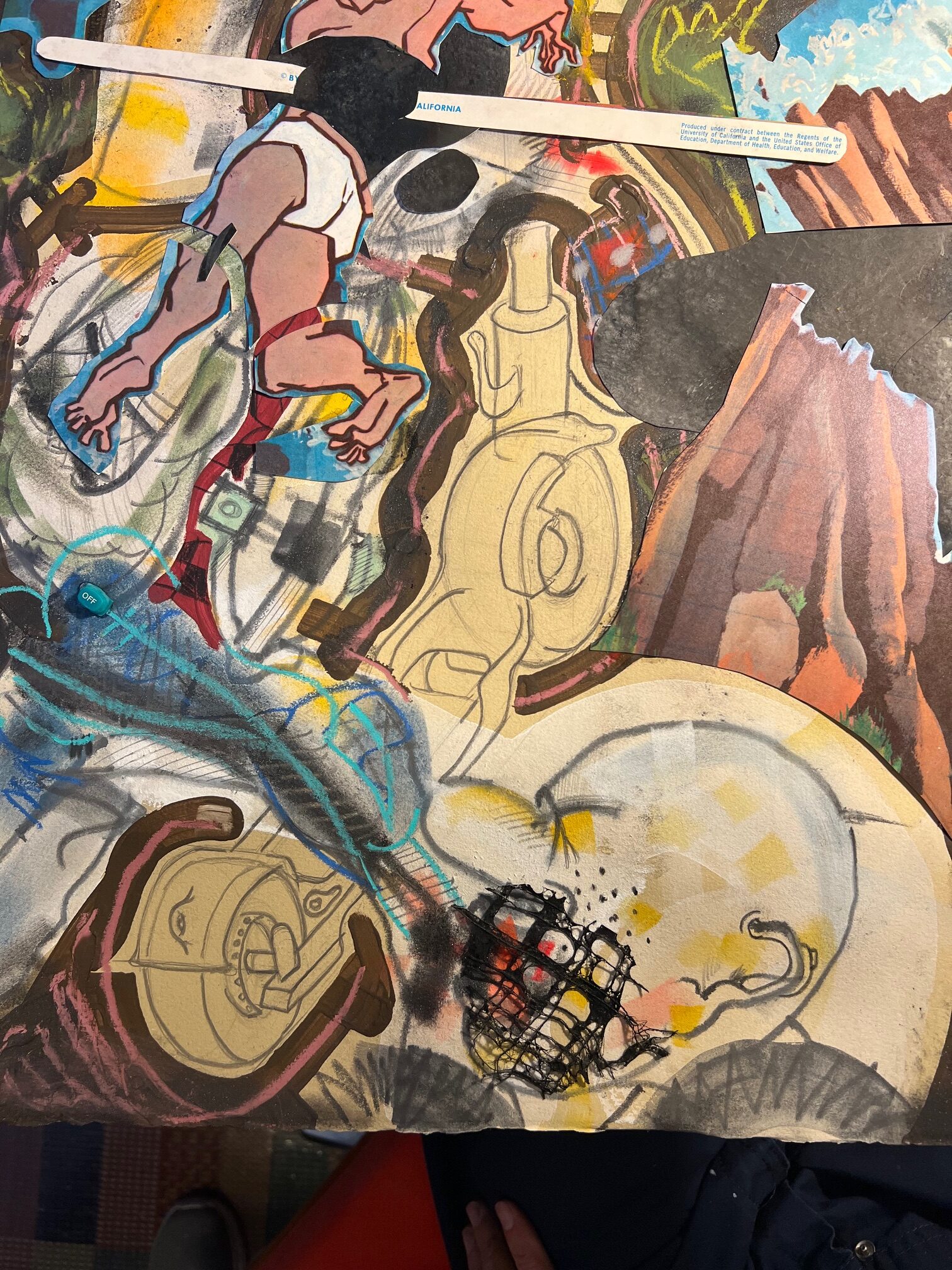
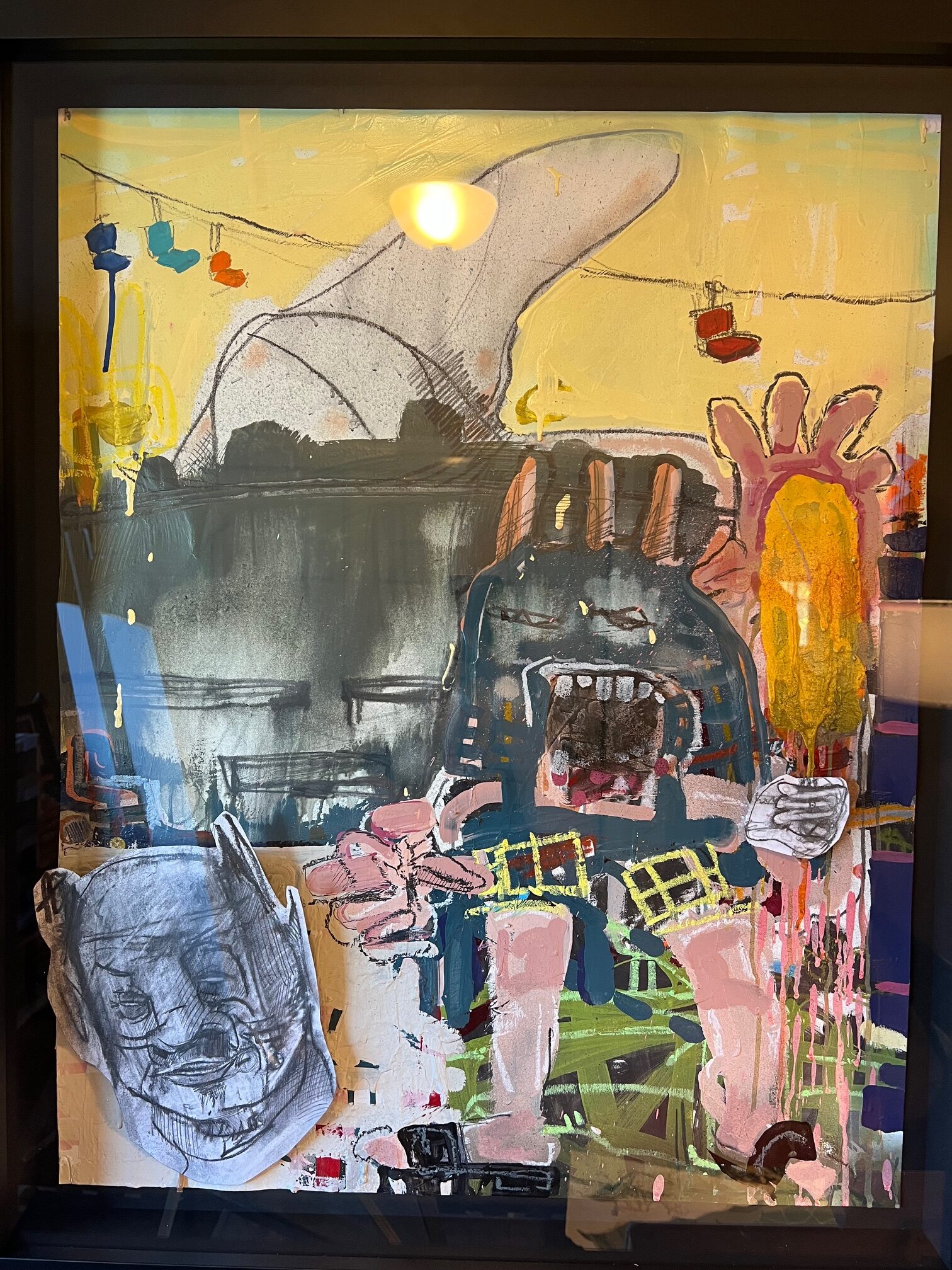
More lighthearted is “End of Summer,” a representation of the Orange County Fair, with fair food, wacky people, screaming faces, and an overhead skyride. “Drone Lost on a Trail” is a representation of a true story in which Jacobs lost his way on a mountain trail near Olympia, Washington, before drones existed. In this piece, drones drawn on semi-translucent vellum float dimensionally, lifted off the surface of the collage on clear beads.
From a poignant yet humor-laced collage story depicting a speed bump at a mortuary and ghostly footprints visiting a cemetery to a series of works based on building or not rebuilding decimated neighborhoods after the 2025 fires in Altadena and the Pacific Palisades, the artist takes weighty, of-the-moment emotions and shapes them as stories both personal and profound. His fire series includes works titled “Mr. Ash” and “Land Developer” as well as “Downed Wires,” each a meaningful gut punch.
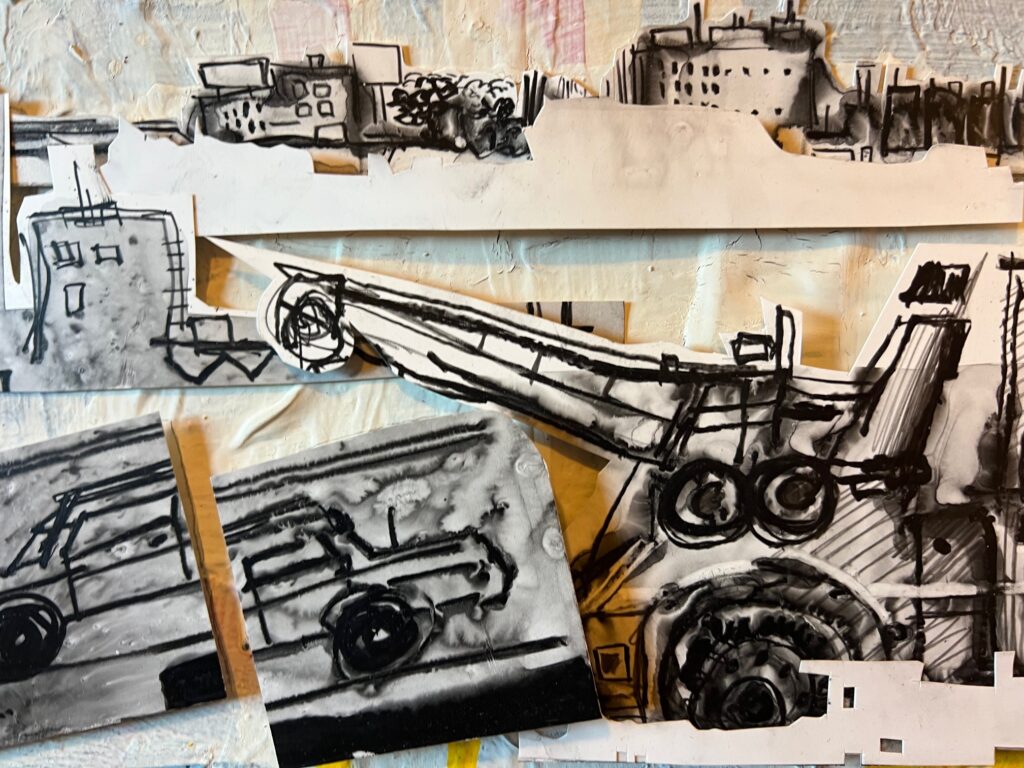
Jacobs, an LA native, even takes on New York City with the ghoulish figures and bright yellow taxis in “City Scarecrow” and its companion piece “New York City” that features an image of a tow truck fracturing a car being towed.
Regardless of medium, from printmaking and monotypes to graphic designer and fine artist, Jacobs visually tells stories laced with humor, heart, pain, and passion. Bold and inventive, this is an artist who encourages viewers to experience every aspect of human life. And maybe that of drones, androids, and ghosts, too.
- Genie Davis; photos by Genie Davis