
Every Picture Tells a Story at the new Lucas Museum

The Lucas Museum of Narrative Art floats low on the Los Angeles skyline, hovering close to the ground, both cloud-like, as its architect Ma Yansong has described the 300,000-square-foot building, and not-dissimilar to a spaceship. The latter of course is most appropriate to the museum’s founder, George Lucas, who has brought joy and fun to all the Star Wars fans out there for decades. The museum is equally guided by Lucas’ wife, Mellody Hobson.

Now he has turned his attention from movie making to museum making. The result may not please everyone: his sole purpose is to portray narrative art, in other words, storytelling as visual art. He does not mind mixing genres, and he has very singular taste in which a Frida Kahlo is not that far from a Shepard Fairey or an R. Crumb or a Norman Rockwell.

The building, or rather two interconnected buildings with an oculus in the center and a massive greenspace spread behind it, is stunningly beautiful, and not entirely dissimilar from the higher physical profile of the new Geffen Gallery at LACMA. Both offer a circular navigation through galleries that curve rotationally in and out.

The elevators are glass capsules infused with light; the oculus offers a shiny beam at the center. There are long windows along the 4th floor main gallery space that offer city views and garden views, some more spectacular than others, with the east-facing windows showing the back of the Coliseum being the least appealing, and the garden view with its sculptures and varied levels of green, as well as rows of palms to the south, the best.

The museum’s focus is on making art of all kinds accessible and inspiring, and that idea is fully realized throughout the museum, including the first-floor gallery that adjoins the two large theater spaces. Titled The History of Narrative Art: Heroes • Myths • The Sacred, this gallery leads visitors through a wide world of visual storytelling. Visitors enter through a vibrantly illuminated photographic image of the Cave of Altamira in Spain, moving through other photographic recreations, some in 3-D rotation (as with The Goddess of Willendorf) to meticulously rendered physical recreations of famous works. Many of the reproductions were created by the museum in collaboration with institutions, sites and governments around the world, including Mexico’s Instituto Nacional de Antropología e Historia for the Aztec Sun Stone.

Among the photographic images and detailed recreations are some incredible original works, such as the predella panel from Tommaso Bernabei’s “Scenes from the Life of the Virgin,” and Pieter Brueghel the Younger’s “The Alchemist. ”

While some will take umbrage at the fact that there are genuine-article artworks intermixed with glowing photographic reproductions and recreations of originals, that is really the point. It is especially resonant for those of us who have ever worked in or been full fans of filmmaking: there are props that recreate an object; there are faux backgrounds that could be real but are not; there are real locations, and there are stage sets. And it is all storytelling. It all creates a masterful whole that draws the eye and stimulates the senses. This is the same basic approach that Lucas is taking here with high-resolution images and 3-D scans of original objects intermixed with original works.

Photo by Stefanie Keenan/Getty Images for Lucas Museum of Narrative Art

As to the jewel-box-perfect 299-seat Robert Flaherty Theater and Slavko Vorkapich Theater, these are designed to be continuous, gallery experiences in their own right, showing films ranging from a few minutes to 90 minutes, running a variety of film programming during the museum’s open hours. According to Lucas, visitors can drop in to screen as much or as little as they want, viewing old favorites or exploring cinematic images previously unknown.

The museum has five floors: on the second is a gorgeous, curving educational library with appealing reading tables and a view straight out to the 13 acres of public garden designed by landscape architect Mia Lehrer.

That garden includes a collection of varied sculptures, including the commissioned Princess Leia Frees Herself from Jabba the Hutt by Mark Newman & Giovanni Nakpil which is the centerpiece of the upper garden level closest to the museum.
The third floor is administrative offices.

The fourth houses the main gallery space, along with a major section of the 5th floor which contains large-scale murals, with a specific emphasis on works by Banksy which were recreated by the artist himself for and at the museum. Also on the rooftop floor of the Lucas is the Skywalker Grill, which was not open at press time; the bottom floor houses a cafeteria-style café with an array of choices including a range of pizzas, noodle dishes, and even soft serve ice cream and churros. There is also a Starbucks.

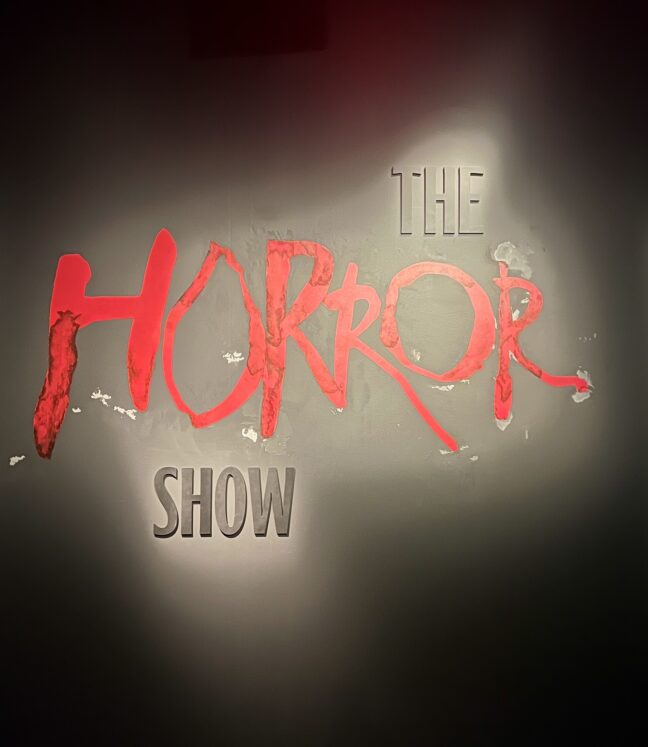
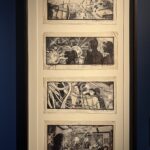
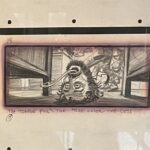
If the café offers a wide variety of tastes, then the main galleries on the 4th level provides a great many more flavors of art. There are illustrations of The Lord of the Rings trilogy, luridly lovely pulp fiction and horror, political poster art, and the works of Maurice Sendak. There are original ink renderings of Garfield and Far Side cartoons, photography, and sculpture.

The latter category alone is varied and crowd-pleasing, including commissioned bronze pieces such as one of Indiana Jones, as well as brightly colored manga characters, Yinka Shonibare’s dazzling “Boy on Globe,” and Banksy’s ornamental lions “with added parts” indicating the demise of a trainer whose legacy is his discarded whip and top hat.

Of course there are a plethora of paintings, including galleries specifically devoted to Maxwell Parrish, Norman Rockwell, N.C. Wyeth, and Jessie Wilcox Smith.

Other fabulous and famous works are intermixed by theme with close-to-complete-unknowns, a Renoir there, and the somewhat infamous painting of dogs playing poker there. Fernand Léger’s “Woman with a Cat” surprises as does a brilliant work by LA artist Narciso Martínez of Latino field workers.


Kadir Nelson’s sprawling, hyper-realistic canvases are on view as are works by Thomas Hart Benton and Diego Rivera, along with Warhol’s “Howdy Doody” and Robert Colescott’s trenchant “George Washington Carver Crossing the Delaware: Page from an American History Textbook.”

Then there are costumes (the Cowardly Lion from The Wizard of Oz steals this category from Batman), and whetting the appetite of millions of Lucas fans, a gallery devoted to Star Wars props, costumes, vehicles, miniatures, and beloved characters including figures of Princess Leia, Luke Skywalker, Darth Maul, and of course R2D2 and CP30. There is even General Grevious’s life-size Wheel Bike from 2005’s Revenge of the Sith.

This gallery will undoubtedly be a magnet to the public; many press attendees were gathered there, eager for the eye candy, while my associate and I were often alone in many of the other galleries.

There are 30 in all, broken primarily into themes, while others are devoted to specific artists. The themed galleries include those devoted to fantasy, romance, adventure, manga, history, cinema, family, work, motherhood, comics, graphic stories, love, community, school, play, sports, and photography.

On the 5th floor, the category is murals—from Banksy, JR, Diego Rivera, and Judith F. Baca’s “The History of California,” the latter presented as a riveting video installation that flows, appropriately enough, over an installation whose base is water.

The museum is inclusive and egalitarian in nature. Lucas and Hobson have made access free to those in the local zip code, making this a special place for lower income families in the neighborhood. The library, like the garden, is free to enter. Any child over the age of 12, with or without a museum ticket, is welcome in the library.

Photo by Stefanie Keenan/Getty Images for Lucas Museum of Narrative Art

In opening remarks, both Lucas and Hobson noted that the museum was initially conceptualized in Chicago and in San Francisco prior to its incarnation in Los Angeles, and Lucas acknowledged some controversy over his vision, calling himself a “contrarian.” Be that as it may, and regardless of how others may critique the mix of genres and the predominance of several artists in the couples’ voluminous collection, like Lucas’s movies before it, the museum is designed to bring pleasure to everyone. The storytelling focus is truly the basis of Lucas’s own auteur/collector’s vision: he is a storyteller, so naturally he is drawn to art that tells narrative stories, stories that are accessible and personally meaningful.

“The artists in this collection didn’t just create images, they connected our modern imaginations with our ancient emotions, with common beliefs creating community. Their work spans genres, media, and time,” Lucas says. “They deserve to be in a museum.”

Hobson adds that “We wanted a museum unlike any other — one that brings people from every walk of life through the same doors. That’s why this collection holds so many different kinds of stories: so that more people can walk in and, somewhere in these galleries, see themselves…”

Photo by Stefanie Keenan/Getty Images for Lucas Museum of Narrative Art

They will also enjoy themselves, learn to recognize art in many forms, and smile at many of the juxtapositions, at the cultural icons from Mad Magazine’s Alfred E. Newman to the sweet watercolor animals of Beatrix Potter, a winter scene by Grandma Moses, or a photograph of The Beatles crossing Abbey Road or the stunning, renowned image of a young Arab girl.

Museum goers will see a poignant 1960s drive-in in the rain, a charming ‘”first day of school” farewell, as well as a resonant pairing of Rockwell’s bucolic 1958 “The Runaway” with its friendly policeman speaking to a small runaway white boy, with Richard Williams’ 2014 update of the painting’s theme, “The Militarization of the Police Department” in which a cop clad in riot gear leans over a young black child.

As author and journalist Mitch Albom said, “There’s a story behind everything. How a picture got on a wall. How a scar got on your face.” Or as Rod Stewart once sang, “Every picture tells a story, don’t it?”

And when we share those stories, we share our humanity, our hopes, and create emotional connection, building and sharing understanding, empathy, and—enjoyment.

And isn’t enjoyment what art is really all about? Even Michelangelo created the Sistine Chapel for his joy and that of the viewer, not for analysis as to whether each of its parts made a critically reviewed perfect whole.

  • Genie Davis; photos by Genie Davis, except as credited to the Lucas Museum 

Scott Tansey Is Bursting With Images

There are two new photographic books soon to emerge packed with evocative images from artist Scott Tansey. Each are quite different but both represent a lush ethos of images that linger once viewed. Wet Point Lobos and Surfaces present very different topics, but both show astonishing grace.

In Wet Point Lobos, Tansey has captured the shape of vast sweeping landscapes and the intimate, sinuous, sensual closeness of sea and shore. He has truly made Point Lobos his own, giving us a personal and profound a look at a destination that is inherently meaningful for the artist, and for his viewers alike.

In these images of Point Lobos, Tansey gives us the stones, pebbles, sea creatures, tide lines, and sea foam of the Central California Coast as an intimate gift. Each image is a jewel, sparkling and wet: he gives us the visceral texture of sand grains, the roughness of rock layers, the eroded shapes of curving and linear tide pools, the glow of water and sunlight, of winter waters and spring tides.

California, Central California, Monterrey County, Point Lobos, Point Lobos State Reserve, Rocks, Water

As a photographic artist, Scott Tansey has captured the shape of vast sweeping landscapes and the intimate, sinuous, sensual closeness of sea and shore. He has truly made Point Lobos his own, giving us a personal and profound look at a destination that is inherently meaningful for the artist, and for his viewers alike.

The cross hatching of sedimentary rock reminds us of well-worn skin; foamy waves erupting through narrow cliff-side channels pulses like a clear, wild blood through our veins. Cerulean blue stone, caressed by calm reminds the viewer of an astronaut’s glimpse of our blue marble Earth from space.

California, California Coast Line, Central California, Monterrey County, Point Lobos, Point Lobos State Reserve, Rocks

This is Wet Point Lobos: a miracle of time, tide, and tenacity, a world in which the viewer can wade through images as cool and alluring as the sea itself.

Moving from sea to land, Tansey’s Surfaces vary, but color explodes in an utterly unique and mesmerizing series of images. As Tansey explains, “Photographs are created, not merely captured,” and his creation of surfaces makes the world around us vibrate in a wild explosion of color and force.

Using post-production techniques that could have been utilized more than a decade earlier, he has shaped a vision that is nonetheless absolutely of this moment, as transforming and dazzling as if the viewer looked through a prismatic screen, exploring compelling kaleidoscopes of color, and a rainbow of resonance.

Altering the color space of simple surfaces alters the mundane, transforming it into something visionary. Whether it is a wall observed outside a restaurant or simply the ground Tansey walks on, these images appear brave and incendiary. Textures are colors, colors are surfaces, color seeps through the pores of every substance revealed in this collection. The artist creates the auras around landscapes, the auroras of opalescent light that make the prosaic into the profound and spiritual.

Seattle

As a viewer, ask yourself if you can imagine animate life leaving behind a resonant glow, a fresh color field. Tansey certainly provides that here, shaping a new spectrum of light and vision. As he notes, “Hundreds of thousands walk over the surface of [these] image[s] each year…” without seeing within them.

Exotic as many of the artist’s images appear at first glance, this abstract and vivid series of works are based on locations captured less than four miles from where he lives. It is a fascinating change for an artist who has traveled the world’s glaciers, explored cities, cathedrals, and distant seas.  What Tansey has done in these collections is a revelation of what lies within the core of the earth itself.

  • Genie Davis; images provided by the artist


A Purrfect Show – Natural History Museum’s Cats Pounces Into LA

Fierce! The Story of Cats, now at the Natural History Museum through February 18, 2026, brings an immersive, intelligent, and fun view of the fabulous feline to Los Angeles.

Saber-toothed cats had pretty impressive bicuspids!

Along with learning that the La Brea Tar Pits were once home to lions, and that cat friendships and mousing expertise long pre-dated the Egyptian culture’s deification of cats, the exhibit revealed not only cat history, but cat breeds, cat physicality, and cats as art and vestiges of good fortune.

There are clips from cat media (of course including last year’s Academy Award-winning Flow), video of Chinese New Year lion dancers, and even a gigantic sculpture of a Japanese “lucky kitty.”

Flow, above.

What and how cats see, below.

Add your kitty to the carousel of pretties…

In its West Coast debut, the show also features clever cat facts and silhouettes of kitties on the exhibition gallery walls; the ability to enter photos of your own cats as part of a slide show of domestic kitties; and a variety of cultural cat objects.

Seeing the size of various cat claws up close, and cat teeth, and cat fossils, the viewer gets a look at the evolution of cats, the array of feline family cousins and descendents. There are hands-on facts and fun, audio exhibits, and perhaps best of all, a wide ranging display of both taxidermied cats, art depictions of cats, and yes, stuffies of cats, all revealing the beautiful and diverse creatures that make up the feline family tree.

Learn how cats leap, all about their vision, their supple skeletal structure, the differences in fur, the commonalities among feline types.  Hear them roar, hear them purr, consider the reason cat claws contract, and the joy of a playful kitten.

From protecting crops to balancing the eco system in the wild, from predatory hunting skills to the healing sound of a purr, this lovely, multi-room exhibition (plus a gift shop with a lot of fun kitty-lover treats) is informative, fun, and packs a potent message about how important it is to protect cats great and small, their habitats and their homes.

The Natural History Museum is located at 900 Exhibition Blvd. in Los Angeles; open hours are 9-5 Monday-Sunday; Fierce tickets are $12 above the regular museum entrance pricing of $18 per adult admission. Go ahead, take a leap.

  • Genie Davis; photos by Genie Davis
Catalina Dreamin’ – Part 2

Catalina Dreamin’ Part 2  – by Genie Davis

If you read about our first day’s adventures in Catalina, you can very likely already tell that any time is the right time to visit Catalina, Southern California’s own special island getaway. But while summer’s joys are now imminent, and it’s almost time to bring out the bathing suits, the quieter months that stretch between November and March are beautiful times to visit, too. Our visit took place at the end of February.

We enjoyed new and updated dining spots,  our first ever golf-cart-ride into the hills, just-beginning to bloom gardens, a terrific new kombucha and beer spot, and fine art exhibitions, still on-going at the Catalina Museum of Art and History.  We also enjoyed a spooky, EMF-enhanced ghost tour and took a VIP tour of the lovely Casino. For our first day adventures, click here. 

The next morning began with our first golf cart drive into the hills. While I’ve scooted around the Avalon streets with kids in tow years past, this was an inaugural trip into the hills, following a well-laid out map from our rental company, Catalina Island Golf Cart Rentals.

We first drove along the coast and up to Mt. Ada, stopping for sweeping viewpoints of the harbor, the casino, and the open sea, made more dramatic by a mix of low fog and brilliant sunshine. Next we headed into town and up to the Botanical Garden, promising ourselves a return trip later in the day when we could spend more time there. Heading to the opposite side of Avalon, we were able to watch and hear the Chimes Tower strike noon before heading down to the Descanso Beach Club, where we dined the previous day, and on through town to return the cart. The leisurely and lovely drive took two hours on the dot.

Afterwards, it was time for lunch at one of our favorites on the island, Bluewater Grill. Part of the Bluewater Grill group of
restaurants on the Mainland, there’s no location like this one: a huge deck sprawls ocean front, for a beautiful view of boats and birds and buoys. This owner-operated spot includes an oyster bar, sushi bar, and full bar selection. And of course, Bluewater’s renowned freshly made bread. We disappointed more than a few sparrows by keeping this warm deliciousness to ourselves. I had the melts-in-your-mouth umami flavors of Misoyaki Butterfish, or Pacific Black Cod, glazed with miso and served with green beans, white rice and eel sauce with green onion, cilantro and daikon sprouts, while my dining partner opted for the Togarashi Spiced Ahi Tuna.

If that wasn’t feast enough, we shared two of the restaurant’s signature desserts – Key Lime Pie and Java Mud Pie. Hard to say which was the best – so you almost have to try both.

After lunch it was time for art and history, as both are beautifully displayed at the Catalina Museum for Art and History. 

We enjoyed two compelling exhibitions: Catalina Clay is on display through January 6th, 2026. A carefully considered mix of historic information and stunning examples of Catalina-made clay works, the exhibition details the artistry of the Catalina Clay Products Company, taking viewers on a visual tour of the vibrant ceramics crafted between the 1920s and 1940s. From colorful tiles to elegant vases, the skilled craftsmanship and stunning creativity that shaped Catalina Island’s artistic identity and legacy is explored insightfully. This is an exciting and insightful exhibition. Don’t miss!

Also on exhibit at the time of our visit, and recently closed, was Pop Icons, a small but impactful collection of iconic works by Andy Warhol, Sister Corita Kent, Robert Rauschenberg, and others who shaped the Pop Art movement. Works on display included Warhol’s screen print of Queen Elizabeth II as well as abstract collage from Rauschenberg, both familiar works made fresh by their curation.

After our museum visit, we made good on our self-made promise to revisit the Wrigley Memorial and Botanic Garden.  

The late afternoon sun made the variety of plants in bloom, from cactus flowers to wildflowers, even more beautiful. The climb up the steep steps to the top of the Wrigley Memorial is more than worth making – along with lush tile work, crafted right there on Catalina Island, the views are sweeping and led down to the sea, where the sunlight dazzled the harbor. After the walk back to the center of Avalon, it was time for a short rest stop back at our relaxing hotel, the Catalina Island Inn. 

Our evening was devoted to ghosts: Jess was the fascinating host for our Haunted Catalina Ghost Tour, a walking tour that lasted a bit over two hours, and featured the use of EMF detectors, just like something out of Ghostbusters. Probably the best ghost tour I’ve ever been on, Jess told historically factual stories as she led us through the town, and out to the casino, where my EMF went off big time at a location I’d long had the sensation of believing haunted. Informative, fun, and adventurous, this is a must-do, and one that will “haunt” your memories for a long time: not kitsch, and all fun.

After another restful night to the sound of waves, we spent our last, partial day in Catalina on two activities: mini-golf and kombucha plus beer. Golf Gardens offers a 51-par course that includes an aligator statue and a water trap on an 18 hole course that has delighted generations. We had a lot of fun, and pars averaging around 70.

Last but not least, Flx Biergarten closed our trip. A bright outdoor spot with firepits, my partner chose a lavender kombucha while I stuck to Pilsner. We shared a large, fluffy, and freshly made soft pretzel that came with both queso and an excellent mustard.  The cheerful proprieters also offer hot links and hot dogs for those craving heartier fare. The biergarten would make a great spot to spend a long afternoon under its pleasant umbrellas or sparkling string lights. This brand new spot’s name recalls island history: Flx takes its name from ’50s-era Flxible buses that carried visitors on the streets of Avalon and along the island’s interior, a similar path to the other we traversed in our golf cart.

As for us, we boarded our return high-speed, smooth-sailing catamaran and headed to the Commodore Lounge for a cozy return trip to the mainland via Catalina Express.

Our sojurn Catalina dreamin’ passed all too fast, but we will be back – because summer, spring, winter or fall…the island will be there, my friends.

  • Genie Davis; photos by Genie Davis and Jack Burke