Quantum Beauty in Quantum Matter at Matter Studio Gallery

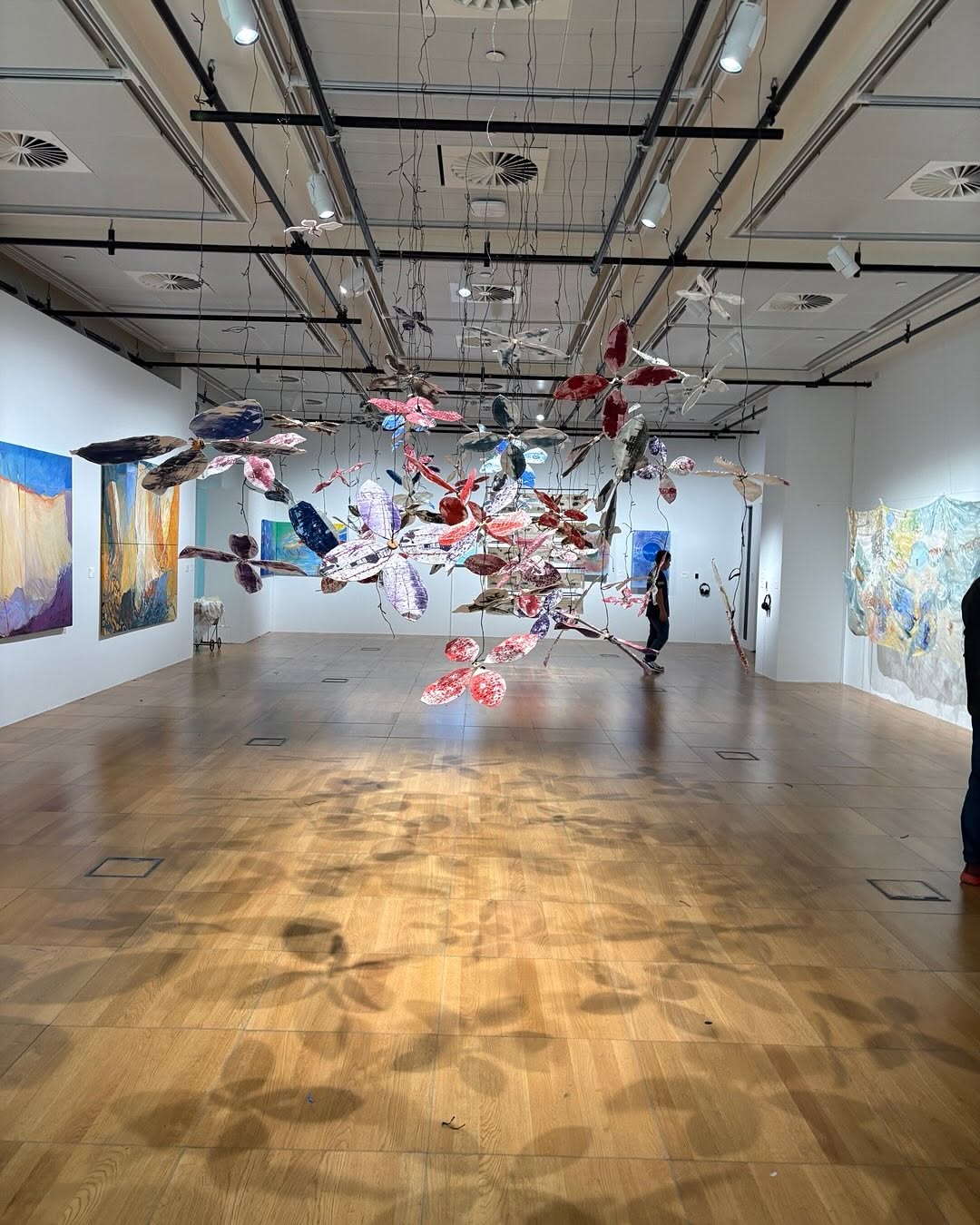
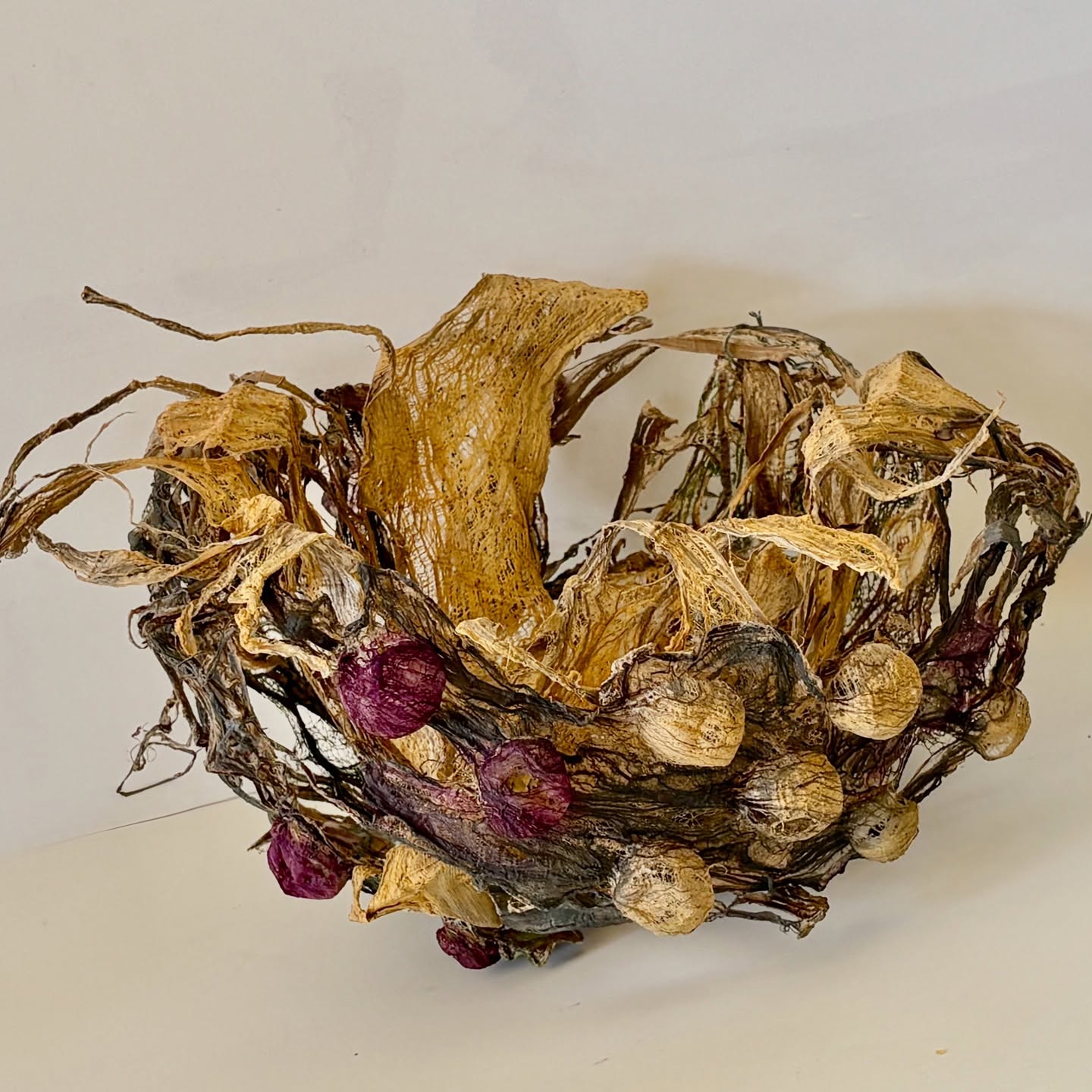
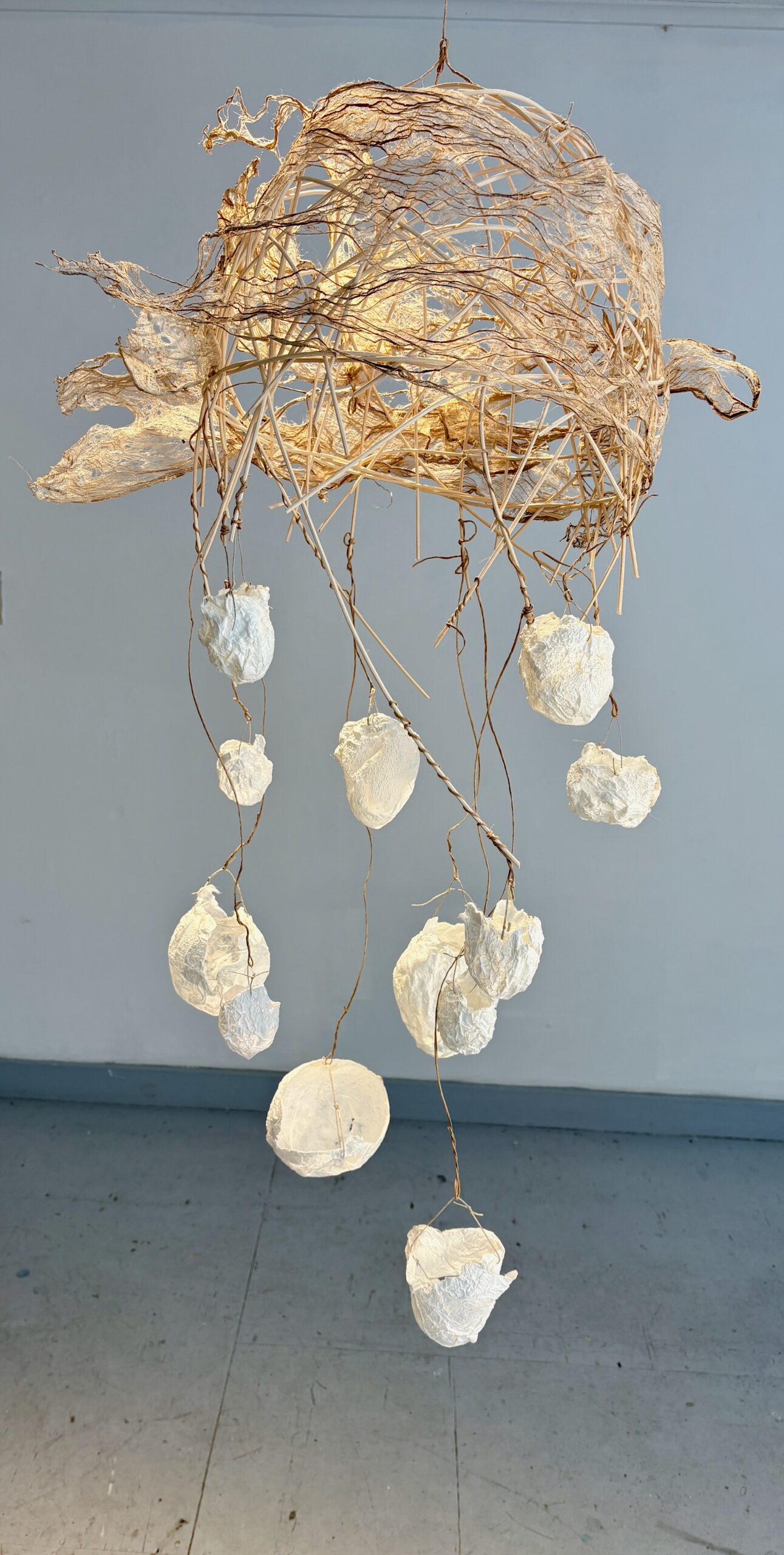
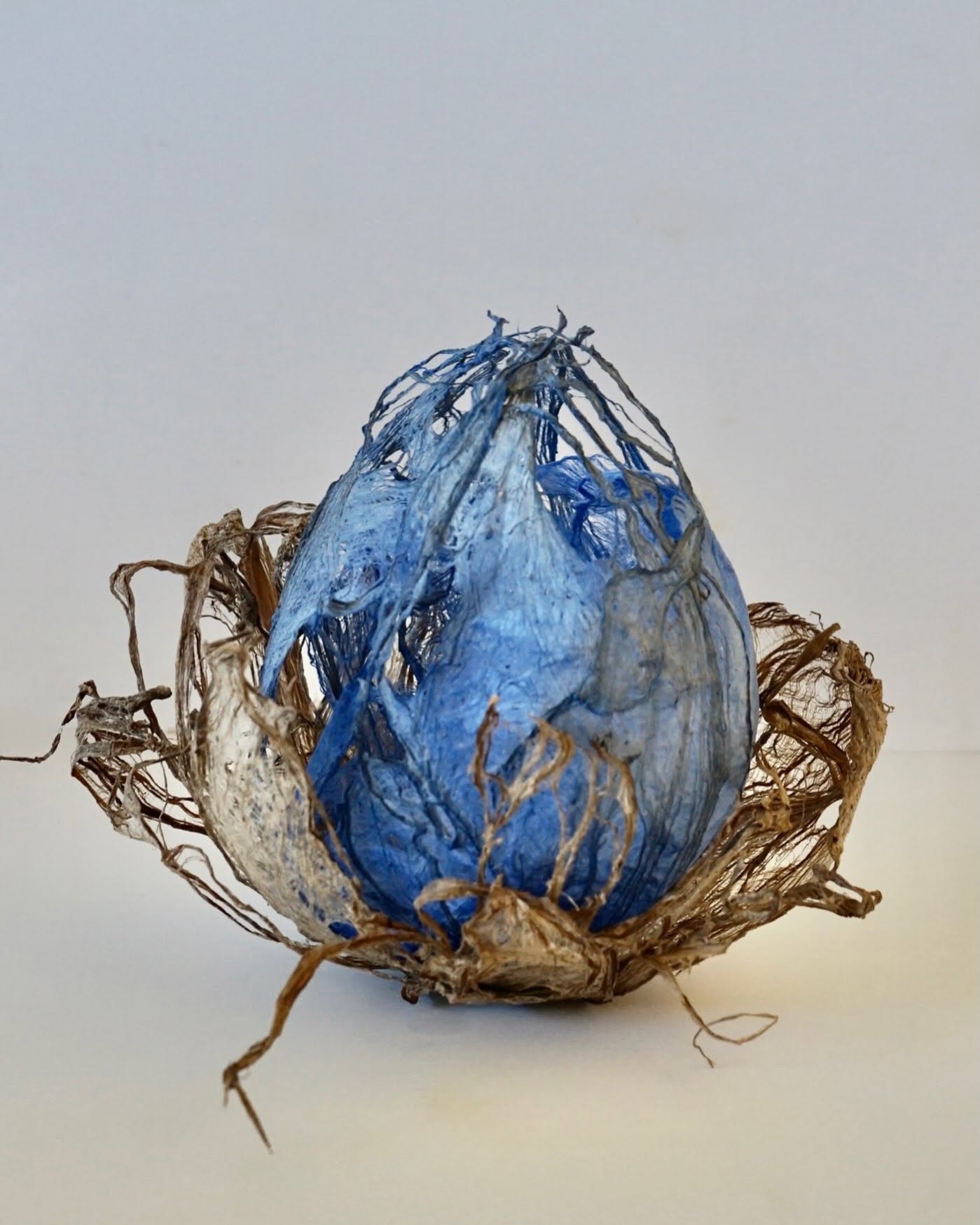
Quantum Matter, which closed at Matter Studio Gallery April 19, was a lush, exciting intermingly of five contemporary artists’ immersive work.  The exhibition included multiple works in mixed media, oil and acrylic painting, collage, and sculpture by artists Susan Ossman, Angelica Sotiriou, Monica Marks, Karena Massengill, and Sandra Vista.

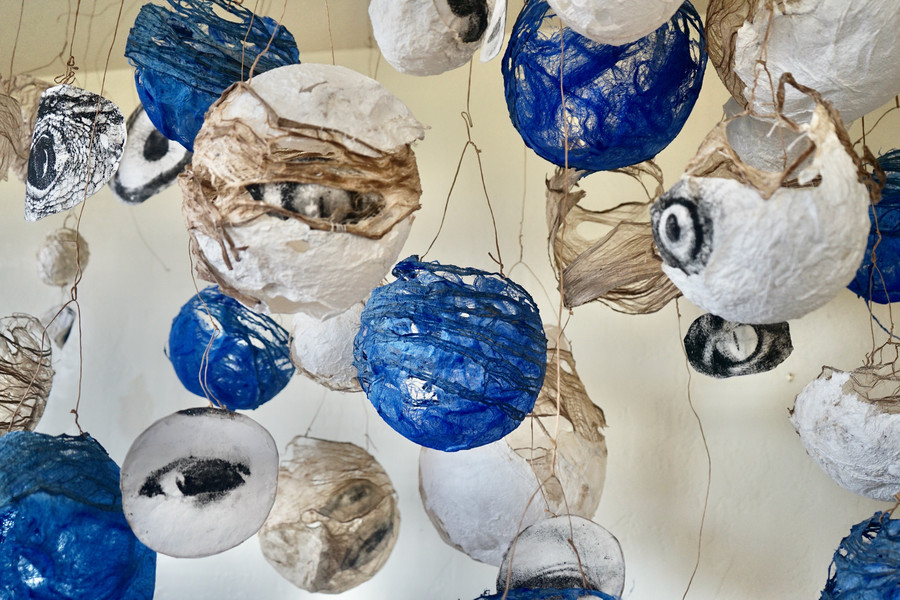
The exhibition explored each artist’s own unique vision of all things connected, great and small. As a scientific definition, quantum matter can be topological and refer to emergent order and exotic properties. These artists each expressed and experienced such, from the vastness of the lines, conjoined brush strokes, and brilliant hues of international artist Susan Ossman to the lush and intensely lovely abstract spiritual landscapes of Angelica Sotiriou to the landscapes of desert, raw earth, and sky of Monica Marks, these artists exhibit vast and fascinating vistas that speak to a rich accumulation of the proportional or quantum energy of the world. For sculptural artists Karena Massengill and Sandra Vista, matter is an infinite use of materials as diverse as beading and gourds for Vista and fine metal works in amazingly detailed shapes from Massengill.

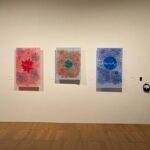
Among the many standouts in the exhibition is Susan Ossman’s oil on canvas “Chergui,” left above, a rush of red wind and pastel light soaring in across the desert of a region, or perhaps a heart.

Also from Ossman is the glorious “One and Many,” a swirling conjoining of blue and orange that evokes the heart of a flower, the intertwined cosmic and natural world, and the conflicts and comparisions within each living being.

Monica Marks’ use of found materials both defines and enhances her work, which here features the language, losses, and love she finds and has for the desert. Her mixed media ” House with Green Trim” uses fragments of wood and metal found near the desert Wonder Valley, Calif. homestead which she has painted. She is fascinated by the abandoned dreams of desert homesteads, and treats these sites, and the remanents of objects such as Del Monte branded cans, with revererance. Small and lovely salvaged objects receive new life in color and form, such as the rainbow paints illuminating “Salvaged Traces Series 10” and the colors of the sunset that form the backdrop to the circles of crushed cans in “Sunset Circles.”

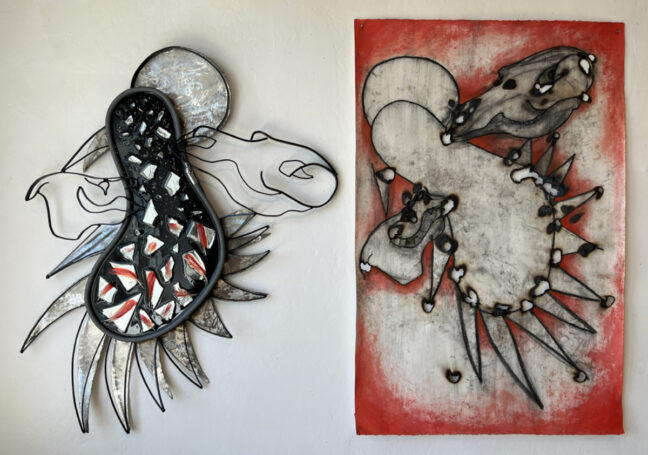
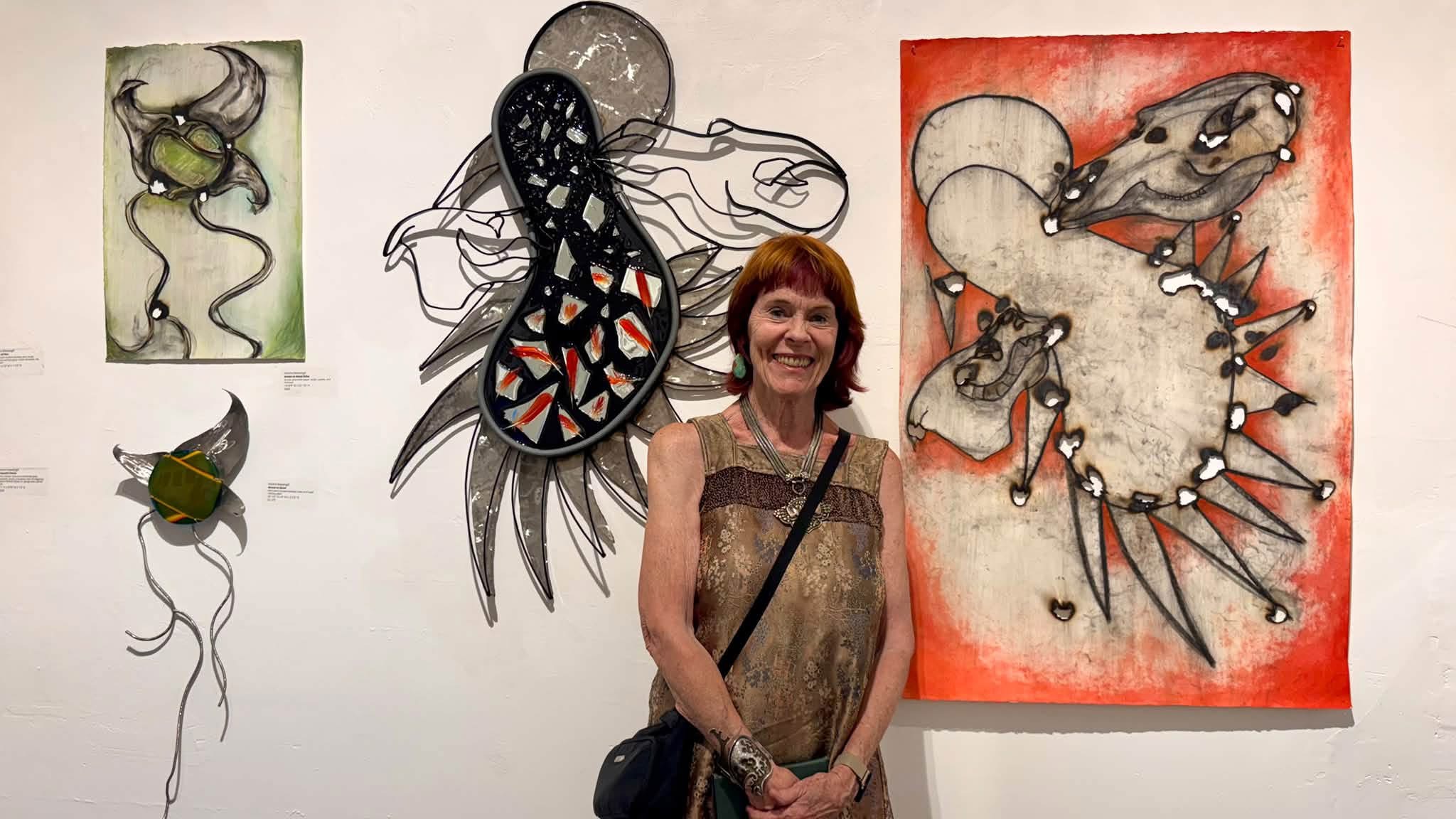
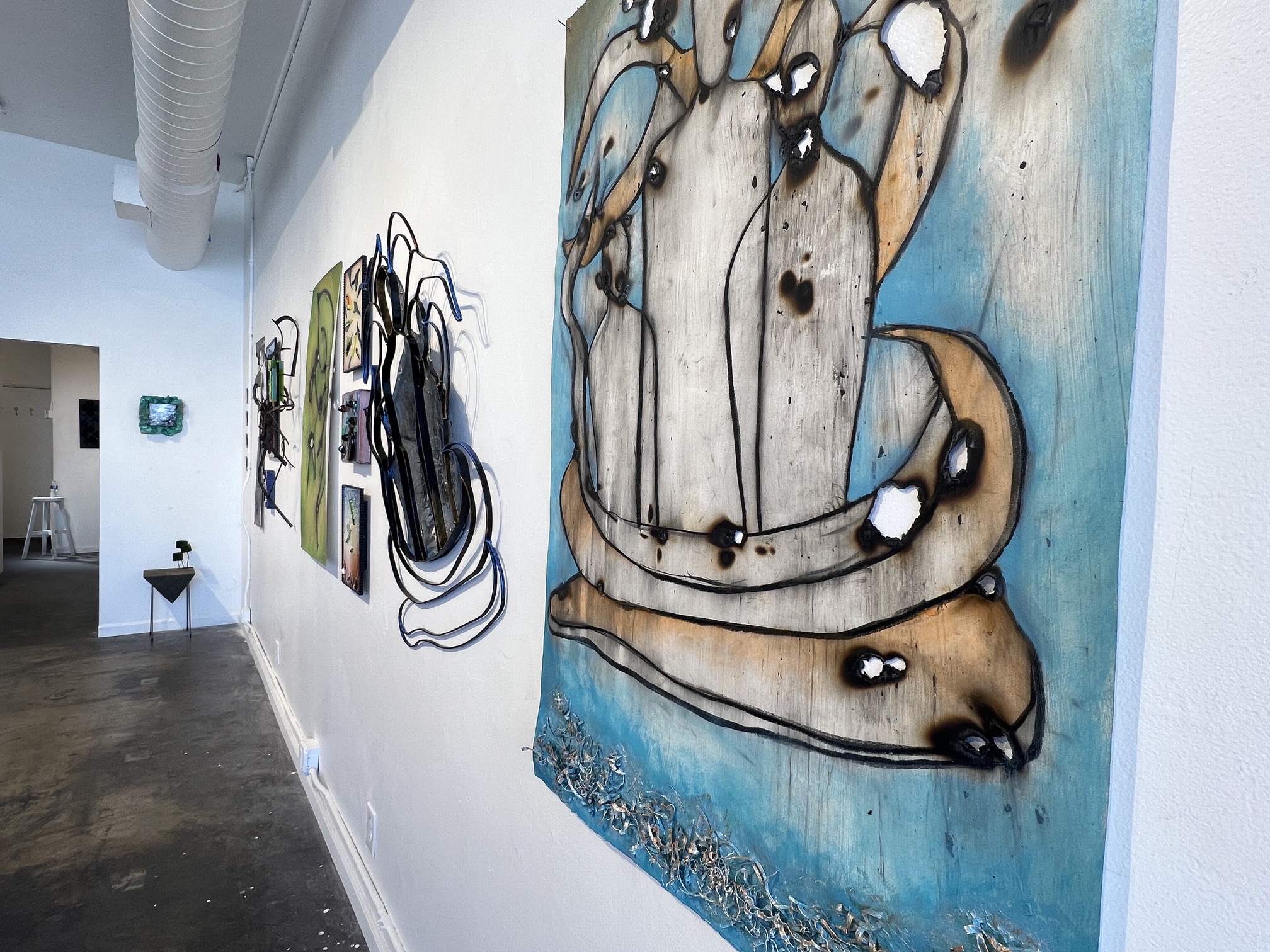
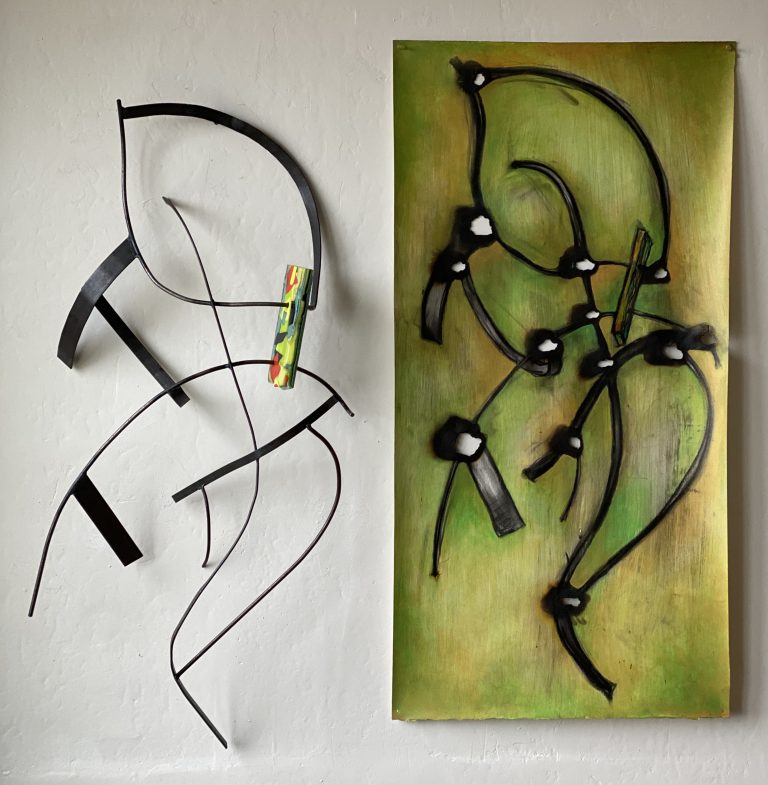
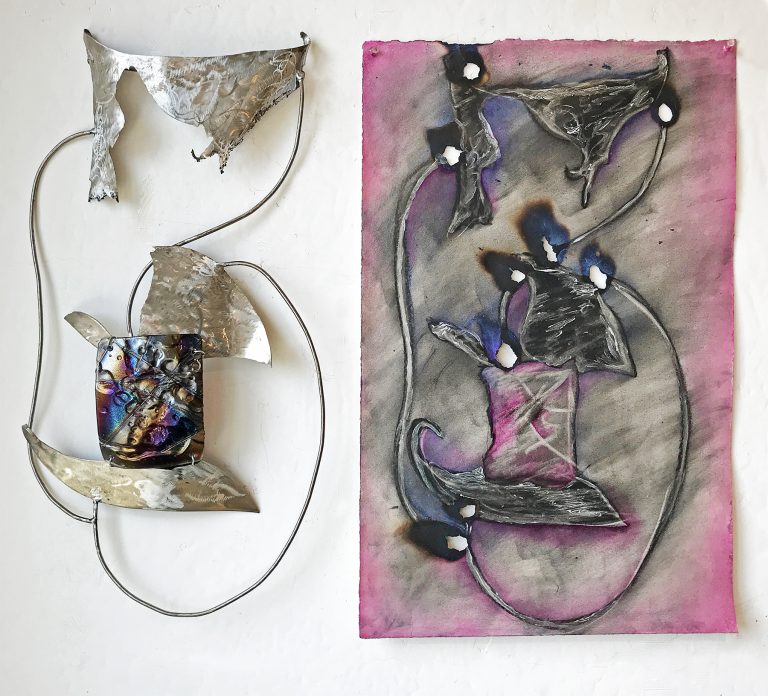
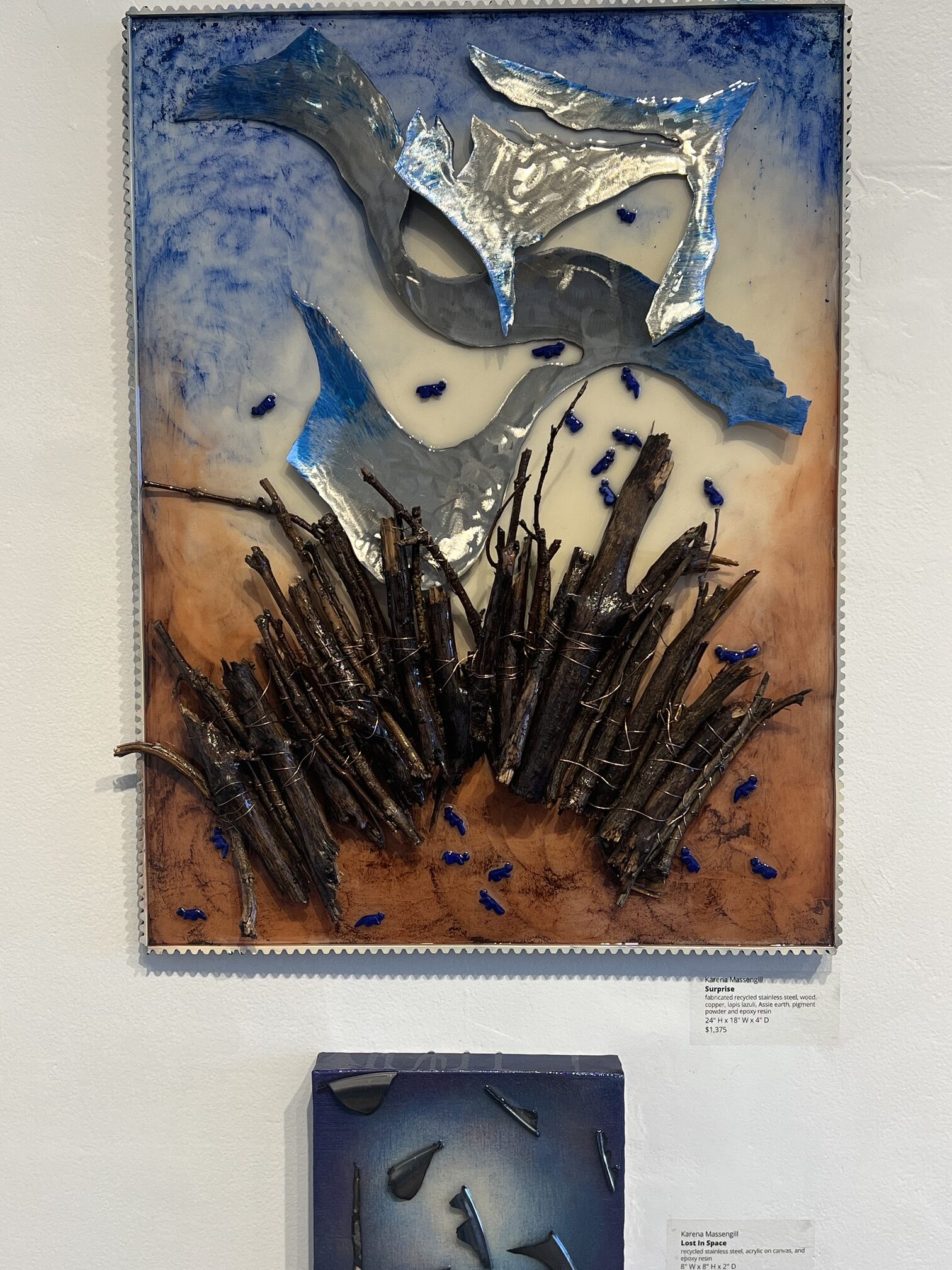
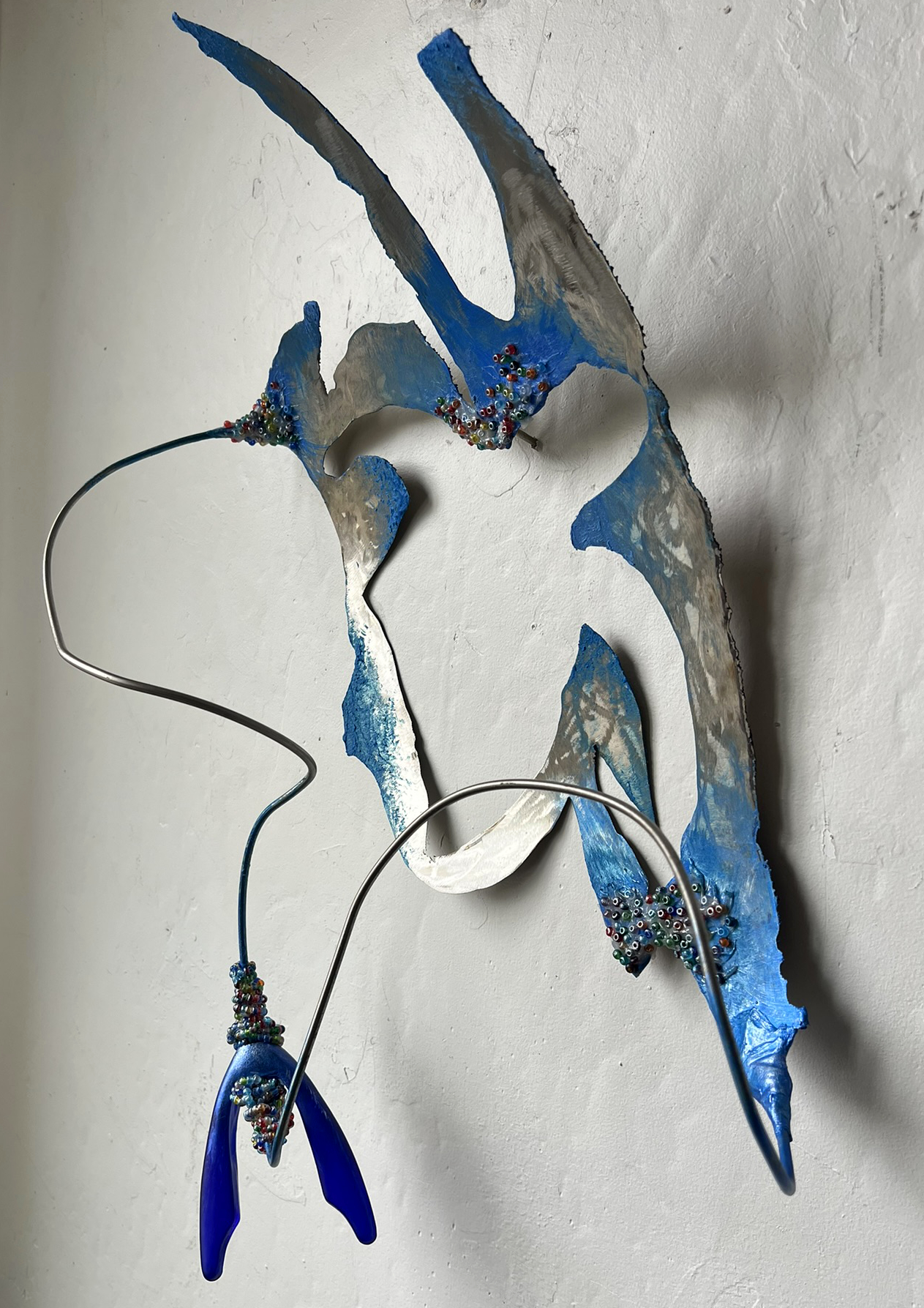
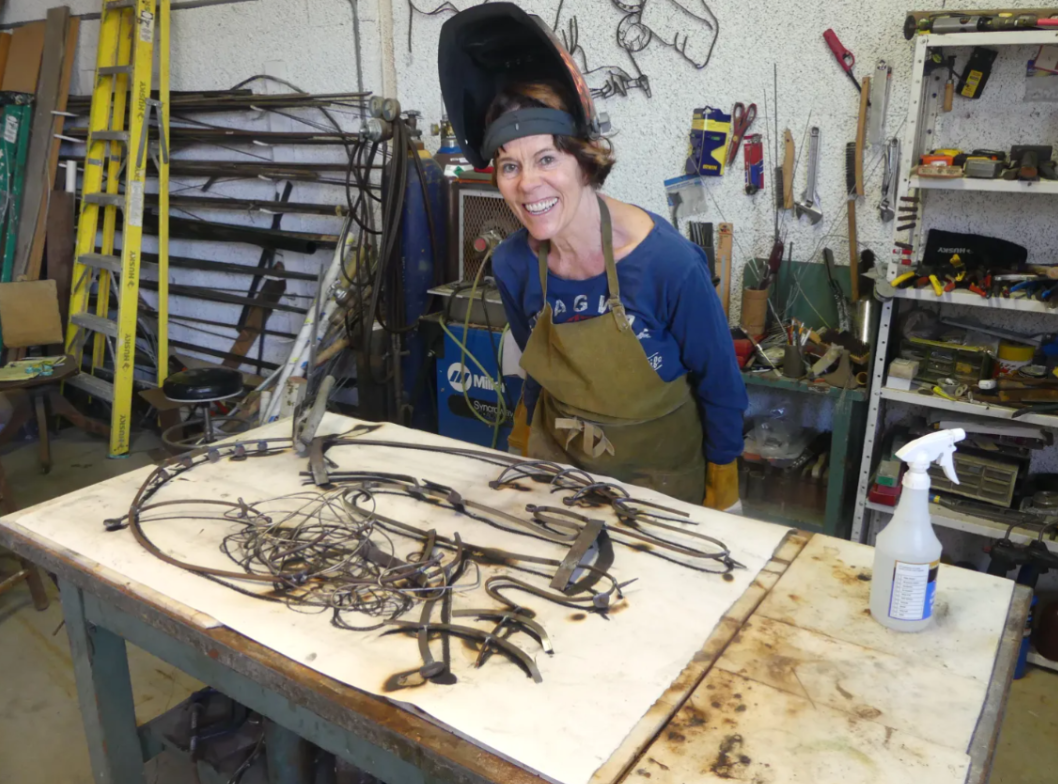
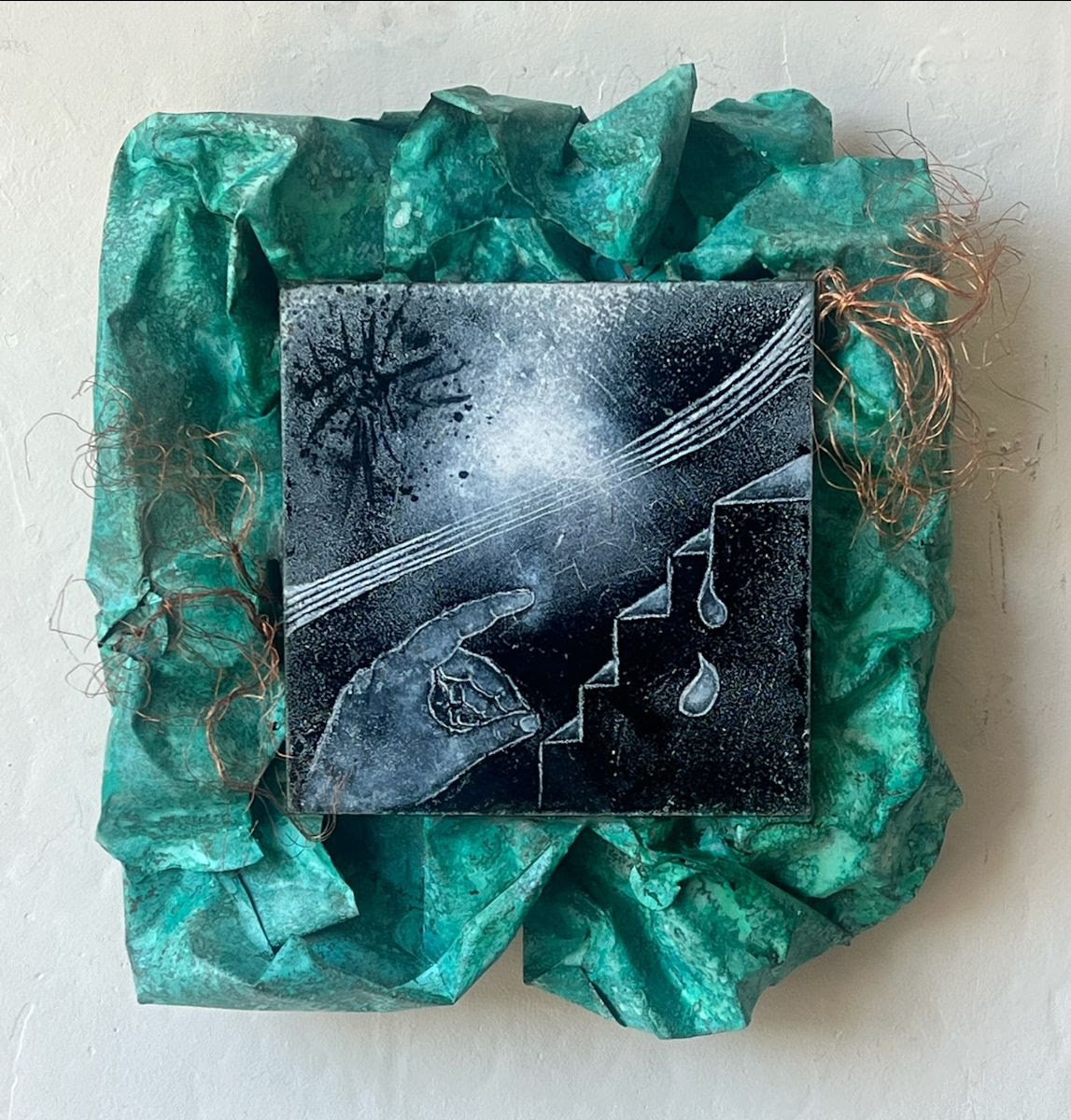
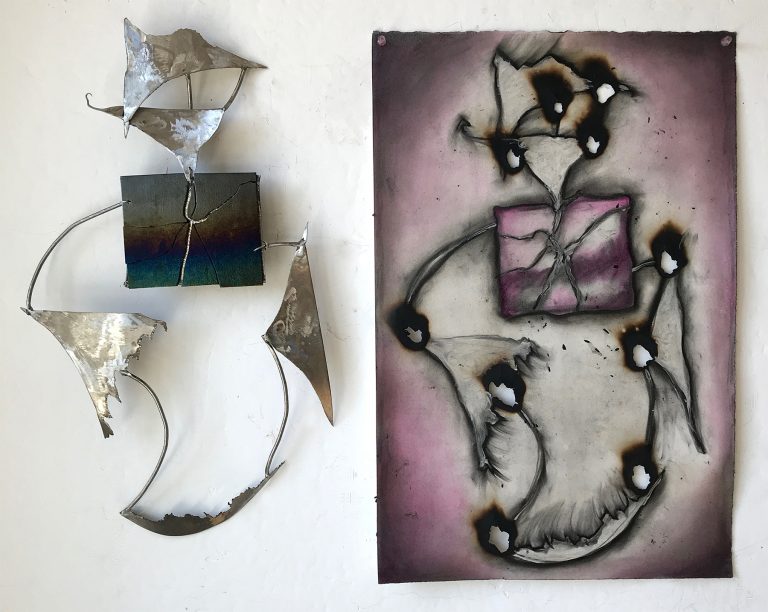
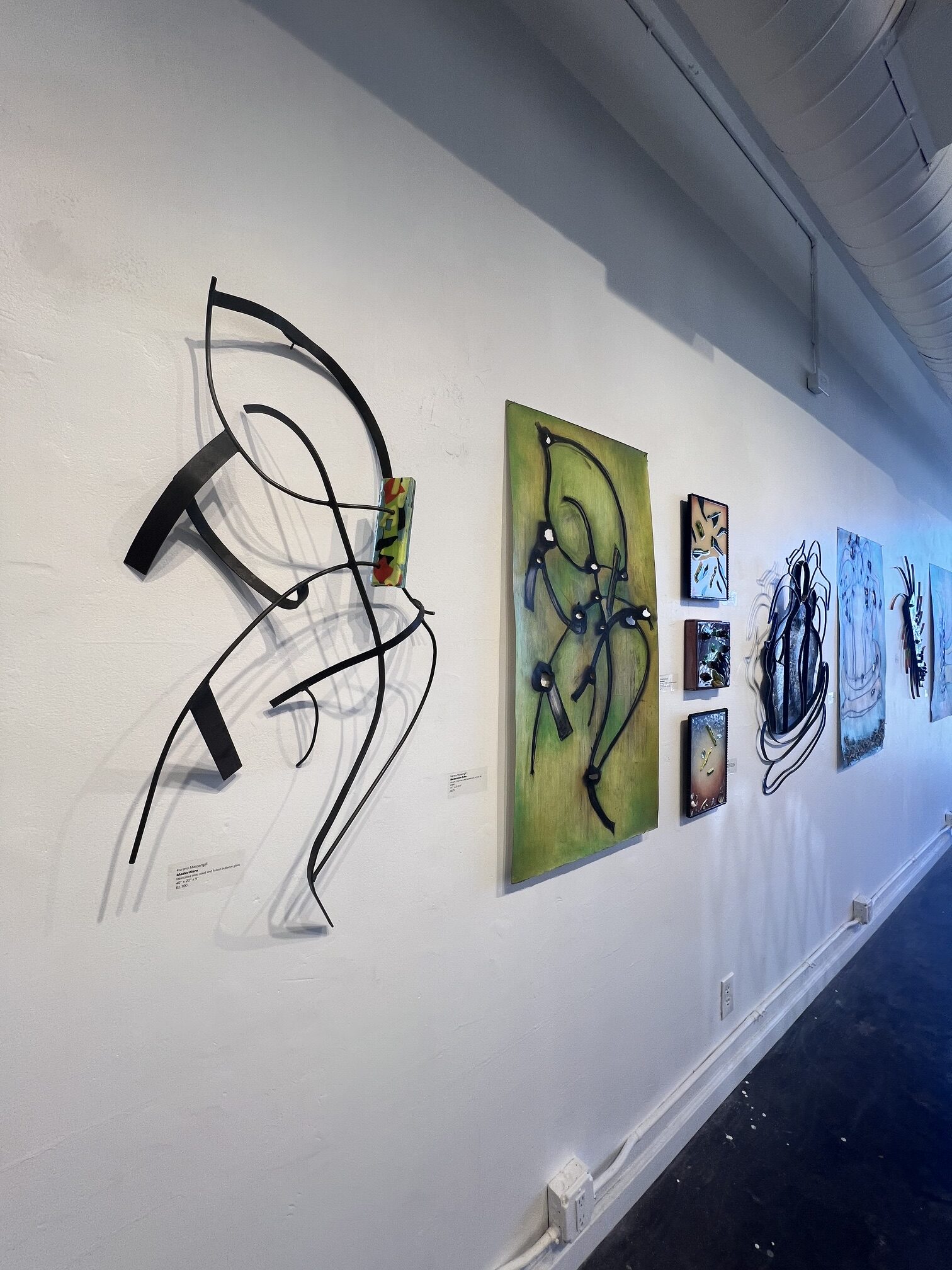
Like Marks, Karena Massengil often works with salvaged material, creating undulating and exciting metal sculptures such as “Billabong,” which depicts environmentally impacted birds, and is shaped from repurposed stainless steel, enamel, wood, mirror fragments and feathers.  Leaves danced in a updraft in her “Joyful Dance,” a colorful stainless steel canvas utilizing oils. Always tantalizingly inventive, Massengil uses her work as a way to express both ecological concerns and political ones.


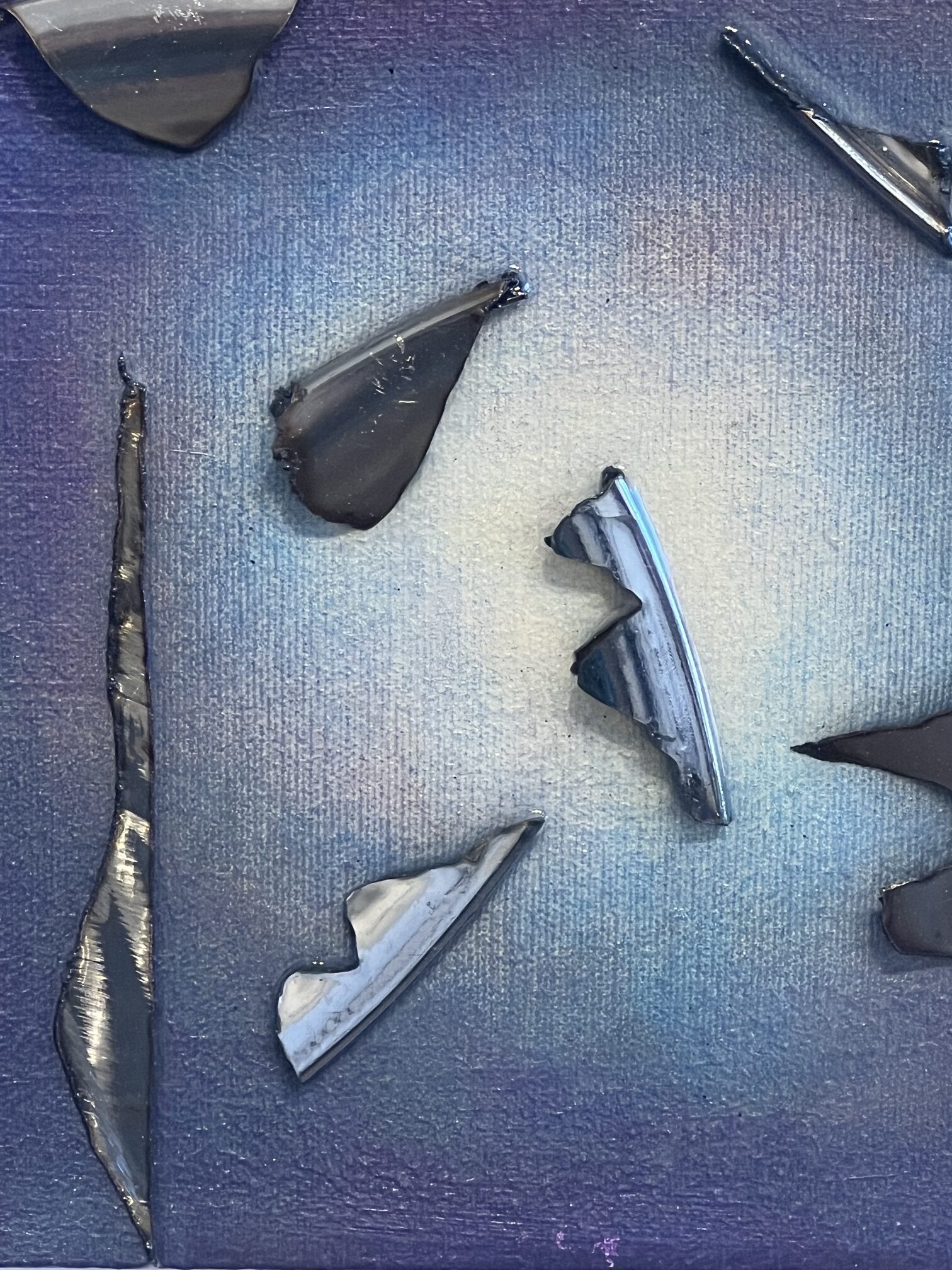
Vista also repurpsoes her wall sculptures, using zipper tabs to create wildly deep sculptural forms that have a deep and shimmering texture. The four long panels of “Museum Horizon” are skyscraper-like in shape, shimmery in gold and grounded in dark grey tabs. Her beaded gourds pay homeage to the death of a loved one; named for the southwest region they represent in style, these meticulously beaded works reflect upon characters such as “Pistachio Mary.”

Painter Angelica Sotiriou revels in light, the spiritual, and a passionate joy for and concern about the natural world. Her large scale, multi-layered canvases such as her acrylic work “Through a Glass Darkly #5” are filled with a luminosity that goes beyond the canvas and radiates. Like many of her works, the effect of her layers creates a kind of pearled opalesence. Smaller scale acrylic and mixed media works such as “Hiraeth #6” shine with rivulets of gold leaf in the presentation of a sanctified breath.

Jenny Hager’s colors are often bold and bright: lime green, canary  yellow, electrifying orange. Working in lines, shapes, patterns, and “monsters and monuments” as she explains, the artist adds further depth and precision to her acyrlic work by taping the canvas. Hager’s appropriately named “Gang of Glee” is a burst of gold and pale purple that brings an explosion of pleasure to the viewer’s gaze. “Cascade” is a meadow of chatreuse through which dreams wade deep.

Each artist’s work is galvanizing on its own, but when combined, of course, the work becomes “quantum.”  The quantum world may defy conventional logic, but creates its own, intense, magnetic language, as do the artists in this beautiful, seminal exhibition. The exploration of the visionary and the unseen, the massive in terms of emotion, brush stroke, sculpted forms, small elements made large when conjoined all comprises the mystical, magical work in this exhibition. The unexpected and the uncanny, the infinite and the minute are all encompassed in a collection of lustrous work.

While the exhibition is no longer viewable live, the works can be studied and purchased online.

  • Genie Davis; photos: Genie Davis

Intense and Powerful Work from Painter Sharon Weiner

Explosive and spiritual, intense and meditative, Sharon Weiner‘s vibrant art is a sensory experience. Currently exhibiting her work at Diversions Fine Arts, as an abstract painter, Weiner says that sheidentifies with many of the postwar American transcendental abstract artists, like Mark Rothko and Ross Bleckner.

Her technique is entirely her own, building layers of poured acrylic paint and acrylic medium. The organic shapes she forms envelop the viewer before melding into the deep space of a smooth, shining surface. Her subjects are born from both her imagination and the natural environment, reflecting her own belief in the importance of having a voice in the world.

“I am inspired predominantly by nature: oceans, mountains, the cosmos. There’s this shape that just stays with me in my work that reminds me of a mountain or a wave,” she relates. Indeed, Weiner’s work has elements that appear both liquid and vast.

“I’ve always been an abstract painter. One thing that’s changed [recently for me] is the addition of working with Yupo paper. I work in a similar way on paper to my work on canvas, with very different results allowing me to express things that I can’t do with canvas, allowing me a certain freedom and lightness,” she explains.

Her mediums are acrylic paint, acrylic ink, and water based spray paint on both canvas and paper, and regardless of the exact medium she uses, she finds that she is “always excited to see what is going to develop in my work.”

She stresses that no matter what the specific subject, color palette, or size of her work – which ranges from small to vast, “my art allows me to connect to my spirituality and has given me a voice.”

Following her show at Diversions Fine Arts, Weiner will be a part of an exhibition at 515 in DTLA’s Bendix Building in June.

But as to her art itself, it remains a part of the universe, a celestial series that speaks to space, light, color, and the promise of a new worlds unfolding.

View Weiner’s work at Diversions Fine Arts through May 3rd at 1069 N. Aviation Blvd., Manhattan Beach.

  • Genie Davis; photos provided by the artist

Connie Saddlemire: Mesmerizing Abstraction

Abstract artist Connie Saddlemire delves deep into intuitive, fascinating abstraction.  Saddlemire is currently exhibiting a body of her recent work at Diversions Fine Arts Gallery, work that is inspired by “Things that I see, either in nature, or man made— colors, textures, shapes and patterns, particularly linear patterns.  I especially like the look of manmade things that have been affected by time and weather.”

Her printmaking, photographic, and complete art process has shifted over time. “I switched from making representational images to doing abstraction when I was in college, in about 1968.  I was fully committed to abstraction by the time I started grad school for art, in 1976. In grad school my work became more minimal and I started making images made up entirely of lines drawn with a crow quill pen.  That was before I had ever seen Agnes Martin’s work.  People ask me if she was an influence on my artwork and I say ‘No, because I was already making my linear images before I saw her work.’ But I know that she was the pioneer who paved the way to make it ok for me to do what I do.  The work I do today is more complex, though, even if it appears relatively simple.”

Saddlemire’s work has evolved in part due to the circustances of her life, as well as “happenstance, such as meeting master printer, Sue Oehme, who introduced me to Solarplate printing.  Solarplates are metal plates with a photosensitive coating.  The artist exposes black and white images— that are either photographic or drawn by hand— onto the photosensitive plate and that image on the plate is inked up and printed the same way etchings are inked up and printed,” she explains.

According to the artist, around that same time, she was invited to take a class with a friend in altered photography, something she pursued for awhile, realizing that she could “expose some altered photos onto Solarplates.” This is the process she now currently has on display.

Saddlemire reveals that her prefered medium is printmaking. “I fell in love with printmaking when I was in college, in my junior year.  Things just came together in my work like they hadn’t done before.  I really feel that printmaking chose me… that I was made to be a printmaker.  It’s how I think and what I love to do,” she attests.

“Thematically the images I’ve been making since 2020 started with a photo of corrugated Corten steel and are very linear.  But I’ve recently purchased a new set of 5 plates that are also photosensitive but they’re a different brand of plate that is higher quality than Solarplate and captures more detail.” Saddlemire adds that “The most significant difference is that they’re almost 4 times as big as my Solarplates were.  So I’m now working bigger and the images I’m creating have more 3D dimensionality. ”

Her images are still made from photos of corrugated Corten steel and still linear, however she is now printing both horizontally and vertically to create plaid.  “Crazy I know, but I’m going on 78 years old and I’ve reached the slightly rebellious ‘why the hell not?’ stage of my life… and the plaid images are really pretty fascinating, especially with the 3D thing going on. Continuing this new exploration is what excites me for the near future.”

Also exciting are upcoming plans for an exhibition in Maine, and in Basalt, Colorado, after her show in Manhattan Beach.

Her work is technically and visually innovative. “I don’t know anyone else who has been making prints from altered photos for the past 6 years. There have also been other techniques that I’ve ‘thought up’ on my own over the years.  It’s part of my particular way of being creative,” she says.

Another part of her creative process is based upon how much she loves working with color. “I started layering translucent colors years ago and I love the unique and often surprising effects that I get from doing that.  It’s my biggest reason for  using the altered photos of corrugated Corten steel.” She notes that “I altered the photos to make plates with ‘lines,’ and spaces between the lines of varied widths, so when printed in sequence, with inks of different colors, the lines don’t land squarely on top of each other. The effects of that can be quite fascinating.”What inspires me?  Things that I see, either in nature, or man made— colors, textures, shapes and patterns, particularly linear patterns.  I especially like the look of man made things that have been affected by time and weather. Seeing the work of other artists also inspires me…  usually when it’s similar to the kind of imagery that I make.

These exciting works are especially striking in person. Saddlemire relates that “An artist friend of mine told me that she loved the way my work is very wabi-sabi.  I took that to primarily mean the embracing of imperfection, with the irregularity of the widths and spacing of the lines.  There’s an earthiness, as when both natural and manmade things show the wear of time and the elements.  I call it intentional randomness and happenstance, with the hope of serendipity!  And that, to me at least, can be seen as a metaphor for life.”

It’s a valuable and lovely metaphor indeed when visualized by Saddlemire. Her work at Diversions Fine Arts is on view April 11 through May 3rd at 1069 N. Aviation Blvd. in Manhattan Beach.

  • Genie Davis; photos provided by the artist and by Davis
Amy Thornberry Takes on a World of Color and Pattern

Currently exhibiting a solo collection in Transformations, now at Diversions Fine Arts, artist Amy Thornberry works with a sense of devotion and delight in her creative work, viewing the manipulations of her materials as a playful way to pray and meditate, while transforming basic elements of paper and pigment and other mediums into beautiful creativity. Saying that she views her works as “portals into places where we may pause, wonder, and reflect,” she also relates that her knowledge of the Buddhist practice of tonglen – sending and taking –  remnds her of the ways in which, through art “we can move from the dark into the light.”

Her work dances with that light, with color, and with pattern and texture that is both exultant and lush. Asked what inspires her the most as an artist, Thornberry replies that “the nature of being, art history, current events, history, nature, and beauty” are all inspirations for her, as are both art materials and found objects. In short, both material and meaning are the core and purpose of her artwork.

Her practice has evolved over the years, resulting in many dynamic changes to the work, which is currently awash in layers, and dreamily vivid. “I used to lash out like say Franz Kline. Very fast and I had no patience to mix colors,” she relates. “Now I tinker and massage a surface endlessly.  I went to the opposite extreme of perhaps too much patience,” she laughs.

“There was a time when I had a complete aversion to making paintings and I only wanted to make installation pieces. I liked hanging and using the entire space which I think came from my background as a theater, set maker, and movie set maker. And  with my background as a competitive swimmer, I had so much physicality. I felt very confined with just a rectangle, and I think this latest body of work the framed shadowbox grew out of a way of processing that.”

Her insightful and meditative work is at least in part a result of the fact that she “thinks a lot in between studio sessions about pieces and my next steps usually come to me early in the morning, upon waking or when I am practicing yoga.”

She says that having “renounced panic” she has also “developed a love of mixed neurtrals and pastel colors,” a palette that her “younger self did not prefer.”

Thornberry works in a variety of mediums. “I use water-based paints as well as oil paints but no solvents, just linseed oil and marble dust. I also love, love, love cutting into work as well, and collaging with other papers and fabrics. I have a huge collection of fabrics and papers. ” She adds that “lately I have been craving drawing as well with colored pencil, conte or ink…I have a love a little bling and metallic shine.”

Thematically, she explains that she’s “a very protective mama bear/big sister and cannot NOT think [and] be influenced by things I find unjust or hurtful to humanity. Making art and getting lost, creating reverie, is a way I think to make sense of things, to process them, and to transform them.”

According to the artist, “I guess its a therapeutic way to use my love of formalism and materiality.” She jokes that she is “very practical,” after all.

That said, she attests that “My aim is for this reverie and creation of a refuge if you will, [one that exists] not only during the making of the work but for as long as it can be looked upon. Staring at art is so much easier than dealing with all the remote controls and trying to decide what to watch on all the streaming services. I am a joking a little,” she says, adding that these are her honest feelings about art, and observation.

In short, Thornberry recognizes the poetry and purpose of art as having a deeper import and more peaceful and involving outcome in viewing it than endlessly watching streaming “content.” Art is far deeper than content: it is creation, and a profound one for her.

With that in mind, she is currently “reorganizing my life in order to move to a bigger studio and work on some larger
canvases,”  a plan and move that she is very excited about pursuing.

She hopes viewers of her work can see that “even [having] one art piece hanging in their home is like a mini-opera or a taking trip. Support your artist friends, buy their work, and sit back and enjoy the show and trip.” In other words, vacation and immerse yourself every day if you wish, simply by owning a beautiful work of art, and taking a lifetime filled with imaginative and fascinating visceral travel through the mind, eye, and soul.

Viewers can certainly start their travels with Thornberry April 11th through May 3rd at Diversions Fine Arts Gallery, 1069 N. Aviation Blvd. in Manhattan Beach, or reach out to her directly for a studio visit to explore her dazzlingly delightful and layered work.

  • Genie Davis; photos by Genie Davis and provided by the artist