
Mammoth Lakes Film Festival Revs Up: Fest Day 2

3R1A2596

The first full day of programming at the Mammoth Lakes Film Festival began with an exuberant collection of shorts that took views from Mojave to Mammoth to Mammoths. The settings added to viewer excitement, but no matter where these films were screened, there was plenty of reason for an enthusiastic response.

3R1A2590

Above, cast and crew of Fay Away

Nevada was a claymation charmer, a fully realized and intimate story that was both poignant and hilarious, detailing a couple’s response to a birth control issue, and a decision not to have a baby – at least not yet. Terrific script and fresh, lovely animation. Next up was Fay Away, a tonally perfect, desert-set live-action about a none-too-perfect estranged father and daughter reunion. Set near Joshua Tree, it captured the dusty flavor of time passing in a timeless setting.  The film was helmed by producer and lead actress Sandra Seeling Lipski and director/cinematograpaher Rainer Lipski in their sophmore outing at the festival. Sandra Lipski noted “This was a gift to ourselves celebrating our 7th anniversary. It was a two-day shoot and ten months of editing.” The  brief abstract animated work Mountain Castle Mountain Flower Plastic touched on the ecology of future landscapes; Zula the Infinite was a coming of age story involving a restless small-town girl and a passing-through “bad girl” with stolen mail and and a stolen car in the mix.

3R1A2595

Above, star and director of Zula the Infinite.

Director Jillian Dudley said the film’s concept was conceived as proof of concept for a TV series pilot, and the four day shoot came with its own misadventure: “Our original sound material was stolen, but because the local Palmdale newspaper published a story about the theft, Universal’s ADR department came to the rescue so we could save our film,” which turned out to be a 2-year process.  Last up was an amazing short documentary, Mammoth, about a Russian scientist’s multi-generational work to establish what could be an eco-system that saves the planet from global warming. Absolutely fascinating, and the kind of film and subject one might only find on view here.

3R1A2610

Above, birthday surprise for Pedro Deltell of Berliners.

More shorts – obviously – comprised the screenings for Shorts Block 1, including several shorts from Pedro Deltell in his collaborative improv series Berliners. It was Deltell’s birthday and he received a surprise cake and candle; the festival itself also had a surprise – Deltell screened more than the expected series entry,  which was an extra comic treat for the audience. ” You look for people to cast and think about stories and characters you can do with them. Each of our episodes is different and each is improv based and set in Berlin,” Deltell explained. The animated Tel Aviv captured the city with poetic, whimsical drawings through the eyes of an art student. From Poland, How to Reach God with Proper Exercising created a surreal story centered on a man’s recounting of a dream.  Birthday offered up a dysfunctional celebration for a father and three adult daughters at a shooting range; while Careful as You Go presented three vignettes on the threatening yet darkly comic behavior of malevolent women.

3R1A2611

Director Jerry Carlson, above, with programmer Paul Sbrizzi, right

From Sweden, Shadow Animals was, director Jerry Carlson said, “Almost a memory of a lived experience. We knew the film was about human behavior through social rituals, and we added our own take on those rituals and a language that went to the physical through choreography.” We found the film to be haunting, with an edgy, horror/suspense vibe that left a chill.

3R1A2615

Above, Guide Dogs for the Blind rep to the left, fest director Shira Dubrovner to the right

Pick of the Litter was a deeply moving documentary about the training of dogs for the Guide Dogs for the Blind program. The rigorous process bonded the audience beautifully to five puppies and their human handlers, trainers, and eventual owners. Bracingly directed by Dana Nachman and Don Hardy Jr., and discovered at a Slamdance screening earlier this year, it was easy to see why there were no dry eyes in the house. Dogs were the guests of honor at an after-screening photo op following the screening. Nachman also directed the accompanying short, a delicate, wistful piece documenting the gorgeous sand art of Brandon Anderton, whose debilitating series of accidents may have left him riddled with pain, but still able to create the transient wonder in Washed Away.

Fort Maria, shot in black and white, was a limited-location narrative feature involving an adopted mother afflicted with agoraphobia and the death of her daughter’s elderly dog. A strong performance by Katerina Stoykover-Klemer in the title role grounded the quiet piece. Weekend, a short about a son who spends weekends with his father – imperfect ones – offered a compelling glimpse at Iranian life.

Minding the Gap

And Minding the Gap, closing the evening, offered an absolutely riveting portrait of three skate-boarding friends growing up and grown up in the dying city of Rockford, Il. Compassionate, semi-tragic, and ultimately uplifting, among the three friends depicted was filmmaker Bing Liu.  The film screened at Sundance in January, and with its heart-stopping skateboard shots and involving personal stories, it will undoubtedly be screened elsewhere.

Once again, fest director Shira Dubrovner and programmer Paul Sbrizzi created a memorable day for film lovers, 12 hours of rich and rewarding programming.

3R1A2617

3R1A2602

Post-screening bonus at MLFF: the clear starry skies and moonlight of Mammoth Lakes after a brief rain.

  • Genie Davis; photos: Jack Burke


Opening Night at the Mammoth Lakes Film Festival: Damsel — Not in Distress

3R1A2543

It’s opening night at the Mammoth Lakes Film Festival, and the first night of our daily coverage of this stellar, growing fest. As festival director and founder Shira Dubrovner remarked while introducing the opening night film, “This is the 4th year of the festival…we’re here to stay.” Along with programmer Paul Sbrizzi, Dubrovner has a wide ranging slate on tap for this year’s edition of MLFF — so drive on up to Mammoth and join us. There are tickets to many events still available at the box office.

3R1A2565

Tonight’s opener, Damsel, premiered at Sundance in January, and it is a quirky, twisty, fresh delight. Set in the old west, the titular damsel, Penelope, ( a galvanizing Mia Wasikowska) is not in distress and does not need rescuing, but that doesn’t deter her persistent former-beau Samuel Alabaster (Robert Pattinson) from trying, aided and reluctantly abetted by Parson Henry (played to lonely perfection by co-writer and co-director David Zellner, who shares writing and directing credits with his brother Nathan).

Mia Wasikowska and Robert Pattinson appear in Damsel by David Zellner and Nathan Zellner, an official selection of the Premieres program at the 2018 Sundance Film Festival. Courtesy of Sundance Institute | photo by Adam Stone. All photos are copyrighted and may be used by press only for the purpose of news or editorial coverage of Sundance Institute programs. Photos must be accompanied by a credit to the photographer and/or 'Courtesy of Sundance Institute.' Unauthorized use, alteration, reproduction or sale of logos and/or photos is strictly prohibited.
Photo above courtesy of Sundance Institute | photo by Adam Stone. 

Devious twists and turns edge between comedy and tragedy – a lot like real life, but with a touch of ironic whimsy and abrupt bursts of violence. The Zellner siblings share some of these traits with two other related filmmakers, the Coen brothers, but their take is fresh and on point. One of the most delightful aspects of the film is its complete unpredictability, signaled from the very first scene, when an exhausted minister gives up the cloth to Henry, before wandering off into the desert. Henry is as reluctant a preacher as he is an accomplice to Samuel’s “rescue” of Penelope.

The film plays on Western tropes and turns them in a surprisingly feminist direction; it touches on current mores and offers a gentle send-up of classic Westerns. But best of all it is dark and funny, dry and yet edgily sentimental. It’s no small thing to wonder where a film or even a scene is going, feel a jolt of adrenaline-producing surprise, and have that sensation occur repeatedly while watching. Lush and at times eerily symbolic cinematography, plus strong acting all around, make this film a winner, and a nicely outside-the-box opener for MLFF.

3R1A2581

Following the screening, an opening night party at the Sierra Nevada Center served up Blue Moon and St. Archer beer, Black Box wine,  and munchies including Swedish meatballs and crunchy cheese tots.

3R1A2570

3R1A2578

With a full day of programming tomorrow, no one needs snow as a reason to head to Mammoth.

  • Genie Davis; photos: Jack Burke


Forestiere Underground Gardens: Fine Folk Art in Fresno

22089195_10212844618777462_7835127216451075878_n

A California Historical Landmark and an artistic and architectural treasure, the Forestiere Underground Gardens is a miracle of folk art.

22046625_10212844617097420_4688730606421791833_n

Akin to the Watts Towers and Nitwit Ridge, it is the vision of a man who could craft anything, and didn’t let a little problem like hard and unyielding soil destroy his vision of a California Eden.

22049784_10212844618817463_5081084850568986946_n

An hour long tour takes visitors through the well-preserved tunnels and caves created by Baldassare Forestiere, a Sicillian immigrant. His underground rooms, courtyards, and passages include producing fruit trees and vines some now 90 years old.

22046124_10212844617017418_6809607244417718806_n

Always a digger, Forestiere immigrated first to New York City where he excavated subway tunnels. He moved west in search of his dream of a perfect climate and a rich orchard; first to Orange County, then to Fresno, where he bought 80 acres for what was then $80 in the early 1900s. But the land he purchased was hard as rock, too difficult to break through the hard pan surface to plant, particularly in weather that in the summer could soar to 120 degrees.

22045997_10212844617057419_1612898873309927774_n

So instead, he dug below, far below, creating an underground haven similar in temperature and construction to large wine cellars or catacombs. His dream evolved: he decided he wanted to create an underground resort with 50 rooms.

20882996_1607103089351781_3598047906458129683_n

He dug for over 30 years; but his dream was unrealized in full: after surgery for a hernia he contracted pneumonia and passed away. His brother Giuseppe knew what the property meant to his brother and saved ten acres from development, opening it to tours and the public.

21752491_1639264149469008_6279552876812078803_n

Today, viewers can explore the ballroom where a terrazzo floor was laid; Baldassare Forestieres ingenious water piping and bathtub, his irrigation for underground fruit trees that are still thriving, his kitchen, with clever nooks and crannies, mosaic decorative work,  and more.

22140866_10212844617697435_1855324065726500427_n

15055638_1283207115074715_963324065453807534_n

It’s a wonderful place, full of smart touches from rotating cabinets to expandable tables; a glassed in pond that could be viewed from a lower level of the caverns and on the floor above.

22089010_10212844617737436_5305372012768696606_n

Giuseppe’s now-80 year old son Rick and his children still work on preserving the gardens, and the rather magical memories Rick has of sleepovers at his uncle’s place have been passed through the generations.

22050064_10212844618737461_2898783232299091806_n

It may not have become a luxury underground hotel, but it is a special luxury to visit the place, to see a wonderfully realized artistic vision. Think of it as installation art that has reached the highest pinnacle of success; something to be lived in, treasured, and preserved.

“To make something with a lot of money, that is easy; but to make something out of nothing – now that is really something.”

— BALDASSARE FORESTIERE

You want to see this brilliant space, it is art and architecture and crazy vision and faith realized all at once. Faith possibly above all.

22050348_10212844617657434_6882620527790086811_n

22089865_10212844617617433_3896952806686279442_n

20476340_1591747104220713_135244186717764737_n

Just get on the 99 and go. The tours are warmly given, the gift shop may have fruit available from Forestiere’s own trees.

On you way back to LA, stop at a Basque restaurant in Bakersfield and eat an inexpensive feast, and raise a glass of beer or wine in a toast to Forestiere – and the power of persistence, and the strength of a dream.

  • Genie Davis; Photos: Genie Davis; and Forestiere Underground Gardens


Susan Amorde: She May Have Lots of Baggage But She’s Going Somewhere

26731456_1638794156156301_6309910006285702192_n

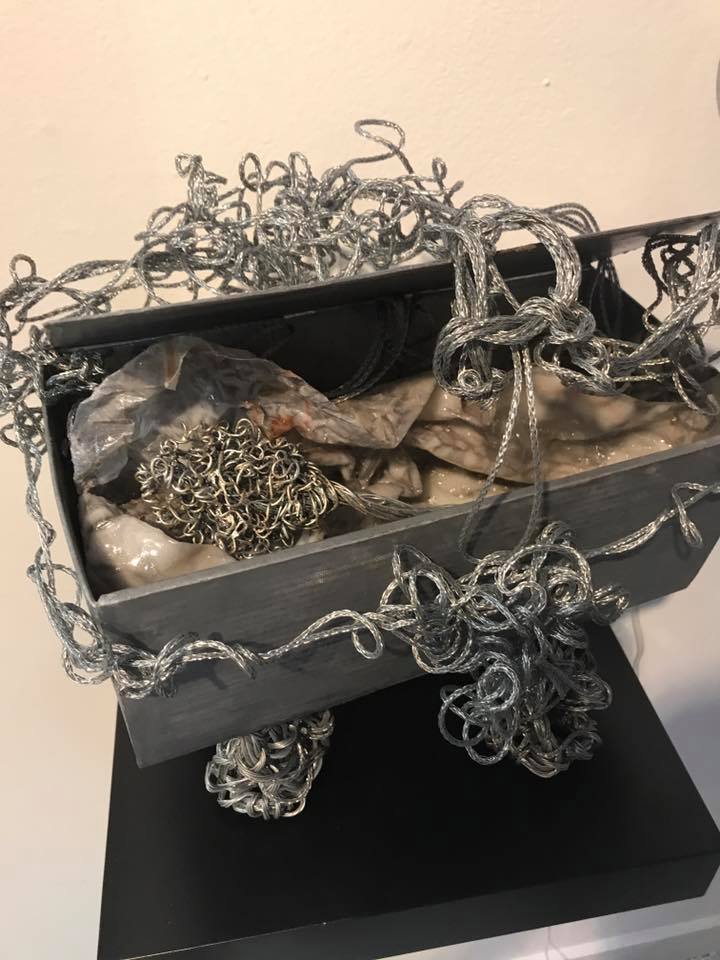
Susan Amorde has a lot of baggage. Or rather, her art includes many works that feature suitcases, trunks, and briefcases as a part of sculptures that travel the distance – evocative, edged with mystery and a dark magic.

23844379_1591729900862727_5840895800515958260_n

Suspended from the ceiling, or weighted on the floor, this luggage isn’t easy to unpack.

31786652_1746672432035139_5499132815624634368_n

From sculptural works made with vintage suitcases to beautiful figurative works in clay, wax, bronze, and plaster, Amorde’s work is moody and emotional; she takes viewers on a journey that is both spiritual and literal. She takes on the metaphorical idea of baggage, and how what we carry with us emotionally can become what we are in life. Her work is often witty, with a double entendre rooted within its sculptural nuance. Below, for example, from her Dick and Jane series, is “Woe is Dick.” Amusing, scatological, and brilliantly anguished, this is a fresh take on what could very well be toxic masculinity as it affects its “owner.”

31117732_1738857082816674_6150226213903269888_n


What travels through all of Amorde’s work is a muscular strength, a determination and a sense of a discovery. What is it that we find so precious, that we we must take with us everywhere we go? What is it that we find a necessity to bring with us, to pack away, to shape our journey through life, to shape us?

With “Mort’s Briefcase,” below, from her Baggage series, the artist juxtaposes the mixed media of a key and a wall hook with a beautiful sculpture of a man with his open brief case, standing on a small trunk. So much here: the secret content of the receptacle on which he stands; how his body has morphed into a series of objects – the key symbolic of the things he has long locked away.

32628283_1759399427429106_3257329654284943360_n

Other, smaller keys are attached to his arms. Such weight: why do we lock away our secrets, and how do they continue to impact our lives even if we keep them out of sight? Amorde has said that “We as individuals, as well as society and culture, have baggage that we carry around and that either enhances or impedes our daily lives. I incorporate the figure with sculptures of suitcases or use mixed-media to explore how we feel about  ‘baggage’ and what it looks like.”

1487435_836914013010990_3780051960651646482_n

At times, what Amorde seems to be telling the viewer is to really look inside that suitcase, to emotionally unpack. In other works, she’s showing us the richness of everything we carry, the wildness and passion of even our most fraught memories. There is a darkness and an edge to some of her works, as with her stunning “On the Edge,” below. Here a woman is weighted down, trapped under lock and key. She has literally become the baggage she carries and is in torment from it.  Is her freedom just a flick of a lock away?

25152086_1609173779118339_8981882872316163474_n

Weighted with an anchor and chain, the suitcase below is emblematic of more than just one individual, symbolic of modern life itself. The more we have to do, the more we may gain or lose, the more we have to hide. And whatever we’ve kept hidden gets heavier, and heavier, until what we are dragging with us might very well take us to the bottom of the sea and leave us to drown there. “Route 66 Anchor and Chains,” below, has an interesting title. Route 66, after all, was where we were to get our kicks, not our chains.

31400989_1742567635778952_6071274321181933568_n

And once sunk under the sea, perhaps we are still “Drowning in Indecision,” the title of the work below.

31944581_1749386621763720_6597191902640996352_n

Amorde’s series of water portal sculptures are especially beautiful, the liquid sections of each piece feel illuminated with light. Perhaps once we drown what we carry we can finally be made free. Or perhaps we are still on the hook for our burdens.

21740037_1528261827209535_8349772631331103082_n

Her “Wounded Baggage,” above, is classically framed, shot through with bloodied arrows. We can try to kill the demons that we carry, but yet they bleed.

One of the many fascinating things about Amorde’s work is how many questions her art raises. She gives us no pat replies: we are finding insight more than answers.

This is an artist ready to travel, taking viewers on a long and internal journey with her and her art.  To quote The Beatles “Boy you gotta carry that weight/carry that weight a long time.”

Amorde’s profound, anguished, and rich art might just help lighten the load.

  • Genie Davis; photos: Susan Amorde, Genie Davis