Body to Bodhi: Heart to Heart Art

F23C0136

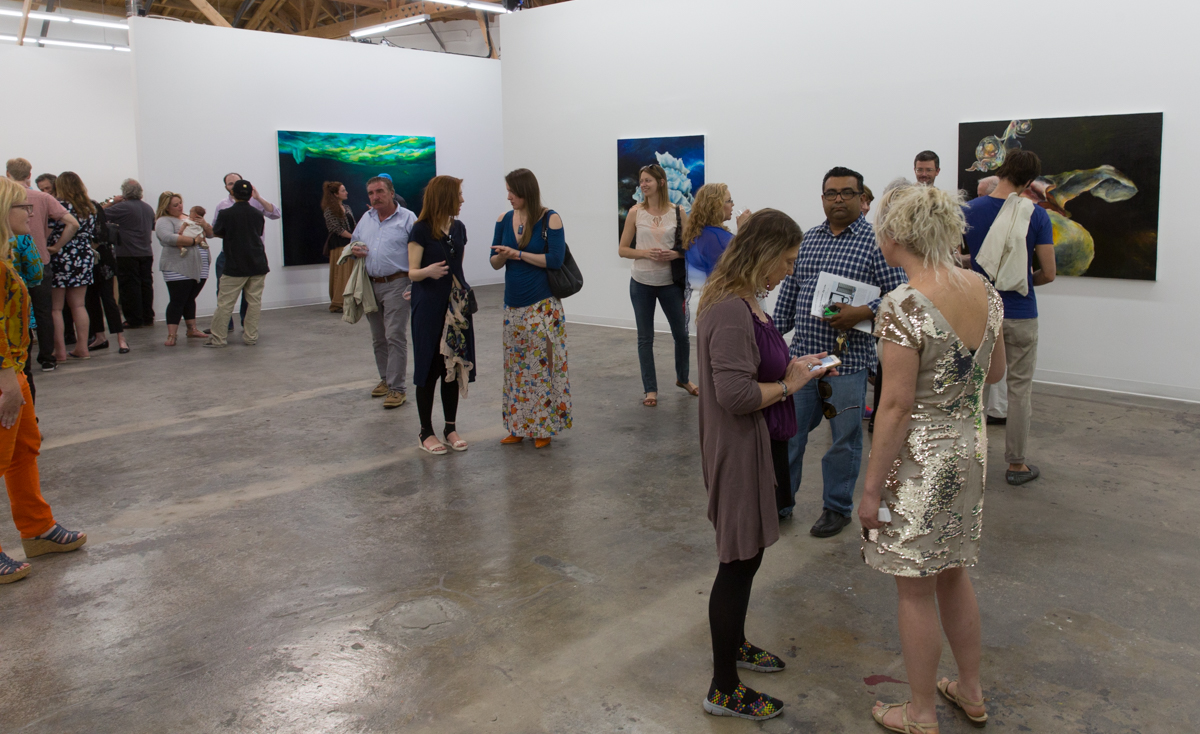
Body to Bodhi is a conceptual art exhibition that connects body shapes to nature and nature to the universe. “The art focuses on how we can use the life we are living now to go a step further along the path to enlightenment,” curator Hayley Marie Colston explains. “The pieces contributed by the twelve artists exhibiting were open to their own interpretation of what that path means.”

Opening Saturday the 19th for a limited run at Oddville event space in DTLA, Body to Bodhi is a wide ranging collection of paintings, photography, mixed media, installations, sculpture, and virtual reality. In short, one vibrant, witty, cavalcade of art.

Oddville’s Steve Payne and Ezra Croft stepped in to host the event, which is experiential in all the best ways.

Artists on display include Nychole Owens, Gus Harper, Hung Viet Nguyen, Johnny Naked, Snow and Kevin Mack, David Malana, David Cedeno, Reid Godshaw, and Bill Mather, among others.

Matt Elson’s Infinity Boxes, below, offer a transcendental experience unique to each viewer – and unique to the same viewer exploring the mirrored, kaleidoscopic sculptures from both the front and back of the pieces.

F23C0135

Yes, even babies were enthralled. This piece reminded us of a more intimate version of Yayoi Kusama’s Infinity Mirrored Room—The Souls of Millions of Light Years Away, now on display in the Broad’s permanent collection.

F23C0125

Another piece by Elson evoked memories of fun house mirrors. What is your body or bodhi reflecting?

F23C0123

Below, guests experience the virtual reality of Kevin Mack, Zen Parade. This is truly and honestly an amazing artwork, the viewing of which is unique to each viewer. The piece lives up to its tag lines of “meditative, invigorating, entertaining, universal.”

F23C0120

The project is entirely a family affair.

Mack worked for years on the technology for this experience, and is a pioneer in the visual arts, known for creating the opening visual sequence in the film Fight Club, as well as winning an Academy Award for visual effects in the film What Dreams May Come. Wife Snow Mack served as producer on this piece, Mack’s sons were also involved in the project. Ray Mack created the music for this work of abstract dimensionalism, Jonathan Mack worked with his father as tech adviser on the 360 degree motion.

Mack says “It’s the culmination of many years of development. I’ve worked in visual effects, neuroscience, and the mechanism of perception. The shape space explores visual consciousness, and the aspect of virtual reality that’s new, the spatial presence using it to create mindfulness.”

I saw alien figures, sea life such as turtles and fish, while my partner saw elephants and other jungle animals. Morphing three-dimensional paint splatters become living, organic beings. Tough to explain without seeing it – the solution is – see it.

“It’s different for every person,” Mack asserts. “The brain has the tendency to find meaning in an abstract medium, the way people can see an image of Jesus in toast or a ghost in a stack of clothes. In this case, there is nothing there to actually identify the images, and it releases your verbal mind so your abstract mind can experience it.”

“It’s a gift for us to share,” Snow Mack adds.

“It’s a truly profound experience,” Kevin Mack continues. “I made it and I’ve seen it five or six hundred times at least but I see different things every time I go through it. It’s a natural system in which I create the rules that govern the system.”

Mack describes his work as a form of simple artificial life. “It’s like crystals. Different from biological life, but entities that have behavior that is generated by a genome with wide variability.”

F23C0090

Kevin and Snow Mack, above. Below,  works by Liz Huston on the left, the nature-body beauties are by Bill Mather on the right.

F23C0116

F23C0115

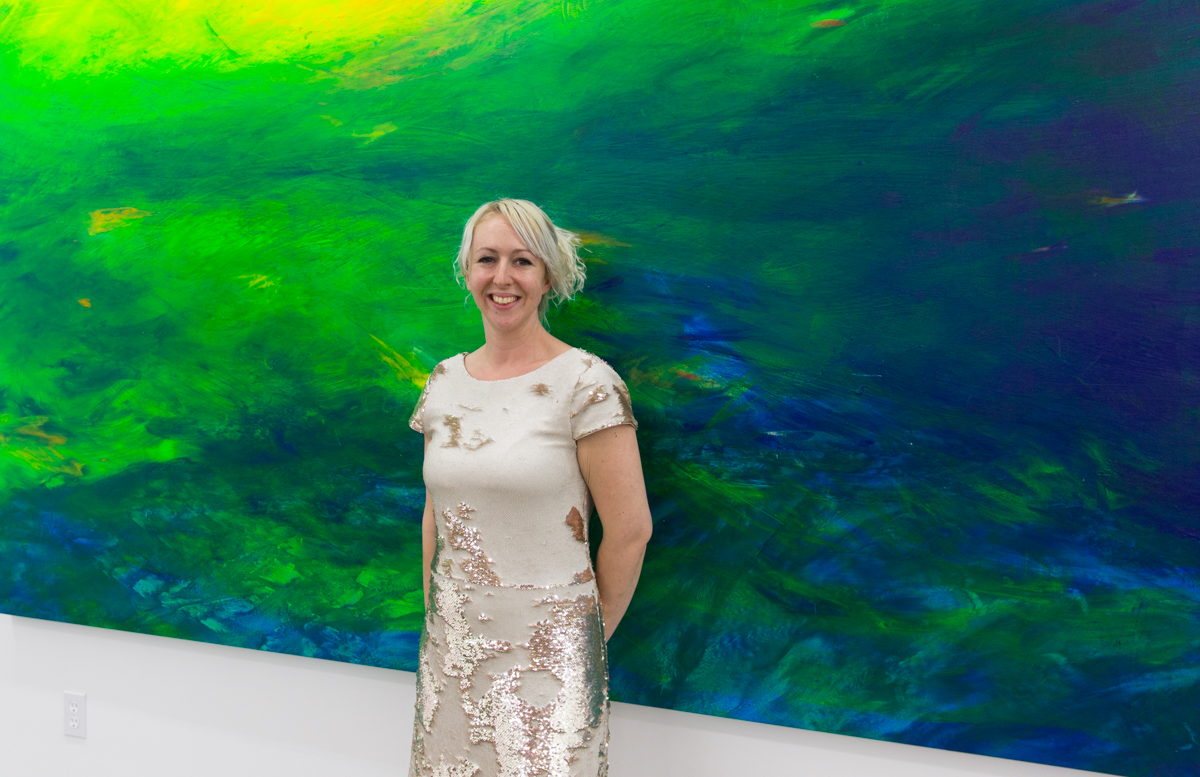
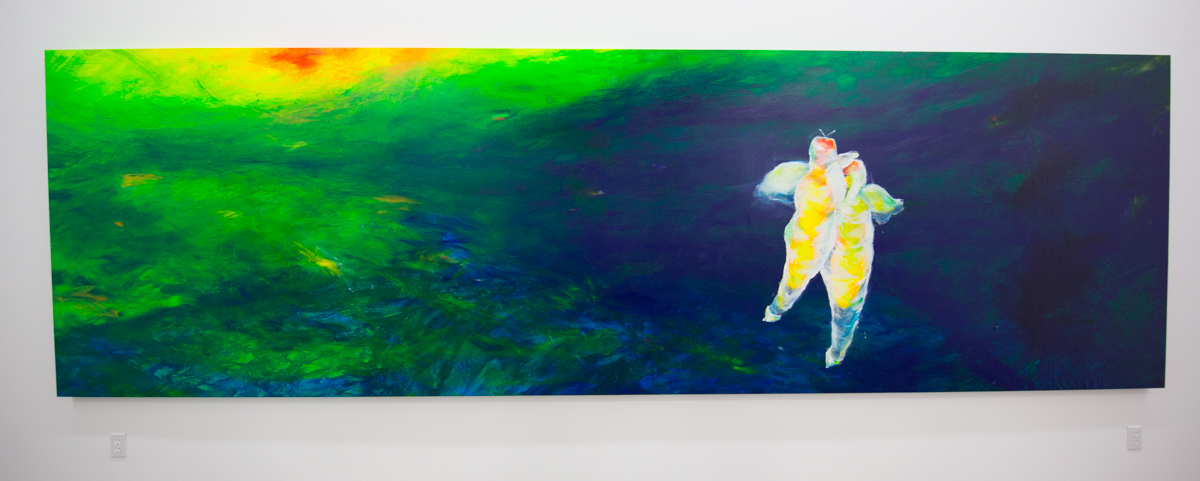
Above, curator Colston with one of her earliest artistic supporters: her mom. Behind them, and below, a beautiful, immense piece by Gus Harper.

F23C0104

F23C0113

Below, photography by Colston. The image of trees, center, was a travel photo that captures a haunting setting and a mystical rainbow.

F23C0111

Below, the hot, bright desert image is by artist Johnny Naked.

F23C0109

Below, more works by Gus Harper, whose west side gallery recently showed multi-media works including an installation of arrows titled “Kill the DJ.”

F23C0107

Below, more of the Macks’ work: 3D printed sculpture and multi-media.

F23C0106 F23C0105

F23C0092 F23C0091

F23C0103

Above, a living sculpture: bonsai trees created by Thousand Oaks artist Travis Goldstein.

F23C0086

Above, Colston with artist Hung Viet Nguyen. His landscape, below, has a quilted quality in texture and design. Nguyen describes his work as an almost mystical, memory-based process. “When I paint, I have two ways of looking at a landscape, sometimes through memory entirely, at other times through a photograph.” The artist cites influences from Chinese landscape painting to David Hockney, but his fluid, dream-like work is uniquely his own.

F23C0084

Didn’t make it to Oddville for this inclusive, immersive, and above all heart-felt and mind-bending exhibition? Watch for more from these artists, curator Colston, and this venue in coming months.

  • Genie Davis, all photos by Jack Burke

The Strasberg Legacy – A play in 2 Acts written by Vic Bagratuni

The Strasberg Legacy Act2

Not every young actor can successful star in and write an intense dramatic production, but Vic Bagratuni pulled off both roles as part of The Emerging Playwright Unit December 2015 at The Lee Strasberg Theater in New York. Starring as Gino, Bagratuni turned in a raw and vital performance in a solid drama directed by Allen B. Ford, The Strasberg Legacy.

The play takes viewers on a trip to Torre di Largo, Italy, with Gino (Bagratuni) and his family. Concerned by the nationalism he perceives in his travels, father Vito is appalled by the performance of a hypnotist named Luparello, who uses his mental powers to control his audience. Representing the control authoritarian leaders in Europe had over their followers, Luparello misuses his power, in an attempt to overcome his own strident inferiority. When Gino falls under Luparello’s sway, Vito is driven to violence. In the end, a native of the region kills the hypnotist, in a cathartic act that not only liberates Gino and his family, but also frees the audience from its role as followers of Luparello.

The Strasberg Legacy Act1

An interesting concept that draws viewers into a metaphor for a political scenario all too relevant in our own current primary election landscape, it’s Bagratuni’s intense performance that elevates the production into something mesmerizing.

Kingdom Come at Stone Malone Gallery

K I N G D O M 04
“Kingdom is an exercise in merging sight and sound,” says co-creator Aaron Bleep. 
This conceptional mixture of visual art and sound, developed by Aaron Bleep and Semjâzâ Ludovico, needs to be witnessed to be fully understood. We intend to do exactly that this coming Saturday, March 26th at the Stone Malone Gallery, located at 7619 1/2 Melrose Avenue, Los Angeles.
K I N G D O M 01
“The technology developed as the ideas were dictated,” Bleep asserts. “Semjâzâ engineered the whole maneuver. The idea came to me about 10 years ago when I was drawing to music, and noticed I was drawing in rhythm. Then I started practicing it for fun. I was about to present it to a studio I used to work with, but we parted ways before I could present it,” he explains.
The product lay dormant for a long period of time – until now.
K I N G D O M 10
“Essentially, people can expect to experience music visually,” Bleep says.
The work is organic to Bleep’s art as a whole. “My previous work is a foundation for Kingdom. People familiar with my work will be able to recognize central themes and motifs throughout, as well my classical training as a musician and artist.”
K I N G D O M 09
The other half of Kingdom, Ludovico, is the engineer and electronics coordinator for the project. The two met at work, and bounced the ideas behind the sound/visual art merger around.
Ludovico decribes himself as the engineer and live composer for the project. “I built most of the equipment that we use, and I handle the effect processing and audio side of things. It’s basically my job to turn Bleep’s painting into music.”
K I N G D O M 13
Ludovico insists that he can’t take much credit for the original idea. “I’ve been building and using synthesizers for years, and one day Bleep came to me asking if I could make this idea happen. I drew some schematics and a few days later the machines that are Kingdom were born.”
K I N G D O M 16
Pressed to elaborate on the experience, Ludovico says he cannot really describe how important the music/visual art mix is to our culture, or how the project is perceived by individual viewers. “I suppose part of it depends on how much they understand about the process. I expect intrigue and curiosity, but either way it’s a new realm for people to explore.”
K I N G D O M 11
The self-professed sound guy describes Kingdom as a meeting of sight, sound, and technology. “It’s a way to break down the boundaries of conventional thinking, and a way to inspire experimentation. It’s a way for people to ask themselves, ‘Why should we be limited by artistic medium, genre, or even physical boundaries as we know them?’ We, as humans, have the technology to create anything that we want, and this is a celebration of that progress.”
K I N G D O M 07
Celebrate and go visit next Saturday. For a sneak peak of what you’ll see:
The video above was shot at the first performance of Kingdom, at renowned tattoo artist Sean from Texas’ solo show closing event held at Stone Malone Gallery. Kingdom’s creators advocate viewers documenting through photos and video unobtrusively throughout the performance.
– Genie Davis; photos and video by Hollowdoubt

Abstract Never Is: Muzeumm


F23C9943

Abstract Never Is, an exhibition of both contemporary and historical abstract photography is a vibrant collaboration between The Venice Institute of Contemporary Art (ViCA) and MuzeuMM that expands on a smaller scale exhibition displayed at Photo LA in January.

F23C9971

Co-curated by ViCA’s Juri Koll and MuzeuMM’s Mishelle Moross, the works are visually rich and emotionally evocative.  Above, Koll with some of his own haunting images, which shimmer with shadows and shapes.

“Abstract photography is harder to create than an abstract painting,” Koll attests. “You’re limited by the lens in front of your face. But you can’t deny the viability and the emotion of a photograph.”

F23C9979

Above, Osceola Refetoff’s abstract take on the lights of trucks on a highway conjure the highway, the allure of an almost ephemeral destination, and a jeweled blur of light. Below, Refetoff with journalist Christopher Langley, his partner on the project High & Dry,  an ongoing representational project documenting California’s deserts and the people who live there.

F23C9919

F23C9911

Above right, co-curator Mishelle Moross.

F23C9898

Above, artist Diane Holland with her richly colored yet ghostly images. The artist says “I use electrotransfer, otherwise known as color Xerography, and Cibachrome photography to convey the relationship between human beings and the technological they create.”

F23C9976

Artists Lena Moross and Bibi Davidson enjoy opening night.

F23C9956

Above, ripples that could water struck by sunset in a stunning work by Sasha vom Dorp.  The artist says of his works, above and below, “These are photographs of sound encountering light as seen through the medium of water.”

F23C9947

The immediacy of a photograph is somewhat of a myth, and never is that more fully the case than with abstract photography. To create photographic art requires not just a given moment, but preparation for that moment, the dance of both immediacy and planning.


F23C9965

The work of Edmund Teske, above, was an early inspiration to co-curator and exhibitor Koll. “He taught me to be an artist,” Koll explains.

Along with Teske, other artists on display include Fatemeh Burnes, Sasha vom Dorp, Kio Griffith, Diane Holland, Suda House, Juri Koll, KuBO, Maria Larsson, Lawrie Margrave, Stefanie Nafé, Kirk Pedersen, Osceola Refetoff, and Lisa Rosel, among others.

F23C9916

F23C9937

F23C9939

Above, Fatemeh Burres draws viewers into an explosive universe.

F23C9941

Above Kubo Hkla’s shimmering gestational pieces.

F23C9949 F23C9962

Above, Lisa Rosel takes on familiar and iconic LA scenes in a complex and fresh vision of lines and space.

F23C9981

Above, haunting, light-filled images culled from Union Station by Osceola Refetoff.

F23C9987

Above, ghostly and deep, caves and orifices – Fatemeh Burres.

F23C9964

An astonishing collection of fine photographic art that is as varied as it is representative of abstract technique, this is a “don’t miss” show that makes viewers think as well as enjoy. Discerning meaning is just a portion of the pleasure here: meaning is mutable, images are themselves profound.

F23C9968

F23C9966

F23C9983

Genie Davis with artist Sonja Schenk.

F23C9961

Above, Bibi Davidson

F23C9933

Above, Loren Philip, Diane Holland, Jodi Bonassi.

F23C9906

Above, artists Jodi Bonassi and Osceola Refetoff with Gary Brewer.

F23C9902

Above, artist Diane Holland (left), Brooke Mason, Peter Frank, Susanna Schulten

MuzeuMM is located at 4817 W. Adams Blvd. Los Angeles