When Art Is Magic – The Arcade of Hypermodernity

“Oh Sandy, the aurora is risin’ behind us/ This pier lights our carnival life on the water…” – Bruce Springsteen

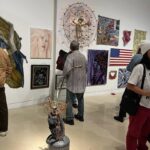
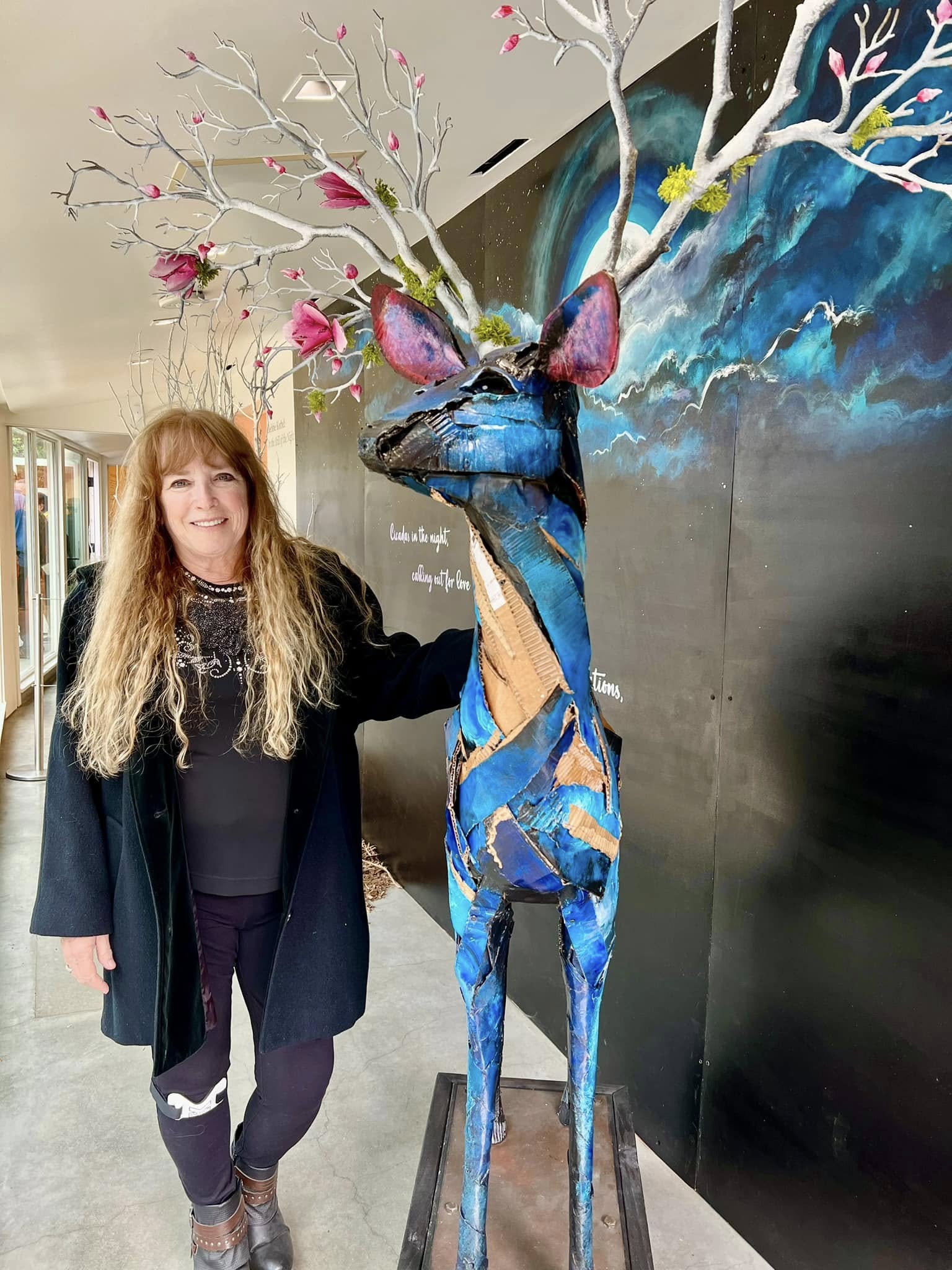
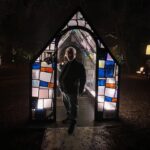
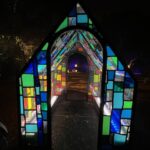
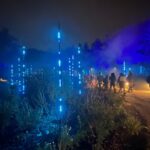
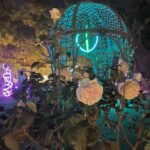
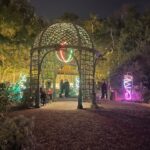
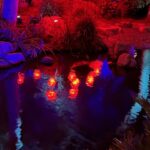
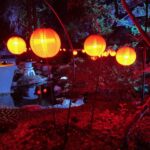
Now at Studio Channel Islands Art Center in Camarillo through, July 27th, curators Jason Jenn and Vojislav Radovanovic create a new kind of carnival life, one that offers its own bright aurora, an interactive world that morphs technology into magic and the rush of modern life and angst into a spiritual and sensual experience.

Exhibiting artists CARLOS LUNA JAMES,  CHENHUNG CHEN, CHRIS TOWLE, EDWIN VASQUEZ, EUGENE AHN, GIRLACN, GREGORY FRYE, IBUKI KURAMOCHI, ISMAEL DE ANDA III, JASON HEATH, JASON JENN, JEFF FROST, JENNIE E PARK, JODY ZELLEN, JOSEPH CARRILLO, KAREN HOCHMAN BROWN, LESLIE FOSTER, LIBERTY WORTH, MATTHEW PAGOAGA, R SKY PALKOWITZ, and VOJISLAV RADOVANOVIĆ each shape a miraculous exhibition that invites viewers to partake of a literal art arcade, touching, playing, dancing, and yes, even inhaling the scent of the art.

It’s a pure wow of an exhibition, one that vibrates with energy, a passion for perfromance, romance, the ridiculous, and the sublime. Just as I struggled to decide where to start when wandering through this treasure trove of an exhibition, I also struggle now with how best to describe an experience that is meant to be – experienced.

The curators aptly describe the show as a “vibrant playground of ideas, focusing on the intersection of art, technology, and imagination….it explores the limits of human capability and what is now possible and in a state of major change within this new era of life globally connected online, and the evolution of artificial intelligence.”

And does it ever explore. Equal parts fantasy and futuristic window, the show is visually dazzling but also robustly meaningful. What does it mean to be human? To feel, enjoy, experience? What does it mean to think without being told what to think or how to behave? What does it mean to feel one’s humanity without conforming to political or social structures that limit or lie? How will technology change us, how has it already? Where are we going, and where have we been?

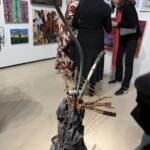
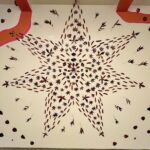
It’s a carnival of art, and a circus of ideas.  Some works are sculptural, as are Chenhung Chen’s flowering burst of wire and cable and found objects, “Currents.”

Some are sculptural forms that move, changing in multi-colored lights, mixing a traditional toy that evokes a carnival kiddie ride with fantastical portraiture, as does Vojislav Radovanovic’s take on car culture, “Phantom Traffic I (The Collectors), Phantom Traffic II (Library Girl), and Phantom Traffic III (West Coast Vibes).”

There are steampunk extravaganzas that twist and turn from Chris Towle, whose five elaborate and engaging works here include a silicone film prop, “Kraken,” and a crazy cool clockwork-type piece, “Teatime Movement.”

Edwin Vasquez offers an interactive, mixed media “Shooting Range” that also serves as a trenchant commentary on American gun fetishism.

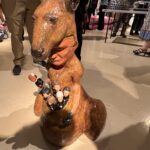
Gregory Frye’s dazzling fiber optics and mixed media work, a freestanding fortune-telling creature called “Frank Fortune” seems ready to walk out of the gallery, even as it dazzles the eye and the spirit.

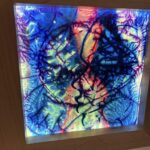
Girlacne’s “Body Électrique” wall art is a sinuous mix of LED, wire, and zip ties that undulates with light and shadow.

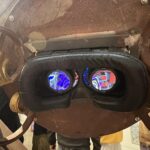
Ibuki Kuramochi’s ” Eggscapes” gives viewers a mystical VR metaverse to plunge inside – and then rehatch from within.

At the June 1st opening, we were also able to view a stunning performance art and dance from Kuramochi, performed outdoors to a rapt audience.

Her sense of visual poetry embodied themes of birth, rebirth, loss, and revival, all relevant to the exhibition itself.


Presenting a terrific, riveting series of altnerating images, Ismael de Anda III & Eugene Ahn use video projection, AR, and a vinyl dance floor to spin their “Dancing Wu-Li Masters.”

Jason Jenn’s lush, fecund “Ye Ol’ Factory Station (Homage to Sir Joseph Paxton),” includes elements scented with essential oils that conjur up forests and fantasies.

Karen Hochman Brown’s “Circuitry” offers a geometric display of digital frames and cords that resemble luminous eyes.

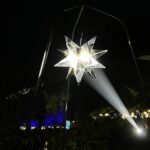
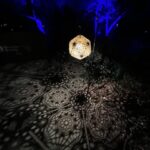
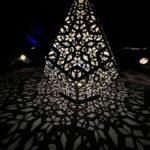
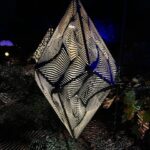
SKY Palkowitz’ “ALIEN ARCADE UFP Unidentified Flying Pyramid – Classified: Pleiades Starship 444 – Codename: Elohim,” invites viewers to stand beneath this mysterious shape, and view its black-lit and transportive interior.

There are mysterious and magical video works from Leslie Foster, and the vivid palette of Jeff Frost…

…a motion-activated low-tech piece from Jennie E. Park…

a thought-provoking digital “film strip” from Jodi Zellen.

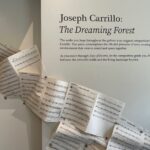
Viewers also get to explore Joseph Carrillo’s musically driven “The Arcade Fantasy,” as well as Mathew Pagoaga’s exciting video game-centered, multiple installation “Trust.”

Carlos Luna James superb and transformative “OPTIMUS” AR activation,  one of two dynamite pieces the artist has here, is an innovative mind-blower. Take a look below:

And these are by no means every piece on display. Each work and each artist offers something quite wonderful, strange, special, and unique – you will not see these works elsewhere. If you saw the DTLA-recreation of Luna Luna Amusement Park, originally created in Germany by seminal artists of that time,  you could easily imagine The Arcade of Hypermodernity as such a revered classic of the future. It’s spectacular, and just a whole lot of fun.

While this exhibition pays tribute to the idea and reality of arcades and midways, it also serves as an homage to this quintessential moment in time, one in which our creativity, our humanity, our playfulness, are all on the verge of great change. There is the expansive possibility of technology, and conversely the dulling of our capacity for connectivity and intimacy through its remoteness.  Can we embrace great change without it forever changing us? How much have we changed already, and become hybrids of the human and the inhuman as the price of simply staying alive? How can our creativity, the root from which our humanity springs, still define us?

Walk through this arcade and you’ll find hope, happiness, and as many questions as answers. You’ll find the magic that makes art live and the art that makes the magic. Now go wave a wand, or get on the freeway – whatever works for you – and go see this show. “Frank Fortune” is waiting to tell your future.

Studio Channel Islands Art Center is located at 2222 Ventura Blvd, in Camarillo. For hours, schedule of artist’s talks and other activations, as well as directions, click here.  

  • Written by Genie Davis; photos by Genie Davis
 

Mixing It Up: A Vibrant Palette of Memory at Shockboxx

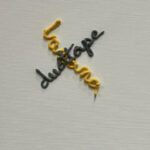
Buzzing with lively energy,  the group exhibition Mixtape, now at ShockBoxx Gallery in Hermosa Beach brings the invigorating result of an international open art call to life while stirring up some good ol’ B-side nostalgia. Remember years ago when you carefully and painstakingly curated a mix of your favorite songs and recorded them on cassette tapes? Such a task was executed with the hope of eliciting the perfect mood to match the handwritten titles scribbled onto their plastic cases with a ballpoint pen.  Artist Laurel Meister’s linoleum block print illustrates this nostalgic fun when “Sexy Time” and “Songs to Cry To” were in rotation along with “2 Good 2 B True” and “Fresh Crush Mix.” It was about the journey, not just the destination.  

 Laurel Meister’s Mixtape inspired print,  “A Love story as told from the passenger seat of an 88′ Mustang.”

But what does Mixtape really mean for this exhibition? Is there just a bunch of art with boomboxes and portraits of famous musicians? There is some of that, yes. Like Meister; Ariel Cohen’s painting “Skanktuary;” and James Frost’s “Little Mermaid (Lady Gaga),” each of which lean into the more literal understanding of the theme. 

 James Frost with his lush and lovely painting, “Little Mermaid (Lady Gaga).” 

Ariel Cohen with “Skanktuary.”

But what the jury happily stumbled upon when culling over 400 submissions, was that most artists had their own interpretation of what Mixtape meant to them.

“Ice Cream Girls” by photographer Alain Bali. 

Punk rock had a big impact on French culture and fashion photographer Alain Bali,as he documented musicians touring Europe in the 80s, from The Clash to the Sex Pistols. It was a time where street photography was minimally edited and imperfections on film were celebrated. Here, Ice Cream Girls catches some mid-lick side eye in a grainy black and white double portrait.

Eileen Oda’s intricate and delicately rendered pencil drawing “Soul Food” also captures  a street scene in black and white. Her warm urban scene gives viewers a look at a tableau that gets to the heart and soul of a specific place, and moment, in time.

Zoe Blackman’s oil on canvas work, “Hereditary,” places a nude self-portrait holding hands with her childhood-created character, Heartman, in front of every youngster’s favorite fast-food icon, McDonald’s. The play on American culture, personal life experiences and fictitious characters create a narrative that teeters somewhere between light-hearted and possibly grave circumstances that makes this an intriguing mix all its own.

The curation of the selected works is a mixtape in its own right, flowing with bold color waves, texture and 3-dimensional storytelling . “Summer Dreaming,”  a vibrant scene using acrylic on a ceramic plate by Theodosia Marchant sets this tone with a black female figure dynamically placed amid the clouds, a rainbow and floral accents. This sunshine-y work hangs over a playfully tactile ceramic sculpture by artist Karl Hauser.

Alison McMahon with her life drawings at the ShockBoxx Mixtape opening.

Hermosa Beach native Alison McMahon, a staple in the ShockBoxx community of artists, took the mixtape theme to the next level with a whole slew of unframed life drawings and watercolor paintings featuring musicians who performed live in the South Bay.  McMahon’s ability to capture the soul of artists like Zeal Levin, V Torres, Steve Aguilar, and Emily V among others, covers a single wall and plunges viewers into a recognizable rock n’ roll past.

Somaya Etamad [left] standing next to her sold work on opening night alongside myself [center] and Mike Collins. [right]

The diverse and vibrant works in this exhibition may recall the past, but they also ably reflect the future with what gallerist Mike Collins describes as “the ever growing community of artists and art patrons that call ShockBoxx home.”

Mike Collins [right] discussing his work with guests at the Mixtape opening.

Above: While nostalgia for a mixtape rings true across the board for most Gen Xers, these tiny humans are way too young to have experienced such a thing. It was fun to watch them take in the artwork and make some summations of their own.

Jennifer Nerio, “Can of Snacks.”

Above all else, Mixtape is about memory, and the ways in which a personal recollection can also be a universal one.

This exhibition reminds us not only of a moment in time where movies, fashion and big hair were breaking the rules, but a time when a musical compilation was a source of identity, a snapshot of our drive to create something soulful, emotive, meaningful or just plain fun. It’s a representation of something that was put out into the world and into the hands of someone you loved, or better yet, into your own hands. And this tape won’t unravel at your favorite song, as ShockBoxx thumbs through the archives, remastering and continuing the anthology. 

Mixtape runs through Sunday, July 7th at 636 Cypress Avenue, Hermosa Beach, CA 90254. See the gallery’s instagram for open hours or email info@shockboxxproject.com for appointments. The exhibition can also be viewed online via Artsy here.

Written by: Aimee Mandala

Photos: Aimee Mandala, ShockBoxx, Matthew Alceves, Kelly Capouya, Theodosia Marchant, Genie Davis.

Earth Day Always for Artist Snezana Saraswati Petrovic

In Snezana Saraswati Petrovic’s exhibition Bionic Garden – The Fossils of the Future, environmental activism meets profoundly beautiful visual art. The inclusive, immersive exhibition blossoms with dazzling and delightful sculpture and innovative technology, shaping a garden that takes root in both the mind and the soul.

Inspired by the artist’s own personal experience of escaping civil war in the former Yugoslavia, an impactful dream, and her commitment to ecological advocacy, Bionic Garden – The Fossils of the Future examines the possible dystopian end of the Anthropocene era, but it is not a eulogy; instead, it serves as a call to action.

“I have dedicated myself to continuously learning about new scientific developments and incorporating this knowledge into my art. My goal is to foster a dialogue, to challenge, educate, and inspire others about the necessity of protecting our future and healing our world. This mission is not just a choice; it feels like a responsibility woven into the very fabric of my being, driven by the desire to ensure that Earth remains a home not just for us, but for generations to come,” Petrovic says.

On display June 6th to July 21st, 2024, at Kahilu Gallery in the Kahilu Performance Art Center on Hawaii’s Big Island, the show embodies Petrovic’s continued commitment to, and passion for, saving our planet from potential catastrophe.

The exhibition depicts a future post-human environment containing the remnants of flora and fauna on both land and sea. Inviting viewers into the physical space of her installations and using interactive elements, Petrovic seeks to instill a deep appreciation for the earth and an understanding of the potential loss we face. “What I most want viewers to take away from the exhibition is a deep appreciation for the beauty of our world and an understanding of the potential loss we face. If the viewers leave with a sense of wonder and an awareness of our power to effect change, that would be truly amazing!” she enthuses.

Her work pulls viewers into a mesmerizing world that incorporates fresh flowers and dried plants along with eco-friendly plastics. It is a head mix, a practice of mingling natural and artificial elements which began with last year’s Leaving Eden, curated by myself at Keystone Art Projects in Los Angeles. There she integrated dry palm leaves into installations that created both a fecund Edenic landscape and a lost one. In subsequent installations, she mixed fresh orchids with fanciful plastic vines, inviting viewers into a lush jungle. In Bionic Garden – The Fossils of the Future, she incorporates native flower leis as well as selections of immersive soundscapes that can be chosen by viewers and range from those of bucolic nature to the rush of a Los Angeles freeway.

Over the years, Petrovic’s ecologically themed artworks have evolved from her initial concepts of upcycling and recycling found objects to the use of sustainable alternative materials. Her focus has shifted along with her medium. She’s created installations that encompass issues of ocean acidity and coral reef bleaching, the growing destruction of plastic pollution, and the detrimental effects of rapid industrial and technological development, as well as the effects of overpopulation.

As her subjects have broadened and become more urgent, the artist continues to utilize materials that are increasingly interactive as she urges collective acknowledgment and action toward environmental crises.

“Initially, my ecologically themed artworks were centered around the concepts of upcycling and recycling found objects. I created weaving installations using recycled newspaper ropes that I made by hand. This process was both time-consuming and meditative, providing a direct engagement with the materials. However, as newspapers became increasingly scarce and less relevant, my art practice began to evolve…During a period of self-directed study in Japan, I delved into the potential of alternative materials derived from nature, such as mugwort and felt. This exploration was aimed at developing projects that were not only ecologically aware but also sustainable. The pivotal moment in my artistic journey came while participating in the Kipaipai professional development program on the Big Island. It was there that my focus shifted towards the issues of ocean acidity and coral reef bleaching. This shift was influenced not only by the publicly available data on the Great Barrier Reef but also by my son’s PhD research on coral reefs, which provided me with a wealth of scientific evidence from Hawaii.”

She now brings viewers into a new role as active co-creators, utilizing video and augmented reality to create an infinitely visceral experience that goes far beyond the boundaries of traditional art. Her transformational ability to weave vibrant digital and natural elements together facilitates a dialog with her audience that is resonant both emotionally and spiritually.

Bionic Garden – The Fossils of the Future features four installations: Haiku Envelopes, The Migration Series, Artificial Reality Series, and the central set piece, Rain Forest Whisperers.

Haiku Envelopes is inspired by the idea of temporal bridges which connect us between our present selves and who we might become in the future. Here, Petrovic invites viewers to write notes to their future selves, encouraging a deeply personal form of reflection and introspection that reaches across time to construct an evolving narrative.

In the Artificial Reality Series, Petrovic seamlessly integrates technology with art, providing viewers with a free smartphone app that allows the dynamic animation of static images, bringing her sculptures and settings dancing into motion-filled life.
Rain Forest Whisperers takes viewers directly into a fantastical world hung with eco-friendly plastic vines, dried kelp, and fresh plumeria flowers, the scent of which perfumes the environment. QR codes encourage participation and inform viewers about ecological themes. At the heart of the installation is a “petrified” plastic rain forest built from the artist’s intricately linked signature plastic zip ties and here intertwined with real flowers and plants. These conjoined materials invite viewers to decipher natural versus human-made elements.

“In essence, my pull towards video and AR reflects my broader artistic ambition: to weave together digital and human elements in a manner that prompts introspection about our place in a technology-infused world. My development as an artist in this realm has been nurtured by a combination of innovative experimentation and a personal commitment to exploring the new frontiers of digital art,” she reports.

Petrovic’s abundant use of plastic is designed to provoke questions about our daily contribution to the overuse of the material, while at the same time, her delightful, playful sculptures encourage touch and connection.

The Migration Series further extends viewer interaction, allowing physical alteration to the composition of her artwork. Viewers can both rearrange and document the changes they create to reshape landscape and ocean-scape. It is a participatory experience, in which one may participate in the artist’s deep dive into themes of change, transition, and impermanence. Petrovic asserts that whether voluntary or involuntary, migration is the narrative of our planet, inextricably weaving movement, belonging, and transformation.

Thematically, migration and its impact on the planet and its people is key to Petrovic’s full body of work at the gallery. She depicts a shared global narrative of compassionate closeness to nature, and emphasizes our adaptability, resilience, and collective responsibility toward our planet. Her belief is that all cultures share the fundamental desires to communicate, to love and be loved, and to breathe fresh air, and that these desires need only to be turned toward our relationship with Earth.

Her installations here also reflect her deep affinity to the Hawaiian Islands. Both the concept of the “aloha” spirit and her commitment to advocacy for the preservation of ocean ecosystems are intrinsically at home in this site-specific work for Kahilu Gallery.

The exhibition will include an opening reception that will welcome attendees to the exhibition in a communal atmosphere, a July artist walk through, and a panel discussion also set to take place in July, aiming to foster a dialogue between artists, curators, and the public. This reflective interaction encourages diverse perspectives, offering a multi-dimensional understanding of the art and its societal, cultural, and personal implications.  There will also be Special Visitation Days targeting collectors, interior designers, and students. These curated experiences are designed to cater to specific interests, providing an enriched context for viewing and appreciating the art.

Additionally, a portion of these interactive experiences will be documented and shared online, extending the reach of the exhibition beyond physical boundaries and allowing a global audience to partake in the immersive aspects of the show.

Online engagement for the exhibition will also be key. As Petrovic notes, “With continuous interactions planned both within the gallery space and online, the exhibition aims to create an ever-evolving dialogue around the art. This dynamic approach ensures that the experience is not static but grows and changes, reflecting the gallery’s commitment to fostering a living, breathing cultural exchange.”

Her goal is to fully support Kahilu Gallery in a way that goes beyond just purchasing artworks. “One way that readers and visiting audiences can contribute to the success of the gallery and its exhibitions is by spreading awareness about the gallery and its events. By sharing information about upcoming exhibitions, artist talks, and other events on social media or with friends and family, individuals can help attract more visitors and interest in the gallery, and on a larger scale, continuing a conversation outside of the gallery about the topics that concern us all would be a great help and support for the cause.” To that end, visit the exhibitions website at Kahilu.org/exhibits, and follow them on Instagram at @kahiluexhibits.

Serving as a call to action and awareness, Bionic Garden – The Fossils of the Future is a powerful tool for change and the greater understanding of environmental sustainability. It is also an astonishing and virtuoso series of installations growing, above all else, a vision of alchemic art.

But it is hardly the artist’s final vision on environmental subjects.

“This exhibition marks the culmination of a six-year journey of exploration that began on the Big Island, closing a significant circle in my career. My project on understanding the nine planetary boundaries is an ongoing effort, reflecting my commitment to environmental sustainability and awareness. During my upcoming artist residency at the Torrance Art Museum in Torrance, Calif., this summer, I plan to continue my experiments with mediums and further explore the integration of nature into manmade objects.” Visit Petrovic at TAM starting in June.

“Currently, I’m delving into the possibilities of Styrofoam upcycling and experimenting with homemade bioplastic. These endeavors represent my response to the urgent call for action in addressing environmental concerns. By exploring these materials, I hope to find sustainable solutions and inspire others in the art community to consider upcycling in their work,” she says, describing the work visitors will see her engaged in there.

“My new works, along with my current 3D printed coral reefs, will also be showcased in September at The Loft at Liz’s in Los Angeles for the exhibition “Diverted Destruction 17,” curated by Liz Gordon. Additionally, they will be featured at Wonzimer Gallery also located in Los Angeles,  for the show “Echoes of Voynich,” curated by Marcie Begleiter which will open this fall. These upcoming exhibitions are vital platforms for presenting my latest research and creations, demonstrating my continuous exploration into sustainability and upcycling within art.”

Exploring and experimenting with these materials not only serves as a cornerstone of Petrovic’s artistic expression but also embodies her response to the global need for sustainability. As the artist herself says, “My work might serve as an example of how art can contribute to environmental awareness and action, highlighting the potential of upcycling and sustainable practices in creating meaningful and impactful art. Through this journey, I continue to seek answers and solutions that align with my commitment to protecting our planet and promoting a more sustainable future.”

  • Genie Davis; images provided by the artist and by Genie Davis
Vibrant Matter – Brilliant Fire

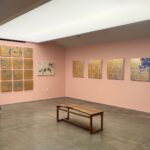
At Wonzimer through May 3rd, artist Gary Brewer has curated an entirely unique group exhibition Vibrant Matter – Brilliant Fire. Featuring the lustrous, alien and exciting ceramic work of Brewer himself, the exhibition also includes artists Tim Hawkinson, Alicia Piller, Matthew Brandt, Iva Gueorguieva, Paul Paiement, Olivia Sears/Earl Flewellen, Cheyann Washington, Aline Mare, and Ernie Lee.

Thematically mixing notions of alchemy, the power of matter and materials such as earth-derived pigments, fire, and air, Brewer combines poetic meanings and mediums to create an inspiring mix of the strange and wonderful, and the ways in which artists use materials of all kinds to create their own original narrative.

In his own work, Brewer embraces the fire discovered by early humans to transform clay into a water-tight substance.  But the exhibition features a wide range of fascinating additional materials.
Additionally, Brewer also integrates the idea of the artist’s mind as “nimble and shape shifting,” basing the exhibition’s themes on two separate and very different books, Jane Bennett’s Vibrant Matter: A Political Ecology of Things, and scientist Gerald Edelman’s Bright Air Brilliant Fire: On the Matter of the Mind. Casting these fascinating but esoteric books aside, the exhibition lives and dies on its art, which is always strong and at times surreal.
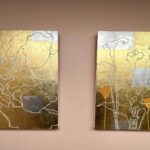
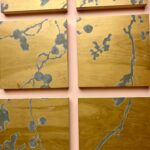
The sinuous forms of Washington’s work are created with natural pigment, but it is their line and terrific aliveness that most captivates.  Her “In the Field the Basket Feels” is a stunning work. Along with Brewer’s seemingly interplanetary floral ceramics, there is his vibrant blue and copper hued painting positioned opposite Washington’s, creating a contrasting and compelling shift in color palette.

Mare’s work here is dark and intense, particularly her “Ghost in the Machine,” a rich dreamscape painted on aluminum.

Piller’s “Corridor of Time” is alluring and yet filled with a searching discontent, a mixed media work involving suede and freshwater pearl, agate, snakeskin and encased feathers among other materials.

Gueorguieva’s work is delicate and wild, her large scale tapestries a world unto themselves; while Lee’s highly textured sculptures seem to represent animal life morphing into existence.

Brandt’s mysteriously dark forests are a pure wow, as ominous as they are awesome, forming compelling works that require multiple contemplation.

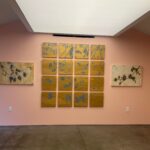
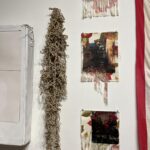
Paiment’s wonderful “Hybrid paint-stallation” yellow bug is as witty as it is cool, while a whimsical windmill flows into the serious with a lovely poetic scroll from Sears and Flewellen. Hawkinson collected avocado skins for five years, cutting them into a variety of facial expressions to create a crazy cool sculptural grid.


In short, the strange and superb parts of this exhibition conjoin to make an inventive whole.  So – you know what to do – go and see the show.

Wonzimer is located in Lincoln Heights at 341-B South Avenue 17.

  • Genie Davis, photos by Genie Davis