
Ruby Vartan Offers Jeweled New Work

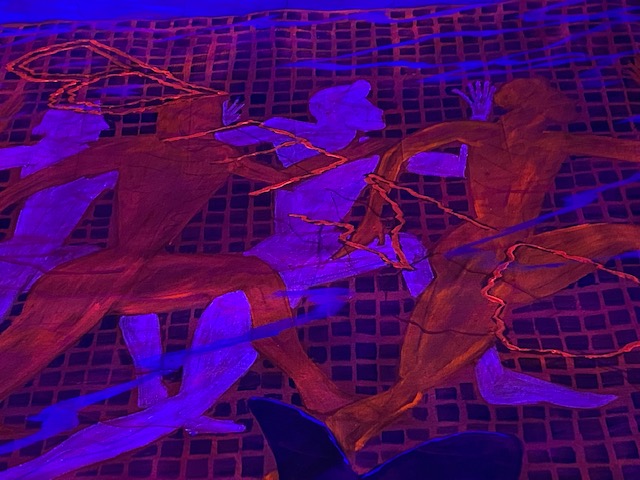
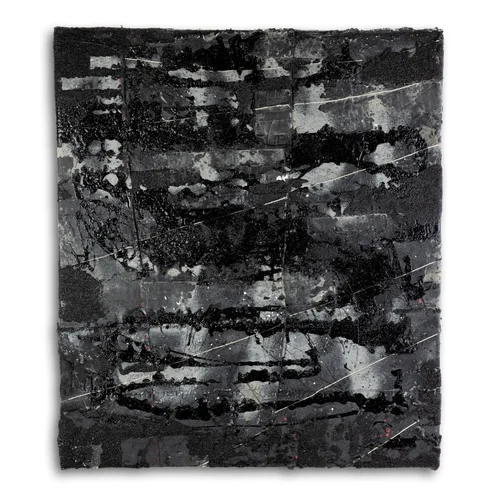
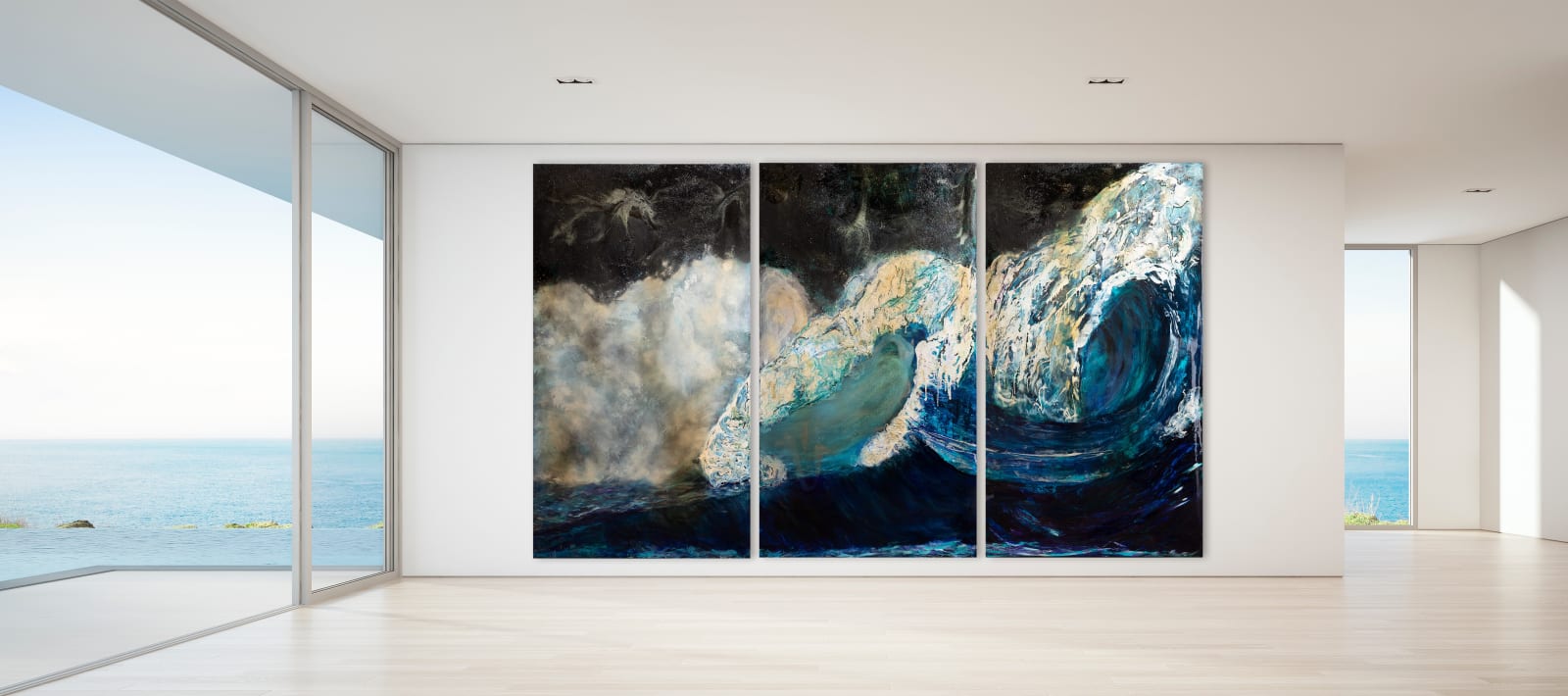
Mutable and mysterious at first look, Ruby Vartan’s artwork represents a figurative abstract exploration based on the feminine form. Working in a wide range of mixed mediums such acrylic, oil, charcoal, and fabric, as well as with oil on canvas, artist Ruby Vartan weaves powerful, emotional images.

Her work expresses both her own inner world and experiences. It evokes the liquid as well as flame, revealing both what Vartan terms messages of peace and love, as well as a flood of highly emotional, evocative images that express her own generational and intimate trauma.

The artist describes her layered and poetically physical work as the process through which she feels most free, where no boundaries exist to arriving at her destination of expression.

From inner emotion to the external body, Vartan uses her own presence to represent a vital life force, light and renewal. Her process often includes painting, tearing, sewing, and the incorporation of unique mediums that resonate with love and pain. Works include elements of empty space which she views as a way to create and uncover and exciting new world that she makes her own.

Born to Armenian parents in Beirut, Lebanon, Vartan moved to the U.S. in 2008, and currently resides in Los Angeles. She says that her strong use of color reflects her heritage and identity, as well as symbolizing her dreams, desires, and emotions. She takes her work and her viewers into a world of volatile honesty and fragile self-expression.

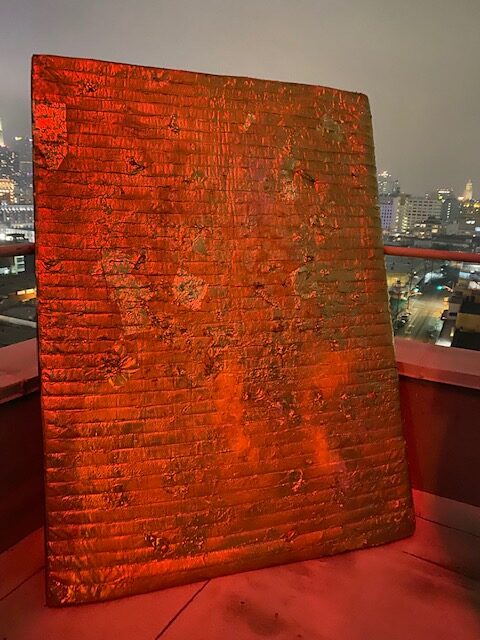
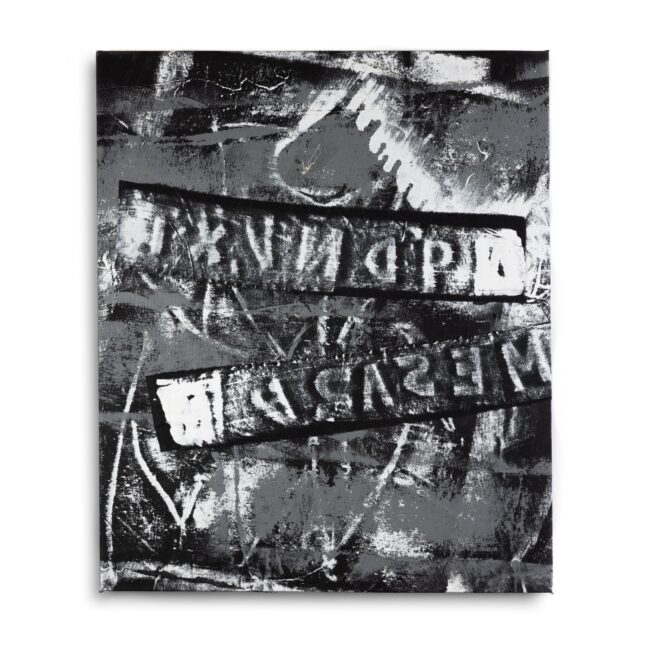
Some images include canvas slashes the reveal a gold texture below, similar to the Japanese technique of Kintsugi that repairs the broken with the use of a precious substance such as gold, silver, or platinum. Other works include text, and intricate patterns.

Regardless of image, Vartan’s work exudes the aura of survival, resurrection, and resilience, shaping an experience of artistic and soulful redemption.

  • Genie Davis; photos provided by the artist

Lauren Kasmer’s Momenta Offers Tactile Experience Online

From Mount, a segment of Momenta

Momenta, a solo exhibition from multi-media artist Lauren Kasmer, is one of the rare online exhibitions that allows viewers to almost feel its textural, tactile elements. Curated by Susanna Meiers, and presented by El Camino College Art Gallery, the exhibition has been extended through May 9th.

The show offers five segments, and perhaps the most absorbing was the video exhibition, Mount.

Mount tells a visual rather than narrative story, as layered as chiffon on silk, and just as graceful. Addressing a hard subject – a fire that destroyed a great deal of Kasmer’s home and art work, as well as the wildfires throughout California, it is poignant, prescient, and poetic.

But each of the exhibitions is lovely: Wardrobe consists of garments printed with photographic images; these are wearable fine art works and upcycled rugs and hangings. Delicate abstract nature imagery created by the artist create the patterns. Having produced wearable art to accompany installations for over ten years, in this exhibition, Kasmer successfully repurposed some of them, as remnants in sitting rugs.

Equipose offers an interactive installation experience. This section was planning initially for public, in-person viewing, but instead here it is viewed photographically; a meditative space with fine art ritual objects.

How is it interactive? Through an Activation section that suggests what viewers can create themselves as a space for contemplation.

There are also two additional photographic sections, Collaboration at a Distance, and Flourish from Fire, featuring stills from 2019’s Blind Courier exhibition at Brand Library.

A group of women posing for a picture

Description automatically generated with medium confidence

Collaboration at a Distance integrates work made by Kasmer and ten female friends via Zoom, Skype, and email during the pandemic. Through photography, they both wore and displayed ten years of Kasmer’s printed clothing.

Flourish from Fire, relates to Kasmer’s devasting home fire experience, and is sourced from that as well as the original arrangement exhibited at the Brand.

This image has an empty alt attribute; its file name is FFF-Peel-metal-1024x769.jpg

Kasmer wants viewers to “tap into the universality as well as respect for the veiled personal history that we each possess. Because of the viewing style, they can relate to the exhibition as a whole or as individual parts.” And about those parts – “While the separate parts of the exhibit might appear unrelated, there is a constant thread of transformation that is expressed in each. I would hope that they can relate the images and film experience to their own lives. I would also hope that they might also tune in viewing a live streaming from one portion of the show that will occur April 30 – May 2.”

While some of the work in the show is new, and specifically related to today’s world, others rework previously exhibited elements, which relates saliently to the layering Kasmer uess in her artistic process. Kasmer feels that each component of Momenta works independently, but notes that. “Each part is likely to be integrated into another project in the future, so there is also a hint of what is to come.” She adds that “There are constants that relate to each other on a physical level but also embed universal themes of generative and restorative powers…Much of the imagery on the wardrobes are sourced from my photograph of the powerful force of fire, and many contain indigenous flora and fauna, both on a microscopic and macroscopic level.”

Mount’s tactile, sensual quality is entirely unique, and the visual poetry is ably abetted by a composed soundtrack. Kasmer describes the work as “both a poetic and abstract interpretation of the regenerative and restorative power that is nature. Imagery was shot in a variety of locales such as environments affected by the Woolsey and Thomas Fires, fires that impacted extended communities throughout California coastline and beyond, as well as the fires that affected me personally. Aspects were also shot in native gardens that were not affected.” Mount is available in three versions, two of which are designed to accommodate viewers with hearing or vision challenges.  

As an online exhibition, a first for Kasmer without a physical gallery presence, the artist worked to “reorient myself to the fact that there would not be an in-person experience nor event where interaction with the works is a key part to the experience…I had to reframe and embrace technology knowing that this presentation would only be virtual. This induced new challenge actually spawned creative opportunity and expanded influences.”

As an artist, despite the wide array of alternative processes which she works in, she primarily considers herself a fine art photographer, she relates, with work that segued into live action in film and video and installations as well as events. “My history as the daughter of a clothing designer made its way into the work early when I began an action called the Clothing Exchanges. Those were a series of public participatory artworks, where people traded or bartered for clothing others donated anonymously to the exchanges.” This idea transformed over time with Kasmer using “transferred imagery that was manipulated and edited to create patterns and designs that maintained an affinity with their origins – even if not recognizable.” In other words, the beautifully mysterious patterns on present garments. 

The exhibition’s planned live streaming event at the end of April will feature COVID-safe individuals and couples performing within the unoccupied apartment bedroom that houses the Equipoise installation.

At that time, Kasmer will also unveil a new book based on the exhibition. Already available is a limited-edition Viewmaster which she says is “intended to evoke the feeling of being in the presence of the elements via the use of an art object that you can hold in your hands,  a contrast to this virtual exhibition.”
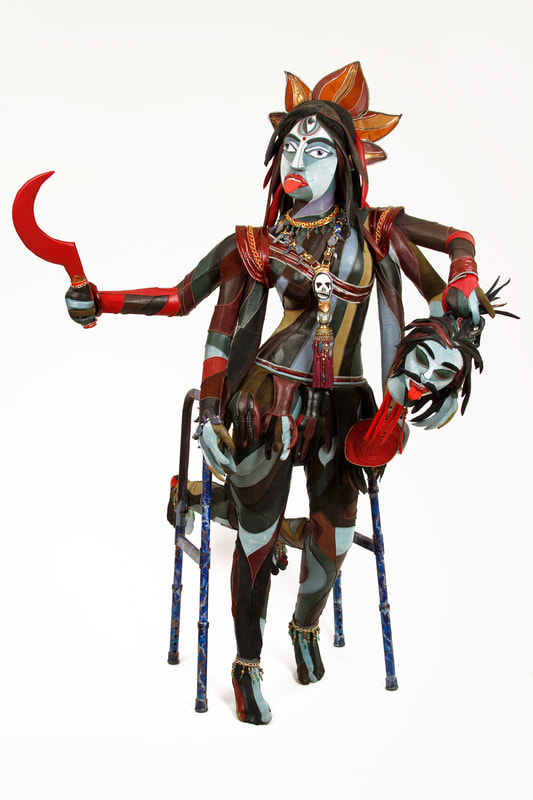
Kasmer_Momenta_8 View Master

After Momenta, Kasmer will embark on other exhibitions, New York City museum space, and with the curation of an exhibition for the Angels Gate Cultural Center.

In the meantime, don’t miss Momenta or its live-streamed event.

Live Stream: April 30-May 2nd.

Exhibition viewable at https://www.laurenkasmersmomenta.com/

  • Genie Davis; photos provided courtesy of Lauren Kasmer

Lilly Fenichel: Going Against the Grain

In the eponymously titled Lilly Fenichel: Against the Grain, artists, curators and critics Juri Koll and Peter Frank have composed a graceful book that traces a passionately committed and curious artist from 1949 until she passed in 2016, compiling her astonishing body of work in a fine retrospective.

To describe Fenichel as ahead of her time – in every decade – seems far too weak a phrase. In a wide-ranging artistic career that spanned seven decades, she worked in fresh forms and compelling shapes, always calling her work “non-objective” as opposed to abstract expressionism, geometric abstraction, or architectural.

She resisted limiting definiations and defied categorization, and in doing so, richly revealed just how far an artist can go without limits, whether self or societally imposed.

Trained in Vienna, an uncle brought her to Los Angeles to escape the Nazi regime prior to World War II. Studying and working in San Francisco, New York City, returning to LA, and moving to New Mexico, where she truly lived was in her art. Her shapes followed the decades, evolving with diverse palettes, moving through abstract rhythms and textures that slipped beyond the easily defined.

Dealing in abstracts of one sort or another, her powerful brush strokes and visceral approach were always astute. There is always a driving force seeming to race through her images, pulling the viewer within her aesthetic view of the world.

Ochre, Red, and Blue

1950’s “Ochre, Red, and Blue” is an explosion of fire and shadow, a revolution of paint and purpose, both firework and campfire, filled with an inchoate sense of desire. Similar in style but electrically bright in lemon yellow, her “Untitled,” (1950) grabs the eye and doesn’t let go.

Other images from this period, such as “Circus” (1951) seem to evoke mysterious faces and shadowed forms within the main image. In this particular work, faces, flowers, and animals seem to lurk, ready to be born into the recognizable.

In 1960, created on yellowing newsprint, her “Nude Study (4)” is one of her few fully recognizable shapes – classic, faceless, and fine. Resting on her elbows, knees bent, the figure is a coil of unspent energy waiting to unfurl.

In so many of Fenichel’s work from this period, there is that same sense of energy, of a temporary entropy about to reformulate itself into immediate action. The sense of impending immediacy is one of the most unique aspects not just to this period, but throughout her entire body of work.

Moving into the gold, red, and blue of her 1962 “Geometric Color Study (6),” that same energy seethes below the surface of this mannered, careful unfurling of what could be flag-like bunting and podiums, or the surfaces of circus tents.

Civil War

The cool, anvil-like patterns of her acrylic on canvas “Civil War” (1968) uses a unique combination of almost ethereal pastel coloring and a warrior like fierceness in its pattern. Fenichel seems to ask viewers if they see the hammers of change and rebuilding or weapons accumulated for wielding.

As this section ends, and elsewhere throughout the book, Koll and Frank offer quotes about Fenichel as an artist, and wonderfully evocative photographs of her. These serve to tie the book together as more than just a record of her artwork itself, but rather as a communication with the artist, a dialog in which her art speaks for her and to us.

Dark Blue, Black Sky

Moving into the 70s, Fenichel’s approach altered and her command became bolder. Here we see the vivid primary rainbow of “Blue Disc,” and the voluptuous ocean-like “Dark Blue/Black Sky,” acrylic on metal sheeting. The latter work is so deep and sensual that it encompasses the viewer, rippling in a dimensional outreach that feels as if its clouds brush the cheek.

Very different is the delicate, golden field of “Reeds/Bridge Hampton” and the layered, floral-like tangle “LA #10,” which subtly assimilates the flora and fauna and sunsets of the Southland in one image.

One of the most interesting elements of Fenichel’s work throughout her life was her very differentness. She did not hew to one medium or one “look,” beyond the non-objective. The other consistent feature of her vast body of work is a certain quality of the tactile, an almost physical emersion in which the artist commands the viewer to taste, touch, and experience what she depicts. And there is her sense of movement, a caught moment, that seems present in most of her images.

Taos Moon

In the 80s, the artist moved into new mediums, including a deceptively clean, haunting work of oil on wood and fiberglass, “Taos Moon.” Invoking a sense of place – the plateaus of New Mexico – she also calls up the timeless, the eternal. Working in the same medium, her vivid yellow “Trikona” is both kite and bird.

From the same period, however, her graphite and colored pencil “Talpa Study 2” is another style altogether but shares an exuberance of line in its freeform monochromatic pattern.

Both visionary and symbolic – and prescient of today’s American political divide, something that’s rapidly becoming as iconic to this nation as apple pie – her oil on wood “Two Parts = A Whole” (1988) is a fiercely vibrant red and blue, both broken and perfect.

Take

Moving forward in time, her work in the 90s, regardless of mediums, took on the quality of gemstones. Smoky quartz crystals come to mind with “Petroglyphs” (1992). Acrylic on processed paper, the painting appears to be a tumultuous but glowing collection of amber and black boulders. Also crystal-like are the bouquet jumble of “1991,” acrylic on Tyvek; and the shard-like image in oil and wax of “Emergence.” Also oil and wax, are the more defined but still quite crystalline shapes of “Take,” created in lapis lazuli blue.

Untitled (2007)

Fenichel moved into an era of more sinuous abstract shapes in the 2000s, with some works that resemble dripping Japanese letters, such as “Untitled” (2007), evocative brush strokes of black and violet. Others, such as “Homage to Pei” are more dimensional, a deep dive into electric splashes of color and crisp form. There is a lushness of color that glows in many of her works from this period.

Work in Progress 10

And in the 2010s, the artist went deeper, darker with images that resemble futuristic shapes, even planets, as in the oil on polypropylene “Work in Progress 10,” with its liquid-like texture. In the same period, “24C” also resembles a water form, a kind of soft grey shoreline against which a glowing near-tangerine landmass rests, while black streaks, curving and twining like serpents, seaweed, or oil spills move through both.

The book serves as a beautiful and thoughtful retrospective of Fenichel’s 65 years of art-making. Whether creating otherworldly sculptures in wood and fiberglass, painting on canvas, paper, or polypropylene, Fenichel made art as a personal statement, as a connection, as a creative lifeforce. Art was her nature, and she created it with as a wide and brilliant a scope as nature itself.

In a video interview with co-author Frank, Fenichel expressed her passion for her life’s work, without losing her sense of humor about it. She took her work quite seriously, but not herself. Art was pure to her, not to be sullied by commercialization, or the constraints of labeling her work as to specific genres or styles.

Always her own person, Fenichel’s art was uniquely fierce. Just as her work was filled with fluidity and motion, she moved through the world and her life as an artist, not categorized as a “female artist,” not allowing herself to be fit in any specific category. Rather, Fenichel was an explorer, whether of form or subject, a flame of joy that burned brightly through the world of art, and through the world itself. Koll and Frank have done a fine job of presenting her glow. The book is available at https://www.amazon.com/Lilly-Fenichel-Against-Juri-Koll/dp/B08WV2W7F1

  • Genie Davis; photos courtesy of the book’s authors

Buena Johnson – A Passionate Soul’s Cry

Wade in the Water

Buena Johnson creates powerful art that is rich in story; intimate, vital work that has the quality of a resonant dream. Johnson says of her trajectory as an artist, “Art became my best friend, my peace, my consolation, escape, and safety net.  It’s always been my purpose and search for my art to have a meaningful message…art is only a burden and untapped treasure if it has nothing to say.”

I’ll Fly Away

Johnson has plenty to say. Her work, which has a transformative quality with an edge of the surreal in many of her current pieces, fully expresses her purpose. “I have an inner need for a deeper message based on my life’s experiences as a woman, visual artist, and artist of color. From birth to now, I’ve faced too many obstacles because of the color of my skin, whereas with the power of art as a tool, I felt I could address and voice these issues. ” 

Address them she has. For her current exhibition Soul’s Cry, now at TAG in mid-city, she created almost entirely new works and updated a few others “because life and history is constantly happening.” Her current work departs from past series honoring jazz, blues, and entertainment icons, as well as being quite different from her Angel series, which is based on Bible verses and scriptures meaningful to her. Johnson notes that she plans to always continue her angels and spiritual imagery, however.

Sweet Revenge

But Soul’s Cry is an aching and glorious response to racism. “From early childhood [I had] experiences of racism, [including] being told as if it was a compliment, that I am an ‘exception to my race,’” she says, also describing the pain of racism that she saw reflected in her parents’ experiences. “I couldn’t keep silent any longer. I needed to express our history from 400 years of oppression and inequality to now.” From the first enslaved people brought to Point Comfort, Va. in 1619, to the horrific recent rise of emboldened white supremacy groups, Johnson sought to recognize that  “America was built with the blood, sweat, tears, deaths and lives of black people.”

Land of the Free

Soul’s Cry is just the beginning for Johnson, who plans to continue this series. “My work is to educate, so we can stop having ‘Karens,’ racial and financial inequities, police killings of minorities without accountability. [It is] to inform, heal, and uplift by the sheer power of recalling our history…to act as a recorder, a visual storyteller of our truths past and present, advocating for positive change.”

In short, this is an important body of work, both artistically and thematically. Johnson works primarily in pencil, and calls her astonishingly detailed work “pencil painting.”  While well-versed in other mediums, she says she loves the “challenge of using one’s natural ability to draw or paint with pencils. I do not like lengthy prepping of a media before I can get started; with pencils I can mix right on the surface I’m working on, and when I take a break or finish, there’s no lengthy cleanup necessary or potentially harmful chemicals.”

Madam, a Crown Deserved – You Nurtured a Nation

That Johnson’s work is inspirational is a given; she says she self-identifies her work as “inspired” because she feels guided as she creates by her “higher power or knowledgeable being revealing and speaking calmly to my spirit and into my life. If at times it doesn’t work out or flow well, it means that there is too much of me in the way, and I need  to reconnect to my power source for guidance and help,” she attests.

Johnson began as an artist before she even reached school age, mesmerized, as she puts it, by art and the fact that a human being could create art images. From her teaching degree to advanced studies at the Cleveland Institute of Art, the Philadelphia College of Art, and the Pratt Institute of Art in New York, Johnson never stopped producing and perfecting her illuminative and passionate work.

Moving from Chicago to Los Angeles, she’s been showcased in the Smithsonian, The Getty Collection, MOCA Los Angeles, and more, as well as producing commissioned works for members of the Hollywood elite from Halle Berry to Queen Latifah, as well as creating for companies such as the Los Angeles Dodgers to United Airlines. But through it all, her ultimate plan is to reach a vast audience and truly elicit transformation through her work.

Songs of the Soul

Today, she plans for expand on a series of works concerning Slave Songs/African American Spirituals, as well as expanding Soul’s Cry as a series. Her purpose is to both expose America’s history of racial injustice and to “motivate positive change.”

Always expansive, she plans to create a new series highlighting and honoring women as well, primarily women of color.

Steal Away

She wants viewers to “hear the cry of the ancestors, to feel uncomfortable with the knowledge of America’s history, the pain, struggle, and injustices I’ve visually recorded.” She hopes that everyone witnessing her works will “let the message speak to your spirit and conscience and move you to see that we all are of the human race and we can make a change for the better together.” Her hope is to evoke the vital necessity of change, so that others will not experience what she did in researching and creating the images in Soul’s Cry, during which process, she says “Many times I’ve felt like ‘I can’t breathe!’”

Johnson’s work, on the other hand is a welcome, expansive, cleansing breath of fresh air, carrying substantial vision. TAG is open for in-person viewing of Johnson’s work, or virtually at http://taggallery.net/buena-johnson-souls-cry

There will be a virtual artist talk and walk-through of the exhibition on Thursday, March 18th at 7 p.m. To join, visit: https://www.taggallery.net/shop/buena-johnson-soulscry-virtual-walkthrough 

Soul’s Cry will be on view March 16th through April 10th; TAG is located at 5458 Wilshire Blvd. in mid-city. On March 25th, a virtual reception for Johnson and other exhibiting solo shows will also be presented online at https://www.taggallery.net/shop/lightner-soetebier-johnson-huffman-virtual reception-tickets.

  • Genie Davis; photos provided by the artist