
Art fair weekend. Yes, PhotoLA and the LA Art Show took place a few weekends back, but we took in five art fairs this Presidents Day weekend, each with its own flavor. First off, Frieze.
In its sophomore year on the Paramount lot, Frieze Los Angeles featured a vast and beautiful collection of works in the gallery tent. From sculptures by Alison Saar to stunning light works from James Turrell and the reflective beauty of Anish Kapour, just about every contemporary art celebrity you can think of was on exhibit here.
James Turrell Anish Kapour Cindy Sherman
A massive Cindy Sherman towered over NYC-based Metro Pictures booth, while Ugo Rondinone’s ten mountains + one sun recalled the artist’s massive outdoor installation Seven Magic Mountains located in Jean, Nev.
Ugo RondinonePae White
Kaufman Repetto Gallery’s Pae White installation “Half Magic” dazzled nearby. The art hits kept coming inside. The clean white space of the tent kept things from becoming overwhelming; the well-curated works ranged across all mediums.
Moving outdoors, the effect was not close to as cumulatively grand as in the gallery tent, but included some lovely works.
Channing Hansen Barbara Kasten
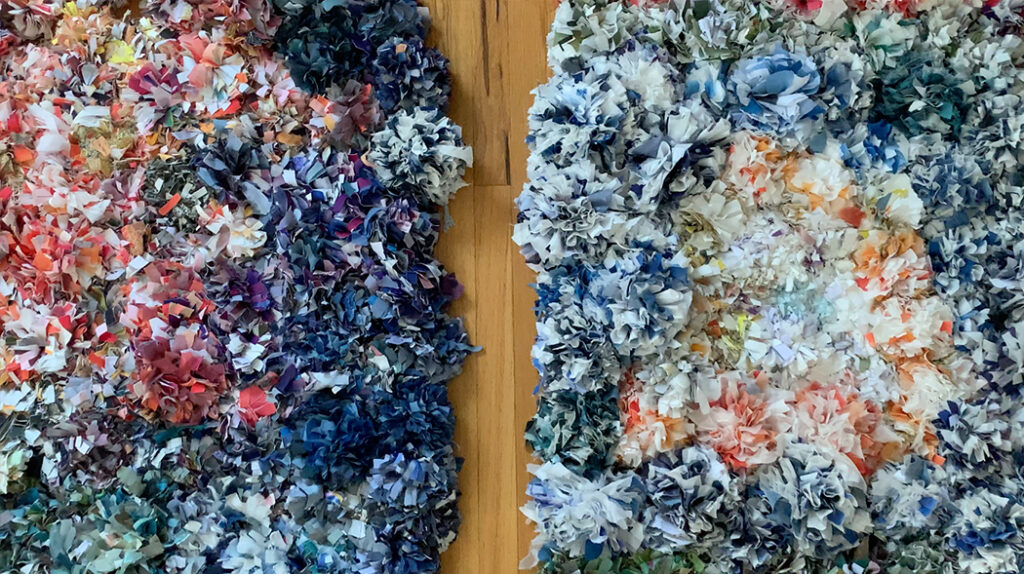
Installations on the backlot included terrific textile art from Channing Hansen inside a false-front brownstone; in a larger indoor space was Barbara Kasten’s massive colored plexiglass and steel-frame sculpture “Intervention.” There was a faux disguised-cell-tower from Sayre Gomez, the sculpture “Tocayo 2020;” and a Mario Garcia Torres film exploring coincidence, “Falling Together in Time.”
Below, Lorna Simpson’s wonderful video installation, “Momentum,” presented in conjunction with Hauser & Wirth.
Lorna Simpson
All in all, a dizzying array of art with the vast richness of the gallery tent overshadowing the curation on the lot.
Outside spaces focused on sculptural works and moving images; many of the former had a humous bent.
Inside the tent, textiles, sculptures, and large scale paintings were the standouts; gallery after gallery offered stellar works, many of museum-quality. As an over-riding theme, texture was key, from crystals to fabric to the fabricated. Rocks and metals were a thing; as was a mix of figurative paintings with the abstract. Here’s a more inclusive
Tent Gallery at Frieze
Genie Davis; photos Jack Burke; additional images, Genie Davis
Los Angeles’ major art fair season commences this month with the city’s largest and longest-running fair. That would be the LA Art Show celebrating its 25th anniversary, once again at the Los Angeles Convention Center on February 5, 2020.
According to the fair’s founder, Kim Martindale “Twenty-five years ago when I began the LA Art Show, there weren’t any big art fairs here.” Now of course, this major fair serves as the beginning to a wide array of art fairs throughout the city. And it’s still seminal.
There will be over 100 galleries from 18 different countries; the opening night preview and premiere party will donate a portion of ticket revenue to St. Jude Children’s Research Hospital. Actress Sofia Vergara will helm the celebration.
Sogen Chiba
The re-branded Feature Exhibitions area of the show includes the return of INK, the largest presentation of both contemporary and traditional ink painting of any art fair outside of Asia. New this year, the LA Art Show will be hosting a live ink painting demonstration, by Japanese master Sogen Chiba. Chiba is from Japan’s 2011 disaster-hit Ishinomaki district, and has created intensely moving imagery as an outgrowth of this experience that can only be expressed in calligraphy. Walker Fine Art will be presenting a the works of M.C. Escher, including never-before-seen VR experiences, and Oscar-winning artist Kazuhiro Tsuji premieres a brand new Iconoclast portrait sculpture.
Kazuhiro Tsuji
Viewers will also find work the 70s era photographic work of John Wehrheim in his depiction of Taylor Camp: The Edge of Paradise.
Work from the Danubiana Museum
The third edition of the DIVERSEartLA showcase focuses on cultural diversity from Southern California, around the Pacific Rim, and beyond, with over 20,000-square-feet devoted to these works which are not for sale. They include exhibitions from LACMA, The Broad, Japanese American National Museum, La
Neomudejar Museum from Madrid, MOLAA, Art Al Limite, LA Art Association, the UCLA Chicano Studies Research Center, and more, such as the Danubiana Museum of Bratislava.
Performance programming for the series includes work by PSJM Collective from Spain and artist Miss Art World, presented by the LA Art Association. Among the participants in the performance “Diversity Walks & Talks” will be LA sculptural and mixed media artist Chenhung Chen.
Mizuma Art Gallery
For the first time, LA Art Show will be
hosting a special programming section named the European Pavilion, highlighting
the world-class exhibitors hailing from Western Europe. Patrick Painter
Gallery, SM Fine Art, Zeal House, Mizuma Art Gallery and Kamiya Co., LTD are
all returning for CORE.
Presented by the Bruce Lurie Gallery, Lorenzo Marini presents his new art-installation ALPHACUBE.
Lorenzo Marini
Curator Sabino Maria Frassà explains that ALPHACUBE turns that paradigm of the the white cube as the best form for conveying contemporary art. The artwork is a large white cube, that immerses guests in a space animated by letters, light and sound.
Along with the LA Art Show’s global cutting-edge programming, a bevy of local artists will be exhibiting at BG Gallery, Coagula, and Wallspace.
Gay Summer RickHung Viet Nguyen
AT bG Gallery, Susan Lizotte will show brand new paintings about LA; her aesthetic provides a visceral look at the city. Artists Barbara Kolo, Fred Tieken, Gay Summer Rick, and Hung Viet Nguyen with his Sacred Landscapes series will also be on display. Photographic artist Richard Chow will be at bG’s Gestalt Projects Wall with an image from his Distant Memories series. Each artist could be described as offering intensely unique work that is rooted in their home in Los Angeles.
Randi Matushevitz Todd Westover
Coagula is helming four booths this year, showing six artists with two in each both. The gallery will be showing new work that includes a group show of Chouinard Art Institute alumni featuring Frederick Hammersly, Llyn Foulkes, Robert Irwin, Judith Stabile, Robert Williams, Chaz Bojoroquez and John Van Hammersfeld, including Williams’ limited edition skateboards. Contemporary LA artists Randi Matushevitz, with her expressionist HeadSpace body of work “combines pattern, figuration, and narrative to cultivate humanistic expressions,” she relates. According to gallerist Mat Gleason, “Todd Westover paints retro floral abstractions, Mark Dutcher is the pre-eminent Los Angeles painter walking the line between dream representations and abstract longing. Lavialle Campbell quilts geometric modernist abstraction that politically nudges issues of race and gender without sacrificing aesthetics. Melinda R. Smith paints the icon of houses… Gabriel Ortiz investigates the many ways in which racial issues have been co-opted and suppressed by imposed religion.”
ViCA, the Venice Institute of Contemporary Art, helmed by artist and curator Juri Koll brings motion pictures to the festival. “We have our own screening space for curated short films from Fine Arts Film Festival 2019 – films from Russia, Australia, the US and Norway.”
Wallspace Art Gallery, which like ViCA also has space in DTLA’s Bendix Building, is also featuring a booth that highlights Los Angeles artists; gallerist Valda Lake says this is the first year at the fair for the gallery. Fabrik Projects hosts two booths, one featuring the innovative richly decorative work of J.T. Burke.
Cathy Immordino
The other booth features a range of artists that include Amadea Bailey, Linda Stelling, Nancy R. Wise, Helena Hauss, Chris Bakay, Ted VanCleave, Cathy Immordino, Jung Yeon Bae, Jessie Chaney, Go Woon Choi, Jessus Hernandez and “guest artist” Eric Johnson. Immordino’s innovative photographic collage work is focused for 2020 on her Heads series. According to the artist “Heads features local Angelenos in collages with magazine elements conceptually discussing how society views others’ imperfections.”
Eric Johnson
Johnson’s
dazzling large scale The Maize Project
abstractly represents a lodge pole-like Native American structure, a sculptural
gathering place that evokes a section of an ear of maize corn.
In short: art fair season has begun with a major bang from the LA Art Show.
When artist Kate Kelton sets out to do something – she does it. She, like her latest series, is Indomitable. Kelton’s astonishingly lovely and glowing images of women are created to tackle an important subject with grace and power: “I try to uplift and elevate Silence-Breakers, Patriarchy-Smashers, Truth-Tellers, Survivor-Hero and Sheroes to the highest reaches of architectural strata. Apotheosis through a reclaimed, reapplied Art Nouveau. Sampling my own lineage, I transform a historical body of work, itself a thing of lasting beauty; exchanging granite for graphite, plaster for paint,” she says. “To date, 105 silence-breakers accused Harvey Weinstein of gross sexual misconduct, 60 came forward about Bill Cosby. Over 200 are rumored to be coalescing against Donald Trump, with 24 having come forward already. More than 400 spoke out within the first 48 hours following the publication of director James Toback’s profile. One can’t even imagine the number for Jeffrey Epstein. With Harvey Weinstein’s trial finally coming up… I want to focus on weaving my protection spell over the subjects of my work, because I’m a hella superstitious astrology aficionado.”
She is also a riveting artist; her subjects leap at viewers, deified, as she puts it with “headdresses, helmets and crowns from my ancestors’ constructs,” as she creates she also works to “weave an unbreakable spell of protection. Could my paintings inadvertently put Harvey in jail? With a pandemic, global 1% conviction rate for rapists who even make it to the courts… it certainly couldn’t hurt to try. I suppose it’s a little like that Bible bit from Isaiah, but far less evangelical since I was raised agnostically. Even under heavy resistance and surrounded of adversaries, no weapon that is formed against me, shall prosper.”
Kelton is also donating a portion of the proceeds from the show to Citizen Lab, located in her home town of Toronto, an organization that studies how surveillance and content-filtering impact the security of the Internet, and in so doing, pose a threat to human rights. In regard to her subjects, she notes that so many have been cyberstalked, tracked, hacked and gas-lit for speaking their truth.
But in her work, the women she depicts are filled with light, life, and fierceness. Her recent paintings include E Jean Carroll, Lili Bernard, Andrea Constand, Victoria Valentino, James Safechuck, Drew Dixon, Louisette Geiss, Kadian Noble, Caitlin Dulany, Jessica Bishop, Lou Godbold, Lisa Christie, Johnathon Schaech, Tasha Dixon, Jill Harth, Lisa Christie, Reverend Vera Lauren, Eden Tiril, Alice Evans, Erika Rosenbaum, Stacey Pinkerton, Molly Maeve, Ani Easton Baker, Sand Van Roy, Natasha Stoynoff, Melissa Schuman, Samantha Holvey, Lauren O’Connor, Mhairi Steenbock, Lucia Evans, Melissa Thompson, Lizzette Martinez, Lisette Anthon,y and Jasmine Lobe.
She terms her current work both a continuation and a departure from her previous art. As to her subjects, she notes that last year she painted famous actors almost exclusively while this year she has included lesser known survivors of abuse atrocities, those who have “been on the very frontline” of bringing down predators. “Uplifting these truth-tellers is triggering, arduous, and begging for trolling from fixers’ bot armies on social media. Yet it’s more fulfilling then anything I’ve ever done. When I began painting these warriors, it was because I too had just been effectively ousted from the acting industry.”
She adds “The women I depicted last year had established careers, most with years of work under their belts. The framed, high gloss, full color, rich and finished quality to my Sentry series is something I wanted to contrast this year while working on paintings of many whose lives and careers were derailed so early they never got the traction to elevate, to become ‘household names.’” The limited palette in which she works serves as a metaphor for the limitations her subjects must surmount to express their messages when careers and platforms were stolen, she attests.
Her moving, lush images, and the almost frenetic pace at which she creates these visually and spiritually glowing works are inspired in part by a story “about a woman who received her poetry on the wind and allowed it to flow through her from the top of her head to the tips of her fingers,” according to Kelton.
She describes her use of gorgeous headdresses with faces as a combination in the “hope the Gestalt elevates the individual pieces into a third and separate whole, something alchemically different.” She credits the subjects for selfies as well as photographers such as Freddie B, Rich Klein, Naomi Kaltman, Dawn Quiacos, Skip Gue, Lou Noble, Sabrina Reeves, Matt Sayles, Dana Patrick, Brooks Freehill, and Ernst Tramposch, who provided images for her to work from.
Her palette has its own poetry. “When paint becomes swampy and muddled from too many changed minds and crazed brushstrokes; when the lines lose their vibrancy buried under the weight of simply too much frenetic gesticulating, OCD levels of surface decoration on my part generally mean color is where I have to place emphasis on simplicity anyway. The eye already moves about so much over the surface of my pieces, that a full rainbow spectrum feels as garish and overwrought to me as it must have to the initial critics of Fauvism, back in the day.”
Kelton says she also clings to the natural color schemes her mother uses in her own painting and assemblage, and uses patient applications of thinly layered glaze in her work, as did one of her father’s favorite artists, Rothko.
“I’m additionally experimenting with the textural differences between matte and glossy surfaces. It’s expanded my grey scale considerably, working from Stuart Stemple’s Blackest Black to various silvers and iridescent whites that exceed even titanium white, given the right light.”
She stresses that she refuses to “lose a painting’s ability to alter through time by reflecting changing lighting conditions.” Her passion for mutable light is both geographically and seasonally driven. “Have you ever noticed the quality of light in different cities? Blue-ish white light bounces from Lake Ontario over most of Toronto, while smog’s red haze hyper-saturates every stunner sunset in LA.”
More on Kelton’s palette: “Underpaintings have always fascinated me. Desaturated, black and white work that emphasizes the importance of Notan, a Japanese design concept involving the play and placement of light and dark elements as they are placed next to the other.” She adds “The only color I’m adding alongside the various metallics, grays and neutral browns I’m working with this year, is green. Partly because it represents lush growth – in plant life as well as one’s finances, something all Silence Breakers could stand to enjoy after all the illegal punitive retaliation – but also because seeing how subtle an infinite amount of different greens naturally appear in the undertones of the gold, or in copper’s oxidization, is unendingly inspiring to me.”
The
visceral quality of her work goes far beyond color, and pay tribute to Kelton’s
ancestors. “Listen, you’d rip off your ancestors too if you suddenly found out
they’d designed the Central Train Station in Prague and hired incredible
sculptors to blow people’s minds… just because. There are dozens of arches on
either side of the train station’s main entrance. Each one is crowned by a face
wearing a helmet, crown, or headdress of some kind. They represent, presumably,
the people and places connected by those trains.”
Just as connected are her recent series of works: With Joe’s Train Station, she paid homage to her great grandfather, Josef Fanta, the architect, engineer, painter and sculptor behind that station. “My father’s family fled Prague when Czechoslovakia was handed over to the Russians after the war. The real repercussions of politics – something that many Americans only seem to be waking up to now – were always a tangible part of my life growing up. Metaphorically rebuilding my great grandfather’s train station became as soothing as any balm or salve for the times.” That exhibition was followed by Artstar, in which portraits of artists “were now cloaked in the garb of statues my great grandfather tasked Ladislav Šaloun with sculpting onto his train station. The work presented a tactility against the digitized space, and represented a taking, an acquisition of power back from the tastemakers.” Next came Sentry, marking the #metoo movement, and combining “the faces of brave silence breakers with photos of the statues’ headpieces, in situ. I asked the incredibly talented artist Steve Seleska to add a super high gloss glaze to the pieces, to bring out the rich reds, blues and browns.”
All of Kelton’s work has a dream-like quality despite its realism. “Working to combine the stone statuary with living, breathing flesh is the trick for me now. The spaces in between fall into an abstract category bridging the gap, hopefully suspending the viewers’ disbelief long enough to be enchanted by the whole; the Gestalt of it.” She describes the headdresses worn by her subjects as “heavy crowns to bear — sometimes showing up in gilded hands holding up heads hung low. These powerful Silence Breakers have been doing the work of moving the dial thanklessly and tirelessly for years now,” she explains.
The inspiration for and genesis of Indomitable comes from those who, Kelton says, “have spoken up at great personal cost to inspire the #metoo wave that’s swept the world…To champion them and their work seems such a small token of gratitude, since they risked everything to make this industry safer.”
Kelton is working on plans to tour the series, starting with the Arkansas Coalition Against Sexual Assault’s Masquerade Ball on May 2, 2020.
A music industry legend, the song that is spilling from Macey Lipman’s artistic heart today is visual. With a new body of work, The Summit Series, Lipman offers a pinnacle – play on words intended – achievement.
The artist has painted all his life, devoting
himself full-time to his art for the last twenty years. The immersive
landscapes of North and South American peaks that make up this current series
were inspired by Lipman’s daughter and her passion for mountain climbing. The
result is exhilarating.
The artist’s acrylic on canvas and birchwood works are uniquely compelling. While the images are firmly grounded in the real world, the dreamy, vibrantly colored works also carry with them expressionistic elements. The works are also highly visceral; viewers can almost feel the chill in the shadows of Glacier Peak Volcano; absorb the crisp thinness of the air at the crest of Mt. Shasta.
On January 25th and 26th,
the artist will hold two afternoon receptions at his West Hollywood studio and
gallery, presenting works from this series and previous bodies that
include images from California’s wine country, Cuba, and Italy.
Over the course of his music career, Lipman received 57 gold and platinum album awards, working with artists such as the 5th Dimension, Heart, Chet Baker, Ravi Shankar, and Johnny Rivers. In 1972, he established Macey Lipman Marketing, the first independent marketing company in the recording industry, through which he managed a wide range of campaigns for top recording artists from Dolly Parton to Cher.
But through it all, he painted. He paints daily, depicting pristine landscapes such as “Mt. Rainer and Nisqually Glacier”; the tallest mountain in Washington and the Cascade Range; “Popocatepetl Volcano (El Popa), Mexico,” raining ash below its slopes; and “Glacier Peak Volcano,” the most remote of the five active volcanoes in Washington State.
One of his sparest and most fascinating landscapes from this series is the 30” x 40” “Foggy Lake/Gothic Peak, Washington,” above, a dream-like vision that merges meticulous pointillist technique with wild and mystical scenery.
Equally absorbing are images such as that of a young Guatemalan woman climbing Santa Maria Peak in Guatemala while breast-feeding her baby. Other recurring motifs in Lipman’s work include the wine regions of Napa and Sonoma; and graceful images of reflections in windows, images that shape their own illusory landscape.
Having been accepted to the Michelangelo Accademia D’Arte in Florence, Italy, Lipman is learning to expand his technique with the use of egg tempera and the creation of paints and colors from scratch.
The
artist says his life-long passion for painting began as a child, visiting the
art section of Gimbel’s department store, attracted to the scent of oil paints
and linseed oil. Despite his early inspiration, he did not sell his paintings
until 2002; but by 2004 he was selling out at LACMA’s Sales Gallery. Today,
Lipman works at his West Hollywood gallery and studio five days a week.
The dual receptions for The Summit Series take
place at Macey Lipman Art studio
and gallery, located at 511 N. La Cienega Blvd., #210 from 2-6 p.m. both days.
The Summit Series will remain on view through February 20th.