
Douglas Tausik Ryder Reveals Rich Body Language

Estee_DTR_portrait_sunil.IV_

Running through October 19th at the DTLA art district’s Jason Vass Gallery, Douglas Tausik Ryder’s Body Language expands upon a sculptural topic he’s worked with in the past, creating an abstract, sensual, and richly geometric view of the female body.

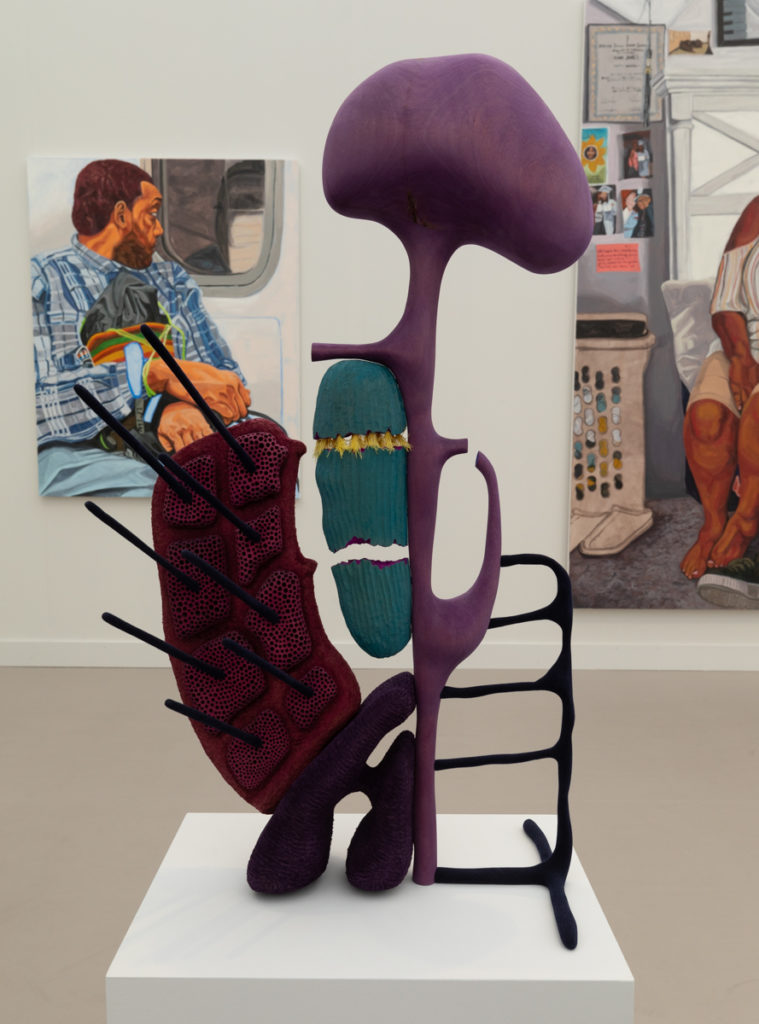
Ryder’s language is a kind of code that bridges technology and nature. The artist creates his smooth, highly textured works using industrial geometric code in a CNC machine, encompassing 3D modeling to create these large-form wood sculptures.

FinalVenus.I

The works are towering, even monumental. Using computer models, he creates his sculptures into assembleable parts, forms wooden maquettes, carves, sands, shapes, and then adjusts his digital model as the work progresses. Once he moves into the machine room, Ryder is using an industrial machine he’s rebuilt, utilizing a digital cutting tool to carve individual portions of his works. He does it all himself with no assistance from an outside source.

52326973_1205487936292010_6261966844739977216_o

The result is a sleek, voluptuous series of works that is abstract in nature but obliquely figurative. Viewed as part of a group show held at Vass several years ago, his “Venus,” which was inspired by his wife’s pregnancy,  is a strong introduction to his work, seemingly entirely smooth, as if it sprung whole cloth after gestating in the artist’s vision.

Reclining_Nude1

“Reclining Nude” is just that, both alien and familiar, a ribbon of wood that reaches out to the viewer in compelling curves.

His work is filled with texture, texture enhanced by the technnology he has long been devoted to, making mysterious, even poetic works with precise tools and machine techniques that he taught himself.


The work is seductive and dream-like. It is neither body nor soul entirely, but embodies both. Similarly, his high-tech process belies an instinctual state of grace in his forms. There are no harsh lines or jagged constructs, and yet each work is essentially an elaborate seies of puzzle pieces fit neatly together. They are smooth, yet filled with a raw power that seems to undulate just beneath the surface of his wood, and slips within the curves of his figures.

FLAUNT_Bodylanguage1

The Body Language sculptures in this five-work series are enormous in scale, large in their passionate use of form, and sinuous. They have a liquidity to their creation, a washed-smooth take on a geometric form which in and of itself seems born of the body but elevated by the mind and heart. 

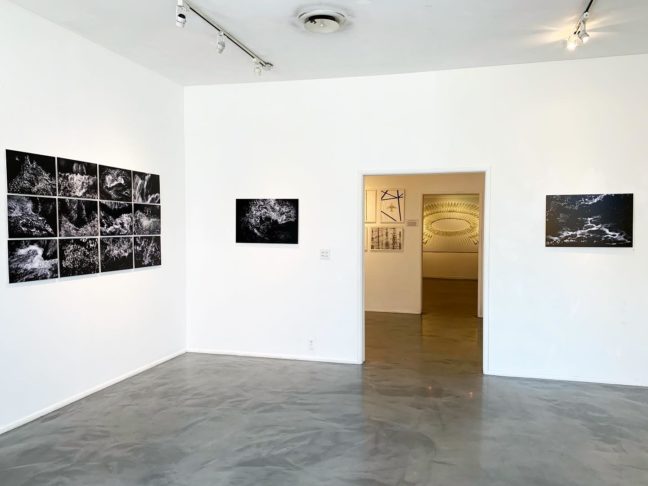
The works are cool, clean,  and connected – both within each individual work’s components and between the sculptures that make up the exhibition. Playing off the white walls of the gallery, Ryder’s pieces stand like fluid creatures, captured and frozen within their lustrous wood.

68402506_1329804003860402_7325718205442293760_o

Seeing these works in one sweeping show is a pleasure, and considering how they were shaped is fascinating and yet entirely irrelevant. However they were crafted, they stand as reflective meditations on both the physical and the spiritual.

  • Genie Davis; photos provided by Jason Vass Gallery


Experiencing Eric Thaller

vV8rlHOQ

Eric Thaller describes himself as “inspired by the human experience. The brilliant, the profound, the sad, the unimaginable. There is so much to learn.  And to share. I like to share and re-share through my work. I think this is the essence of art.”

And the essence of Thaller’s complex, asethetically thrilling work is experiential. According to the artist “I don’t want people to view my work.  I want them to experience my work. I endeavor to create imagery that is compelling on its own, but this is not enough.  I will have failed if the viewer simply glances at the visual composition and walks on. I want the viewer to engage in the piece.”
6TrnrEUQ

He describes messages in his work as sometimes explicit, other times hidden to reveal the context behind them and the human experience they contain. He asks viewers not to judge the work merely from a distance, but to get close to it. When one does, Thaller’s work grabs the viewer, and surprisingly won’t let go visually or emotionally, as is surely intended.

EH44YBDQ

He notes “There is always some other dimension to the work that I hope will draw in the viewer. This secondary element could be the process itself, an embedded message, or a visual surprise when up close.  My last series, Rebirth of the Pixel, incorporates all three.”
His process of creation is entirely unique, beginning with the message or information he wants to convey.

q0Xh_FUw

“Once I’ve figured this out, then I plan the execution of the works. In Rebirth of the Pixel, each of the images required a translation into the 4 colors of the palette.  This allowed me to visualize where the individual pixels – Legos in this case – needed to be placed one at time.”

CVQ2IfKg

The monochromatic palette in no way diminishes the deep visceral imact of the work, the detail and precision of which is mind-blowing.

Thaller asserts “For the full series I individually placed hundreds of thousands of Lego pieces.  It took me 2 years.” 

He chose his current palette so that the work would “permeate with a sense of history and time. From far away, I’m aiming for a very detailed image. Up close I want people to see the pixels and appreciate the process.”

lb7plFTA

In his Rebirth of the Pixel series, he relates that the 4 pixels range from black at the weakest intensity of the spectrum to white at the strongest – with just two pixels in between.  He describes the chosen palette as selected in order to “emulate the effects of black and white photography.”  Using Legos as a construct injects a sense of fun and accessability to images that are filled with gravitas.

The overall sensation when viewing is that of entering into a black and white photo, a realm more dimensional than could be conveyed in conventional photographic art. The palette, though limited, vibrates, as if the image could plunge from the work and into real life. The viewer experiences a kind of futuristic noir from this series: there’s a poignant history to each image, and the sense of seeing it from an almost sci-fi perspective.

QWxdvViQ

Thaller says that his work has undergone a lot of changes over the years. “Mostly around the medium though. I’ve experimented with a lot of different techniques.  But I would say my focus around creating experience hasn’t changed at all. And I don’t think it will.” 

Upcoming for the Los Angeles-based Thaller is a series of pieces contemplating the impacts of social media on younger generations, family, and culture in general. 

“I truly believe in technology as a positive force, but also think it is important to be cognizant of the negative externalities that result from overuse and dependence,” he explains. “The irony in these pieces is that I force the viewer to use technology itself to access the explicit message I want to convey. ” 

  • Genie Davis; photos provided by the artist


Layers of Metaphor and Imagery: The Art of Karin Skiba

KARIN SKIBA Sabine 2018

Artist Karin Siba offers sensual, deeply resonant images – landscapes, the female face – all are vivid with color, and alive within and through layers. This deeply resonating work feels immediate, vital, and elegaic at the same time. It takes a vivid moment and captures that moment’s emotion.

Skiba says her work reflects an ongoing process of art, one that “evolves as I do, involving layering metaphor and imagery much like all of contemporary life.  It changes and flexes and reflects what I am experiencing as an artist in the world. It is my interpretation of the life I am living. “

3-648x835

She says “I love fashion photography and it inspires me to make my own fictional portraits of women.  Sometimes I use a photo as a base to do a drawing that turns into a mixed media work. The result is a surprise to me depending on how the work grows and changes under my brush and scissors.” According to the artist “Using a variety of material – old paintings and drawings, magazine clippings, photos – all make for a rich collage of color and shape.  I think fashion is an art form in itself and a great resource of information.”

11-2-648x864

“My ‘ecofictional’ landscapes and trees come from my experience with nature, and they usually involve my own photos layered in to give different realities to the finished work.  Architecture is fascinating and makes its way into the work as well,” Skiba explains, adding that photographing areas that have meaning for her and including them in her work adds yet another dimension.

FEATHER TREE 1 Karin Skiba watercolor and mixed media on paper

Each of her works truly grabs the viewer with color, motion, and with its range of material, all of which fits together like the cohesive pieces of a glowing puzzle: photography, prints, painting, drawing.

75full-532x800

She frequently depicts female faces in both her mixed-media work and paintings. To the viewer, her images are both beautiful and mysterious; these faces are lovely yet internal; dream-like.

Many of her paintings feature shades of the color blue taking the place of skin tones. This feels very natural even graceful, and adds to an aura both alluring and enigmatic.

64full-655x568

“I have an instinctual way of working with color. For quite a few years now, I reach for blue to begin a work.  It is comforting to me visually and works well with other colors,” she explains. “I love color in general and playing it against itself or a pure white background. I have a strong design background and making beautiful combinations of color is a natural.”

This intrinsic sense of color has shaped her work regardless of format throughout her work as an artist. In fact, the progression in her art over time has been reflected more in medium than in meaning, Skiba asserts.

LADDERS #2 FOREST MOON 2019 Karin Skiba watercolor and photo collage on paper 22x30

“When I had a retrospective four years ago, I had no idea if the work from all those years would be cohesive,” she laughs. “But when we installed all the pieces covering 40 years, it was great. My style and color sense flowed! My work has changed in format, since I began with soft sculpture I dyed and sewed, then went on to cut out painted wood pieces. These went on to include words, then writing into the paint, then a switch to colored pencil then back to painting.” 

66full-850x800

As to her attraction to photographic images, she says “Photography has been present for many years in my art.  I finally realized my father influenced me in a large way. He was a professional photographer and my favorite memories are watching him work in his darkroom.” She remarks that “Photos inspire me, and I am inspired by my own photos as well. So you will see some reference to photography as a medium on the pieces. Now I am obsessed with paper. Painting on it and cutting it, layering it, is what I am working with.”

Texture is certainly a strong part of all her work; her use of different textures and overlapping images shapes the experience of her art.

Skiba

Artist Karin Skiba, above

Having made a move to the high desert also affects her work – its colors, style, and space. She reports that “Living in Joshua Tree has given me the chance to have more time in a great private studio space.  That in itself is giving me freedom to explore more than ever. The art community is lively and I associate with artists more easily since we are all in a reachable area. You can really see here, it is not smoggy, there is a big sky. It seems to open you up to yourself.”

That openness is also visible in her work, which seems ever more expansive, in terms of both subject and approach.

JU JU JUNIPER Karin Skiba mixed media collage on paper

For an upcoming solo show, HABITAT,  her works involve “the concept of habitat or environs, whether residential or emotional. I am planning on using work I have created about Detroit, my home town, that illustrates photos I took there of downtown religious and residential architecture,” Skiba says. “Ohter work reflects the desert and the symboloism it generates.”

The exhibition will include collages that mix with watercolor and drawing.  It opens November 2nd at the historic 29 Palms Art Gallery, originally an adobe home built for Western pulp fiction author Tom Hopkins, located at the Oasis of Mara in Twentynine Palms, next to the Joshua Tree National Park Headquarters. Well worth a drive: enjoy the desert landscape and the internal landscapes of Skiba’s art.

  • Genie Davis; photos provided by Karin Skiba

Heaven on Earth Takes on the Corporate Culture

68558459_10219055514277026_721755420003139584_o
Manfred Manz’ Heaven on Earth: Imperialistic Evolution of the Corporate World,  at CMay Gallery through August 31st, gives viewers a vision about all-too-real messages in the clouds.
Upending the viewer with images of bucolic  scenery and quiet roads, the cloudscapes reveal commercial messages that seem to explore the soullessness of our corporate-driven culture and its constant advertising.
IMG_7322
IMG_7323
The idea of product placement in tent-pole motion pictures seems quaint compared with today’s all-encompassing corporate advertising. In this exhibition, the artist presents a disturbing future that has to a large extent already overtaken us.
As timely as it is haunting, the exhibition begs for discussion. On August 24th, the artist will conduct a walkthrough and talk about his own messaging with Shana Nys Dambrot, who composed an essay for the exhibition that intriguingly discusses the “pernicious intrusiveness and low key mind control perpetrated by the corporations that rule the world.”
IMG_7319
Menz’ work is both satiric and astute, using simple images to incorporate our complacent buy-ins to corporate sponsorship, advertising, promotion, and ownership. It would come as no surprise if Amazon actually advertised its near monopoly on the white fluffy clouds above us; or if Nike put it’s footprint on the sky.
IMG_7320
Presented as a series of 14 photographs, Menz looks at clouds as if they were corporate billboards flashing their moving images and familiar logos in advertisements.  We see Coca-Cola on a fluffy white cloud; American Airlines advertised on chemtrails, Netflix taking over a growing nimbus cloud much as the service obliterated video stores and conventional media viewing. Binge watch Menz’ warning, a cautionary tale as sharply observed and amusing as it is terrifyingly true.
Our politicians are brands, some of them as toxic as weed killer; our prediliction for the consumption of products define us; Amerika is the land of the corporate shill. All in all, it is one small leap to a bar code for the soul.
manfred-menz-invisible-spanish-steps
Menz is not new to creating a satiric view of a prescient subject: a previous exhibition, the Invisible Project, presented images with flora and fauna surrounding nothingness, their famous man-made landmarks, such as the Spanish Steps, not-seen above, obliterated.
Before being scanned into the Big Lots of life, take in the surrealism, wit, and darkness of Menz’ powerful new exhibition and the insightful talk this Saturday — and take the first step in resisting the corporate entities that insidiously engulf our consciousness.
CMay Gallery is located in mid-city at 5828 Wilshire Blvd. in Los Angeles.
– Genie Davis; photos provided by the gallery