
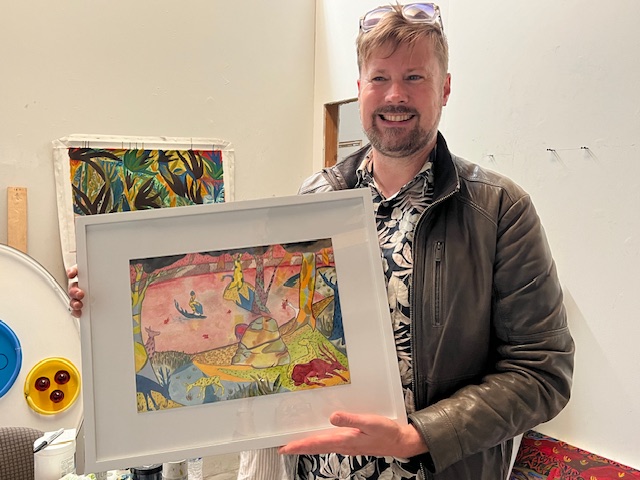
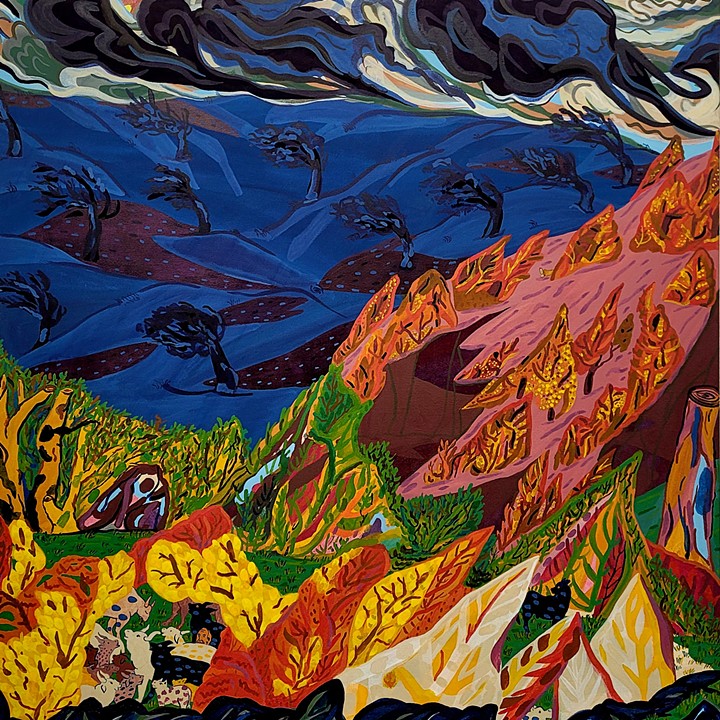
Earth Day Always for Artist Snezana Saraswati Petrovic

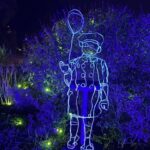
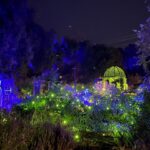
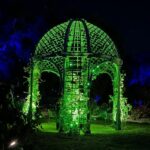
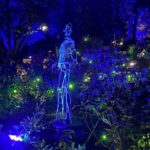
In Snezana Saraswati Petrovic’s exhibition Bionic Garden – The Fossils of the Future, environmental activism meets profoundly beautiful visual art. The inclusive, immersive exhibition blossoms with dazzling and delightful sculpture and innovative technology, shaping a garden that takes root in both the mind and the soul.

Inspired by the artist’s own personal experience of escaping civil war in the former Yugoslavia, an impactful dream, and her commitment to ecological advocacy, Bionic Garden – The Fossils of the Future examines the possible dystopian end of the Anthropocene era, but it is not a eulogy; instead, it serves as a call to action.

“I have dedicated myself to continuously learning about new scientific developments and incorporating this knowledge into my art. My goal is to foster a dialogue, to challenge, educate, and inspire others about the necessity of protecting our future and healing our world. This mission is not just a choice; it feels like a responsibility woven into the very fabric of my being, driven by the desire to ensure that Earth remains a home not just for us, but for generations to come,” Petrovic says.

On display June 6th to July 21st, 2024, at Kahilu Gallery in the Kahilu Performance Art Center on Hawaii’s Big Island, the show embodies Petrovic’s continued commitment to, and passion for, saving our planet from potential catastrophe.

The exhibition depicts a future post-human environment containing the remnants of flora and fauna on both land and sea. Inviting viewers into the physical space of her installations and using interactive elements, Petrovic seeks to instill a deep appreciation for the earth and an understanding of the potential loss we face. “What I most want viewers to take away from the exhibition is a deep appreciation for the beauty of our world and an understanding of the potential loss we face. If the viewers leave with a sense of wonder and an awareness of our power to effect change, that would be truly amazing!” she enthuses.

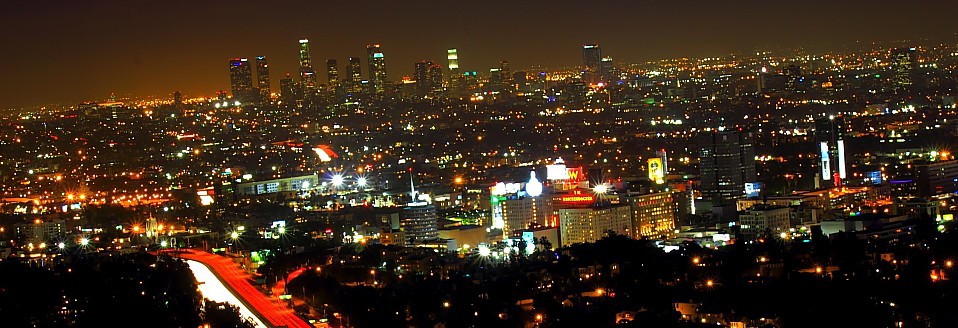
Her work pulls viewers into a mesmerizing world that incorporates fresh flowers and dried plants along with eco-friendly plastics. It is a head mix, a practice of mingling natural and artificial elements which began with last year’s Leaving Eden, curated by myself at Keystone Art Projects in Los Angeles. There she integrated dry palm leaves into installations that created both a fecund Edenic landscape and a lost one. In subsequent installations, she mixed fresh orchids with fanciful plastic vines, inviting viewers into a lush jungle. In Bionic Garden – The Fossils of the Future, she incorporates native flower leis as well as selections of immersive soundscapes that can be chosen by viewers and range from those of bucolic nature to the rush of a Los Angeles freeway.

Over the years, Petrovic’s ecologically themed artworks have evolved from her initial concepts of upcycling and recycling found objects to the use of sustainable alternative materials. Her focus has shifted along with her medium. She’s created installations that encompass issues of ocean acidity and coral reef bleaching, the growing destruction of plastic pollution, and the detrimental effects of rapid industrial and technological development, as well as the effects of overpopulation.

As her subjects have broadened and become more urgent, the artist continues to utilize materials that are increasingly interactive as she urges collective acknowledgment and action toward environmental crises.

“Initially, my ecologically themed artworks were centered around the concepts of upcycling and recycling found objects. I created weaving installations using recycled newspaper ropes that I made by hand. This process was both time-consuming and meditative, providing a direct engagement with the materials. However, as newspapers became increasingly scarce and less relevant, my art practice began to evolve…During a period of self-directed study in Japan, I delved into the potential of alternative materials derived from nature, such as mugwort and felt. This exploration was aimed at developing projects that were not only ecologically aware but also sustainable. The pivotal moment in my artistic journey came while participating in the Kipaipai professional development program on the Big Island. It was there that my focus shifted towards the issues of ocean acidity and coral reef bleaching. This shift was influenced not only by the publicly available data on the Great Barrier Reef but also by my son’s PhD research on coral reefs, which provided me with a wealth of scientific evidence from Hawaii.”
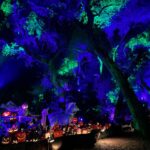
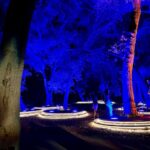
She now brings viewers into a new role as active co-creators, utilizing video and augmented reality to create an infinitely visceral experience that goes far beyond the boundaries of traditional art. Her transformational ability to weave vibrant digital and natural elements together facilitates a dialog with her audience that is resonant both emotionally and spiritually.
Bionic Garden – The Fossils of the Future features four installations: Haiku Envelopes, The Migration Series, Artificial Reality Series, and the central set piece, Rain Forest Whisperers.

Haiku Envelopes is inspired by the idea of temporal bridges which connect us between our present selves and who we might become in the future. Here, Petrovic invites viewers to write notes to their future selves, encouraging a deeply personal form of reflection and introspection that reaches across time to construct an evolving narrative.

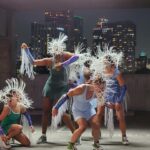
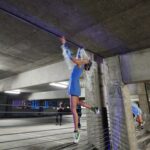
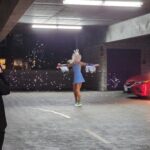
In the Artificial Reality Series, Petrovic seamlessly integrates technology with art, providing viewers with a free smartphone app that allows the dynamic animation of static images, bringing her sculptures and settings dancing into motion-filled life.
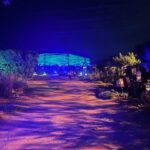
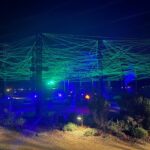
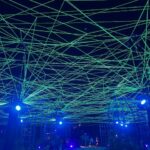
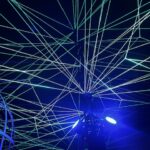
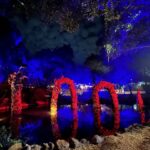
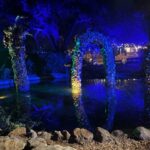
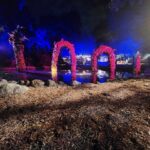
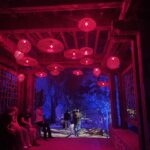
Rain Forest Whisperers takes viewers directly into a fantastical world hung with eco-friendly plastic vines, dried kelp, and fresh plumeria flowers, the scent of which perfumes the environment. QR codes encourage participation and inform viewers about ecological themes. At the heart of the installation is a “petrified” plastic rain forest built from the artist’s intricately linked signature plastic zip ties and here intertwined with real flowers and plants. These conjoined materials invite viewers to decipher natural versus human-made elements.

“In essence, my pull towards video and AR reflects my broader artistic ambition: to weave together digital and human elements in a manner that prompts introspection about our place in a technology-infused world. My development as an artist in this realm has been nurtured by a combination of innovative experimentation and a personal commitment to exploring the new frontiers of digital art,” she reports.

Petrovic’s abundant use of plastic is designed to provoke questions about our daily contribution to the overuse of the material, while at the same time, her delightful, playful sculptures encourage touch and connection.

The Migration Series further extends viewer interaction, allowing physical alteration to the composition of her artwork. Viewers can both rearrange and document the changes they create to reshape landscape and ocean-scape. It is a participatory experience, in which one may participate in the artist’s deep dive into themes of change, transition, and impermanence. Petrovic asserts that whether voluntary or involuntary, migration is the narrative of our planet, inextricably weaving movement, belonging, and transformation.

Thematically, migration and its impact on the planet and its people is key to Petrovic’s full body of work at the gallery. She depicts a shared global narrative of compassionate closeness to nature, and emphasizes our adaptability, resilience, and collective responsibility toward our planet. Her belief is that all cultures share the fundamental desires to communicate, to love and be loved, and to breathe fresh air, and that these desires need only to be turned toward our relationship with Earth.

Her installations here also reflect her deep affinity to the Hawaiian Islands. Both the concept of the “aloha” spirit and her commitment to advocacy for the preservation of ocean ecosystems are intrinsically at home in this site-specific work for Kahilu Gallery.

The exhibition will include an opening reception that will welcome attendees to the exhibition in a communal atmosphere, a July artist walk through, and a panel discussion also set to take place in July, aiming to foster a dialogue between artists, curators, and the public. This reflective interaction encourages diverse perspectives, offering a multi-dimensional understanding of the art and its societal, cultural, and personal implications.  There will also be Special Visitation Days targeting collectors, interior designers, and students. These curated experiences are designed to cater to specific interests, providing an enriched context for viewing and appreciating the art.

Additionally, a portion of these interactive experiences will be documented and shared online, extending the reach of the exhibition beyond physical boundaries and allowing a global audience to partake in the immersive aspects of the show.

Online engagement for the exhibition will also be key. As Petrovic notes, “With continuous interactions planned both within the gallery space and online, the exhibition aims to create an ever-evolving dialogue around the art. This dynamic approach ensures that the experience is not static but grows and changes, reflecting the gallery’s commitment to fostering a living, breathing cultural exchange.”

Her goal is to fully support Kahilu Gallery in a way that goes beyond just purchasing artworks. “One way that readers and visiting audiences can contribute to the success of the gallery and its exhibitions is by spreading awareness about the gallery and its events. By sharing information about upcoming exhibitions, artist talks, and other events on social media or with friends and family, individuals can help attract more visitors and interest in the gallery, and on a larger scale, continuing a conversation outside of the gallery about the topics that concern us all would be a great help and support for the cause.” To that end, visit the exhibitions website at Kahilu.org/exhibits, and follow them on Instagram at @kahiluexhibits.

Serving as a call to action and awareness, Bionic Garden – The Fossils of the Future is a powerful tool for change and the greater understanding of environmental sustainability. It is also an astonishing and virtuoso series of installations growing, above all else, a vision of alchemic art.

But it is hardly the artist’s final vision on environmental subjects.

“This exhibition marks the culmination of a six-year journey of exploration that began on the Big Island, closing a significant circle in my career. My project on understanding the nine planetary boundaries is an ongoing effort, reflecting my commitment to environmental sustainability and awareness. During my upcoming artist residency at the Torrance Art Museum in Torrance, Calif., this summer, I plan to continue my experiments with mediums and further explore the integration of nature into manmade objects.” Visit Petrovic at TAM starting in June.

“Currently, I’m delving into the possibilities of Styrofoam upcycling and experimenting with homemade bioplastic. These endeavors represent my response to the urgent call for action in addressing environmental concerns. By exploring these materials, I hope to find sustainable solutions and inspire others in the art community to consider upcycling in their work,” she says, describing the work visitors will see her engaged in there.

“My new works, along with my current 3D printed coral reefs, will also be showcased in September at The Loft at Liz’s in Los Angeles for the exhibition “Diverted Destruction 17,” curated by Liz Gordon. Additionally, they will be featured at Wonzimer Gallery also located in Los Angeles,  for the show “Echoes of Voynich,” curated by Marcie Begleiter which will open this fall. These upcoming exhibitions are vital platforms for presenting my latest research and creations, demonstrating my continuous exploration into sustainability and upcycling within art.”

Exploring and experimenting with these materials not only serves as a cornerstone of Petrovic’s artistic expression but also embodies her response to the global need for sustainability. As the artist herself says, “My work might serve as an example of how art can contribute to environmental awareness and action, highlighting the potential of upcycling and sustainable practices in creating meaningful and impactful art. Through this journey, I continue to seek answers and solutions that align with my commitment to protecting our planet and promoting a more sustainable future.”

  • Genie Davis; images provided by the artist and by Genie Davis

Enchanting and Enchanted Art at Loft at Liz’s

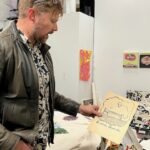
Above, curator Dale Youngman, right

What better way to celebrate Earth Month than by visiting the beautiful exhibition currently at Loft at Liz’s in mid-city,
Enchanted Earth: Capturing Nature’s Magic.

Nature’s diversity – and a wide range of artistic mediums and impressions of of nature itself – are the subjects of this lovely group exhibition, curated by Dale Youngman.  Filled with vibrant and varied art works including sculptural, mixed media, paintings, and more, this is an immersive, blossoming body of work that includes a stunning use of rose petals by Lori Schouela; lush monoprints from Rhonda Burton, and immersive organic-based works from artist Sarah Pigion.

The heady and ethereal bronze sculpture of Stuart Kusher and the beautiful trompe l’oeil realism of Mark Brosmer are also standouts, but there are no leaves of lovliness left unturned in this exhibition. While each artist works uniquely, the show blends together as a cohesive whole, taking viewers on a walk through forest, field, jungle, and garden.  Exceptional scenes of  endangered animal species from Luis Sanchez pair well with a pop-surrealist view of nature from street artist Mike ‘Tewsr’ Duncan.  Sinulous organic wood sculptures and mixed media works from  Joshua Abarbanel, Matteo Borgardt and
Gary Polonsky are as intricately lovely and unique as the landscapes that inspire them.

It’s a compelling show, filled with joy, light, color, and a fascinating use of materials. As radiant as the natural world itself, put this Loft show on your must see and linger list.

The exhibition runs through June 1st.  Loft at Liz’s is located at 453 S. La Brea Ave., Los Angeles. There are several special events of note as well, including one coming up this week.

Saturday, April 20th from 1-4 p.m., curator Dale Youngman along with exhibiting artists Rhonda Burton, Lori Schouela, Sarah Pigion, Matteo Borghardt, and Joshua Abarbanel will speak about the various processes and materials used in their unique work, from garden grasses to rose petals to wood in a discussion titled “Bringing Nature Inside: Using Nature’s Materials in Art.”

Can’t make this event? Then visit May 11, 1-4:00 when Youngman along with artists Luis Sanchez, Mark Brosmer, Mike ’Tewsr” Duncan, Gary Polonsky, and Stuart Kusher will talk about the how, the why, and also the
importance of, their inspiration from the beauty of nature in ” Nature’s Beauty is SURREAL!”

  • Genie Davis; photos by Genie Davis


Charles Derenne Inhabits Uncharted Territory

Green and lush, fecund and fabulous, artist Charles Derenne claims territory that is dream-like and wistful in a magical space. Using landscape paintings and photographic collage, as well as a brilliant conception of a leafy vending machine selling Poloroid images of fictional land, Derenne invites viewers into unclaimed spaces of both self and environmental exploration.

In his just-closed exhibition at Wonzimer Gallery, Uncharted, Derenne offers an immersive exhibition about humanity’s impact on wilderness landscapes, emotional and spiritual landscapes, and the wonder of the earth itself.

Whether traditional paintings or encompassing draped canvas as in his “Desert de Coronel,” a backdrop with a social-media-perfect chair placed in front of it, the artist invites viewers to inhabit his radiant world.

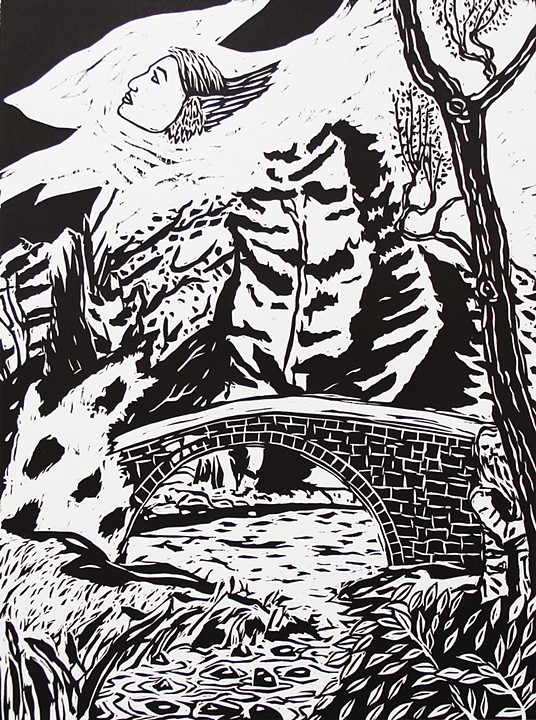
He shapes that world from a variety of real-life and imagined spaces, from Pasadena’s Colorado Bridge to Echo Park, but perhaps the centerpiece of this exhibition is his large scale “From the courtyard,” in which a pyramid of white takes central focus, lined with palms, an entirely uninhabited yet human-made space.  In the prominent right foreground, there is one creature astir – a fly.

Representing the solitude of the artist’s studio as well as the welcoming branches of a tangled forest, the theme most uncharted here is that of sanctuary, a place still being searched for, in an urban park or mysterious jungle. Along with the rich greenery on land, Derenne offers a series of wistful cloudscapes, in pale blues and white.  There is also a billboard of sorts, advertising “Land & Air for Sale – Cash Only.” One can sense such a time coming.

Parisian-born, the Los Angeles-based Derenne’s first LA solo show is impressionistic and dreamy, with a green and blue palette that soothes and surrounds the viewer. There are two notable exceptions in the exhibition: one is the diorama of “Picnic at Hermit Falls,” a miniature free-standing landscape that along the hilly green space it shapes, also includes the detritus of a tossed beer can. The pristine can never remain quite perfect once humankind is involved.

The other exception is a series of silver gelatin print photographs within large segments of torn paper, through the holes of which the darkness of humanity’s effect on natural life is revealed, such as graffiti carved into the trunks of trees.

Infused with a sense of longing and poetry, Derenne’s work delves deep into the wonders of nature, the pending loss of our ability to connect with same, and the sense of isolation and loneliness that disconnection shapes in our lives. Entering the exhibition and encountering Derenne’s delicious weaving of place and personhood, his sensitive yet humorous view of nature vs. human nature, is an experience to be savored, perhaps pressed in the book of memory in the same way in which we might save a fragile leaf or flower between pages long unread.

We had the pleasure of taking in the artist’s world after dark, with a candlelit dinner at the gallery. It’s exciting to see that along with the environment the artist created, Wonzimer is continuing to create its own world for artists and viewers to contemplate as well.

Missed Derenne’s work in person? Check out the 3D virtual exhibition here. 

Genie Davis; photos by Genie Davis and as provided by the gallery

Froggy Becomes Is Fabulous, Edgy Fun

Coming of age never looked this filled with magical realism. Offering a funny, sharp commentary on growing up rough with an ogre of a father and a mother in love with the family priest, A Froggy Becomes is a fast-moving 75-minute play that offers a smart gut punch along with its belly laughs.

A powerhouse Sandra Kate Burck (above, post-performance) is middler schooler Bumpy Diggs, living in the material world – as the Madonna soundtrack excerpts imply – in the 1980s. Her father (Peter Breitmayer) inhabits his ogre costume while Bumpy tries to shape her misbegotten frog-based science project, her friends tease her, the prettiest mean girl is dating Bumpy’s main crush, and her mother carries on a secret affair with a cowardly but sexually enthralled priest.

As written by Becky Wahlstrom and directed by Pat Towne, the play vibrates with wit and poignancy. Colorful sets contrast with an ominous sense of the mysterious goings on in the woods near Bumpy’s home, her crush’s callous desires,  and her father’s brutality. Her resillience is the key to her success with both her mocked science project, and as viewers can see, her plucky survival.

Wahlstrom’s vivid emotional palette fits with the bright set design intentionally, the writer says “Puberty is a time when colors,
smells, words, and kisses are vividly electric. I think that kind of passion is still there. We just need to wake it up every once in a while.”

It’s a jubilant play, one filled with hope and the strong belief that carrying on is what we must do. “Bumpy chooses life no matter what, and she wants you to join her,” Wahlstrom says.

The exuberance of Burck’s lead portrayal engages and defines the play, which is expertly performed all around. Smart, fast-moving dialog propels the action forward, and the play’s single act moves so dynamically that viewers can’t help but be swept up in the highly fraught fun and vicissitudes that make up Bumpy’s life. A Froggy Becomes is a fine light shining in those dark woods that grow near everyone’s adolescent home.

The Open Fist Theatre Company performs the play runs through April 13 at Atwater Village Theater Fridays and
Saturdays at 8 p.m. and Sundays at 7 p.m. General admission to all performances is $30,  with $25 tickets available for seniors and veterans, and $20 tickets are available to those under 30.  Atwater Village Theatre is located at 3269 Casitas Ave in Los Angeles, CA 90039.

  • Genie Davis, photos: Genie Davis and courtesy of Open First.