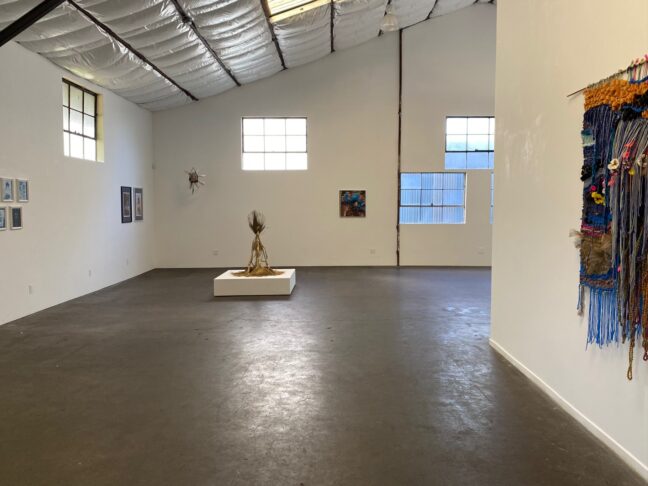
There is something quite wonderful in the Cultural Undertow, something that allows the viewer to be pulled into the waters of observation willingly, and rebaptized in them. Curated by artist Narsiso Martinez, at Luna Anais Gallery in the Tin Flats exhibition space, Cultural Undertow offers a variety of works by two exciting LA-based artists, Gloria Gem Sánchez and Tidawhitney Lek.
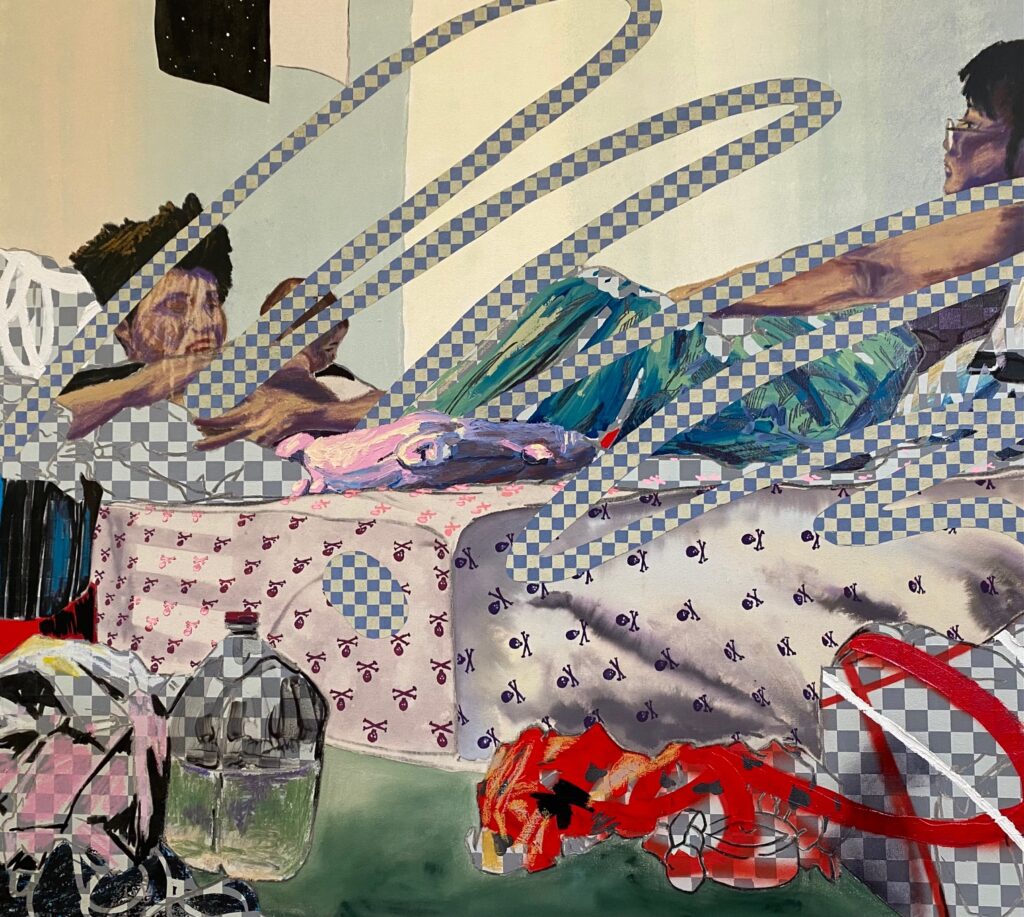
Working in acrylic and oil, Lek’s exquisitely rendered figurative works shape involving depictions of viscerally recognizable moments in time, each filtered through a highly feminine and feminist sensibility. In one painting, a sinewy man, looking away from the viewer, glancing back toward a sunset sky, is carrying a bright pink bucket and one very large koi in Lek’s “Between the Bucket and the Sun.”
In another, a female cat and dog, rear ends directed our way, vibrant sky and brilliant orange and yellow flowers as background, serve as a prescient double entendre in “The Pussy and the Bitch.” In another lovely work, “Encounter,” dark clouds rim an intense patch of blue, and a wall, topped by flowers, separate a woman’s face from the reaching, hands and multi-colored nails of another woman on the other side of the wall. It’s both elliptical short story and mystery – they could be a couple separated but longing to see one another, they could wish each other harm. The dark clouds and that brilliant sky – it portends many things.
Regardless of subject, Lek’s use of startlingly vivid color, floral elements, and an underpinning of longing mark her as fresh and fascinating, a highly original talent taking both the figurative and the feminist to an entirely new and heightened level.
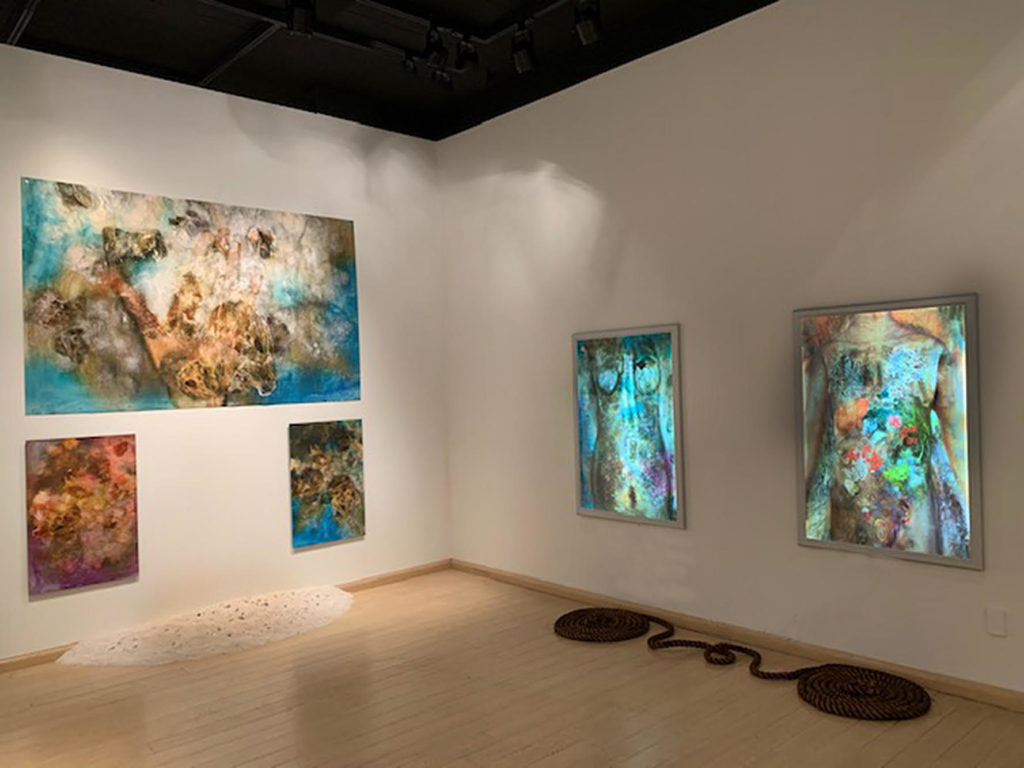
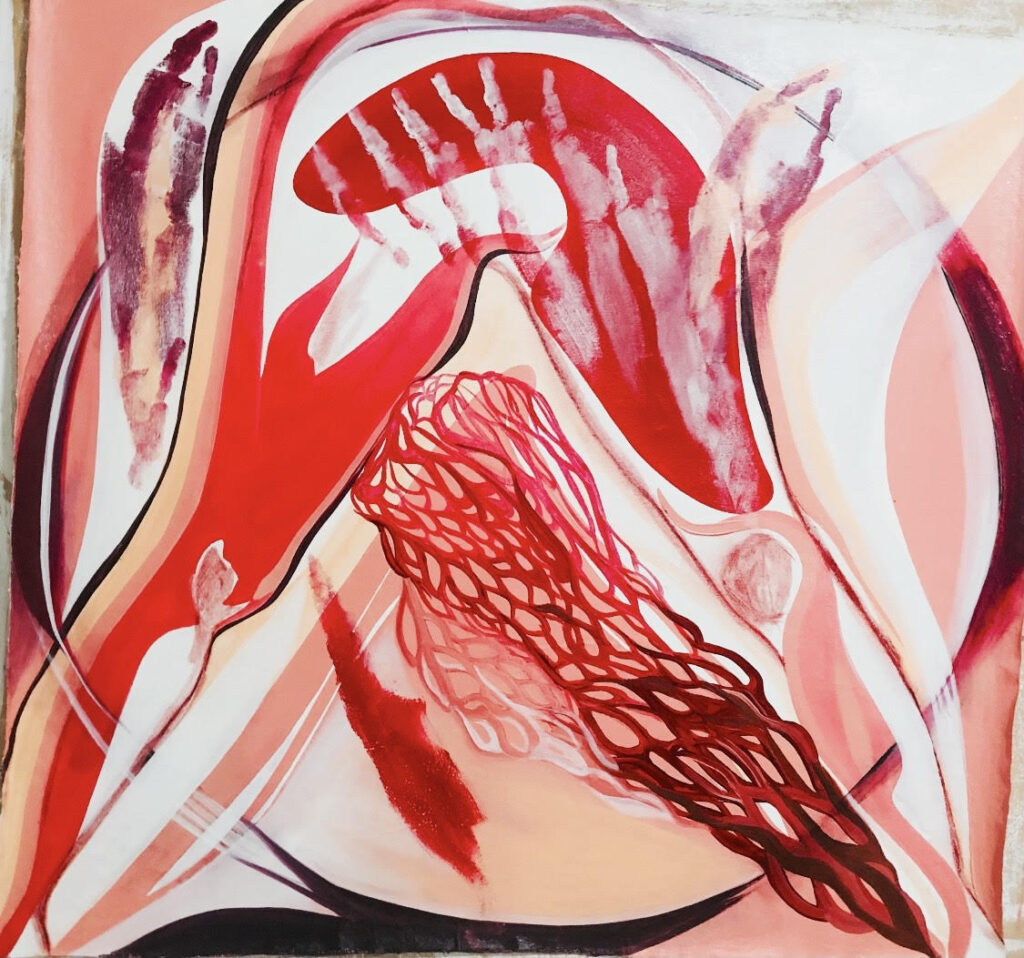
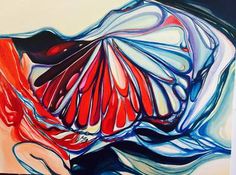
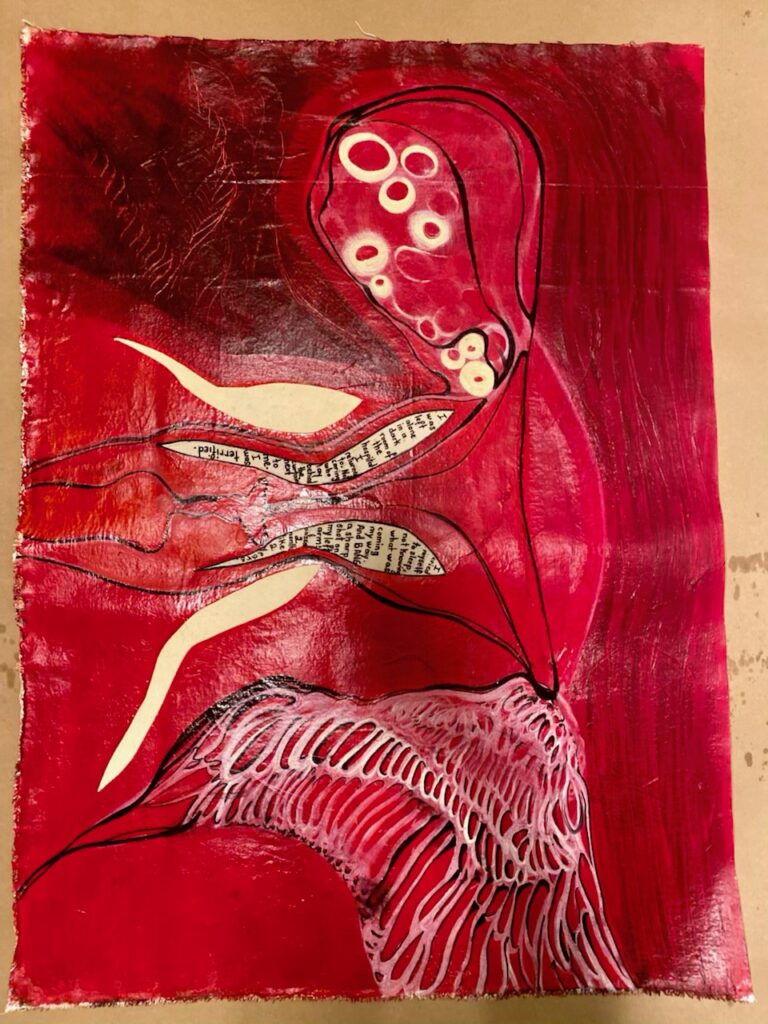
Sanchez’s work is entirely different, and yet Martinez’ thoughtful, conversational curation binds the two artists’ works into a cohesive and immersive experience. Sanchez offers a variety of lush mediums here. Her richly blue cyanotypes are haunting, some, as in the otherworldly figure revealed in “Twin Spirit” (far left), literally seem so; others are more abstract. Her archival photographs, like Lek’s paintings, revel in original portrayals of floral elements that celebrate personal heritage.
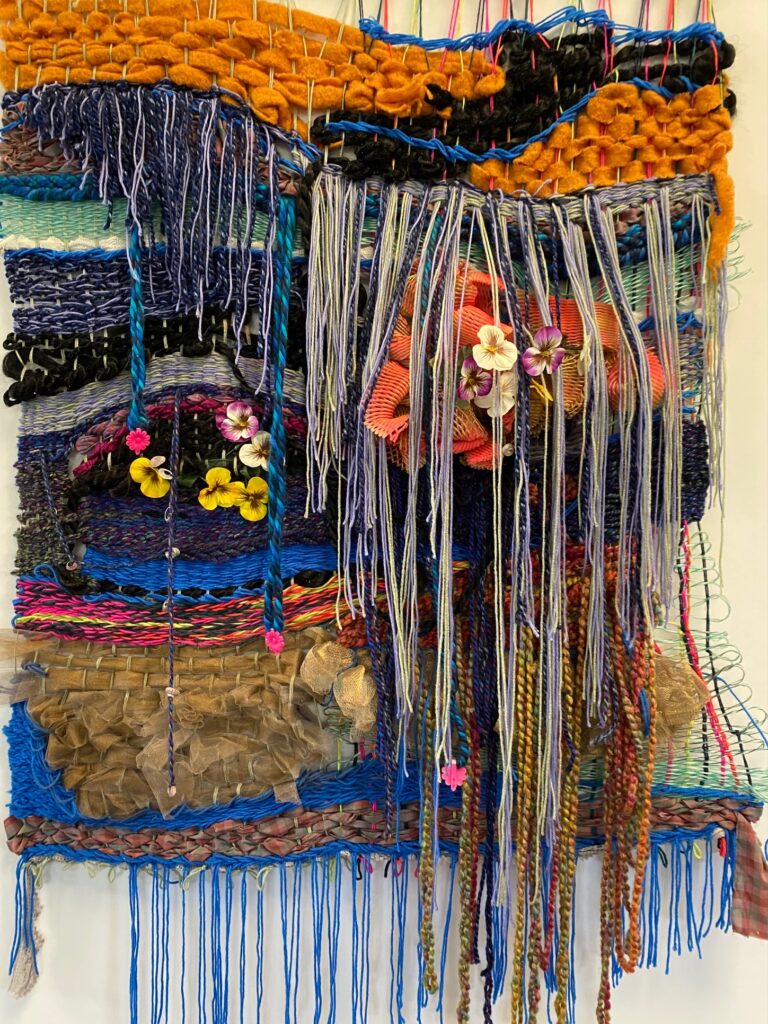
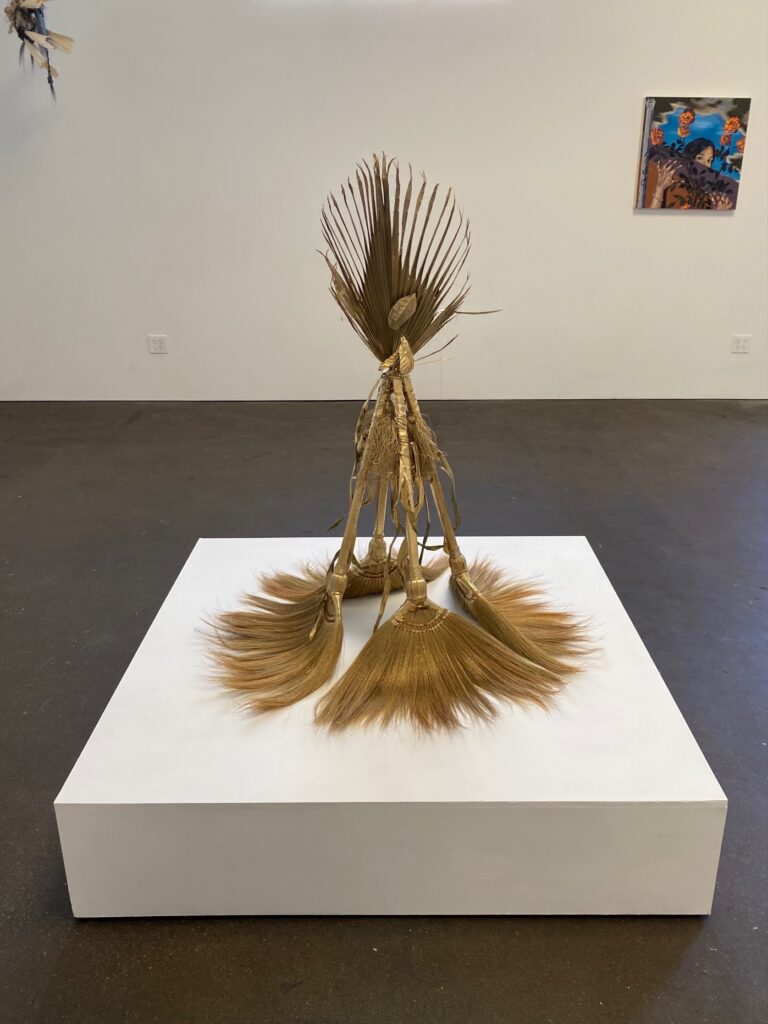
Perhaps most involving are her mixed media works, from woven, vividly colored wall work such as the tapestry that is “Nocturne Before Dawn” to her more sculptural work, each evoking something of the mystical and ritualistic, like “Araw (Sun),” consisting of a mix of shed snakeskin, bamboo, hojas de maiz, and faux hair. There is a strong element of the spiritual, even mystical, in each of these works.
Both artists’ work arises in part from their family’s cultural roots; for Sanchez it is a Xicana-Filipina heritage and for Lek, it is Cambodian. Martinez, having celebrated his own heritage through art, including a profound sense of respect and honor revealed in paintings of Mexican farmworkers in America, is no stranger to introducing intelligent cultural references and encouraging a broadening of viewer understanding and experience through art. His attention to intimate detail and his passionate respect for often under-represented communities is fully evident in this gracious, 18-work show.
And while representing those outside the standard artistic mainstream, Cultural Undertow also serves as a galvanizing focal point for the diversity, beauty, and electrifying wonder that celebrates a variety of family backgrounds as well as an intensely feminine point of view. Perhaps most profoundly of all, the art allows us to see all of these elements as part of a beautiful, universally relatable and recognizable whole.
The exhibition is on view at Luna Anais at Tin Flats, located at 1989 Blake Avenue, Los Angeles, through July 24th.
Originally scheduled to open when COVID-19 hit in 2020, through June 4th this lustrous collection of works is now viewable at Wonzimer Gallery in DTLA. The article and most of the photos are taken from its earlier frozen-in-time incarnation, but it is expertly curated at Wonzimer.
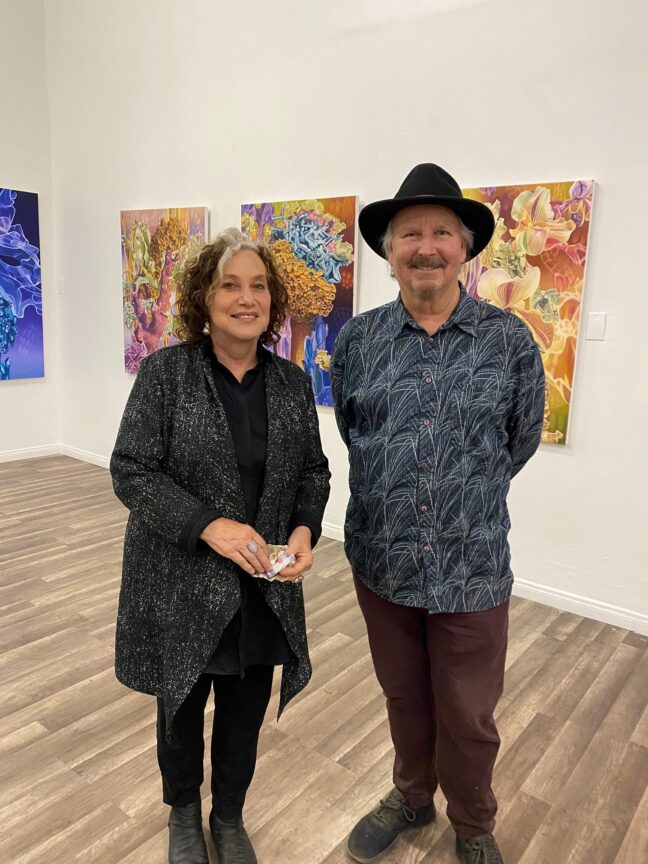
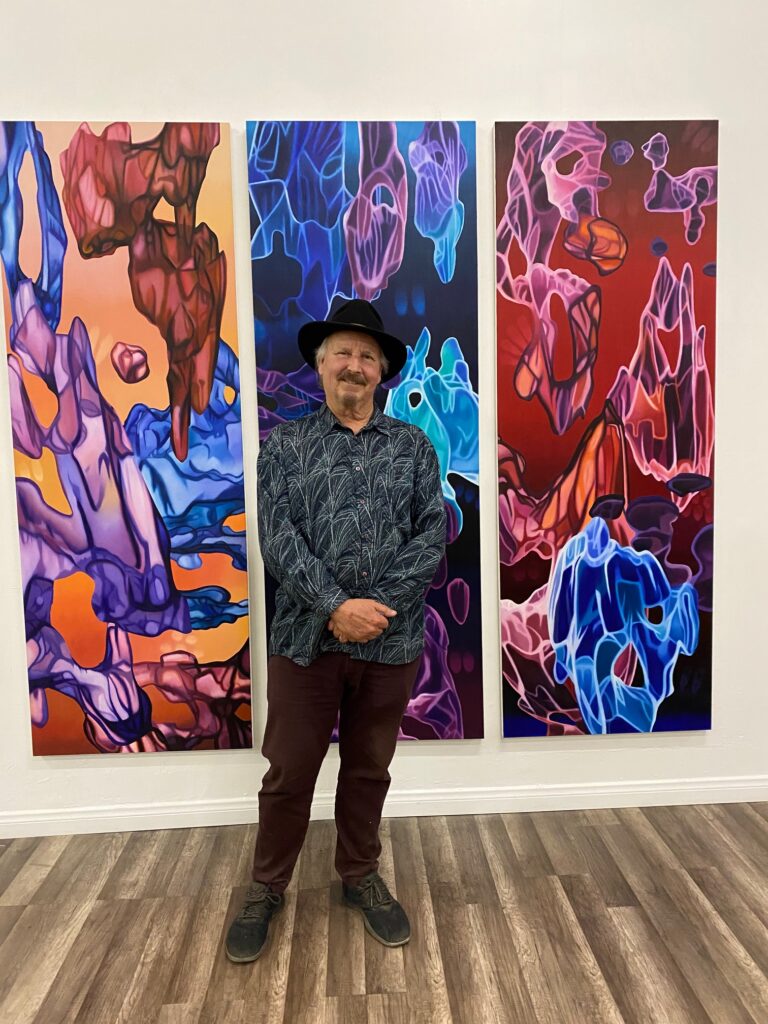
The radiantly lovely works of Gary Brewer and Aline Mare are a fine collection by married artists enmeshed in a beautiful dance of passionate art and companionship.
Aline Mare
Entwined Roots: Symbiotic Relationships is a tribute to both artists’ works, individually and viewed together.
Aline Mare
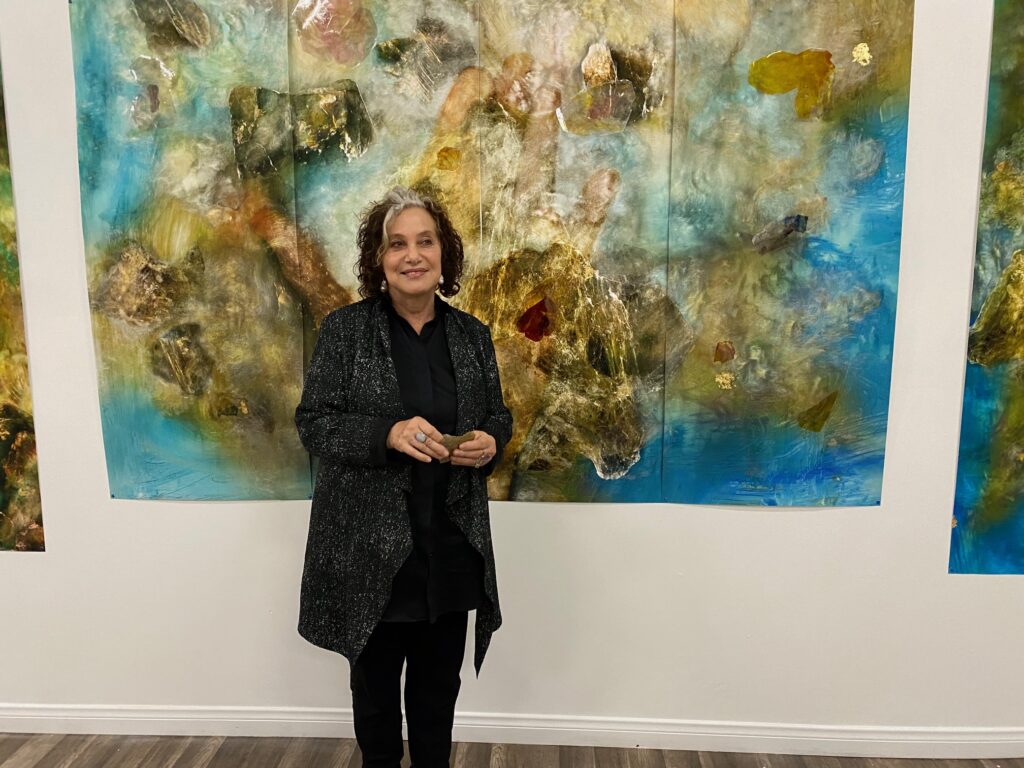
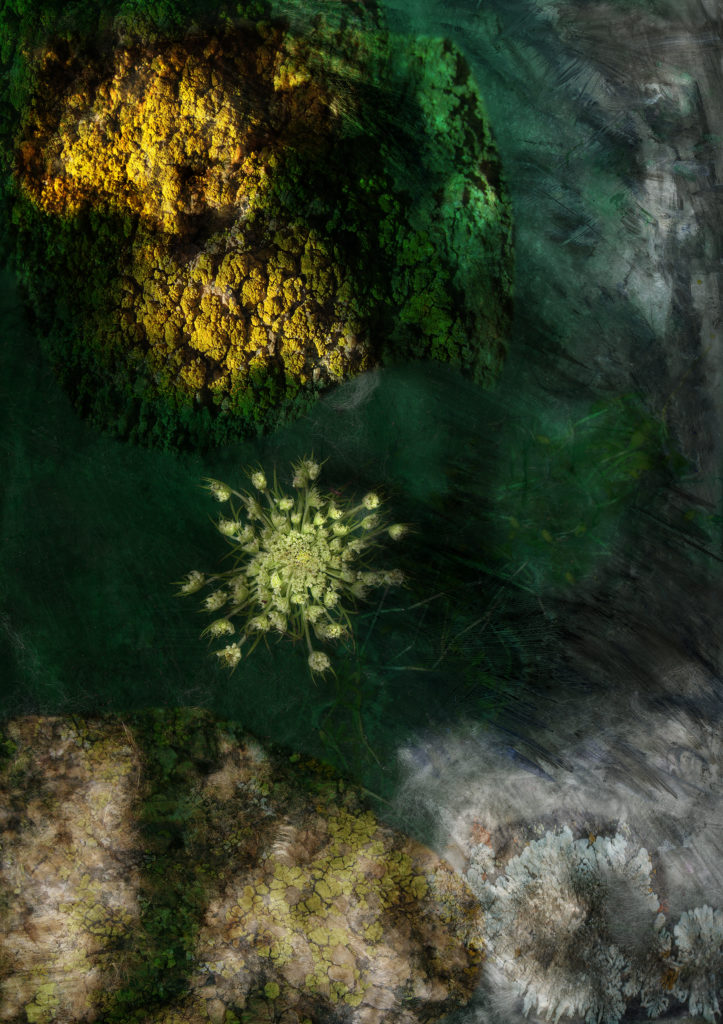
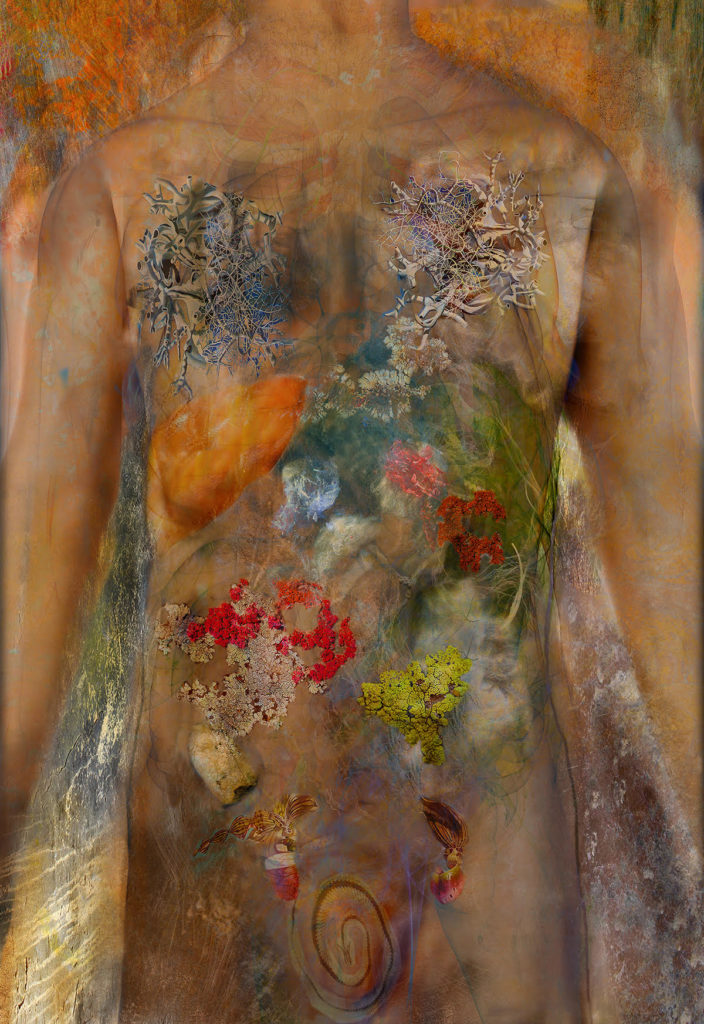
Mare works in hypnotically dense, fabulously fecund mixed media; Brewer in oil on canvas. Both are abstract artists, each non-figuative piece here is nonetheless rooted with recognizable elements from their artistic pasts that are sublimely figurative images of nature.
Gary Brewer
Their palettes are rich, their sense of beauty sublime. There is a wildness in both artists’ works that defies categorization, that welcomes the subversive and the sweet in equal measures.
One can view the cosmos or the untamed sensuality of nature in both artists’ works. Mare gives us a universe in a forest floor; a galaxy within a rain soaked garden. Brewer gives us twined cells, seeds and flowers, twisted cords of natural beauty that are larger than life. Both create works that flow in a fine and fanastical series of perfectly calibrated colors and patterns that are almost hypnotic.
Mare’s “Green Seeded” combines a delicate, evocative painted background with photographic images of seeds and images from space. Layers of paint shift the image so that the viewer is both above, beyond, and within the it; we are seeing the vast and infinite in the small and perfect.
Brewer’s works here feel more decidely floral, but what a fierce and marvelous series of blooms these are. In his “Constellation,” or in “Seeds of Life,” we see orchids that seem to burst from the canvas with a muscular life-force. These flowers are no swoony, scented bouquet, but rather vital, living entities.
Brewer, above; Mare, below
Where Brewer works in vastly large canvases depicting what could be minute objects – petals, seeds, flowers – writ large, Mare’s smaller works depict a strange and tumultous vastness contained in a smaller space. Both artists seem to work in a kind of synchronistic counterpoint, creating a sense of unseen wonder and hidden, intertwined gestural relationships.
And speaking of relationships, their own – to each other, to their art, to the way in which they seem to play off one another both in life and in this exhibition, is intrinsic to this exhibition. It is a great ritual alchemy celebrating the “other” within all of us.
Both artists invite the viewer – or perhaps the correct word here is compel – to go beyond surface perceptions and into a deeper, stranger, more wonderous realm: that of intertwined roots of life and love and into the celestial, where words may be inchoate but beauty falls like a welcoming, luminous light.
Now that this exhibition is no longer in COVID limbo, the life force it brings to the viewer cannot be constrained. Drink it in deeply, in the heart of downtown.
Wonzimer is located at 621 S Olive St, Los Angeles, CA 90014 – no appointment is necessary; check open hours; through June 4th.
Genie Davis; Photos at Wonzimer by Genie Davis; photos provided by the artistsof individual works.
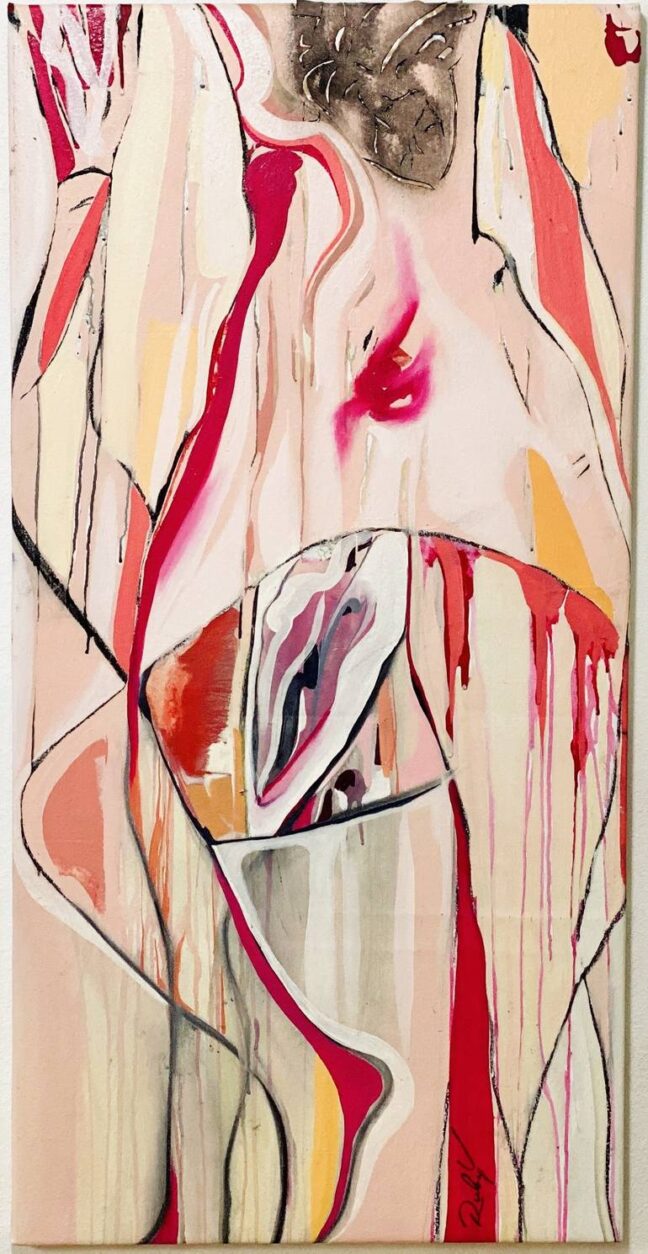
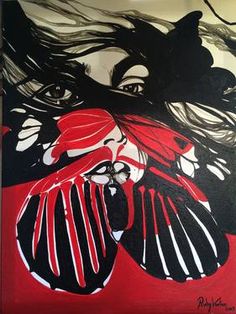
Mutable and mysterious at first look, Ruby Vartan’s artwork represents a figurative abstract exploration based on the feminine form. Working in a wide range of mixed mediums such acrylic, oil, charcoal, and fabric, as well as with oil on canvas, artist Ruby Vartan weaves powerful, emotional images.
Her work expresses both her own inner world and experiences. It evokes the liquid as well as flame, revealing both what Vartan terms messages of peace and love, as well as a flood of highly emotional, evocative images that express her own generational and intimate trauma.
The artist describes her layered and poetically physical work as the process through which she feels most free, where no boundaries exist to arriving at her destination of expression.
From inner emotion to the external body, Vartan uses her own presence to represent a vital life force, light and renewal. Her process often includes painting, tearing, sewing, and the incorporation of unique mediums that resonate with love and pain. Works include elements of empty space which she views as a way to create and uncover and exciting new world that she makes her own.
Born to Armenian parents in Beirut, Lebanon, Vartan moved to the U.S. in 2008, and currently resides in Los Angeles. She says that her strong use of color reflects her heritage and identity, as well as symbolizing her dreams, desires, and emotions. She takes her work and her viewers into a world of volatile honesty and fragile self-expression.
Some images include canvas slashes the reveal a gold texture below, similar to the Japanese technique of Kintsugi that repairs the broken with the use of a precious substance such as gold, silver, or platinum. Other works include text, and intricate patterns.
Regardless of image, Vartan’s work exudes the aura of survival, resurrection, and resilience, shaping an experience of artistic and soulful redemption.
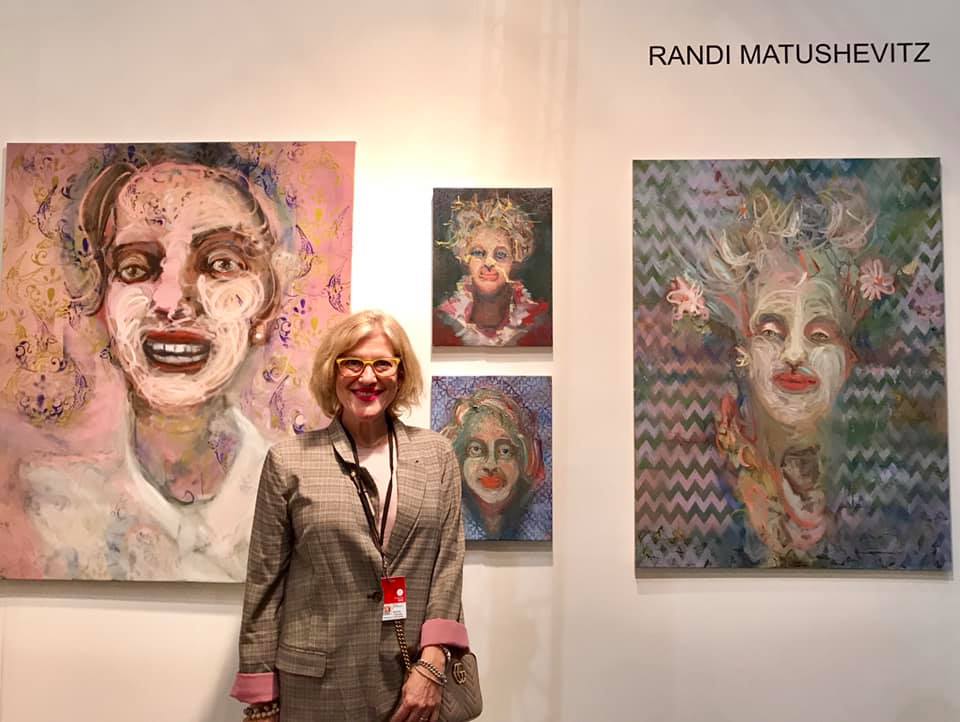
Artist Randi Matushevitz has created astonishing three recent bodies of work that are both emotionally resonant and plugged into the zeitgeist of today’s world.
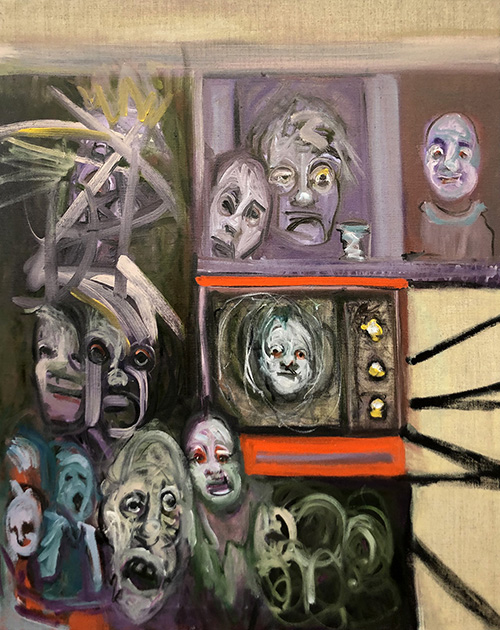
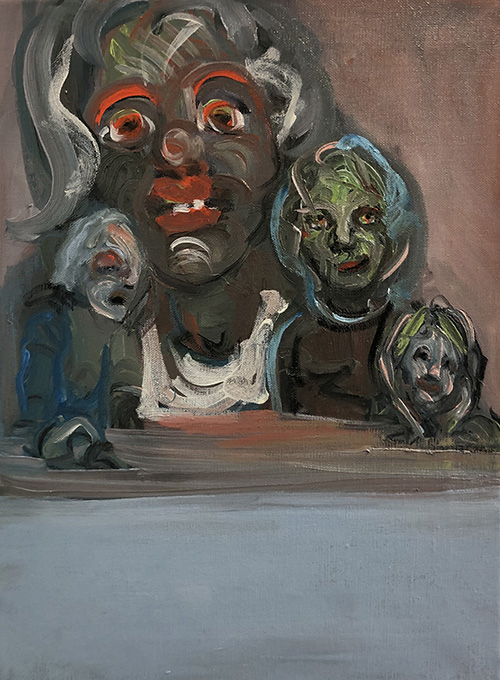
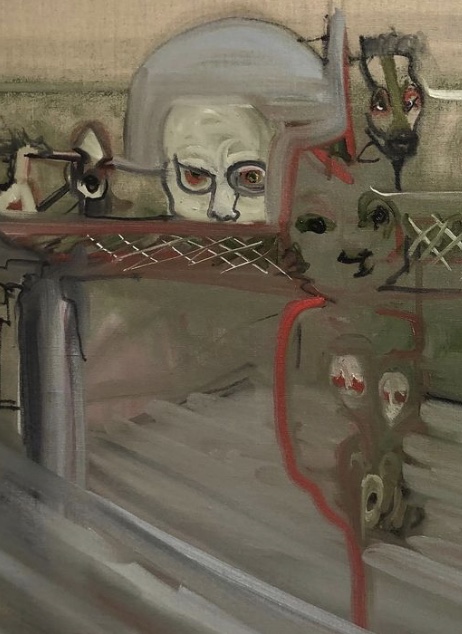
The earliest series is Dystopian Lullaby. What is such a song? Does it soothe, does it rock the saddest soul into something astonishingly beautiful, hovering at the edge of hope? Does the strange melody somehow also seem distorted and off-balance, chaotic and inchoate? Matushevitz somehow manages to do all of these things with this series , one which is so poignant and real as to defy any routine categorization.
It is that poignancy perhaps that serves as a lullaby to these dystopian faces and settings. The people she creates, and even their elusive situations, are each sublimely real; they have lives we may not have been invited to visit before. For every element of distortion or horror at the state of their – and our – world – there is a sense of the rhythm of life, a brief impulse of comfort or longing. Created in oil on linen, the artist’s paintings feature backgrounds that are muted, often grey toned; the faces themselves reveal a palette of oblique and uncommon shades, while remaining entirely recognizable as “real.”
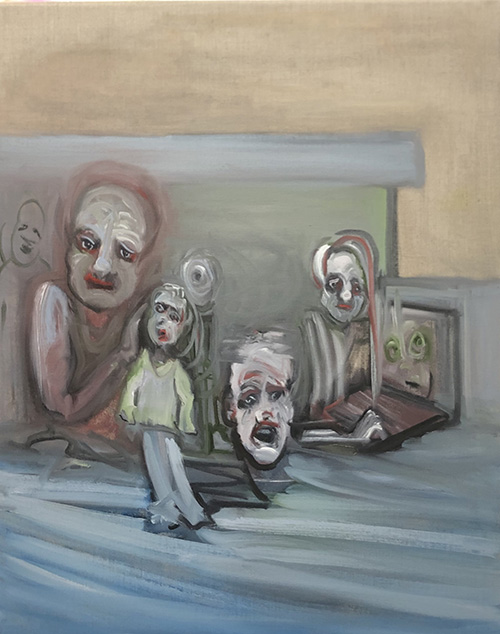
In images such as the artist’s “Cluster 4” (above), this dichotomy is richly evident. Matushevitz shapes an intimacy that compels the viewer into identifying with these dystopian inhabitants. In this work, a large, possibly disembodied figure appears to comfort a fully realized, frightened young girl. Behind her to one side, a shadowy outlined figure watches, with a benevolent if sorrowful expression. Two disembodied heads display alarm; one figure is partially reclining and seemingly viewing something entirely inward – perhaps this entire scene is a part of her memory. Like a film that makes the viewer long for a sequel, this work, too, aches for continuation and explanation, while still being wholly satisfying in its mystery.
There is a sense of family in each of the artist’s clusters, whether it is a “real” family, or characters that inhabit our own minds. Some of these characters reveal a sense of abject dread, but others seem at peace, resigned, ready to accept/embrace the dystopian world around them and possibly even shape an antidote for it.
Each image is both grounded in realism and yet layered in metaphorical abstractness. One can see the physical layers, which the artist creates by drawing, smudging, superimposing, and re-drawing or painting; and within those physical representations, within those impressive, passionate countenances, are layers of meaning and belief. If our own realities are made up of years of experience and knowledge, social interaction, and beliefs passed on from others and learned within ourselves, then so is the reality of these images.
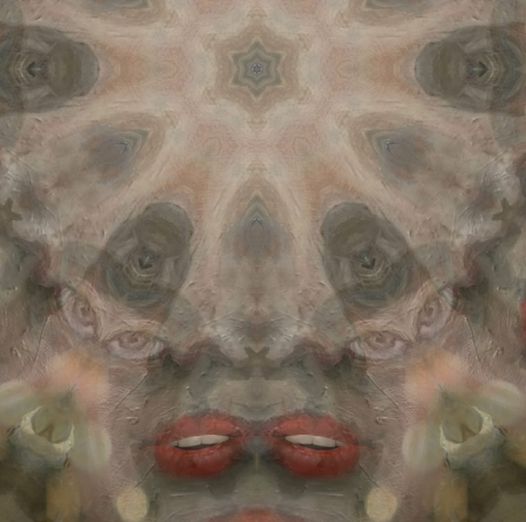
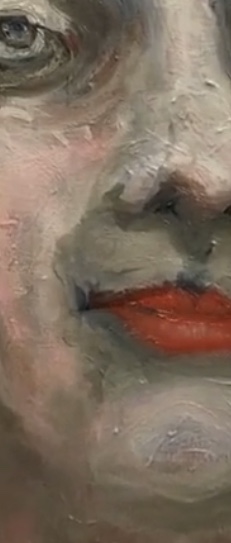
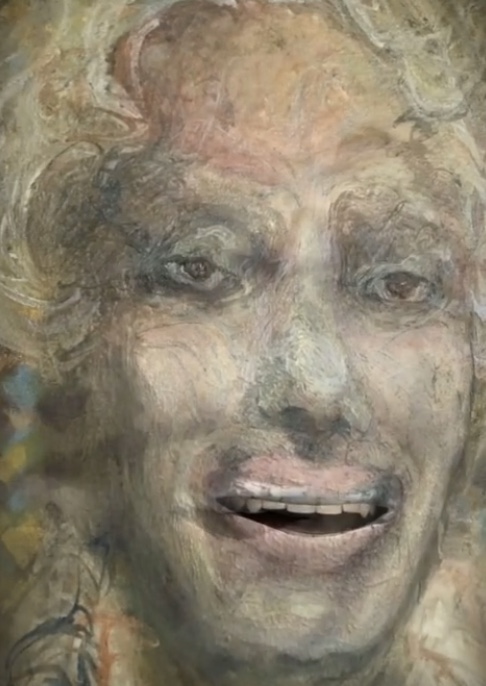
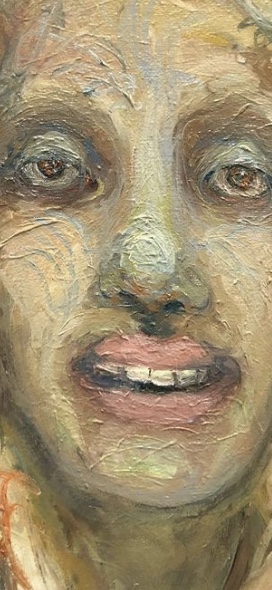
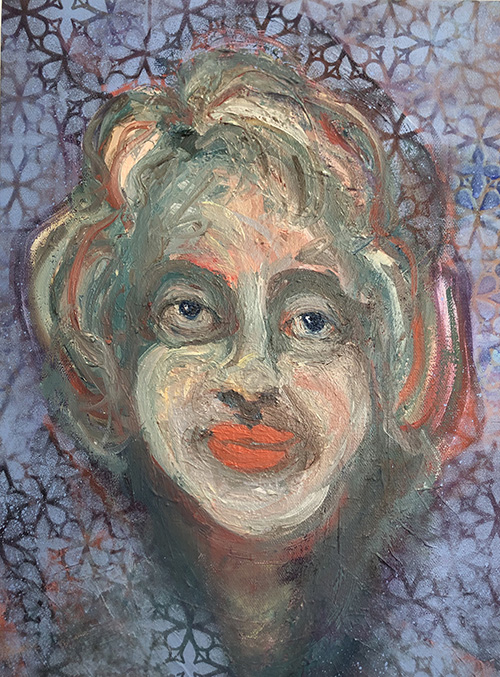
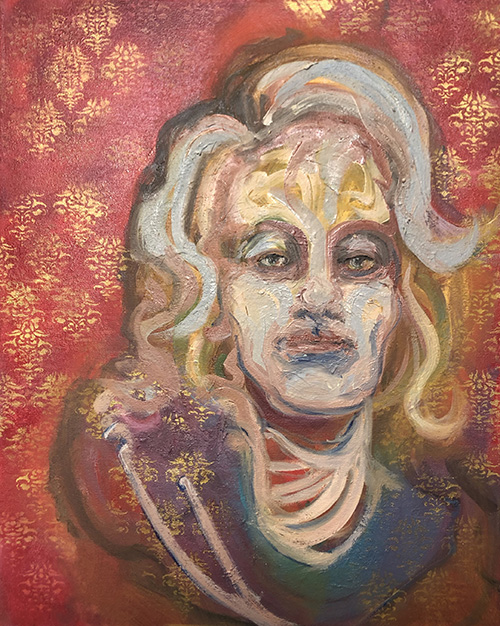
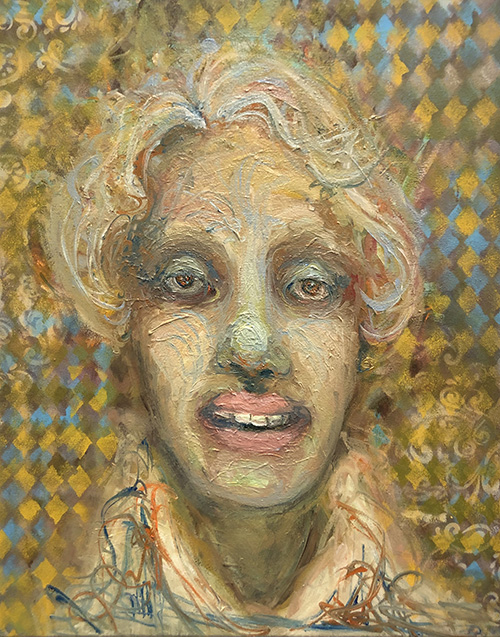
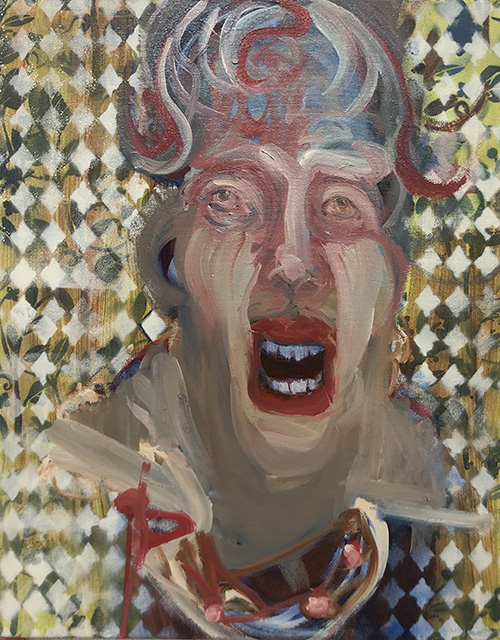
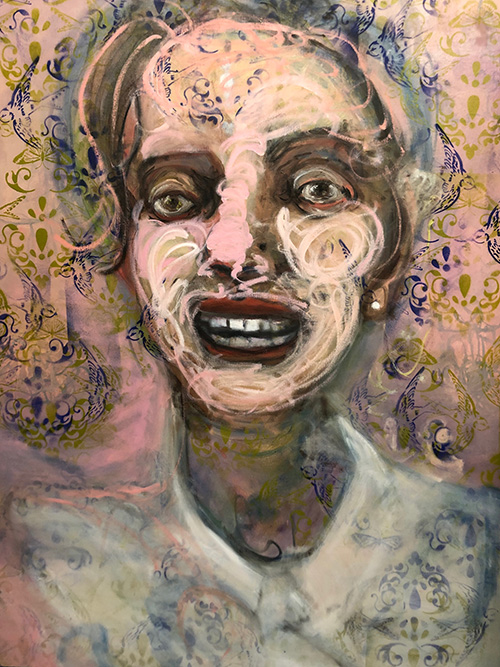
With Headspace and Headspace 3D (above), Matushevitz continues her nuanced exploration of the human condition and spirit, her works entering into increasingly complex spaces, mesmerizing and self-illuminative.
She often presents a conundrum of the spirit, in which she reveals the fears and indecisions, even the anger, that may lurk in each of us, but also a sense of exhilaration, of hope and connectivity, all filtered through her own affection for and exploration of human emotion. Just as her work itself is physically – and now, dimensionally – layered, so too is the meaning within it, packed with feeling and perceptive sensation.
Using what she describes as “emotional” portraiture, she captures an enormous amount of grace and resiliency in human expression, in both the oil on linen Headspace series, and its 3D and video iterations, Headspace 3D, the latter of which offers a vast expansion of fresh perceptions.
To create Headspace 3D Matushevitz initially used smartphone technology to animate her works, furthering her passionate deep dive into human expression, and to foster a sense of connectivity and community.
She began with simply animating the still images from her Headspace series, shaping a number of the images into Headspace 3-D. However, now they have grown into longer video explorations, revealing the subject of each image as a character with a breadth of emotions, as the artist explores meaning and non-meaning, and the true nature of understanding, and when it can occur. Matushevitz believes “We have an innate human ability that is in our DNA and in our sympathetic nervous system to understand. It goes beyond culture, gender and language.”
These new-media digital art works last from 6 to 20 seconds, and offer an intimate looking into portraits that have become uniquely alive.
As an artist, she reassures us that we may not be perfect constructs – in fact, we are each inherently flawed – but that does not make us any less valuable or worthy. She celebrates her people, however imperfect, revealing varied expressions, changing moods, and inviting the viewer into a full and immersive interaction with them in her 3D works.
It is a wonderful morphing of technology and art, very much of the moment and yet very much infused with a classic, intuitive intimacy associated with the art of portraiture. Nodding, laughing, turning, smiling, eyes close to filling with tears – these are the “living” manifestations of the moments her oil works portray.
Both in the more surreal-tinged 3D version, and in the original Headspace, much like ourselves, the people in her portraits are complex. They are both fully realized and in-progress, both expressing our outward personas and our inward dreams, fears, hopes, and unrevealed traumas.
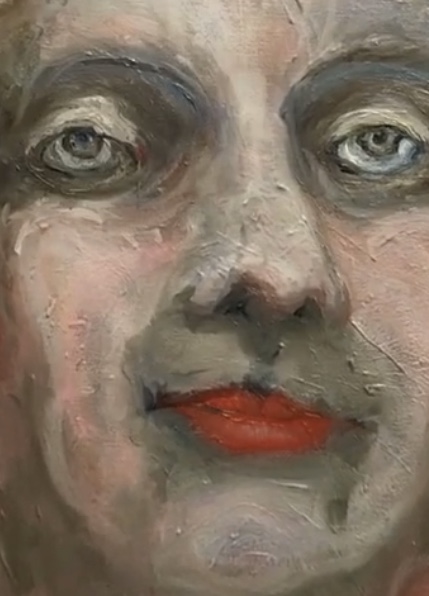
Matushevitz’ “Adoration” may be the most benign image of the Headspace series. Peaceful, accepting, she has a half-smile and the most realistically-grounded skin tone.
“At the Wedding” (above, top) is another graceful image, one that nonetheless reveals watchfulness, resignation, subdued interest or acceptance; “Call Me Coiffed, I just left the Salon” (second image, above) offers a similarly recognizable and interested countenance, here, that familiar expression of feeling self-confident in one’s looks, in appraising one’s appearance in a passing window or mirror and feeling “well-done.”
“Chuckles, an ode to Matthew Barney” (above) is darker in tone, just as Barney’s works were often riven with allusions to defeat, failure or a sense of conflict.
It is perhaps with “I am She” (above) that all aspects of this series coalesces: this portrait appears to be of the Headspace universe’s creator, certainly of an every-woman. She feels, thinks, and is – everything. You see pleasure, sadness, hesitation, strength, all of these shifting across this image, although it remains physically still, not a 3D AR depiction – at least as yet.
Two interesting things to note about the wonderfully deep Headspace and Headspace3D series: they are all of women, and in some way appear to be a kind of personal as well as collective self-portraiture; and the backgrounds are perfect and puzzling. Like a kind of patterned wallpaper or edgy Zoom background, these faces stand out against an environment that both clashes and offsets. All in all, that is not so dissimilar to how we experience the world today. We are who we are; the backgrounds we inhabit, whether IRL or virtual, do not empirically change us, although we may change them.
Headspace and Headspace 3D are both relatable and mind-bending, as all truly passionate art must be. These wonderfully immersive works make a perfect pairing with a visual “listen” to Matushevitz’ Dystopian Lullaby, a song for the senses, a melody of hope playing softly in a very discordant world.