
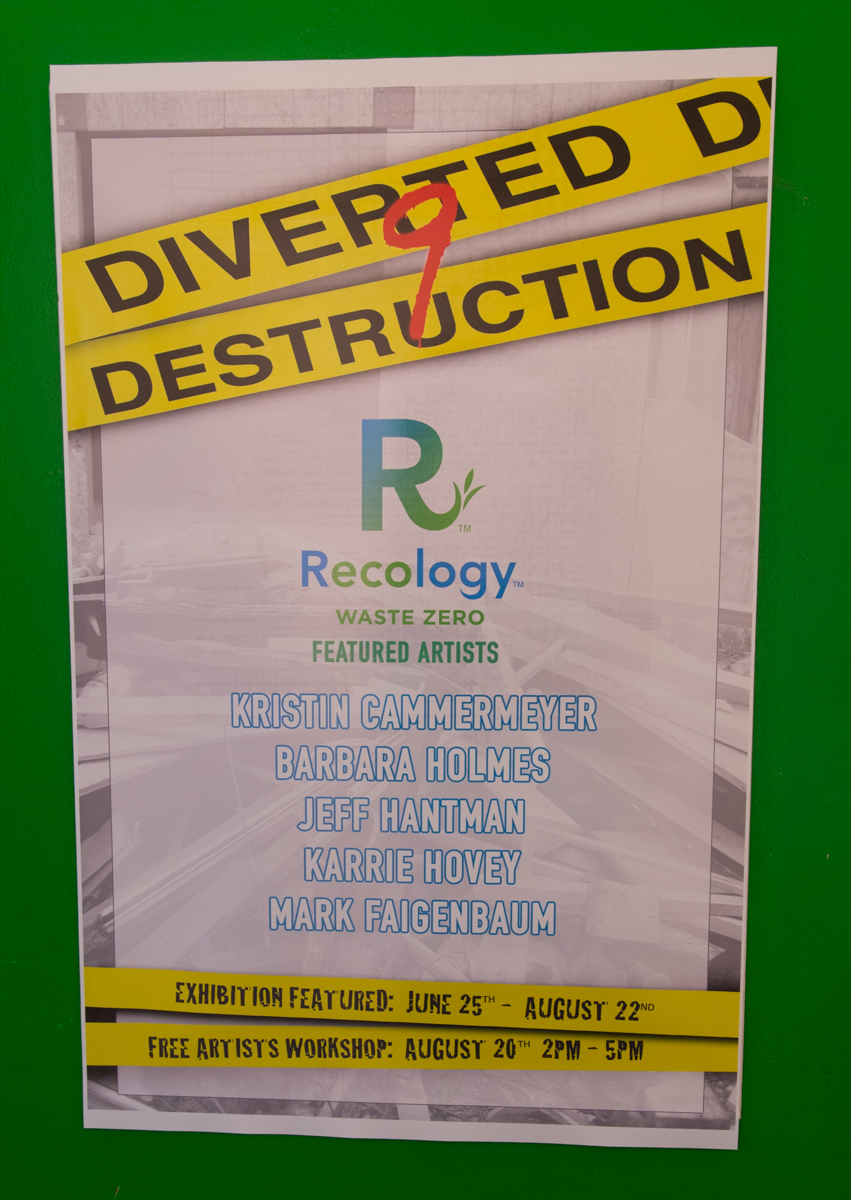
Waste Not, Want Not: The Loft at Liz’s Delivers Diverted Destruction

F23C6890

An annual assemblage show runs through August 22 at the Loft at Liz’s on La Brea. The 9th annual such show, this year’s collection, Diverted Destruction, features five artists participating in the Recology San Francisco Artist in Residence (AIR) Program. For the past 26 years, the Recology AIR program offers artists access to studio space at San Francisco’s transfer station, and access to materials in the public dump. Along with supporting artists, the program encourages children and adults to think about their consumption practices and recycling and reuse. Recology plans to offer a Los Angeles Artist in Residence Program in the future.

F23C6870

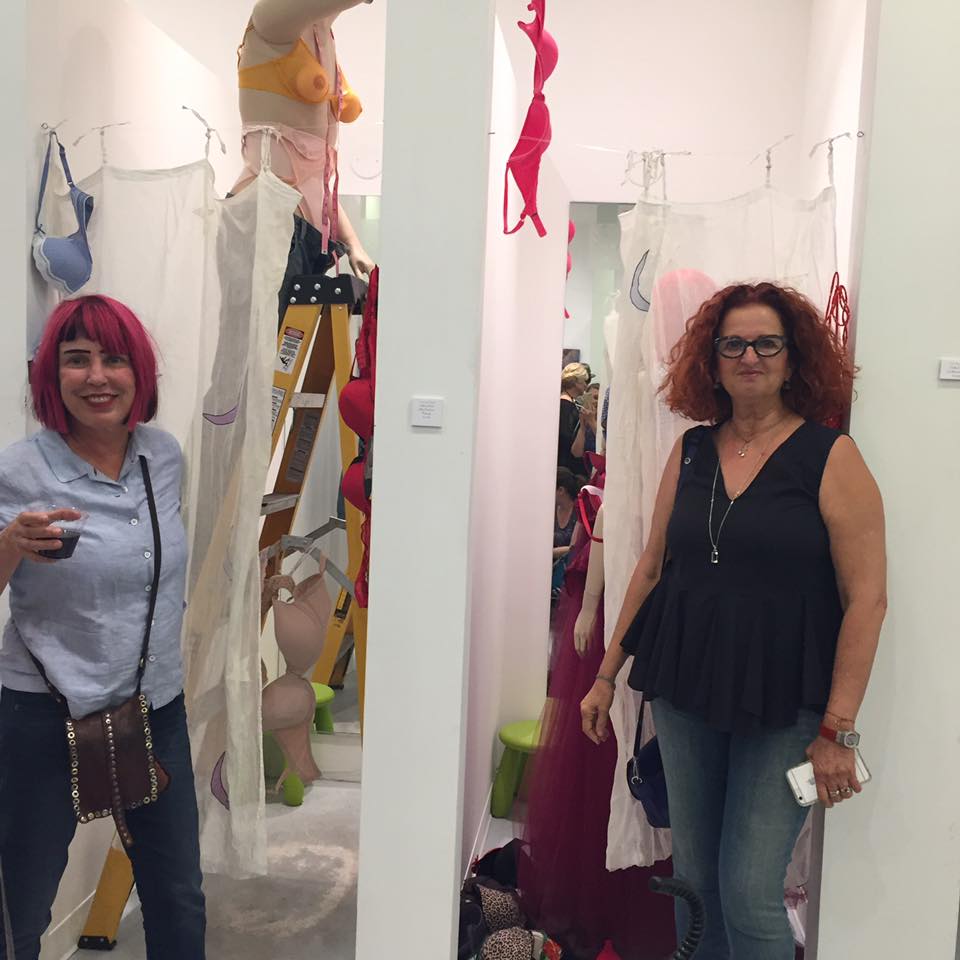
Above, gallery owner and curator Liz Gordon, left, Recology artist in residence director Deborah Munk, right.

Deborah Munk, Director of the Artist in Residence Program at Recology calls her program “the first artist in residence program located at a dump. Artists scavenge materials and use them to create a body of work for exhibition.” She notes that “we work with artists in all different mediums including video, painting, and multi-media.” Student shows are also a part of the program, and Recology maintains a three-acre sculpture garden.

At Loft at Liz’s, curator Liz Gordon offered up a vast selection of free-for-the-taking assemblage materials in front of and behind the gallery on opening night, and will offer this wealth of material again on August 20th along with free recycled-materials workshop.
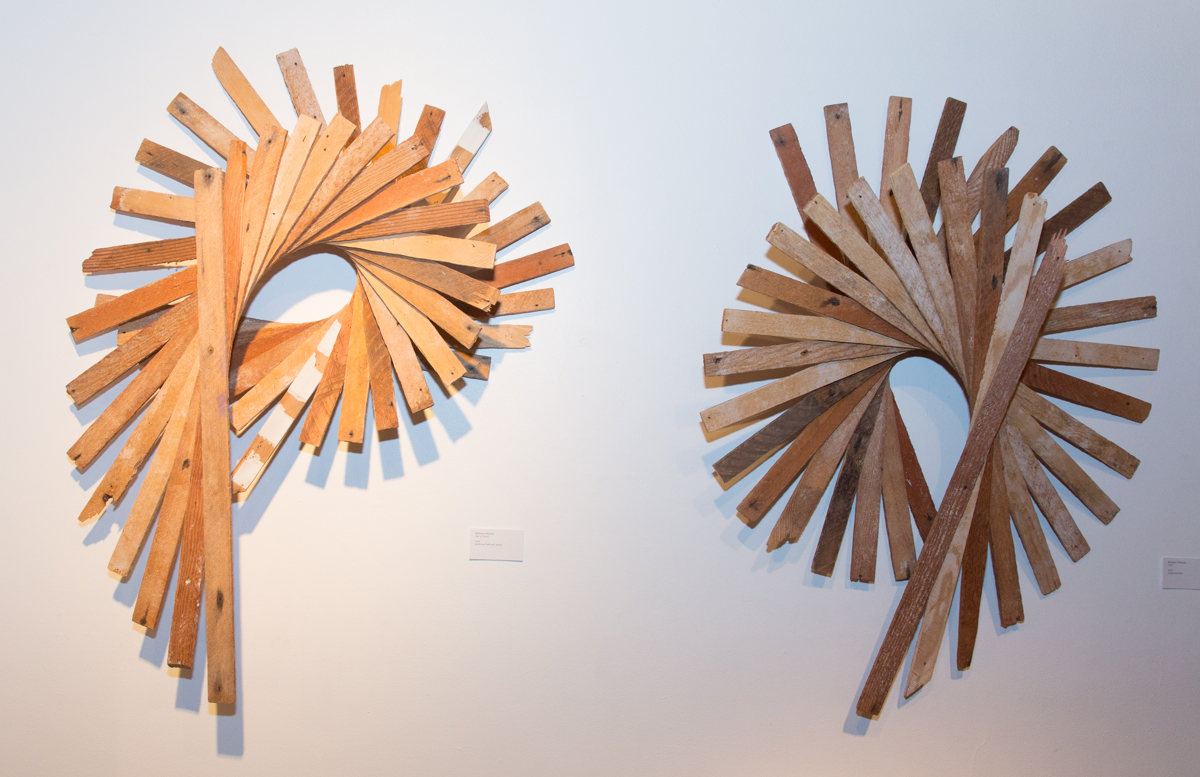
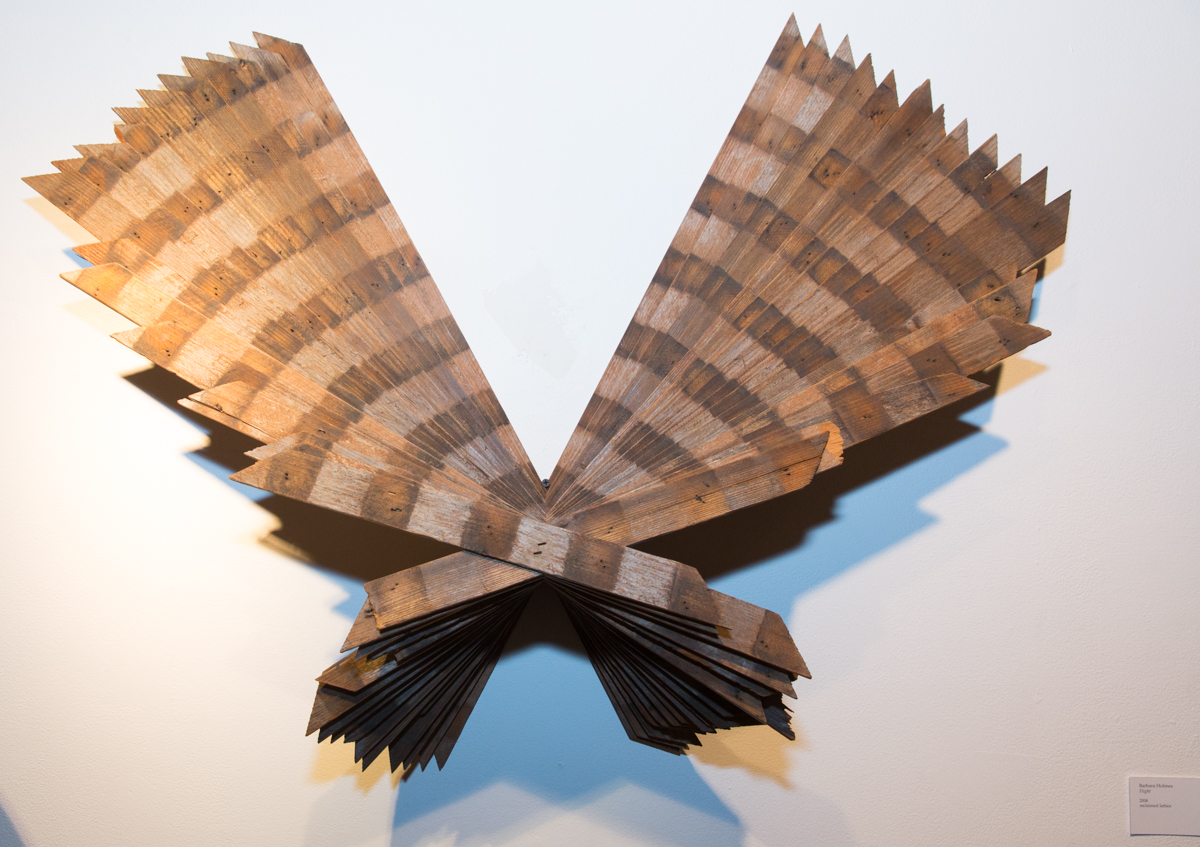
F23C6828 F23C6830

Above, the recycled woodwork of Barbara Holmes.

Exhibiting Recology artists are Kristin Cammermeyer, Mark Faigenbaum, Jeff Hantman, Barbara Holmes, and Karrie Hovey.
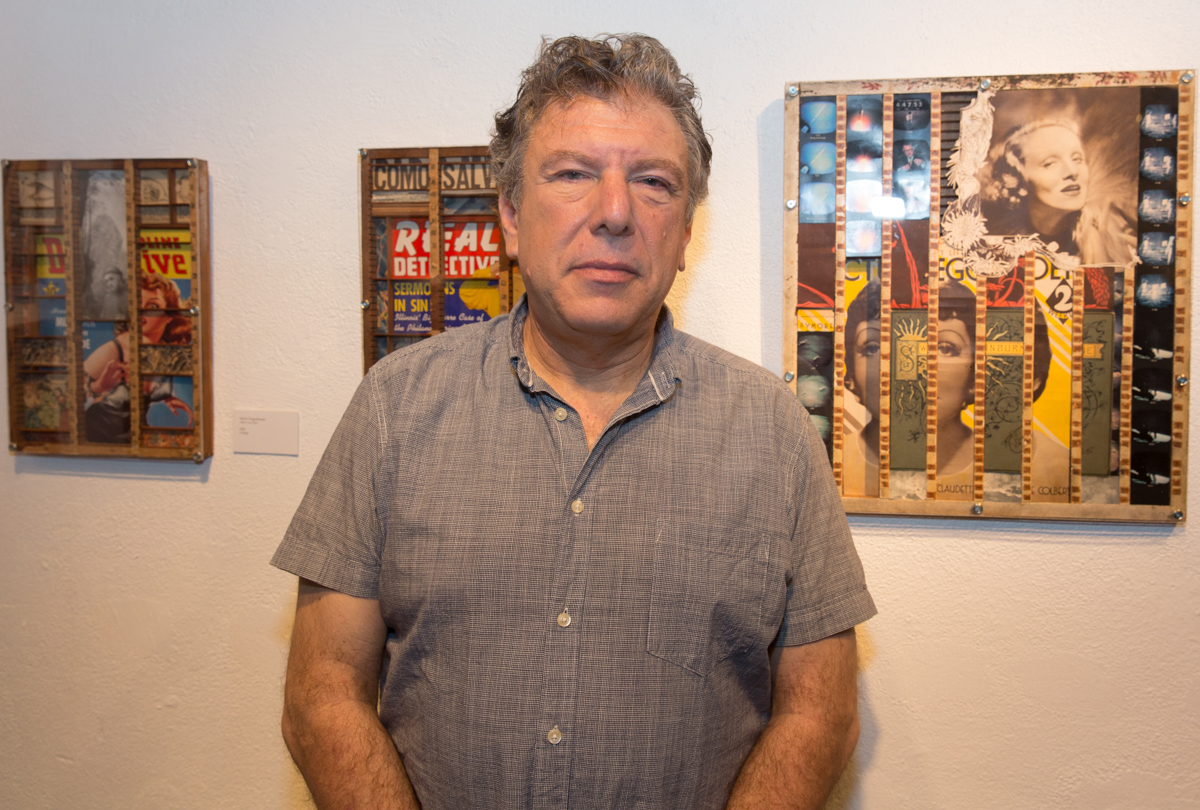
F23C6836

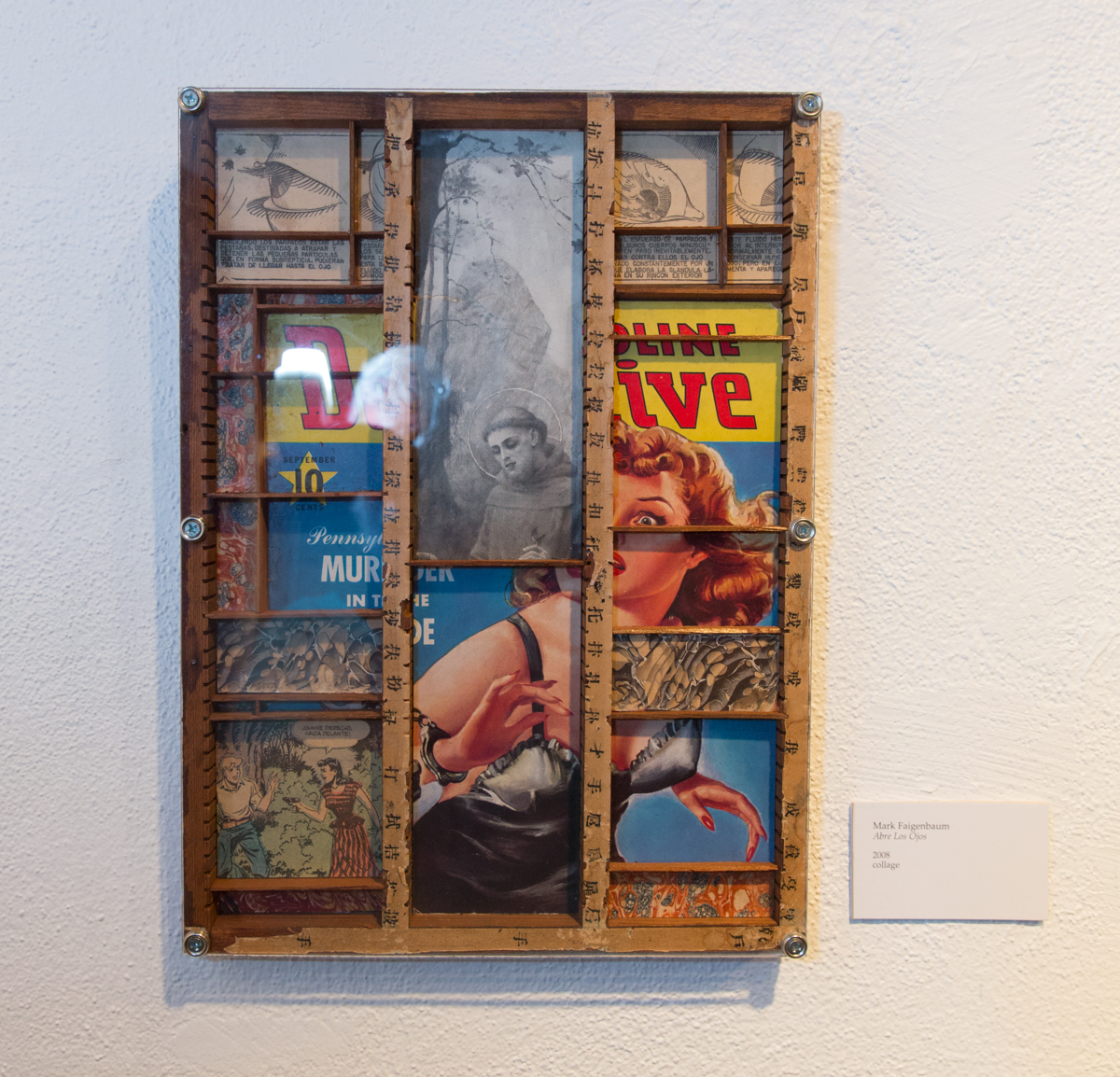
Above, Mark Faigenbaum.

Faigenbaum says “I love old movies and old movie magazines, which goes along with a theme of Hollywood and movie stars. I like people to fit things into their own narrative, whether I’m using old detective magazine style or old Chinese-type boxes. I work on a gut level.”
F23C6832

F23C6863

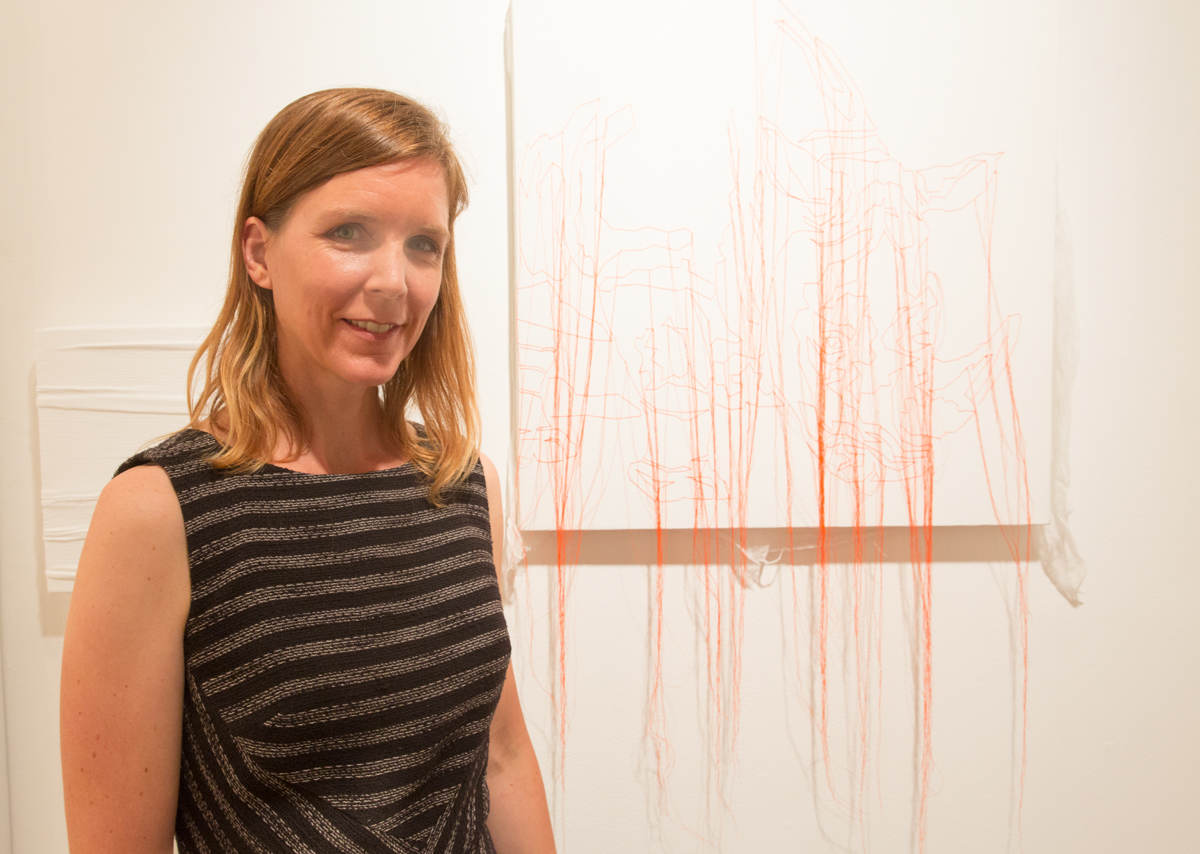
Above, artist and animal activist Karrie Hovey.
F23C6859

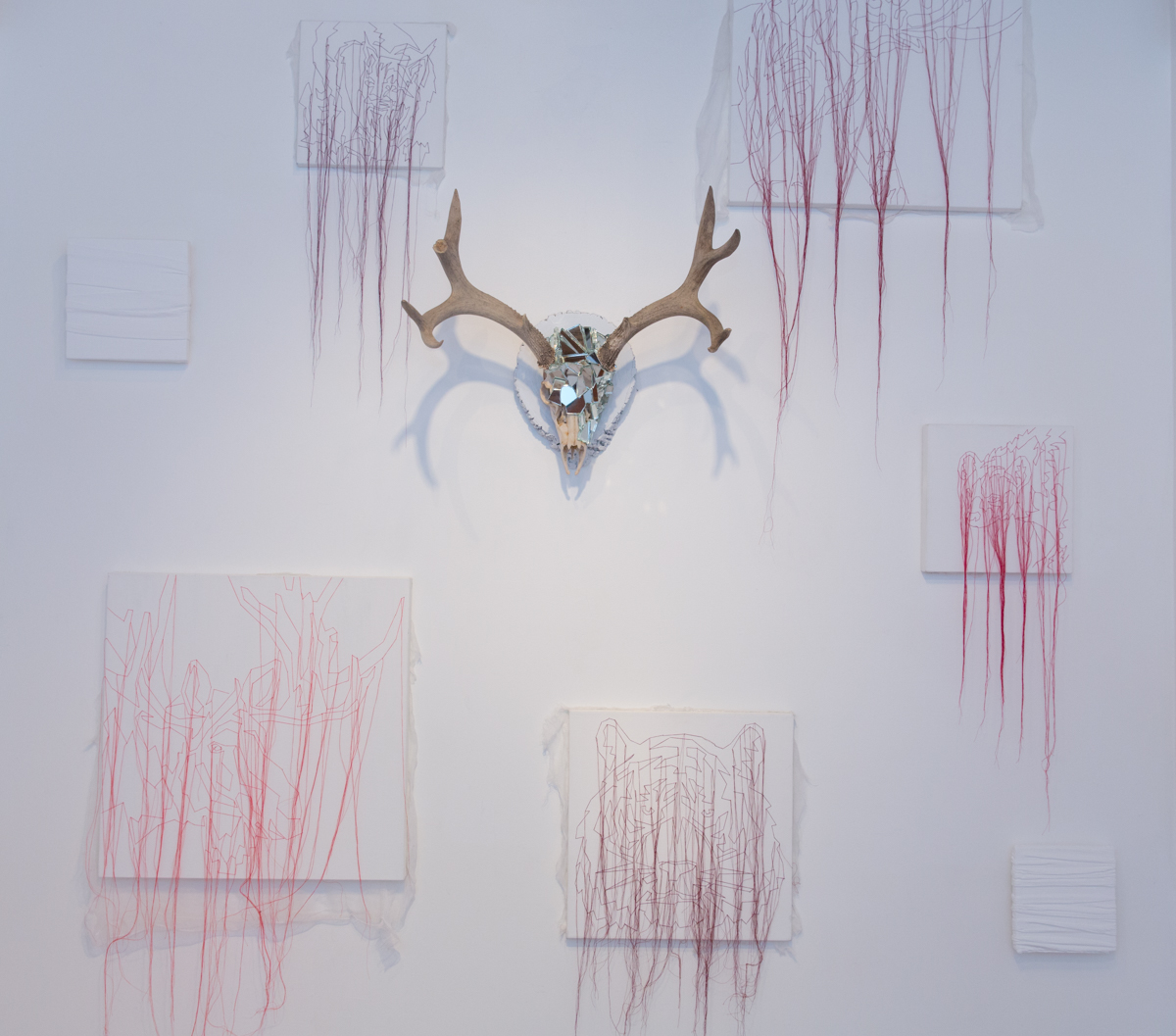
Hovey says “Recology is all material diverted from the trash, and here I used medical materials, such as bandages. I hold on to a lot of stuff, and it is difficult sometimes to know what I am going to do with it. In this case I could’ve wrapped the whole room in bandages, but went in a different direction.” Hovey works with the environment, focusing on Project Thron, which helps with the conservation of rhinos.  “That focus helped me create this Trophy Room. All the animals represented here are endangered or used for ornamentation or medical purposes, such as ivory. The bandages specifically relate to my work with the rhinos. If they are poached for their horns they are often not killed, but abused horribly to remove the horns, their faces. Bandaging can save them.”
F23C6876

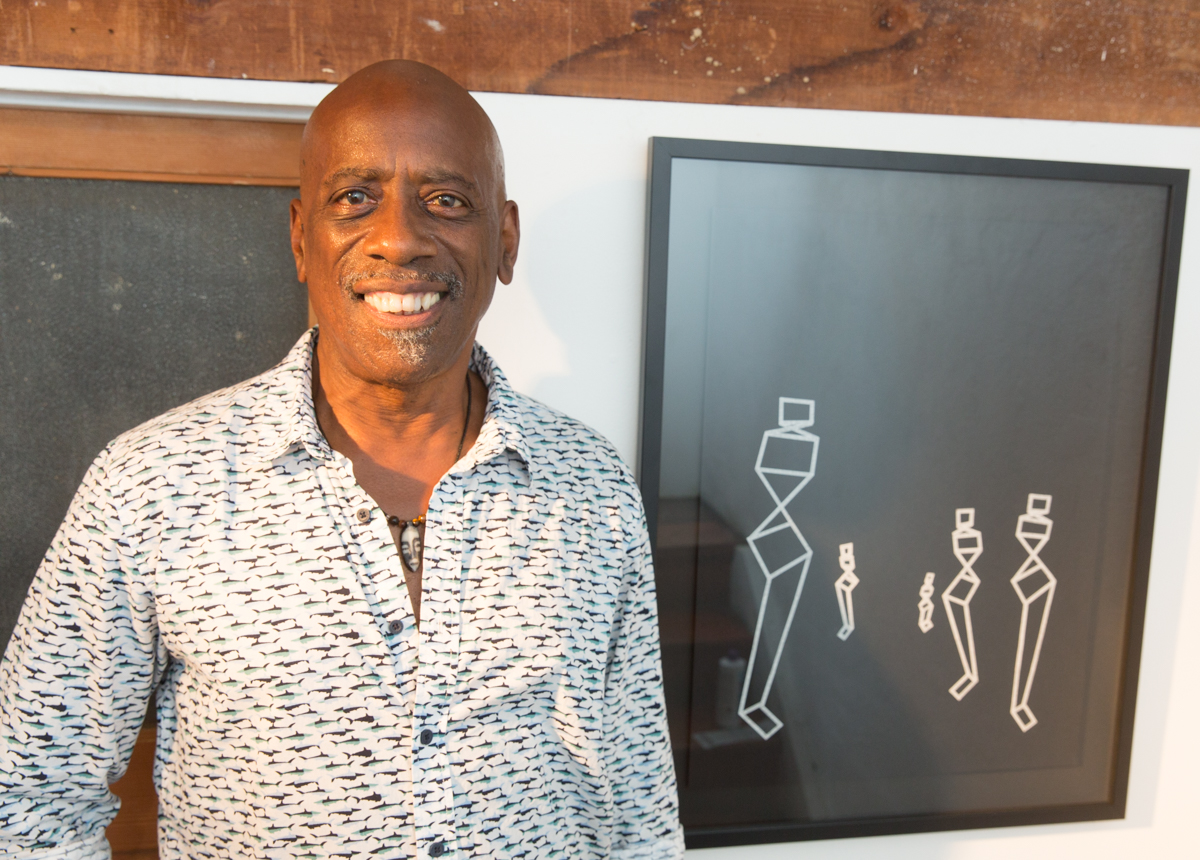
Above, artist Doug Pearsall.

F23C6888

Doug Pearsell describes his work as “repositioning material. These are pages from articles in Vogue. Normally, I work with ads, but these pieces are strictly text. I just  use both a figure, stories, a poem, and visually piece it together.  It’s minimalism. What I want to do to synthesize down to its quintessence, an idea that is essentially to converge out of ether.”

Don’t miss the August 20th workshop, or this terrifically artistic and ecological show.

The Loft is located at 453 S. La Brea in mid-city.

  • Genie Davis; all photos: Jack Burke
 

Corey Helford Gallery: Phantasmacabre with Allusions and Allegories

F23C7598

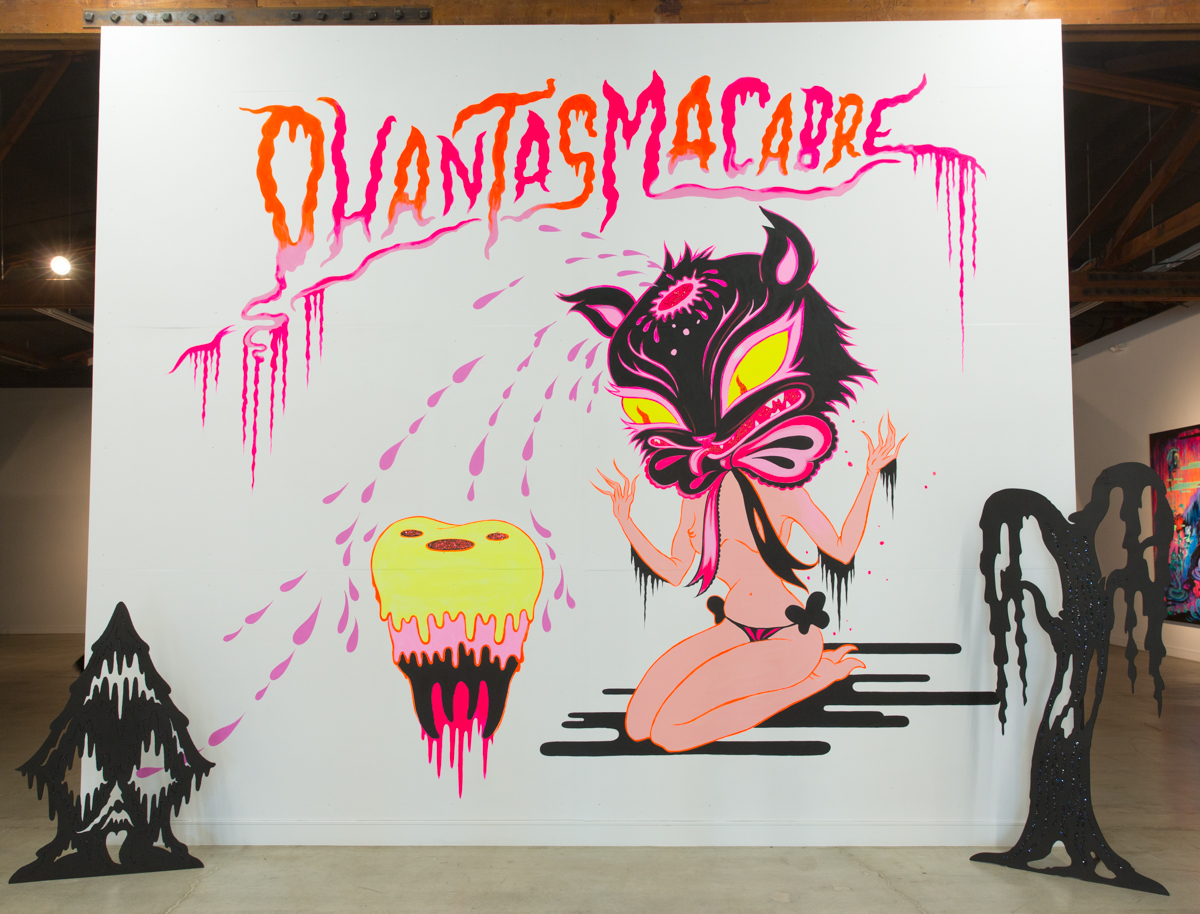
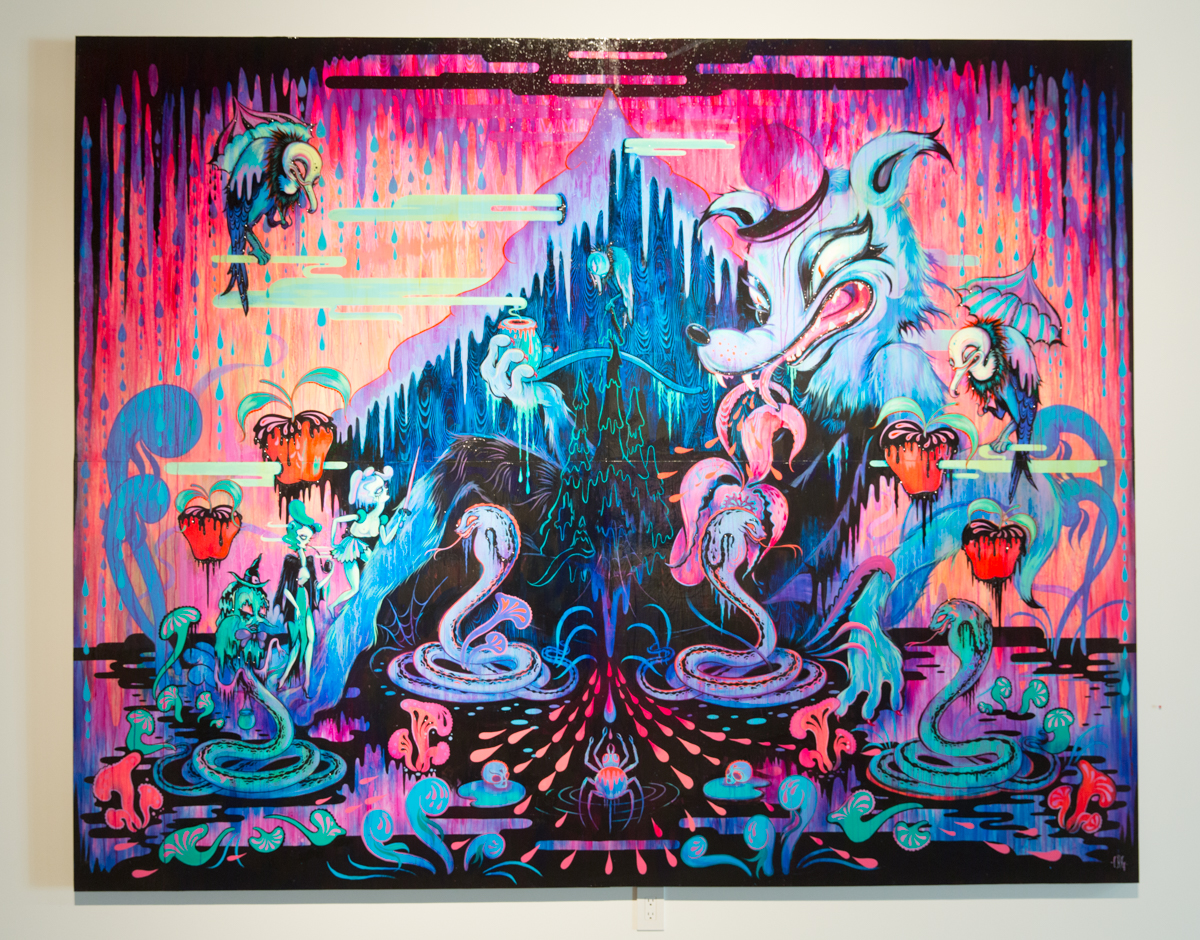
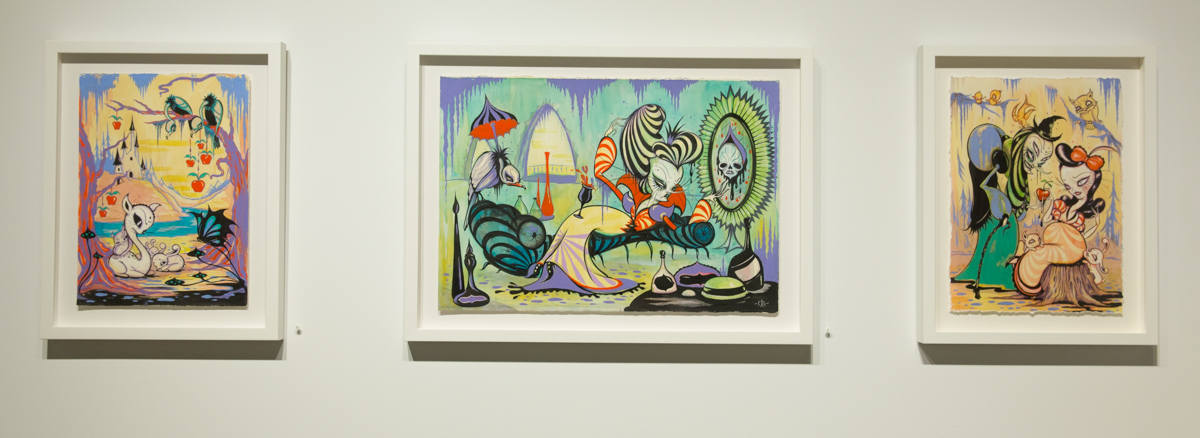
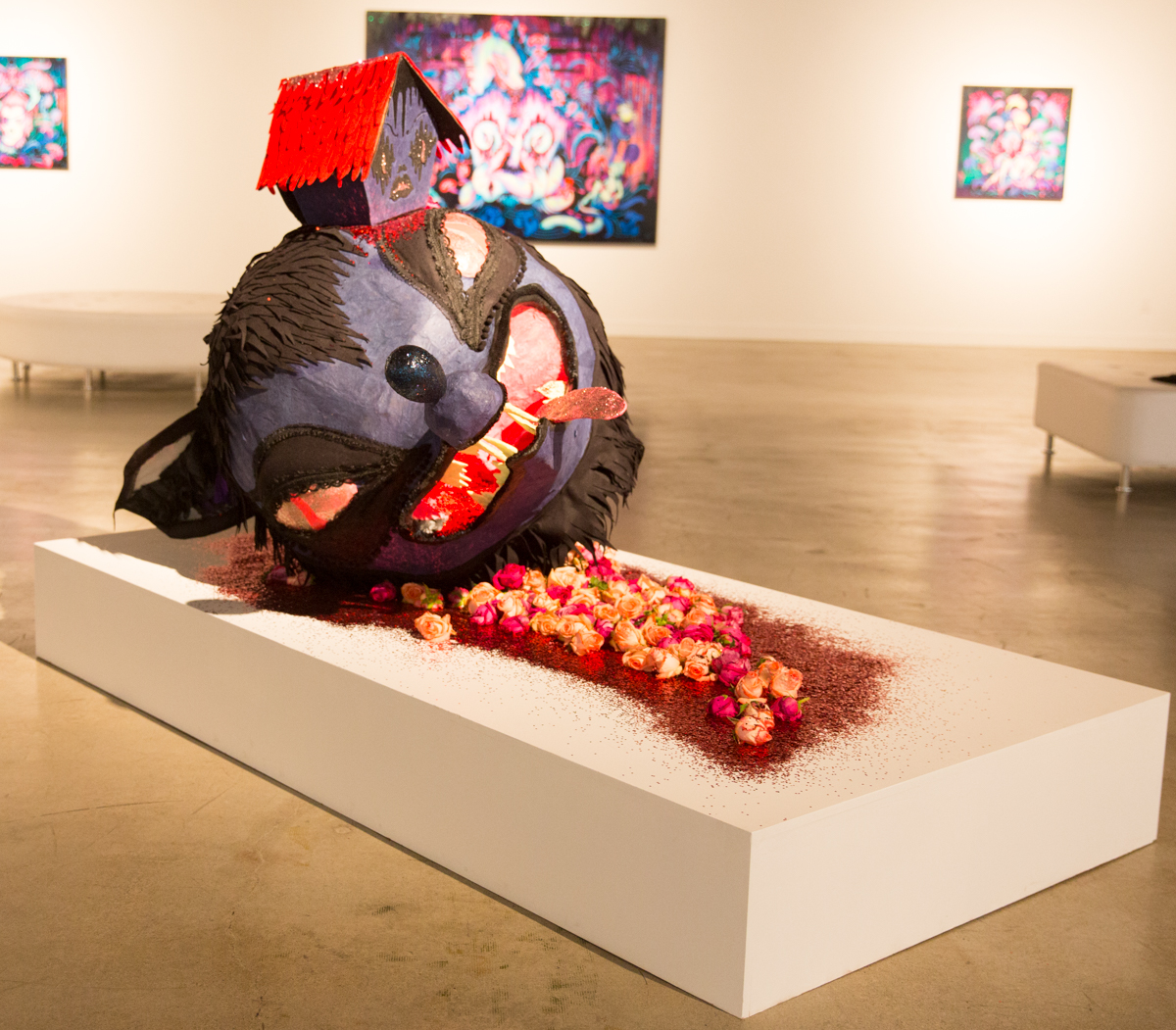
Running through August 20th, two powerful female artists take center stage at the Corey Helford Gallery. Camille Rose Garcia offers two separate exhibitions: Phantasmacabre and the illustrations of Snow White, while Jasmine Becket-Griffith presents Allusions and Allegories.

F23C7708

Both are the stuff of fairy tales and dreams, the mystical and the enchanted.

F23C7601

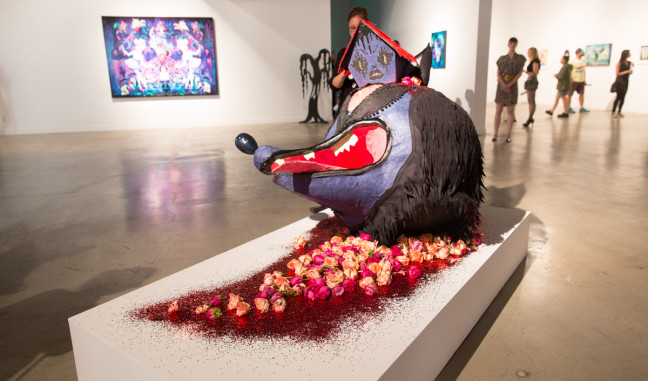
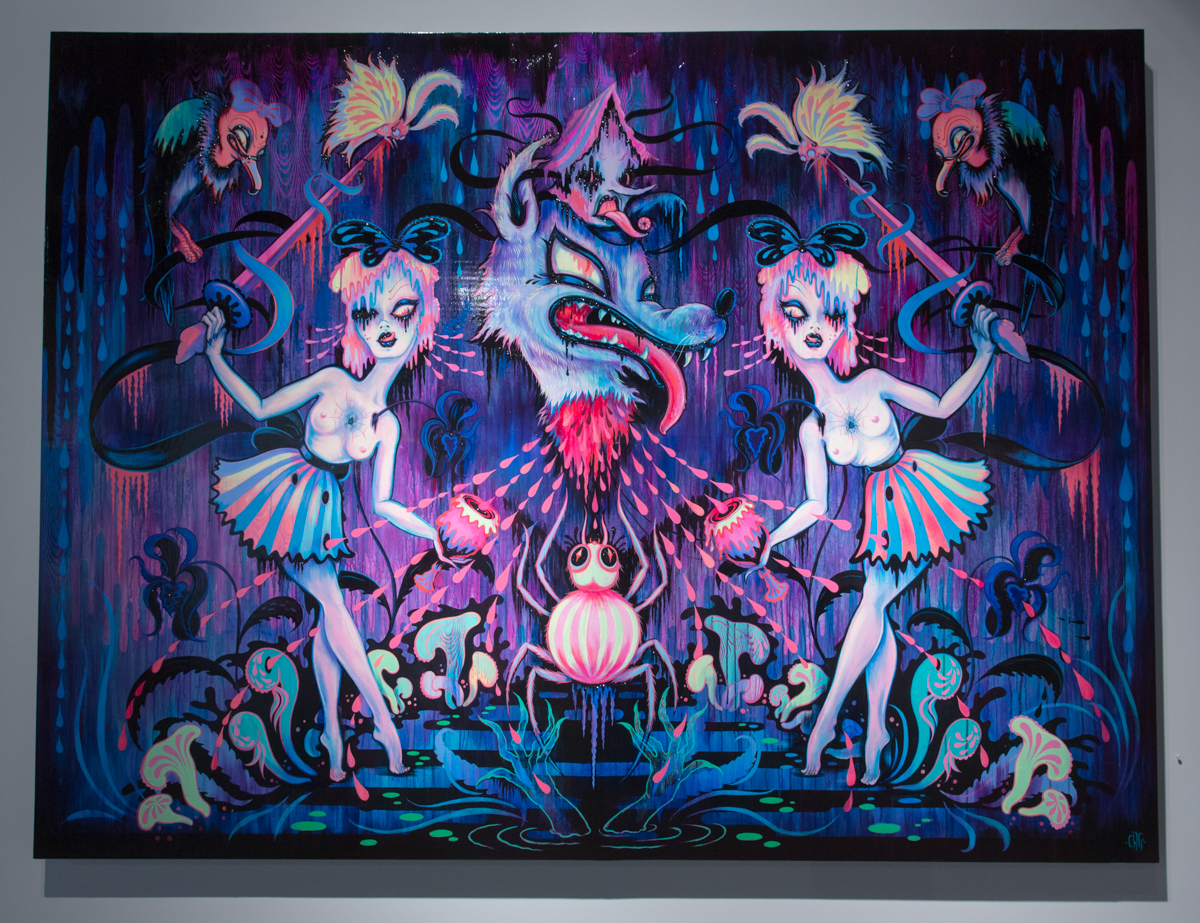
Los Angeles artist Garcia is a pop art surrealist, and in Phantasmacabre, in CHG’s main gallery, she spins gothic art that practically glows with color, art that sparkles with a kind of witchcraft. The paintings are huge, as is a humor-rich sculpture of the big bad wolf.

F23C7602

Not only large in scope but in intent, they’re crammed with Jungian references and influenced by the surrealist films of Alejandro Jodowsky.

F23C7664

Above, Garcia, looking as if she just stepped out from one of her canvasses.

F23C7609

Born of dreams, fragments of fairy tales, feminine symbols, the tangle of a forest, and the interwoven textures of childhood and myth-making archetypes, the fully formed result in a vibrant series of canvases that create a landscape of wonder. Beauty, fear, the nightmare and the promise: this is the language of Phantasmacabre.

F23C7610

“I was inspired by the idea of symbolic language, language as symbols for personal life. I made a deck of cards to create a series of associations, of personal symbols for my life and my personal message,” Garcia explains. “My paintings use that.”

F23C7613 F23C7606

In Gallery 3, Garcia’s Snow White illustrations create a new and surreal spin on the classic fairy tale. “I always try to find other dimensions of color and emotion,” Garcia relates.

F23C7623 F23C7617

Heading into Gallery Two, a whole new world emerges.

F23C7735

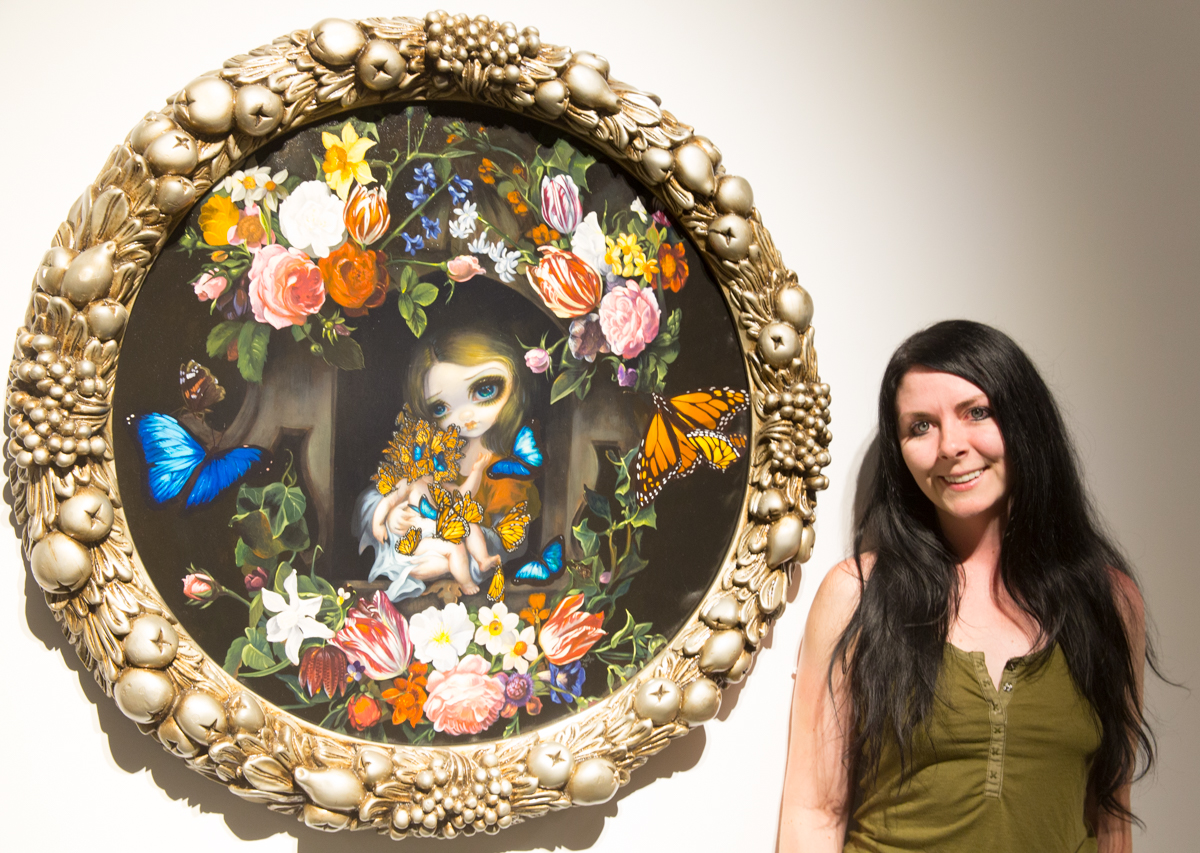
Above, Becket-Griffith and a wonderful work that morphs traditional and classic art with fanciful anime.

F23C7688

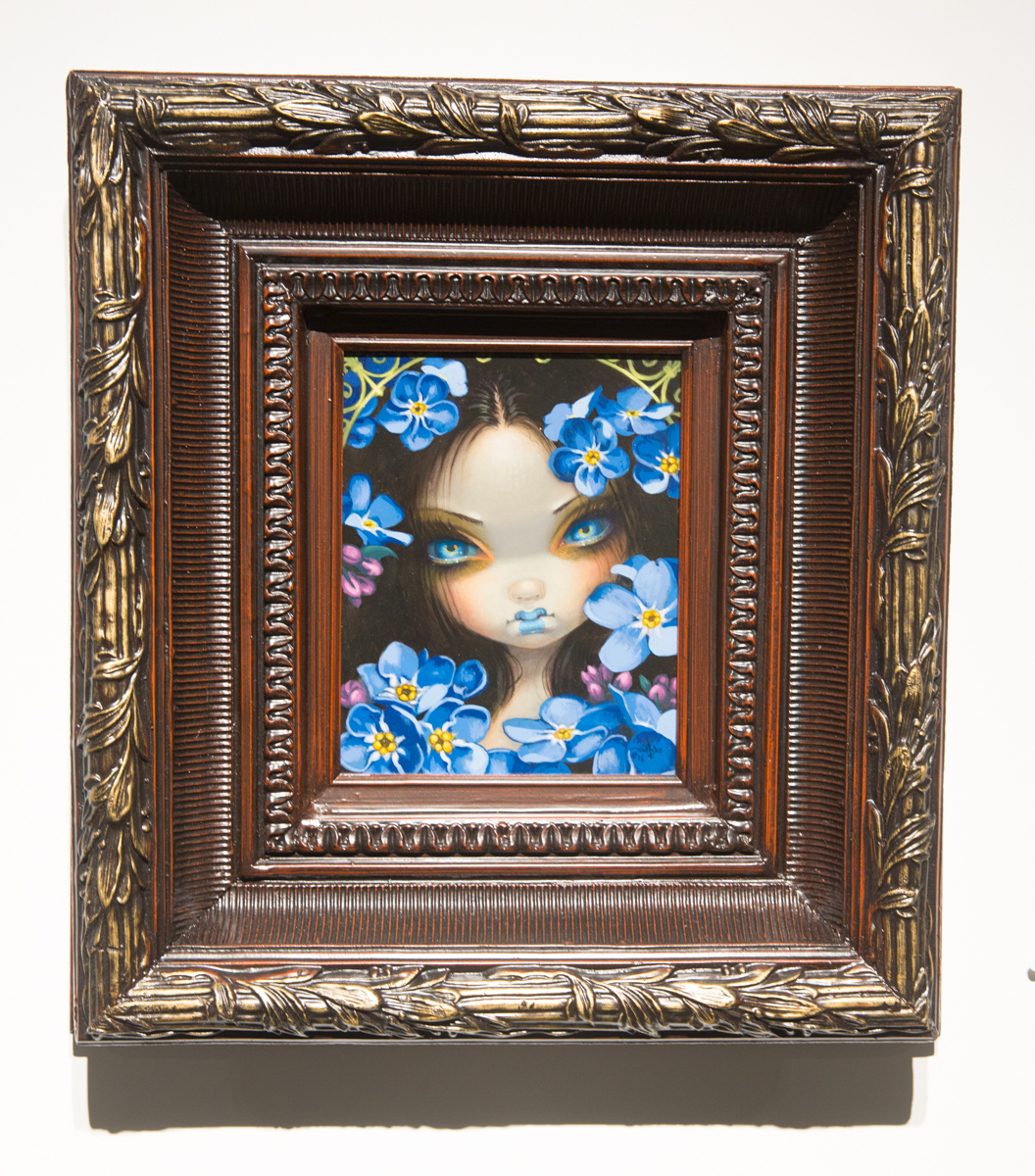
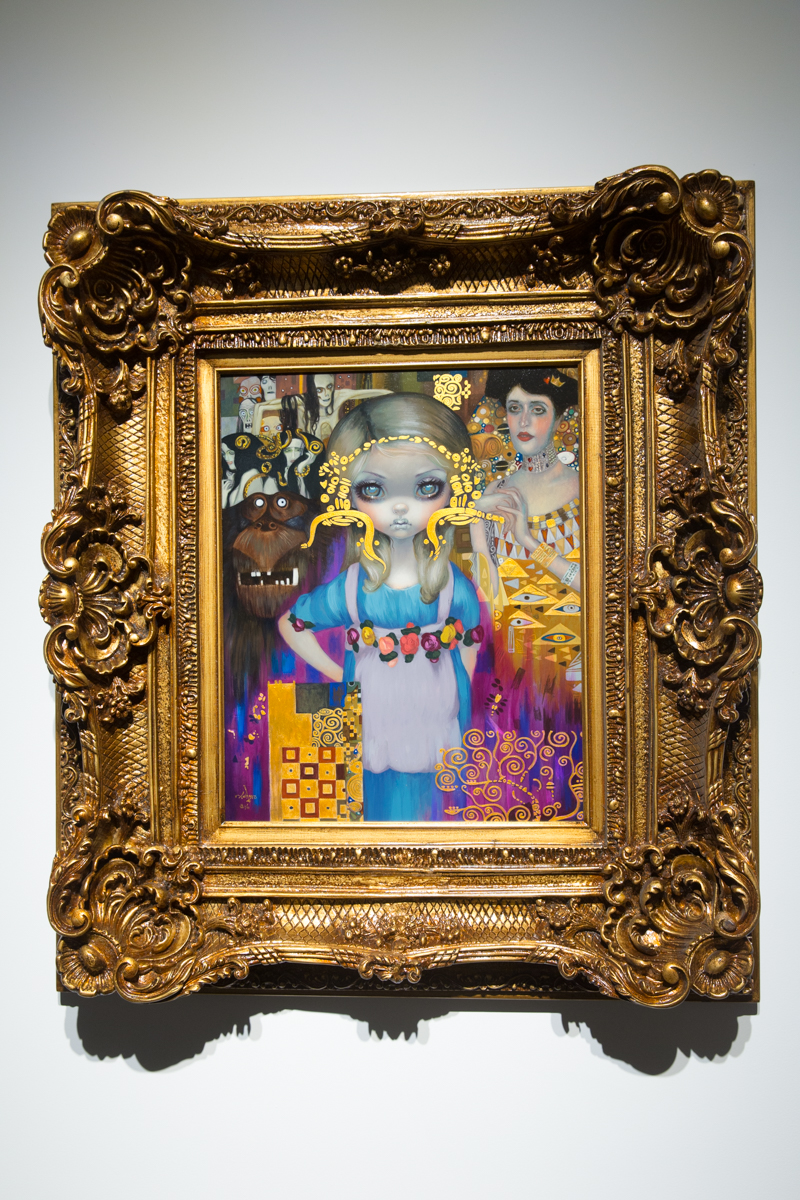
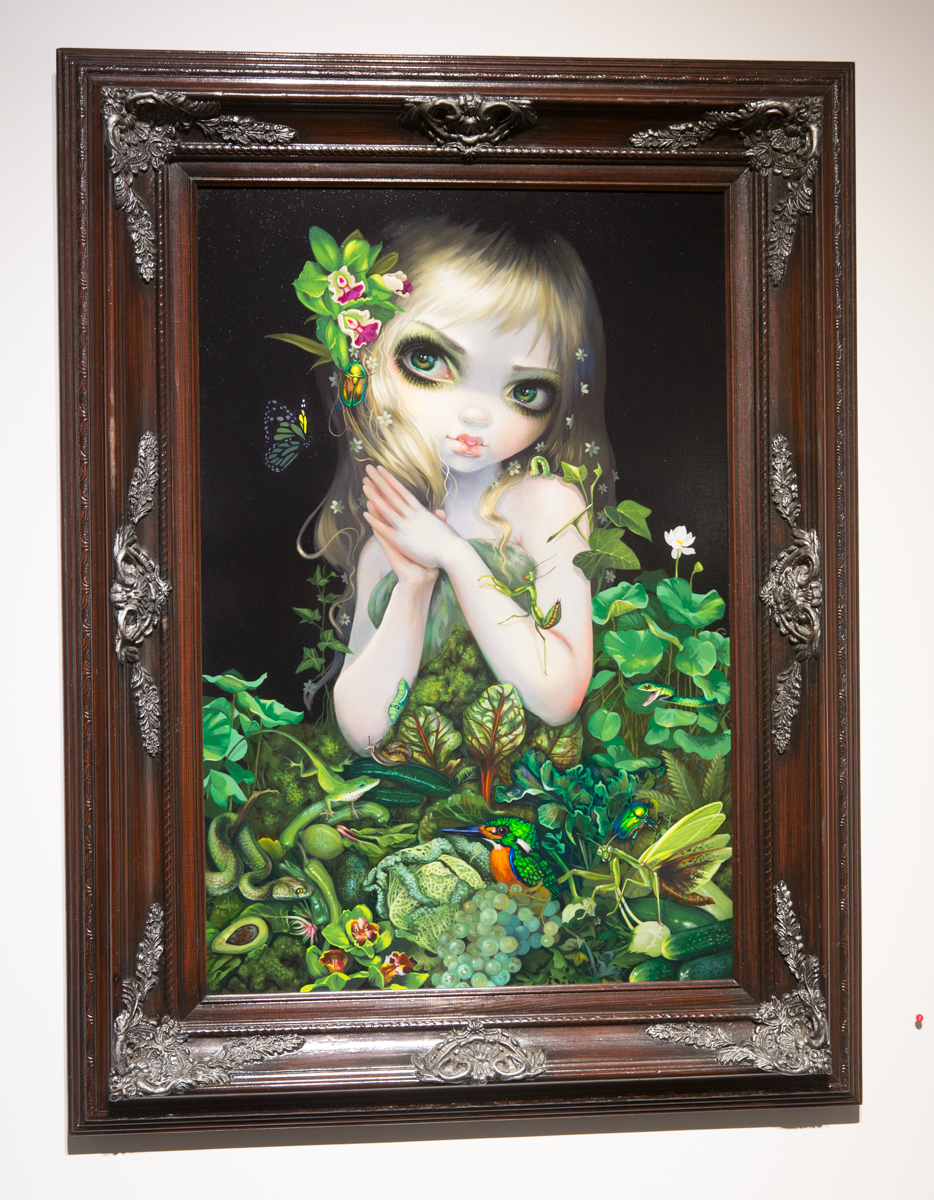
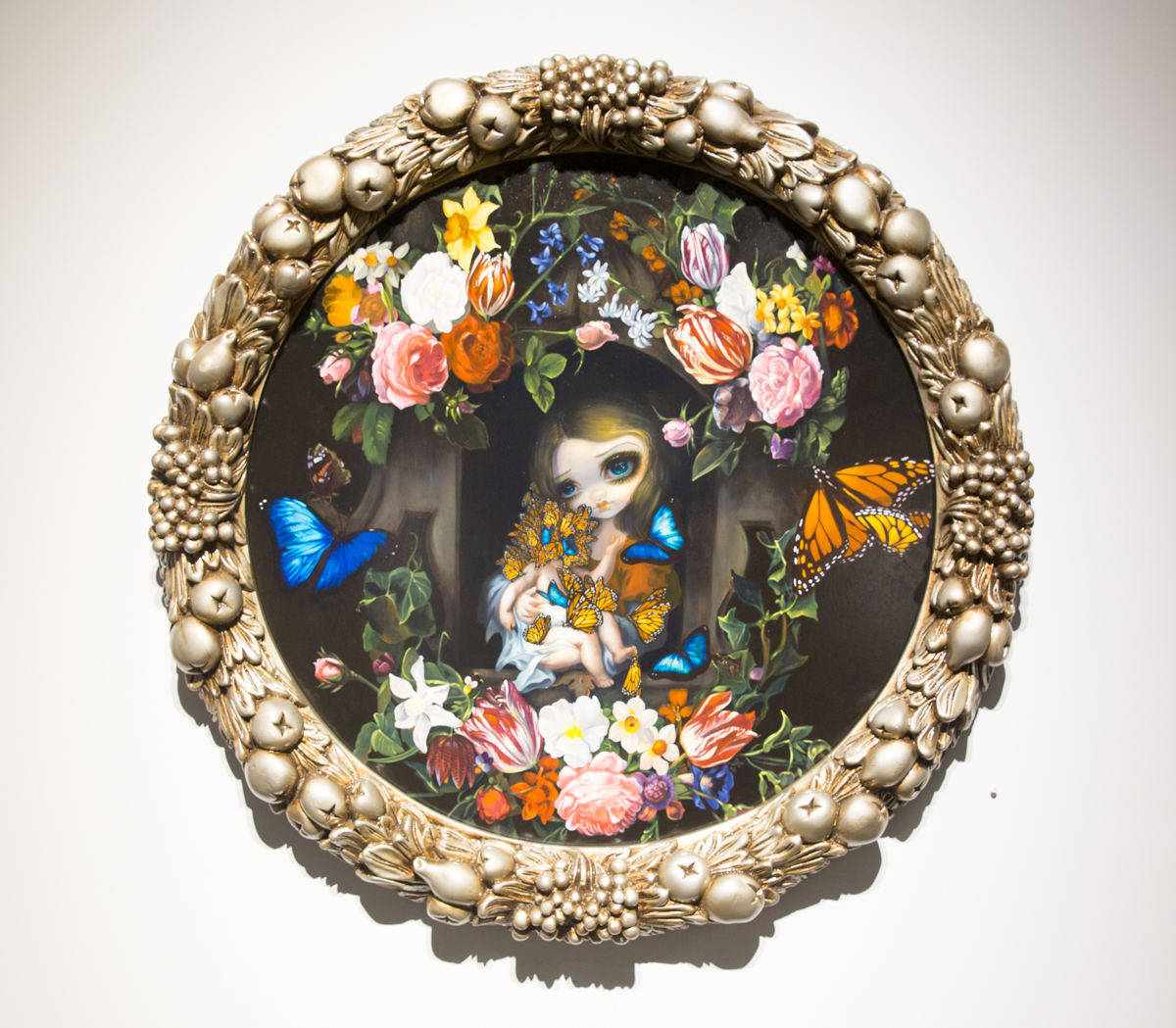
Becket-Griffith’s works in Gallery 2 have an equally female, mythic cast. Allusions and Allegories represents involved fantasy and fairy tales that offer a riff on anime as well as  classic art.

F23C7695

The Florida-based artist paints in a traditional style utilizing acrylics to capture a mix of the gothic and lyrical natural settings. She has her own licensing line with Disney, and exhibits at Pop Gallery Orlando at Downtown Disney in the Walt Disney World Resort. You can’t get more fairy tale than that. Like Garcia, she uses symbols and stories to create allegories, in this case, between art master works and magical imagined worlds.

F23C7706

“There’s a story behind each one of my paintings. I have created cartoons of myself and my sisters, I did anime work, and then I tried to make what I create more realistic and stylized, with references to art history and such artists as Klimt, Bosch, and Van Ellenberg,” she says.

Many of her paintings have antique replica frames uniquely created in resin, while others were carefully curated and purchased. “My husband ran a frame store before I met him,” she says.

She says of her work that “I’m trying to bring a bit of mystery into a mundane world with each piece.”

F23C7604

Mystery and magic: feminine epic adventures born of night flowers, strange symbols, and provocatively sensual color.

Find all of this in the works of Garcia and Becket-Griffith at Corey Helford. The gallery’s well curated walls are located at 571 S Anderson St. in DTLA.

  • Genie Davis; all photos: Jack Burke
August Brings Art on the Outside to West Hollywood

weho 5 the chase as well
The dog days of summer are considerably enriched by West Hollywood this August, where the heat is on: exciting new art installations sizzle on the streets.

weho 4 can you dig it

A vibrant collections of works include “Food-Prints,” a new entry in the “Can You Dig It?” sculpture garden in Plummer Park; “The Cube,” a 10-day, ‘round the clock solo performance installation in the heart of the Sunset Strip; and “The Chase,” large scale, origami-like steel sculptures on Santa Monica Boulevard.

WeHo Arts is offering an outside, site-specific public art program that captivates and enlightens.

Weho 3 Food Prints

Located in Plummer Park as a part of the “Can You Dig It” series dealing with California’s drought, “Food-Prints” by Brett Snyder, Edward Morris, and Sussanah Sayler uses wooden food sculpture in a whimsical zen-like dry garden to depict California’s most abundant native agricultural products.
This sculptural piece reveals how water use correlates to the food we eat. Food sculptures form a circle that reveals the item’s virtual water footprint. The style of the installation evokes the Zen rock garden of Ryoan-ji, one of the most famous in Japan. The placement of the installation itself close to the park’s weekly farmer’s market, references the past history of Plummer Park as a farm, as well as the produce vendors themselves. The installation is an interactive experience for viewers, including a guide that compares the water footprint of each food, from almonds to grapes, as well as exploring the footprint of the entire “art zone,” designed to represent the virtual water needed to “grow” a single piece of steak.

The garden itself offers a dual art experience: the garden is contemplative in nature, the large fruit and veggie sculptures are as playful as they are educational and appealing to the youngest visitors at the park. Revealing how water affects the food we eat, the duality of the exhibit is carried even further, revealing the differences between nature itself and our food culture.

Weho 1 The Cube

Located in the Sunset Strip’s city parking lot at 8775 Sunset Boulevard, Brazilian born artist, pianist and composer Manuel Lima offers a 10-day, around the clock performance piece from August 12 through 21. Lima will live in a translucent, sparsely furnished 10-foot-square cube. The purpose: integrating daily life with his own artistic process, and creating a meditation in a public space. His only time outside the cube other than rest breaks will be a morning shower and breakfast. From 9 to 5 daily, the artist will perform his composition “Sunset Blvd.,” riffing piano compositions based on what he hears moving from left to right on the FM radio dial. Then from 5 to 7 p.m., he’s take a tea break outside the cube, allowing viewers to join him for conversation. At 8 p.m, Lima performs an original light and sound composition, “Red Light Piano,” which utilizes some sixty music cycles each ranging from one to five minutes, with variations increasing in length each day of his performance, until reaching five hours in length. Then, near midnight, he will sleep.

This fascinating performance integrates place, personal space, and culture. This is not the inaugural performance for “The Cube;” he performed a 10-day trial near Valencia earlier this year. A metamorphosis for both the artist and the viewer, this experiential performance piece engages, stimulates, and changes both viewer and viewee through landscape and the creative process.

We Ho 2 The Chase

Place and process are also key with “The Chase,” origami-like shapes of steel that vividly depict the quest for survival. Created by LA-based public artist Hacer, there are four large scale sculptures along the median of Santa Monica Boulevard, starting at Doheny Drive. The works will be installed August 20-21. The abstract but highly defined pieces include “Coyote, Stalking” which looks east at its prey, “Rabbit Sitting,” unaware of the danger stalking it while scouting for food. “Coyote, Running” takes a sharp turn in an attempt to gain on “Rabbit, Running,” who is now facing the eyes of the hunter. The sculptures form an open-ended quartet in terms of story: each animal is fighting to survive in a land of limited natural resources. Who survives is left to the viewer. The sculptures are powder coated steel, and evoke the tension of a predator on the prowl, the leap toward escape by the prey. Motion captured and frozen in a monumental moment in time, these pieces are meant to create a sense of commonality – we are all in this together – as well as expressing differences. Hacer was inspired in this work by the book Sadako and the Thousand Paper Cranes which he read as a child. The sculptures share a playful and conceptual approach with the works of Alexander Calder and Jeff Koons. Hacer notes “Like the dynamic, formative process hidden by my seemingly simple designs, my work’s simple existence aims to elicit a dynamic response about the viewer’s relationship to their formative process: childhood.”

In combination or viewed separately, these three public installations offer an insightful experience for the viewer, one that immerses viewers into a different world – of predator and prey, a partnership in the eco-system, an intimate engagement with creative process, and a learning experience involving drought, food ecology, and meditation.

Entering that world, summer doldrums slip away. These exhibitions resonate a powerful artistic vision in West Hollywood. Don’t miss them this August.

CA 101: Mall Art Gets a New Meaning

CA 20

Mall art used to conjur up images of blah Andy Warhol prints and tepid ocean views. No longer.  The 2016 edition of the CA 101 art exhibition is located in the South Bay Galleria shopping mall in Redondo Beach, and is packed full of fascinating artworks from paintings and photography to some stunning installations.

CA 101 runs through July 31st, and should be on anyone’s shopping list. Produced by the Friends of Redondo Beach Arts (FRBA), a non-profit organizationpromoting the arts in Redondo Beach, the opening last Friday was jam packed with art lovers – over a thousand, in fact, visited this former clothing store.

The 5000-square-foot-space was divided into two spaces, the CA 101 Gallery and the CA 101 Affordable Art Store, where original works were for sale at $200 or less in price.

Curated by Nina Zak Ladon and exhibition director Sandra Dyer Liljenwall, the exhibition changes locations throughout Redondo Beach every year, with artworks chosen adapting well to their varied environments – last year, the former AES Power Plant near Redondo’s waterfront. The Galleria location led to some pointed and wonderful pieces that reflect the space, from body image to sexuality, from commercial culture to feminism.

CA2

Above, Bibi Davidson and Dwora Fried combined forces to produce an installation located, as most of the installations were, in the former dressing rooms of the store. Their “Peeping Tom” depicts a transgender man spying on a woman in a dressing room, not for titillation, but to learn how to properly wear a bra.

CA3 CA4

The lively, fun piece had viewers buzzing.

CA5

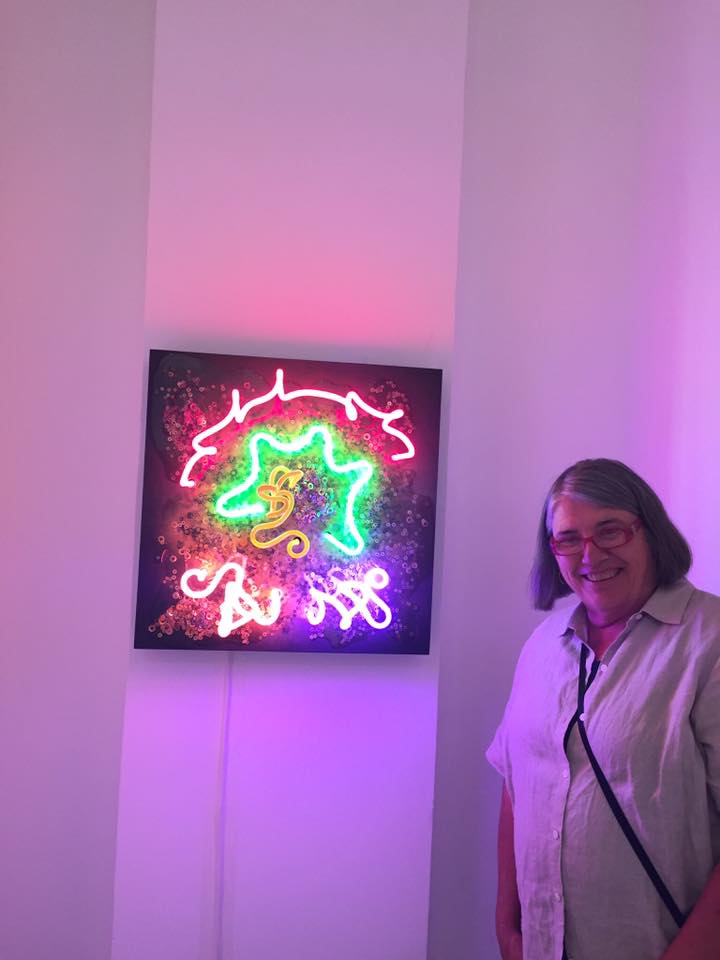
Above, neon artist Linda Sue Price exhibits “Jesse,” an homage to her father. The beautifully symbolic piece included references to their conversations together, his love of Chinese food, and his work with machinery.

CA6

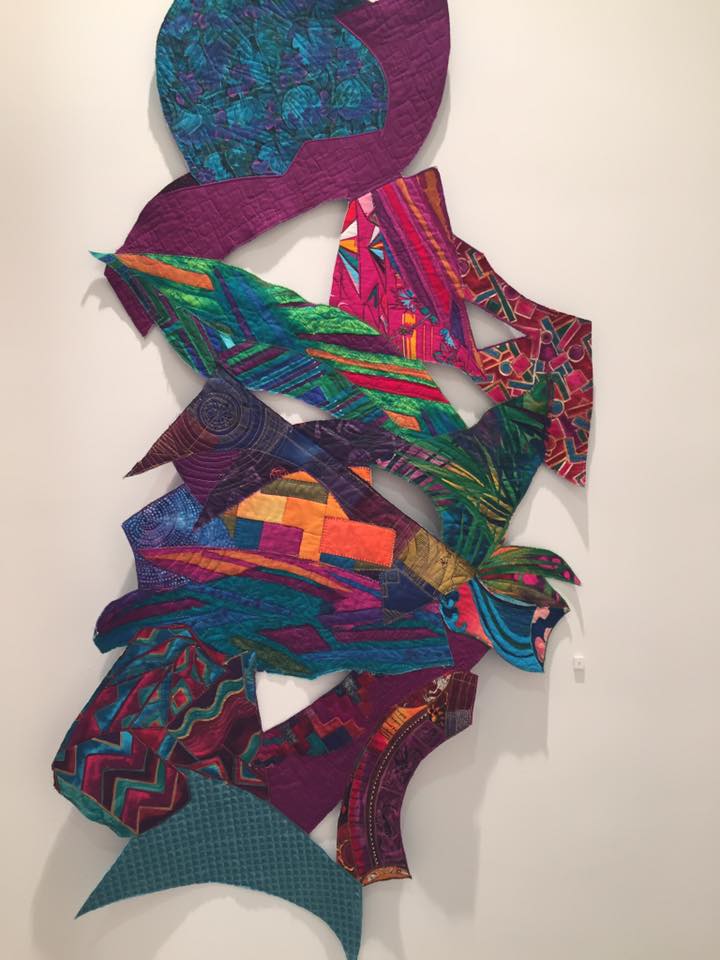
Above, the work of Sandra Lauterbach, whose beautiful fabric work befits this former-clothing-store location. The piece is titled “Materials Matter! Why textiles?” and features bold, dimensional abstract work.

CA7

Above, Janet Johnson’s “Up a Tree” provides a whimsical take on the yarn bombing movement.

CA9

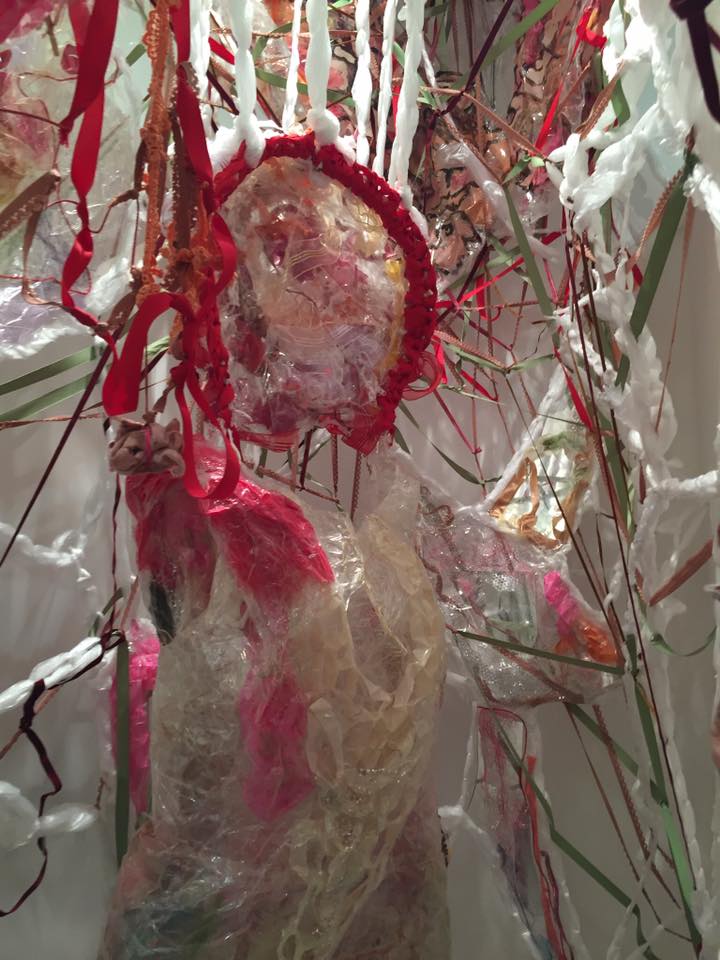
Above, a close-up detail of “Butcher’s Window” by Katie Shanks and Stephanie Sherwood, which creates a static shell as container for human bodies – and the fetishized flesh of our society. As with many of the works here, there is a focus on consumerism, consumption, and society’s view of the body – and soul.

CA10

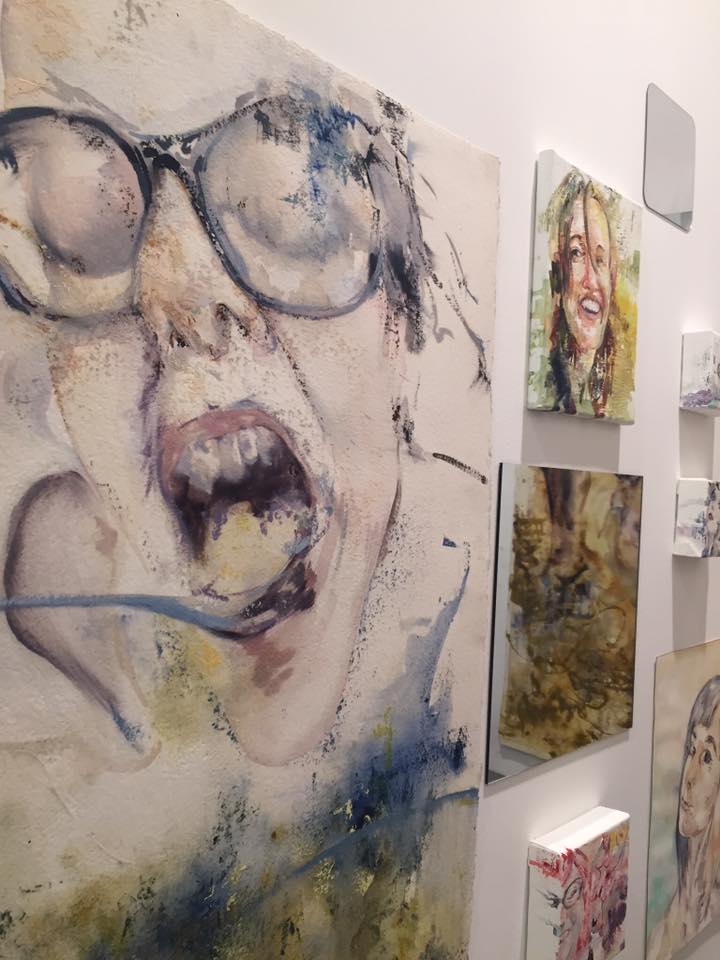
Above, paintings by Sheli Silverio are part of “The Selfie Experiment.” The artist utilized selfie images sent to her to create painted conversations of self-perception.

CA13

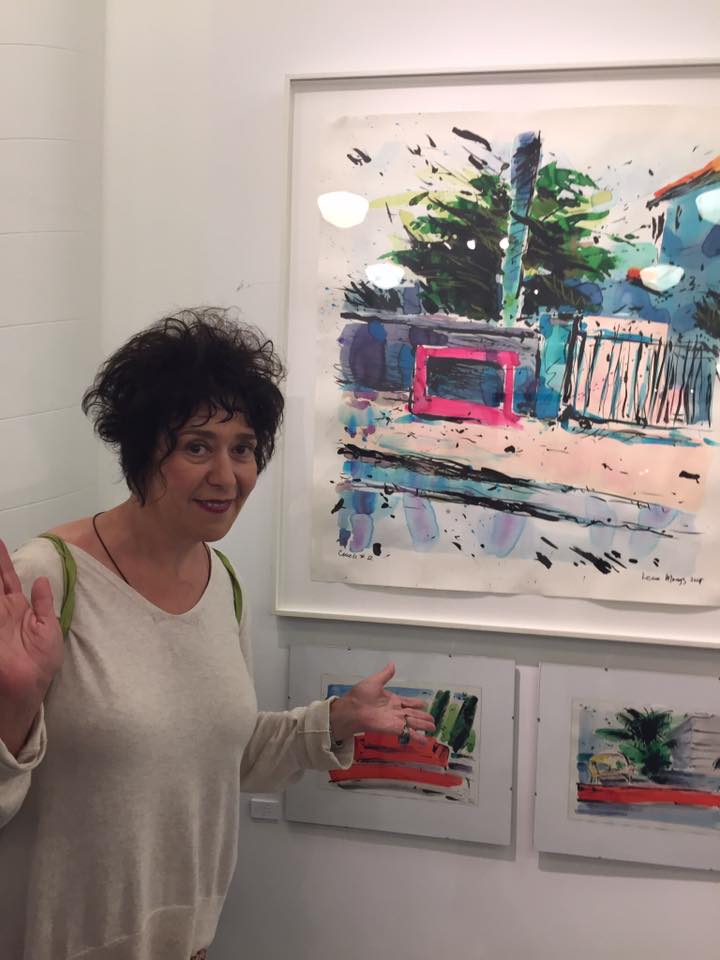
Above, Lena Moross’ beautifully lush impressionism features one of her favorite colors, red.  Her watercolors are as rich as if they were painted in oil.

CA26

Above, artist Andrea Kitts Senn with her “Chromer,” part of a collection of pieces focusing on bones and beasts, whose dazzling form represents the essentials inside – when stripped of flesh and fantasy.

CA 1

Above, Cie Gumucio with one of her two installations at CA 101, this one focused on what the artist terms “the grace and ease of sculpted fabric.”  This piece, “Open Windows” uses mirrors and video footage, the latter culled from years of filming, to depict both “promise and possibility.”

CA 11

Above, artist Malka Nedivi with her exhibition first place prize winner, “Home Nest.’ A mix of paintings and sculptural forms shaped from cardboard, this beautiful instillation is a dreamy and elegaic tribute to the comfort and memories of “home.”

CA 14

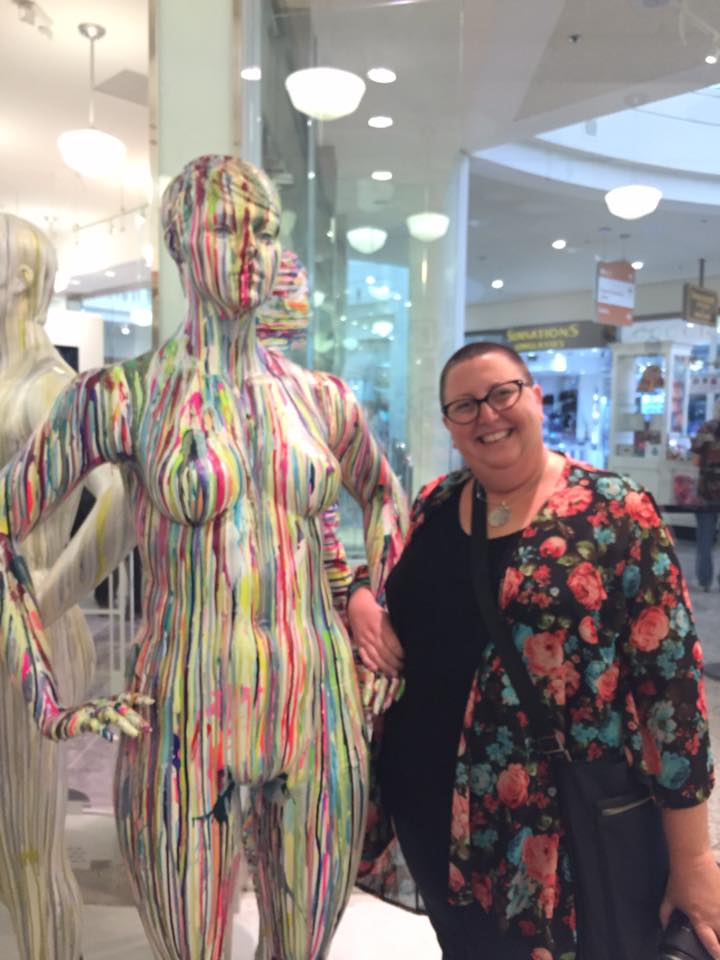
Above, artist Kristine Schomaker with one of her mannequins, subjects in her “A Comfortable Skin” series. Schomaker aims to alter societal obsession with body image, and heighten self-awareness. She uses her gorgeous, multi-hued palette to engage viewers’ eyes and function as a metaphorical mask, a skin hidden behind.

CA 15

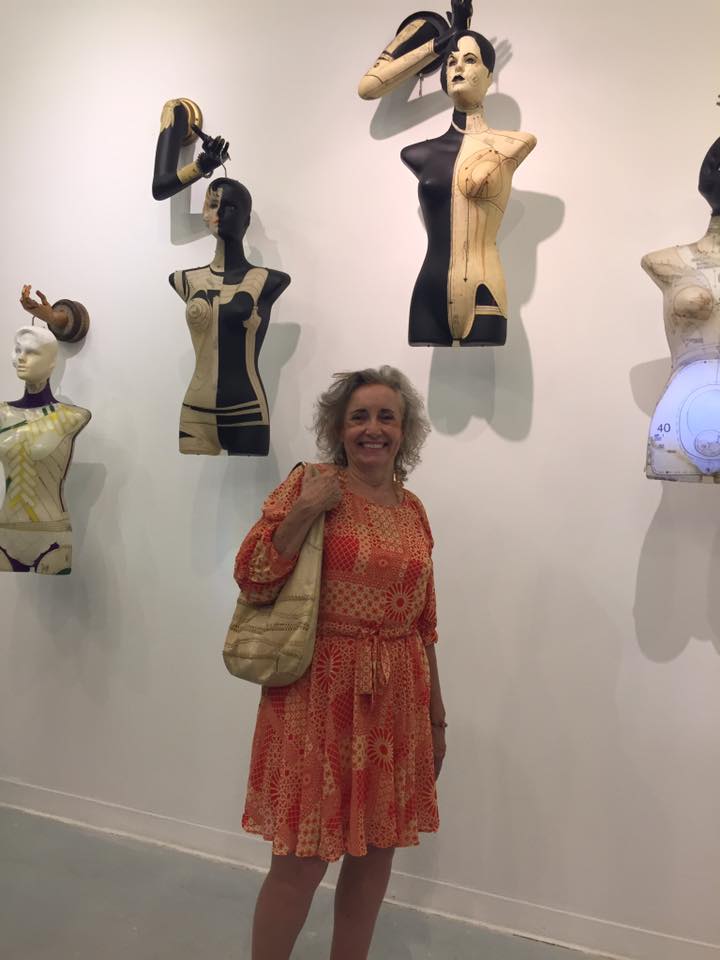
Above, Susan Melly with several of her works, which dynamically explore female identity, fashion, and power. Inspired by her mother’s work as a seamstress, and her use of powerful sewing machines, Melly takes retro dress patterns and the female form, and re-purposes both in images that suggest ritual tattooing.

Melly, Schomaker, and Senn are all focusing in their own distinctive works on body image, on strength, on what goes on beneath the artifice of clothing and skin. Likewise, L. Aviva Diamond’s “Window Display, West Hollywood,” which graced the exhibition’s catalog cover, took on the perception and portrayal of the female form.

CA 18

Above, artists Malka Nedivi, Chenhung Chen, Bibi Davidson, and Susan Amorde.

CA 19

Above, Chenhung Chen with a sinuous, sensual sculpture that is a part of her Entelchy series. Chen’s work here evokes the feminine form.

CA 21

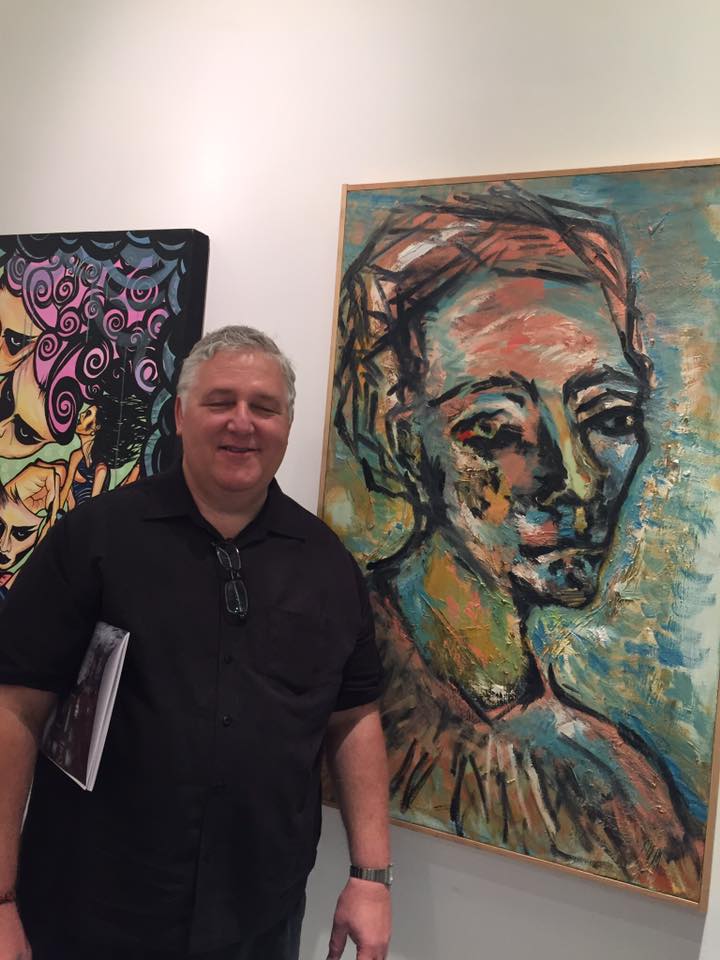
Above, Scott Trimble, whose marvelously poignant portraits create a look into the soul.  Trimble has several pieces in the show, each with evocative, nuanced impressionistic style that is distinctly his own.

CA 22

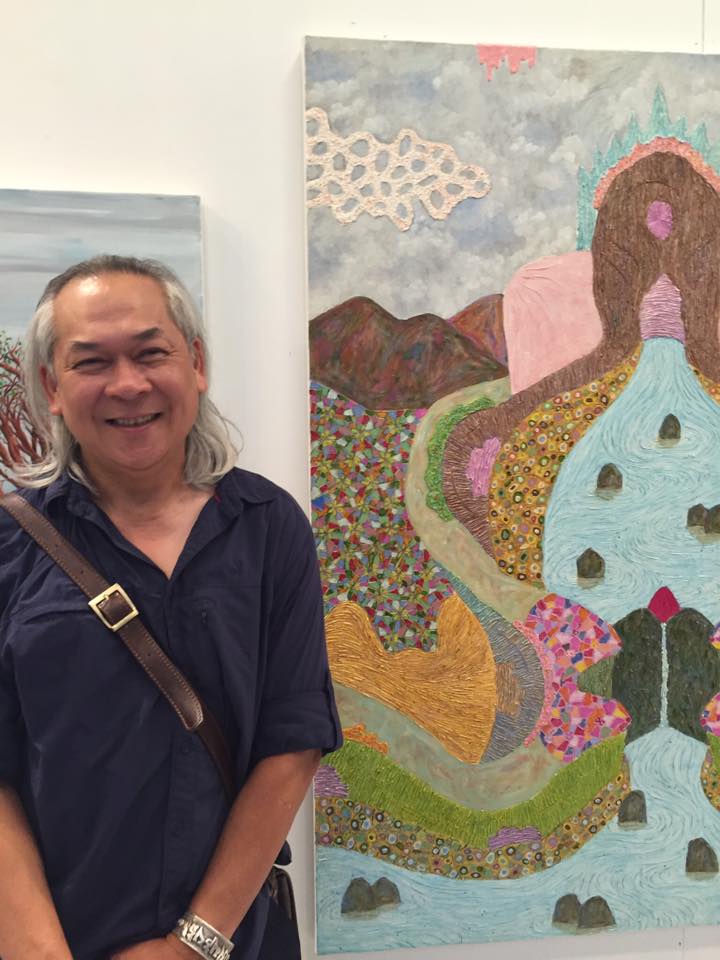
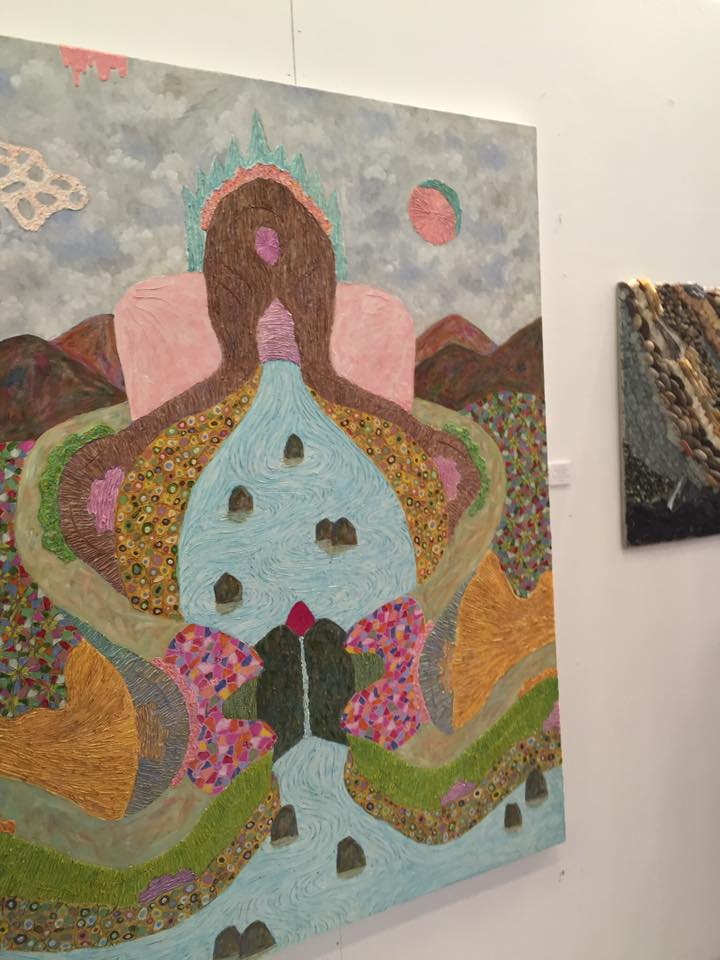
Above, Hung Viet Nguyen with his “The Queen/Sacred Landscape II,” a beautiful, mystical piece with a mosaic-like quality and jewel-colored glow. Detail, below.CA 23

Other pieces that were standouts in the show include Mike M. Mollett’s installation, “Winter in the Poet’s Garden II,” a forest of sticks and pipes and poetic phrases scattered like leaves below them; three dimensional work by Shelly Heffler;  Steve Fujimoto’s take on commerce, “The Task,” and Ellen Riingen’s abstract brown on brown planes in “Redondo Beach Strolling.” Photographic artists Jane Szabo and Janet Milhomme each created profoundly strong images as well, Milhomme depicting views of architecture looking in, and Szabo depicting two works, including a uniquely individualized dress as the armature of the person unseen inside.

jane

Above, Jane Szabo with curator Nina Zak Laddon.

With over 240 artworks on display, not every artist is mentioned here, of course – but each is well worth experiencing.

Don’t miss the mall art this weekend in Redondo Beach.

  • Genie Davis; photos: Genie Davis and Jane Szabo