
15 Cubic Years – Artwork of Robert Costanza

F23C6545

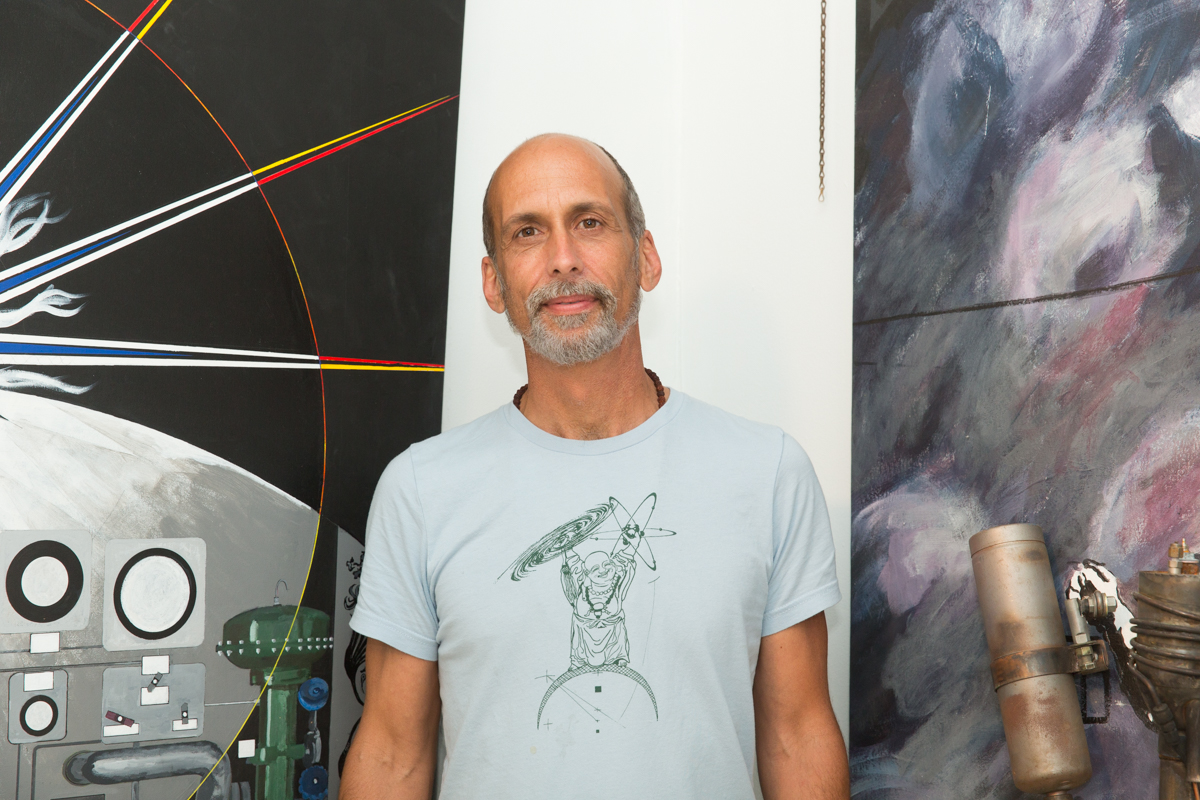
Above, artist Robert Costanza

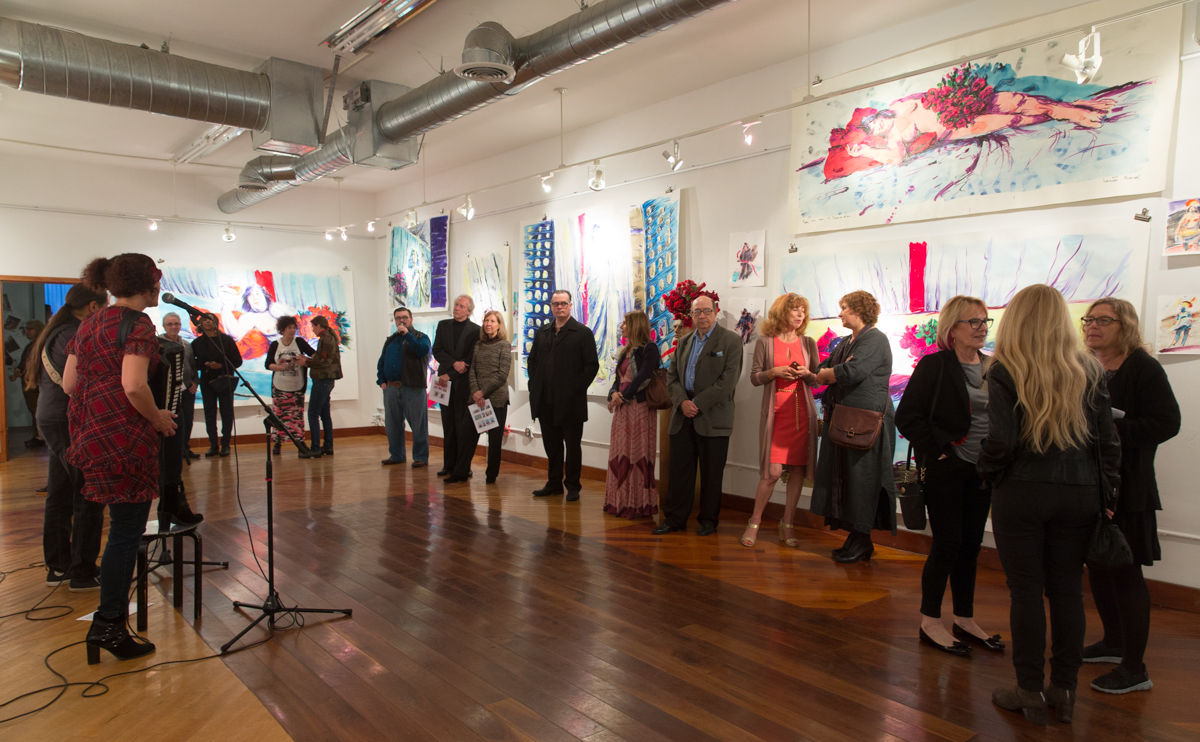
Robert Costanza has done an incredibly brave and beautiful thing. He’s laid out his life’s work in his artwork on the walls of the Neutra Institute Gallery and Museum in Silver Lake.  The show is closing this weekend, July 3rd, and it’s a don’t-miss event.

15 Cubic Years follows the artist’s spiritual, artistic, and life journey, intimately revealing his trials and tribulations, successes, and failures.

“Initially it was going to be called ‘From the Darkness to the Light,’ because of the new, more spiritual direction my work was taking. I was looking at art as a spiritual path. I was hoping it would inspire artists to be inspired into evolution,” Coastanza relates.

Settling on 15 Cubic Years as a title, the works are less an exhibition than a connected portal through time. It revels in ideas and themes about connectivity and power: human, electric, steam, new technology. His engineering and teaching skills are as much a part of Costanza’s work as is his artistic skill. Connected, indeed.

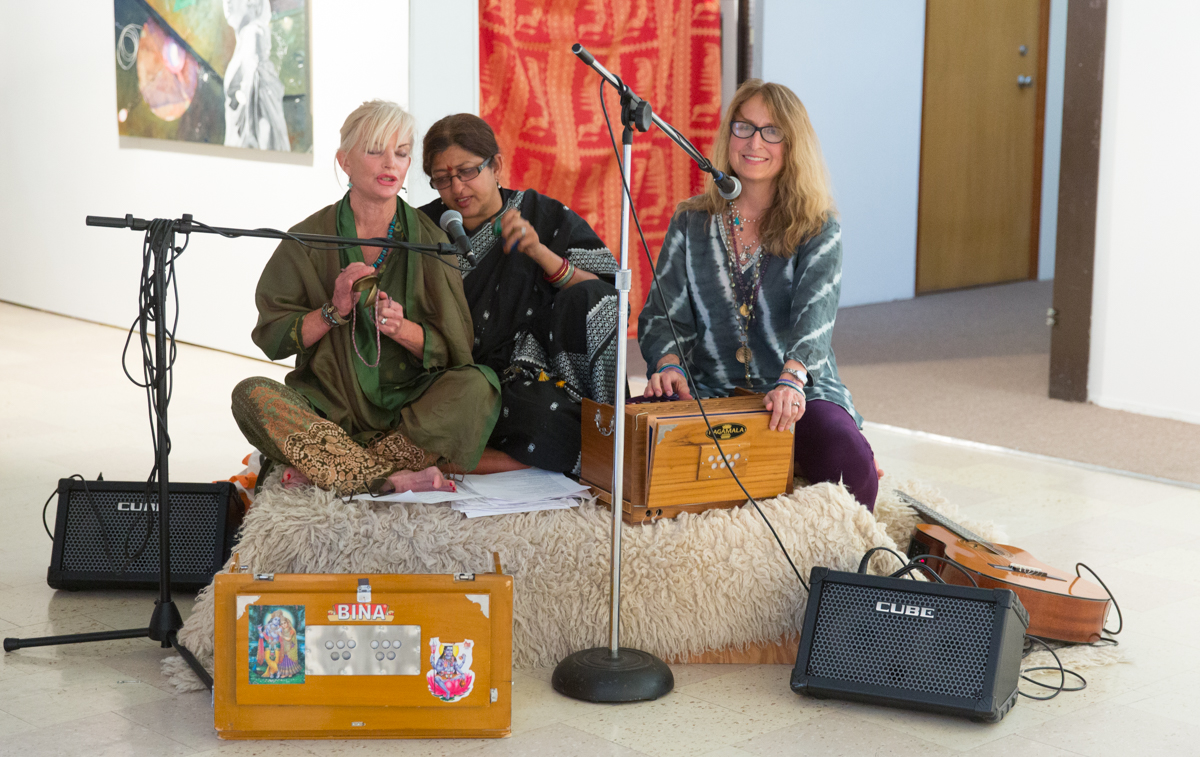
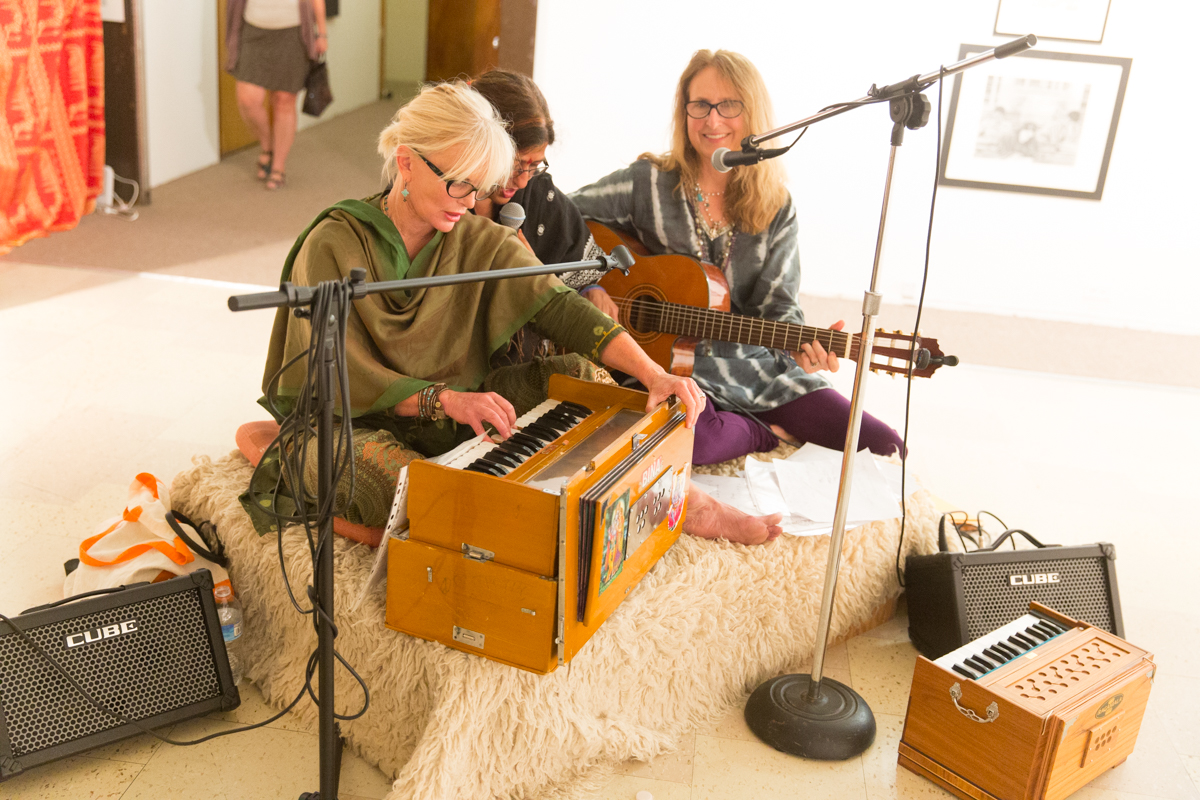
At the event’s opening June 18th, Costanza’s work was punctuated, much as his personal life is, by meditation and music. Below, the Om Shakti Family.
F23C6546

Curated by Dulce Stein, this wildly exciting and highly kinetic exhibition traces 15 years of the artist’s life and art. Paintings, mixed-media, installations, and a video experience lead viewers around the ample gallery space to absorb Costantza’s witty, science-laced, and meditative works. The exhibition itself moves in a linear fashion, from Costanza’s early educational experiences to working in aerospace, a focus on meditation, an entering into the light of a more human and humane worldview.  Note: the works depicted here in this article are not presented chronologically.
F23C6548

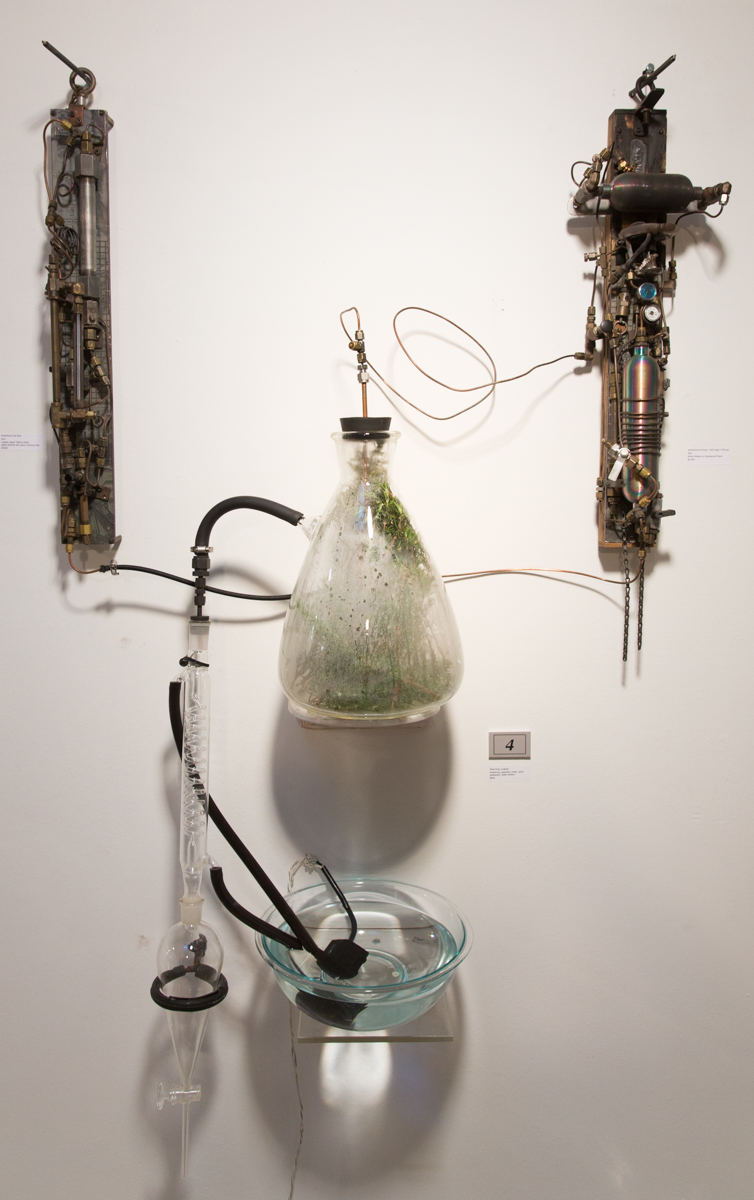
A fascination with science and the spiritual, not a dichotomy to Costanza, runs through the exhibit. Above, Costanza’s sculpture “Returning Jurassic.” This piece is also an attempt to create steam using heat generated from the heat of a jet engine. The assemblage used both gas and liquid fuel sources – but not in this exhibition. The piece stands on its own though, as a sculptural work even without the creation of “real” energy. The art’s energy speaks for itself.
F23C6551

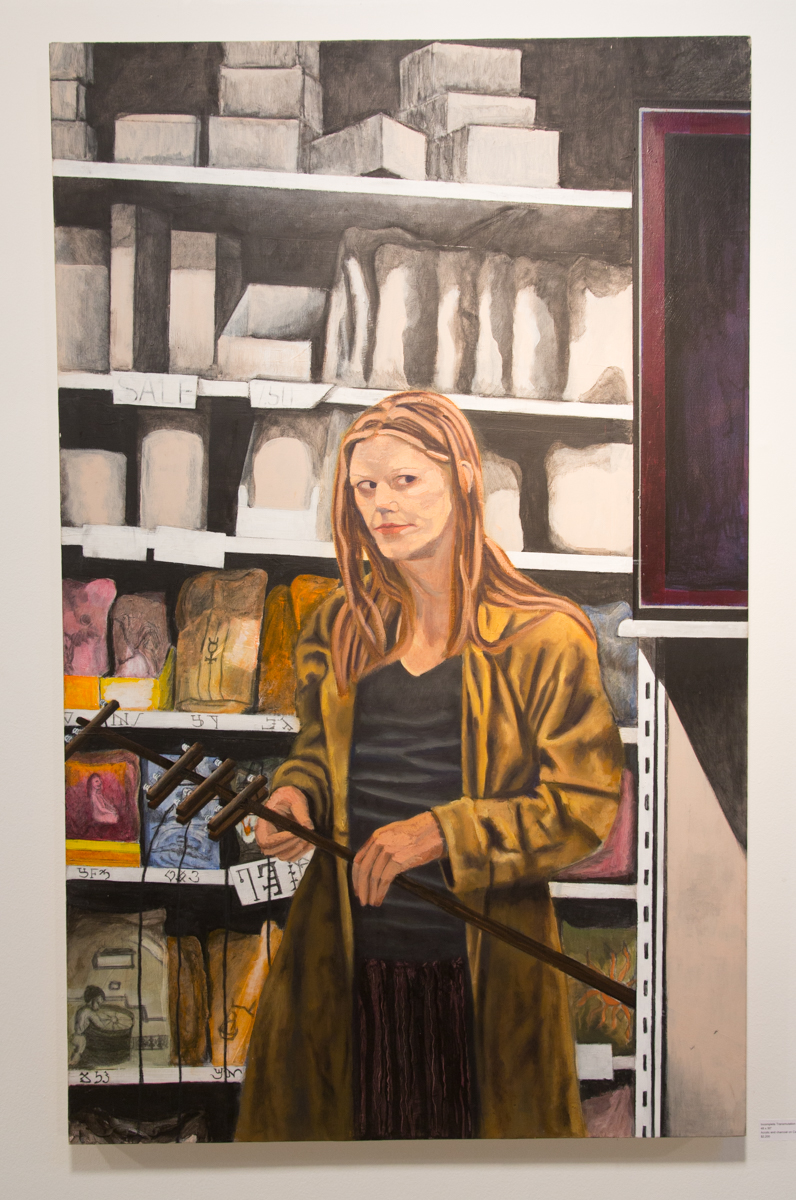
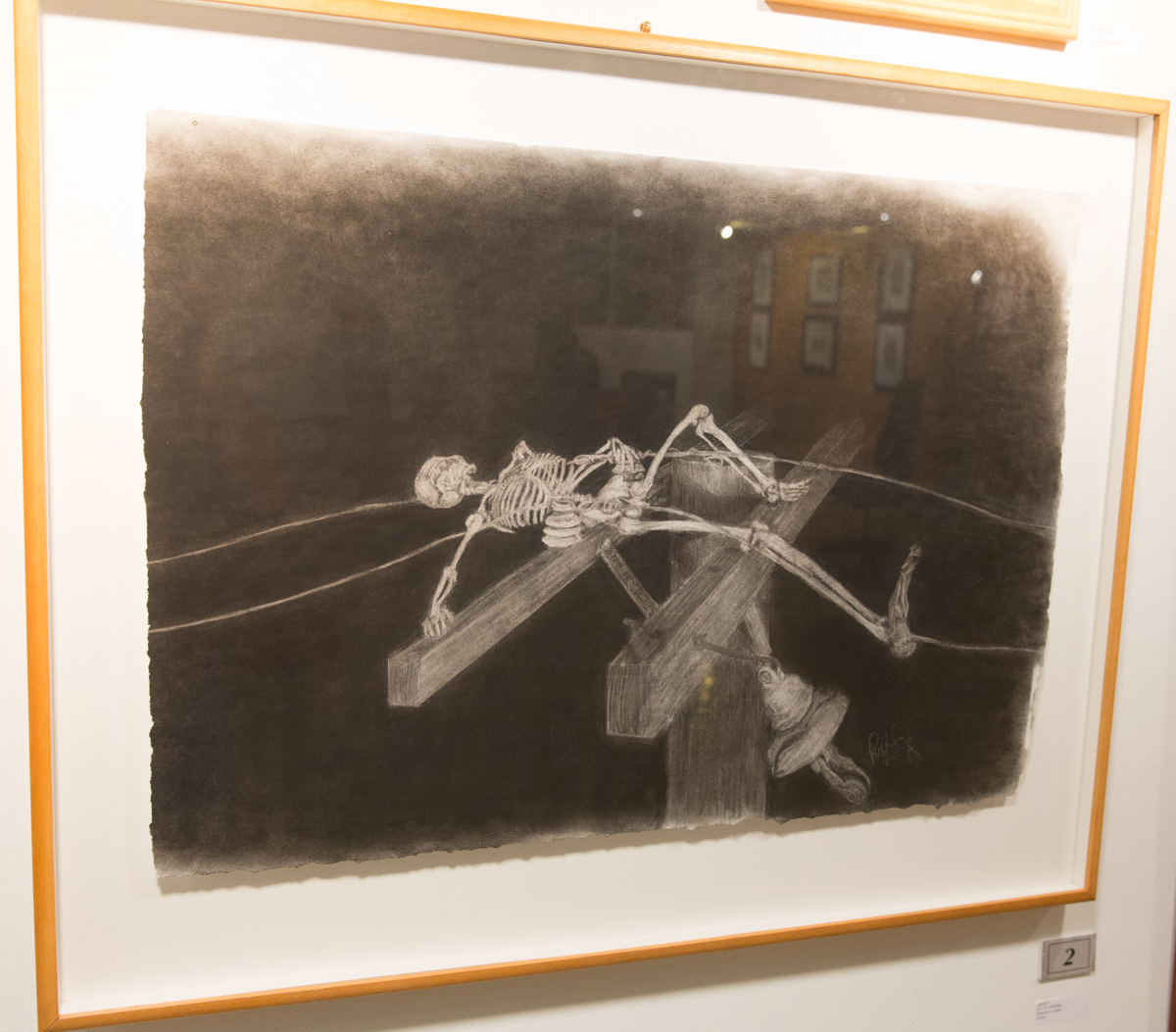
The artist’s fascination with the electrification of cities and homes carries throughout his work. He’s buried copper wire under layers of pigment, earth, and gesso and induced current through the wires, taking him 1.5 years to create a literally searing early work.  He’s utilized actual power poles for installations and stage sets. Above, this theme is carried in a hyper-realistic work edged with the abstract and surreal in both form and function.
F23C6554

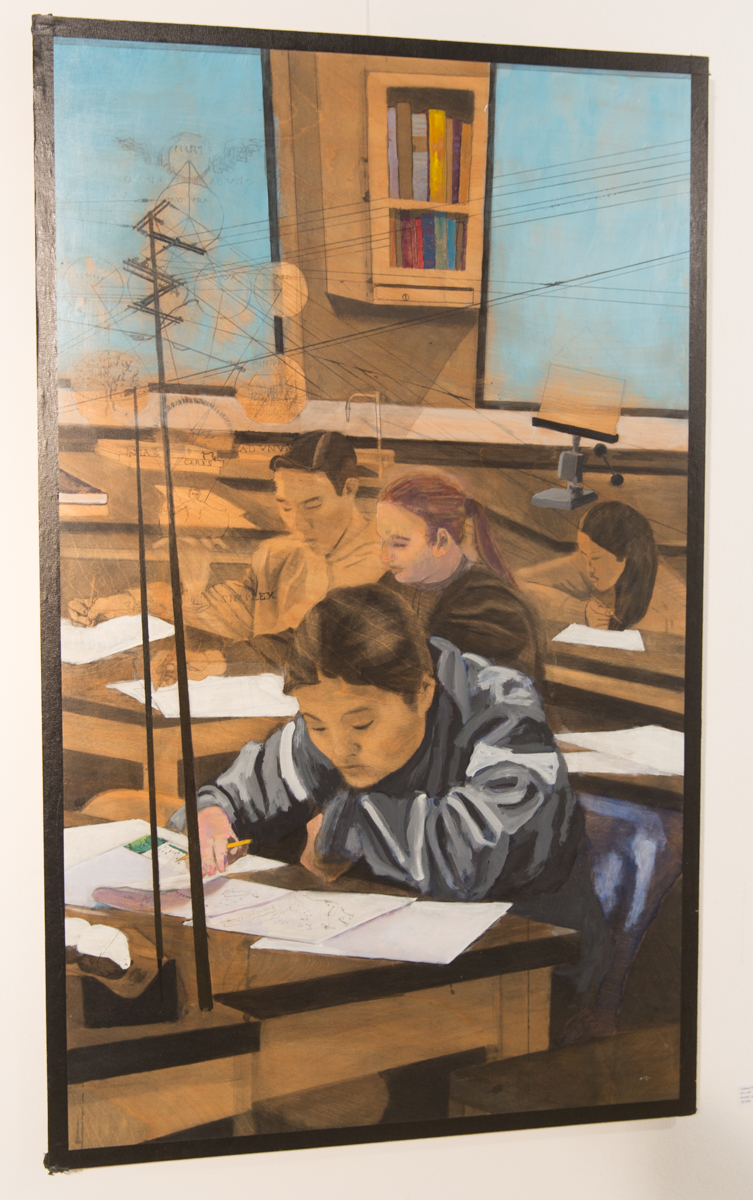
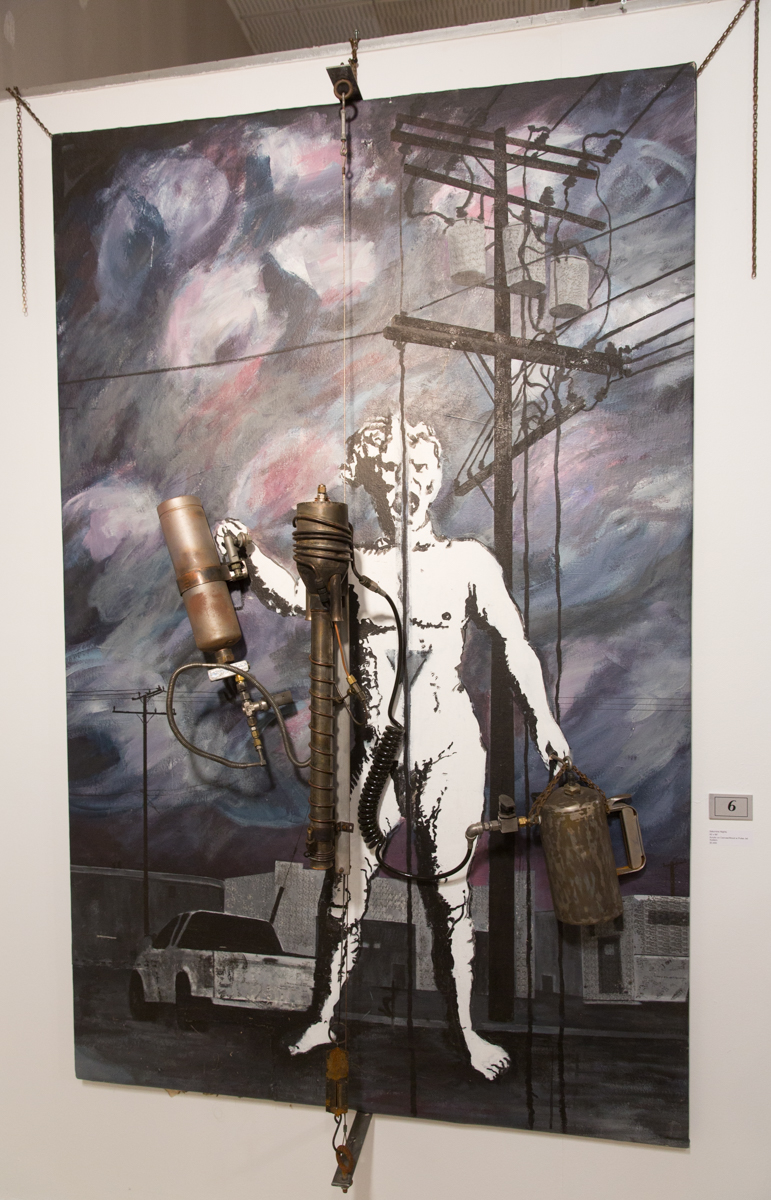
Above, a depiction of Costantza’s experience “moving from the vacuum of a nuclear family into the educational system.” Rote learning and the subjugation of the mind produced little of the energy that fascinates the artist. Rather it was a negative energy space from which his personal positivity later sprang.
F23C6556

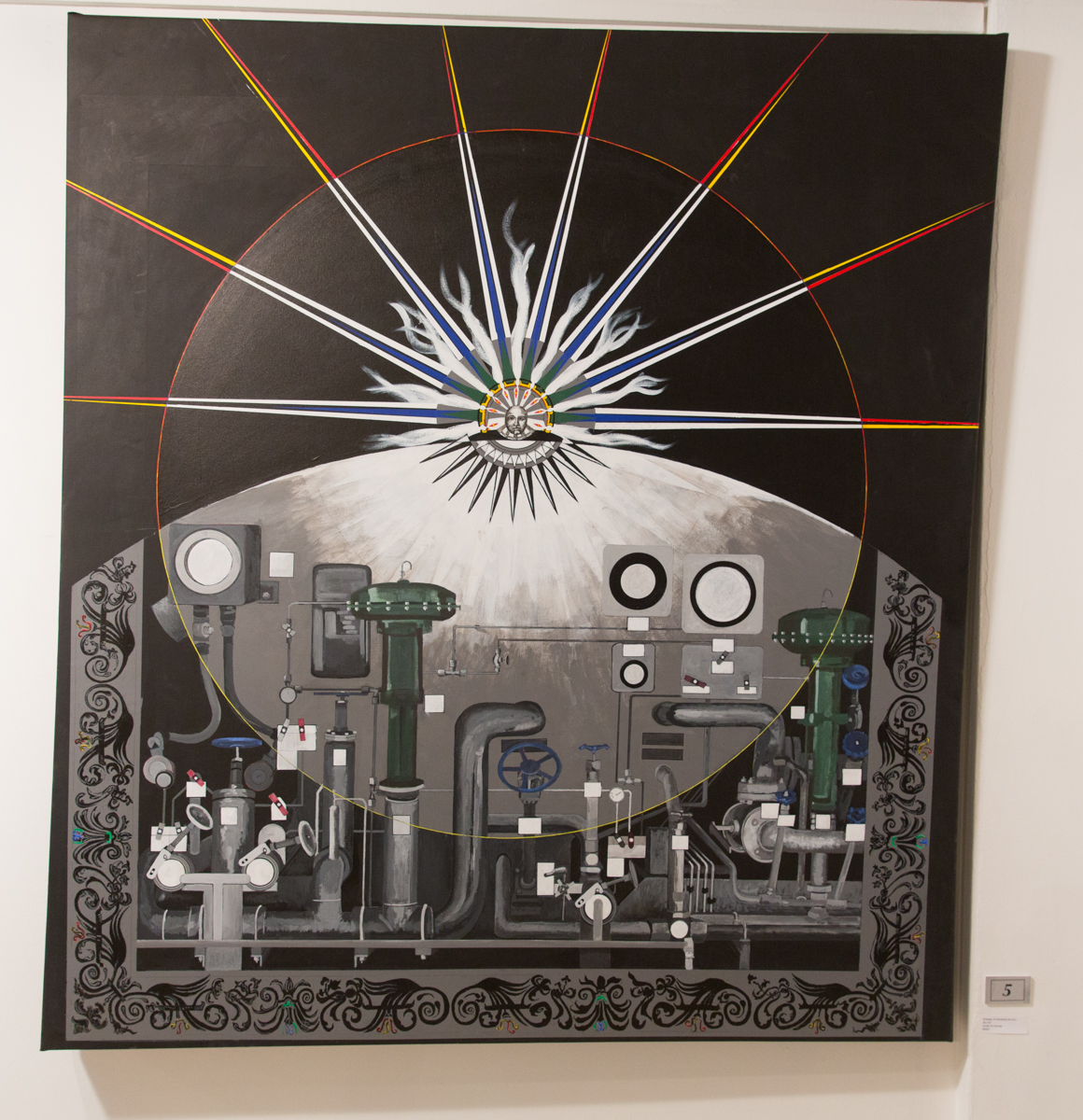
Wires, grids, power, energy. Connections.
F23C6557

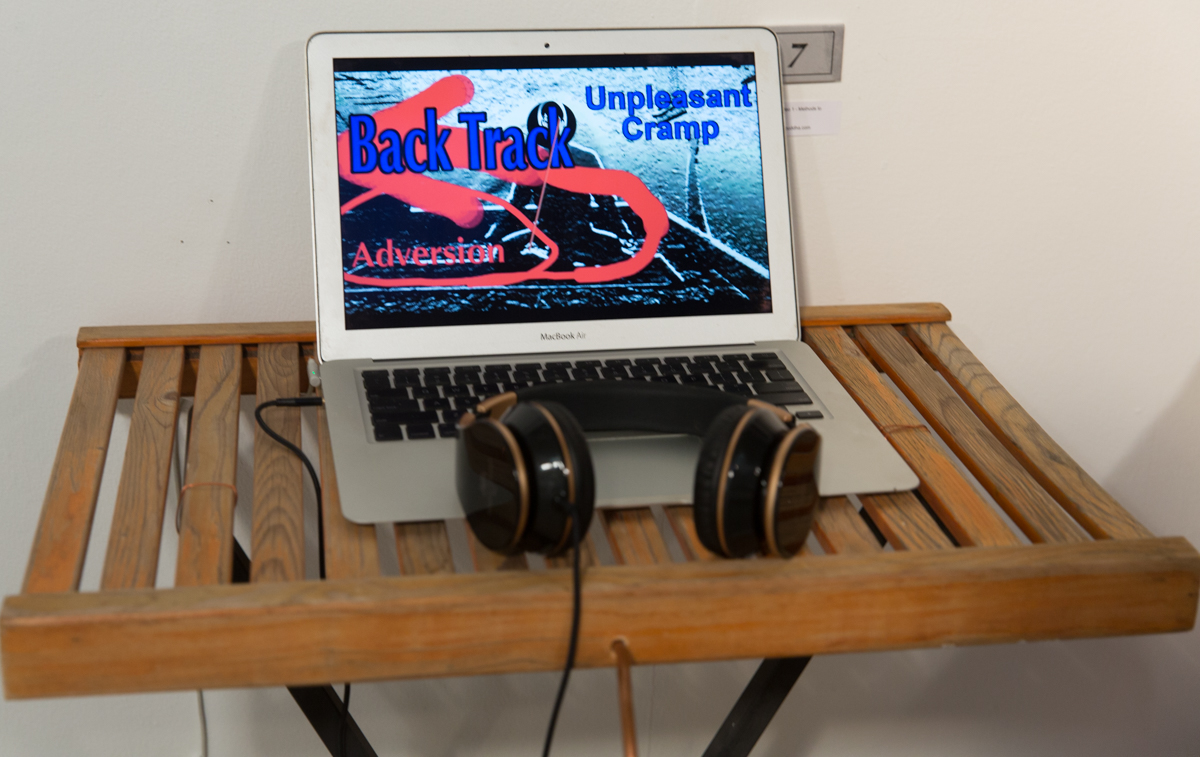
Below, a video detailing the process of “stream entry” using Vipassana meditation. Costanza learned to create videos on his Mac for a crowdfuding campaign, wherein he pledged to upload this second, enlightening video.
F23C6562

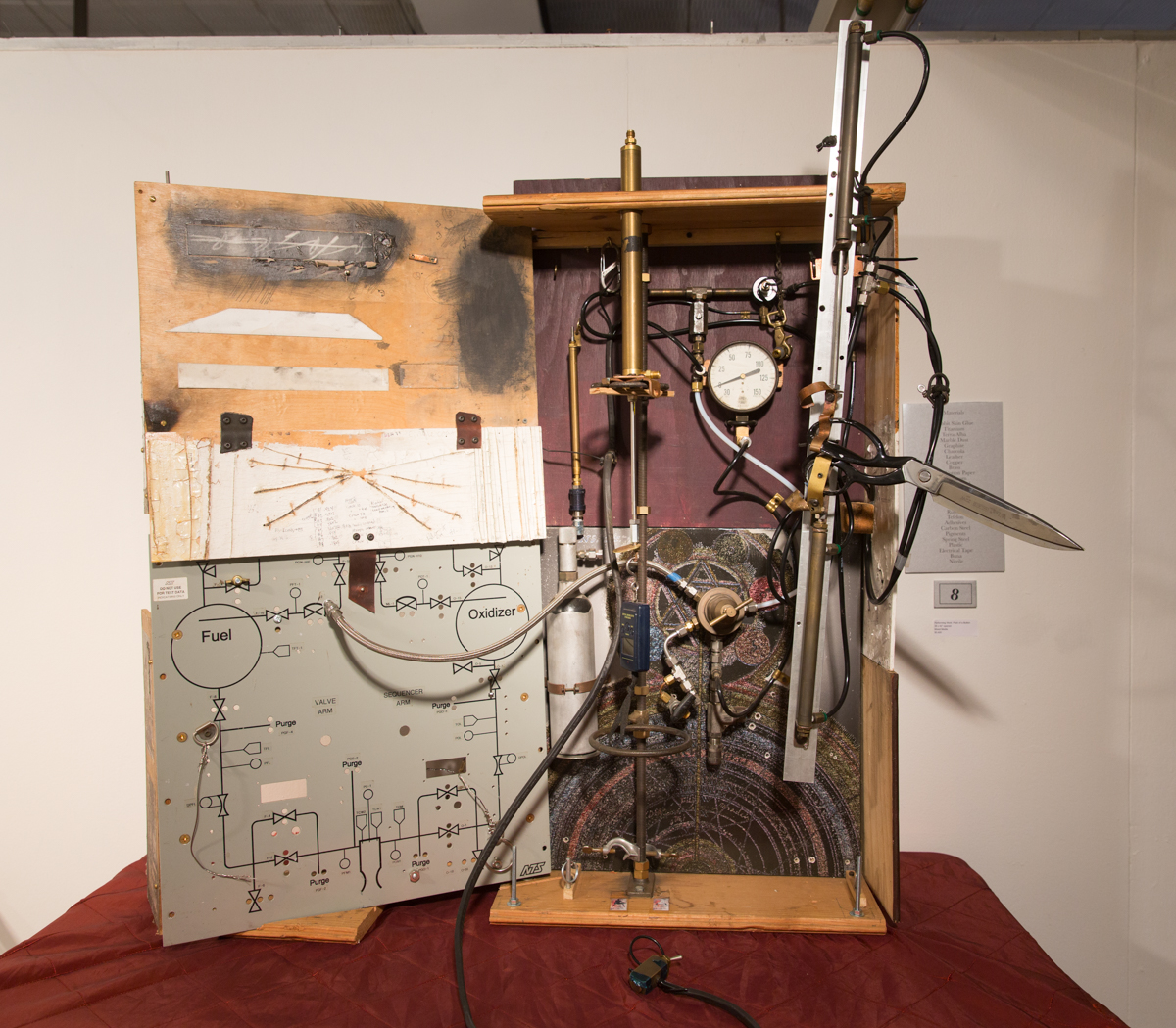
Costanza has worked on and off in the aerospace industry for years. He has termed himself “mesmerized” by  the “visual aesthetics” of systems built and used.
F23C6565

“The book that changed everything for me was mastering the core teachings of the Buddha through Theravada Buddhism. If done correctly there are four awakenings,” Costanza relates. Theravada Buddhism is one of two great schools of Buddhist doctrine, one which emphasizes personal salvation through one’s own efforts.

The dynamic of “repulsion and attraction” that the artist feels for the intellectual and literal power grid, is very evident below, as he’s dropped in and out of the industry.
F23C6592

And the bliss continues. “I taught a class on meditation last summer to prepare people for a retreat. I can help people prepare and go deeper. I’m doing this show to get a direction forward. My older stuff is darker, my newer stuff lighter. I’m ready for a new transition, but it’s not crystal clear yet where it’s coming from. Maybe it’s a balance of the two extremes.”
F23C6597

Costanza has started a company, Rocket Buddha, which creates artistic, meditative T-shirts. This may be a new direction.

But the heart of his work? “Assemblage,” the artist says.

And in a way, every piece in this show and every step Costanza takes is an assemblage – of varied techniques and moments that have come before, follow after, and exist only in the present, in viewers’ artistically electrified eyes.

Let’s continue the metaphor. Costanza’s work is electrifying.

Go get connected. Sunday’s closing runs from 5 to 10 pm. At 7:30, Costanza will create a performance that supports this quote: “Is it not an ethical imperative and challenge to create situations that mock, question, interrupt, undermine and subvert the continuum of progress that keeps (catastrophic) things going?” Victor Zamunio-Taylor

Neutra Institute Gallery & Museum is located at 2379 Glendale Blvd, Los Angeles, California 90039

  • Genie Davis; All Photos: Jack Burke
 

Why You Should Click Our Ads

F23C3315

You don’t have to buy anything. Just click and look around…each click earns us some pennies toward the upkeep on this blog.

F23C3225

F23C1159

Do you enjoy reading our art reviews?

F23C5654


Check out our coverage of travel spots …

F23C9511

…and films?

F23C6178

F23C3768

F23C4151

Drool over the food photos at cool restaurants?

F23C1263

Click, click, click.

I know, I never clicked on ads either.

But that’s how Google AdSense works, and how blogs stay in business.

And of course – please follow the blog – followers count, too, and make us smile.

Follow us on Twitter, like us on Facebook, check out photo highlights on Instagram and follow us there too.

And most of all, read and enjoy. We love you!

Thanks! Commercial message over!

Genie Davis, Jack Burke 


Wilding Cran Gallery: Revisiting Childhood

F23C4787

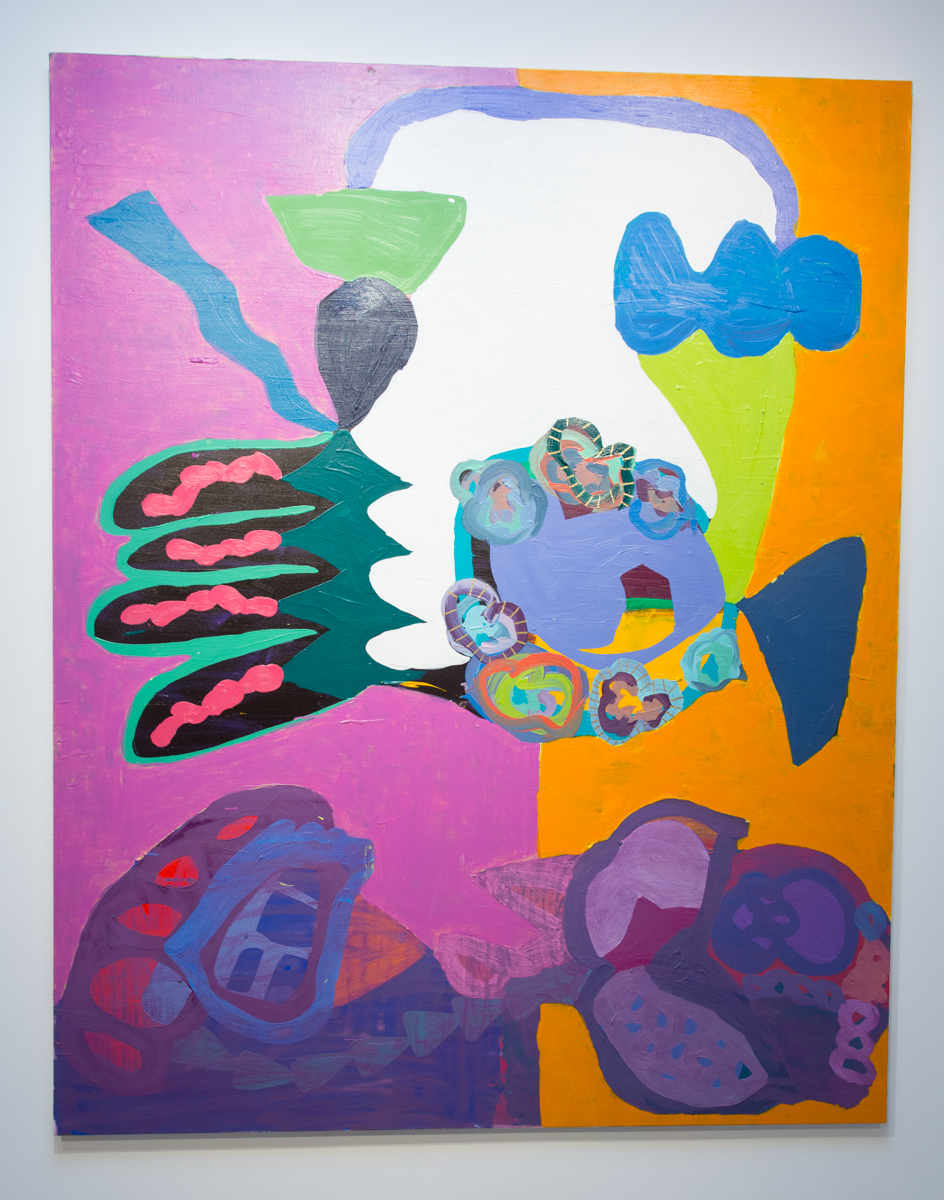
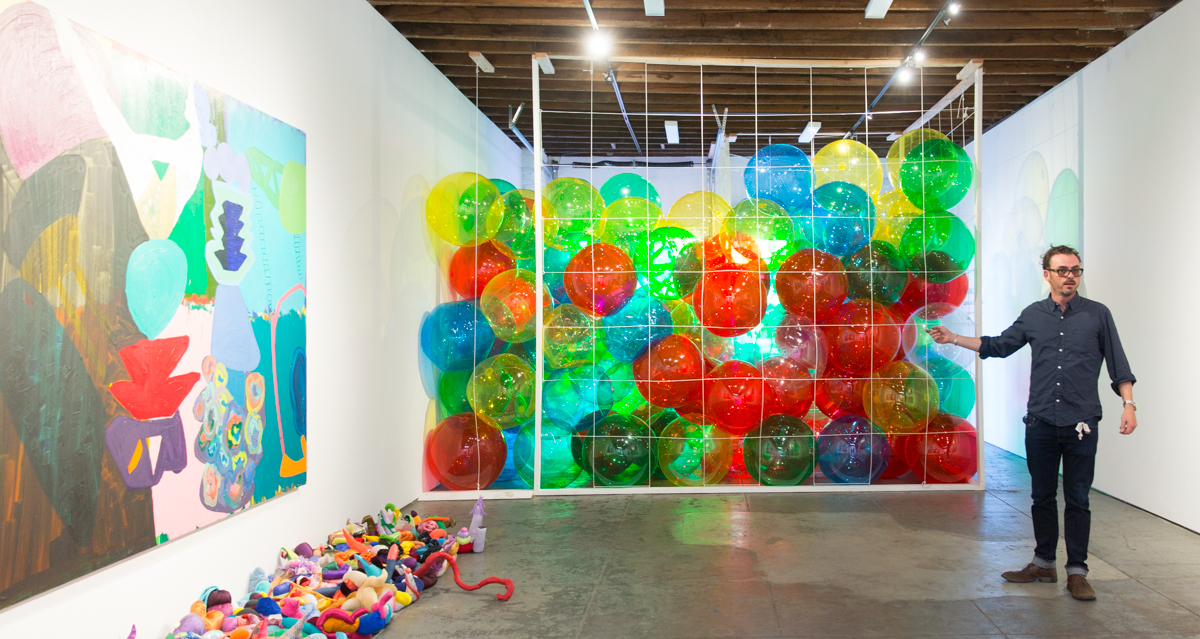
Maria Lynch: Spaces and Spectacles runs through July 24th at downtown LA’s Wilding Cran, a vibrant, participatory look at childhood through the eyes of an adult, and a rumination on what fills the space in your mind and heart.  Above, artist Lynch nestles among her multi-colored plastic spheres – and you can, too.

F23C4782

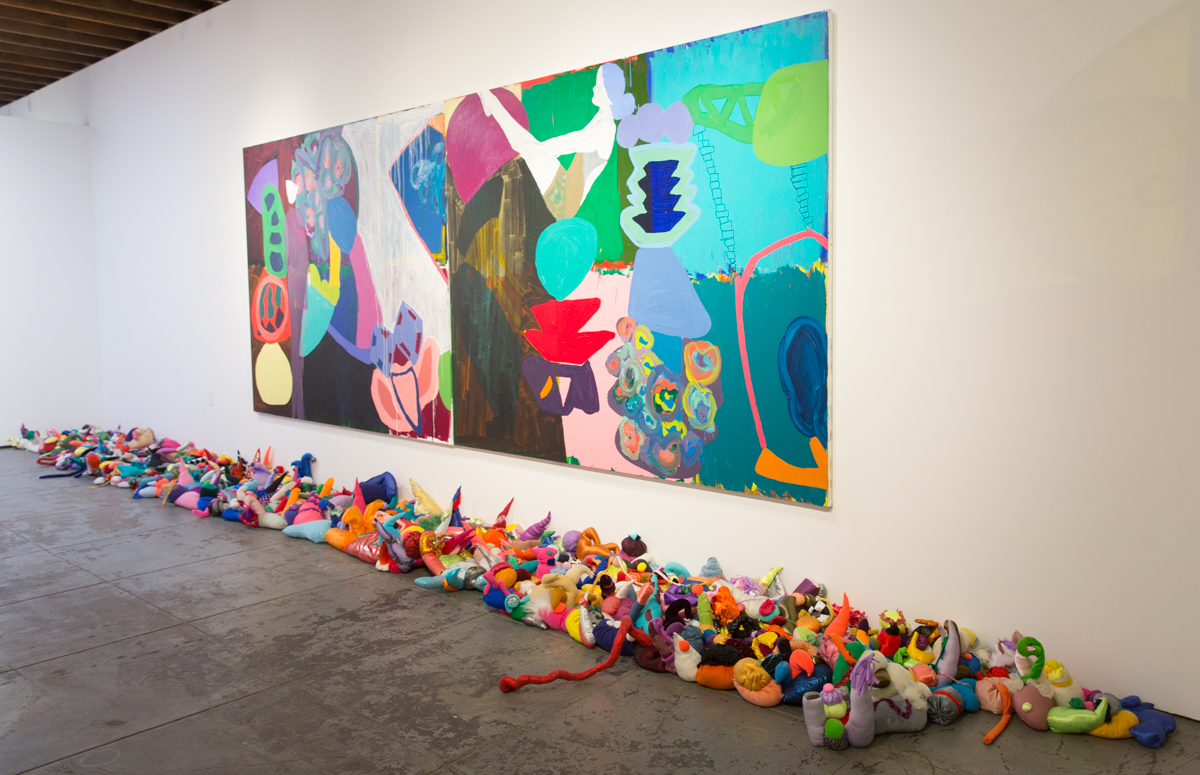
Lynch is a Brazilian multi-media artist. Her exhibition here includes large paintings, soft sculptures, and an interactive installation consisting of translucent, vividly colored balls – a fantastical version of that ball pit toddlers crave at Chuck E. Cheese. Accompanying the installation is a soundscape by Brazilian musician Rodrigo Amarante.

F23C4762

F23C4773

Above, the “ball pit.” Step inside the exhibit’s gate, and move inside. It’s like entering a world of soft, shifting jewels.

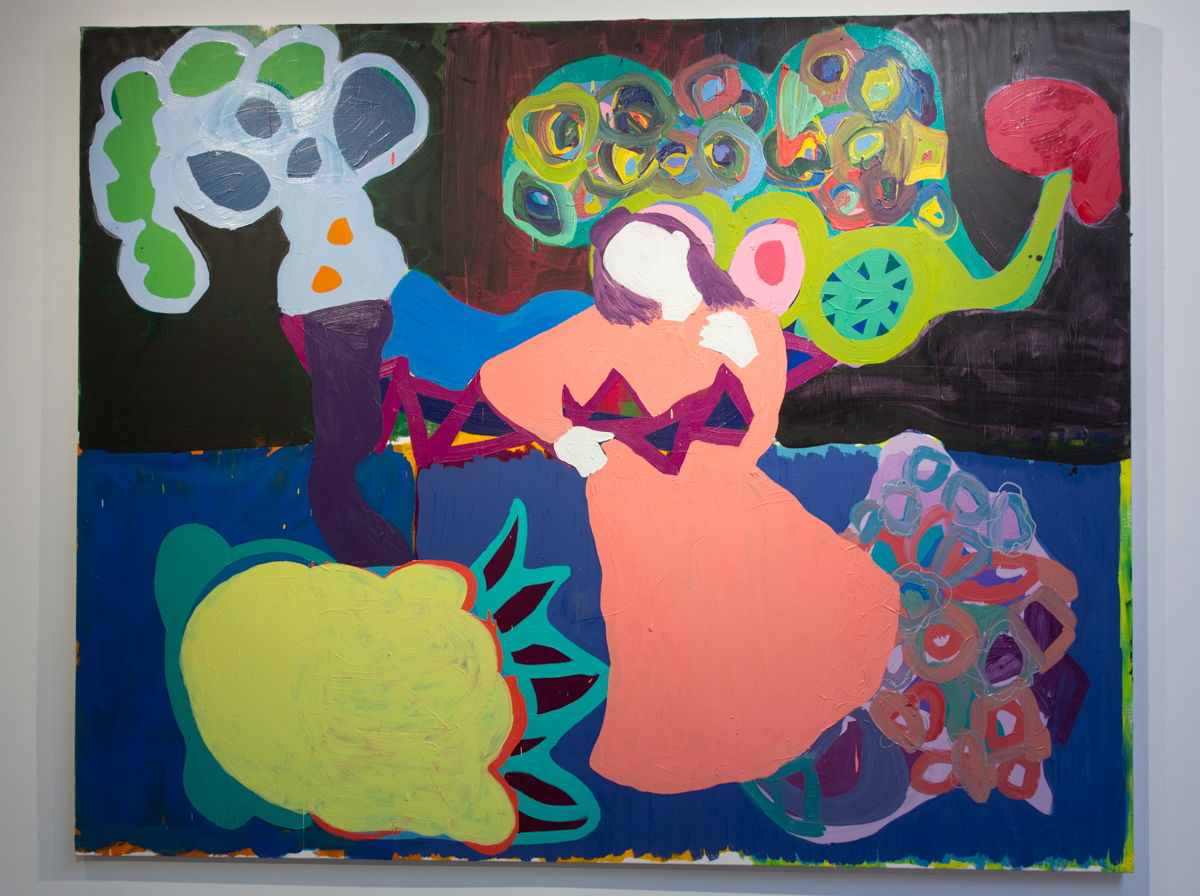
Below, Lynch with one of her large scale, brightly colored oil paintings.  “You can create a fantasy that links childhood and memories, you can come back to that place of freedom. You have to regain that freedom and interact with it. As a child you are just naturally a part of it,” she says.

F23C4770 F23C4767 F23C4766

Below, some of the soft cloth sculptures that are a part of the exhibition, deconstructed teddy bears.

F23C4765

The exhibit is joyous, packed with a deceptively simple, childlike-approach to color, light, sound, and space. Lynch says that the installation is site-specific; the fenced in section of the gallery containing her bubble-like spheres captures and reflects the light from Wilding Cran’s front window.

Enter Lynch’s magical kingdom and feel the years drop away as you run off to join the circus of this artist’s candy-colored, blossoming art.

The gallery is located at: 939 S. Santa Fe Ave., Los Angeles 90021

  • Genie Davis; All Photos: Jack Burke

Leonard Greco: Out of the Boondocks

013

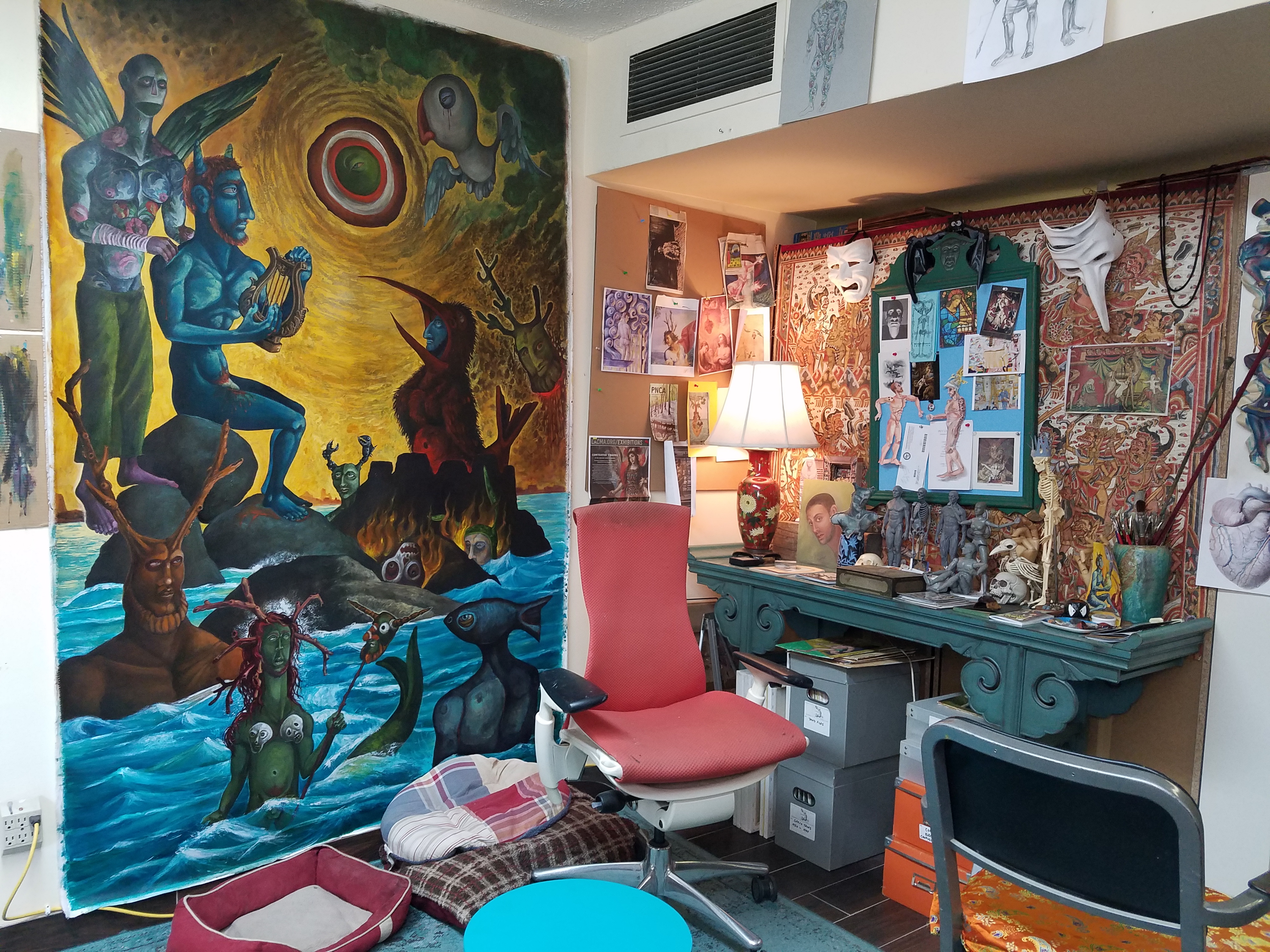
Artist Leonard Greco is something special. A decorative muralist and painter for over 25 years, Greco also have his own blog, https://boondocksbabylon.com, which tells the story behind his works and inspiration for same. His paintings are powerful, haunting, often including religious or mythic imagery in settings that evoke surreal icons. In short, his work is like nothing you’ve ever seen before, fusing generations of disparate cultures and art. Along with his paintings, drawings, prints, and puppet figures make up Greco’s full oeuvre.

The work is startling and compelling, both in its use of color and its story telling style. Greco says he is exploring narrative figurative painting, frequently using archetypal figures. He also has a secondary objective: “to explore the extremes of human existence, most notably birth and death.”

studio visit 5-27 (2)

He has other themes that appear throughout his works as well, of transformation, salvation, and re-birth. Drawn to the narratives of early peoples, he’s inspired by the Mayan creation myth and Popol Vuh’s tales of the Hero Twins Hunahpú and Xbalanqué. This Meso-American mythos is restructured and reflected through the artist’s own experiences and interests in the Italian Renaissance and Roman Catholic saints, the surrealism of English-born Mexican artist Leonora Carrington, and Ghosticism, among others. Greco’s own dreams prove an equally compelling landscape from which the artist draws.

His love of narrative depictions in the midst of these varied influences takes on universal themes, and a universal visual vocabulary, which the self-taught artist describes as “Life and death, mortality, morality, and most importantly, inner knowledge, gnosis.”

The artist’s narrative is also intensely personal, so that the refined surrealist images also take on an aspect of reality – real life as observed through the prism of a dream.

Greco Jonah

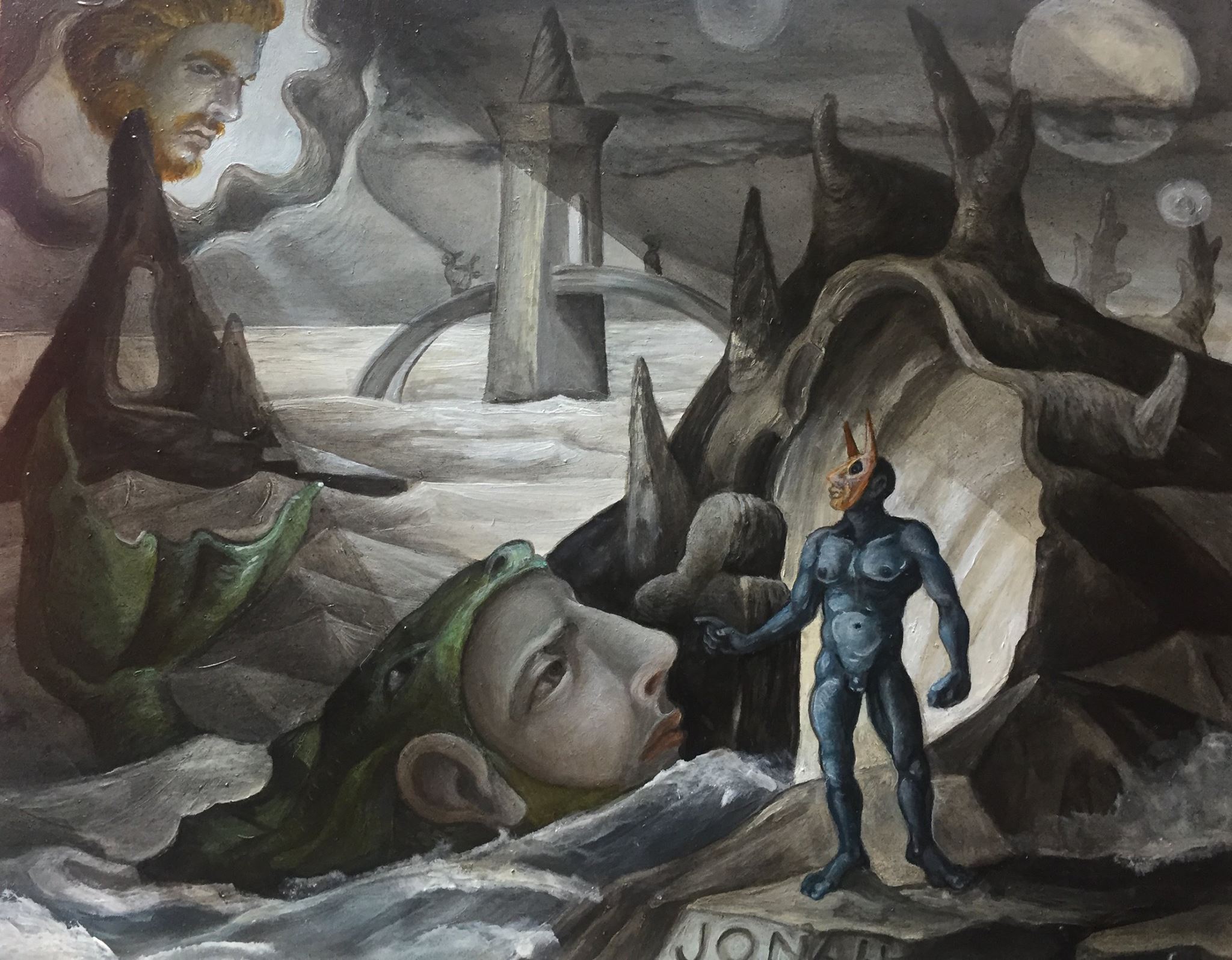
Greco’s “Jonah,” oil on panel, is a dark, surging, seething painting, with the green whale against whom Jonah triumphs floating in a turbulent grey sea. The whale has a head disproportionately huge – and human. A God-like head parallels the whale’s, looking down from the sky. A turreted bridge is in the background; a strange monument on which Jonah stands, a pedestal with the name Jonah upon it, in the foreground. Dark but translucent beams of light spill down from the sky. Jonah, his body blue, his face masked, looks up toward God, his hand pointing to the whale. This Jonah, unlike earlier painted incarnations such as those by Pieter Lastman, or Frederik van Valkenborch, is no pale creature fleeing the monsters jaws. He is no circumspectly robed elderly prophet, praying as he emerges in Jan Brueghel’s stormy sea.

No, this Jonah has emerged with his own strength. Jonah may have spent three days and nights in the belly of the beast, swallowed by both the whale and his futile attempt to avoid a mission from above, but the experience has not broken him. The Jonah Greco depicts may not have seen the error of his ways, may have fought his own way from the beast rather than being saved by an act of God. Is Jonah’s mask an attempt to still flee God’s will? In this raw and tumultuous world, Jonah’s figure is powerful, even if his face and motives remain hidden.

flea-w-fig
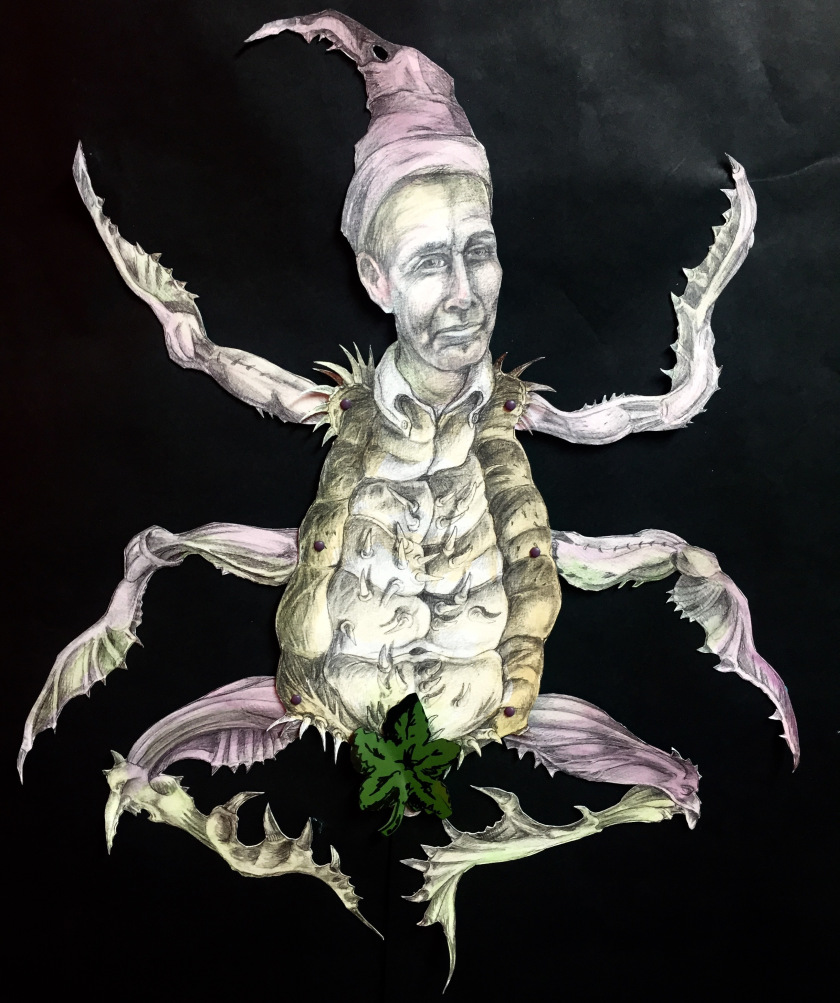
Deeply visceral is “Self Portrait of the Artist as a Flea,” a recent pencil and watercolor on paper, a paper doll of sorts that can be made to move through the judicious use of brads and string. Drawn in lavender, yellow, and white, it is the artist’s head on the body of a flea, but one which features abundant frontal nudity – except when covered by the artist with a ripe green fig leaf to render the work acceptable to social media. There is so much to be said about this piece, which in Greco’s words uses nudity and the body of a flea both unabashedly against “the bigots and the nasty folks who hate us, particularly important after the Orlando massacre. Queers have been treated like vermin for so very long, by fashioning myself as a flea I embrace what they find so vile.” The work has the quality of a fairy tale image, in part due to the colors chosen, in part due to the anthropomorphic flea, whose head shape resembles a jester’s hat. The fast, tiny, hard to destroy flea, a creature which though reviled, remains hardy, one who has been made to dance, to leap, to claim it’s own “flea-ness,” seems a triumphant image, as well as a humorous one. It’s a recognition of self, an acceptance, a dare to the world to accept, too. There is both anger and joy in that flea, and pride, in its careful, detailed rendering.

Greco Uranus

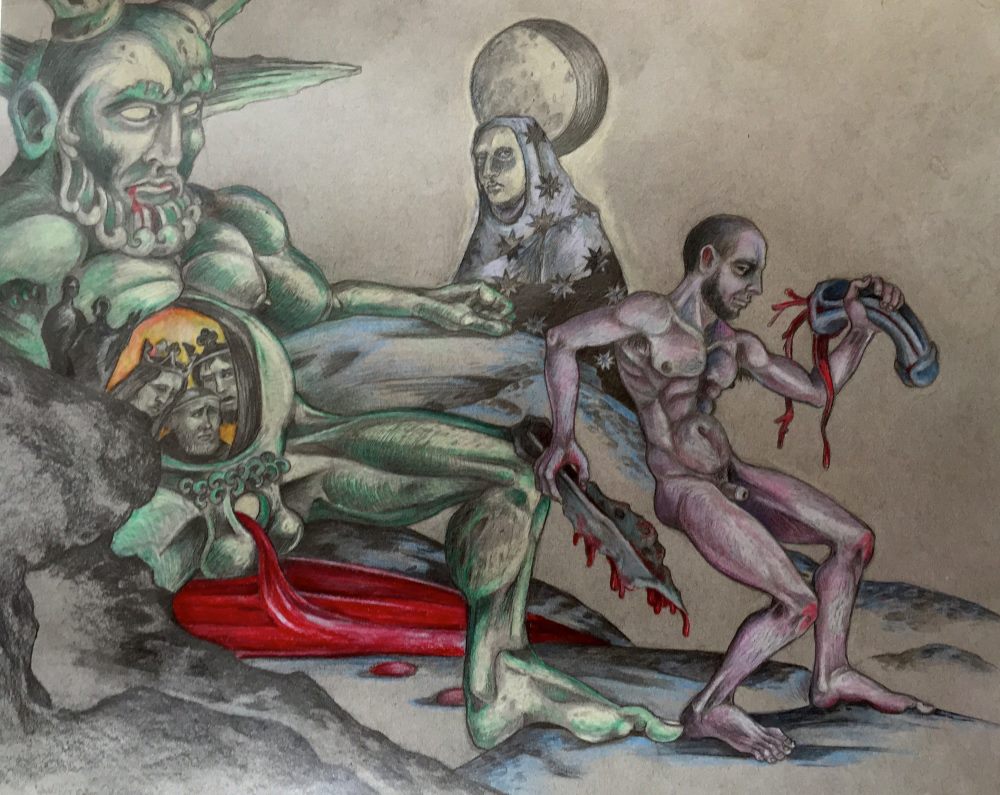
The artist’s 2015 watercolor on paper, “The Castration of Uranus” depicts the rather brutal outcome of son Titan Cronus’ attack with a stone sickle on his brute of a father. Greco uses this image to translate his own rage and inability to perform such an act on his own cruel father. In the painting, the green, monstrous beast-man, complete with images of the siblings he devoured in his distended belly, is castrated by his pale and sinewy son, blood pouring in a muscular wound from the gaping hole in Uranus’ genitalia. A pale woman, the moon behind her head, stands in blank observation. The twinning of the myth and Greco’s own experience creates a painting that is as alive as it is apocryphal. Particularly compelling is the vitality in Titan Cronus’ muscles, his life gained, his body about to spring forward into a future with fear vanquished.

Each of these works is a reimagining – of a Biblical story, a Greek myth, family violence, societal roles and values. Seamlessly blending the surreal here, the underlying narrative story there, adding brush strokes of irony and wisdom to his perfectly detailed images, Greco writes a new kind of artistic story, which like that self-portrait as a flea, itself contains joy and anger, pathos and triumph. The stakes are high, the world is strange. And art and artist go on.

greco_genesis

Greco recently exhibited at the 2016 Second Annual Mask Art Show in Venice, but has shown throughout the Southland. Until a new show is announced, follow the artist’s blog for a look into his art and his mind.