In a way, who isn’t afraid, just a little bit, of flowers? We may fear their incredible fragility, of losing them to an all-too-quick death, to knowing their perfection is ephemeral and their beauty so temporary – an aching reminder of our own mortality.
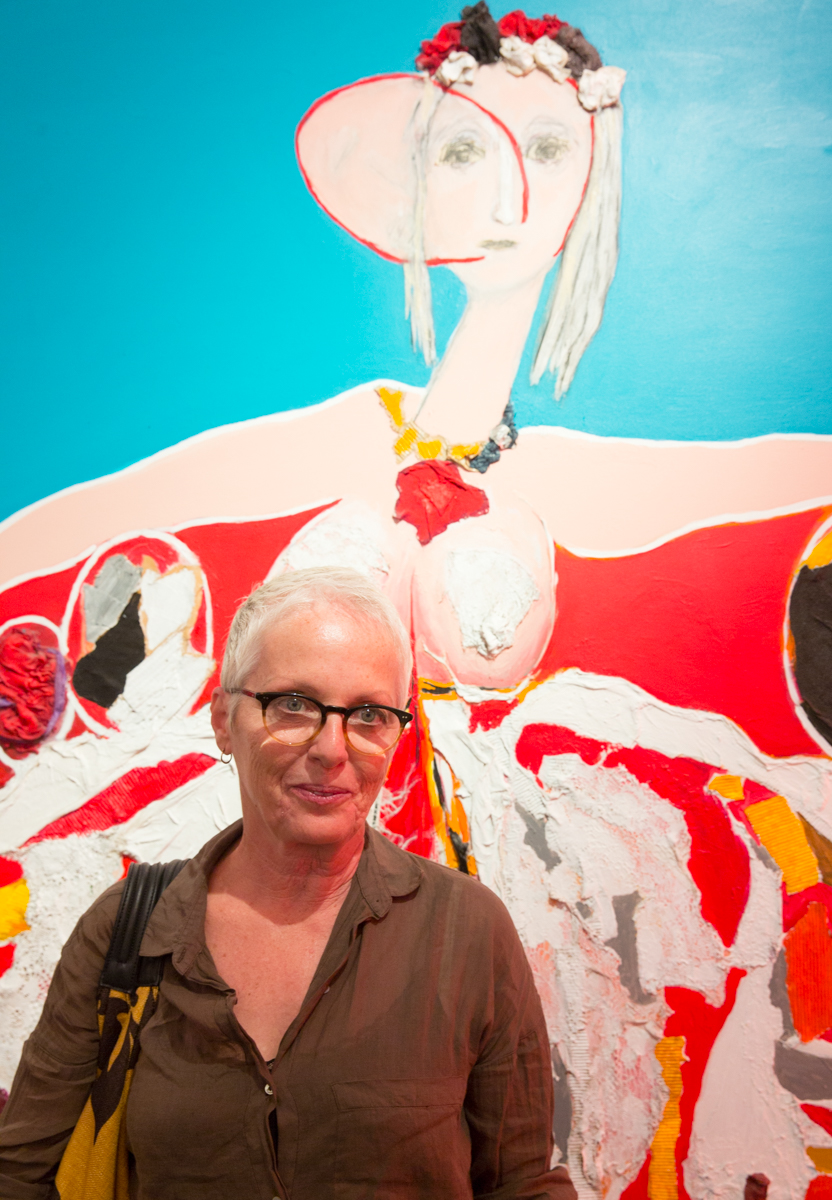
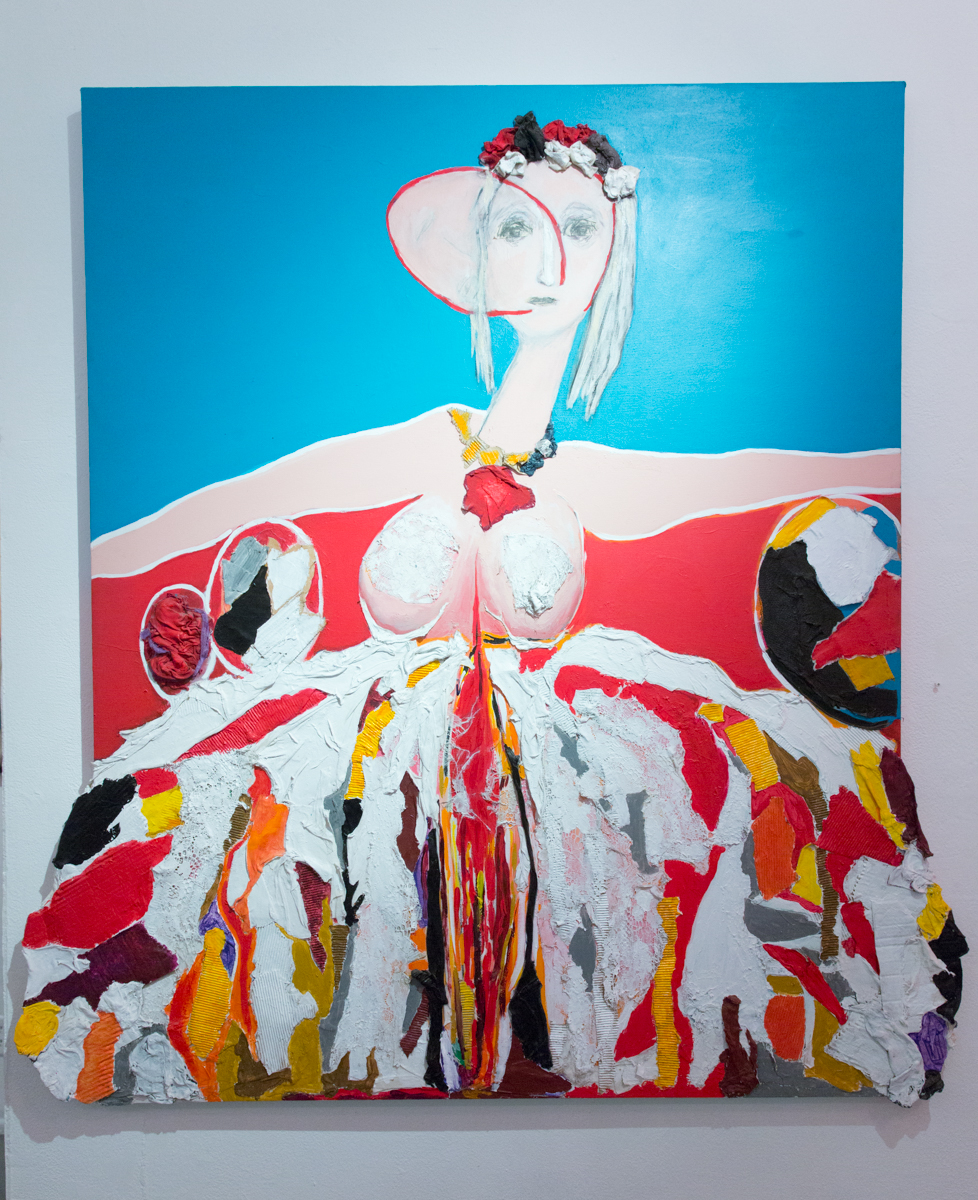
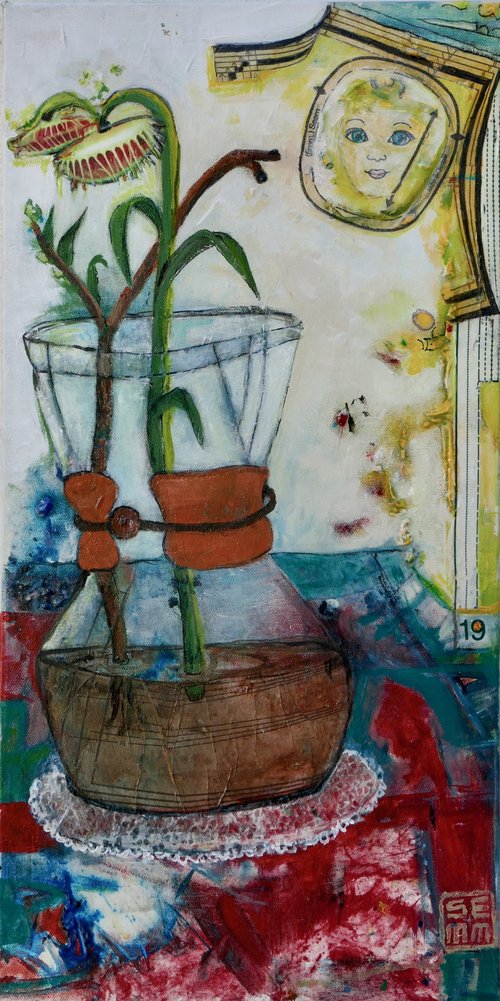
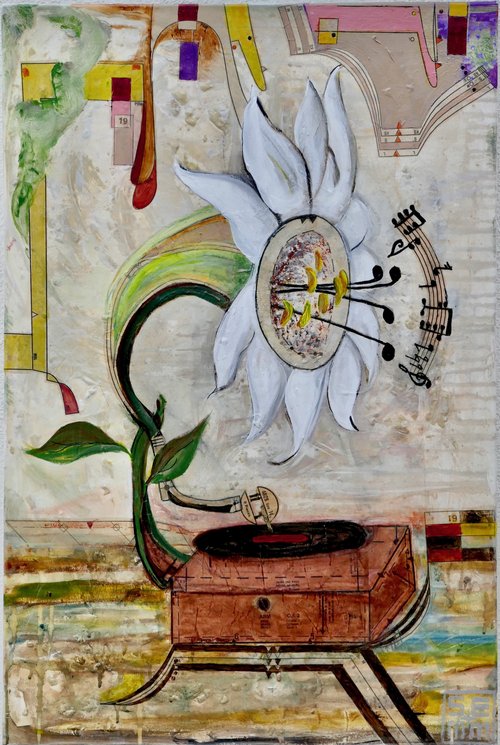
However, for artist Susan Melly in her new Emerging Fear of Flowers now at LAAA ‘s Gallery 825 in West Hollywood, her emerging fear was something different, risen from over two years of COVID-19 pandemic isolation. During that time period, Melly’s husband brought her a weekly bouquet of flowers from an open air market. As her own statement informs viewers “As my anxiety blossomed, my art making changed and became more abstract and colorful to ward off my dark feelings. Each work is embedded with a hint of humor – and the number 19 – as an homage to coping mechanisms, even as familiar sources of comfort counterintuitively transform into a strange beauty that is tinged with the edge of the unknown.”
After about a year of receiving the flowers, despite the loving intention of bringing beauty and romance to her life, she began to ask hereslf if she would be “condemned” to receiving the flowers every single Friday for the rest of her life, indicating that the pandemic would never end. The blossoms blossomed – into increased anxiety, alleviated through her art. As viewers we can witness this progression in her new body of work, and revel in its layers, as fragile-seeming as flowers themselves.
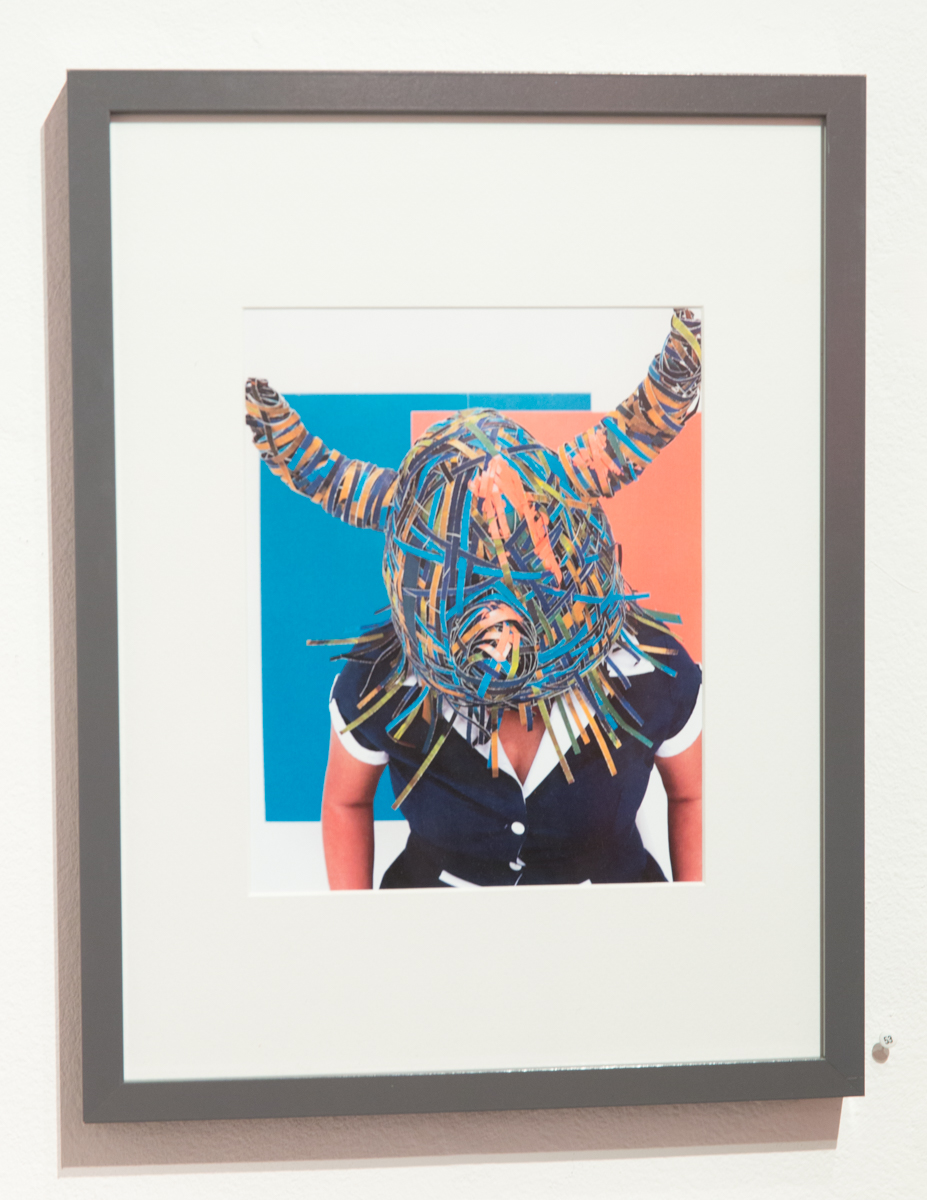
The works of course make use of Melly’s signature use of vintage tissue paper dress patterns, something that she terms an “integral part of my practice and personal history…” As a mixed media artist, the LA-based Melly creates work that includes paintings, assemblage-based sculptures, and installations. In this latest body of work, there is a powerful new energy as these flowers morph with the artist, spin discs on an old Victrola record player, weep, rail in anger, whine in frustration, sing, and seethe. Do flowers mourn their entrapment in bouquets? Do they discuss day to day travails as they grow in the garden, rage and wish to curse those who pick them? While we may never know, here Melly certainly posits that they might.
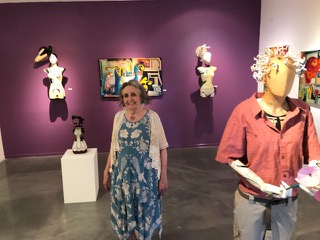
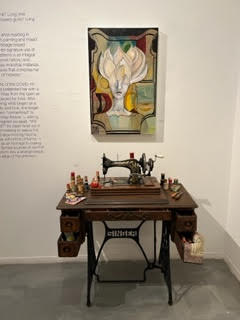
Within the primarily paint and mixed media on canvas works are a variety of sculptural pieces. While some stand alone, a vintage sewing machine, a male figure bearing flowers, “Hanging Out,” is a wall scupture. It emerges like a being encased in and protruding from the wall itself, a partial mannequin entrapped despite a glowing heart and uterus at its center, sheathed and layered with the dress patterns.
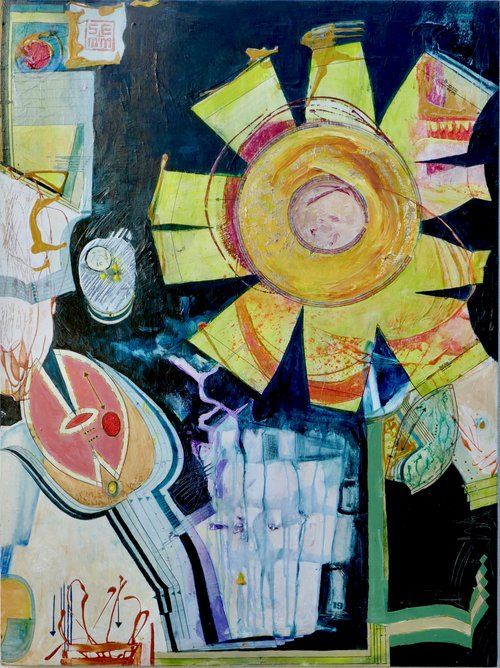
The titular “Emerging Fear of Flowers” is a colorful mix of the tissue patterns, acrylic, and art paper on canvas. While a hand holds a cocktail glass in the right corner, center stage is an alien looking three pronged flower that seems to have grown eyes, and one prong is looking and leaning and reaching ominously toward that hand. The viewer can’t help but think of Little Shop of Horrors and Audrey, that musical’s violently sentient plant. It is a large work, vibrant with indigo and burgandy; the human hand, however, is so white it could easily belong to a person confined from the sunlight in which these flowers gained a robust if menacing vitality.
Melly’s “Cut Stems” also makes use of the tissue dress patterns combined with acrylic. These highly geometric flowers have sharp edged like wind mills and are exhibiting just emerging facial features.
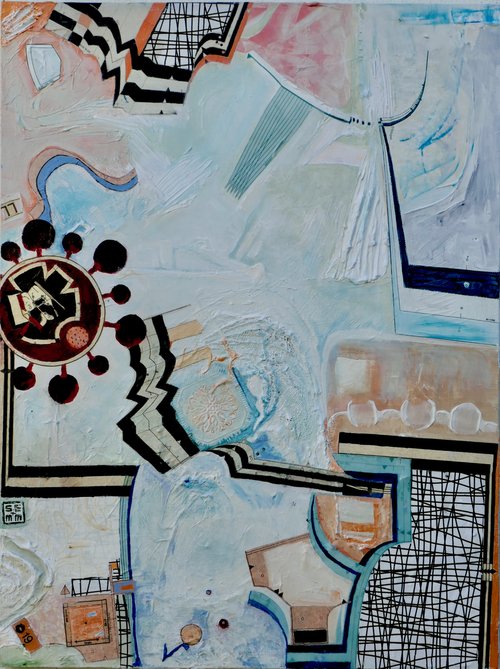
With “Enter Covid,” what’s blossoming here appears to be the shape of COVID itself, entering via a kind of conduit into an abstract human vessel. Layers of white on white recall bandages, sheets, and fog, as if a ghostly landscape now enveloped us all.
Quoting Charles Baudelaire with the title “Evil Comes up Softly Like a Flower,” Melly uses acrylic, charcoal, and dress patterns to make one of the most ominous, yet still amusing, paintings in this series. Here, flowers have teeth and raging faces.
But they are comfortably more relatable in “Dandelion Wine,” in which a dandelion tears out its seeds in frustration.
And we can feel intense empathy for the sad blooms in works such as “Un-Still Life,” in which a lavendar, daisy-like flower has thorns and weeps purple blooded tears.
In another work, the artist herself melds or morphs into a flower, a pale periwinkle and peacefully meditative one, in “Portrait of the Artist as a Young Lotus.” Surrounded by a geometric abstract patterns, the figure is part statue, part flower, absorbed fully in the act of blooming, yet trapped in stillness.
Perhaps, we can hope that our time in pandemic shut down can allow us to achieve a similarly mesmerized state. Viewing Melly’s delicate, lovely, and unsettling works may just have that effect.
Melly’s work is beautifully paired with the light-based blend of Richard Slechta’s photography and art, Incompressible Flow; Chris Madens’ glowy dimensional assemblies, The Covid Kiss; and a group show, Felicitious, an all-media compilation depicting the current zeitgeist.
The exhibition is on view through June 24th. Gallery 825 is located at 825 N. La Cienega. Melly is offering curated visits; the gallery is also open by appointment at other times, reach out at gallery825@laaa.org.
He’s a mystic and poet – and a prolific artist who paints rich and complex stories every day.
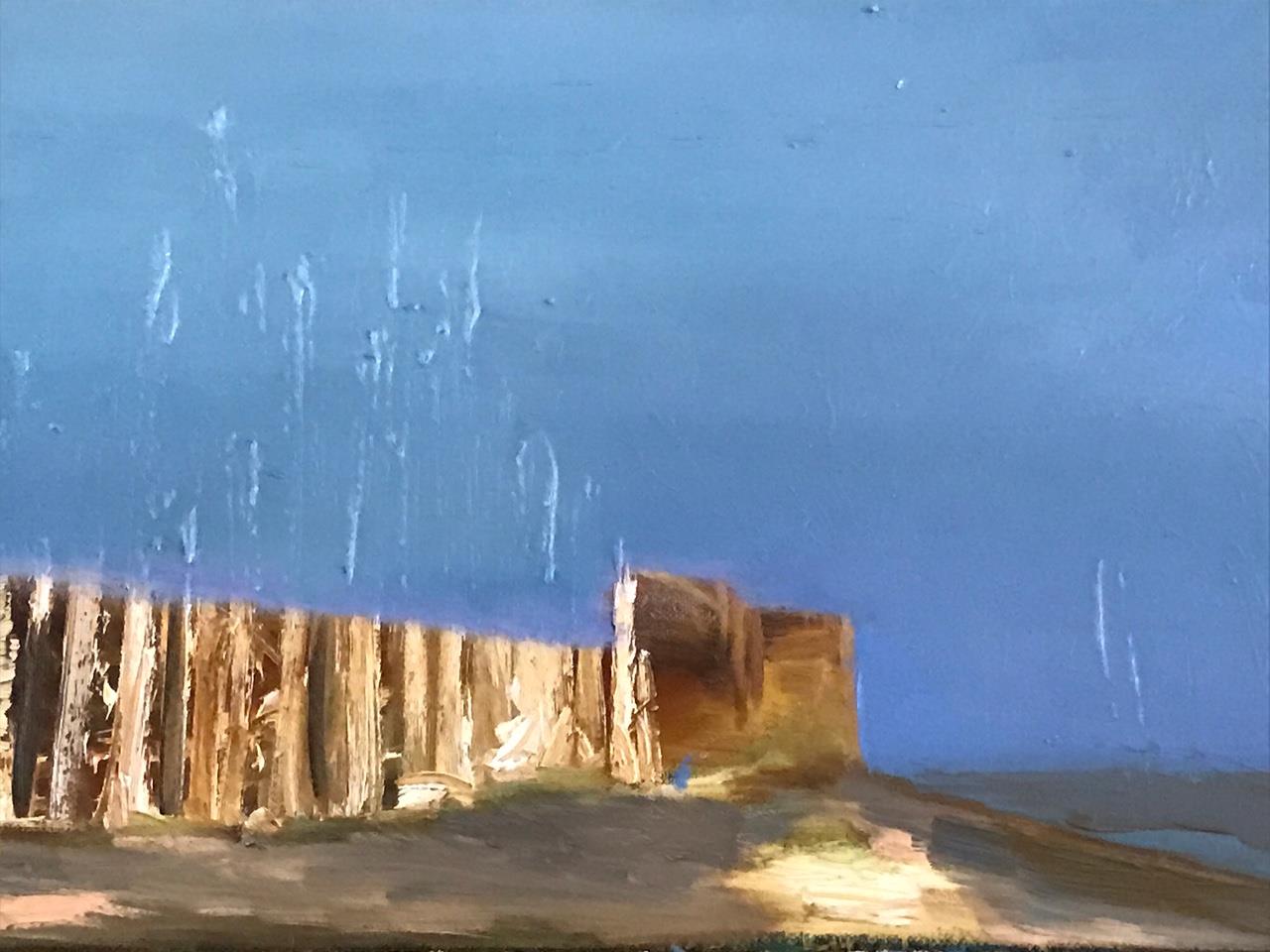
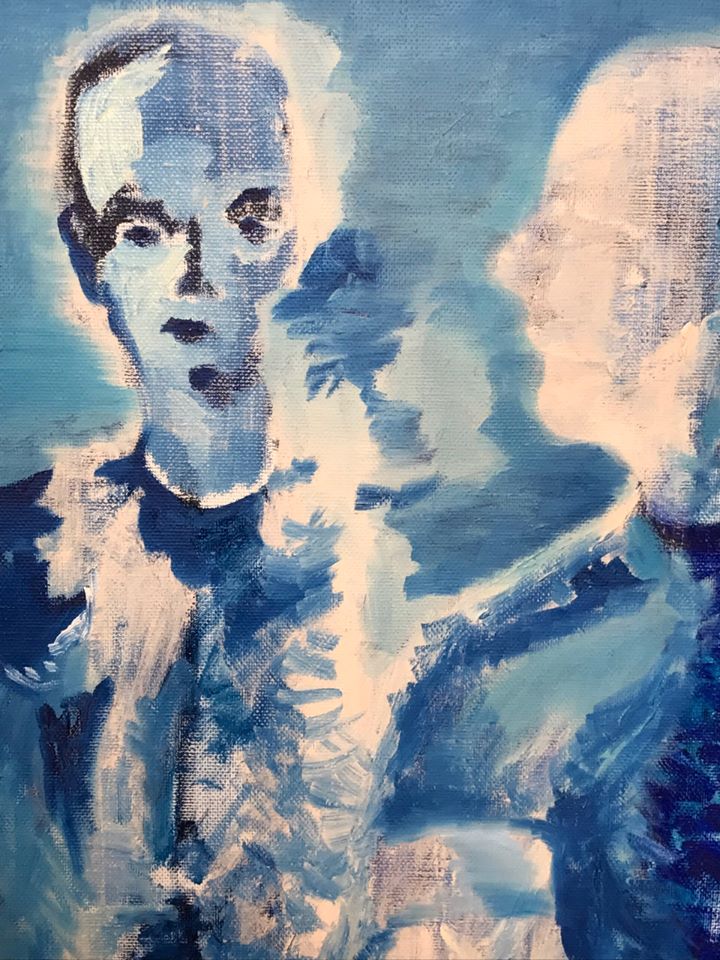
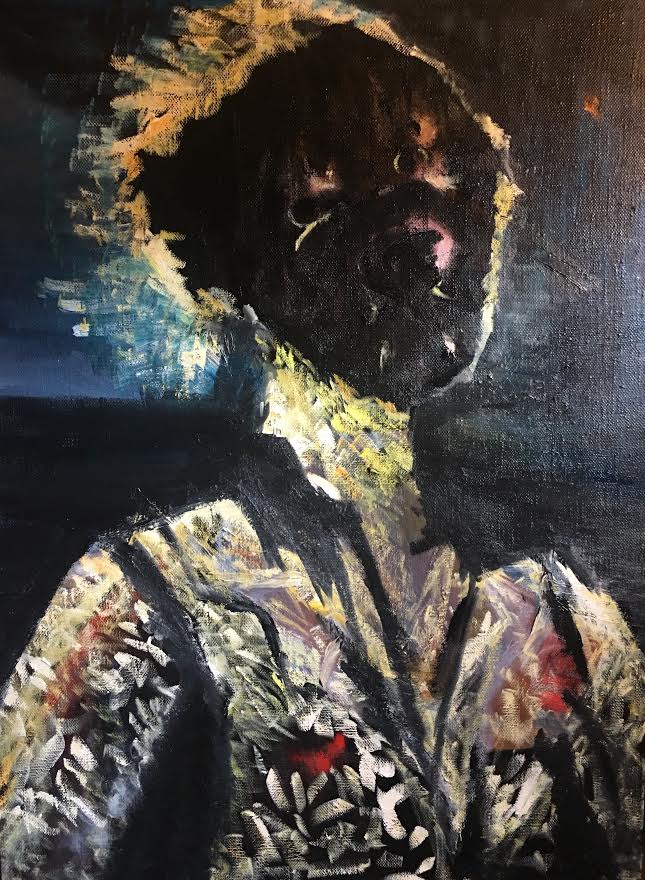
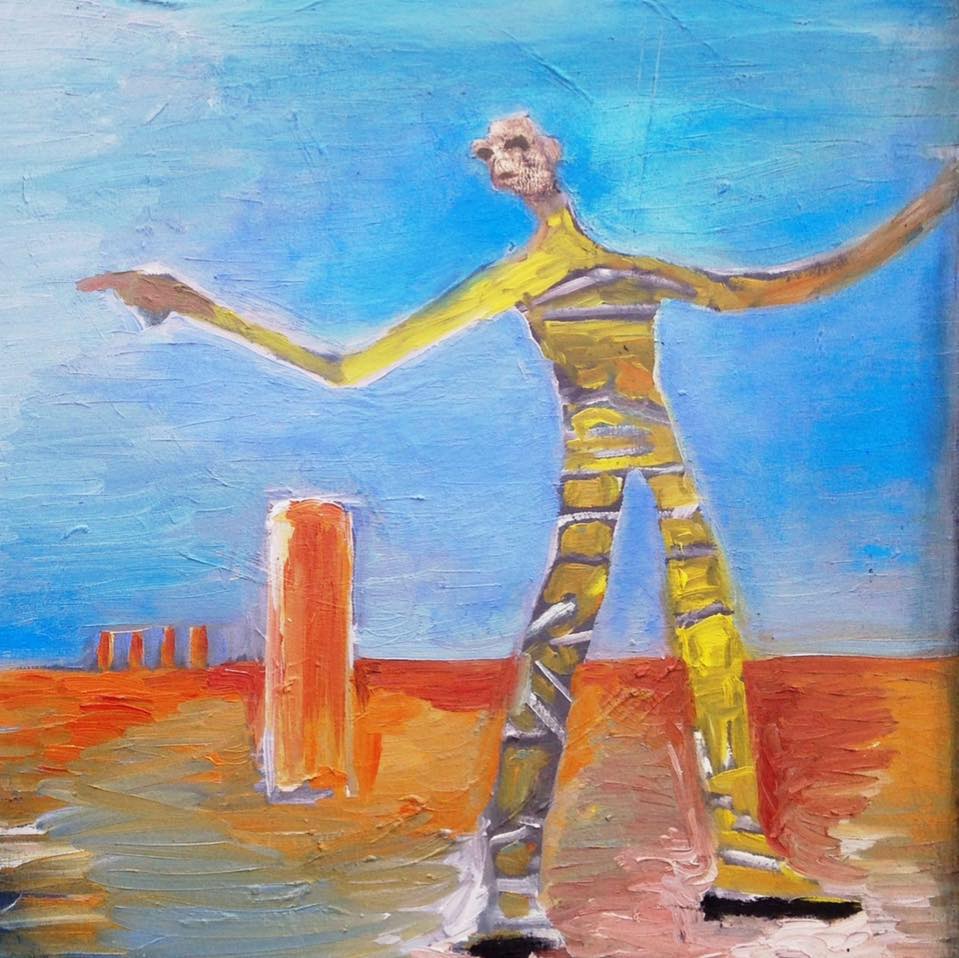
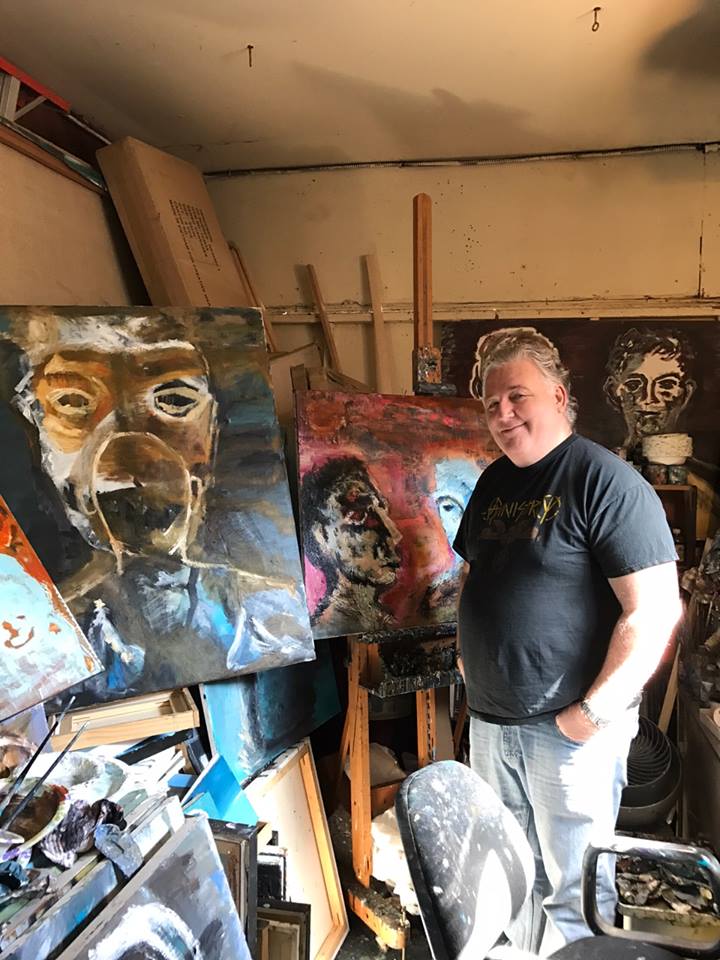
Scott A. Trimble is a painter of profound depth and grace; each work is not only visually acute but resonates with meaning both opaque and transparent. His unique, figurative yet freeform expressionistic style, captures light and motion in layers of paint, shadowy faces, and otherworldly landscapes.
“What enables me to paint is that I found a way to not be concerned at all about what other people are going to think. I don’t engage my mind, I just try to use my eyes and enjoy myself- it’s a real simple process,” Trimble relates. “I don’t worry about something being particularly recognizable or anatomy being precise, I just enjoy what I’m doing.”
Indeed, there’s an almost wild joy in his work, a thrumming sense of emotion in each piece.
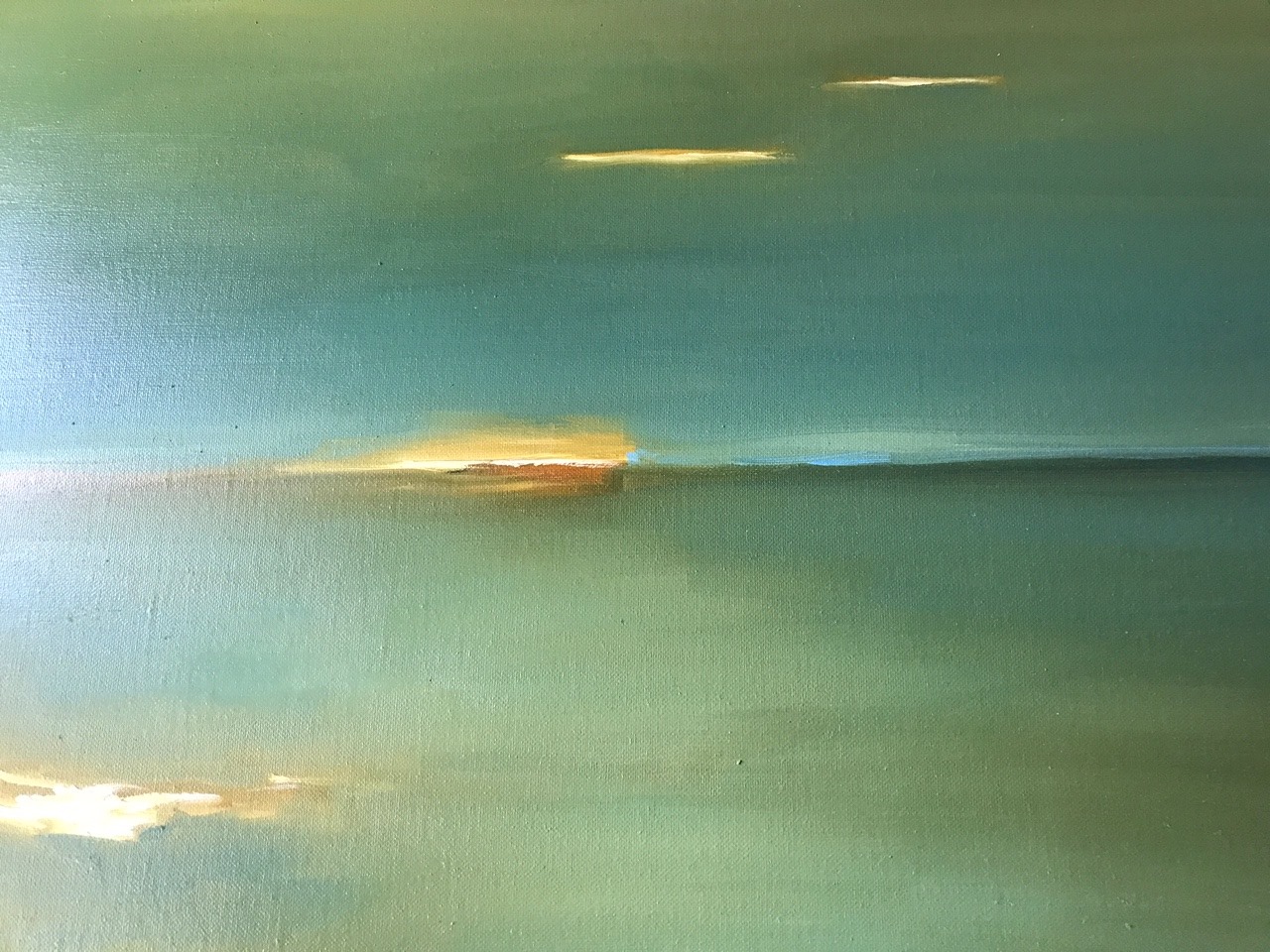
Each painting tells not just a story but a novella of emotion. One piece, “A Love of Place” was inspired as a reaction to what the artist calls a “disturbance in the essence of life’s fabric” by our current political landscape as well as by a strong love of place, according to the artist. Dealing with troubling politics and long days, Trimble painted aqua sky and sea – calm and divine. For Trimble, blue represents happiness.
“It was inspired by a time when my kids were young, and every weekend we would pick different environments in Los Angeles to explore – whatever popped up first in Google search, we would visit. What I learned and imparted to my boys, was that most people really loved where they lived no matter what we thought of the place. People who lived there, it was their home and they loved it. This is Los Angeles for me.”
The piece also features four small bars of light. “I use that constantly – four is a reference to me, my wife, and two kids – so they always know I’m thinking of them.”
He adds “In most of my paintings those groupings of four have three bars clustered together and one apart, observing or being observed.”
The observer – that’s Trimble indeed.
“I’ve spent my whole life thinking the single most important thing in life is your memory. My mom had several strokes a few years ago and her memory is gone. I’ve become interested in the way memory functions, the way it can be elusive, and memories mixed with other memories, and I wanted to replicate that process in the action of doing paintings that are physical manifestations of memory,” he explains, “and treat them with differing levels of preciousness, the way a really fond memory is nurtured and saved, where a less interesting memory is forgotten.”
With that elegiac thought in mind, Trimble has begun to paint over some works.
“I haven’t bought new canvas in five months,” he says. “Most of my paintings have been through the wash cycle more than once.”
Trimble notes that his very first paint-over was originally created in 1984, and painted over in 2014. “When my sons asked me why I had partially painted over something they had grown up with, I replied that it took me 30 years to finish it,” Trimble laughs. “It was an empowering thing to do to paint over it.”
Although Trimble has painted for decades, he took a hiatus when day job and family life consumed his time. “I had no time at all to paint, so I started again in 2013 when my son started college.”
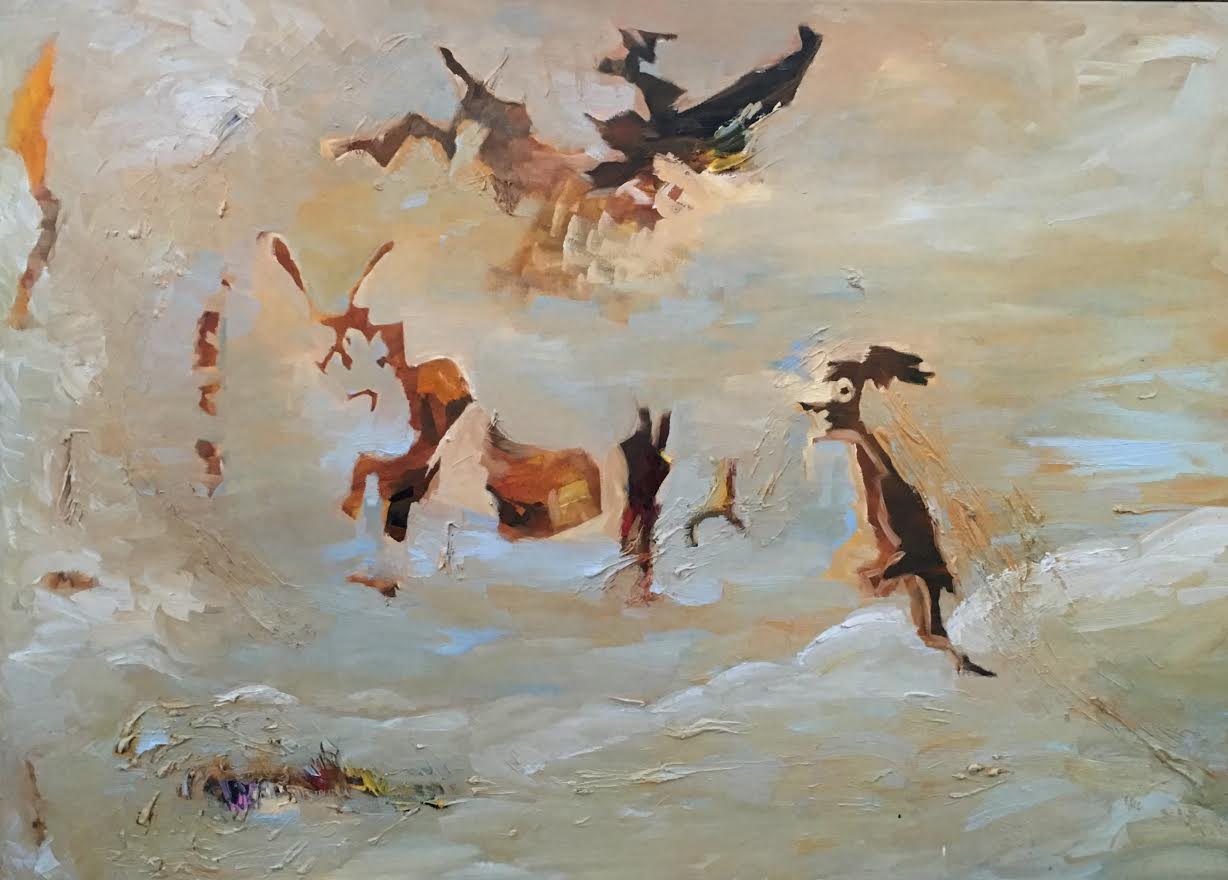
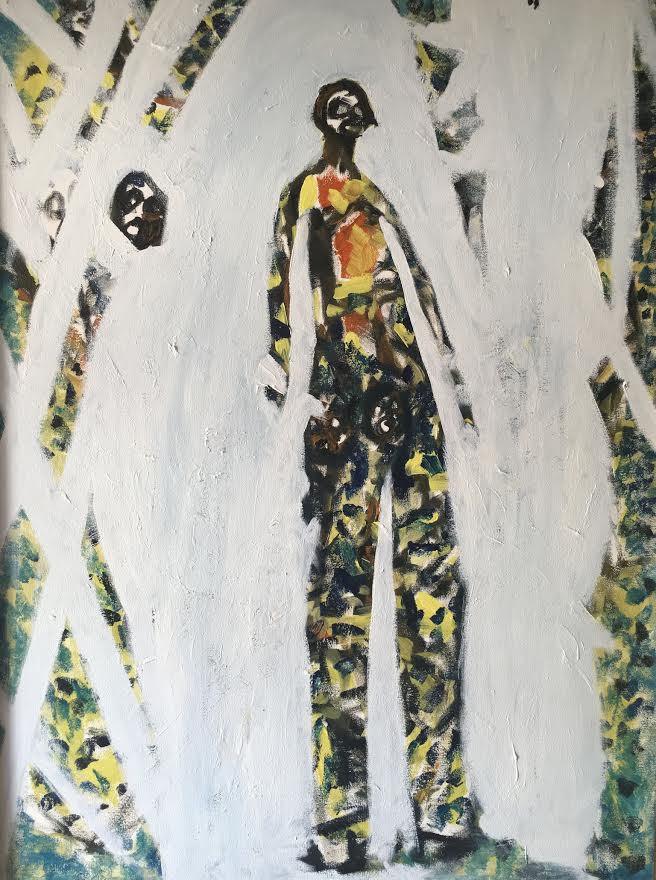
He painted angry portraits of unlikeable people, abstracts, shadow figures, human figures, faces, and landscapes.
His voluminous output – art perhaps stored in his heart for years, follows an almost relentless process of nightly painting. “When I get home at 7:15, I come straight to my garage studio and work until 10:30 or midnight. I’m enjoying the moment, flashing through memories with paintings that are growing and changing.”
Older works exhibit thicker paint from paint-overs.
Many of his paintings have a dark and dreamlike quality, with images partly out of focus, due perhaps in part to working by a dim 60-watt bulb in a small space.
His titles reflect his past studying screenwriting – which is the wordsmith equivalent of visual poetry.
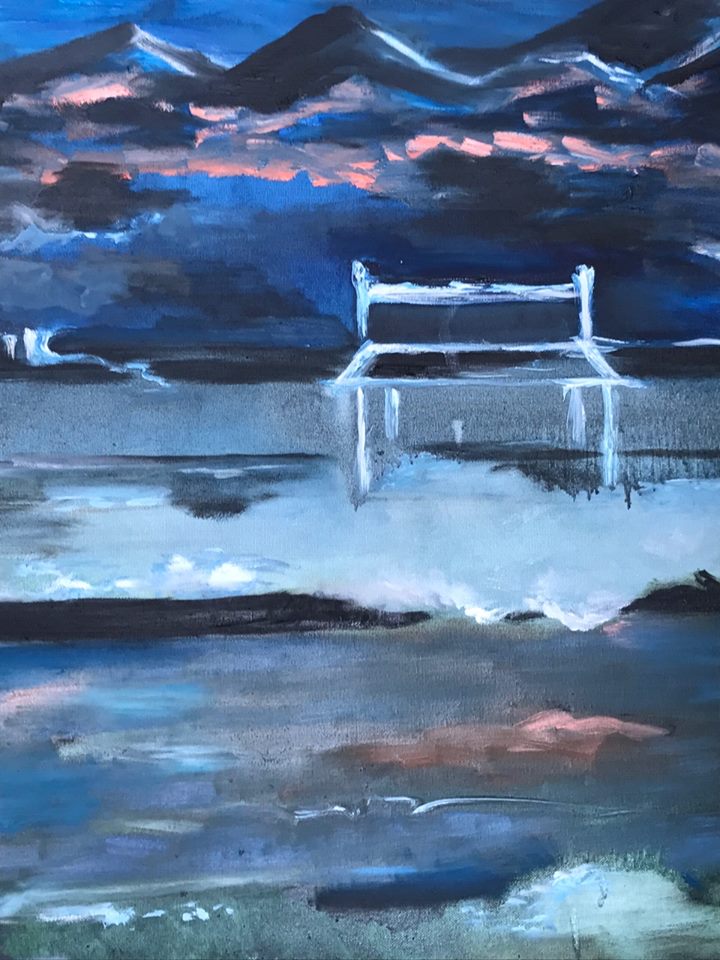
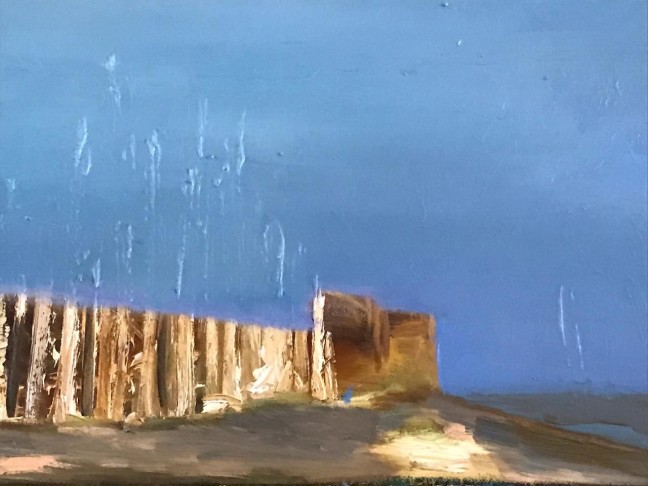
Take “I’m Pining for our Bench at Two Bunch Palms,” with a white bench, a reflection in a pond of skyline and desert mountains. The viewer immediately recognizes desert, but the intense blue is oceanic – it’s the visualization of the longing in the title, grand and inchoate.
“Ultimately in each of my paintings, I try to create pocket narratives, a short story comprised of a set of mixed up memories, emotions, and history, that are distilled down to a single sensation. It’s not something you can easily describe, but it’s meant to be felt.”
Feel what Trimble feels this month: the artist has 5 works that are a part of Satan’s Ball, the large group show currently at DTLA’s Art Share, and a collaborative piece at VS, a show which pairs artists together at Gallery 825 in West Hollywood. Sixteen other paintings are on exhibit in a stellar solo show at Laemmle’s NoHo Theater in North Hollywood. You can see more of the artist’s work at www.scottatrimble.com
Genie Davis; Photos: Genie Davis and provided by artist
One of the best ways to start a brand new year is by exploring art which resonates with life, promise, joy, and beauty. Southern California-based artist Catherine Ruane exemplifies all of these in her work, and specifically in one large scale piece currently on display at the Los Angeles Art Association’s Gallery 825 as a part of LAAA’s signature survey exhibition featuring the best in emerging art.
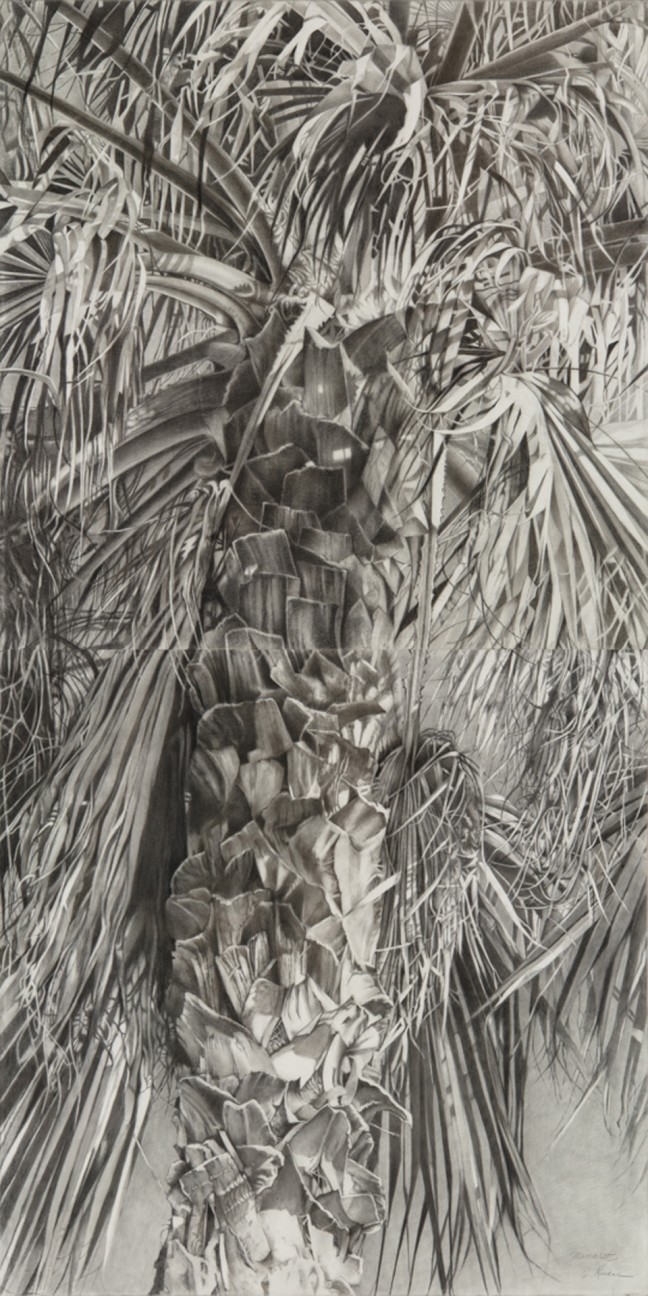
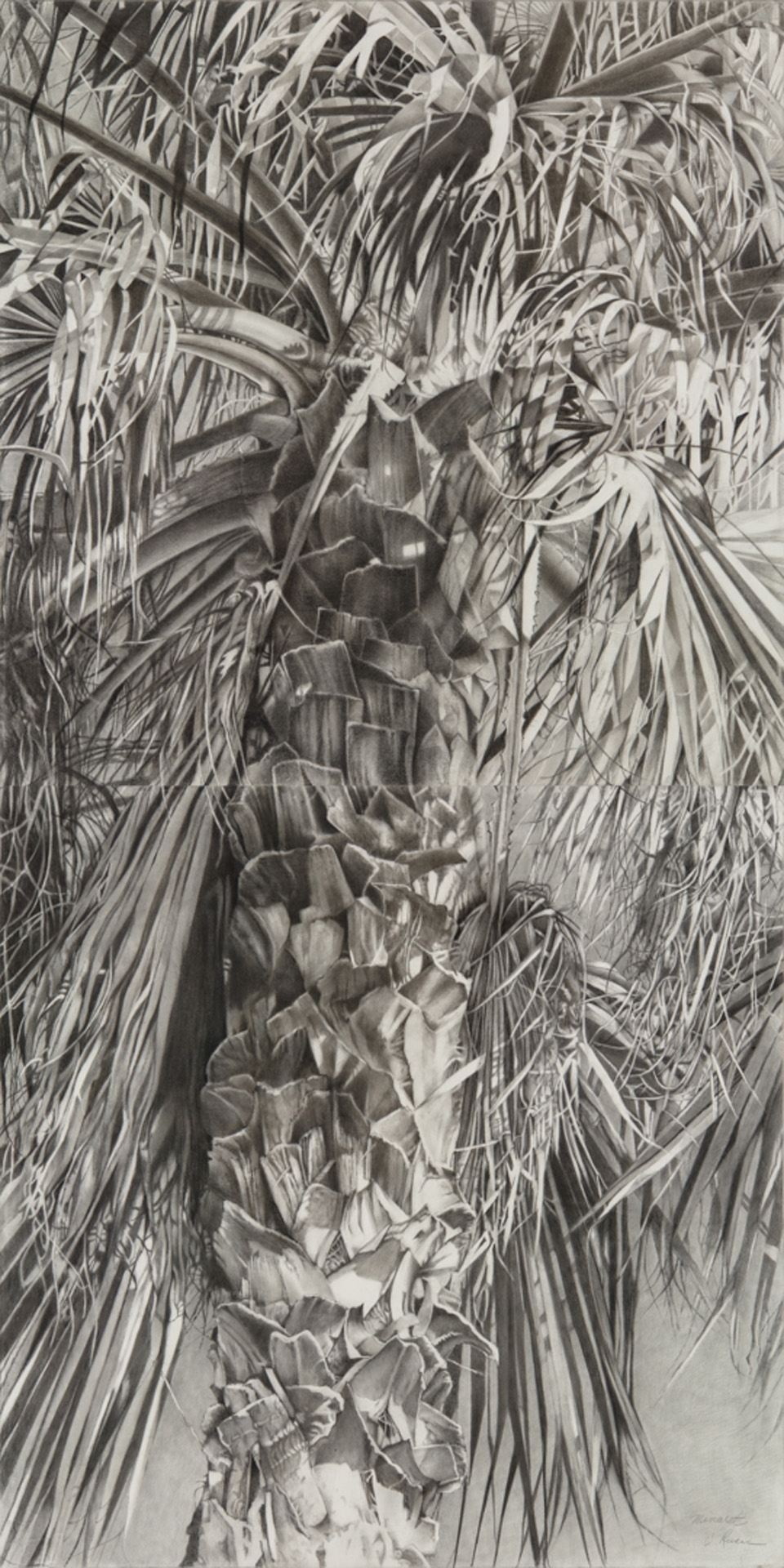
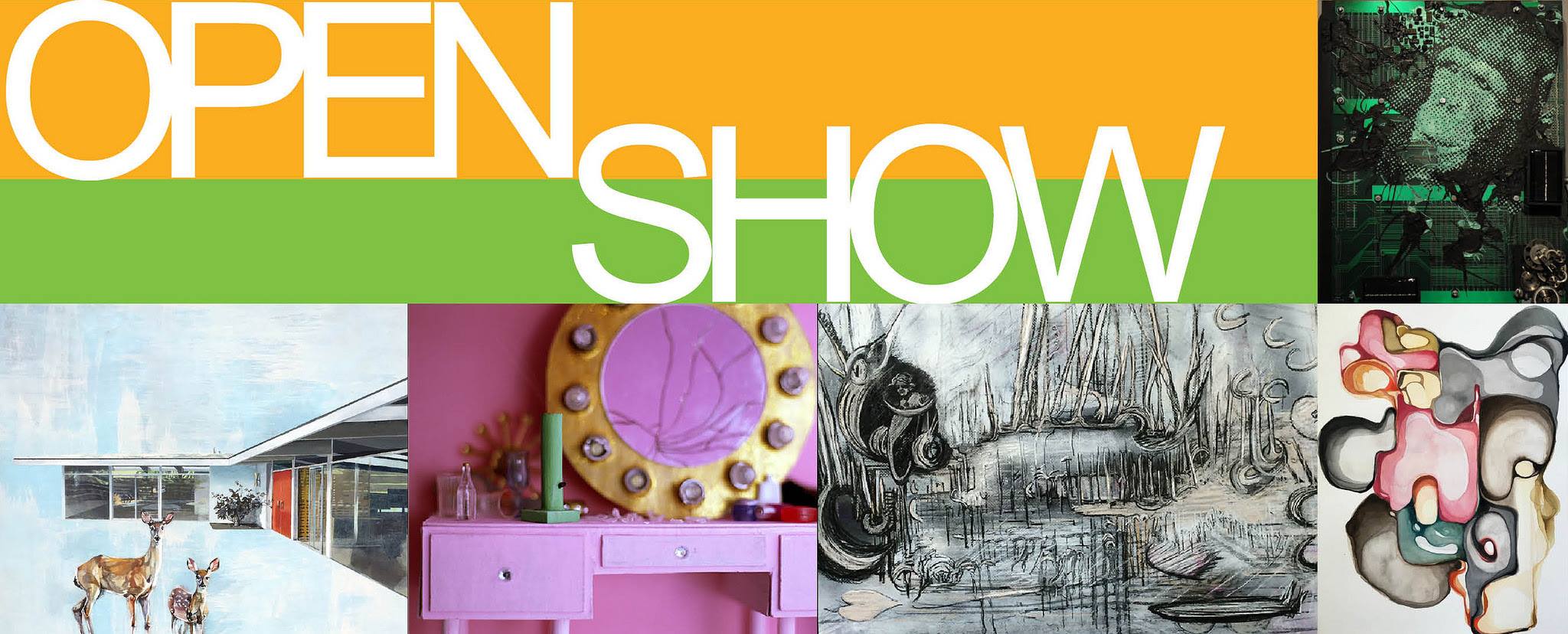
The stellar Open Show 2016, on display now through January 13th, includes Ruane’s simply gorgeous, inspiring 36″ by 72″ “Minaret,” which is reason alone to take in the exhibition, juried by Jennifer Inacio of Perez Art Museum Miami. Featured artists include:
Elizabeth Bailey, Kelly Berg, Clovis Blackwell, JT Burke, Mario Canali, Chenhung Chen, Nathaniel Clark, Jaime Coffey Bateman, Karen Duckles, Holly Elander, Birgit Faustmann, Laurie Freitag, Dwora Fried, Kaori Fukuyama, Miguel Galán, Danielle Garza, Tanner Goldbeck, Antoine Guilbaud, Yoon Chung Han, Gina Herrera, Sol Hill, Mark Indig, Paul Ivanushka, Lynda Keeler, Carol Kleinman, Kevin Michael Klipfel, Faina Kumpan, Tom Lasley, Barbara Lavery, Jung ji Lee, Stuart Marcus, Randi Matushevitz, Dan Monteavaro, Alexis Murray, Makan Negahban, Robert Nelson, Denise Neumark-Rreimer, Eric Oliver, Elizabeth Orleans, Thibault Pelletier, Lori Pond, Meghan Quinn, Margaret Raab, Catherine Ruane, Larisa Safaryan, Shilla Shakoori, Chris Shelby, Susan Swihart, Haikuhie Tataryan, Reisig and Taylor, and Terry Tripp.
We’ve written before on the stunning work of Chenhung Chen, whose life-filled sculptures vibrate with delicate, contained motion; Dwora Fried’s intricate tableaux that inspire passionate discussion; and the touching, funny miniature worlds of Tom Lasley. Each of them and so many more terrific artists are represented in this show. Do explore it.
But today, we are writing about Catherine Ruane, whose graphite and charcoal works, of which “Minaret” is one, are quite simply profound.
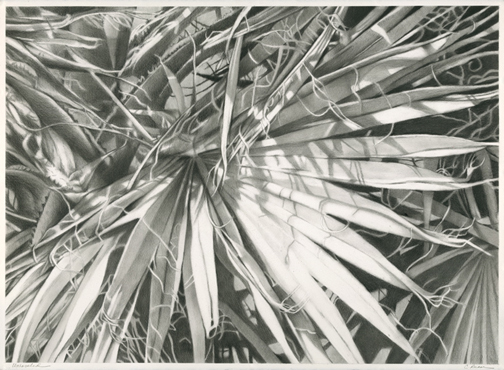
Above, “Minaret.” The perfect, delicate detail in this intricate black and white image of a fan palm is nothing short of astonishing. Rough fronds, the scaled surface of the palm’s trunk, the finely caught shadows – this is an image of life itself, contained is a literal and lovely evocation of a palm tree.
Viewers who study this work will find, as with so many of the artist’s pieces, something that goes beyond the literal, that morphs a perfect tribute to nature into something ethereal and transcendent.
“The ubiquitous palm tree is both a part of Southern California which is my home, but also a plant that is a survivor despite long hot summers. The tree was once used as a tall tower to call people to prayer before a temple with a minaret could be built. I am fascinated by how this tree has been used as a way to bring people to a place of spiritual calm. I experience an internal peace while carefully rendering all the complicated mix of details in the bark and leaves. Within the chaos there a structure of order. Opposites thrive,” Ruane says.
Above, “Transgression.”
Ruane’s work is pristine, but it’s almost photographic nature is just one part of what pulls the viewer into her world. She doesn’t just chronicle, she creates a transporting experience, pulling viewers into what feels like a sacred space, fecund with life.
Above, “Gila River II.”
Below, “Cloister.”
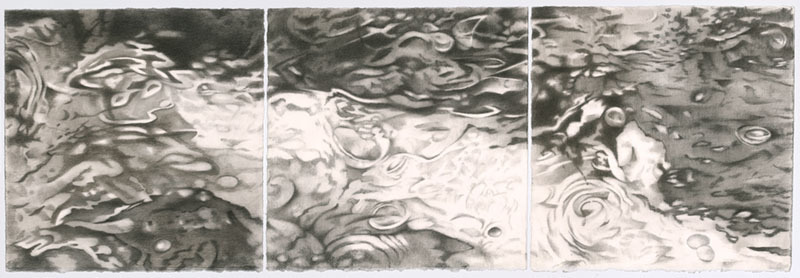
Her water series ripples with light, the life of the water is vivid motion and shadow; her cacti are so sharply drawn you can feel the spines.
Above, “Unravelled.”
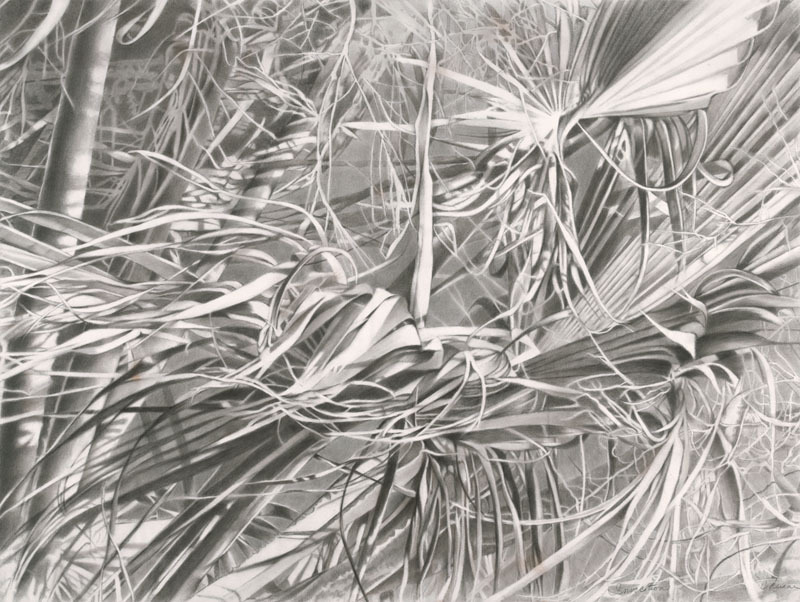
About her palm series, the artist says “The palm tree is the iconic tree growing throughout much of Southern California, Arizona, and Mexico. The Washingtonia Filifera or California Fan Palm…defines my personal experience of ‘home.'”
Above, “Invocation.”
There is a sense of awe and wonder in each piece, a complexity that is as nuanced as it is sweeping. Above all, Ruane takes a realistic approach that is exceptionally vivid and at the same time that approach is entirely poetic. It is a true experience of beauty to look at her works, and to study their detail is to fall in love with them and the desert life they represent.
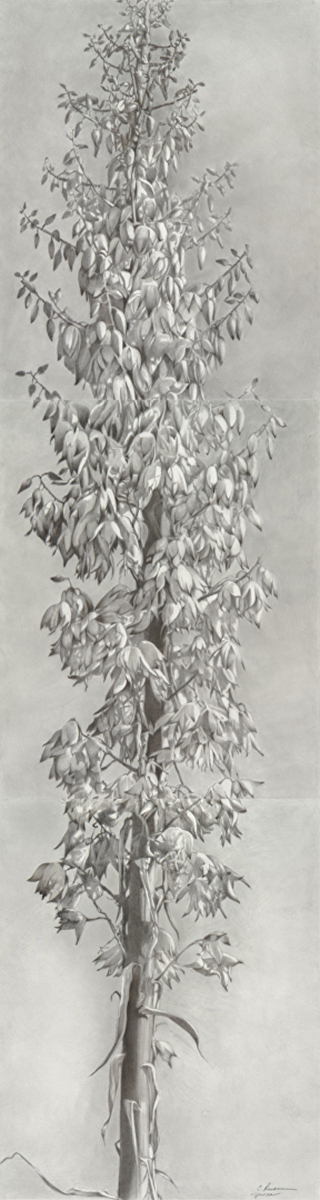
Above, “Chaparel,” yucca.
Here’s the thing: the natural beauty she depicts, whether it is her palms, water, or other desert plants, is truly wonderful. But she inhabits each aspect of this flora so viscerally and so completely that her work involves the viewer in the intrinsic life force of that particular piece of nature. One can feel it breathe, feel compassion and empathy for a growing thing, an eddy in a river, a sheaf of cactus blossoms. Feel admiration for the resilience of a desert plant, feel the danger of its spines, feel the magnificence of wind, water, branch — she creates a vibrant personality in each work. These are living beings that she shapes.
Above, “Only the Wind.”
The artist also shares with the viewer a sense of discovery, both of the exceptional wonder of the natural images she depicts and of our ability to view them. Ruane says she hikes and explores the area around her home constantly, observing visual images that help her develop a work.
Feel the artist’s intimate observation in her “Constantine,” below, barbed wire pinning back desert blossoms.
Explore the glowing detail in this section of Ruane’s water series, below, focusing on the environmental improvements on the Gila River.
Do not miss a chance to view the lush, personal, thoroughly alive nature in Catherine Ruane’s work. It’s a beautiful way to start the New Year.
Catch Ruane’s “Minaret” in the exciting group show now at LAAA, located at 825 N. La Cienega in West Hollywood.
The Los Angeles Art Association’s Gallery 825 often hits it out of the art ballpark with their well-curated solo and group shows. Running through November 18th, the La Cienega gallery offers three solos and one group show that is definitely a home run.
In the front room, Countenance Divine is a multi-media exploration of portraiture in art. Ranging from photography to graceful watercolors, the show was juried by Rick Royale. Participating artists include Robin Adsit, Robyn Alatorre, Susan Arena, Donna Bates, Maria Bjorkdahl, Ivan Bridges, Annie Clavel, Allan Denolo, Tina Frugoli, Rob Grad, Vicky Hoffman, Brittany Hutchinson, Lynda Keeler, Coolen M. Kelly, Gershon Kreimer, Campbell Laird, Jun jii Le, Theodosia Marchant, Lena Moross, Malka Nedivi, Julio Panisello, Justin Robinson, Ann Marie Rousseau, Sheli Silverio, Howard Steenwyk, Susan Swihart, Jane Szabo, Devin Thor, Ariel Vargassal, Iben G. Vestergaard, Peter Walker, and Diane Williams.
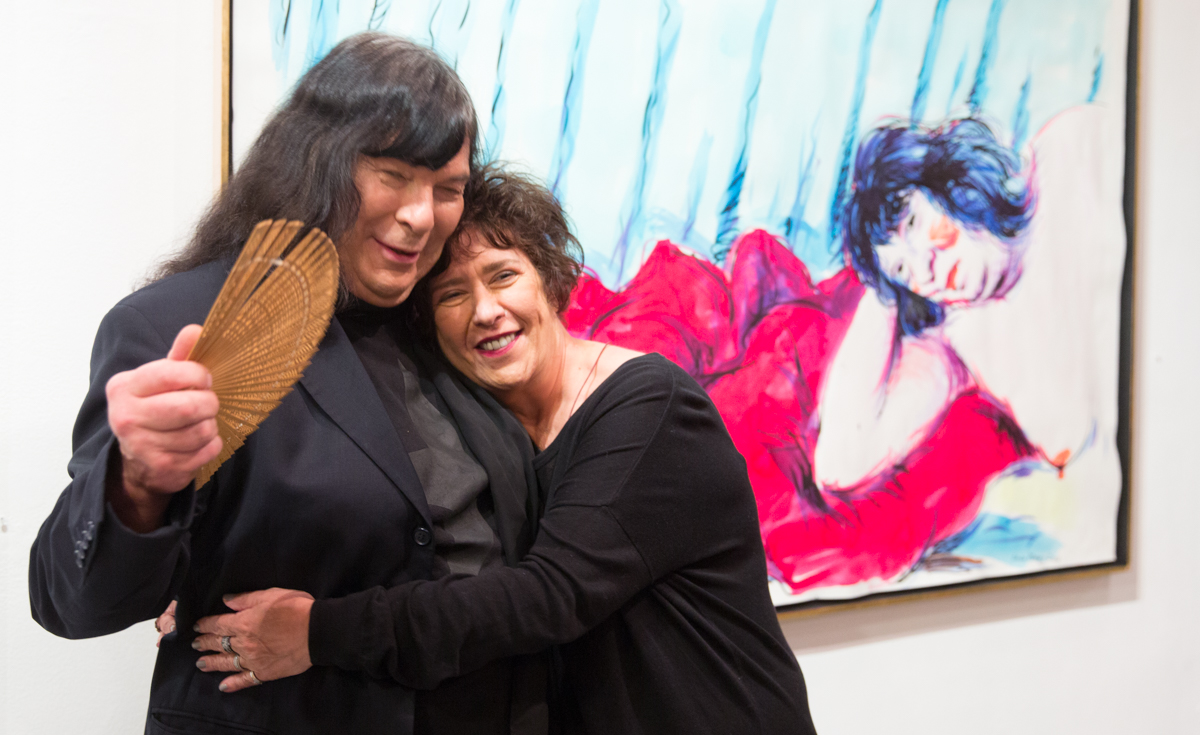
Lena Moross, whose method of working is usually to create a series on a specific subject, was captivated by the Carmine Messina after meeting him, heavily made-up and dressed in women’s clothing, on a Hollywood street corner. Through that meeting, Moross began to explore, with her subject, what it means to be transgender. Exhibited here is a piece from that series, “Red Pillows,” delicately drawn and vibrantly colored. Using watercolor and ink, Moross has created a intimate and sensual painting that respects and pays tribute to Carmine’s story.
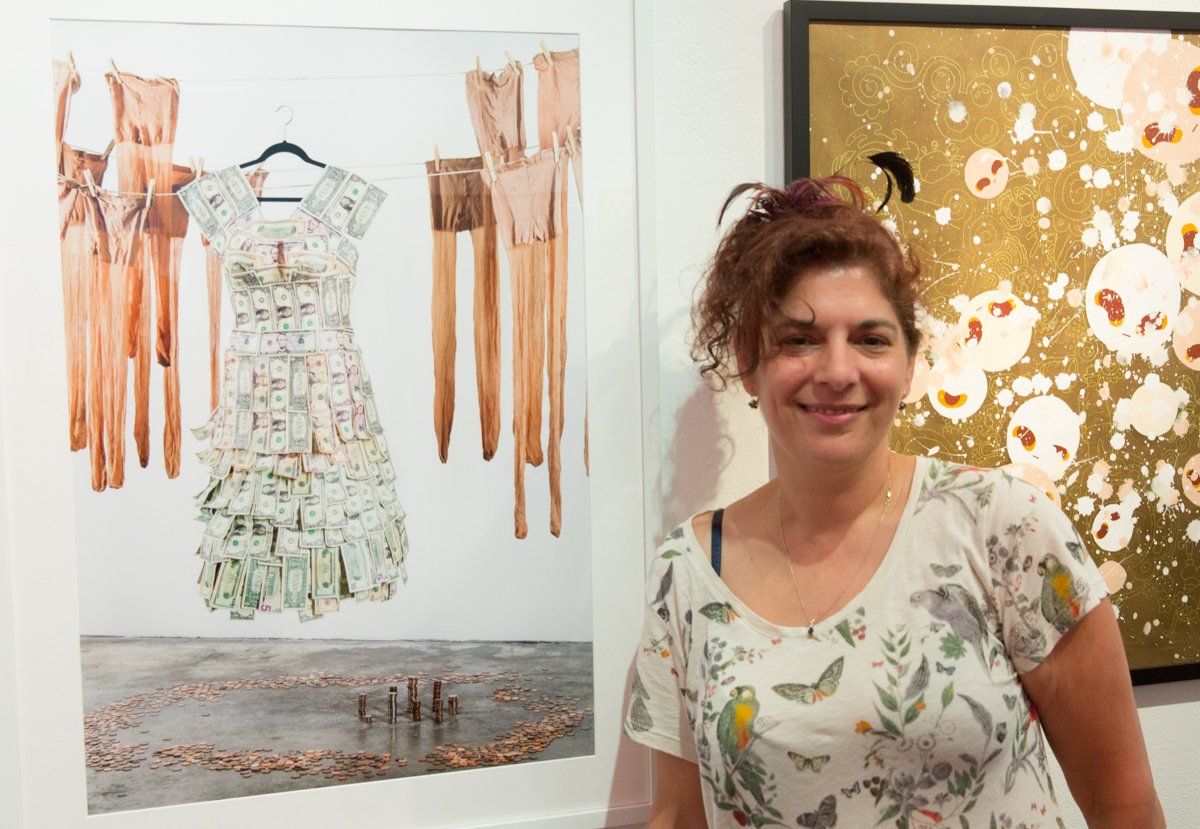
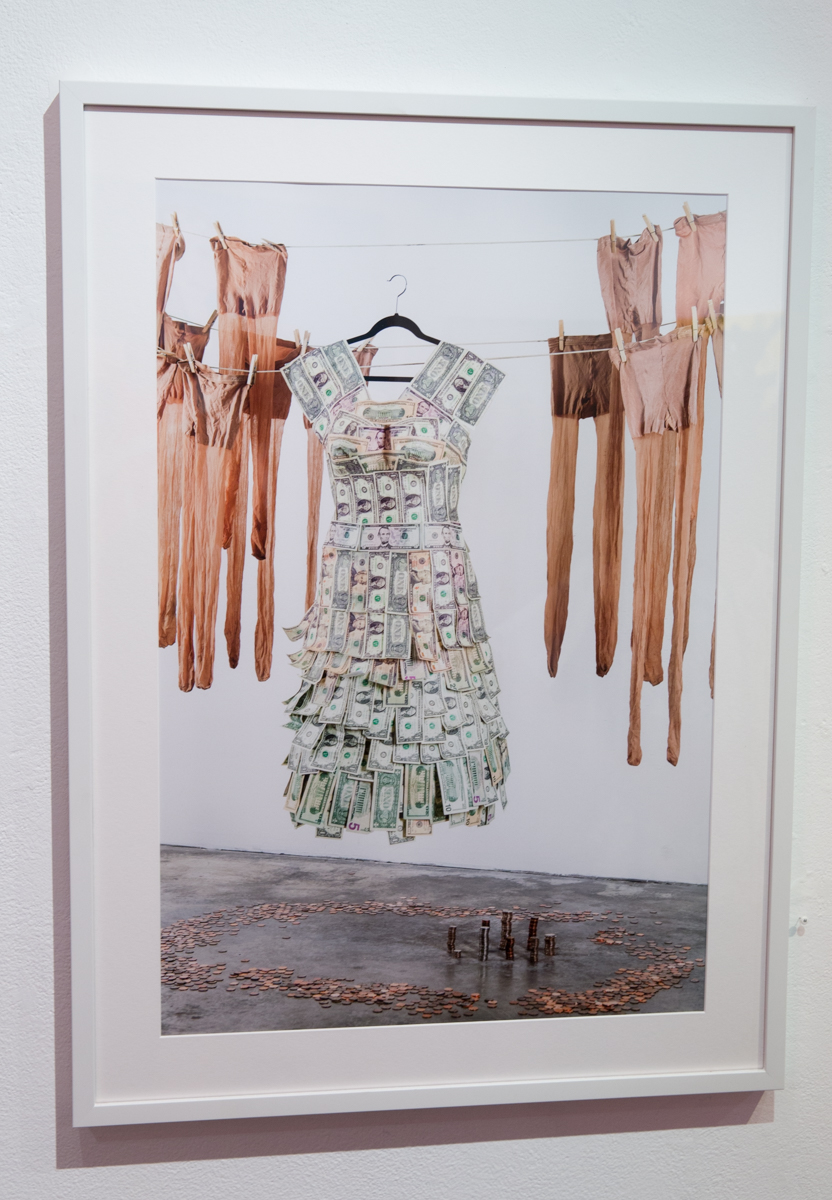
According to fine arts photographer Jane Szabo, “Photographs of dresses made from familiar objects such as coffee filters and road maps, suggest a persona, and become a stand in for myself.” This is a unique version of the self-portrait, which invites viewers to form their connections and myths. The digital photography archival pigment print displayed here is “Money,” from her series Reconstructing Self. The money dress and money beneath it is a fascinating stand-in for that part of the artist that must, as we all must, seek renumeration for our work to thrive.
Robyn Alatorre’s “Canto VI,” oil and ink on canvas is a portrait of a different sort, one that is as controversial as it is riveting. Alatorre calls her work “feminist, subversive, and obsessed with color.” The neo-surrealist here depicts a couple with fingers in their throats, attempting an antedote to gluttony.
Malka Nedivi’s “The Bride” is embelmatic of her work as a painter, sculptor, and collage artist. Nedivi says that all of her work is inspired by her mother, and both her parents’ previously unknown past as Holocaust survivors. Nedivi’s work uses a great deal of wood and fabric. Here, the large scale mixed media on canvas work features a bride whose bountiful skirt is the color of autumn leaves, and asserts in its own passionate way a presentation on the passage of time.
Diane Williams photographic work, a photo from the performance of “Monsters & Aliens #2” is a look at just who we are and what we hide behind; Sheli Silverio offers a beautifully drawn watercolor and oil, “Sharing Cereal” that evokes an untold intimacy.
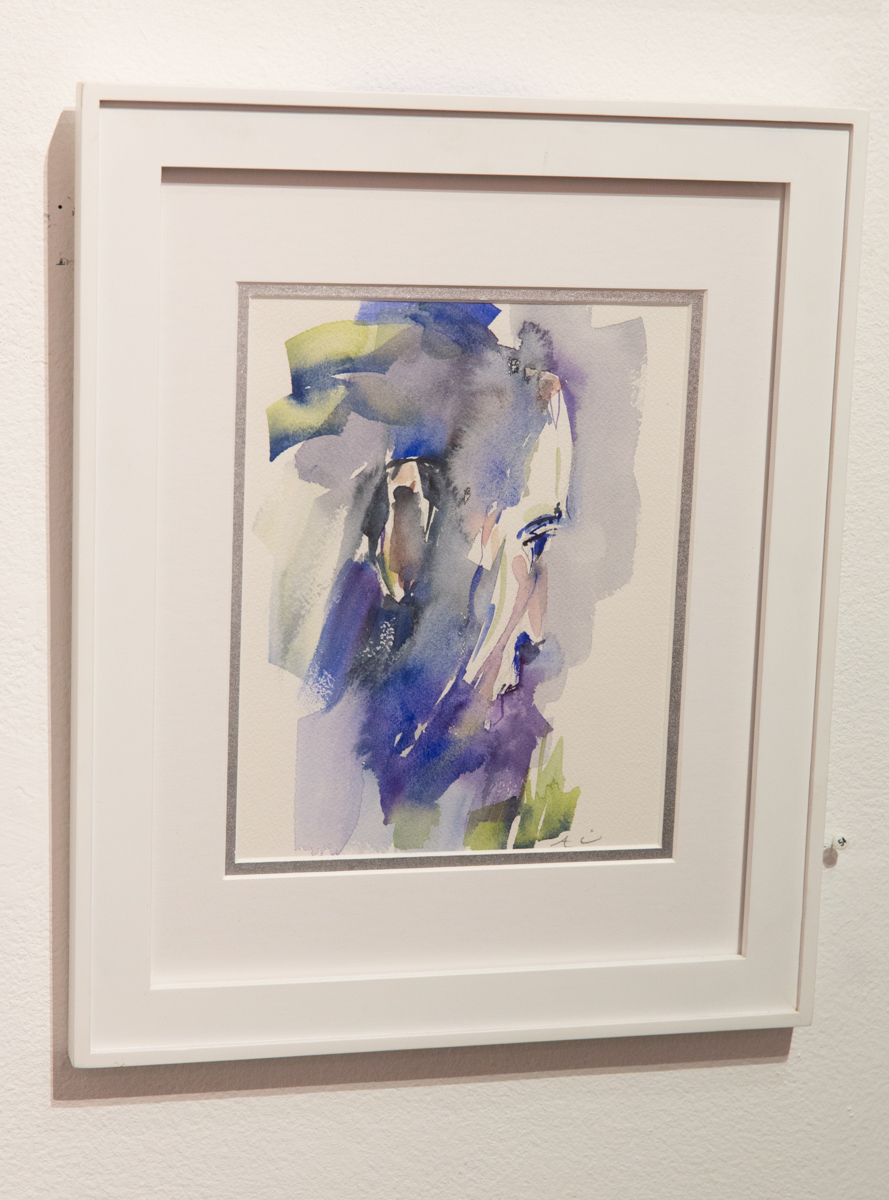
Annie Clavel’s lush watercolor on paper, “Lui,” differs from the work we’ve been familiar with that features mixed media on canvas paintings and a preference for the abstract. Here we have a narrative figure, a profile portrait that is both haunting and pastoral.
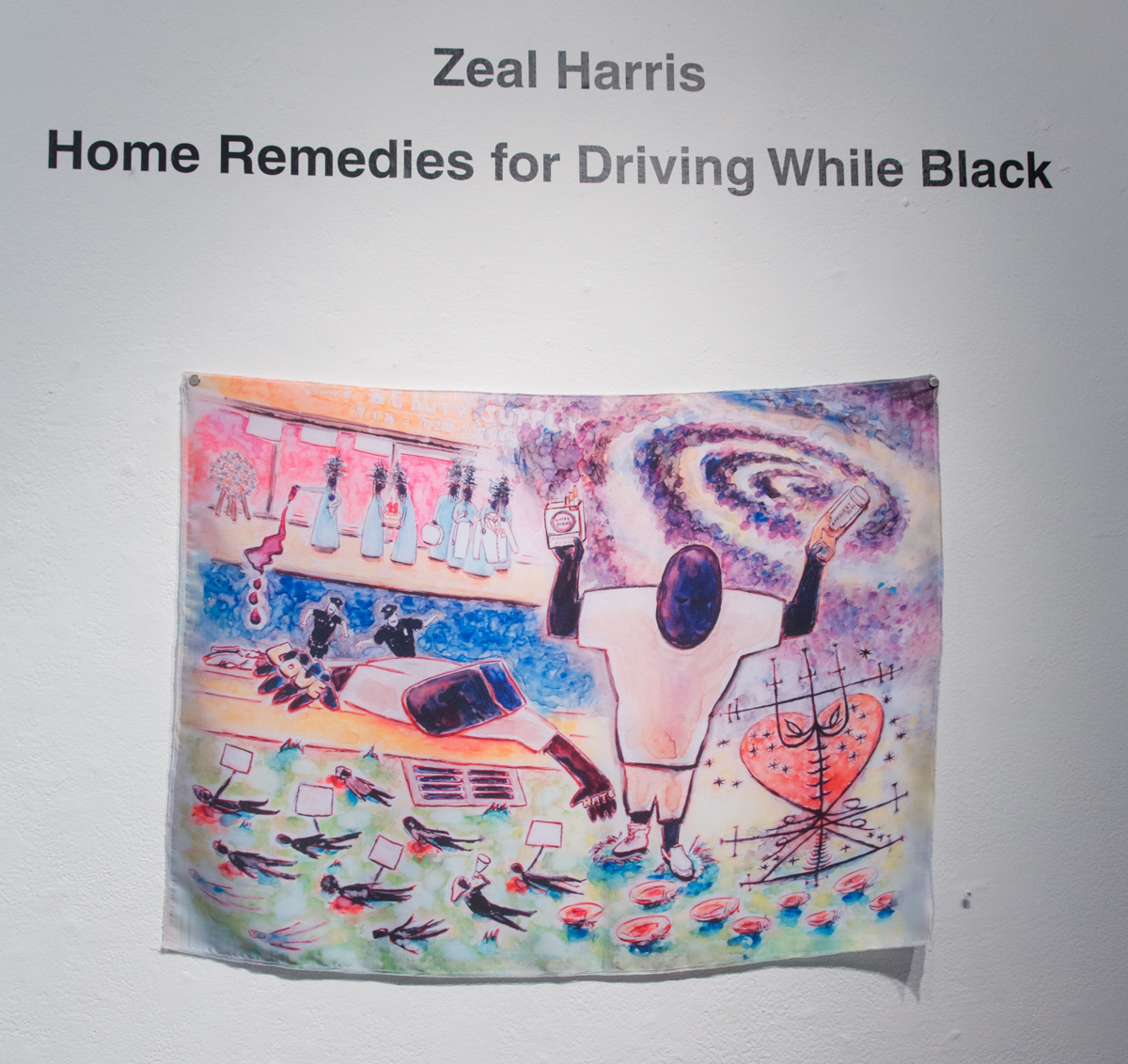
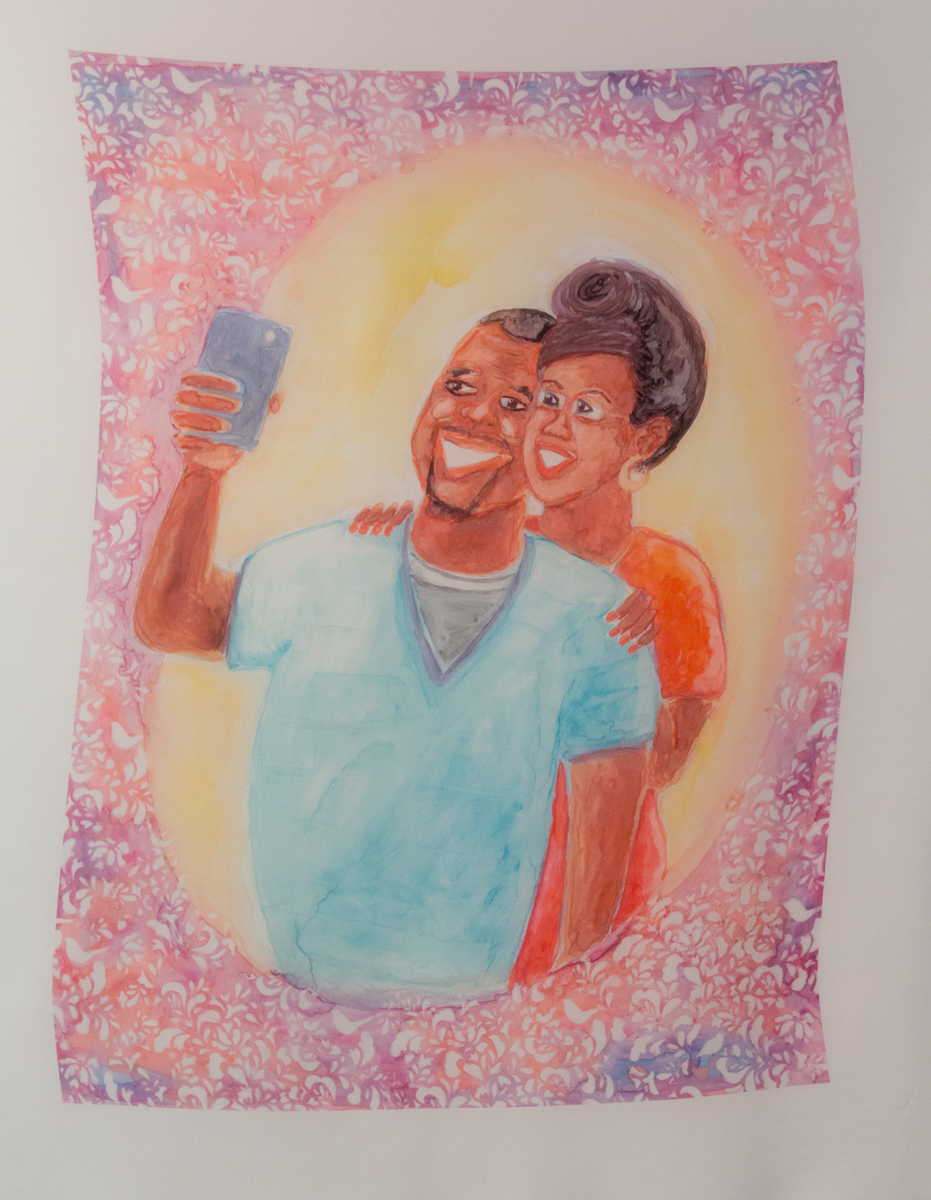
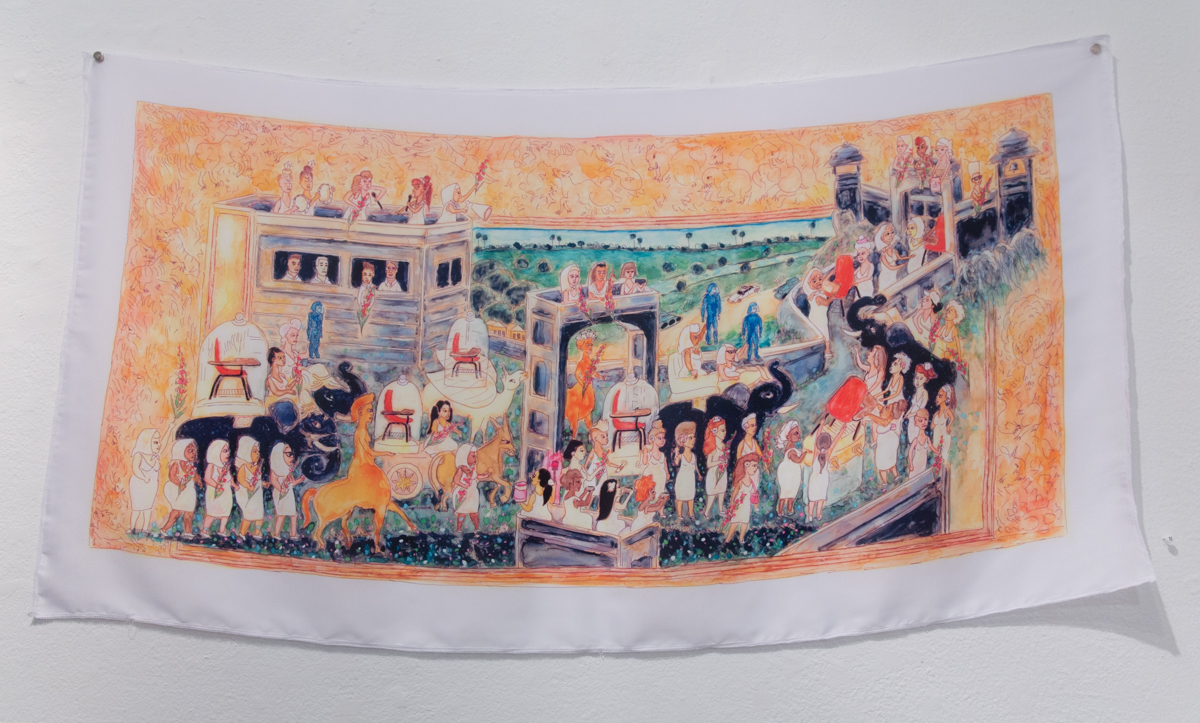
Moving on to the solo shows on exhibit, Zeal Harris offers a series of stunning works created in dye sublimition on fabric. Home Remedies for Driving While Black is both political and poignant, an autobiographical and biographical statement that has universal reach. Dealing with the intensely pertinent subject matter of police brutality, police killings, and racial profiling, Harris approaches the weightiness of her sculpture with a delicate, light touch, one that resembles the creation of banners, tapestries, and animation cels.
Her deftly accessible style draws viewers into a world that they may not personally know, but which her incisive commentary virtually insists they become immersed in. A raw and riveting show.
In the middle room, Bibi Davidson’s The Girl in the Red Dress continues the artist’s use of her intense primary color scheme and an alternative universe in which her stand-in, her “girl” represents the artist herself. Davidson’s work always enthralls: for more on this stunning solo show, read the details on the artist’s movement into some incredible three dimensional works at Art and Cake.
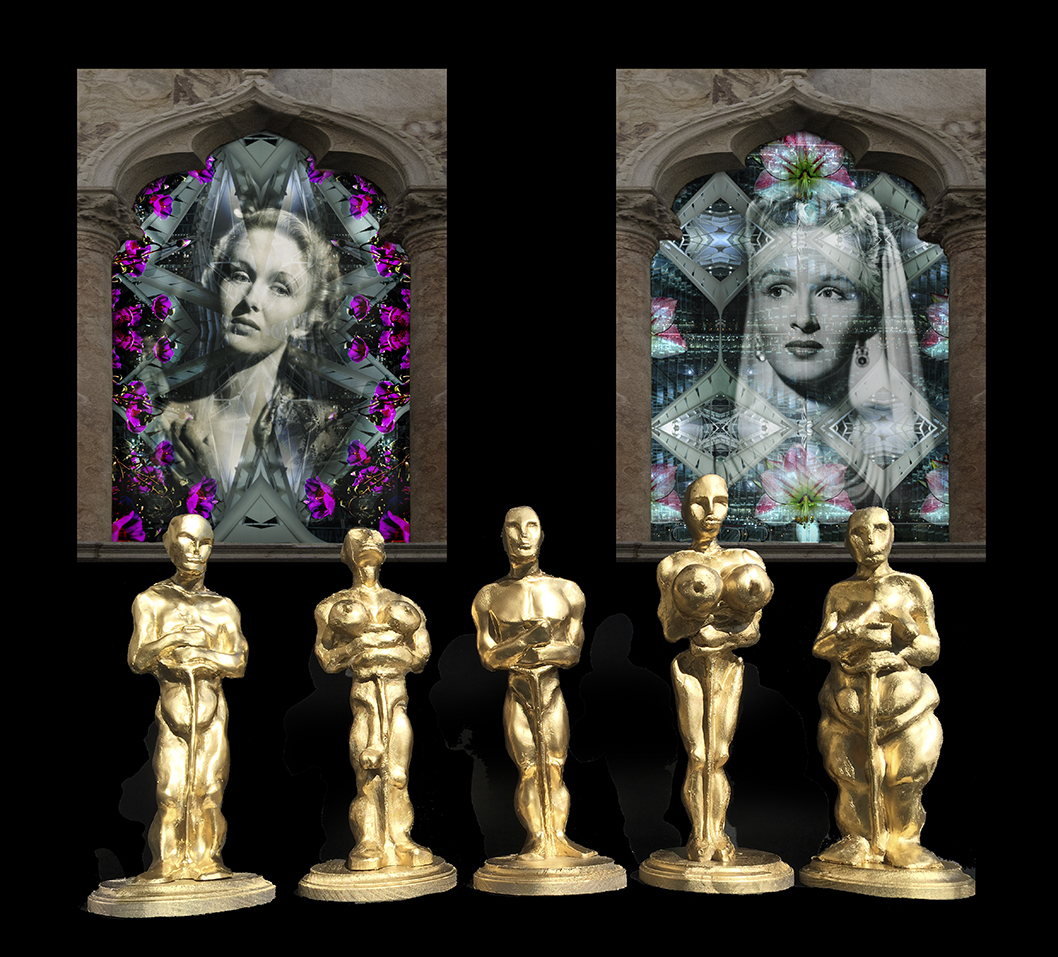
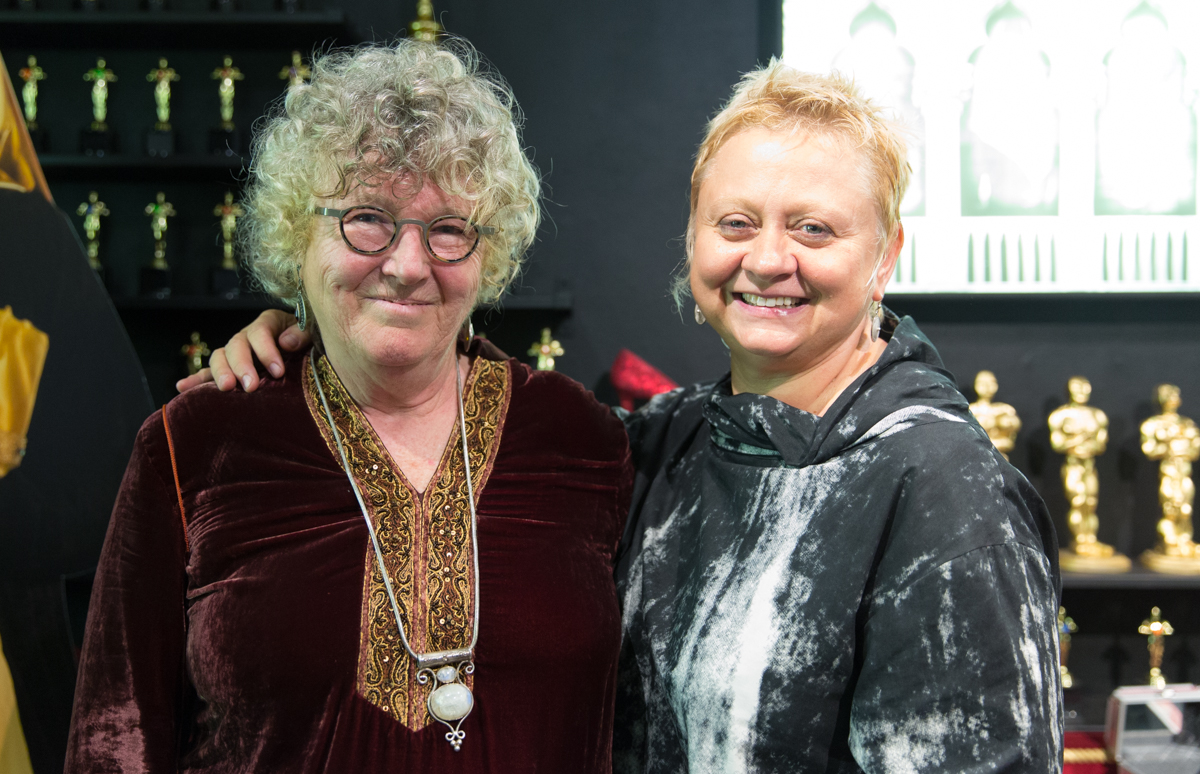
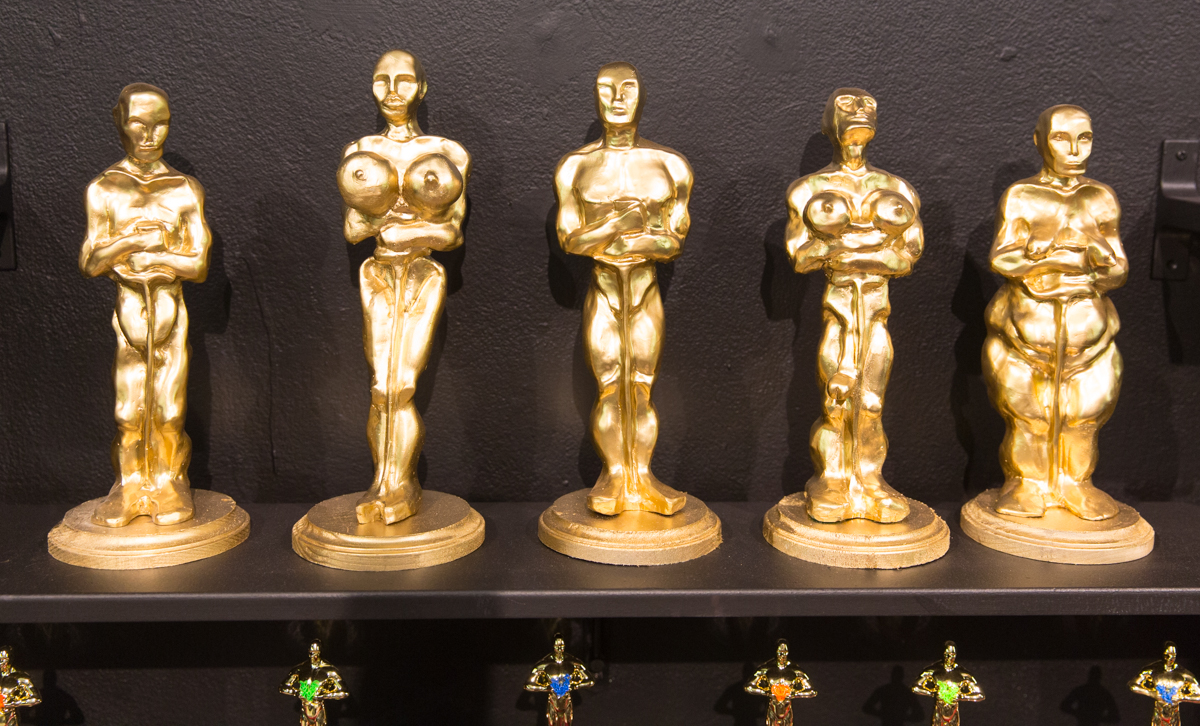
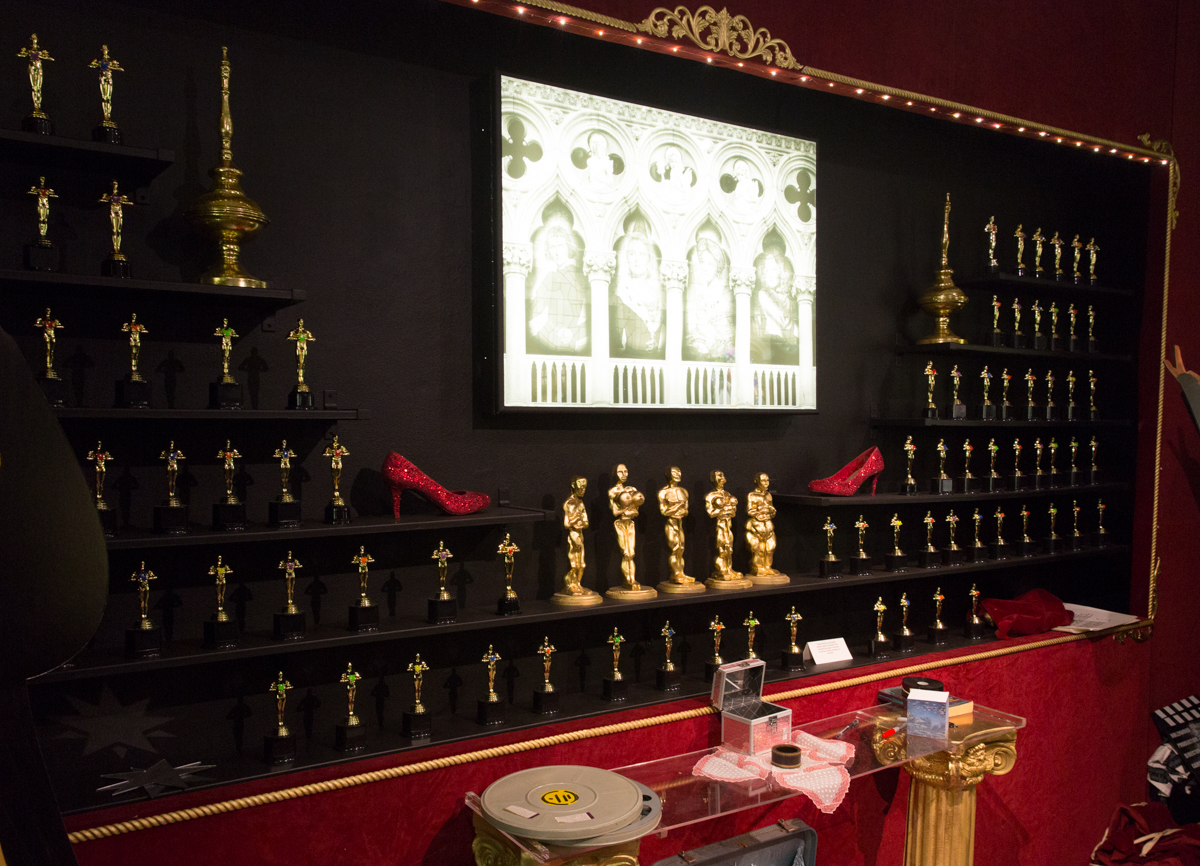
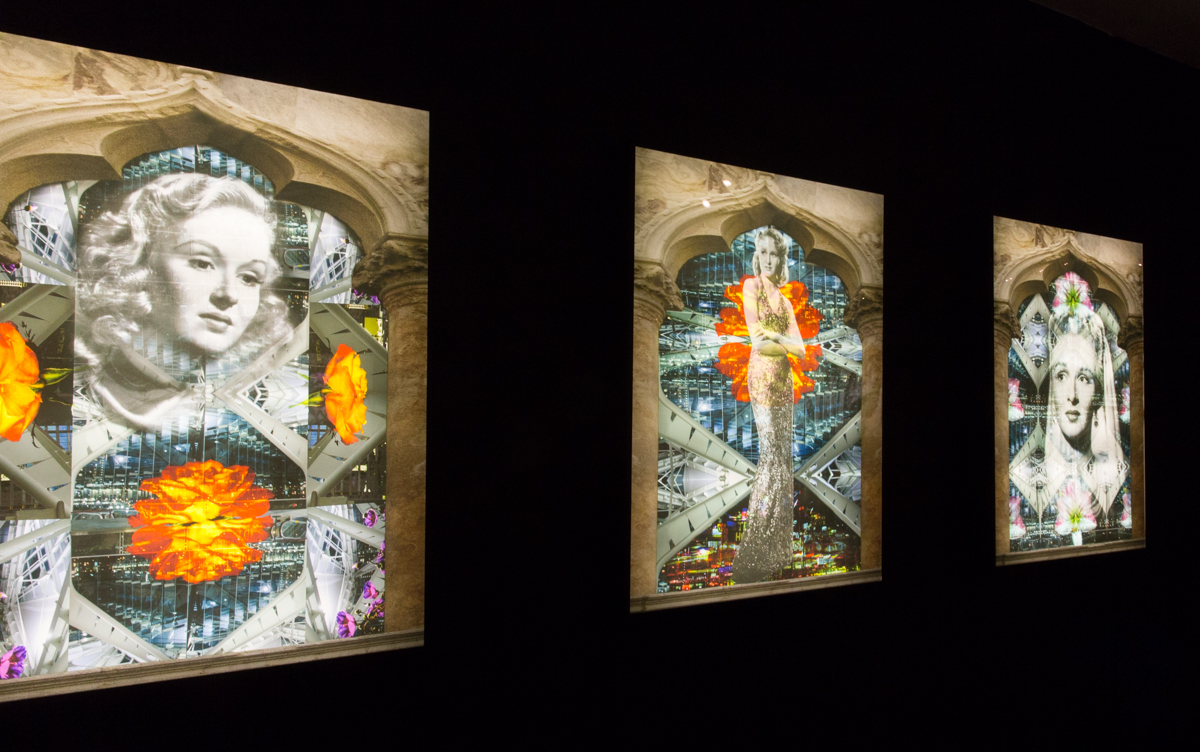
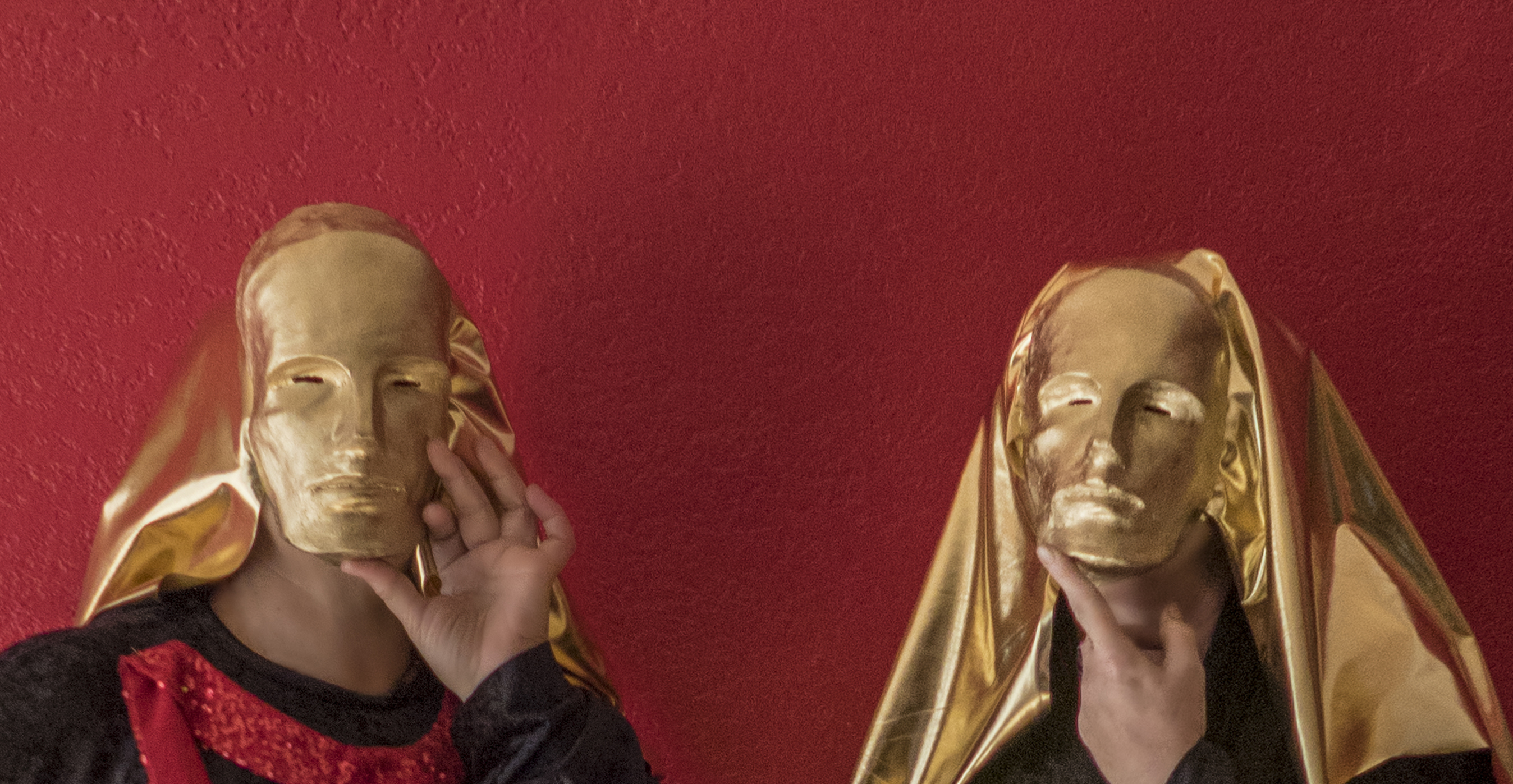
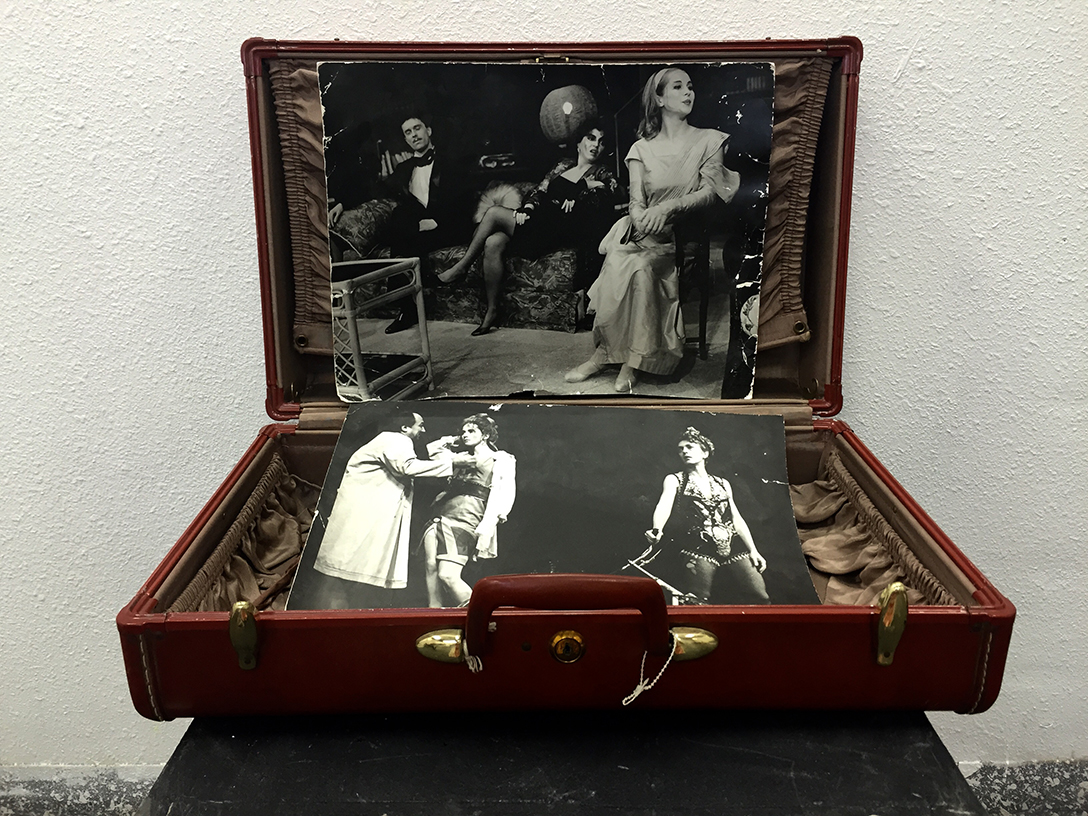
The Shrine of Stolen Identities explores the diversity that exists far beyond our collective obsession with celebrity culture. The collaborative duo “steph ‘n snez,” artists Stephanie Sydney and Snezana Saraswati Petrovic offer an immersive multi-media installation designed to dazzle with an homage to unknown artists who made the trek to Hollywood seeking fame and fortune, and to their unique individualism.
A performance component was a highlight of the opening October 15th, and will be offered again on Saturday October 29th, when at 4 pm, will enact a 15-minute performance, a re-imagining of a Buddhist sand mandala producing a glittering replication of a Hollywood Walk of Fame star on a mirrored table. The artists wish the Buddhist ritual of impermanence to speak to the impermanence of the values that our celebrity-obsessed culture indulges.
So — go for one, go for all. Gallery 825, located at 825 S. La Cienega has a divine countenance indeed this month.







 His titles reflect his past studying screenwriting – which is the wordsmith equivalent of visual poetry.