Monica Marks Considers Abandonment

Monica Marks Considers Abandonment – Genie Davis

What does it mean to be abandonded? A state of loss, adrift, free? To quote Janis Joplin, “Freedom’s just another word for nothing left to lose.”

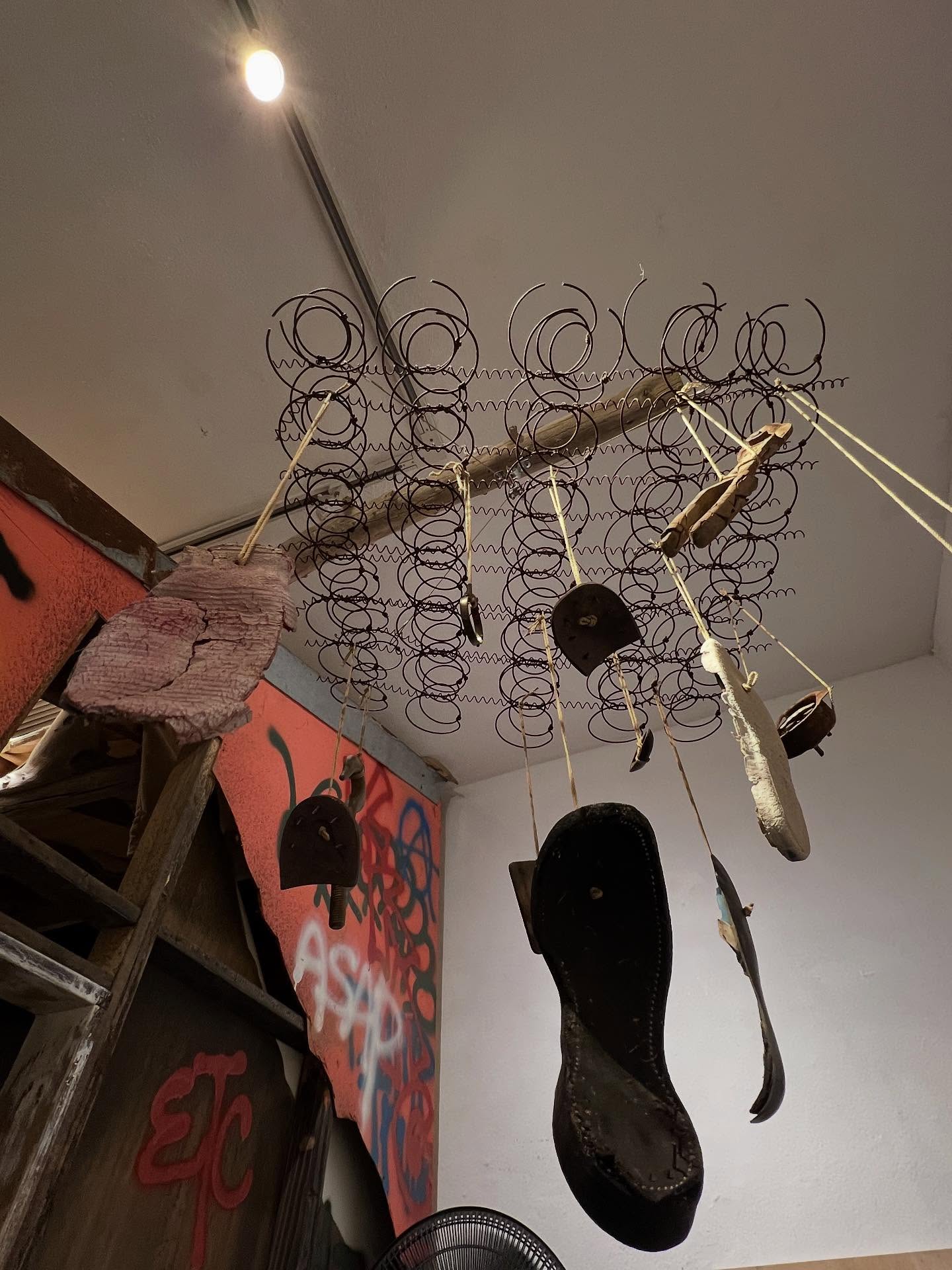
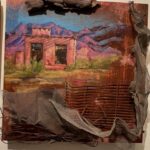
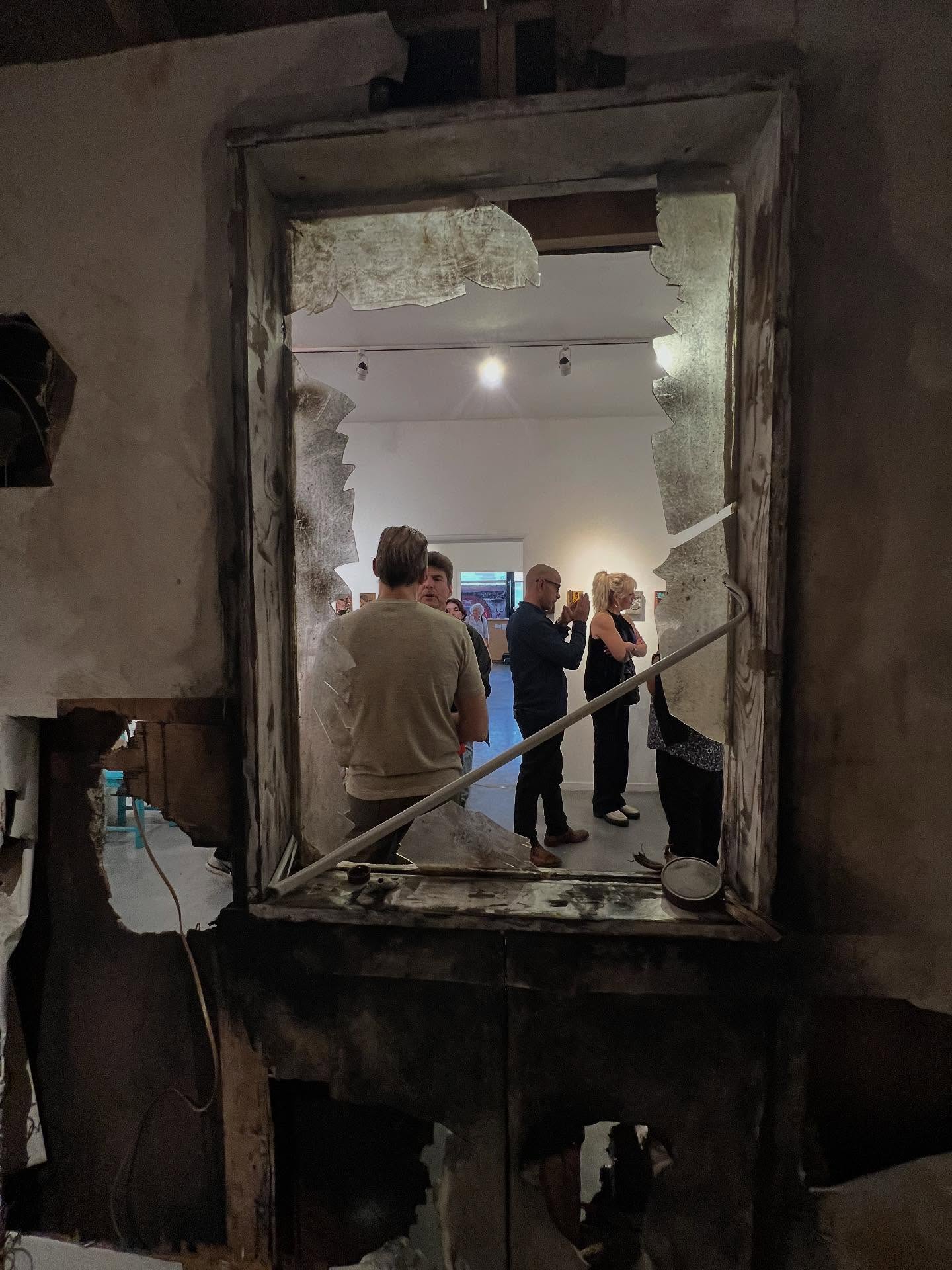
It is with that in mind that viewing Monica Mark‘s compelling installation and individual, but linked works in Abandonded, now at LAAA through the 21st,  echoes with an eternal sense of wanderlust and loss, the aching state of the deserted jackrabbit homesteads with which the artist became fascinated traveling through the Mojave’s Wonder Valley, just a few miles past 29 Palms.

Marks says “I’m struck by how these small, weather-beaten cabins seem to hold both the weight of forgotten dreams and a quiet beauty born of survival. Originally built under the 1950s and 1960s Small Tract Act, these structures once represented possibility—a promise of new beginnings in an untamable landscape. Today, they stand as fragile monuments to ambition, disappointment, and endurance.” There’s nothing left to lose, but plenty to be gained in taking in Marks’ conception of these structures.

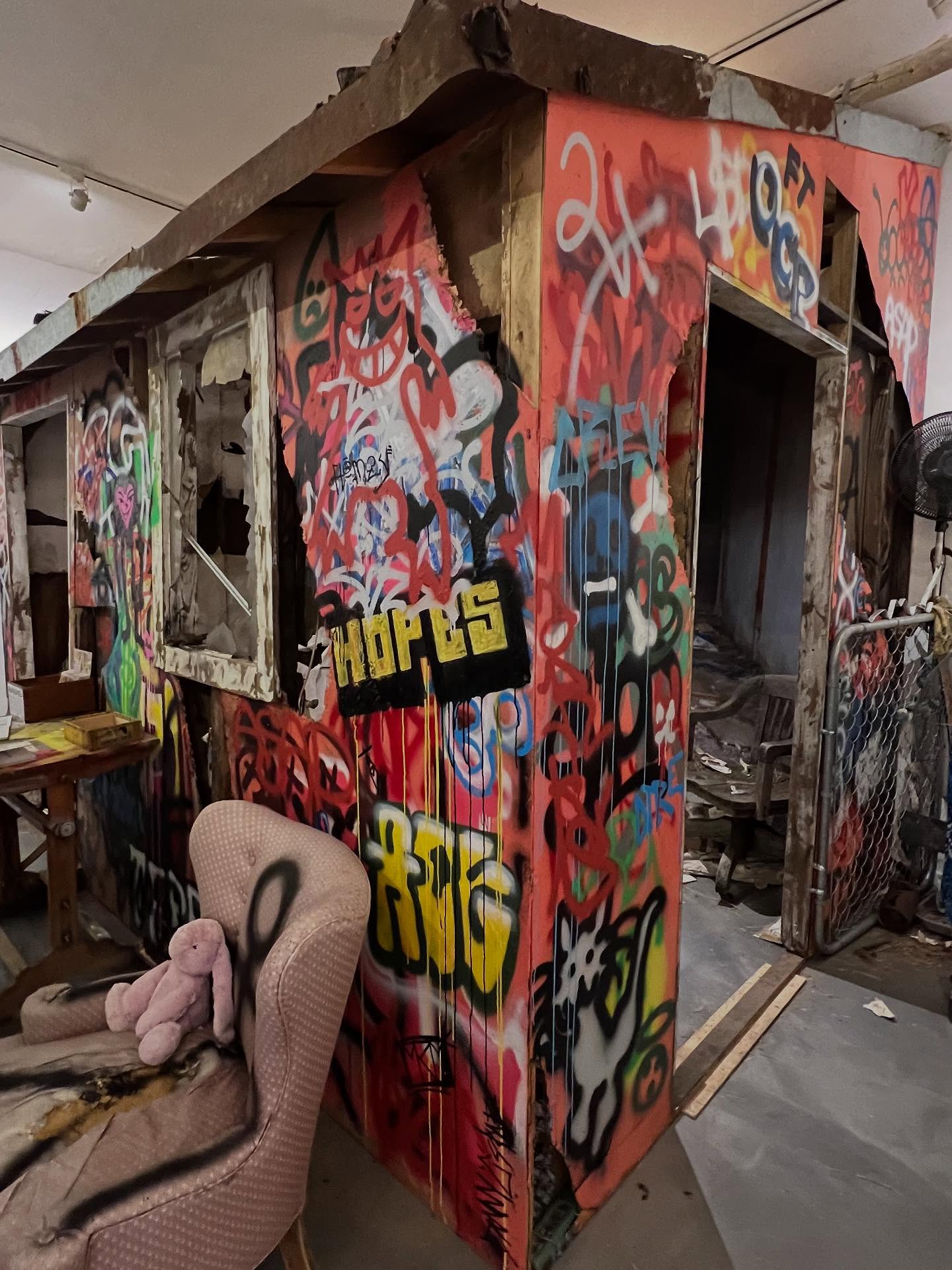
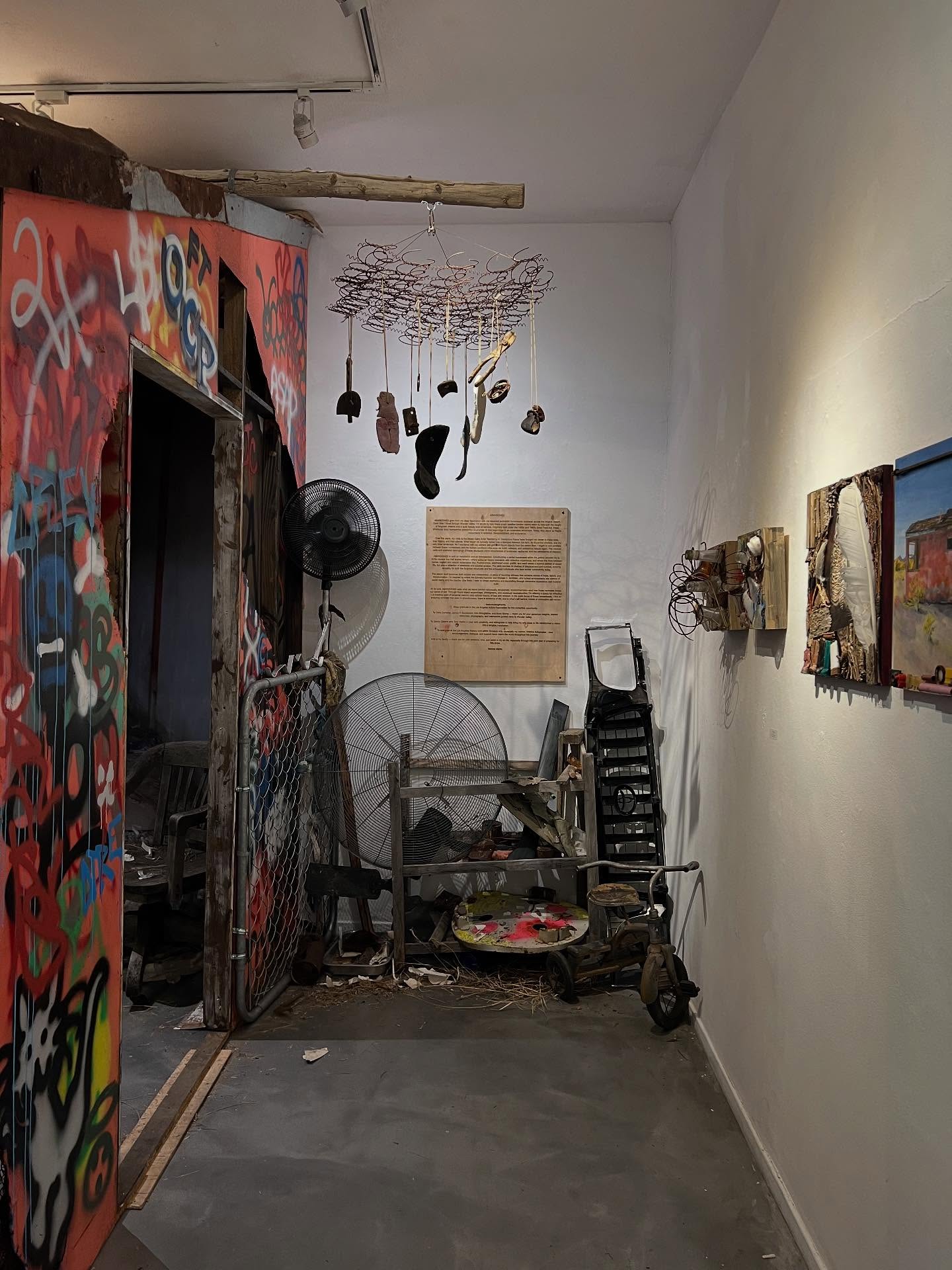
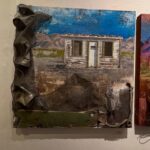
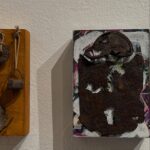
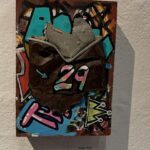
Shaped around her own beliefs about the history of the sites, her own personal feelings, and the “human condition– the ways we build, collapse, and sometimes rebuild again,” her exhibition is a truly beautiful work that includes the construction of a partial homestead contained within the gallery walls, as well as photography, painting, and found-object assemblage, Marks takes viewers into an immersive world that revolves around memories and loss, the fleeting nature of both human civilization and our secular beings, as well as our resilience and capacity for dreams to come true, or to fail and reincarnate.

Marks states that in these works “The desert itself becomes both subject and collaborator—a place of haunting stillness that contains stories of hope, failure, and transformation…At its core, ABANDONED asks what we leave behind—physically, emotionally, environmentally—and how those remnants shape our sense of self. ”

For the viewer, the installation lifts us beyond the gallery walls and into the realm of great loss, great dreams, and the tattered but still quite present beauty that inhabit each of our hearts.

Into the lonely desert sands we blow, and where the soul stops, only an artist truly knows. Certainly Marks has found this knowledge, felt it, and transmits it here deeply. She believes and beautifully expresses that “To rebuild something that was left behind is to insist that meaning still exists in the fragments.”

For Marks and the viewer, these fragments are both tragic and terrific, a meaningful walk through abandonment, and the hopes, dreams, refuse, and reimagining that remains no matter how far away from our own creations we walk.

Don’t miss the event’s closing on the 21st. LAAA is located at 825 S. La Cienega in West Hollywood.

  • Genie Davis; photos by Genie Davis

Glowing Gems from S.P. Harper at LAAA

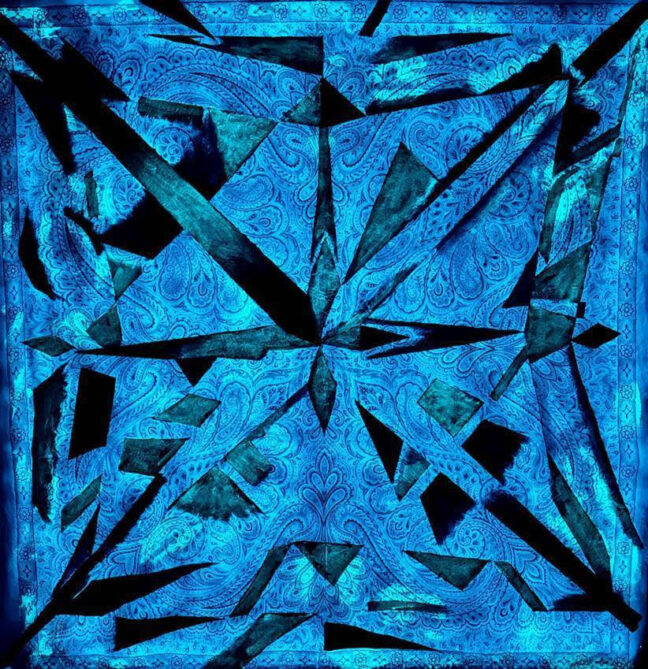
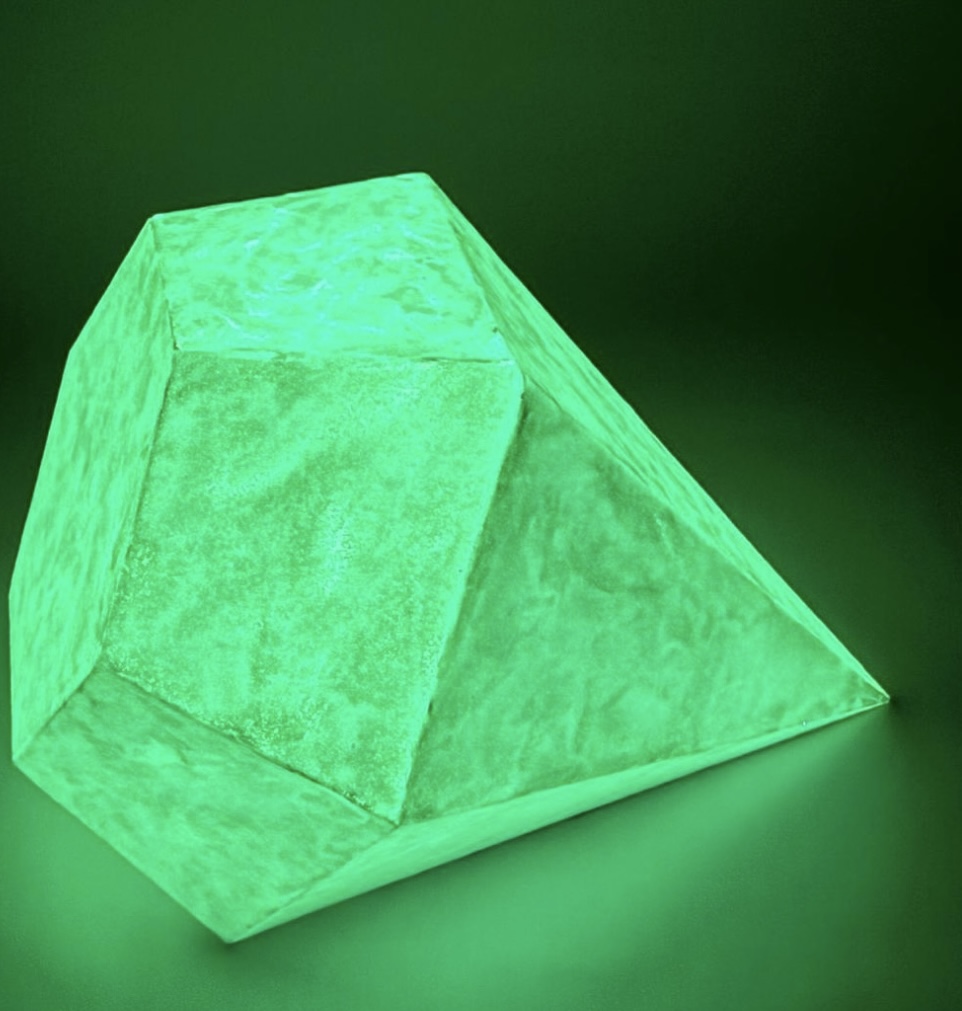
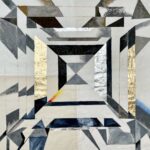
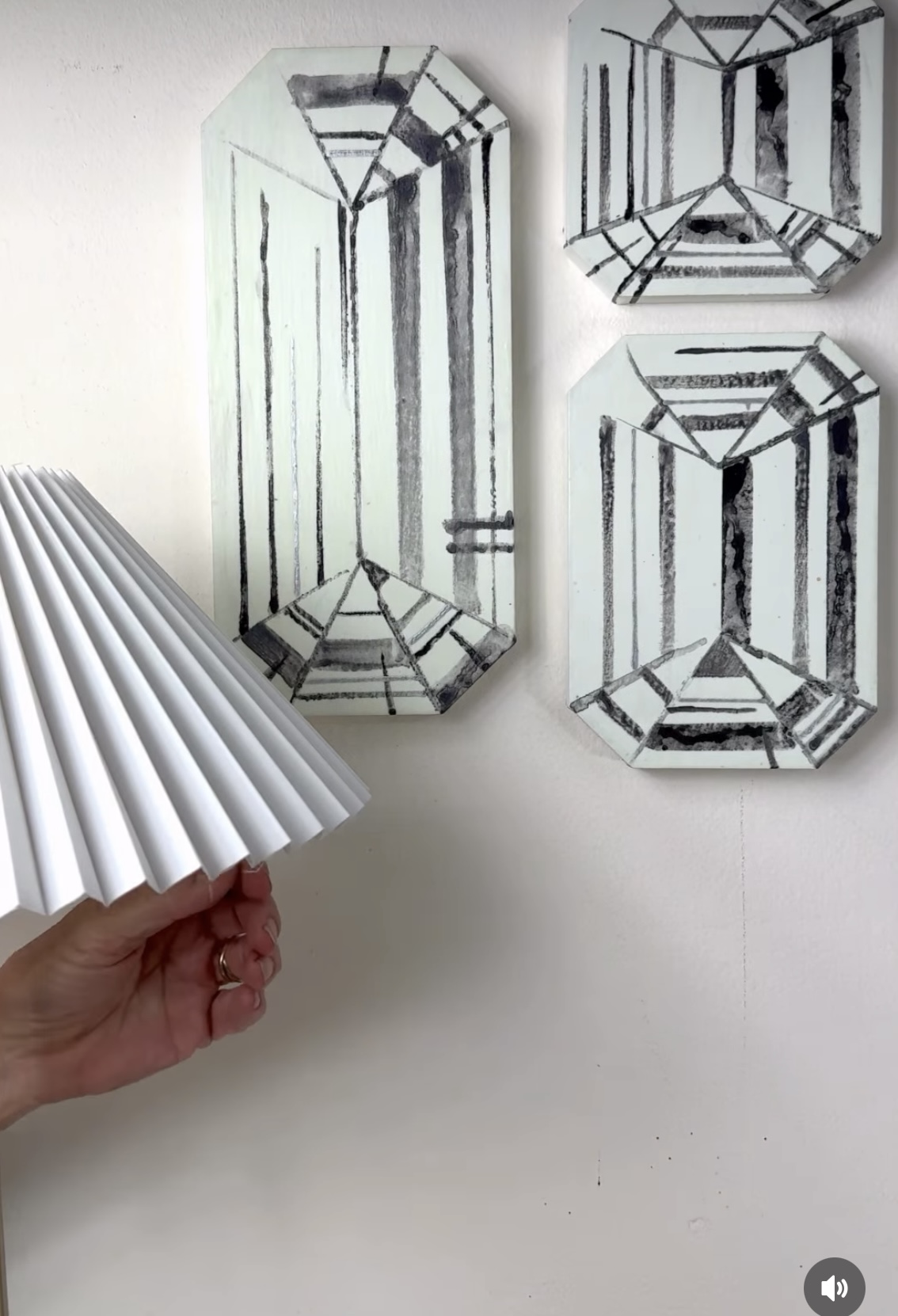
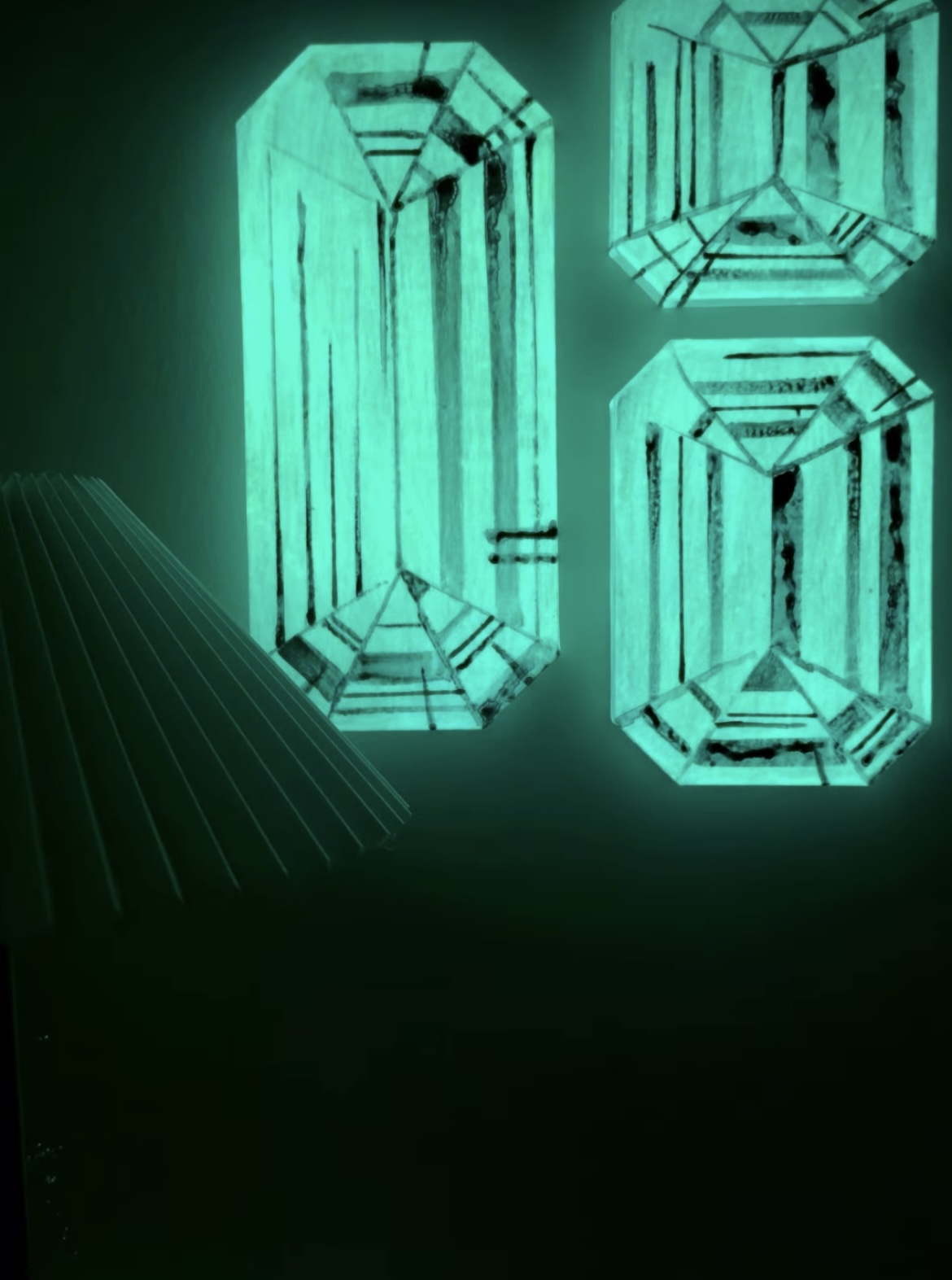
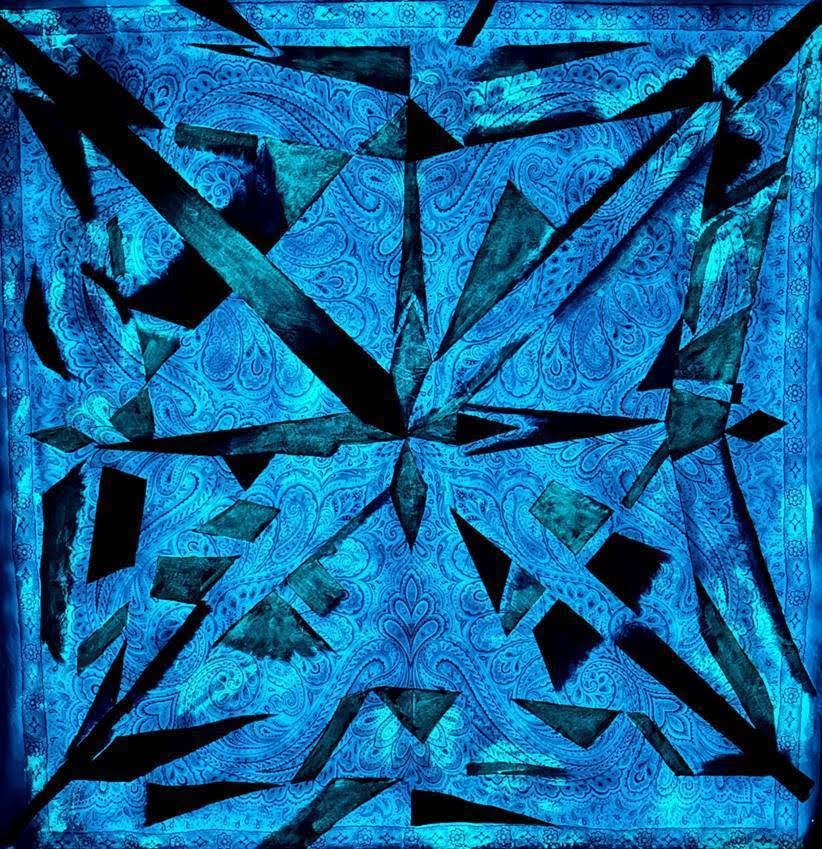
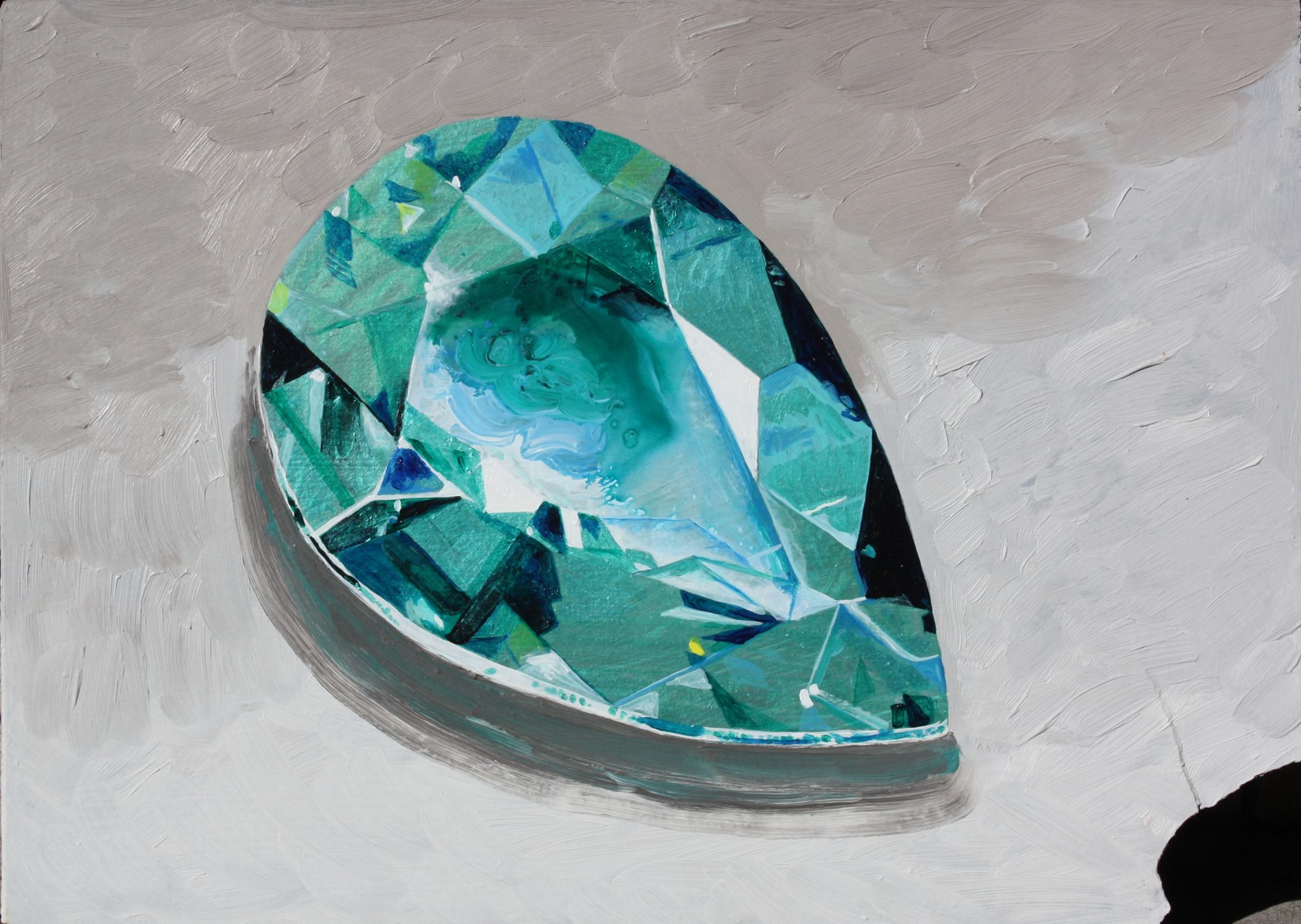
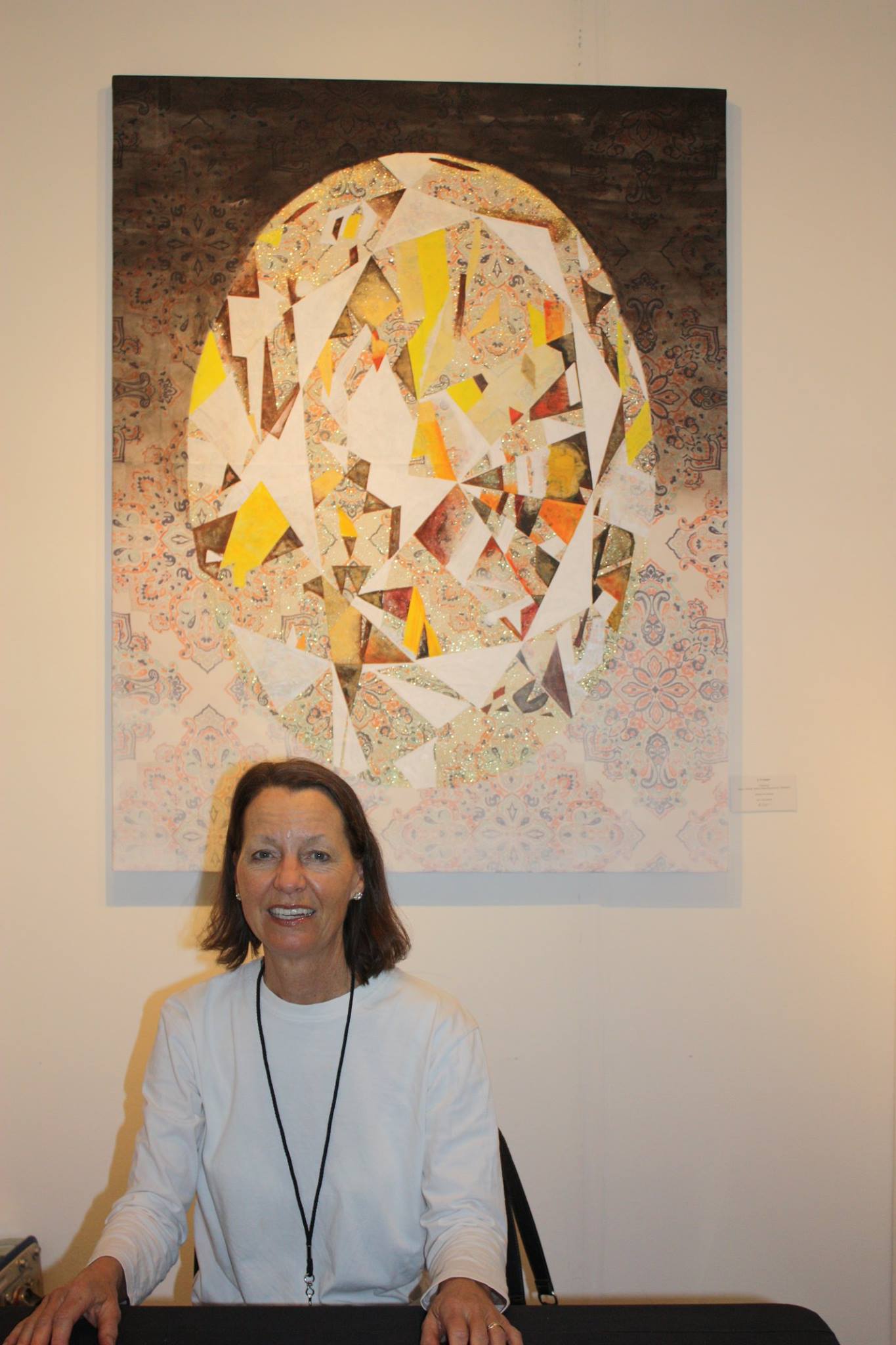
S.P. Harper‘s Oracles of Effulgence glows literally and figuratively in her solo exhibition at LAAA’s Gallery 825 which opens September 13th. The exhibition is mesmerizing from the artist’s mysterous, gem-like geometric imagry to her use of phosphorescent material that makes these works literally glow in the dark.

Harper has used geometric form and gemstone images to dazzling effect in other series as well, each lovely and immersive.

However in her new show,  there is something resonately deep going on, a visionary transformation due to the way in which the works transition between daylit radiance and what look like bioluminescent forms in the dark.

Melding found objects with phosphorescent paint, Harper creates something entirely different, both reflecting a magical transformation and a hidden source, as if inviting the viewer to step into the depths of the earth and uncover some long buried and secret elements of the earth.

Riffing on cubism and the luster of gemstones, specifically diamonds as inspired by the artist’s diamond cutter grandfather, Harper shapes her own jewels as perfectly and precisely as nature forms minerals and crystals, or just as diamonds-in-the-rough are faceted and reimagined as stunning rings.

Diamonds are definitely this artist’s best friend, as she uses their shape and their sparkle to create richly dimensional, emotionally faceted work that is both elegant and luminous, alluring and delightful. She toys with the veiwers perceptions in a joyful and perceptive way– while we know the objects she presents here are not really aglow, they take on a life of their own, pulling the viewer into a compelling and intimate dance with a fantasy both familiar and impossible.

There is a subtle hint of throwback to the era of black light paintings and psychedelic trips– if that sort of hippie, happening past had been passed through a finely tuned filter and turned into fine art as delicately constructed as it is subversively joyous.

Harper has painstakingly applied multiple coats of an invisble phosphorescent paint. With gallery lights dimmed, each form leaps from the wall and illuminates the darkness; the gallery is tented off to fully reveal the magical mystery tour that Harper is taking us upon.

Harper’s use of transforming material is not new to her. She has painted and sculpted using recucled gemoterics in other series, utilizing media as diverse as discarded canvas and plaster scraps to reform materials into a kind of patterned contemporary vibrancy that is both unexpected and minutely rendered. The materials she utilizes in this exhibition include a shower curtain, wood salvage, and canvas. Her color palette here revolves on a series of dazzling blues and greens, an electrified ocean of  treasure.

And she knows her faceted styles, literally, titling works after their cut, Ascher, Brilliant, Princess, and Miner cut faceting, introducing viewers to her own magical knowledge of a creative skill few of us understand. Each image is immersive in this way, taking viewers into an emotional mine shaft in which gems are embedded, waiting for us to dig them out (pun intended) and take these treasures home.

The artist has explained her work simply and beautifully, saying “I paint jewels because they transfix and reflect.” Indeed they do.

Also exhibiting at Gallery 825 are Aileen Rodriguez Imperatrice with her new series Selective Memory;  Faina Kumpan with her whimsical and vivid fantastical sci fi figures in Are we alone? Aliens, mutants and visitors; and Tom Lasley with his evocative DioramaDrama.

Opening reception for all four solo shows at Gallery 825 is Saturday ,September 13 from 10 a.m. to 5 p.m. The gallery is located in West Hollywood at 825 N. La Cienega. The exhibition runs through October 17.

  • Genie Davis; photos provided by the artist


Can You Fear and Adore Flowers? Artist Susan Melly Provides Answers in New Work at LAAA

   In a way, who isn’t afraid, just a little bit, of flowers? We may fear their incredible fragility, of losing them to an all-too-quick death, to knowing their perfection is ephemeral and their beauty so temporary – an aching reminder of our own mortality.
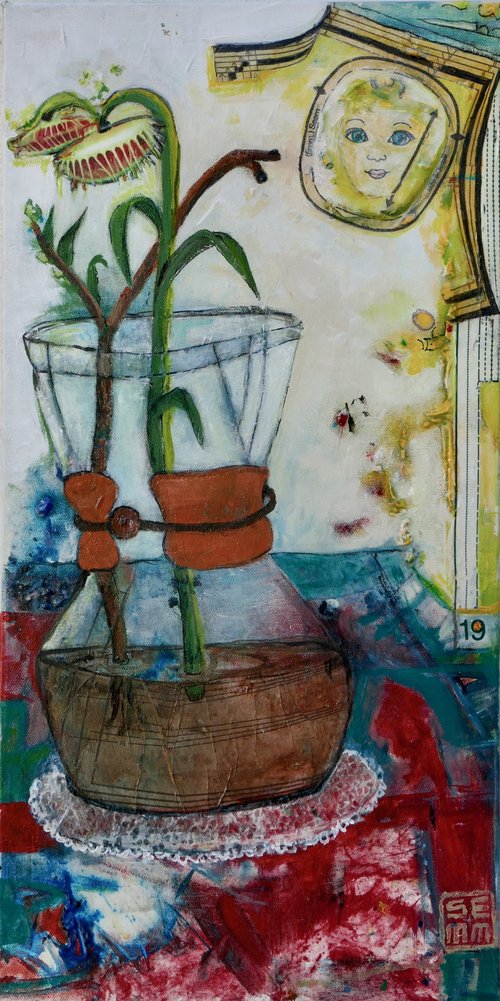
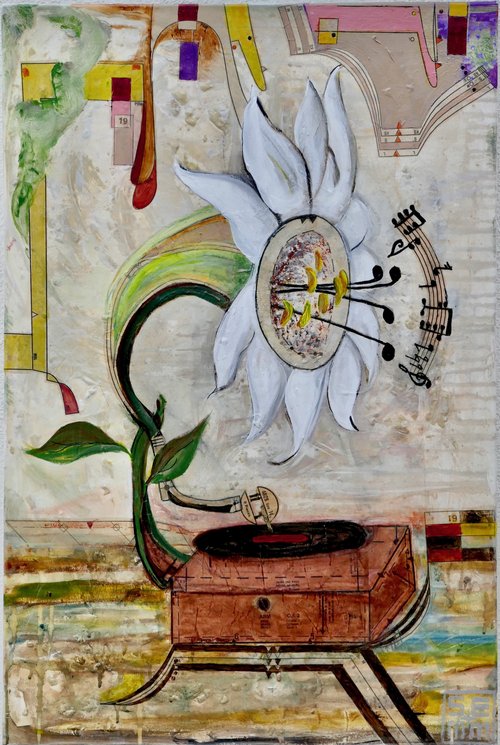
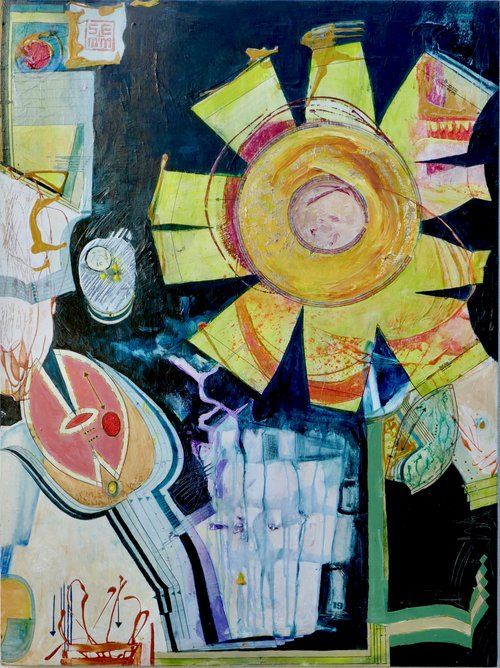
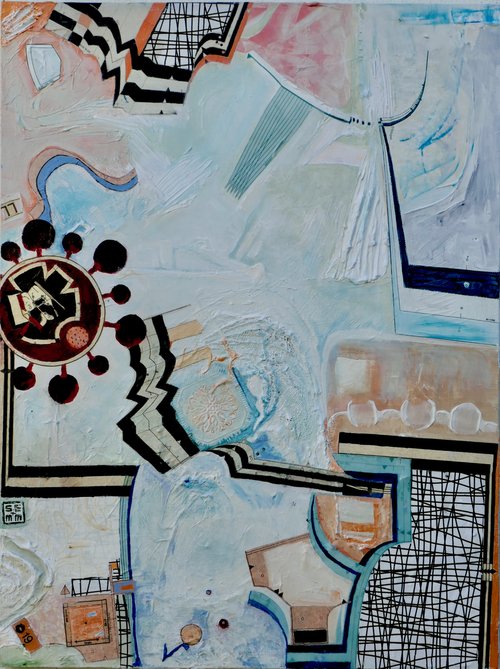
   However, for artist Susan Melly in her new Emerging Fear of Flowers now at LAAA ‘s Gallery 825 in West Hollywood, her emerging fear was something different, risen from over two years of COVID-19 pandemic isolation. During that time period, Melly’s husband brought her a weekly bouquet of flowers from an open air market. As her own statement informs viewers “As my anxiety blossomed, my art making changed and became more abstract and colorful to ward off my dark feelings. Each work is embedded with a hint of humor – and the number 19 – as an homage to coping mechanisms, even as familiar sources of comfort counterintuitively transform into a strange beauty that is tinged with the edge of the unknown.”
   After about a year of receiving the flowers, despite the loving intention of bringing beauty and romance to her life, she began to ask hereslf if she would be “condemned” to receiving the flowers every single Friday for the rest of her life, indicating that the pandemic would never end. The blossoms blossomed – into increased anxiety, alleviated through her art. As viewers we can witness this progression in her new body of work, and revel in its layers, as fragile-seeming as flowers themselves.
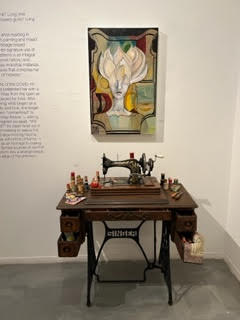
   The works of course make use of Melly’s signature use of vintage tissue paper dress patterns, something that she terms an “integral part of my practice and personal history…” As a mixed media artist, the LA-based Melly creates work that includes paintings, assemblage-based sculptures, and installations. In this latest body of work, there is a powerful new energy as these flowers morph with the artist, spin discs on an old Victrola record player, weep, rail in anger, whine in frustration, sing, and seethe.  Do flowers mourn their entrapment in bouquets? Do they discuss day to day travails as they grow in the garden, rage and wish to curse those who pick them? While we may never know, here Melly certainly posits that they might.
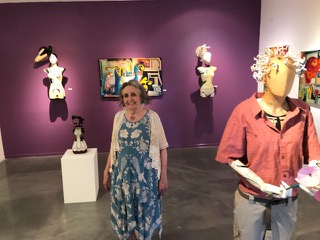
   Within the primarily paint and mixed media on canvas works are a variety of sculptural pieces.  While some stand alone, a vintage sewing machine, a male figure bearing flowers, “Hanging Out,” is a wall scupture. It emerges like a being encased in and protruding from the wall itself,  a partial mannequin entrapped despite a glowing heart and uterus at its center, sheathed and layered with the dress patterns.
   The titular “Emerging Fear of Flowers” is a colorful mix of the tissue patterns, acrylic, and art paper on canvas.  While a hand holds a cocktail glass in the right corner, center stage is an alien looking three pronged flower that seems to have grown eyes, and one prong is looking and leaning and reaching ominously toward that hand. The viewer can’t help but think of Little Shop of Horrors and Audrey, that musical’s violently sentient plant.  It is a large work, vibrant with indigo and burgandy; the human hand, however, is so white it could easily belong to a person confined from the sunlight in which these flowers gained a robust if menacing vitality.
   Melly’s “Cut Stems” also makes use of the tissue dress patterns combined with acrylic.  These highly geometric flowers have sharp edged like wind mills and are exhibiting just emerging facial features.
   With “Enter Covid,”  what’s blossoming here appears to be the shape of COVID itself, entering via a kind of conduit into an abstract human vessel.  Layers of white on white recall bandages, sheets, and fog, as if a ghostly landscape now enveloped us all.

   Quoting Charles Baudelaire with the title “Evil Comes up Softly Like a Flower,” Melly uses acrylic, charcoal, and dress patterns to make one of the most ominous, yet still amusing, paintings in this series. Here, flowers have teeth and raging faces.

But they are comfortably more relatable in “Dandelion Wine,” in which a dandelion tears out its seeds in frustration.

And we can feel intense empathy for the sad blooms in works such as “Un-Still Life,” in which a lavendar, daisy-like flower has thorns and weeps purple blooded tears.

   In another work, the artist herself melds or morphs into a flower, a pale periwinkle and peacefully meditative one, in “Portrait of the Artist as a Young Lotus.” Surrounded by a geometric abstract patterns, the figure is part statue, part flower, absorbed fully in the act of blooming, yet trapped in stillness.

   Perhaps, we can hope that our time in pandemic shut down can allow us to achieve a similarly mesmerized state. Viewing Melly’s delicate, lovely, and unsettling works may just have that effect.
   Melly’s work is beautifully paired with the light-based blend of Richard Slechta’s photography and art, Incompressible Flow; Chris Madens’ glowy dimensional assemblies, The Covid Kiss; and a group show, Felicitious,  an all-media compilation depicting the current zeitgeist.
   The exhibition is on view through June 24th. Gallery 825 is located at 825 N. La Cienega.  Melly is offering curated visits; the gallery is also open by appointment at other times, reach out at gallery825@laaa.org.
Genie Davis – images provided by the artist

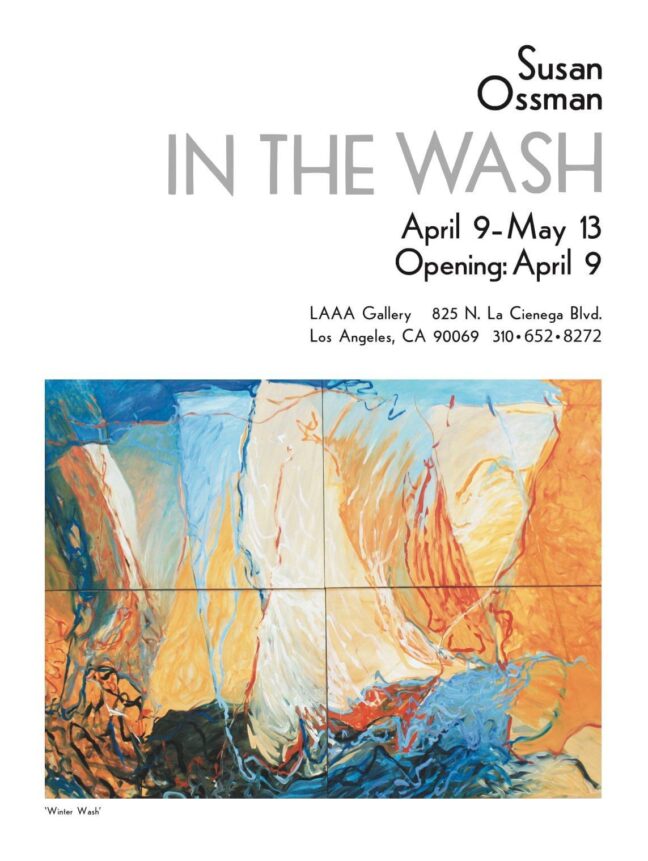
Susan Ossman’s In the Wash is Beauty in Motion

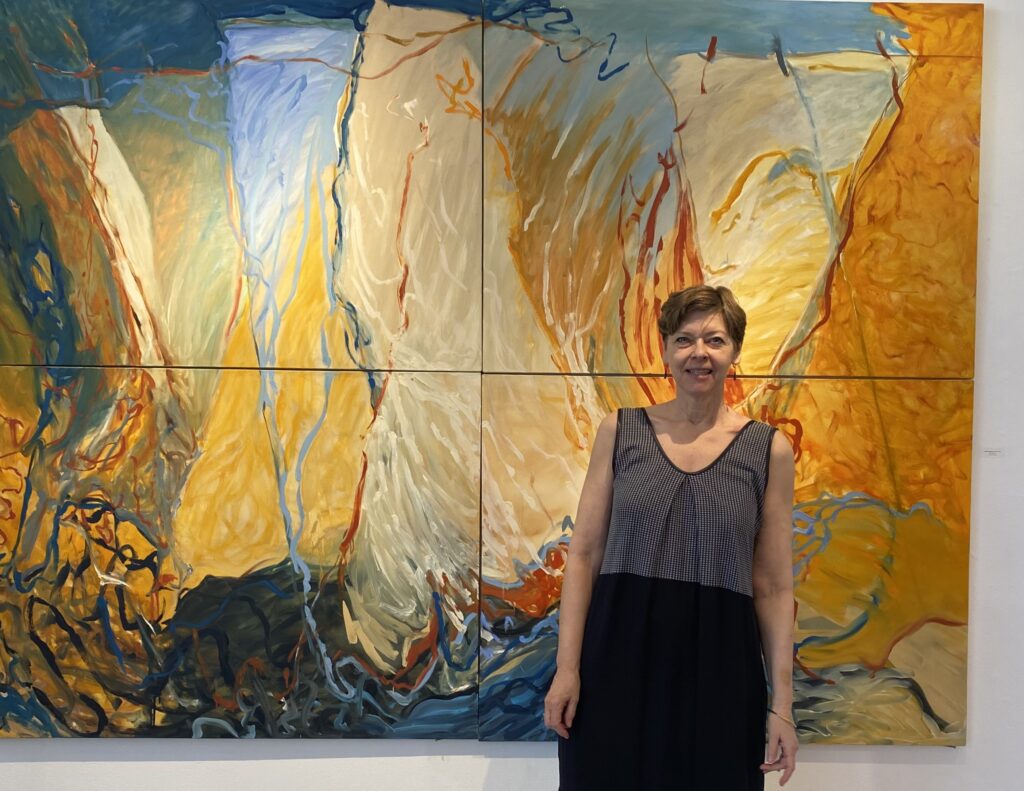
Beautiful and evocative, Susan Ossman’s exhibition In the Wash is as vibrant as it is graceful.

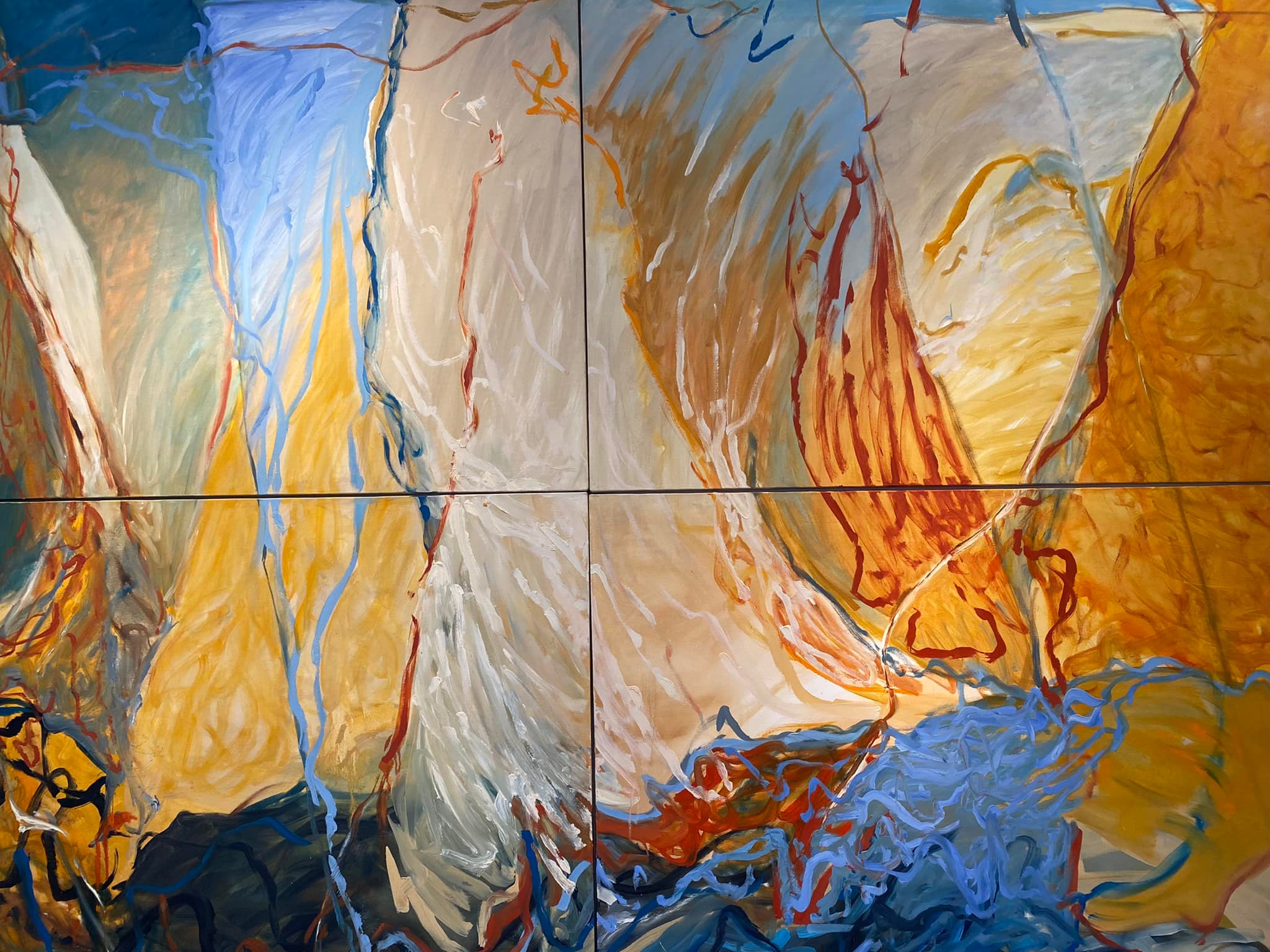
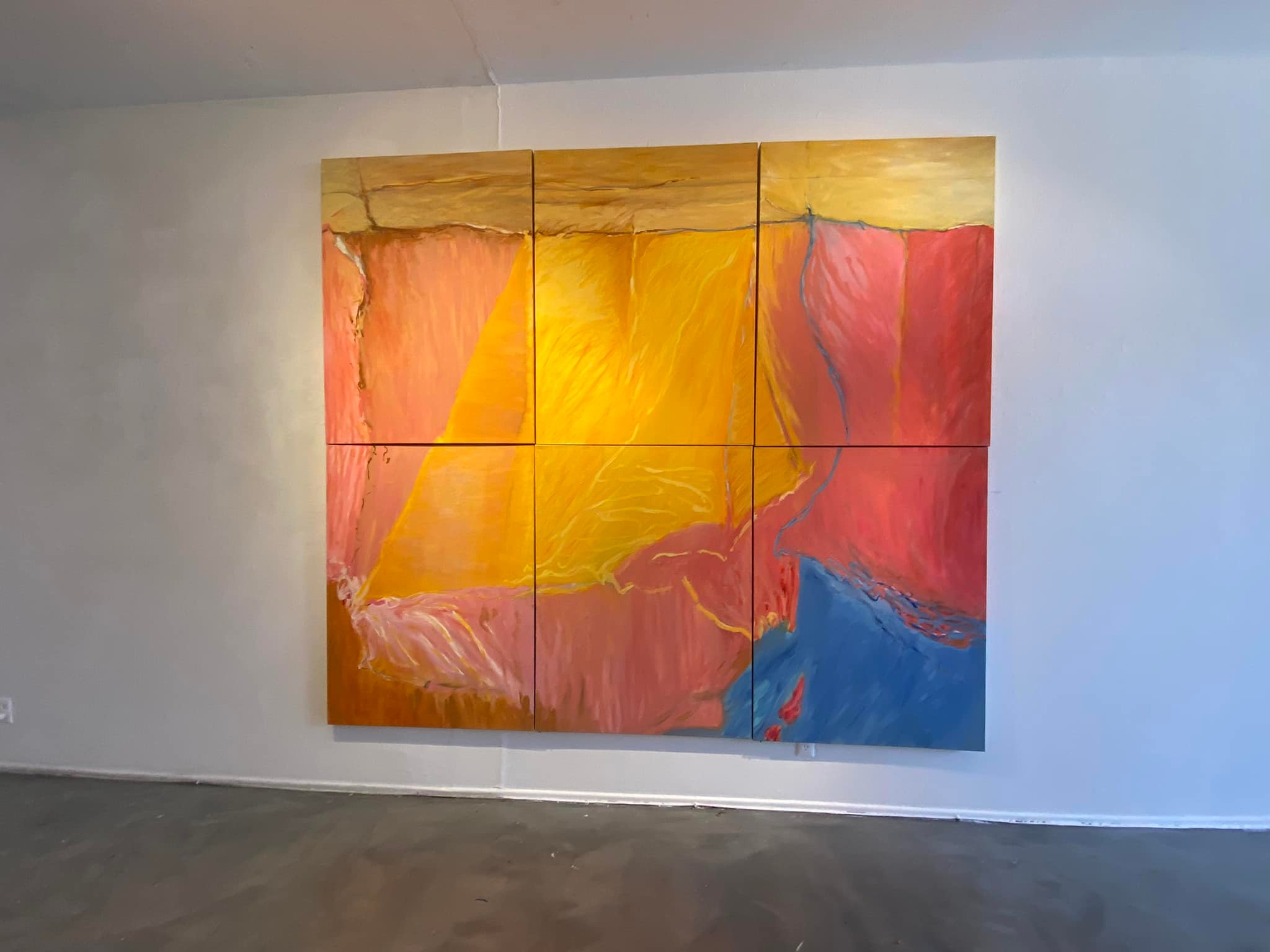
Made up of three large-scale works, each of which is comprised of four to six canvasses, the works depict laundry drying in the open air, stretched across multiple canvases like sheets strung on a clothesline.

Each piece follows a progressive color palette, as alive with the changing seasons as the sheets are with movement of the breeze, and the generations-long ritual of pinning freshly washed objects to clotheslines. The works are also a reflection on waiting, according to the artist.

Like all Ossman’s art, these pieces suggest movement and light, emerging from her use of lines. Clotheslines, and the action of hanging laundry are intrinsic in the gestures of the paintings, but the lines also seem to represent a kind of kinetic energy running through the works. The undulating sense of motion is hypnotic in these pieces, as is the artist’s use of rich color and soft texture.
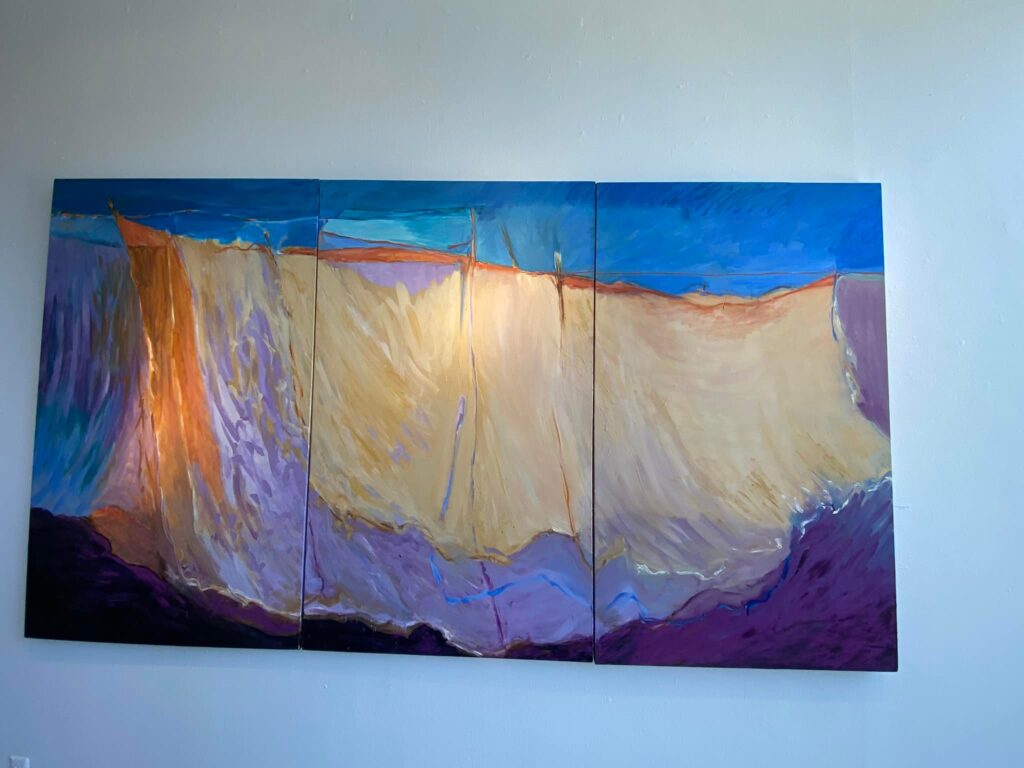
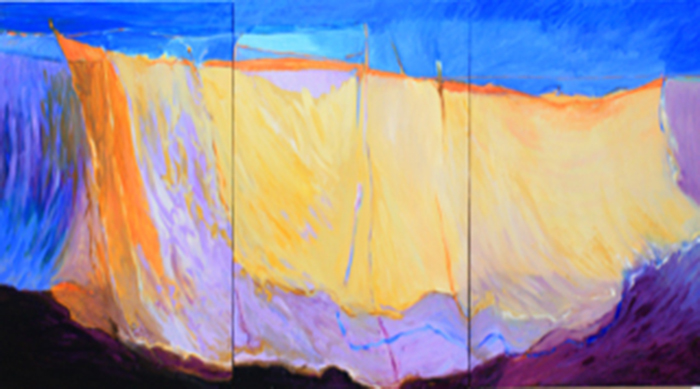
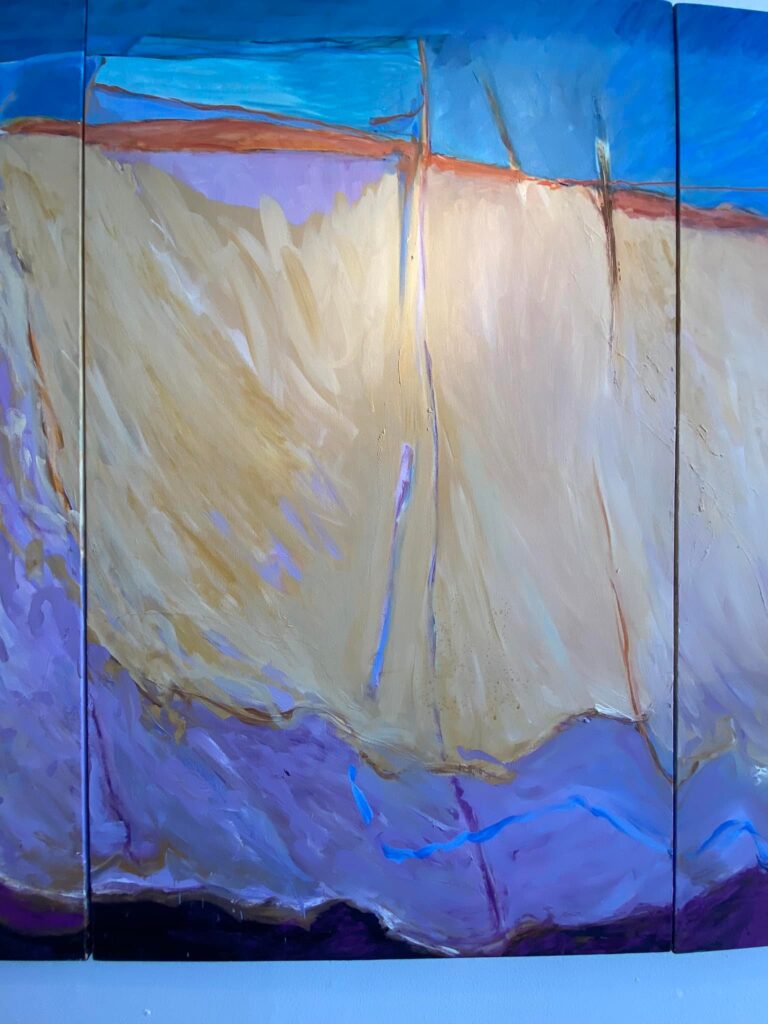
The first painting in the exhibition, “Christo’s Laundry,”  above, uses a classical style of oil painting that recreates the soft, gentle movement of the fabric on a spring day. There’s a sense of calm in the subtle movement she depicts. The colors are those of spring flowers, lavender, pale blue, deep purple. The yellow of the sheets is soft and pale, like the spring sun.
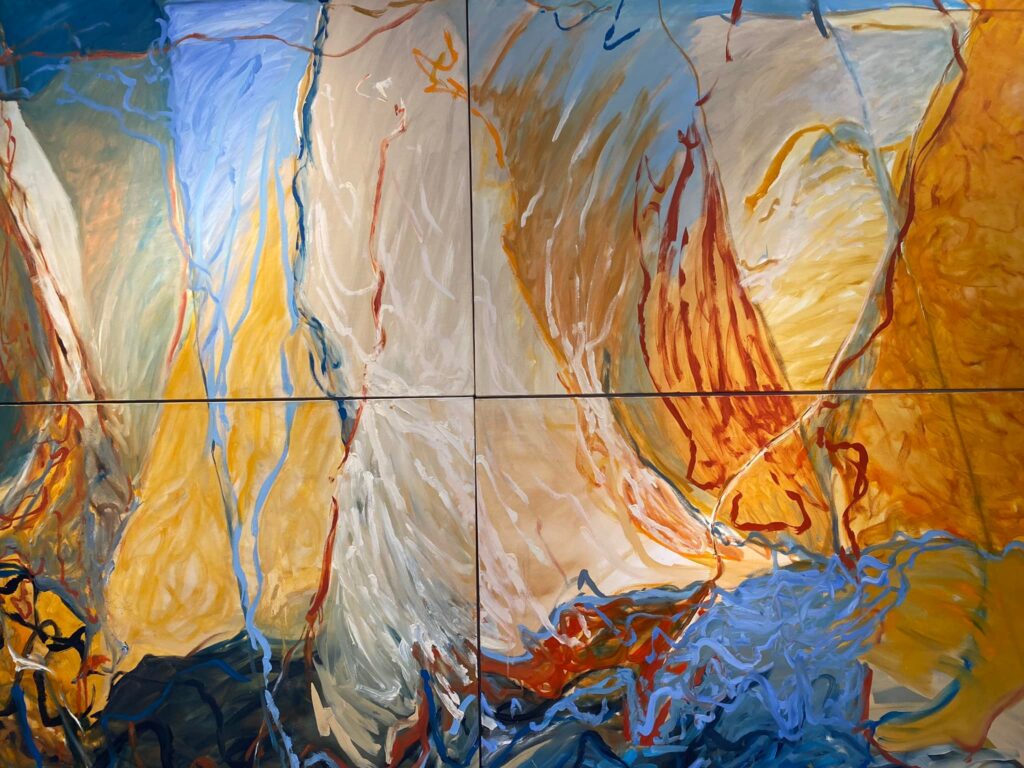
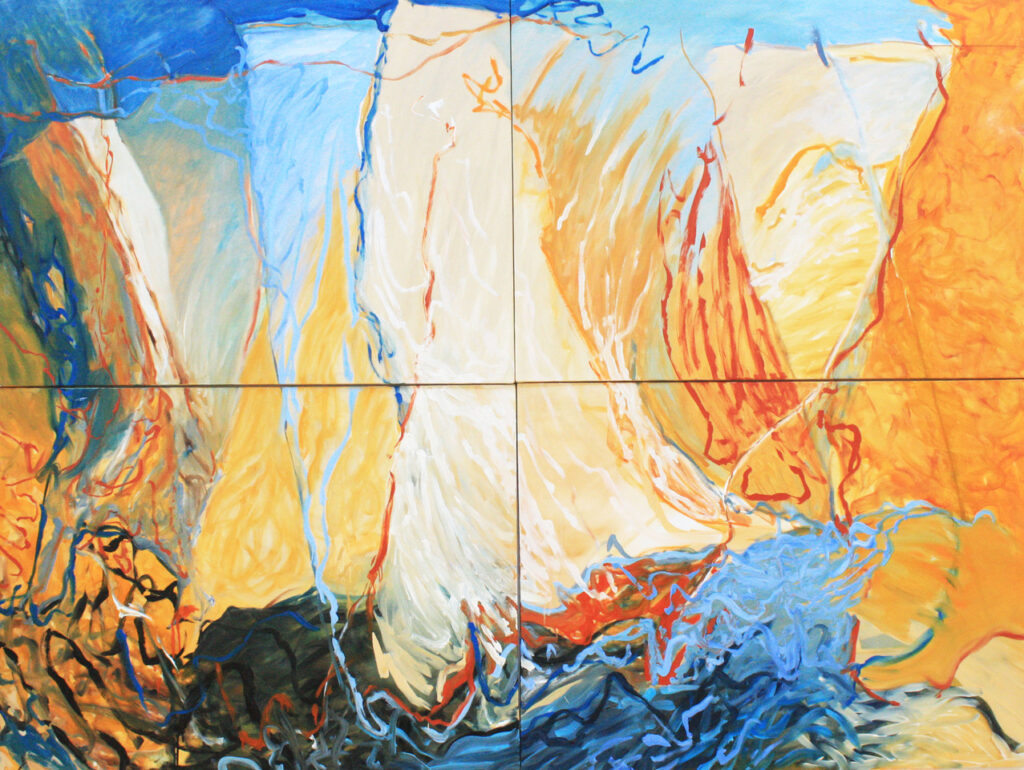
Ossman’s style veers more toward the modernist in the expressionistic “Winter Wash,” which evokes a sense of haste in the more rapid wintery movement of the wind, and her depiction of the environment in which the laundry lines are strung. It is a tangle of swirling lines and the curls of blue and orange seem to be a visual depiction of motion itself. The palette is darker, with a stronger emphasis on the burnt umber quality of winter light.

The lively, vivid “Caught in the Sheets,” edges into the abstract, the energy and sense of movement it exudes are almost palpable. We see the sheets in intimate perspective, tangled up with them, forming a relationship with them. The sheets fit together like the pieces of a large puzzle or mosaic; and while the oranges and yellows are dominant in hue, they are paler, the light blue in the right canvas component drawing the eye the most.
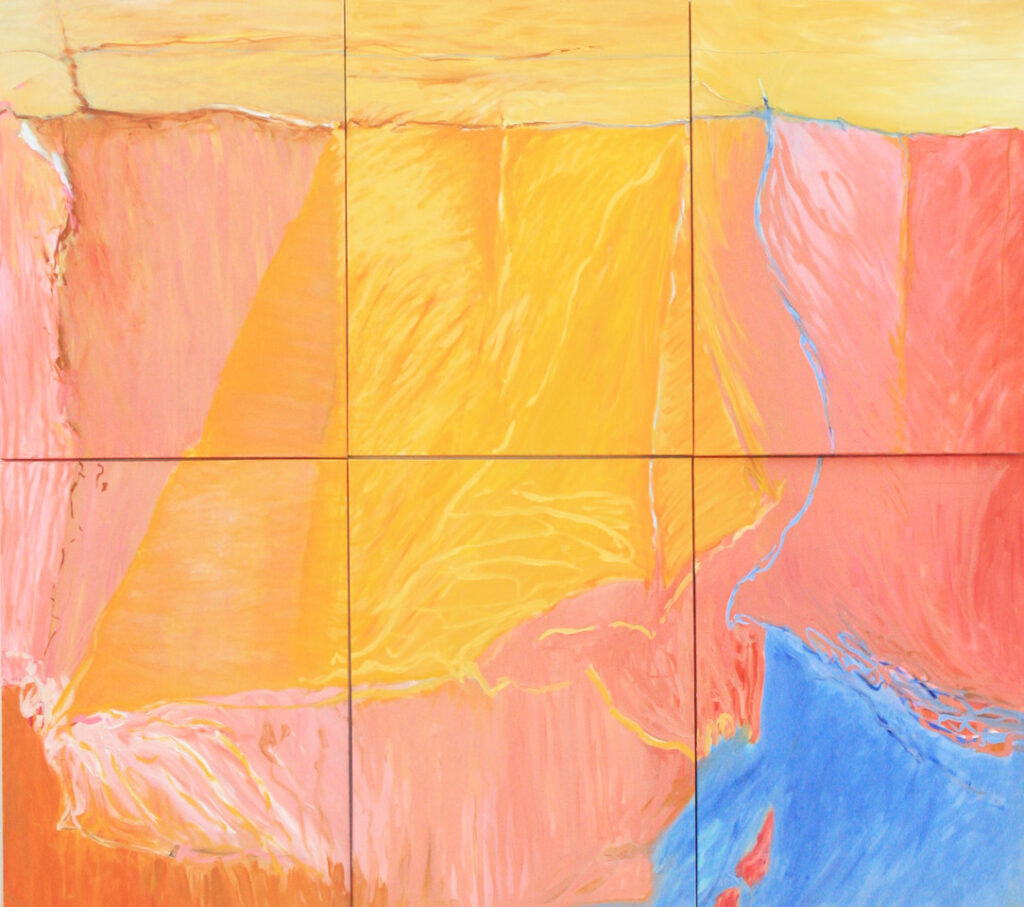
Each work requires contemplation, or rather demands it, both to take in the full long strokes of the artist’s brush, and the enormity of the canvases as well as their details. The humble nature of the subject – and indeed, the context of it as a fundamental, necessary, and unappreciated part of life itself, imbues the paintings with a subtle grace, a sense of gratitude for simple rituals.
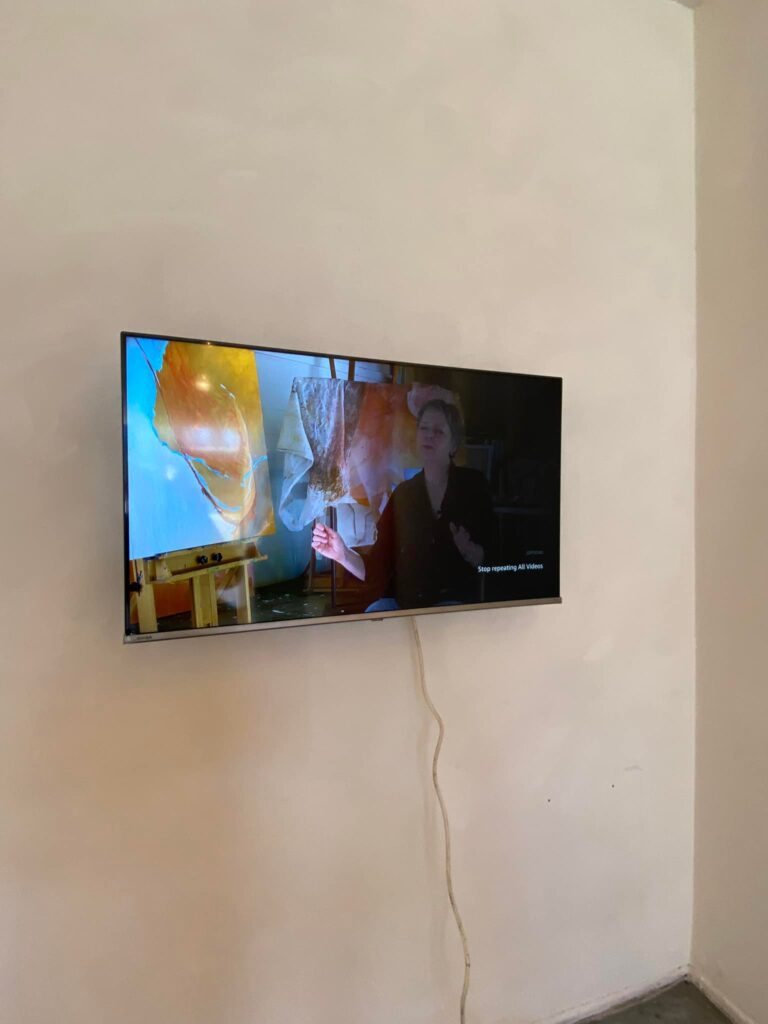
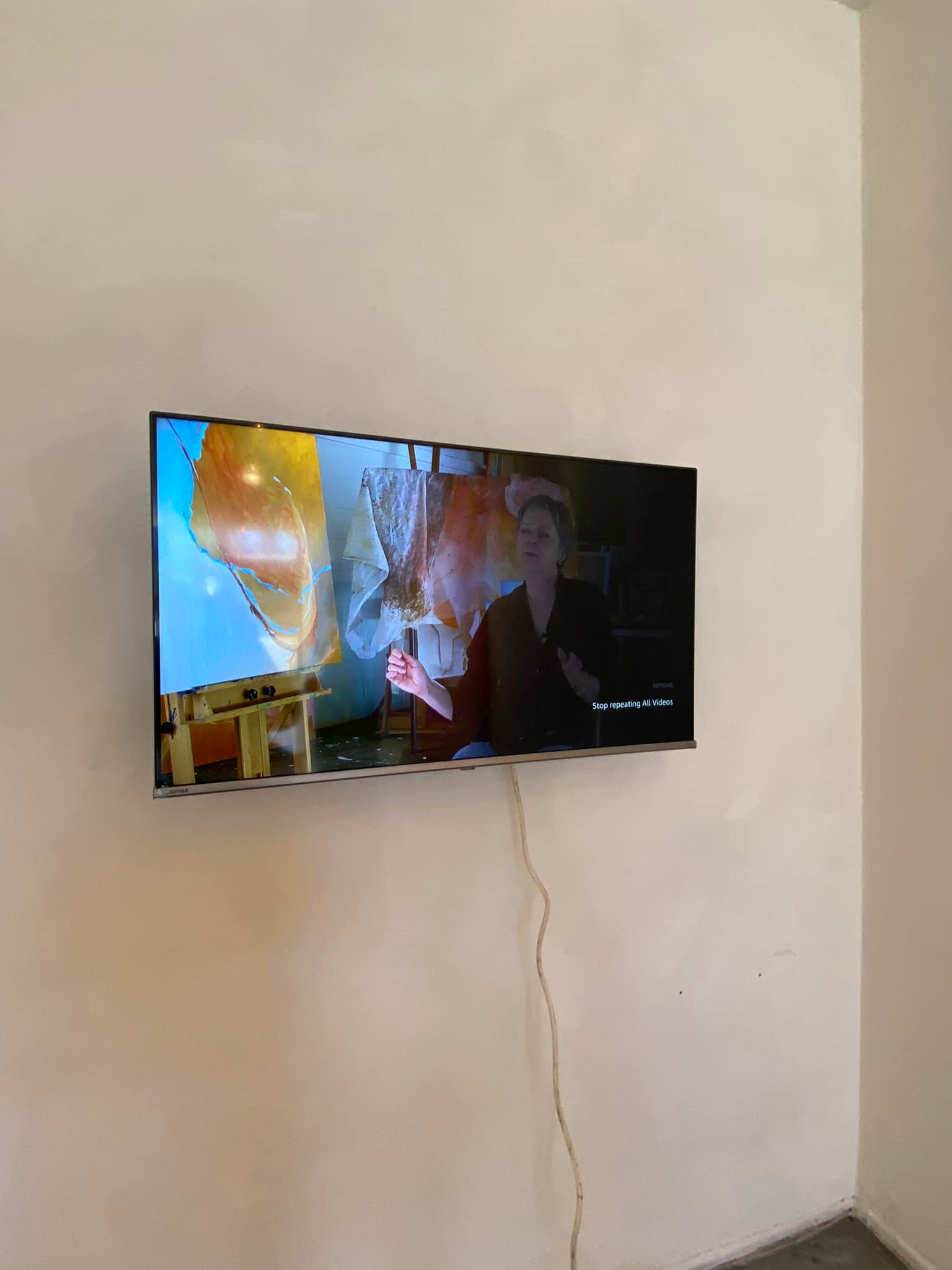
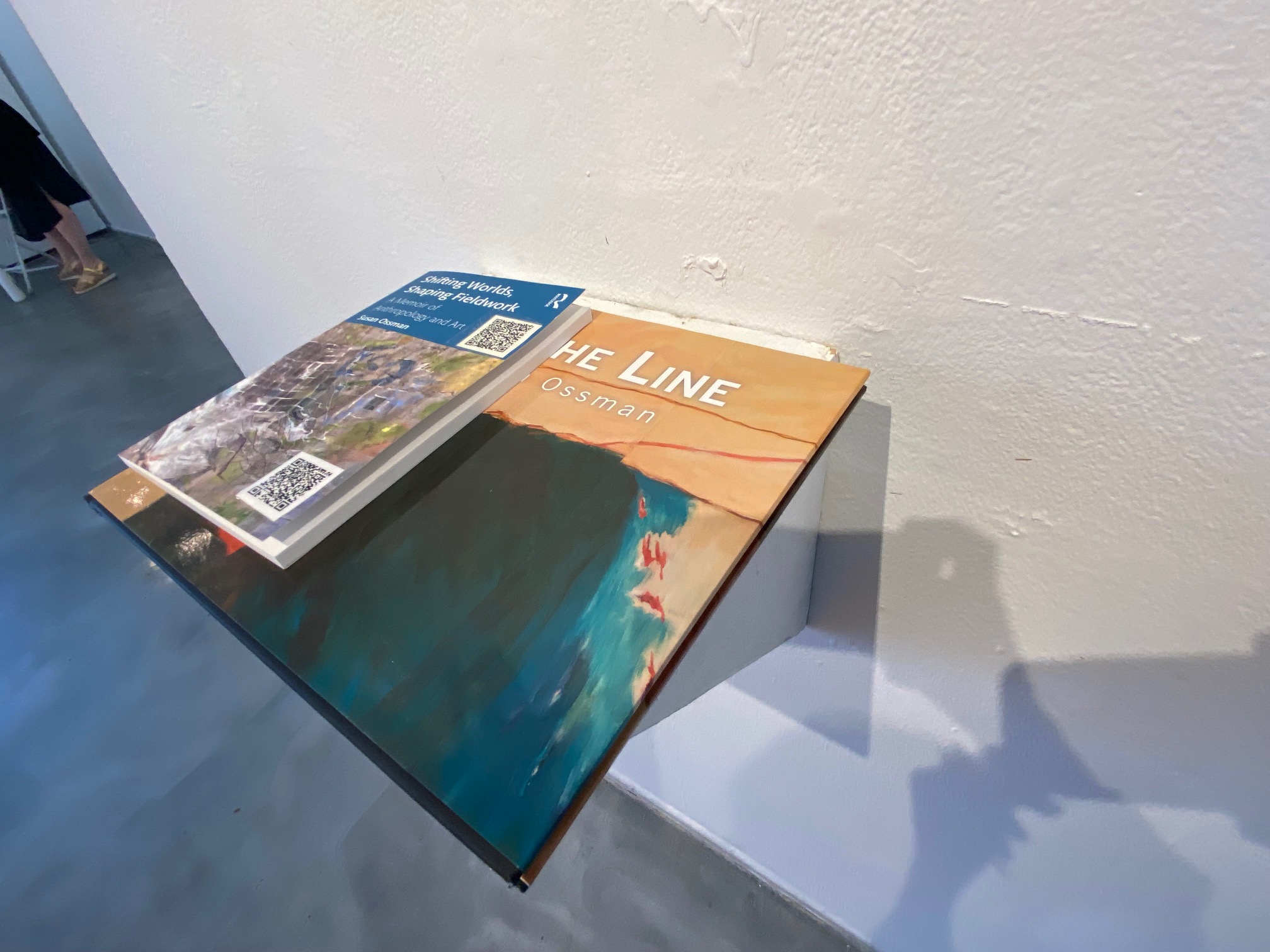
The exhibition also includes a video depicting the artist’s process and the context of her paintings within a broader overall project, On the Line, that also included anthropological research and historical research on laundry lines, as well as reflection on her own past art practice and the creation of an environment to inspire an extension of the work into other art forms, including performance. Ossman has worked with dancers interpreting her works. “In the video you see the connection between the movements and the paintings and the movements of the bodies of the dancers. Showing these and telling the story of the project expands viewers’ ways of thinking about these paintings and painting more generally… perhaps these works encourage attention to these movements more than some others. The multiple panels, the compositions and in some cases the brush strokes encourage this,” Ossman explains.
The video, which runs approximately six minutes, explores how poets, dancers, and musicians picked up on the movement and rhythms with sound, words, and their bodies. “It was like an extension of my own movement, almost as though the movement of my arm and body painting created a momentum and a direction that they picked up on with their arm or leg or the way several dancers intertwined their own bodies,” she says. The dancers took on the dynamics of her painting, using actions that indicated bodily movement, the sense of wind, and the sense of the seasons passing, which are all visually revealed in the paintings themselves.

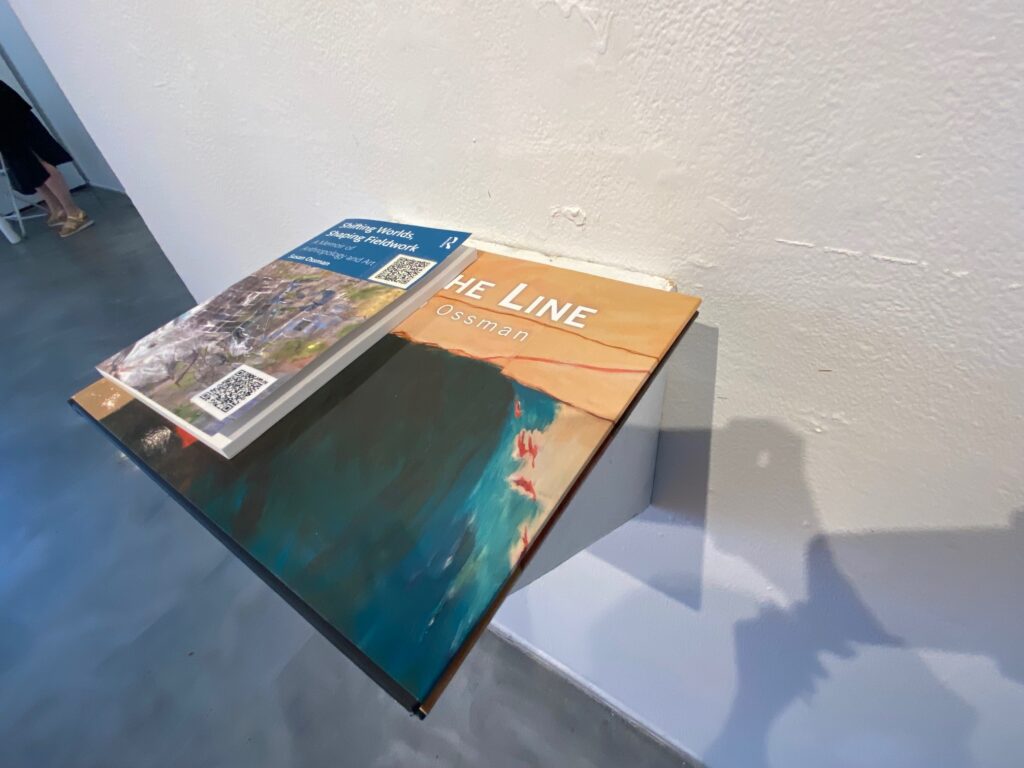
Also available at the exhibition, for further insight into Ossman’s work, are two publications: one about her art, and one that discusses both her work as an artist and as an anthropologist, Shifting Worlds, Shaping Fields, A Memoir of Anthropology and Art.
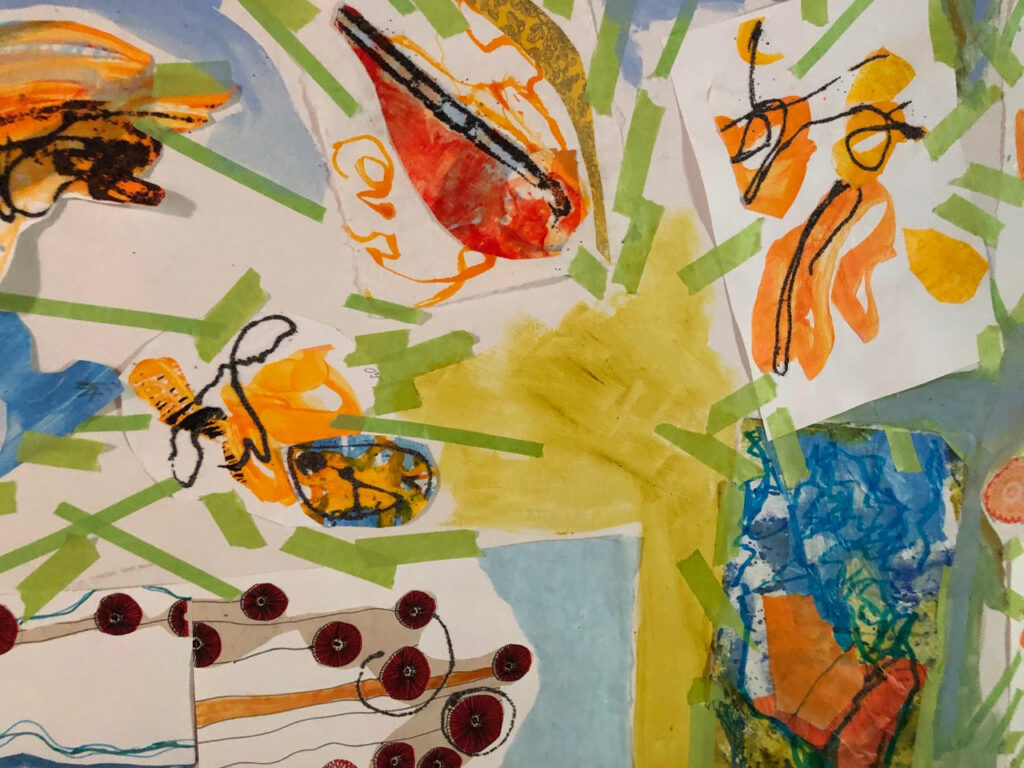
The generosity of Ossman’s collaborations and insight into the ebb and flow of natural life recently took a different bent in an early March exhibition on the steps of the Museum of Riverside, in which her 22-foot collage “One and Many,” inspired by California poppy fields, invited a reflection on “the relationship of the part to the whole, the individual, the group, the community.” Participants were invited to take a small piece of artwork from the layered collage and fill in the blank space on the canvas with work of their own.


That same sense of inclusivity, universality, and movement, is what drives In the Wash. Like the wind, change is constant yet the wind itself stays as an eternal force. Ossman goes a long way to expressing the constancy of change itself, and the collective consciousness of those who are a living part of it. And, these large works are, in and of themselves, separate from any choate meaning, simply visually dazzling.

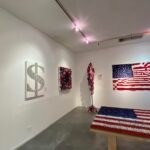
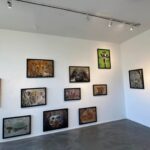
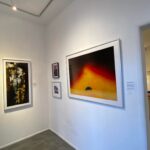
Also on exhibit at Gallery 825 are (left to right) the thought-provoking textile flag works of Sol Hill, in State of the Union; James R. Lane’s EYECU, a delicate series of acid-washed images of animal art viewed from their perspective that’s both haunting and wise; and the tragic beauty of the looming destruction of our planet in the photographic work of Matricide – Destiny Manifested, from Don Porter.

These fine exhibitions, along with In the Wash, are on display until May 13th, and are visible both online at https://www.laaa.org/4-solo-shows-at-gallery-825 and in person at Gallery 825, located at 825 N. La Cienega Blvd. in West Hollywood. Call or email the gallery for hours.

  • Genie Davis; photos by Genie Davis and provided by Susan Ossman