
Metaphor for Magic: Stunning Work from Vojislav Radovanovic and Museum-Wide Exceptional Exhibitions at the Museum of Art and History  

Metaphor for Magic: Stunning Work from Vojislav Radovanovic and Museum-Wide Exceptional Exhibitions at the Museum of Art and History  – Genie Davis
The Museum of Art and History’s Metaphor, which runs January 31st through April 19th is a dazzling series of exhibitions featuring solo shows and installations from Nathan Huff, Sharon Kagan, Diane Briones Williams, Frances C. Robateau Jr., Brian Singer, Bachrun LoMele, and Vojislav Radovanovic.

MOAH curator Robert Benitez, Heber Rodriguez, and curatorial assistants Clara Baxter and Jaushua Rombaoa have presented a rich cornucopia of works which each resonate with poignancy and visual poetry.
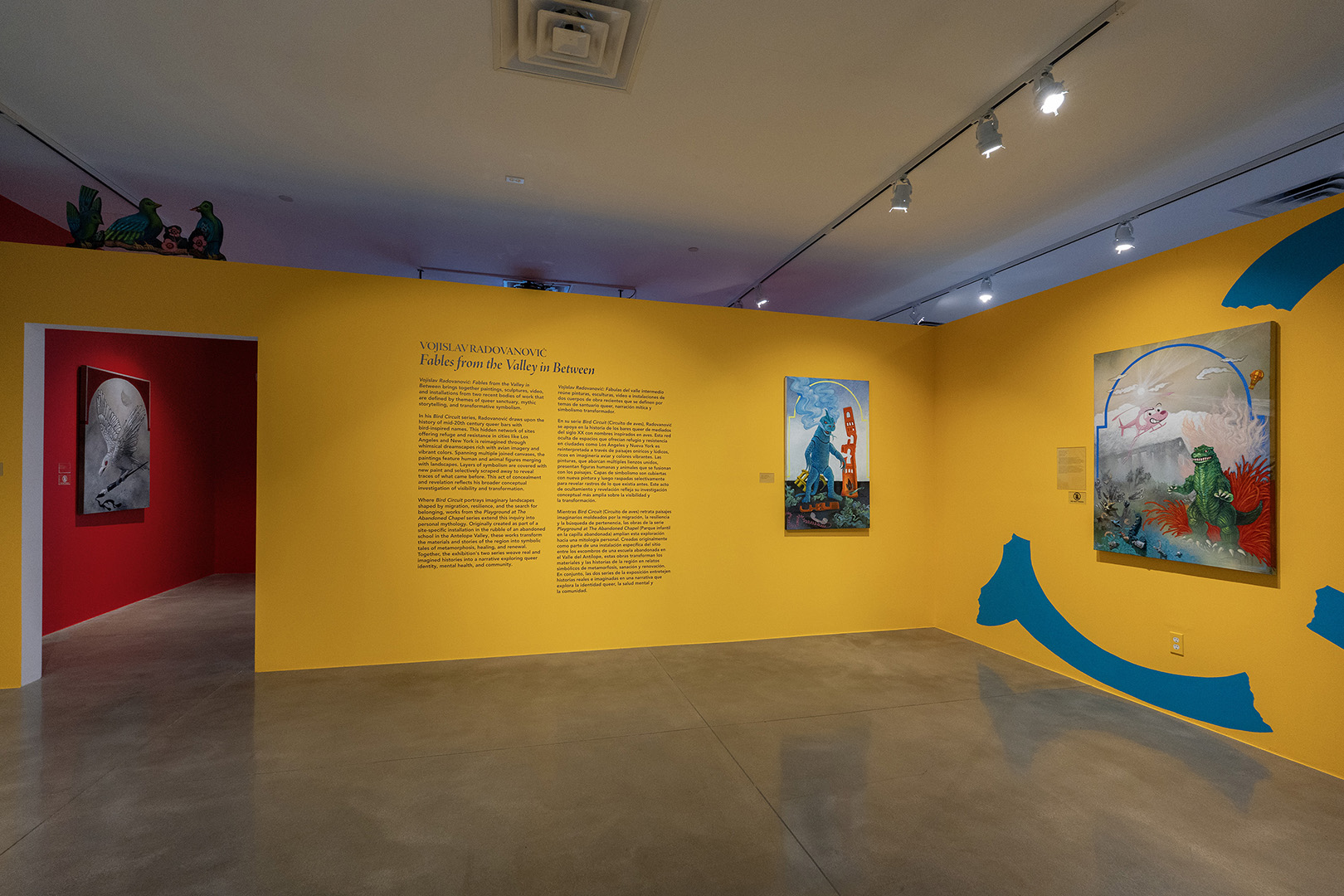
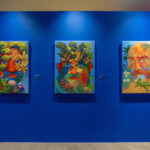
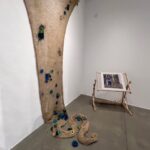
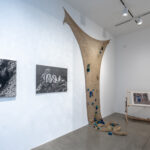
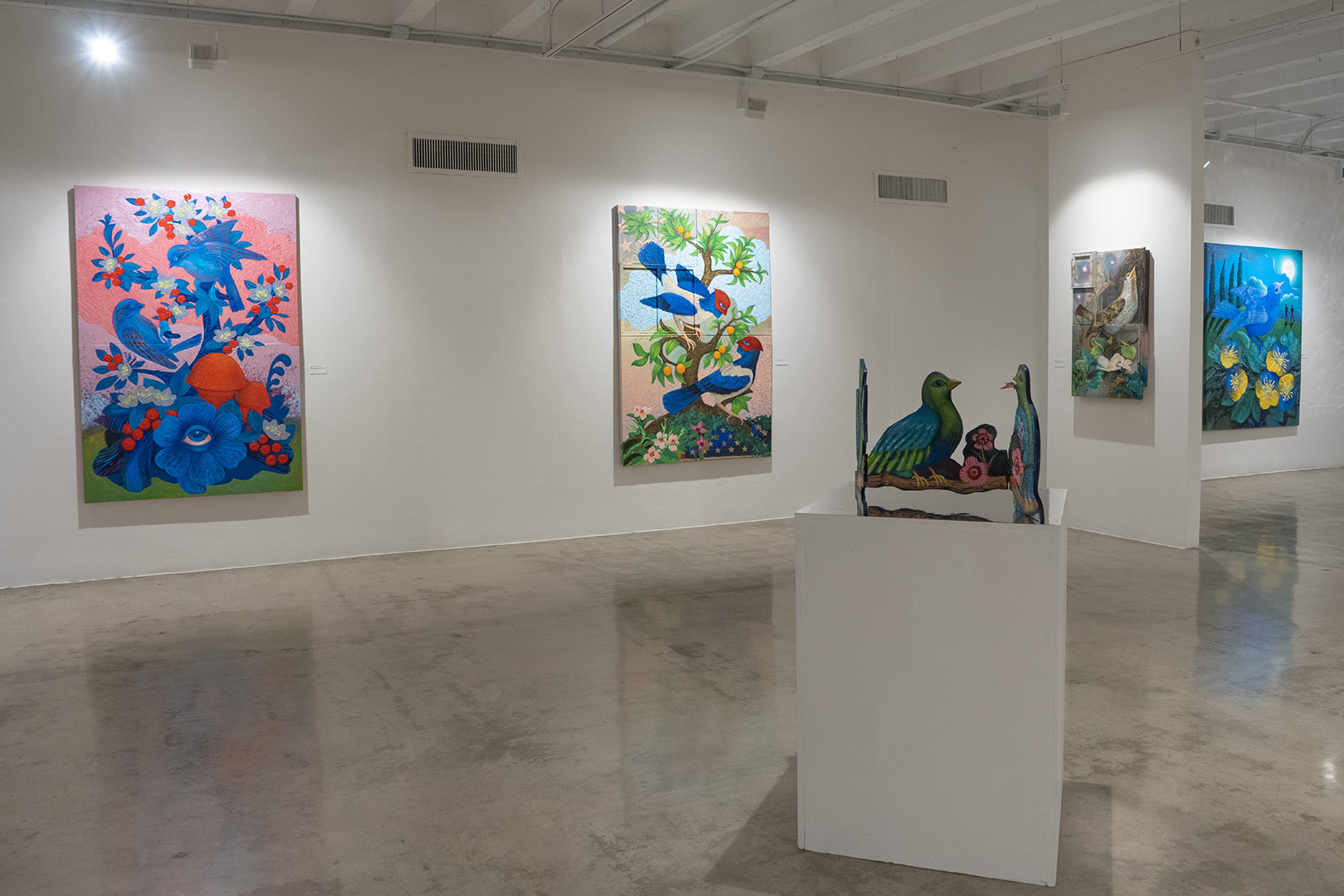
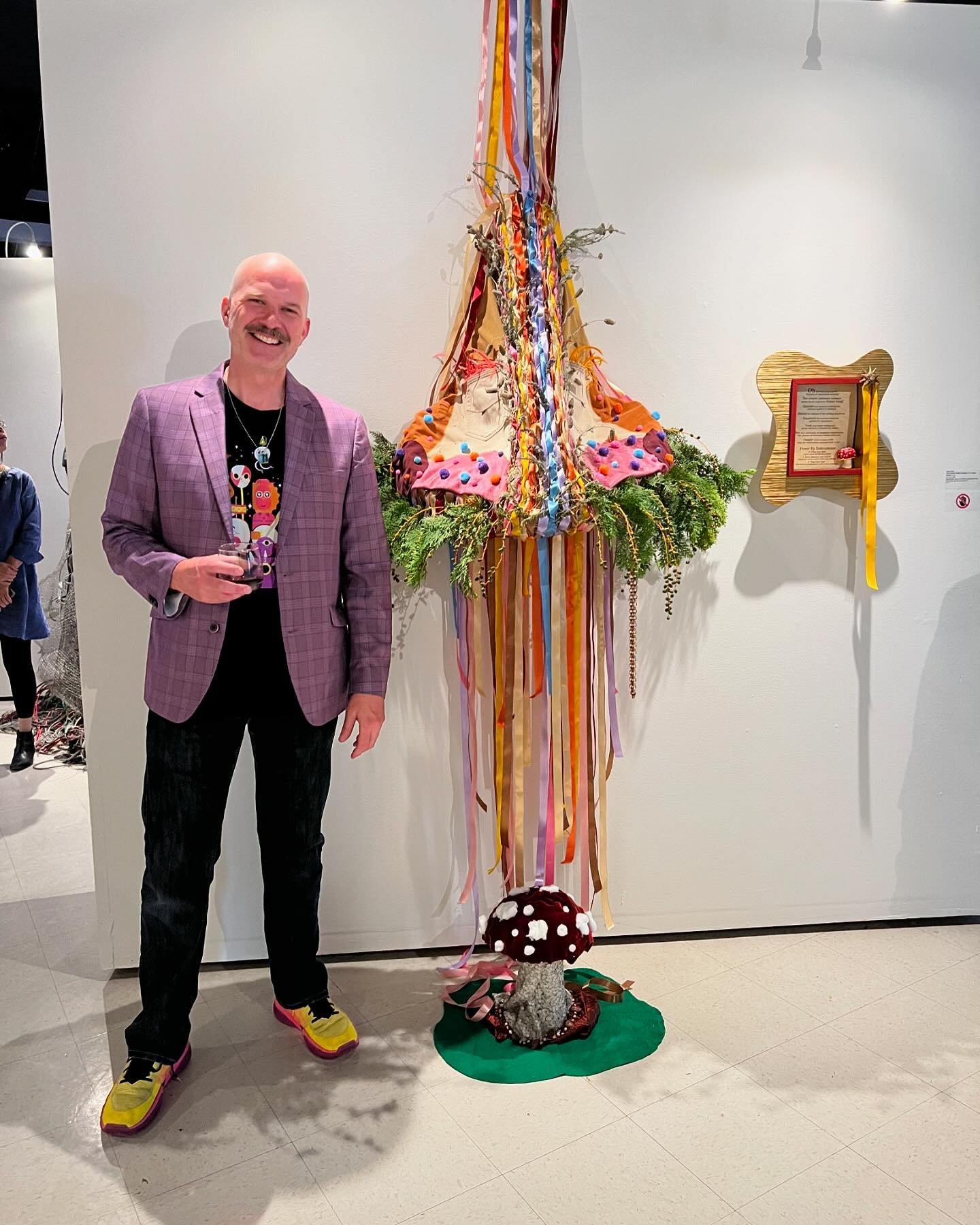
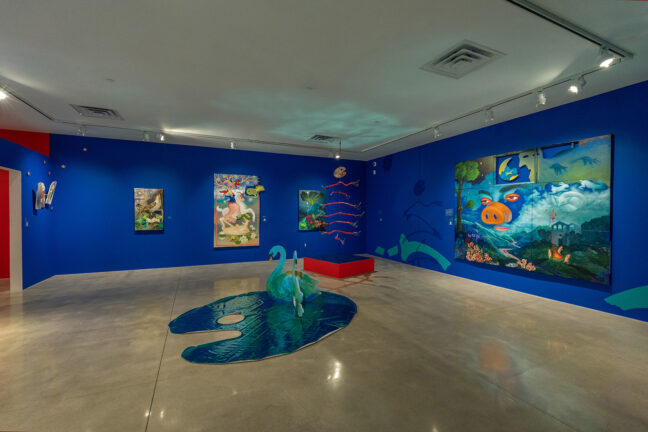
Each show is strong and beautiful, although my focus here is on the work of Vojislav Radovanovic, who always creates mystical, magical worlds in his exhibitions. Here, with gallery walls painted in electric hues that tie in with his work, his Fables from the Valley in Between is especially alchemic. Enriched with an exuberant palette, with intricate bead work and applique, and a sublime attention to detail, the artist entrances the viewer into experiences that are rapturous and transformational.
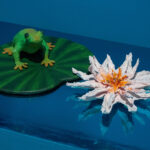
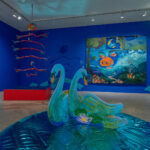
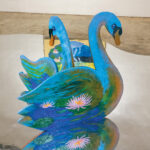
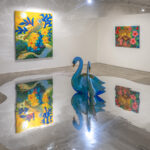
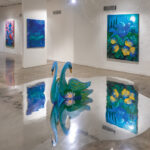
Three-dimensional swans float across a shimmering lake; a sculpted frog and lily pad perch nearby. Paintings of birds are perfectly rendered, representing multiple meanings in serendipitous settings. Childhood play-monsters come to life; a video installation ties together elements of play, nature, pain, and passion amid natural landscapes; fairy tale characters and delightful animal figures inhabit special places in large scale works. These works are dream-like fanciful, fabulous, and deeply moving.
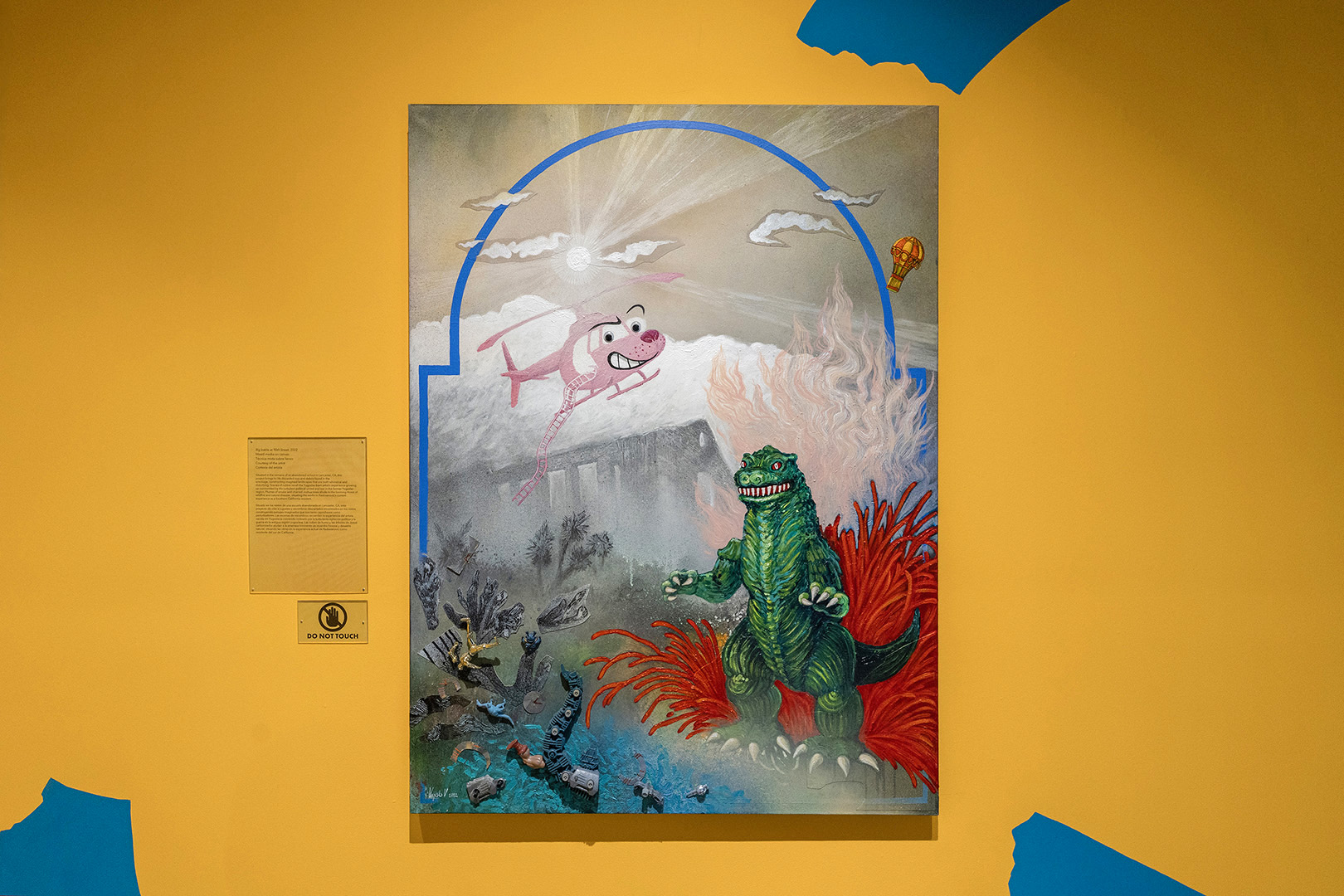
Integrating both human figures and animal life, weaving a tapestry of rich storytelling, Radovanovic creates a galvanizing and lovely exhibition that leads viewers through a land of connected gallery rooms. In the first, the room is populated by paintings of childhood toys and deserted Lancaster-area locales that tie into the artists own experience of turbulent unrest and warfare in eastern Europe.
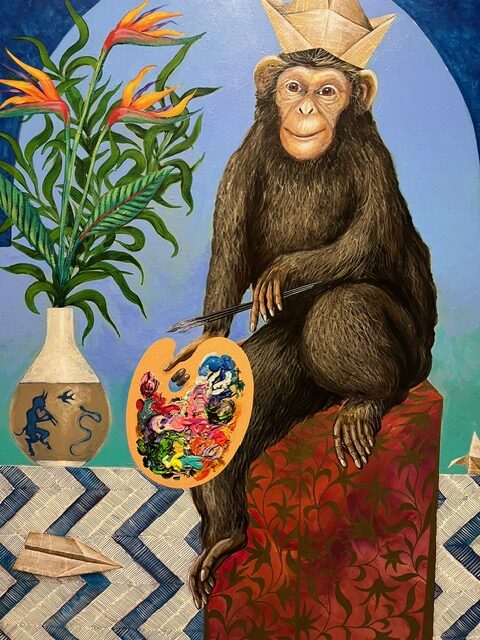
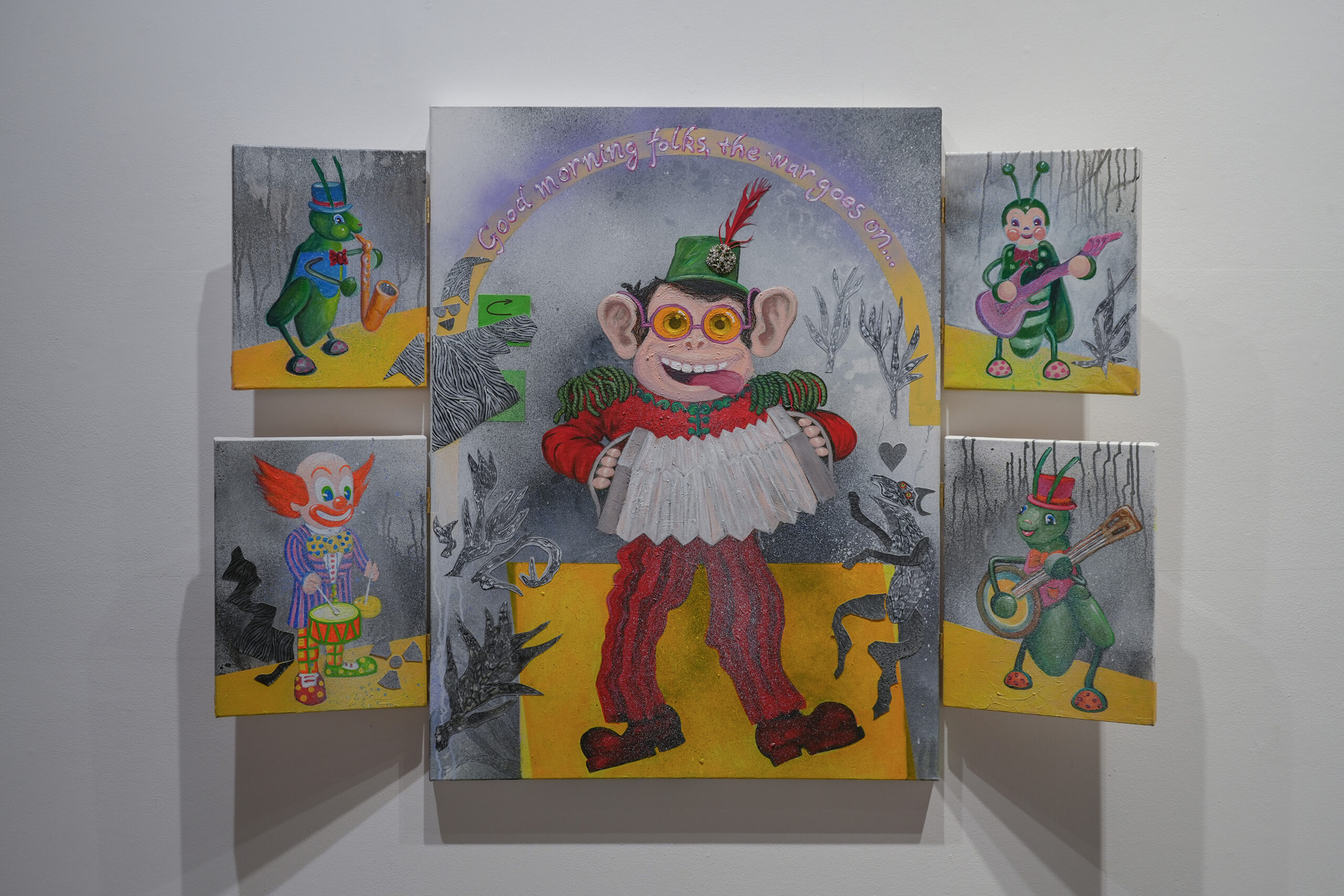
Segueing into other series, “Portrait of a Painter,” gives the viewer a look at an artist as chimpanzee, paint palette in hand, paper jester’s crown on his head. It serves as a transition point from the conjoined images of warfare and play to the freedom and sense of hope in richly nuanced paintings featuring the symbolism of birds.
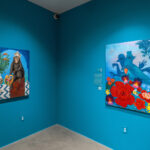
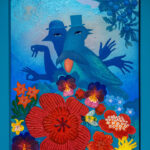
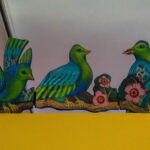
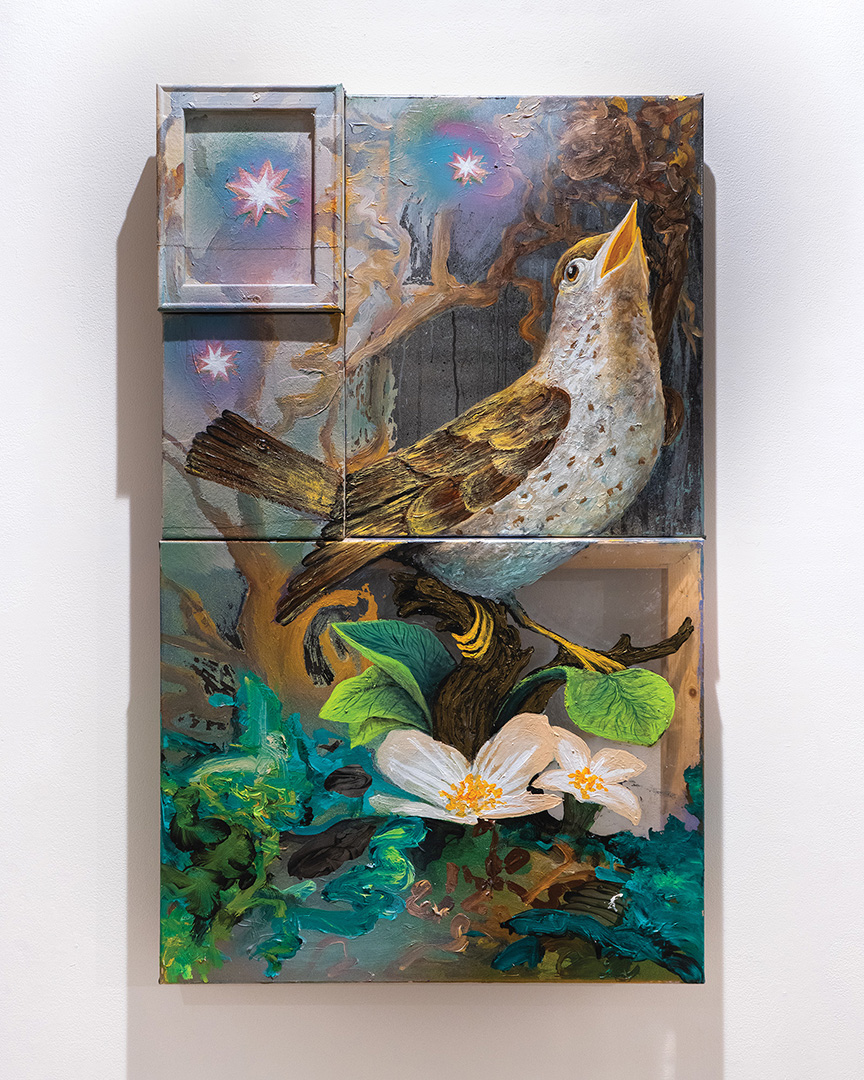
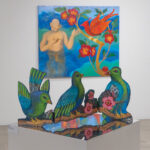
These paintings are a part of the artist’s Bird Circuit series, which refers to a network of mid-20th-century gay bars. The birds themselves are symbols of sanctuary and safety, indicating the location of gathering places for the gay community despite laws discouraging congregation. These images exude a powerful sense of energy, purpose, and resistance. Within the artist’s avian world there are anthropomorphic creatures, playful scenes, loving couples, and sculptural images that both charm and delight. A cut out of three “Small Birds” with beautiful green and lapis lazuli blue plumage stands above a doorway, leading into the next gallery rooms.
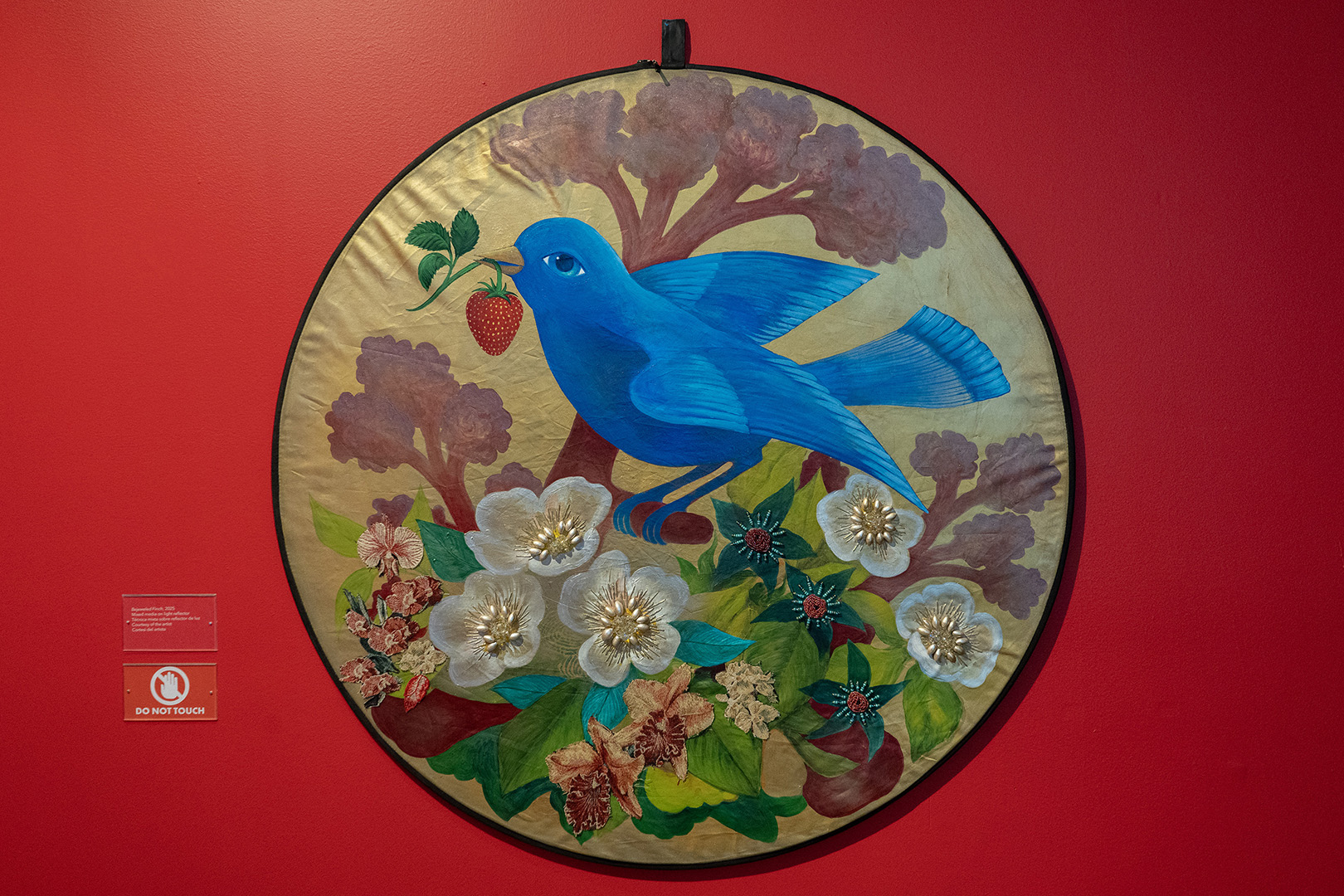
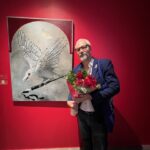
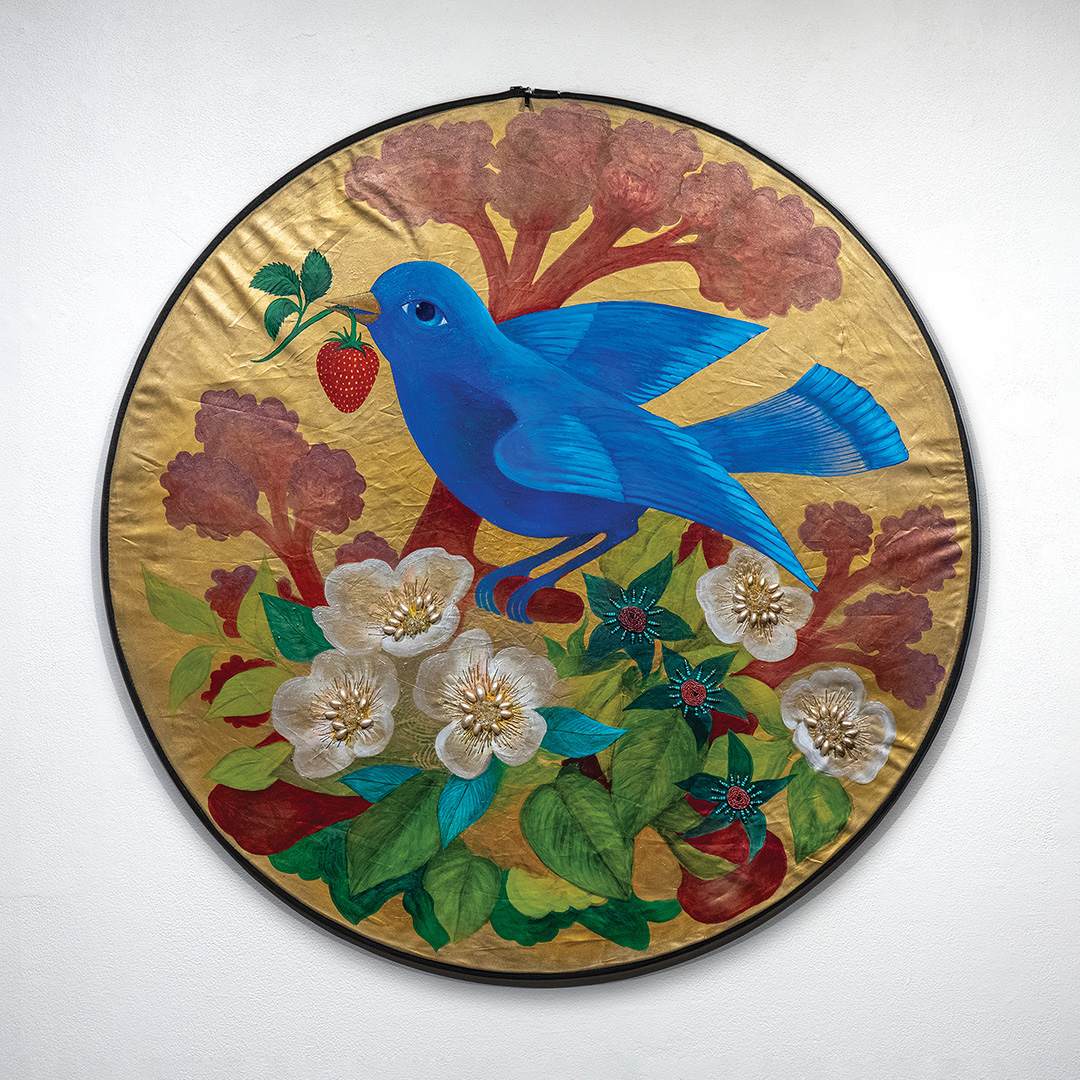
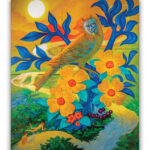
One of the most gorgeous images here is “Bejeweled Finch,” featuring a brilliant blue bird with a strawberry in his beak; lush, jeweled appliques sparkle in floral bursts, and the entire piece is set on a gold light reflector. It recalls both traditional religious icons and shields carried by medieval knights in battle. A very different avian image haunts the imagination in the mixed media “Omen,” featuring a silvery bird clutching a fountain pen between his teeth, ink trailing from its tip.
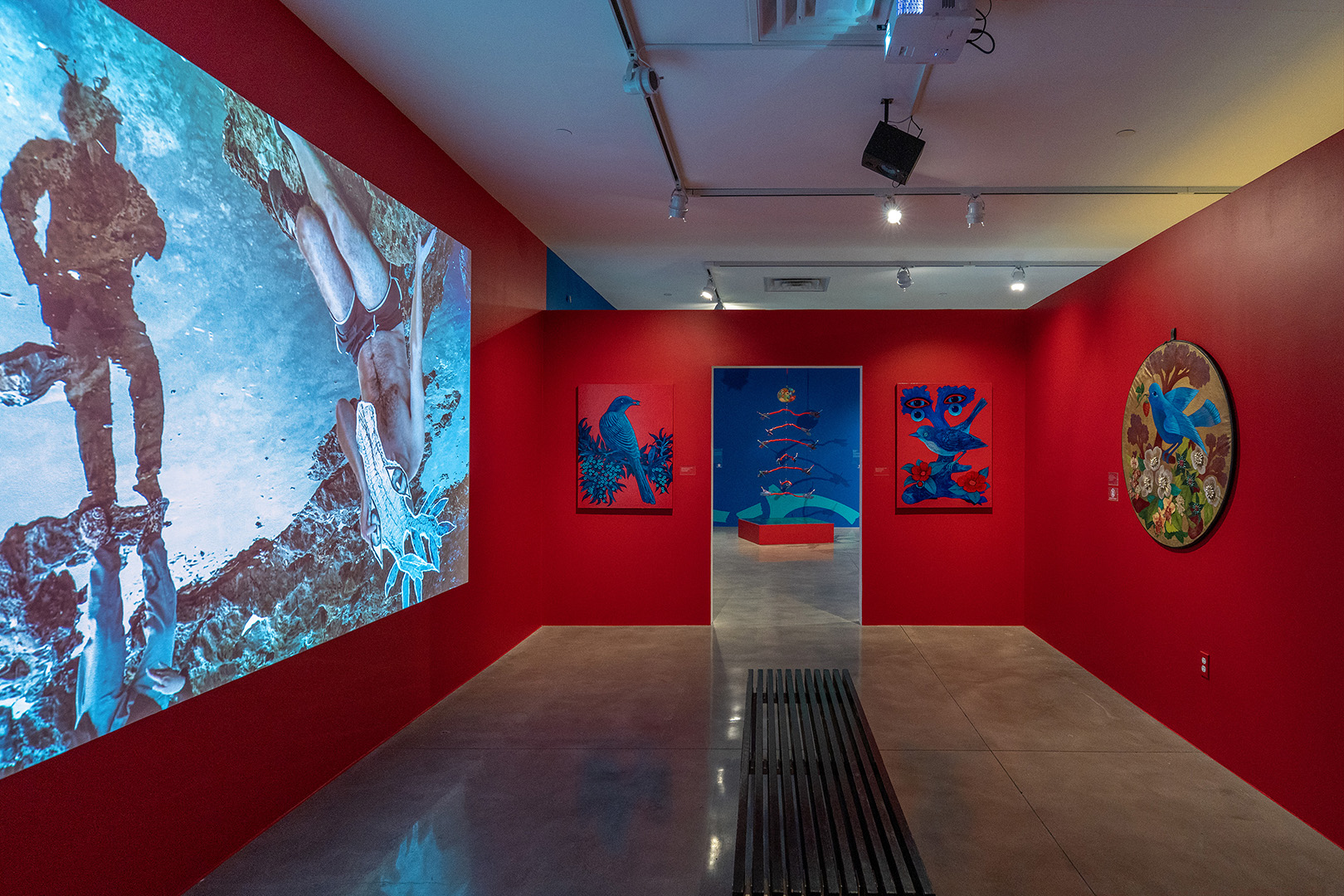
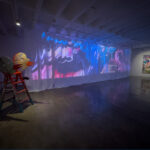
Across the gallery, a large video installation plays titled similarly to the exhibition itself as “The Valley in Between and Other Fables.” A variety of experimental film segments play created through poetic collaboration with the late Robert Patrick Playwright, Jason Jenn, Chuck Hohng, and Joseph Carrillo.
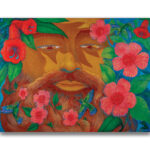
Having moved from childhood toys engaged in news media chaos and warfare to the fraught but free sanctuary of Radovanovic’s Bird Series, the final and largest room of the exhibition, moves into a series of works that speak to fairy tales, fantasy, and pure magic. Here viewers will meet the heavily floral image of a “Frog Prince” whose hair is landscaped into the fecund branches of a brilliant green tree. At the base of the painting, within the flora, an actual frog wearing a small gold crown, blows a kiss.
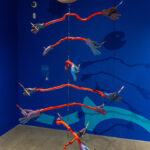
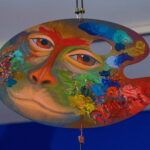
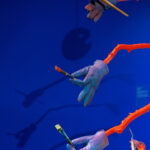
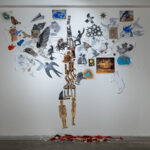
A suspended sculpture, reminiscent of Alexander Calder in shape is described by Radovanović as a “self-portrait.” The multi-armed figure has a head in the shape of a painter’s palette, while multiple arms and hands hold paint brushes. This piece also recalls the many-handed figures of Greek mythology, the Hekatonkheires.
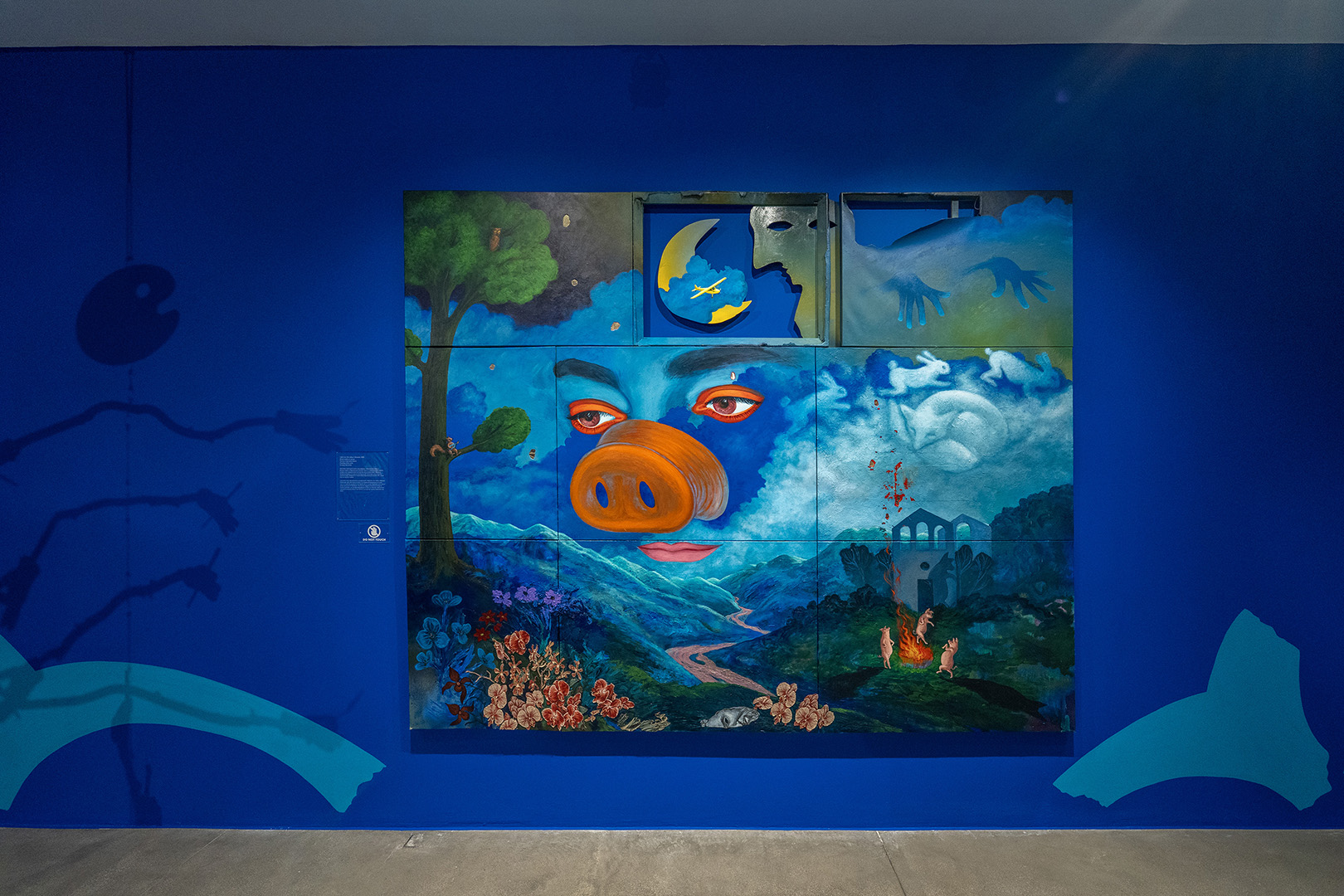
Moving deeper into fairy tale mythology is “Fable from the Valley in Between,” which includes the “Three Little Pigs” dancing by a roaring fire while a wolf’s shadow lurks, a charming owl, a musical squirrel in a tree, and a painter’s palette moon.
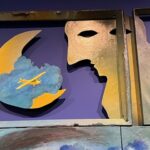
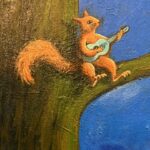
Dreamy and also lightly ominous, here the magical and the sublime eclipse the possibility of dread.
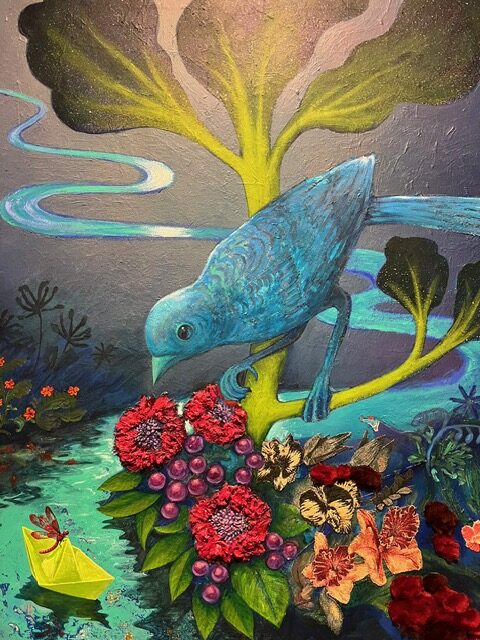
“Journey Down the Stream” in this same gallery is exquisitely wonderful, depicting a curious bird watching a small paper boat carrying a dragonfly as it sails down a small, moonlit stream. This piece speaks to hope and promise, including the promise of another world. Dragonflies, after all, represent many things, including change, transformation, self-realization, joy, light, and even a connection to the spirit world — all of which are a part of Radovanovic’s work.
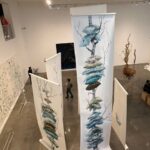
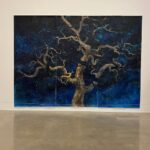
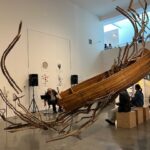
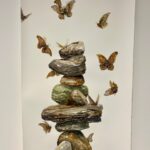
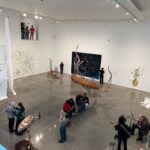
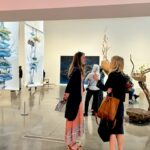
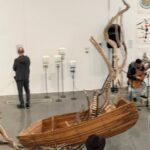
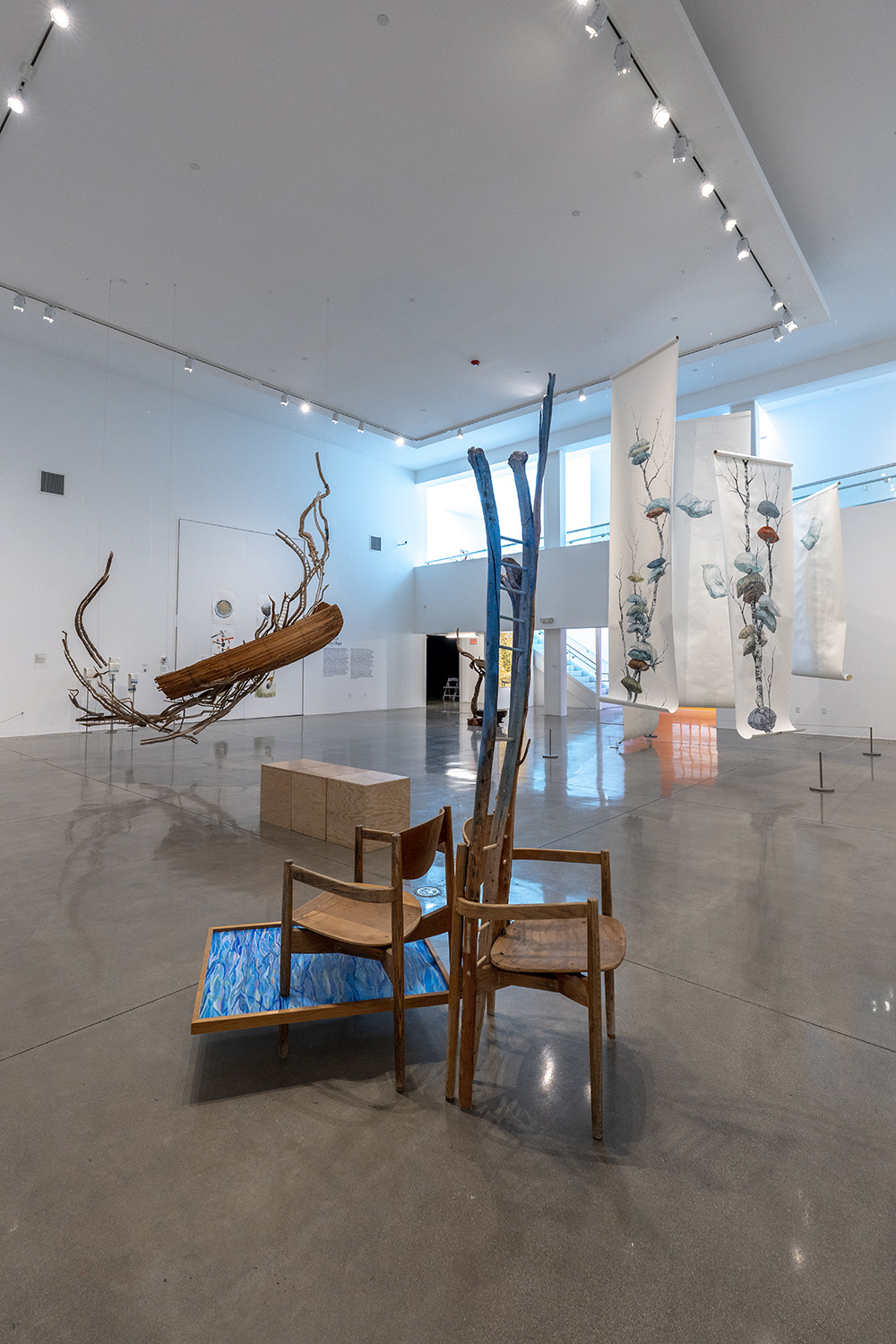
The other exhibitions in the museum are also potent and lovely. Nathan Huff’s Heavy Hope mixes natural beauty with elements of domesticity, creating a delicate and complete balance that includes installations and sculptures, paintings and drawings. Like Radovanovic, but completely different in style and tone, Huff deals with magic. Located in the expansive first floor gallery, the exhibit gives the viewer upended boats, chairs and flowers and stones, table tops with golden, hovering flowers.
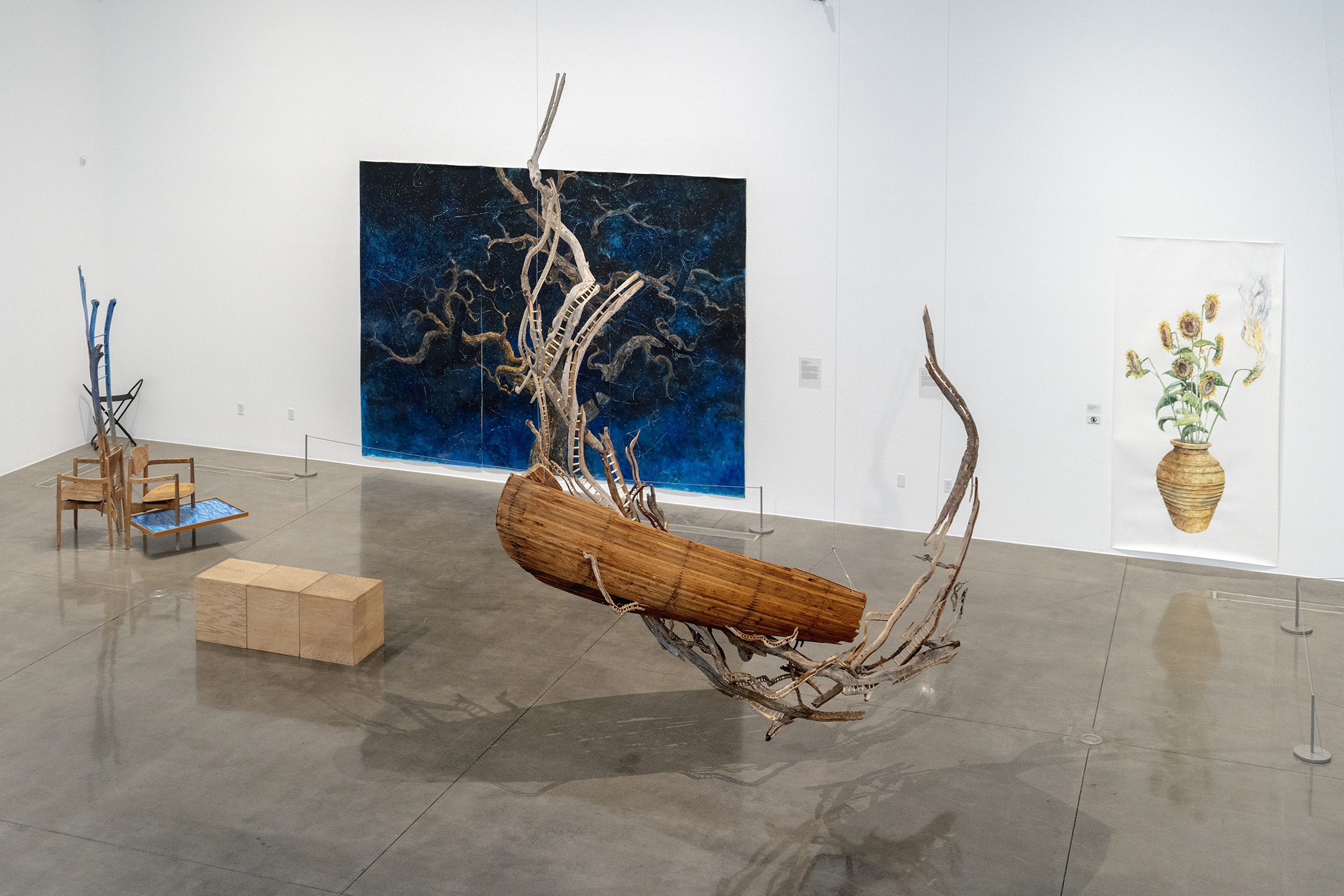
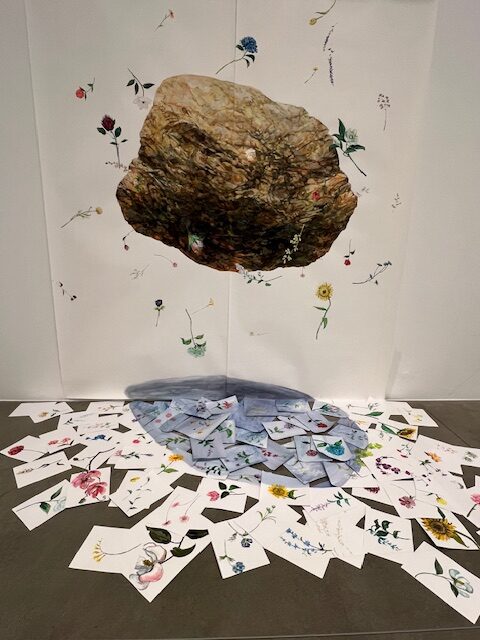
There are perfectly nuanced gouache and watercolor works that glow with inner and external light, installations that upend expectations and move toward delight. This, too, is a fairy tale, but one steeped in the alchemy of nature and the ache of the human heart.
Sharon Kagan’s Bearing Witness is also woven with deep meaning, both literally and figuratively. Working in both mixed media painting, drawing, and textile work, her exhibition is finely wrought. Her knitted, linked, conjoined, and wonderfully sinuous sculptures explore both pain and compassion along with a profound sense of strength.
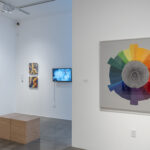
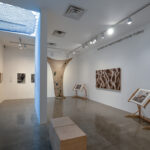
That strength and deep emotions is carried in both her use of seemingly fragile materials and through an indomitable subject. Her beautiful work explores both her own experience of human connectivity and her connection to the trauma of the Holocaust as a survivor’s daughter.
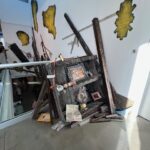
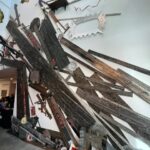
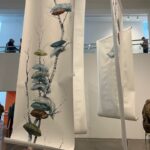
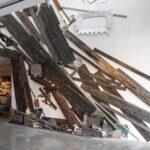
Other MOAH exhibitions include the expansive sculptural installation by Bachrun Lomele, Burn Pile/All Kinds of Murmuring Here and There which includes anonymous phrases and statements made by residents of the San Joaquin Valley, reconfigured to serve as symbols for the disjointed and ever mutable world we live in today. The installation towers between the two floors of the museum.
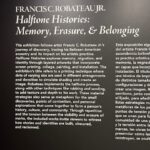
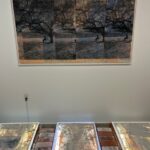
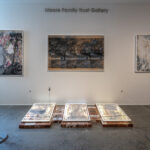
Francis C. Robateau Jr.’s Halftone Histories: Memory, Erasure, and Belonging is a hauntingly lovely mix of screen printing, collage, and painting. There are Mayan ruins and Lamanai sites in Belize as well as images from the LA area depicted here, each adding not only accumulated visual layers but a sense of the layers of history and ancestry, self-discovery, and communal heritage.
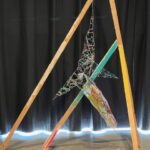
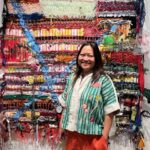
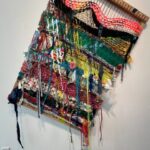
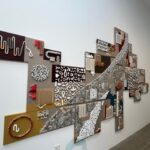
Also evoking a sense of heritage and cultural reimagining is artist Diane Briones Williams in her The Precarious Life of the Parol, where mixed media and textile works examine not just sculptural weavings but the memories and past history of her Filipinx identity.
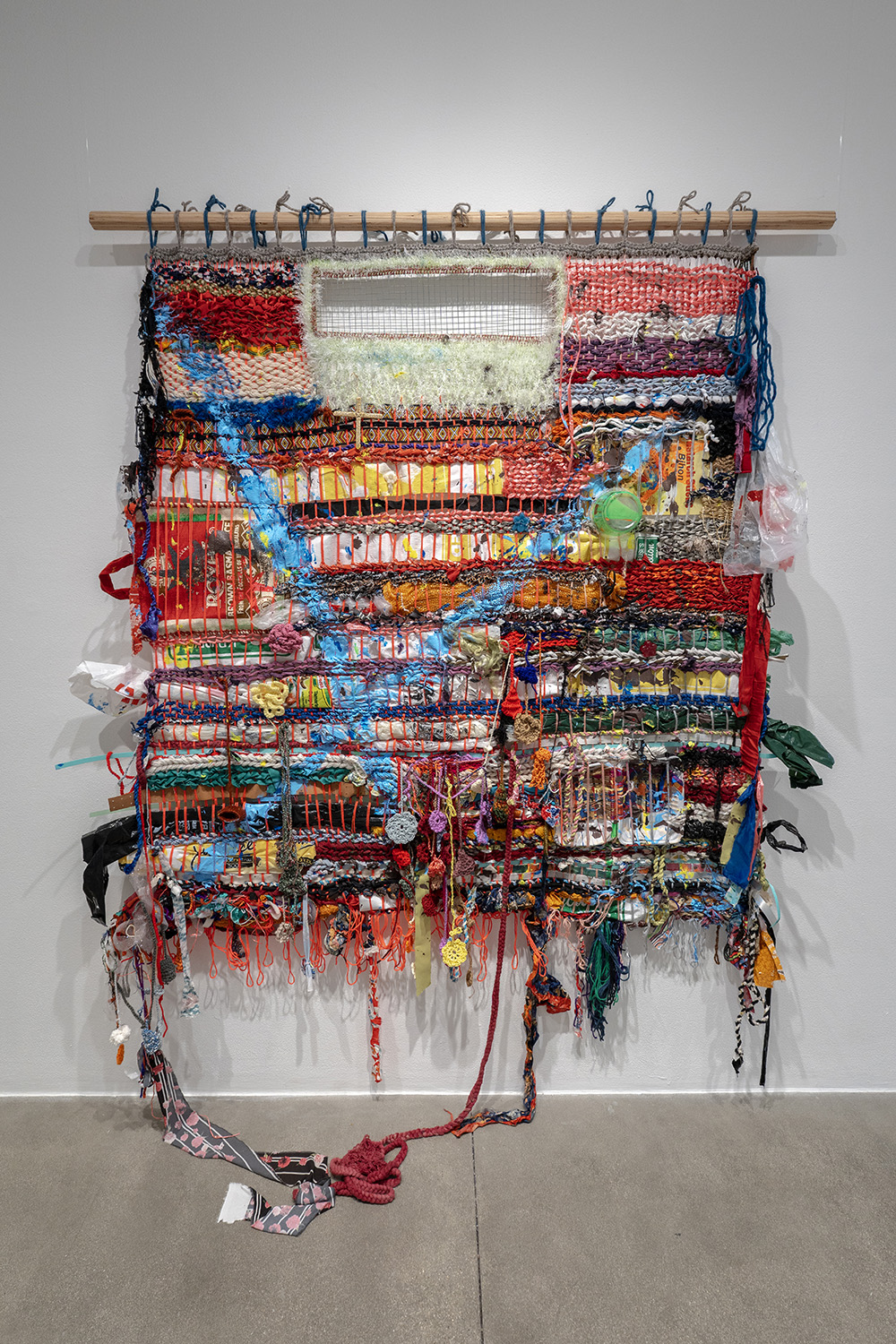
Jubilantly colorful and bearing the weight of collected detritus, each image is complex and carefully rendered.
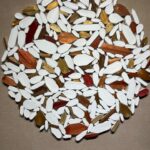
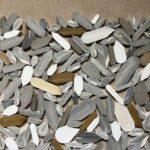
In contrast, it is a loss of heritage that makes the focus of Brian Singer’s It was a pleasure to burn.
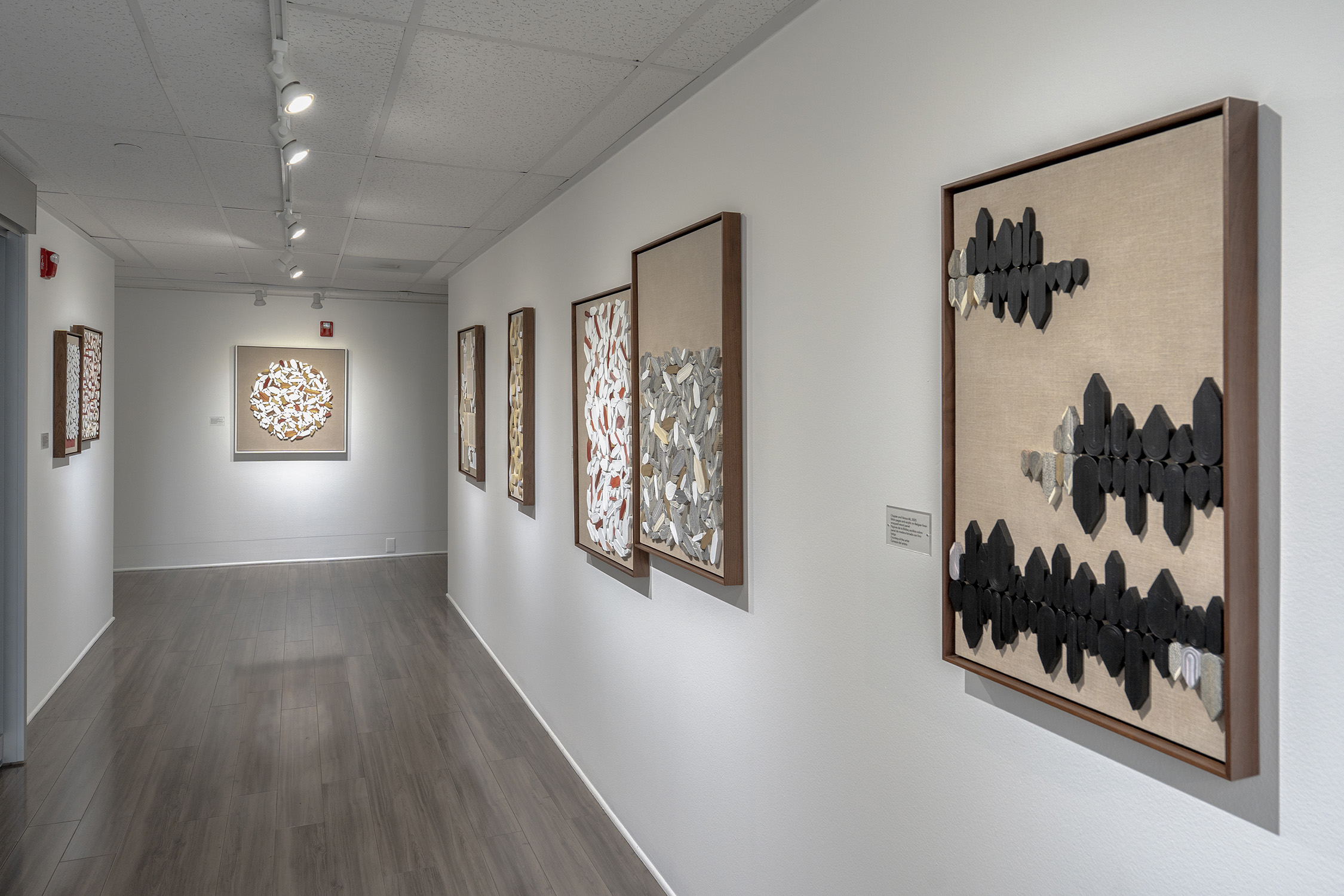
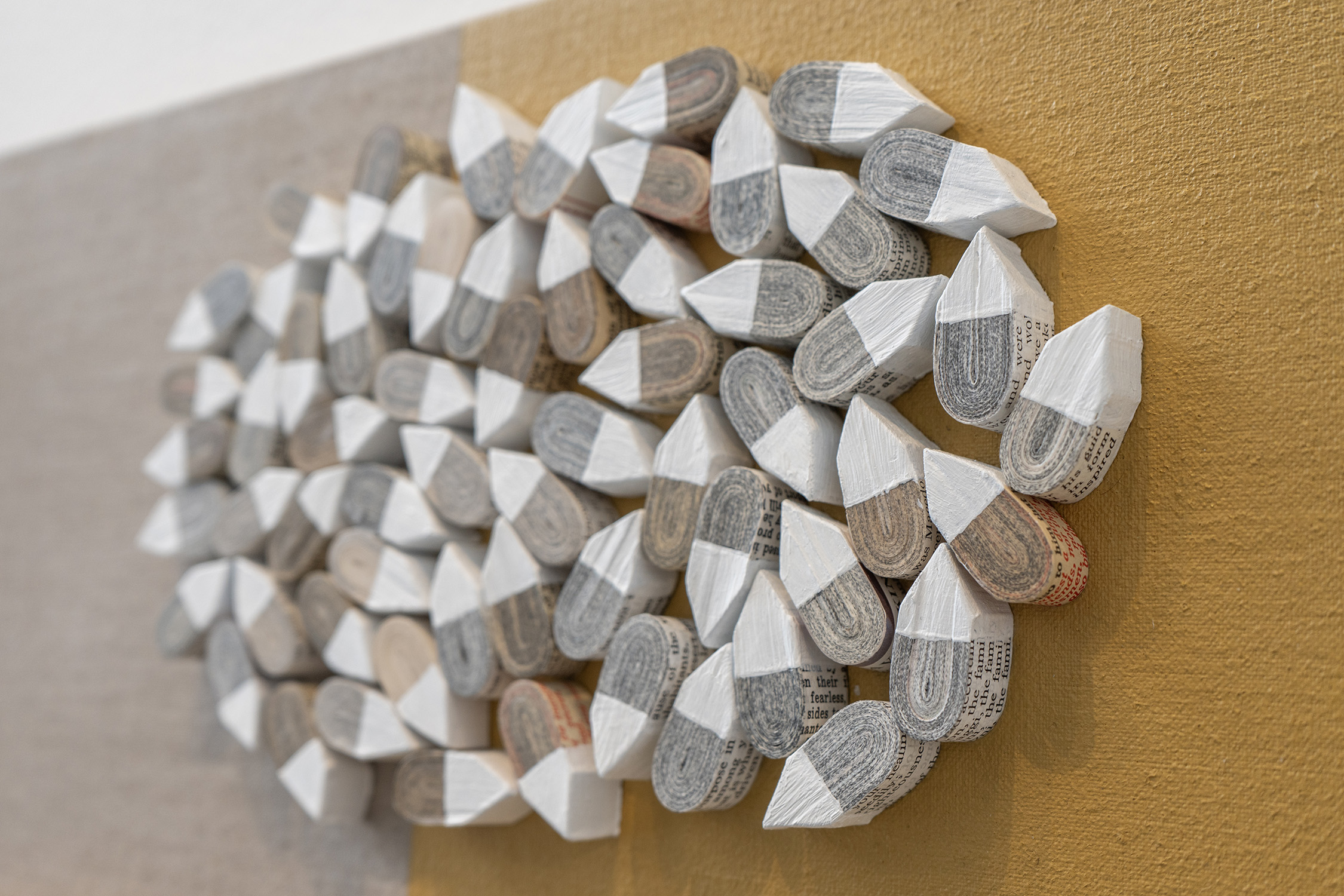
In this exhibition, the artist examines the power of words, utilizing the text of banned books and the Bible to create beautiful, muted mosaics made of compressed book pages.
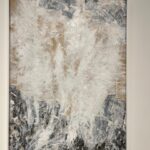
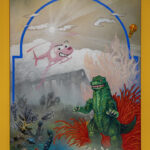
Taken together or individually, the museum’s Metaphor is a beautiful mix of the representational and abstract, of deep meaning arising from stories writ large and luminous. Experience the joy and absorb the stories: you will be wiser and happier for making the drive.

MOAH is located at 655 Lancaster Blvd. in Lancaster.

  • Genie Davis; photos by Genie Davis and provided courtesy of L.A. Art Documents 
Vojislav Radovanovic’s Bird Circuit Sings

           Vojislav Radovanovic’s Bird Circuit Sings – by Genie Davis

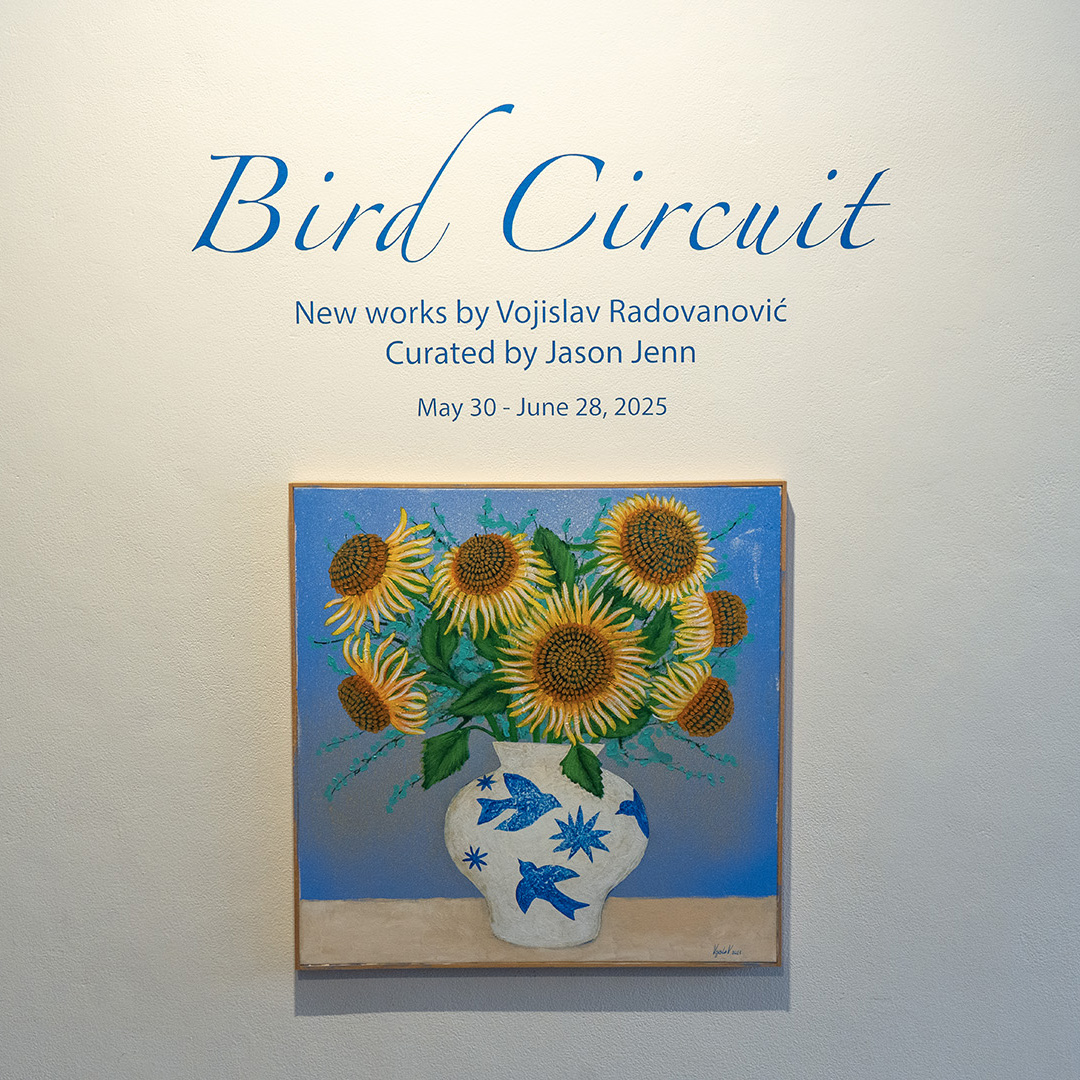
Vojislav Radovanovic’s stunning solo exhibition Bird Circuit soars through a poetic exploration of identity, self-expression, and joy. Using an exciting, primarily brilliant palette and perfectly detailed images of wonderous birds as its starting point, the exhibition is inspired by the historical bird circuit, a collection of bars with names inspired by birds, which welcomed guests to queer-friendly spaces in cities such as New York and Los Angeles when such were considered to be illegal.

Radovanovic’s work is a lesson in painterly perfection and magical realism. As curated by Jason Jenn, the vibrant images fly through a variety of remarkable, mystical paintings which in many cases landing in immersive installation space.

Above, “Bejeweled Finch” is rich in layers, materials, and the intricate lovliness that is the make-up of each piece in this exhibition. Here, Radovanovic uses mixed media on light reflector, glass and wood bead, and thread to create a delicate and dreamy image.

Each of the artist’s works here are both profoundly lovely and filled with dynamic energy. The winged cultural mascots he depicts herald the strength of cultural resistance to oppression, the vibrancy of which has never been more pertinent and vital than today. These avian figures pull viewers into stories that were born in a network of gay bars, sanctuaries for connection. In these images, birds indicating these places of sanctuary lead one into a world of metaphor and music as potent as birdsong. There are anthropomorphic figures, playful scenes, loving couples, and alchemic mystery — the latter firmly embued in each work.

Along with the birds themselves, there are elements of magic. Mysteriously dark, seemingly shape shifting birds clad in top hats appear in  “Magician; a silver bird astride an artist’s brush with a half moon perched between his wings, in “Omen.”
 

Some of the paintings are magical in approach if not subject. These are layered in theapplication of paint and the precision of Radovanovic’s brush strokes, or involve the quilts of smaller previous paintings conjoined into larger work, as in “Urge to Sing,” below.

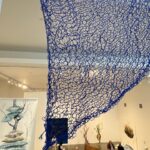
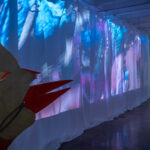
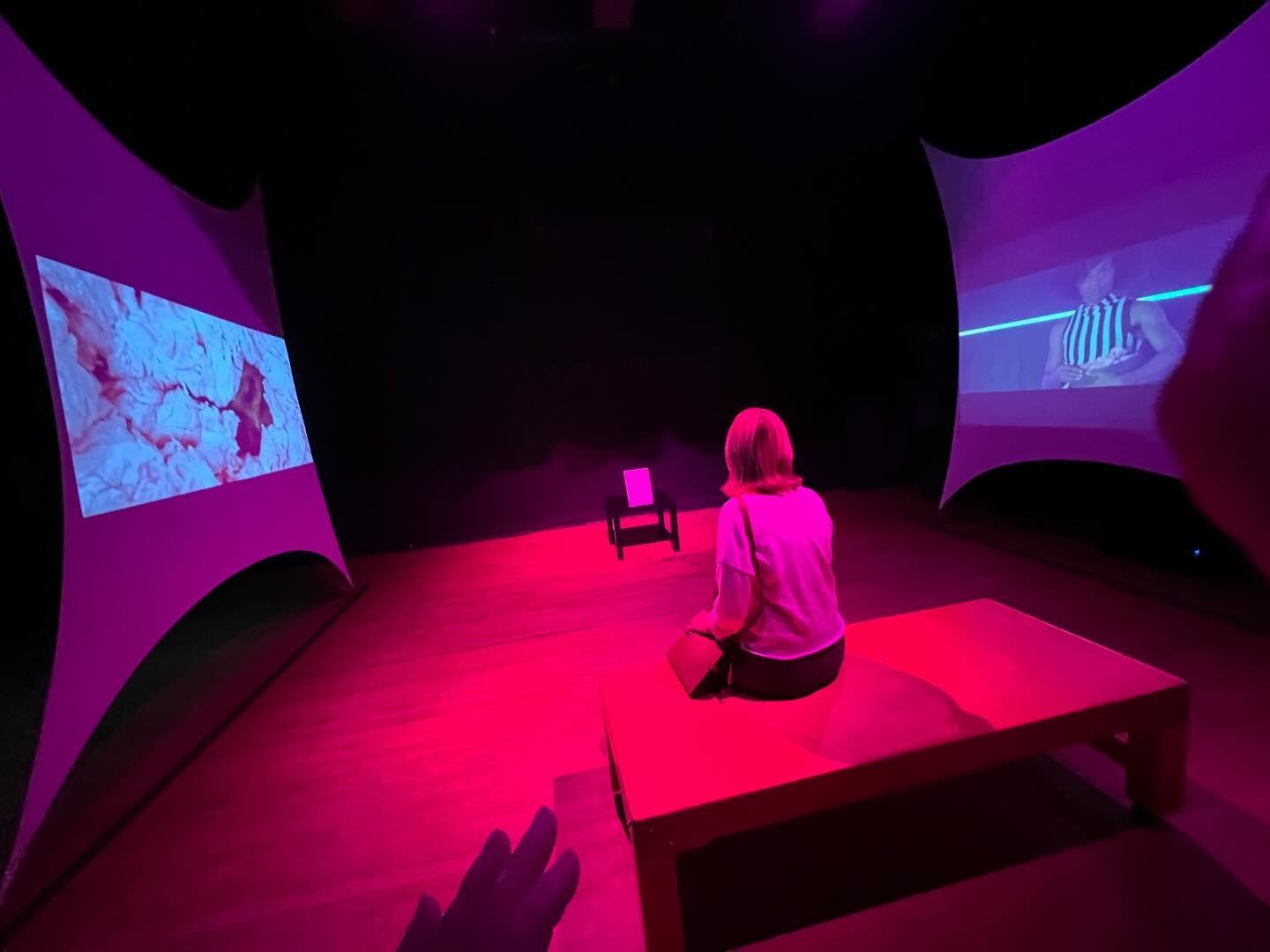
And along with his paintings, Radovanovic offers sculptural images, including fantastical blue wooden swans sailing across a shiny silver lake in one gallery, and video projected on soft fabric behind shimmery curtains in another.


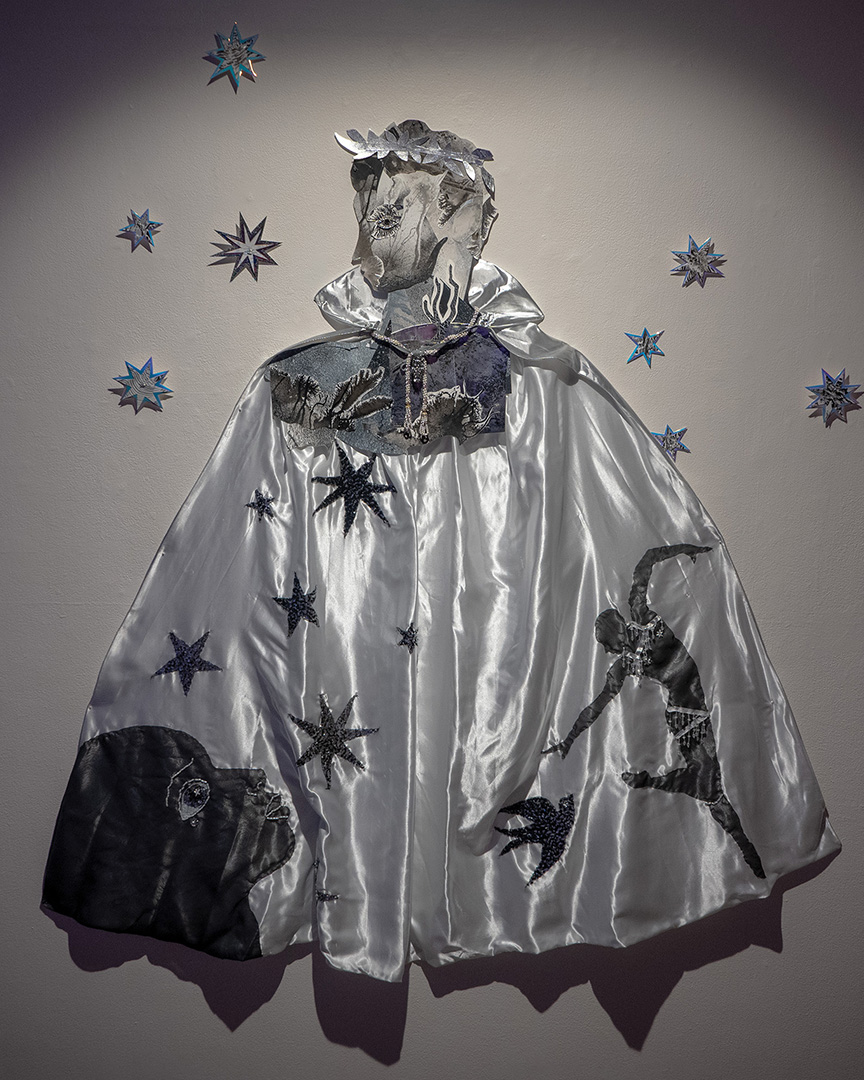
The fabric serving as the location of the video projection makes the images move and dance like ripples on a clear lake, each embodying a different reflection. In the same gallery are the artist’s assemblage, “Ladders,” and the lush collage of “Let Love Flourish (Cape),” an elaborately embroidered silver cape with a dimensional collage that once again speaks to the idea of magic, of talismans, or a conjurer’s protection from risk.

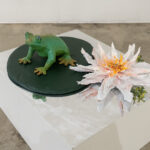
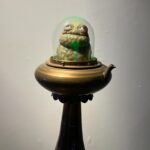
Other sculptural pieces also shine. “The Frog” is a whimsically vivid green friend, accompanied by a wildly blooming water lily, while “Small Birds” are layered, hinged sculptural visions in green and blue,  enjoying a small water source surrounded by pink flowers.

Each of these transformative paintings and sculptures speak to the power of love, and the ways in which love always finds a way. They are also powerful rebukes to the hatred and ugliness of the world in the past, and even more certainly of the present. They are a reclamation and a redemption.

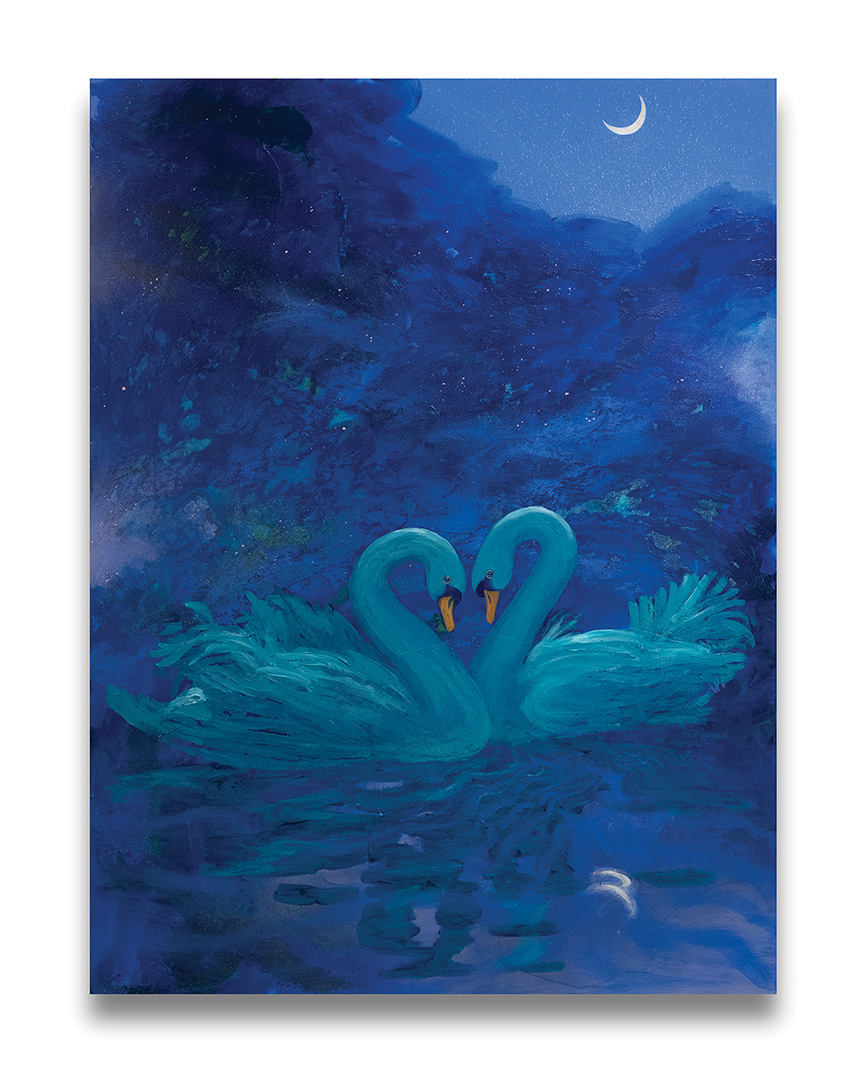
“Swans” form a beatific heart in one intensely moving piece, awash in moonlight, moody and romantic with its sliver of perfect moon and palette of watery blues.

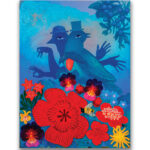
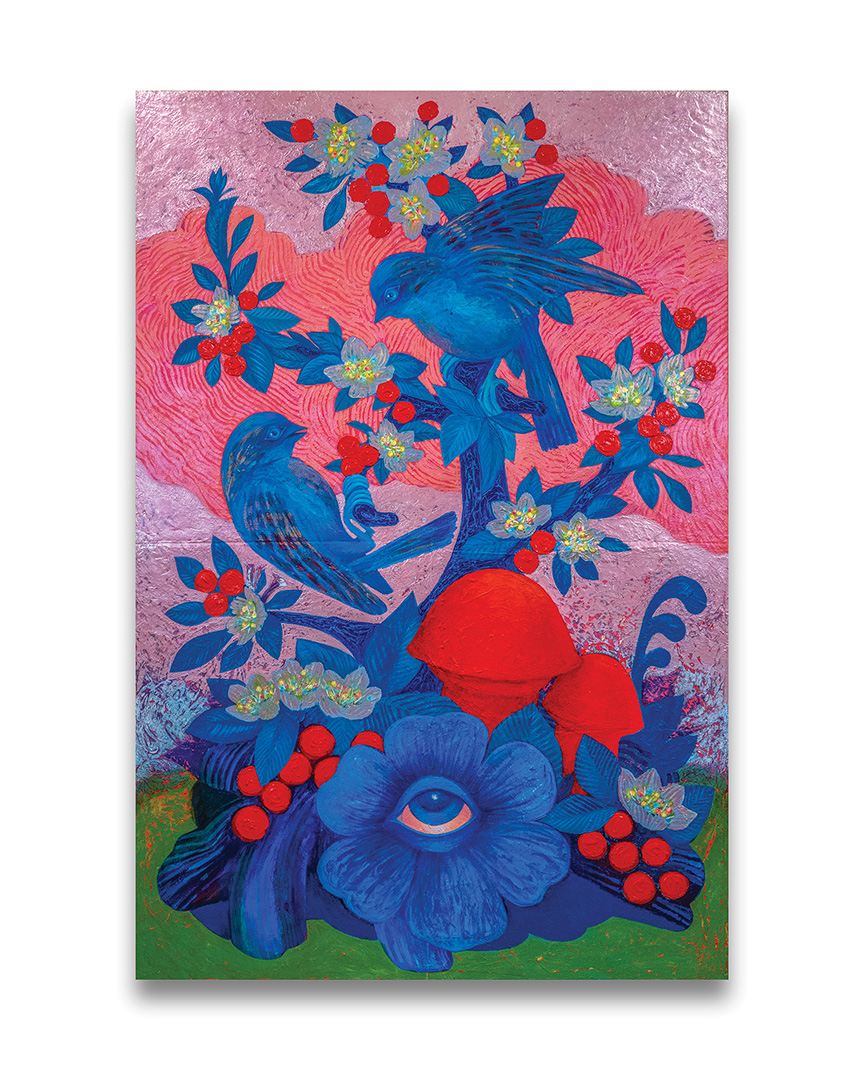
“Ultraviolet”  presents the ways in which the unique vision of birds allows them to see the world through vision that far exceeds human sight in their perception of colors and light, including ultraviolet light. A velvety blue flower features an eye, while two blue birds pluck intensely ruby-colored berries from a branch, and two red mushrooms pulse with sensual energy.
In a way, the artist’s perception is equally heightened. He sees not just the subjects he paints but presents their innermost souls, rich and rewarding, as multiply layered as the feathers on bird wings. He embraces the need for sanctuary, succor, sweetness, and celebration in every work, weaving the fantastical with the fabulous, the fierce with the importance of faith, magic, and hope.
There are many ideas nesting within Radovanovic’s work, but one of the most vital is the importance of joy and the ability to take flight above the darkest of times, claiming special places as our own, always seeking the radiance of love and freedom, and envisioning the promise of delight.

Bird Circuit closes Saturday, June 28 2-5 p.m. at the Ronald H. Silverman Gallery with a closing reception, catalog signing, and artist and curator walk-through. The exhibition will also be on view at https://www.laartdocuments.com/ if you’ve missed this beautiful show live.

  • Genie Davis; photos provided by the artist and curator


When Art Is Magic – The Arcade of Hypermodernity

“Oh Sandy, the aurora is risin’ behind us/ This pier lights our carnival life on the water…” – Bruce Springsteen

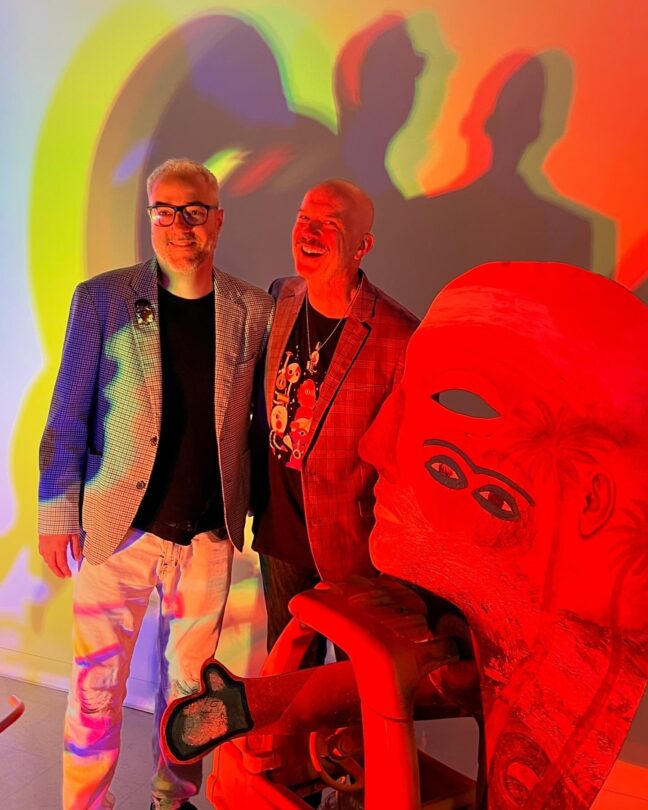
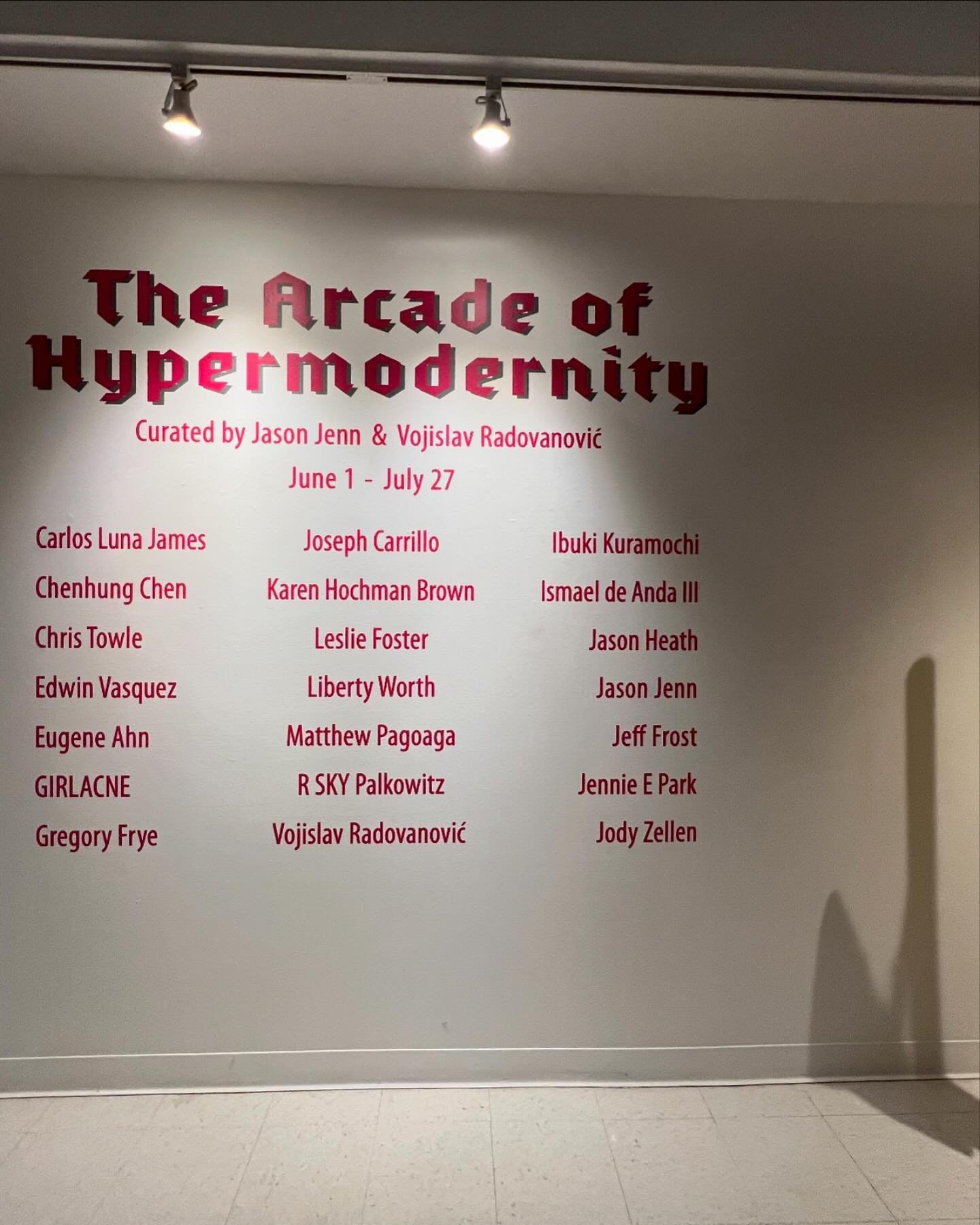
Now at Studio Channel Islands Art Center in Camarillo through, July 27th, curators Jason Jenn and Vojislav Radovanovic create a new kind of carnival life, one that offers its own bright aurora, an interactive world that morphs technology into magic and the rush of modern life and angst into a spiritual and sensual experience.

Exhibiting artists CARLOS LUNA JAMES,  CHENHUNG CHEN, CHRIS TOWLE, EDWIN VASQUEZ, EUGENE AHN, GIRLACN, GREGORY FRYE, IBUKI KURAMOCHI, ISMAEL DE ANDA III, JASON HEATH, JASON JENN, JEFF FROST, JENNIE E PARK, JODY ZELLEN, JOSEPH CARRILLO, KAREN HOCHMAN BROWN, LESLIE FOSTER, LIBERTY WORTH, MATTHEW PAGOAGA, R SKY PALKOWITZ, and VOJISLAV RADOVANOVIĆ each shape a miraculous exhibition that invites viewers to partake of a literal art arcade, touching, playing, dancing, and yes, even inhaling the scent of the art.

It’s a pure wow of an exhibition, one that vibrates with energy, a passion for perfromance, romance, the ridiculous, and the sublime. Just as I struggled to decide where to start when wandering through this treasure trove of an exhibition, I also struggle now with how best to describe an experience that is meant to be – experienced.

The curators aptly describe the show as a “vibrant playground of ideas, focusing on the intersection of art, technology, and imagination….it explores the limits of human capability and what is now possible and in a state of major change within this new era of life globally connected online, and the evolution of artificial intelligence.”

And does it ever explore. Equal parts fantasy and futuristic window, the show is visually dazzling but also robustly meaningful. What does it mean to be human? To feel, enjoy, experience? What does it mean to think without being told what to think or how to behave? What does it mean to feel one’s humanity without conforming to political or social structures that limit or lie? How will technology change us, how has it already? Where are we going, and where have we been?

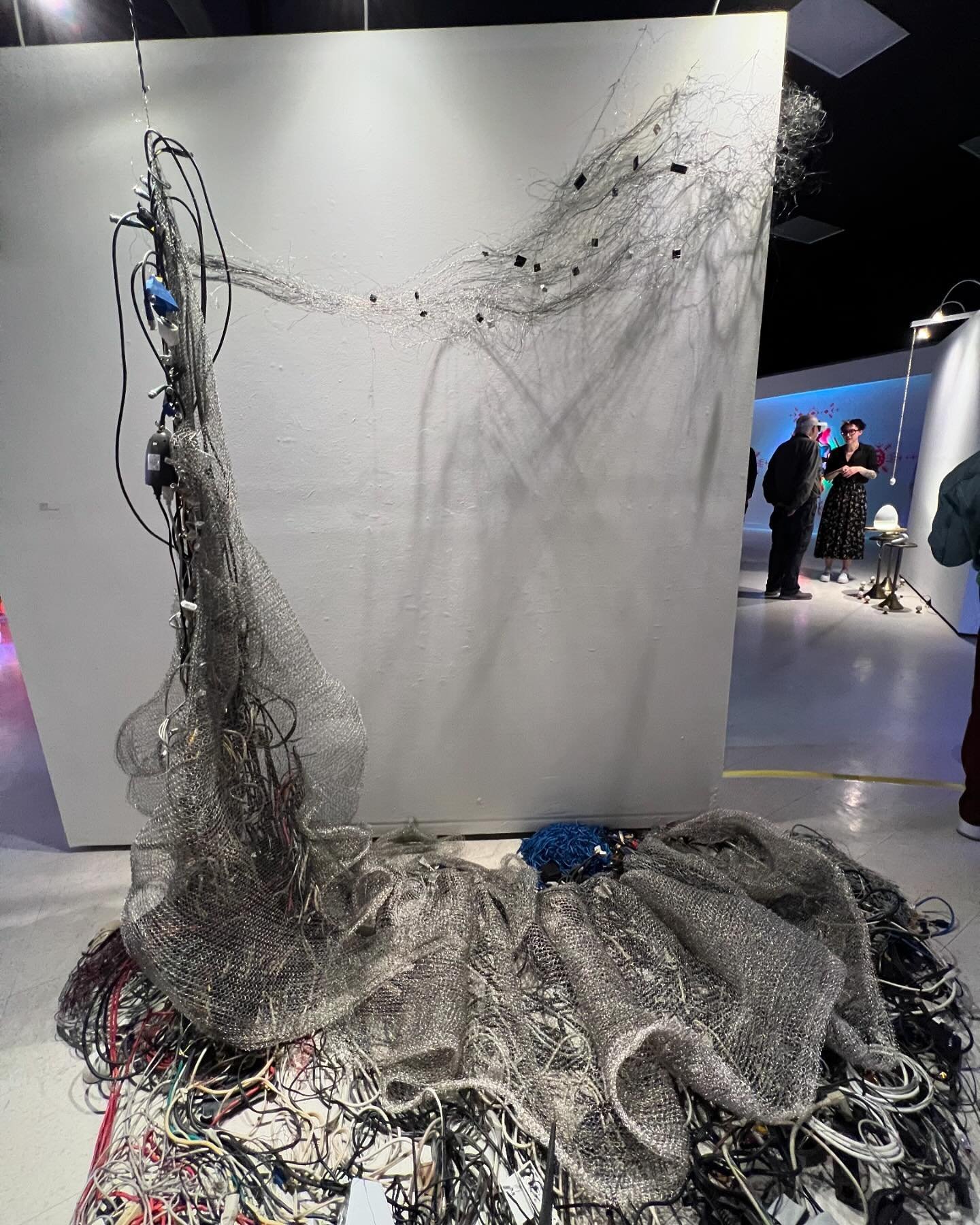
It’s a carnival of art, and a circus of ideas.  Some works are sculptural, as are Chenhung Chen’s flowering burst of wire and cable and found objects, “Currents.”

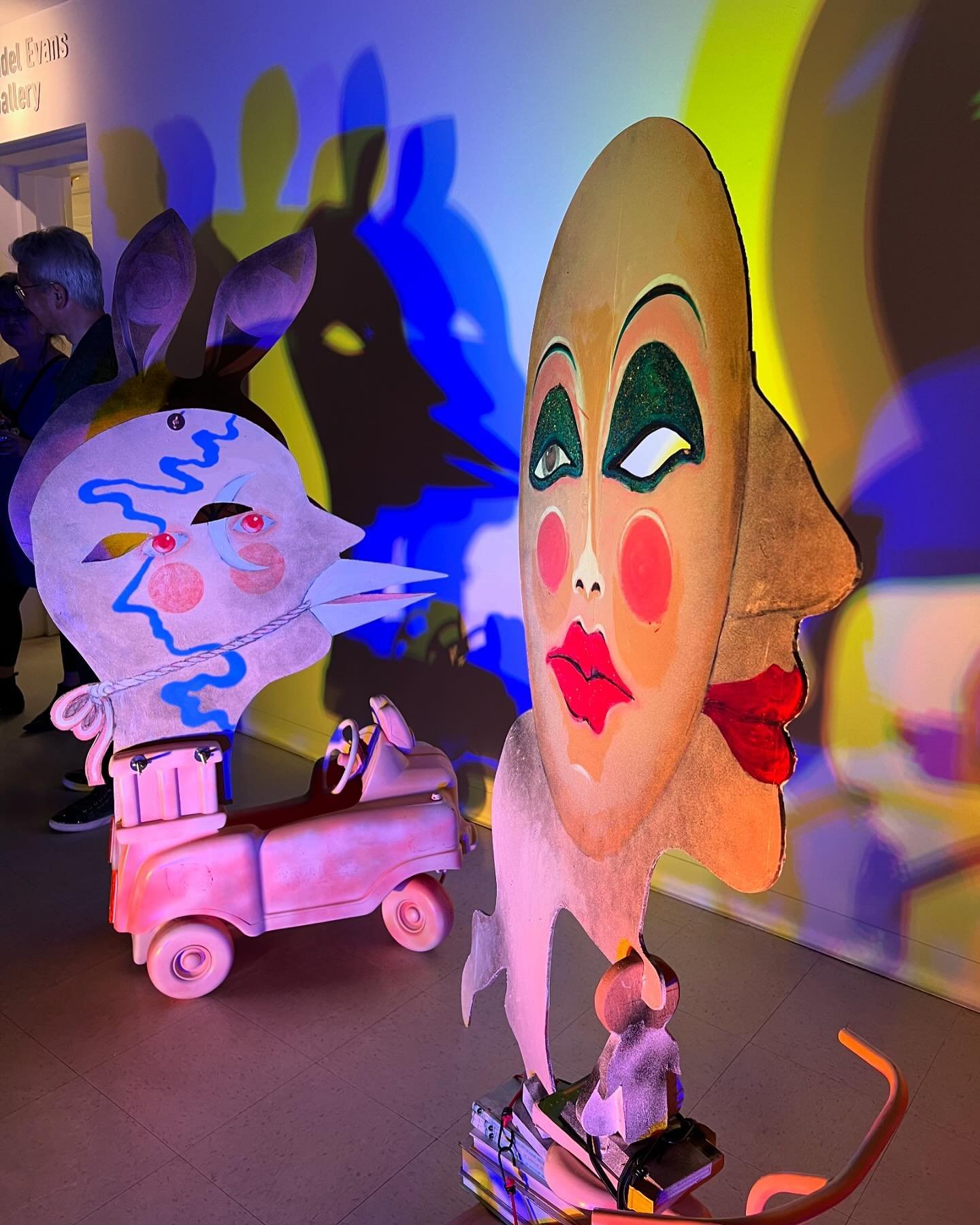
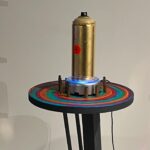
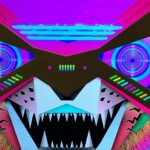
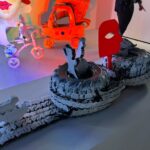
Some are sculptural forms that move, changing in multi-colored lights, mixing a traditional toy that evokes a carnival kiddie ride with fantastical portraiture, as does Vojislav Radovanovic’s take on car culture, “Phantom Traffic I (The Collectors), Phantom Traffic II (Library Girl), and Phantom Traffic III (West Coast Vibes).”

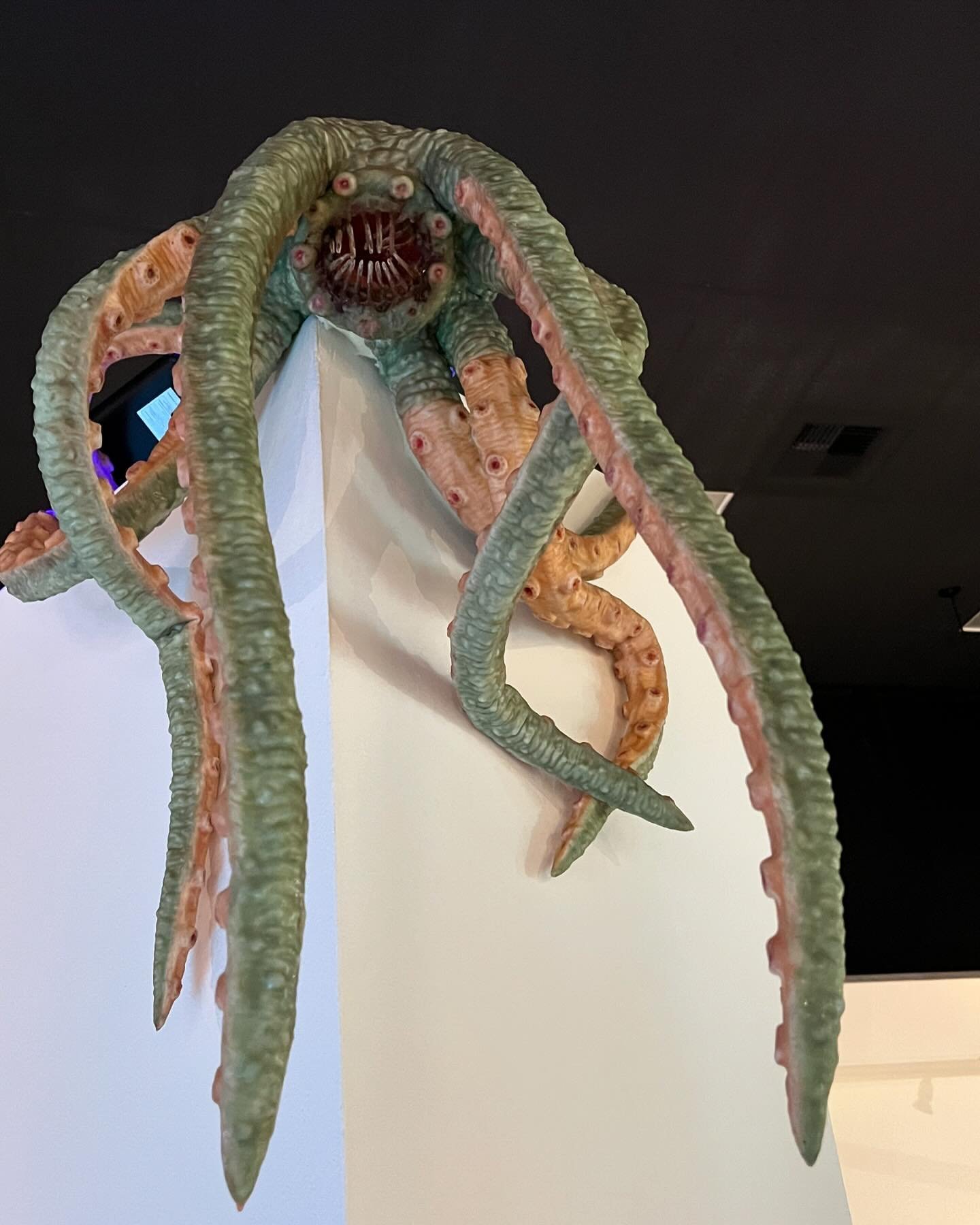
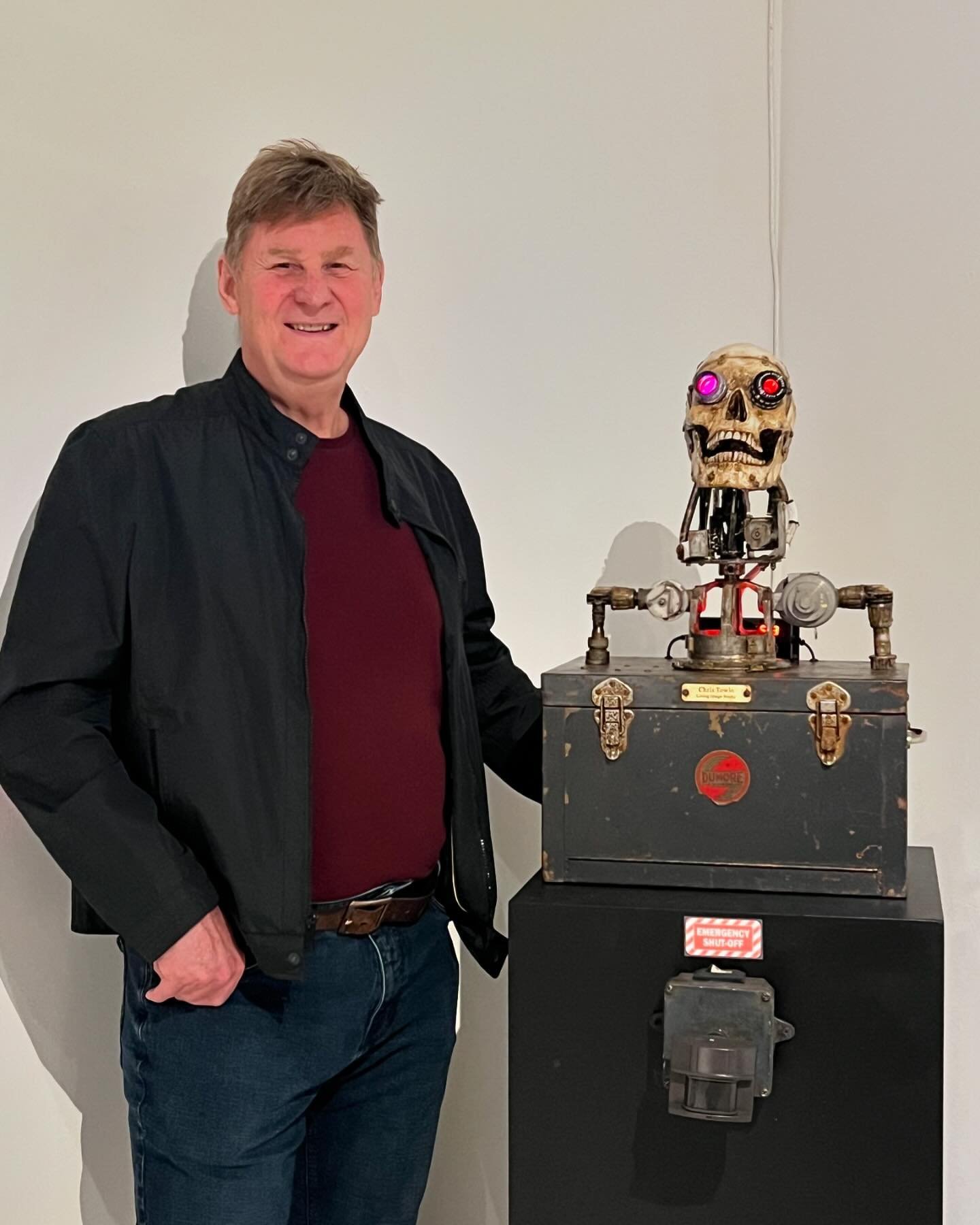
There are steampunk extravaganzas that twist and turn from Chris Towle, whose five elaborate and engaging works here include a silicone film prop, “Kraken,” and a crazy cool clockwork-type piece, “Teatime Movement.”

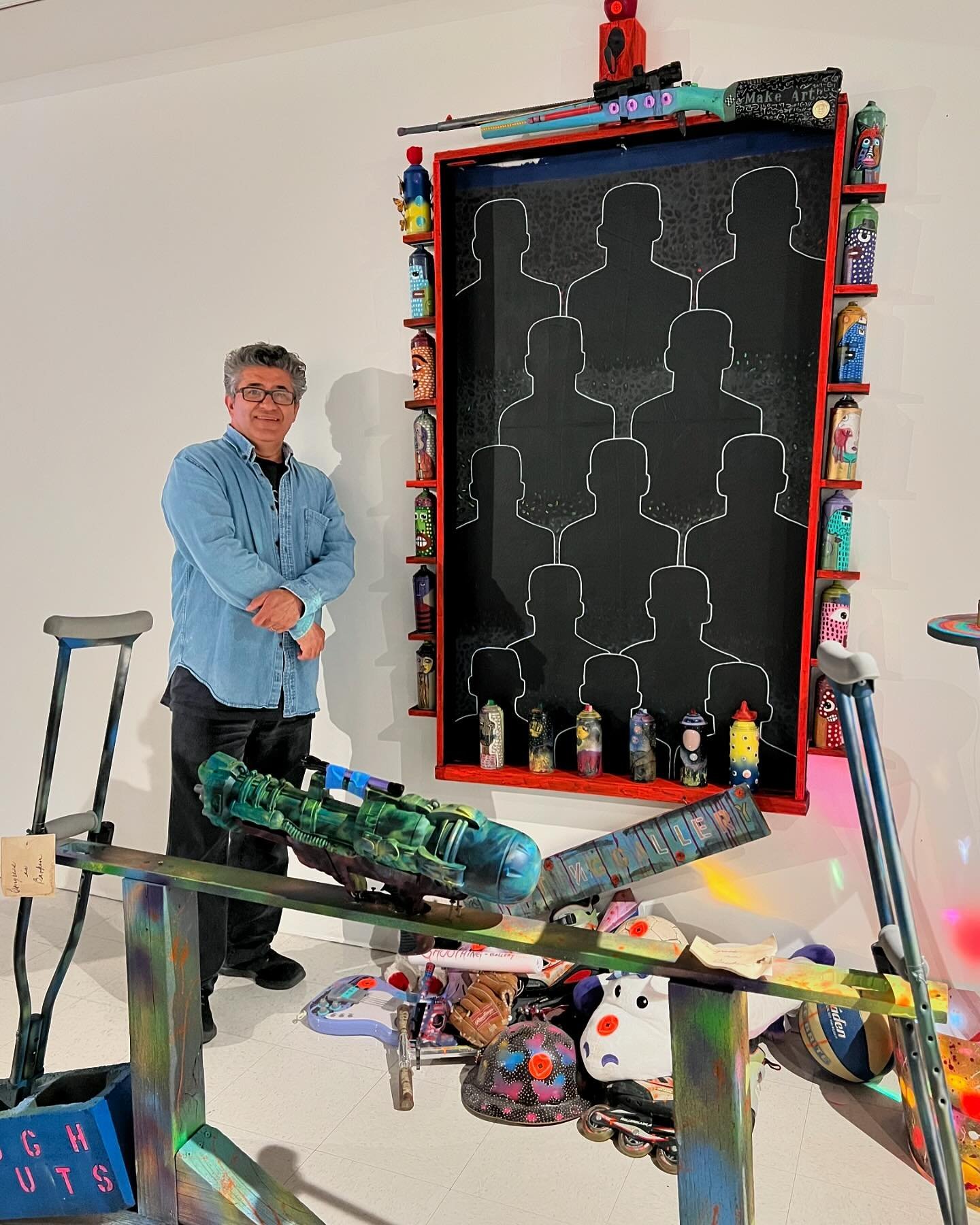
Edwin Vasquez offers an interactive, mixed media “Shooting Range” that also serves as a trenchant commentary on American gun fetishism.

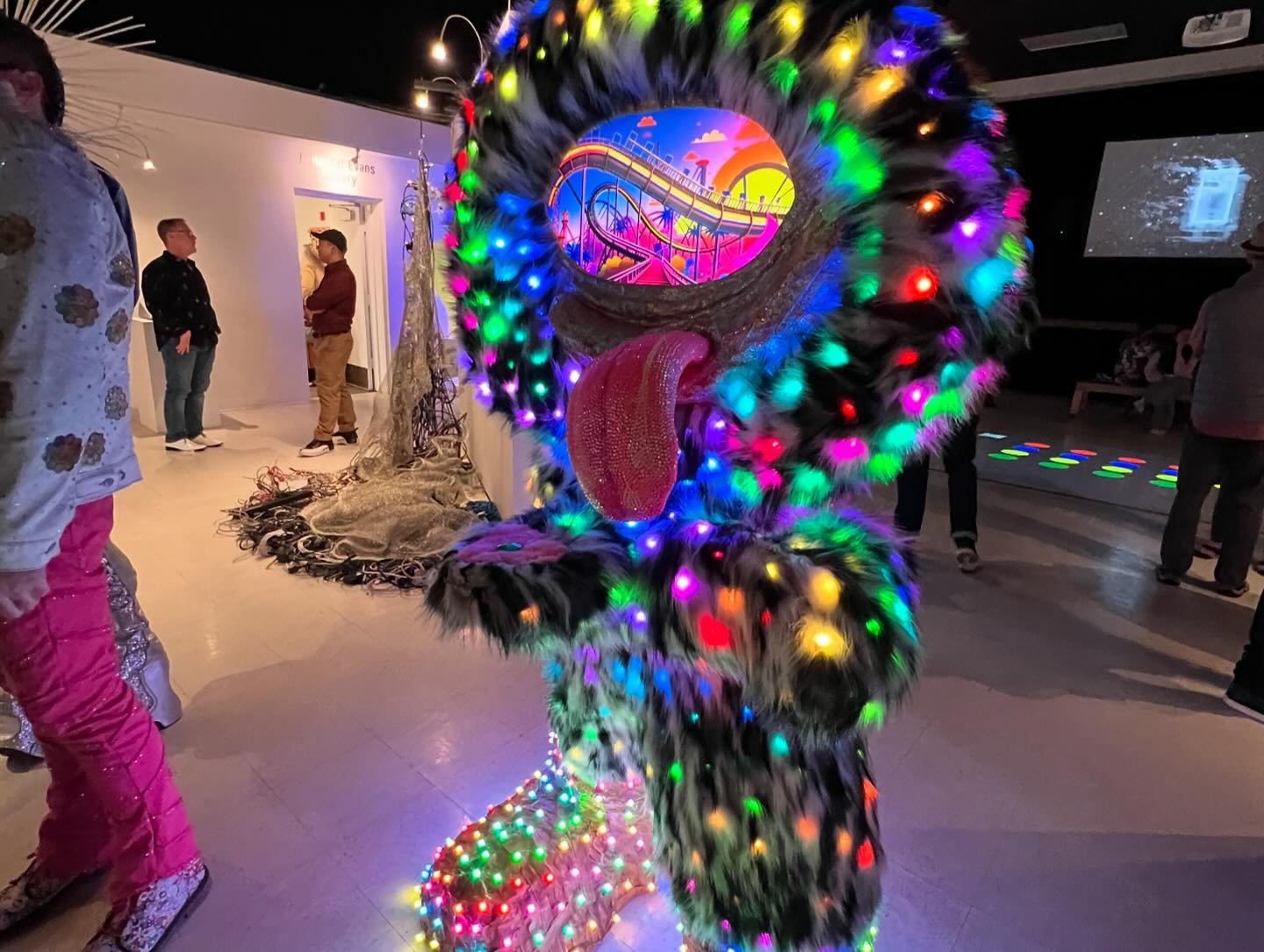
Gregory Frye’s dazzling fiber optics and mixed media work, a freestanding fortune-telling creature called “Frank Fortune” seems ready to walk out of the gallery, even as it dazzles the eye and the spirit.

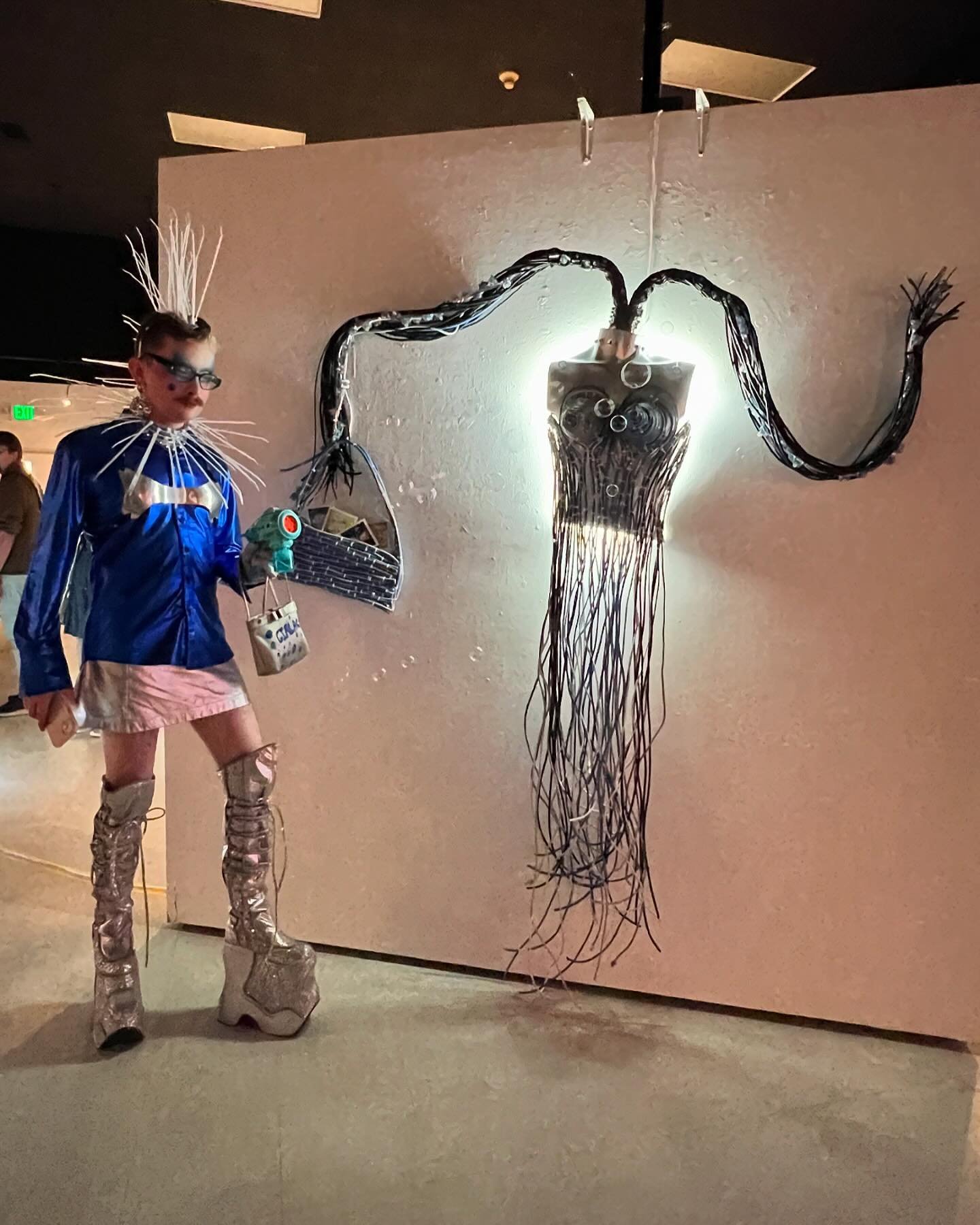
Girlacne’s “Body Électrique” wall art is a sinuous mix of LED, wire, and zip ties that undulates with light and shadow.

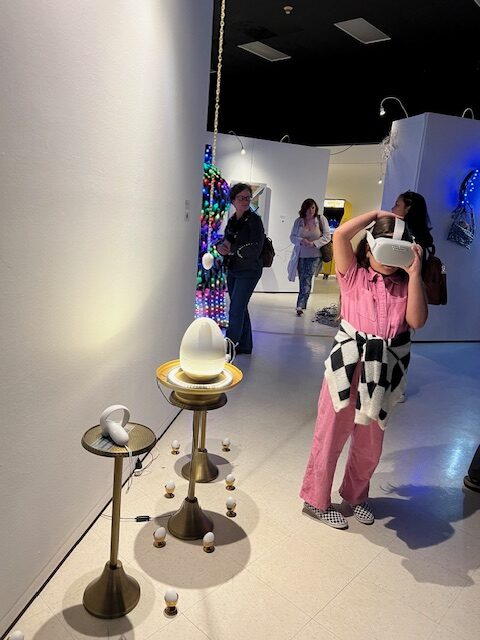
Ibuki Kuramochi’s ” Eggscapes” gives viewers a mystical VR metaverse to plunge inside – and then rehatch from within.

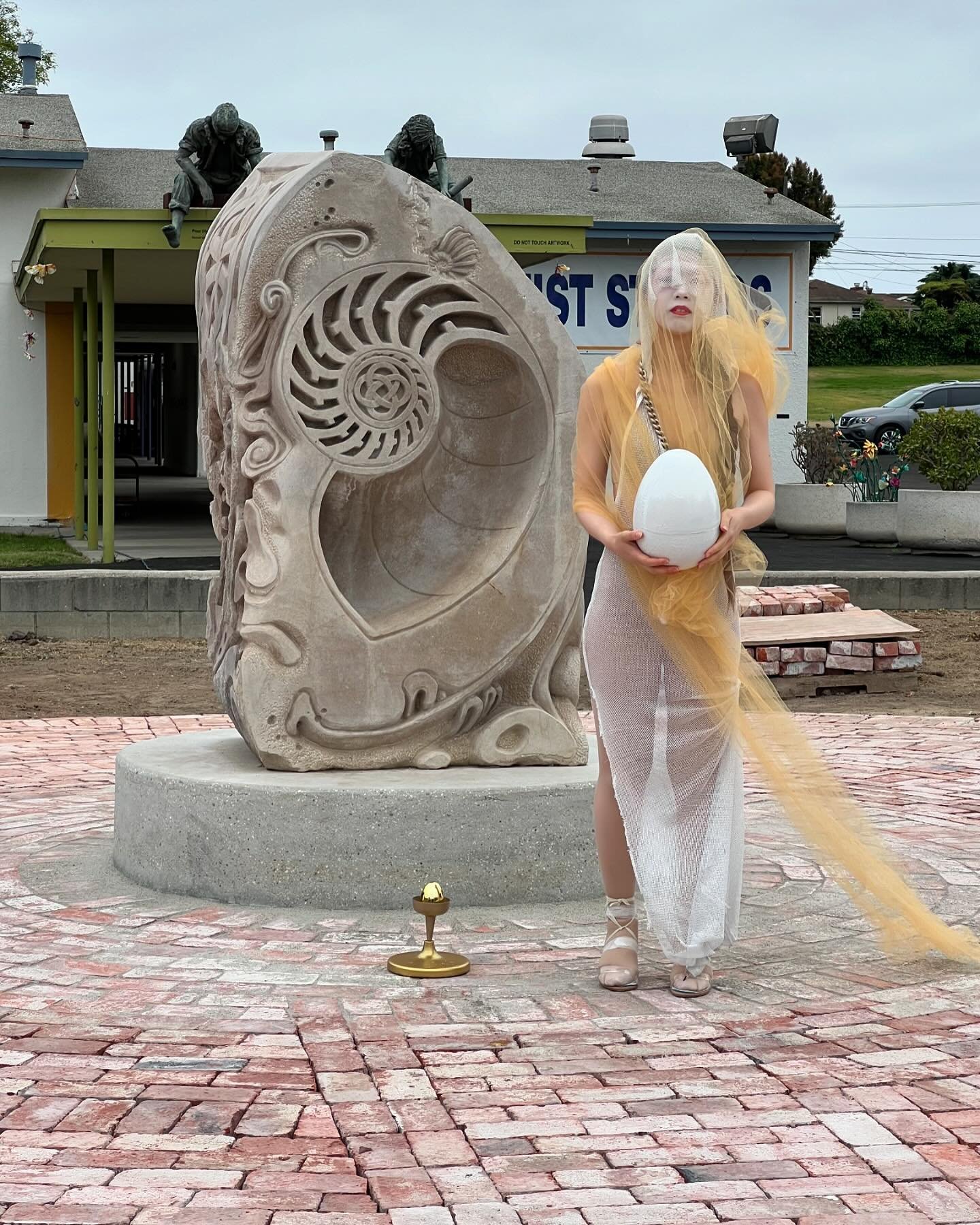
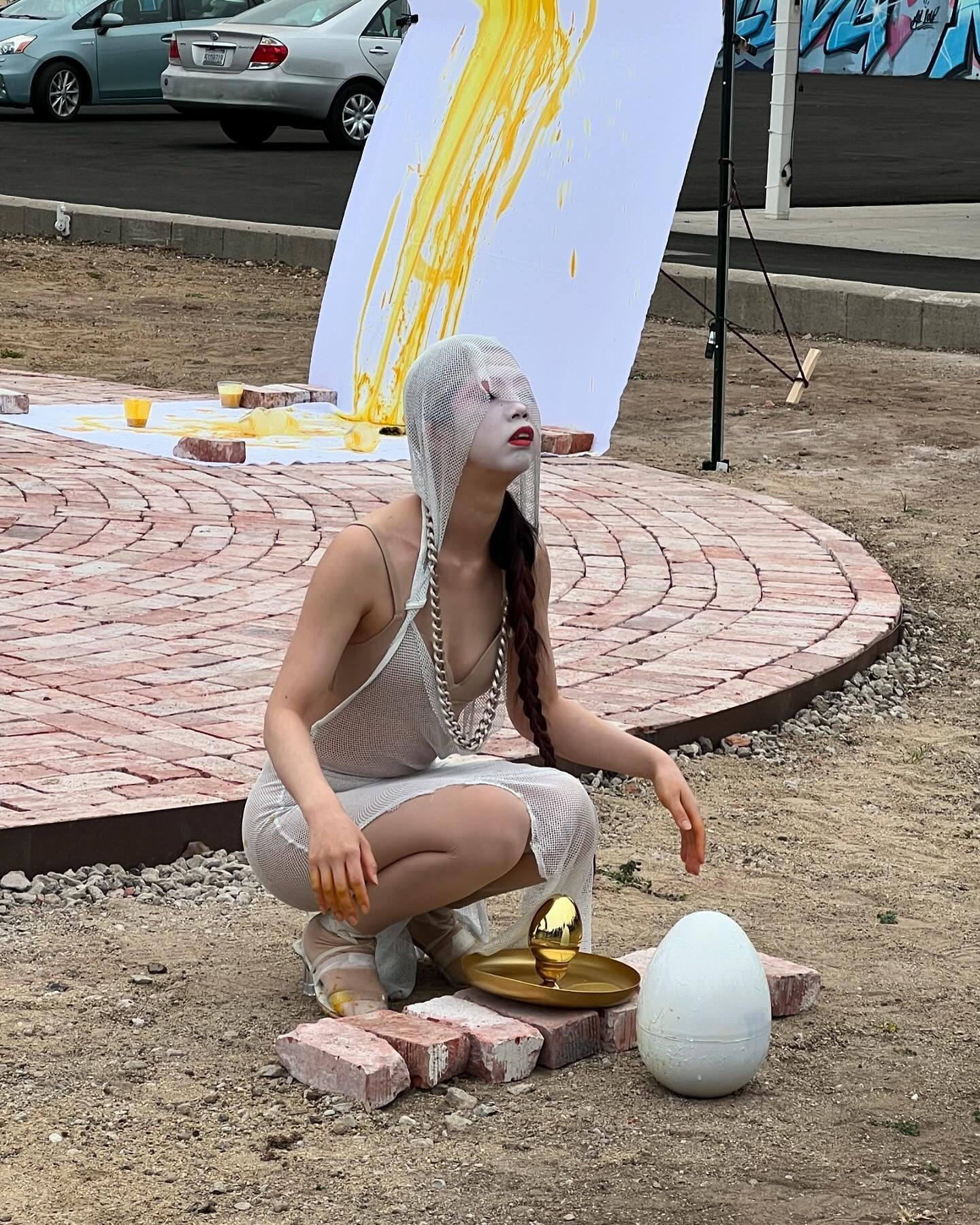
At the June 1st opening, we were also able to view a stunning performance art and dance from Kuramochi, performed outdoors to a rapt audience.

Her sense of visual poetry embodied themes of birth, rebirth, loss, and revival, all relevant to the exhibition itself.


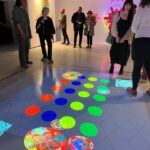
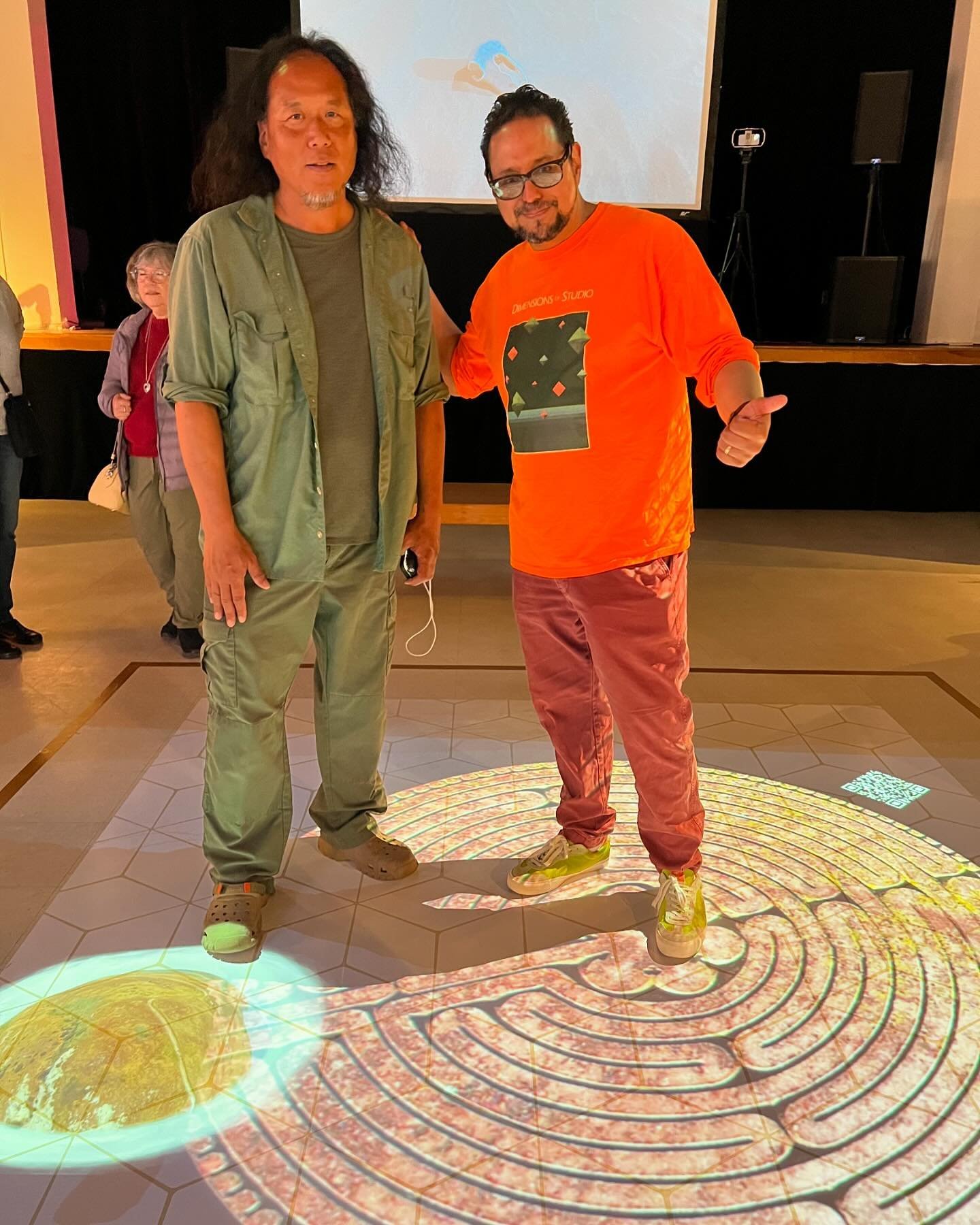
Presenting a terrific, riveting series of altnerating images, Ismael de Anda III & Eugene Ahn use video projection, AR, and a vinyl dance floor to spin their “Dancing Wu-Li Masters.”

Jason Jenn’s lush, fecund “Ye Ol’ Factory Station (Homage to Sir Joseph Paxton),” includes elements scented with essential oils that conjur up forests and fantasies.

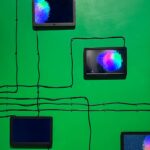
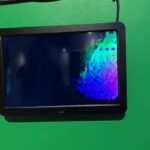
Karen Hochman Brown’s “Circuitry” offers a geometric display of digital frames and cords that resemble luminous eyes.

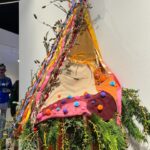
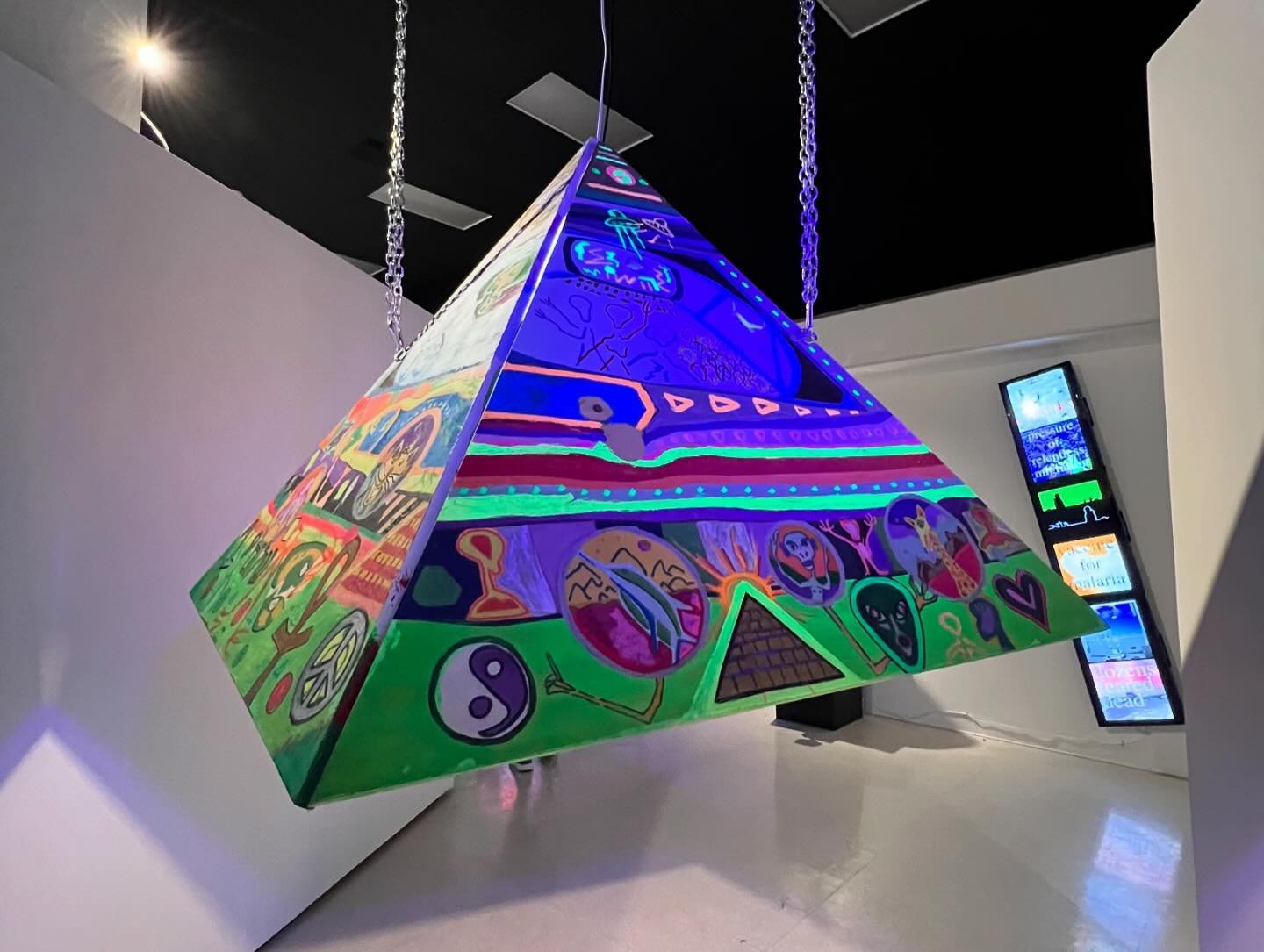
SKY Palkowitz’ “ALIEN ARCADE UFP Unidentified Flying Pyramid – Classified: Pleiades Starship 444 – Codename: Elohim,” invites viewers to stand beneath this mysterious shape, and view its black-lit and transportive interior.

There are mysterious and magical video works from Leslie Foster, and the vivid palette of Jeff Frost…

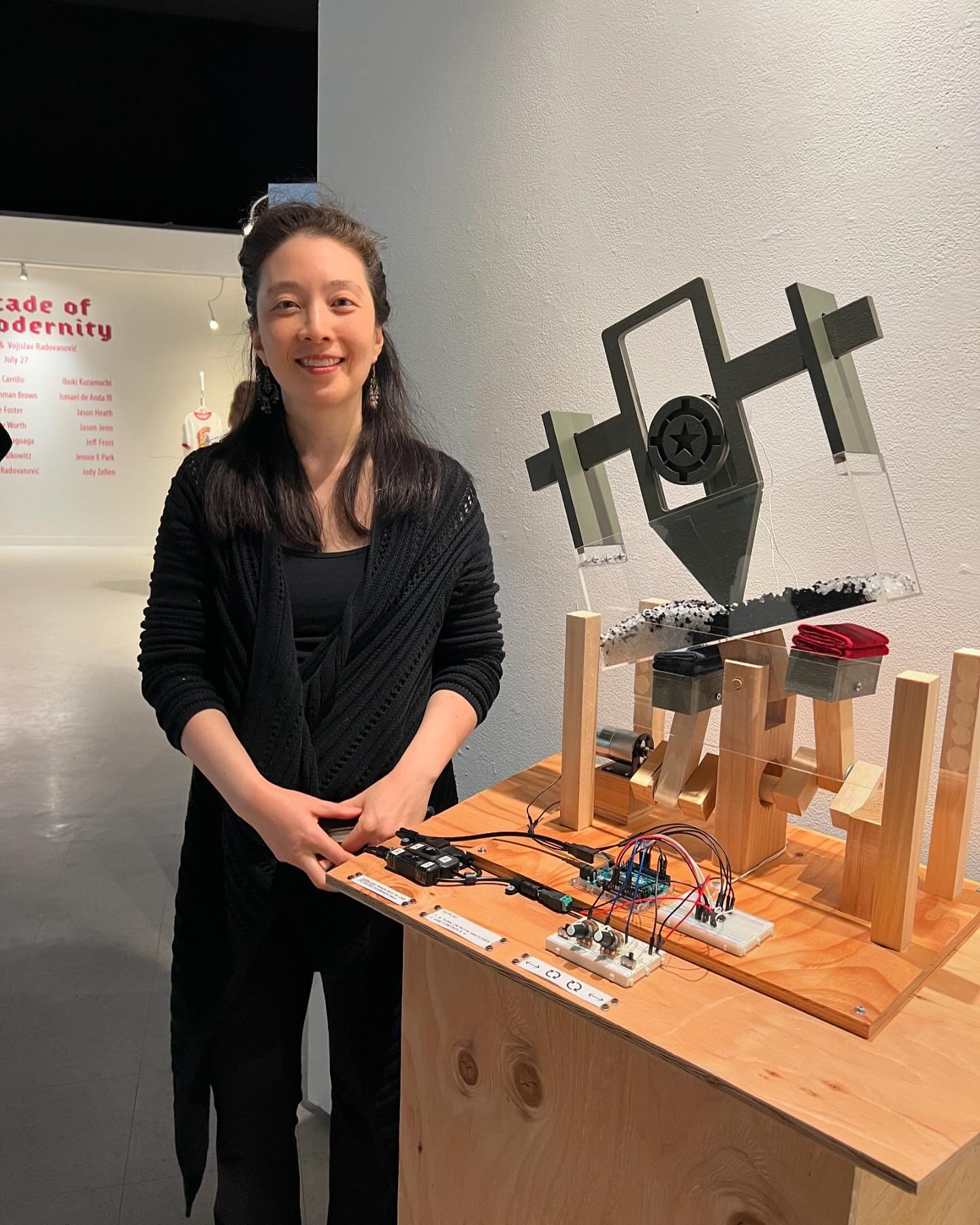
…a motion-activated low-tech piece from Jennie E. Park…

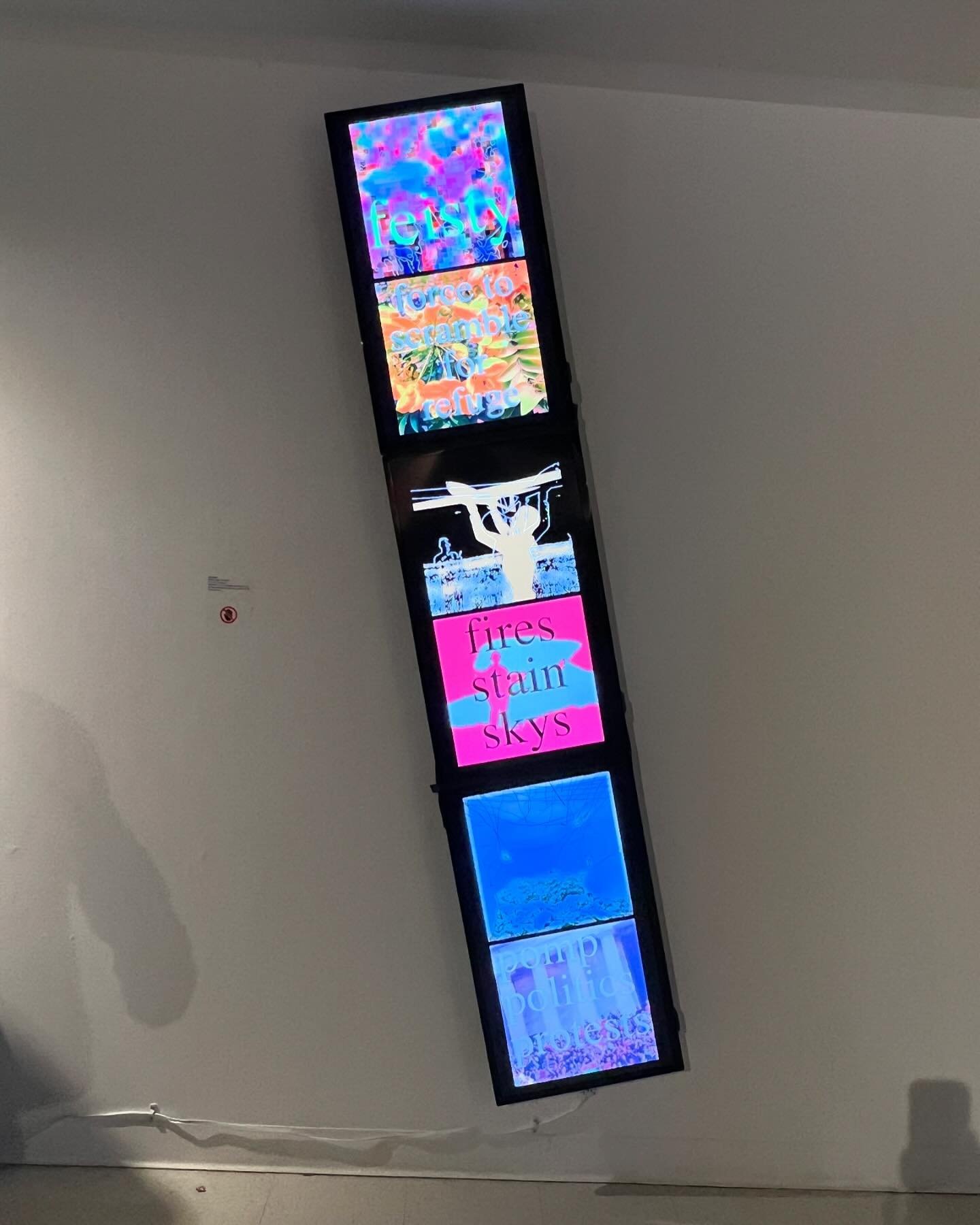
a thought-provoking digital “film strip” from Jodi Zellen.

Viewers also get to explore Joseph Carrillo’s musically driven “The Arcade Fantasy,” as well as Mathew Pagoaga’s exciting video game-centered, multiple installation “Trust.”

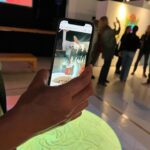
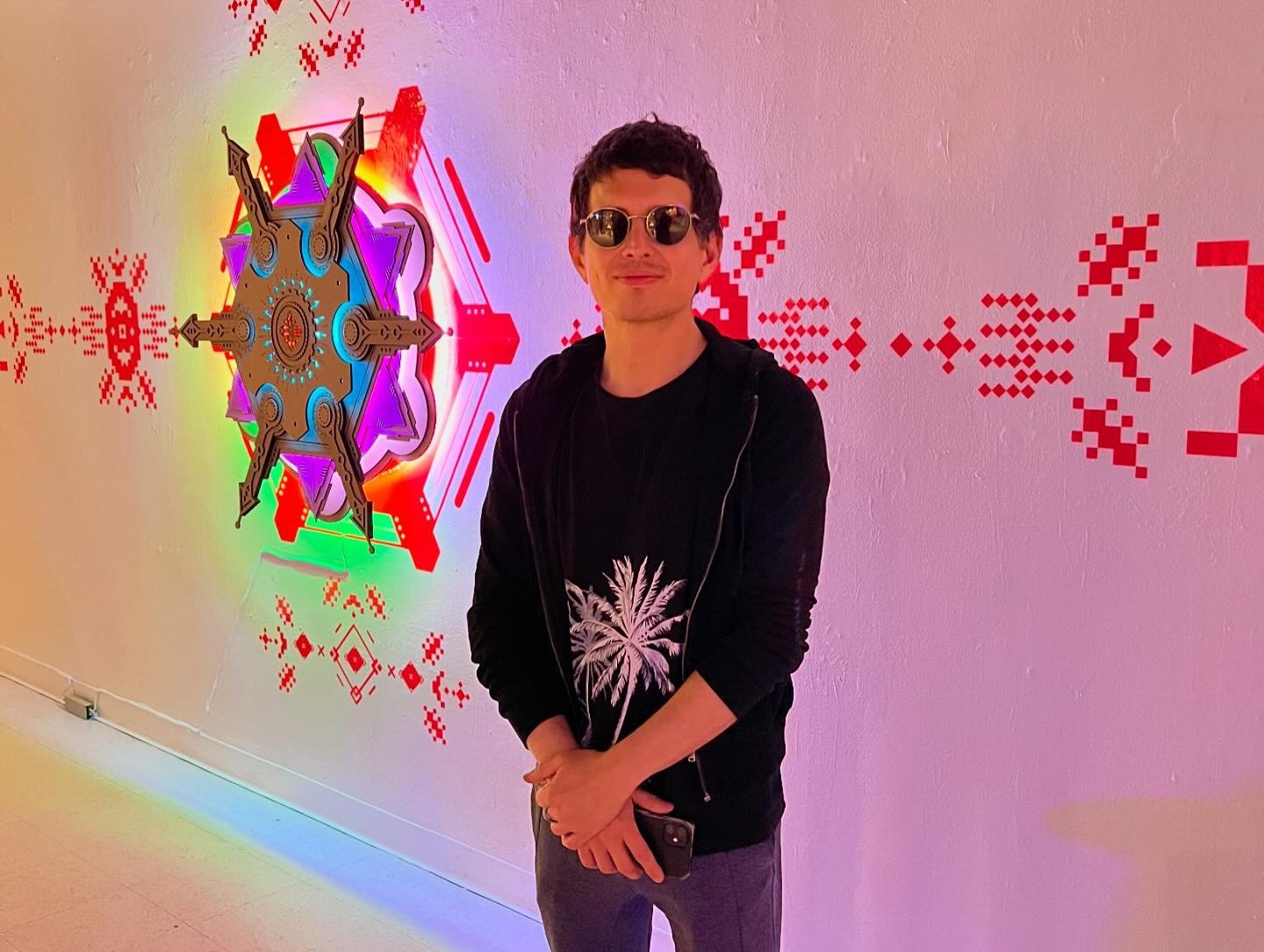
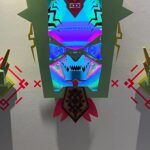
Carlos Luna James superb and transformative “OPTIMUS” AR activation,  one of two dynamite pieces the artist has here, is an innovative mind-blower. Take a look below:

And these are by no means every piece on display. Each work and each artist offers something quite wonderful, strange, special, and unique – you will not see these works elsewhere. If you saw the DTLA-recreation of Luna Luna Amusement Park, originally created in Germany by seminal artists of that time,  you could easily imagine The Arcade of Hypermodernity as such a revered classic of the future. It’s spectacular, and just a whole lot of fun.

While this exhibition pays tribute to the idea and reality of arcades and midways, it also serves as an homage to this quintessential moment in time, one in which our creativity, our humanity, our playfulness, are all on the verge of great change. There is the expansive possibility of technology, and conversely the dulling of our capacity for connectivity and intimacy through its remoteness.  Can we embrace great change without it forever changing us? How much have we changed already, and become hybrids of the human and the inhuman as the price of simply staying alive? How can our creativity, the root from which our humanity springs, still define us?

Walk through this arcade and you’ll find hope, happiness, and as many questions as answers. You’ll find the magic that makes art live and the art that makes the magic. Now go wave a wand, or get on the freeway – whatever works for you – and go see this show. “Frank Fortune” is waiting to tell your future.

Studio Channel Islands Art Center is located at 2222 Ventura Blvd, in Camarillo. For hours, schedule of artist’s talks and other activations, as well as directions, click here.  

  • Written by Genie Davis; photos by Genie Davis


Playground of Art – Vojislav Radovanović at Walter Maciel Gallery

Playful, provocative, grand, and just plain fun – that’s Playground at the Abandoned Chapel. This is his first solo exhibition at Walter Maciel Gallery. Serbian born/Southern Californiabased artist Vojislav Radovanović previously exhibited a variety of works at the gallery’s fine Future Patchwork, a group exhibition curated by Annie Seaton last summer.

Before describing the wonders of this Playground, it’s more than worth noting that it is a big departure from the artist’s delicate, spiritual, almost ethereal work in a solo exhibition at Diana Berger Gallery, ORNITHOMANCY, with its almost-holy references to nature, the universe, and the spiritual. In that exhibition, color palette often focused on silver, blue, grey, black, and mirrored or liquid surfaces. But it, too, like this exhibition, featured a mixed media exploration of both human light and darkness.

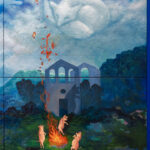
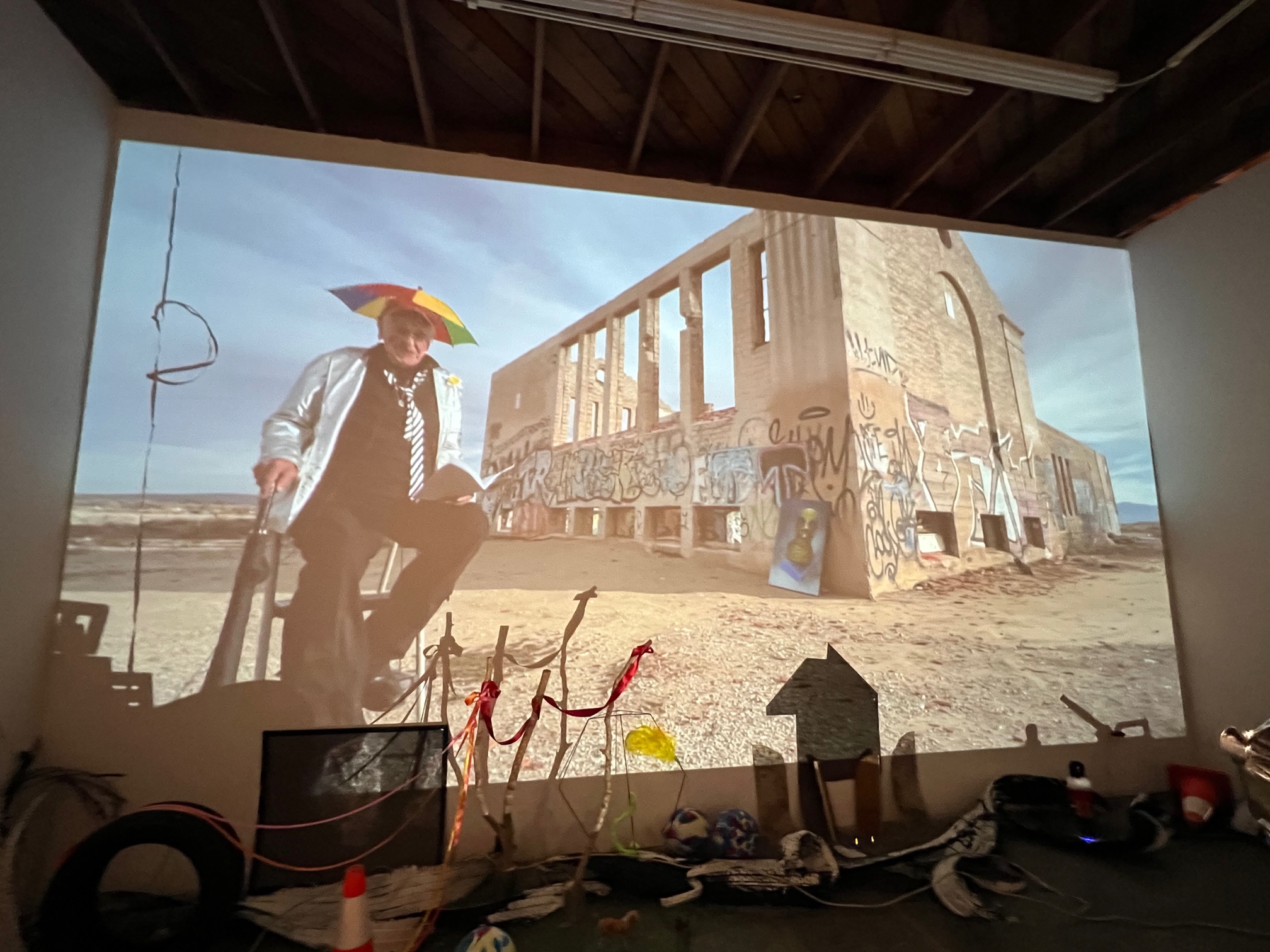
Playground at the Abandonded Chapel offers a wild circus ride of color and desolation combined, one that reflects Radovanovic’s recent year-long desert residency at the Museum of Art & History in Lancaster. His love for both the dusty landscape and broken or abandoned structures — so many dreams come to the desert and fade away – shows in these works. So, too does his fascination with a specific old gym, the remains of a burnt-out school, it’s arches chapel-like, but covered with vivid graffiti, discards, and trash.

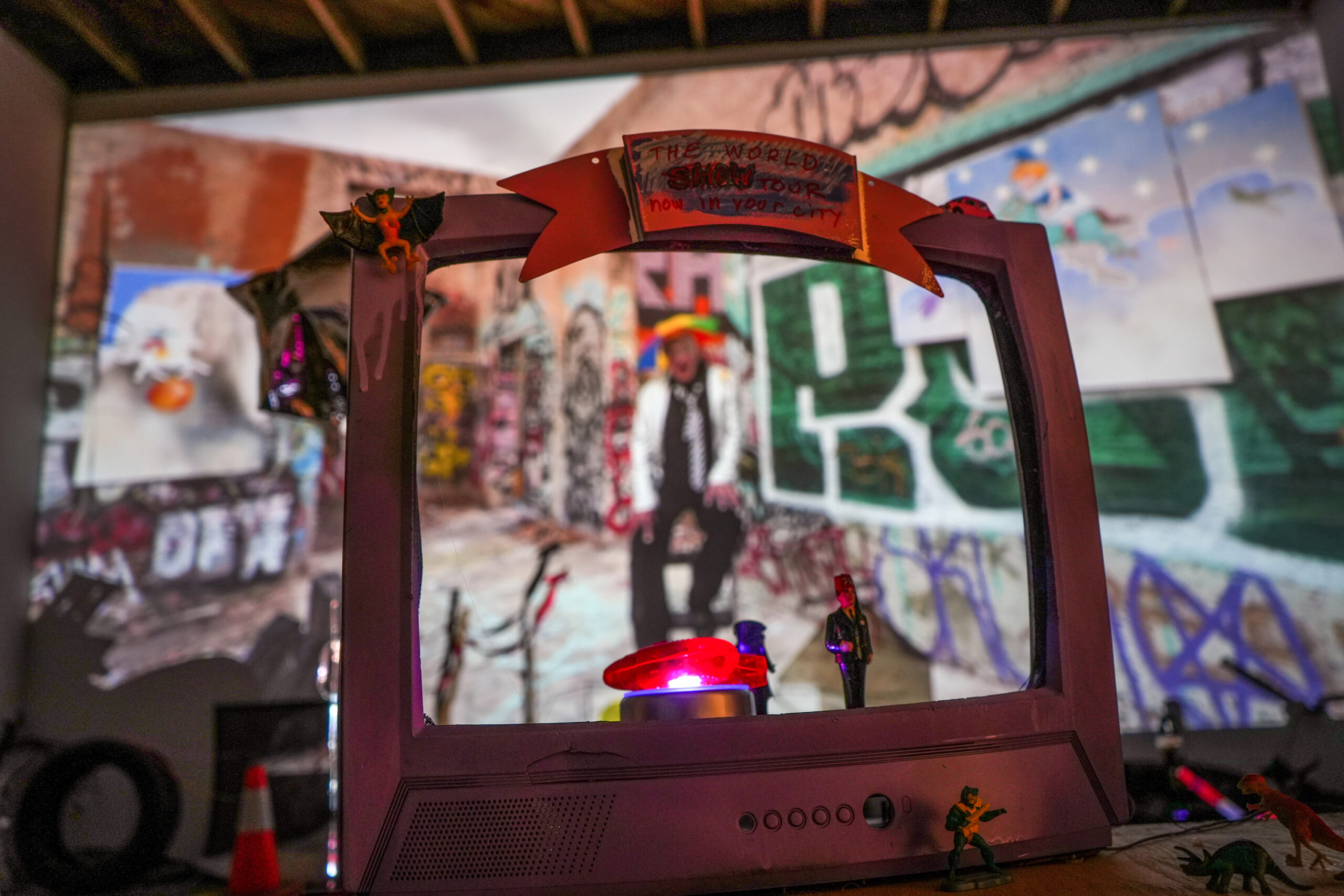
That specific setting is used in a site specific video projected in the back gallery, with scattered toys and discarded objects like computer parts and safety cones strewn on the floor in front of the projection. The viewer is invited to watch both the projection unfold and how its images look when viewed through or around these objects, adding a vibrant textural and sculptural element to the video.

The video itself stars playright and performing poet Robert Patrick, in a tour de force performance singing and reciting his own poems and excerpts from an unpublished play.  Whether viewers start with this experience or conclude their visit to the gallery with a view, it serves as a perfect background to the acrylic paintings in the main room.

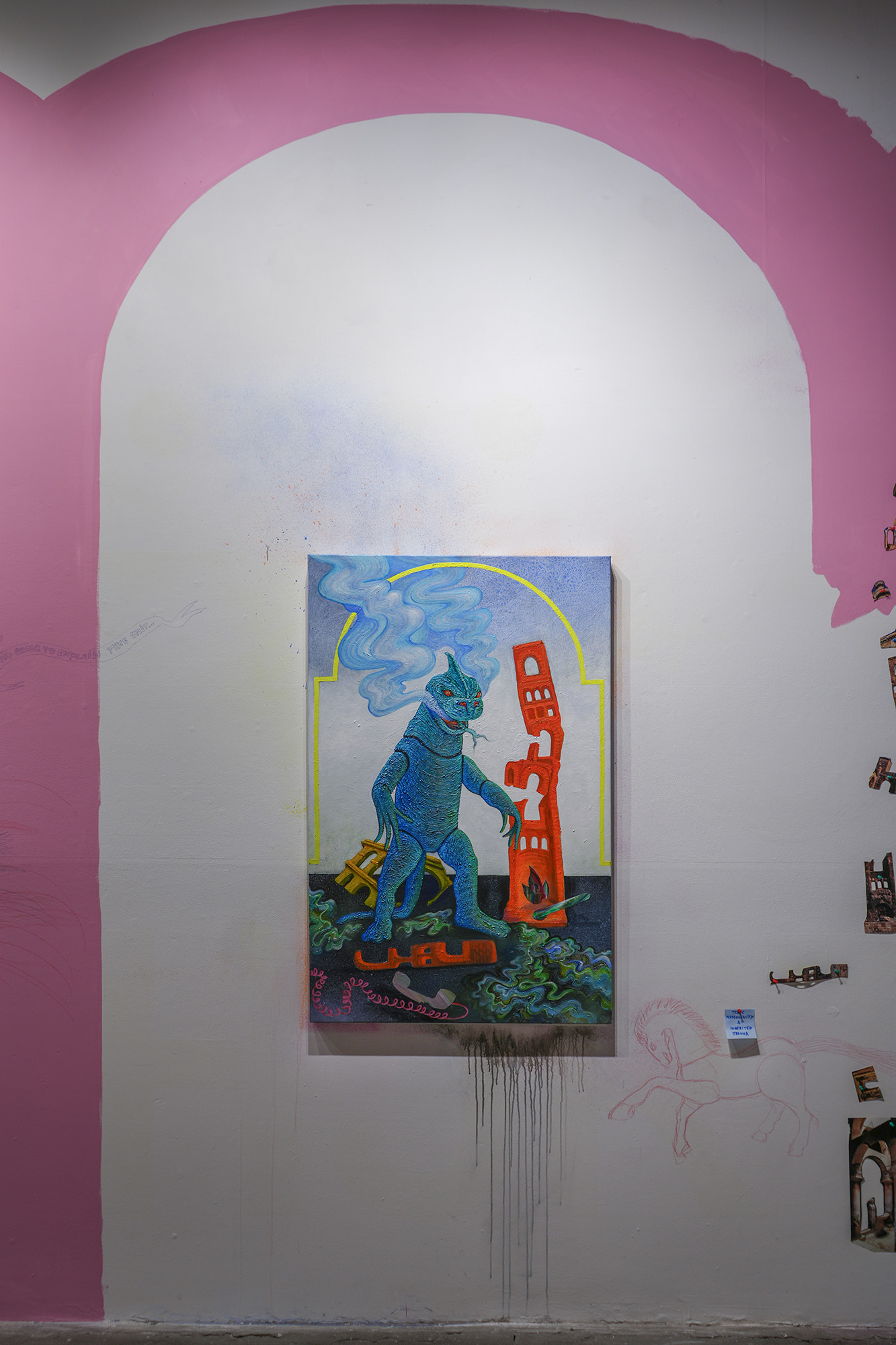
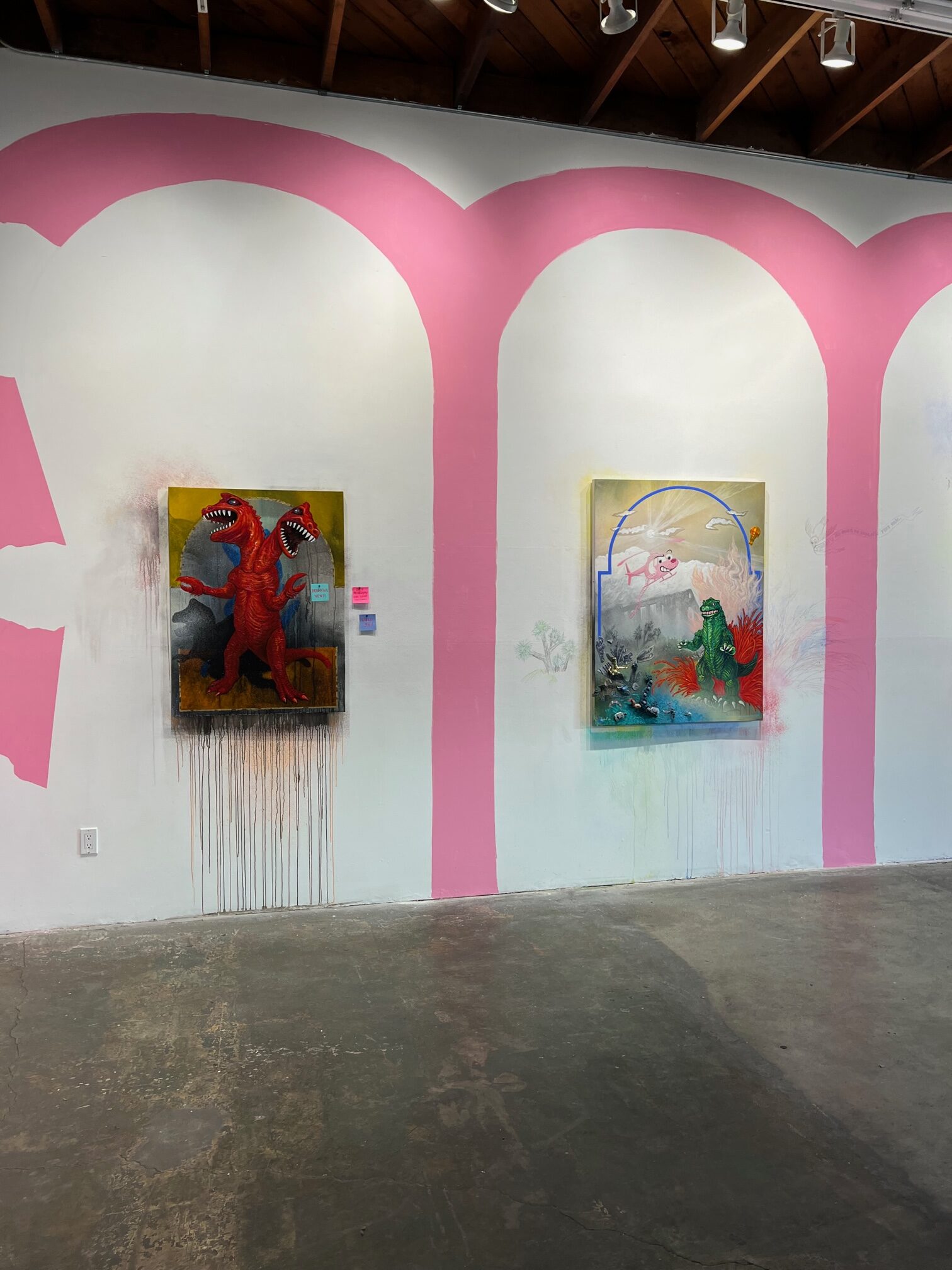
The main gallery also includes site-specific elements, such as the pink arches painted on the gallery’s white walls, reflecting the form of the abandonded gymnasium depicted in the video. The acrylic paintings themselves are fantasy personified, but grounded in themes of redemption, the kind that can only be achieved by reconciling losses and finding new meaning through them. It is a glorious vision, filled with both whimsical elements and darkness.

There are strong references to the war-torn backdrop of his Serbian childhood in the former Yugoslavia, as well as to consumerism, political anger, personal anguish, and the relentless march of history. How do we reconcile the childhood innocence of toys and play with the detritus of war? How do we reshape our own destiny after loss, after childhood innocence is forced to end?

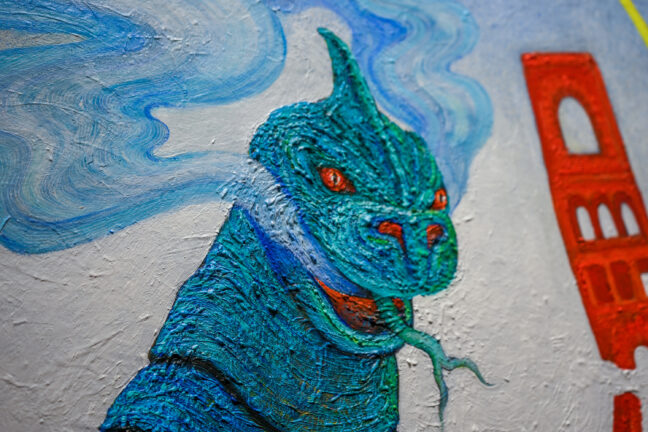
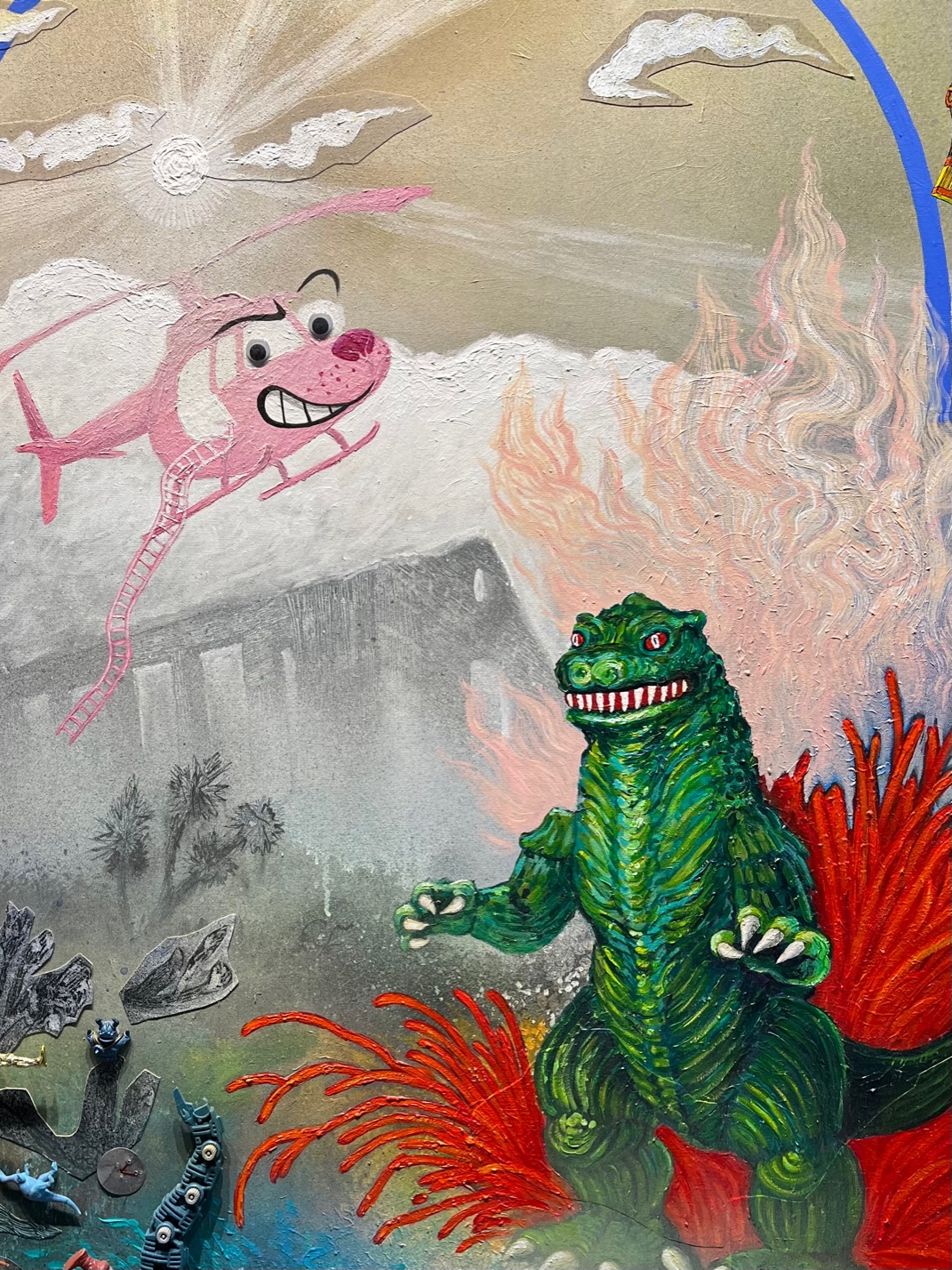
Referencing the often harsh reality of the Southern California landscape – from wildfires to climate change, as well as the rubble of war, and the personification of ourselves, our battles, and our hopes and fears, the visual subject may be toys, but the themes are much deeper. Godzilla,  clear plastic robots, an accordian-playing monkey clown, and more fill canvasses as intricate, ominous and absorbing as any dark fairy story. The brilliant pinks, greens, oranges, and blues belie clouds of smoke and broken buildings.

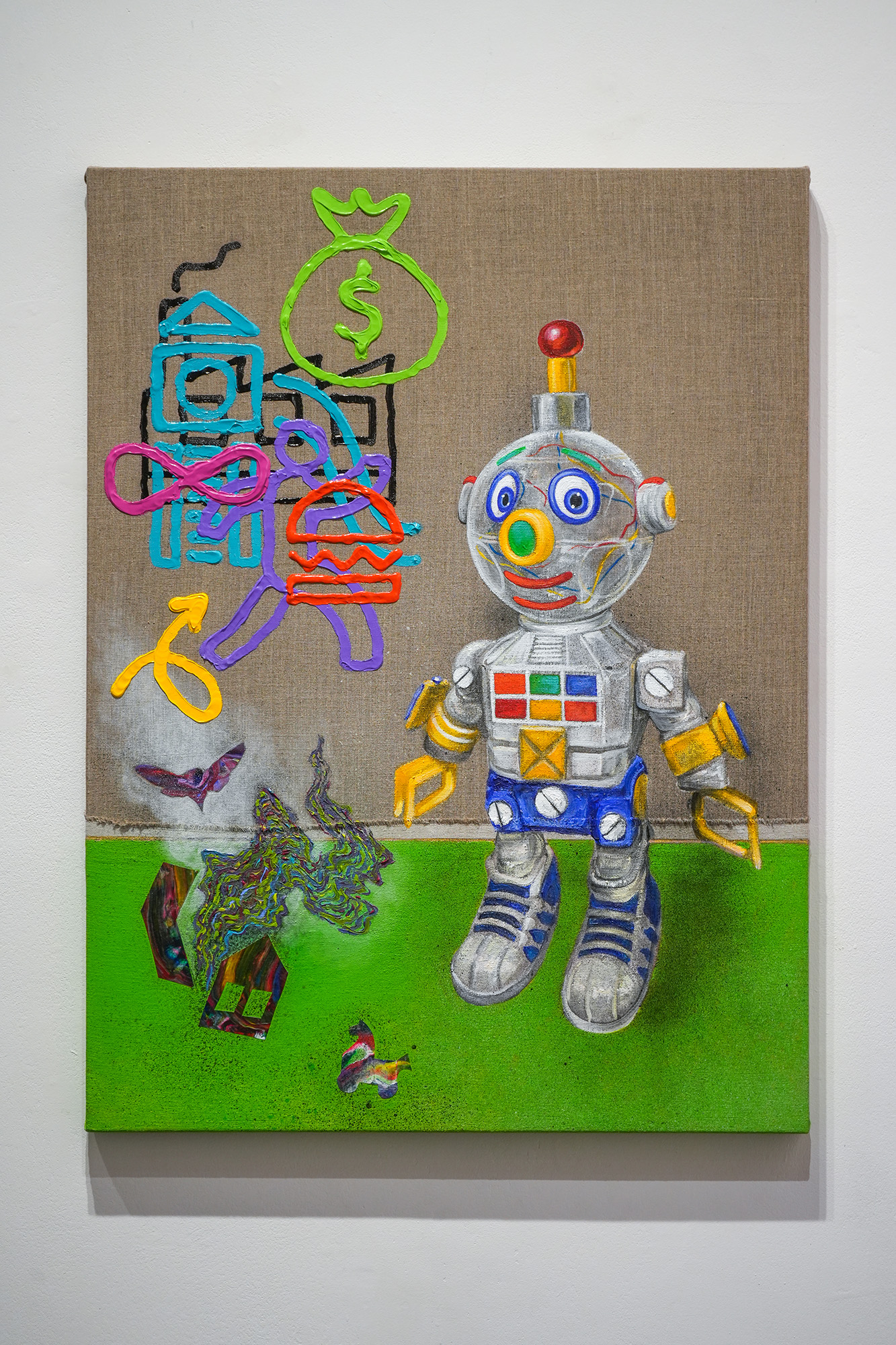
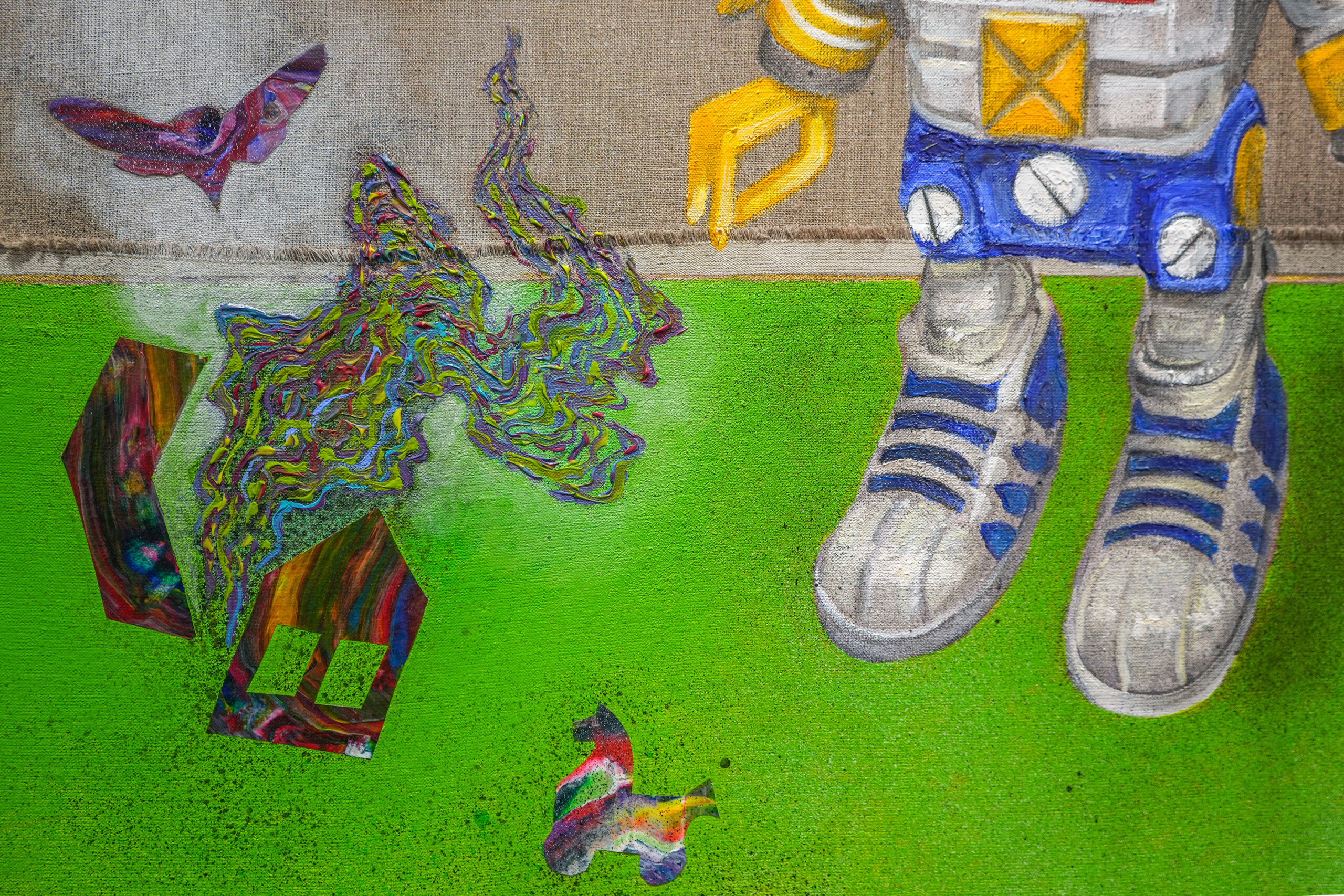
“…and That’s How it Happened,” is a truly wonderful work, in which a grinning clear robot toy looks on at a simply, thickly painted depiction of money going down a housefront that also features a fast-food burger, and a camera. The “end” of this visual story is this: a house broken asunder, a rainbow of dark smoke issuing from it, a bird escaping from it, a small rainbow horse looking on. This disaster may have begun on a child’s playground, but it concluded in real loss and corporate greed.

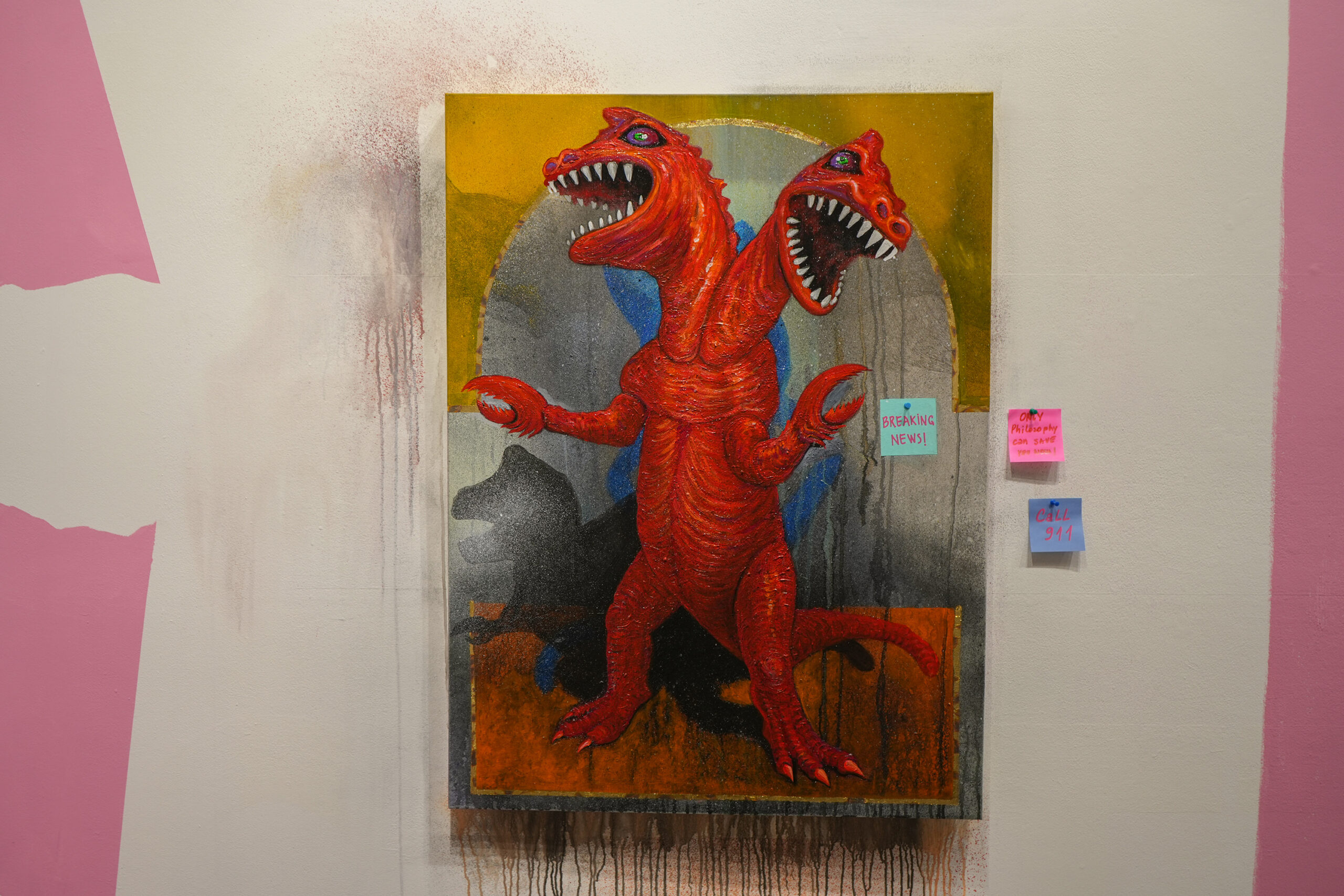
“And now a word from our new spokesperson, Richard, with breaking news” features a two headed red T-Rex monster with a post-it note reading “Breaking News.” Another post-it reads “Only philosophy can save you now.”  It’s funny and horrible and true – likely coming soon to TMZ.

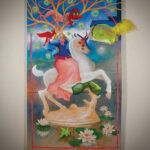
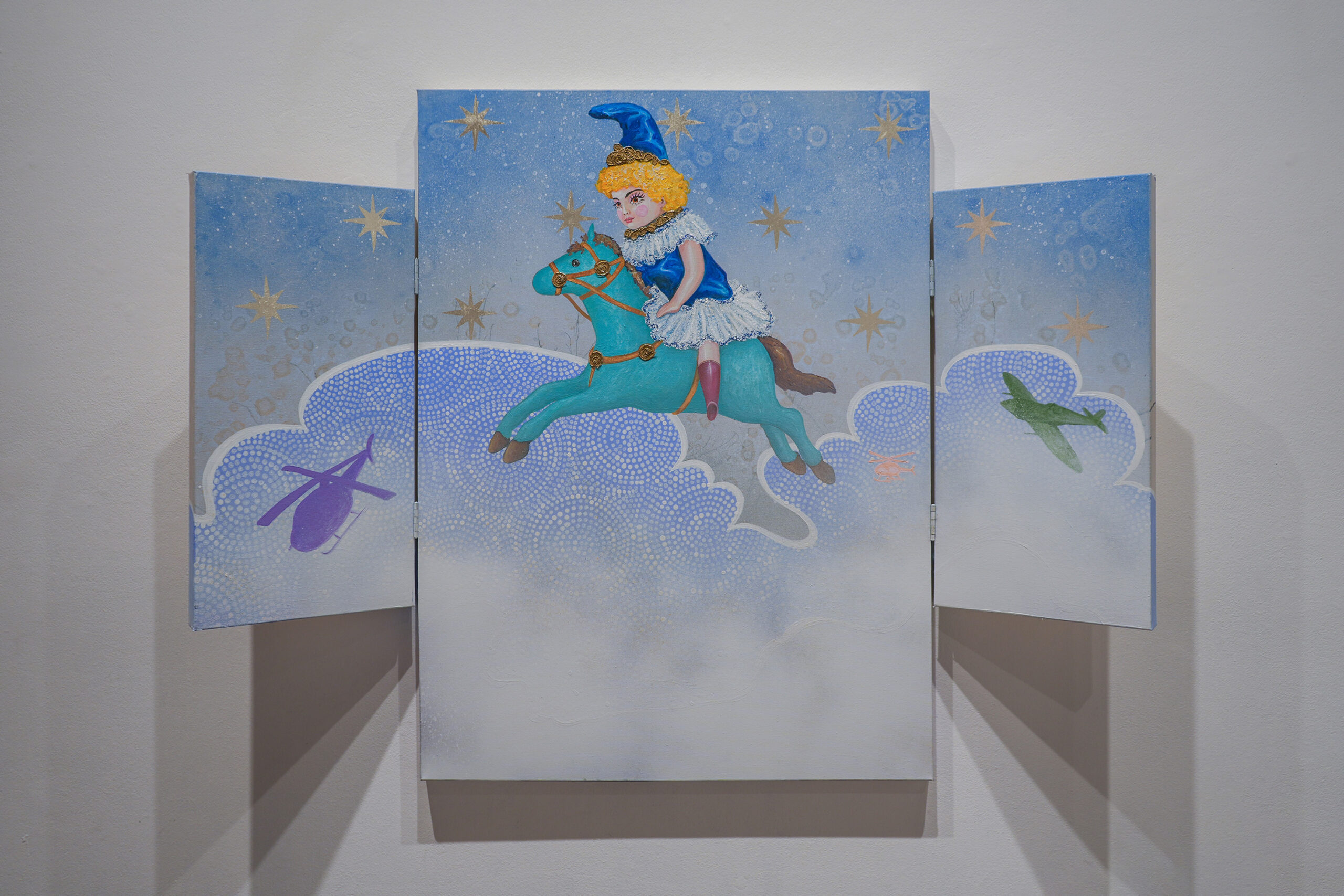
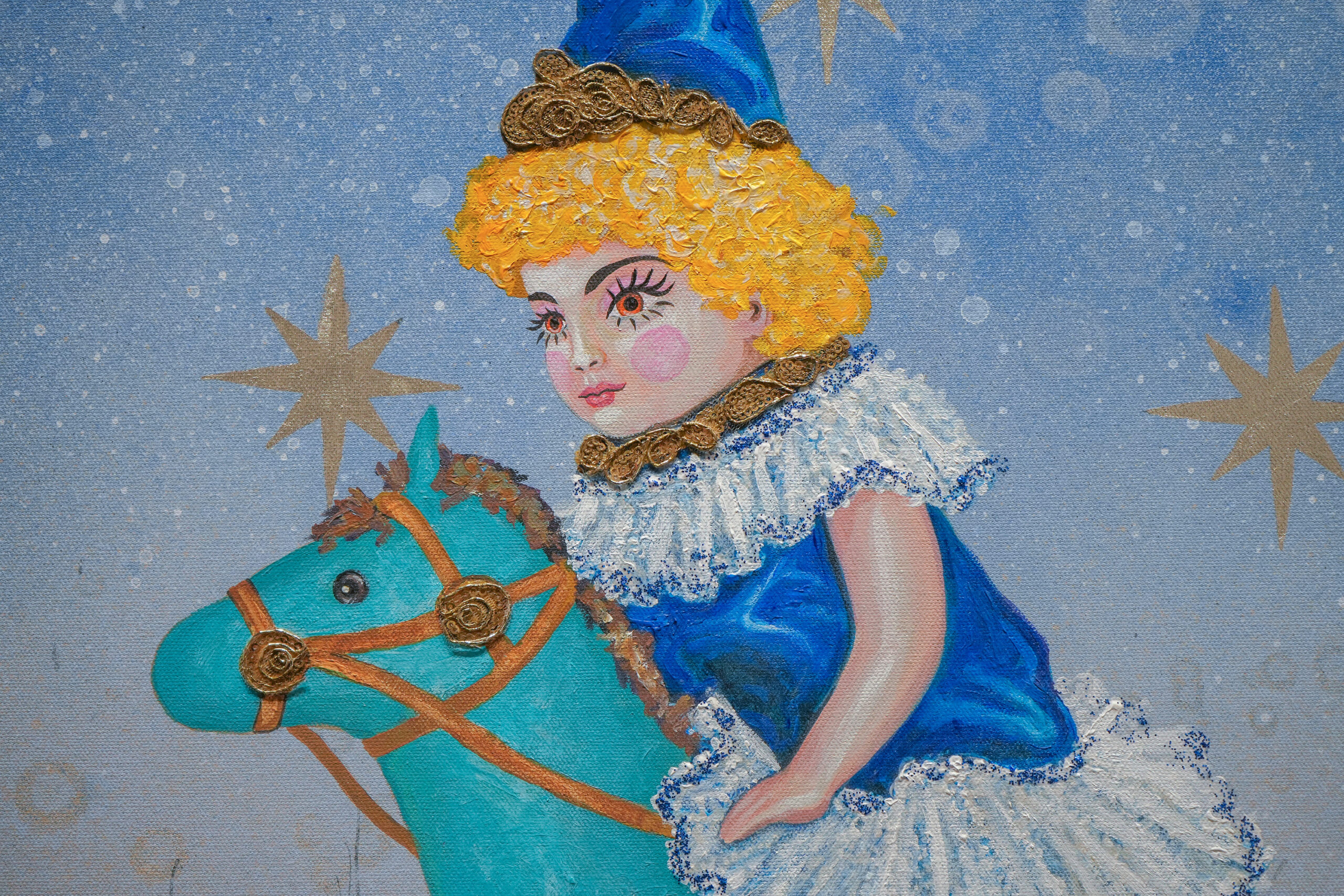
Some of my favorite works are perhaps the softest: in the large-scale triptych “Europa,” a blonde cherub in circus garb rides a blue rocking-horse-like pony through a sky filled with stars.  She is the central figure in the triptych, the two sides of which feature silhouettes of a helicopter and an airplane, both toys and ominous fellow residents of the sky in which she rides.

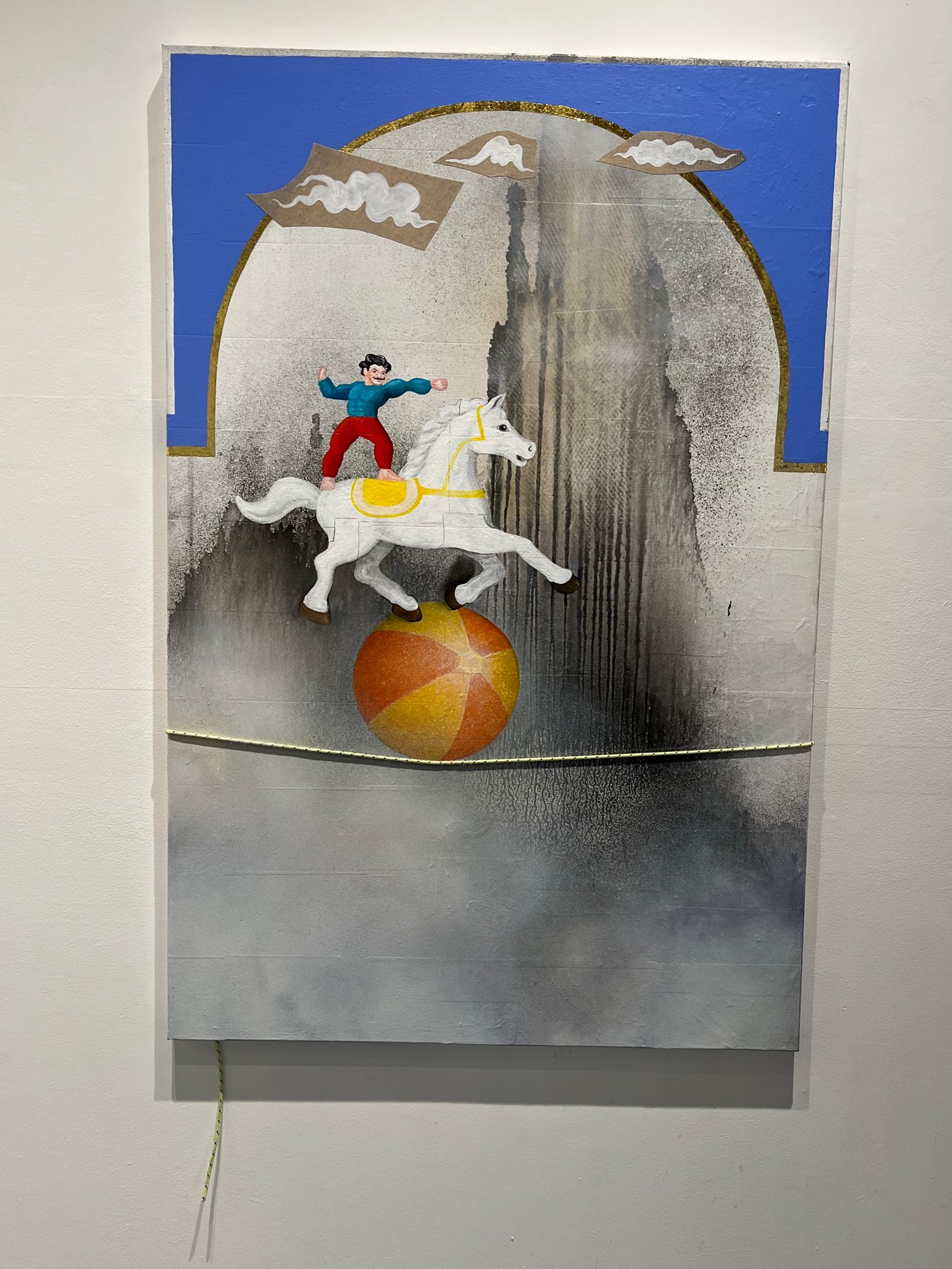
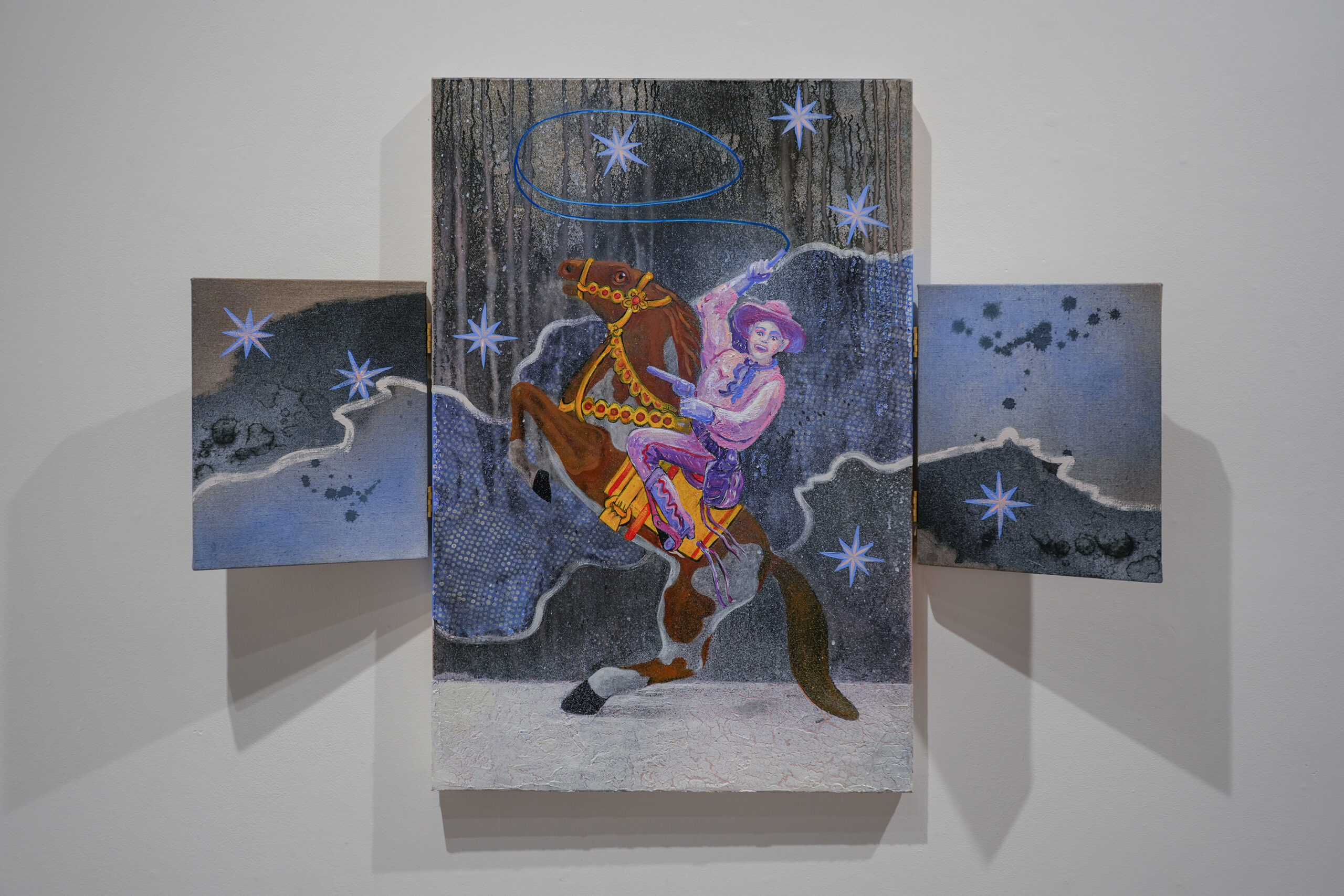
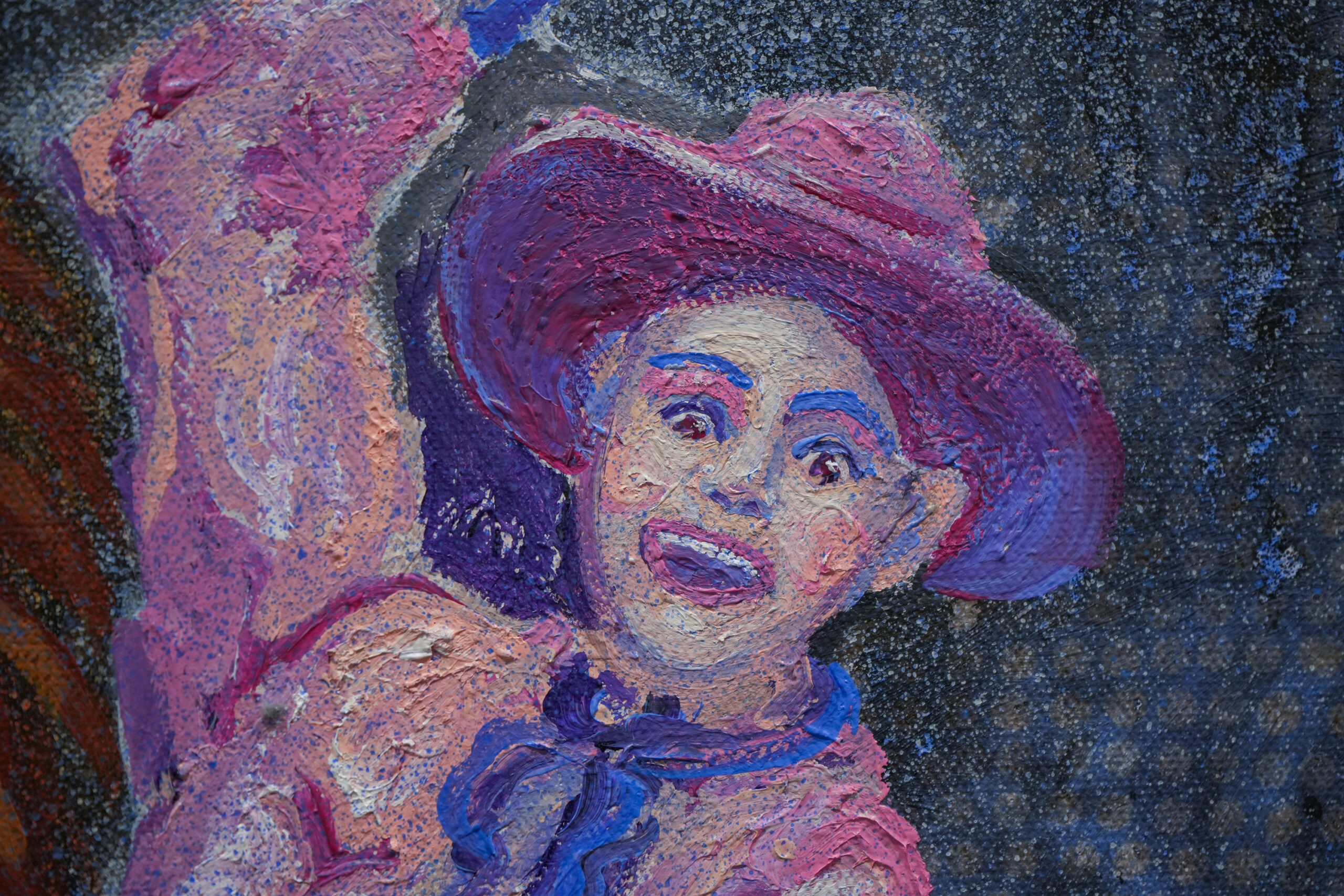
“Everyday Balancing Act” gives us a muscular strong man riding a white horse balanced on a striped ball across a golden wire. Clouds rise in ghostly puffs around a foggy grey mountain backdrop. This may be a very brave man, playfully conquoring a desolate landscape, or it is simply the way we all live, day in and day out, on the precarious edge of getting by.  “Star Wrangler” is just that – a lavendar-clad cowboy lassoing stars, gracious, happy, riding his horse with aplomb. Be the star wrangler.

This is exciting, resonant, fascinating work, an exhibition one can breeze through and simply enjoy for the colors, the toys, the embedded collage elements; or one in which you can consider its implications, the fears for humanity, the hope for the future, the joy and the terror that happens on playgrounds, in war, and in life on this planet, in this city, in its lost desert dreamscapes, today.

Go see it and consider how this world plays. The exhibition runs through February 25th. Gallery hours are Tuesday-Saturday, 11-6.

  • Genie Davis, photos provided by the artist, and Genie Davis