
Diverted Destruction: Found Objects Rediscovered as Art

36189242_10214894788670428_9152791623803863040_nAt Loft at Liz’s, gallerist Liz Gordon, above, presents an annual exhibition that is dear to her heart, one that is pivotal both in terms of the art itself, and as an aesthetic for the LA art community.

36188216_10214894790830482_4717128350307450880_n

The 11th annual Diverted Destruction exhibition, now at the La Brea gallery through August 20th,  is a continuation of this popular, provocative, and ultimately profound concept. Gordon offers her reasons for the exhibition – and more reasons for you to visit.

She originally conceived of the show from her “other” life as an antique dealer.

35296505_10214894793470548_5246044119586832384_n

“Throughout my 40 year career, I have had to decide on the value of millions of pieces that have come across my path.  It has always been a struggle when I know it is impossible for me to sell an item because it is broken or perhaps too new, or not my specialty, as to what to do with it,” she explains. “I have always had a section in the store labeled the ‘Artist Boxes,’ these items were always sold at a fraction of their price in order to encourage artists to use them,” she notes.

36051152_10214894794630577_2749767234040627200_n

Once Gordon became a curator and gallerist,  she began to accumulate these items and store them, ultimately conceiving the idea of her Diverted Destruction show.

36261494_10214894794550575_7576537432170954752_n

“This happened within the first year of starting the gallery,” she reports. “I have always had an affinity for found object, assemblage art.  I think now more than ever, we need to rethink how we deal with our garbage, and artists are the perfect people to inspire us.  We need to keep as much as we can on the land, In lieu of in it.”

36176471_10214894793190541_518644007098646528_n

This show is a little different than previous incarnations. Gordon curated the show with only female artists this time around.

Her reason? “We continue to live in a ‘man’s world’….and look what they are doing and have done,” she exclaims. “It’s time we give women the platform and maybe, just maybe, the approach would be humanity first,” she states. “In addition the women are from a variety of cultural backgrounds: Mexican, Iranian, African American, Philippines, Chinese and American.” That inclusiveness reflects a larger theme for the exhibition.

36053098_10214894792270518_3255278528228229120_n

“This year, the theme within the medium is a sociological one dealing with the current human condition. The show has evolved throughout the years to encompass specific mediums,” she explains, as in past iterations, titled Diverted Destruction: The Paper Edition or The Fabric Edition

The work is always done with materials that are destined for, or found in the trash.

36114317_10214894790070463_5429469537005207552_n

“This show is relevant for all of us if you look at the materials, and realize that each of us walks to the garbage with things that can be reused,” Gordon enthuses. “Take the mesh bags that fruits and vegetables come in. Instead of ripping it open, cut it cleanly and it can be reused for so many purposes.  This is one small example.”

Gordon says her close personal connection to this exhibition makes it easy to curate. “It is an extension of what I do everyday in the store.  My appreciation for objects extends to the garbage.”

However, she is strongly aware of finding an underlying theme to add meaning and depth to these exhibitions. “This year, that took seeing Hai Wei Wei’s documentary Human Flow to inspire the theme The Human Condition.”

For Gordon, the film resonated on a number of different levels. “Those people who have found the courage to leave their homeland with virtually nothing but the shirt on their backs have no choice but to live on what is thrown away,” she asserts. “They have to have enormous resilience and resourcefulness in order to survive.”

36188522_10214894795550600_5282179388845064192_n

The feedback for this year’s show as well as for past exhibitions has always been positive; her generous offering of art materials from discarded items she’s collected over the course of a year is a highlight for many art-makers and those simply interested in finding treasure in another’s trash.

36034627_10214894794190566_2382000793780748288_n

“I used to just throw all the items on a table in a huge melange, but as of last year, I created an installation that is virtually a mini Liz’s Antique Hardware, equally as organized. Because of this order, the items resonate as something other than garbage.  I believe people are inspired and see their potential and their beauty.  We hang a sign in the store window saying ‘Free Art Materials.’  It literally stops traffic, so many young people are coming up to the gallery and taking things.” Gordon continues  to add items and change the installation throughout the run of the show.  “It continues to inspire me and those that partake in the offerings,” she adds.

36222913_10214894794470573_5798445766473154560_n

Gordon finds a link between the use of found objects, recycling, and creating new forms from old, with the mission of the artists she chose for this year’s show.

35923017_10214894791510499_8301297186092613632_n

Above and below, the work of Ching Ching Cheng.

36228282_10214894791910509_2905835092762951680_n

36088312_10214894792870533_6484564077589823488_n

Above and below: haunting images from Camilla Taylor.

36002422_10214894793390546_3655406005170208768_n

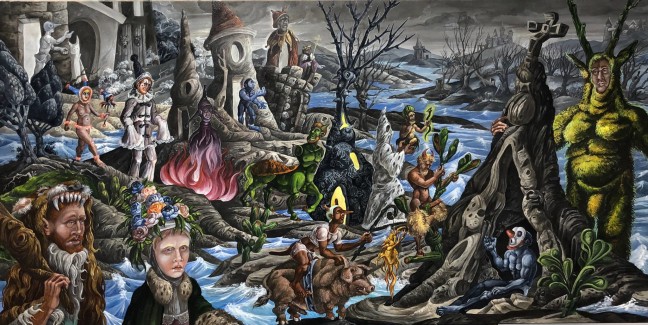
“Each artist deals with the theme from their perspective, using recycled items to express their idea of the Human Condition. Ching Ching Chen deals with motherhood. Linda Vallejo did her work 10 years ago with images that continue to confront the same issues today: ecology, genocide, war.  Marjan Vayghan’s installation of a found-dollhouse represents the death sentence Iranian women are given upon marriage.

36064219_10214894791950510_1573771601751572480_n

“Alexandra Dillon’s portraits of refugee women (above) subjected to cruelty beyond our imagination, and Kathi Flood’s collage all deal with the current immigration issues,” Gordon attests.

36063986_10214894789190441_4204166241344028672_n

Diane Williams, above, also offers a strong invocation of the immigrant experience.

36137373_10214894789630452_743427030409805824_n

Gordon suggests that to learn more about the artists and their use of materials, the upcoming Artist Talk this Wednesday the 8th, and a free Adult Workshop on the 11th, will both offer deeper insight into the meaning of the exhibition.

Upcoming Events:

Artist Talk, August 8th, 7-9pm

Free Adult Workshop, August 11th 1-4pm

Free Youth Workshop, August 18th 1-4pm

Closing Day August 20th

Loft at Liz’s is located at 453 S. La Brea in mid-city.

  • Genie Davis; photos: Genie Davis

Glenn Waggner – The Stories He Builds

38433245_10156666266094884_497675203665461248_n

Glenn Waggner’s artistic mythology is that of a storyteller with a perfectly rendered aesthetic. A SoCal native, Waggner riffs on familiar images painted in meticulous, diminutive style. His background in architecture shows in his perfect composition, but his oil works are rich microcosms, worlds that viewers can step inside.

DesertHouseWithoutFencing

“Desert House without Fencing,” above.

Waggner says that his works reflect his intimate visual relationship with his home. “Growing up, I spent every summer day at the beach, and think the light and color from that show in my painting.” He adds “I have worked in architecture for many years and am fascinated by buildings, cities and how things work. I like to take the light, details, and ideas to create a world that is slightly different from the one we live in.”

WithATwist

Above, “With a Twist,” a drink one could swim in, like the backyard pool in an LA-home.

His works are designed, he says, to “spark someone’s thoughts and imagination” and cause them to “think of, or imagine, an experience. I encourage the viewer to create their own narrative of what the painting means, and I love it when they see something I did not consider. It creates a dialog and connection.”

There is a strong riff of humor and lighthearted mayhem in his approach, which may come from the fact that he has “always” sketched scenes or cartoons. “I started painting almost twenty years ago. My day job is in architecture, and for years I tried to separate the two, sort of a church and state relationship. When I finally combined them, everything took on a whole new aesthetic and opened new possibilities.”

Lift

Above, “Lift.”

Wherever Waggner exhibits, his work draws viewers in, seemingly through a wide, expansive horizon-line, pulling eye and heart to small, succinct figurative images often on the lower half or in a portion of the canvas.

ItWasConsideredGoodForm

Above, “It Was Considered Good Form.”

“ I do a lot of small scale work because I like the aesthetic of seeing brush strokes. I plan to do more large-scale paintings, and an 8 foot x 8 foot painting soon, which is much larger than anything I have done,” Waggner relates. “There is also a practical aspect in that collectors may not have a lot of wall space. It seems people with lots of wall space have less money, and people with lots of money have glass walls,” he laughs.

The artist’s work has evolved over the years. “My work started as having an illustrative look to it, then became more painterly and expressionistic. I like the idea of the painting having a story or narrative.”

KitchenCanOnlyHave1Boss

Exemplifying wit: “The Kitchen Can Only Have One Boss,” above.

His precise structures may be in part due to the fact that he thinks each evocative story through carefully. “My cartoons and sketches translate to stories on my paintings in many cases. I also like to have fun with titles, which always seem to come to me after the painting is finished.”

Plotting

In his recent “Plotting,” above, two men and a woman stand on the edge of a precipice, appearing to be engrossed in a secret meeting; behind them, inside an illuminated home, three executive-type office chairs are positioned. The piece exudes film-noir and a streak of wit – are they plotting a murder or a board room take-over? “Town House with Lawn View” gives us a long, narrow, expansive view of grass leading to a horizon line, above which swirling grey clouds prevail. In “Gliding,” a galvanizing yet tiny figure skater sails across a frozen expanse, dwarfed by a tree-lined shore and a rich orange sunset sky behind. We ask questions, shape answers from Waggner’s works; they are short stories as paintings.

In “The Tide Goes Out,” below, a vivid red sky is a-flame behind seaside cliffs; the perfect lifeguard tower poised on the edge of a flat blue sea. We have been here in our dreams.

TheTidesGoneOut

Waggner notes that above all else, he wants “to keep pushing new ideas. Hopefully more opportunities will come about by constantly working and creating.”

JoshuaTree

“Joshua Tree,”  above.

Asked about his paintings’ perspective and scale, Waggner proves that indeed, here, size matters. “Playing with scale can have powerful effects. It is fun to do a large, minimalistic painting and add small, very detailed elements like buildings or people,” he explains. “With small paintings, vivid colors and intimate details can be explored with a deceptively effortless look. There is an immediacy about the smaller scale, even though some take longer than the large paintings.”

These are intimate works, carefully woven, each note of color or line adding a bit of deeper nuance.

28279211_10156239951049884_4574048130731604151_n

“ I started out doing really colorful work, maybe a bit much early on,” Waggner muses. “Then I fell in love with using grays, and now I am somewhere in between.” He says “I do love color because there are so many possibilities and effects. It is sort of a language of its own.”

In Waggner’s works, there are multiple layers of language, of color, size, and story. His often vast backdrops pull the viewer in as we study, smile, and absorb the beautiful, sometimes ironic, always charged quality of his work. This artist tells a story, and he makes it live; these are breathing, moving moments caught in time and canvas, exuding energy and meaning, posing questions we want to answer or at least contemplate.

Here is where Waggner’s architectural background really shows: he is designing, building art that takes on more and more resilient shape and meaning the longer a viewer inhabits it.

  • Genie Davis; photos provided by the artist

Debbie Korbel: The Alignment of Inspiration and Laughter

Lovers in progress w DebDebbie Korbel says what most inspires her sculptures is laughter.

“I love to laugh and to make other people laugh. As a kid it was fun to go up to people and tickle them.  I’ve found, as an adult, that is not so appreciated, but I can try ‘tickle’ them with something I make.”

Lovers cu_Debbie_Korbel

And indeed she does. Her beautiful, sometimes poignant, sometimes wonderfully amusing assemblage sculptures are a pure pleasure to see, layered and sensorial indulgence that truly reaches into the viewer’s mind and heart. Her works tell stories we want to hear again and again.

17553753_10209190841265243_1322957177902708786_n

“In a specific way, I am inspired when an idea just wafts in the window in my mind. There it rests, and blossoms – or festers – until I decide what to do about it. The origins of these ideas are varied –perhaps something is provoked from an overheard conversation, or I might come across an old car part that has a beautiful organic shape,” she relates. “Trying to dissect inspiration feels a little like trying to understand a butterfly by pulling off the wings—it doesn’t look that great when you tear it apart, but there is magic when everything is in alignment.”

Korbel-Passion Flower

Korbel explains that she hopes to connect with viewers on an emotional level, and wants viewers to recognize something they can relate to, or find familiar in her work. “Maybe, even see a bit of themselves at a vulnerable moment and by seeing me, a stranger, express these feelings, be reminded that as humans we all share them, even though we put on our socially appropriate adult exteriors.”

One way in which she tries to connect with her viewers is through the laughter that inspires her as an artist. “So, when I do pieces that I think are funny I am always so delighted if other people find them so, because in laughter, there is understanding,” she attests. “There is a bond in both laughter and tears. I am always on the verge of either laughing or crying.  Some of the work I do is a combination of the melancholy and humorous, while other projects are more solidly in the vin triste category.”

deb and skull

Korbel has always gravitated toward art. She’s made jewelry, learned Chinese brush painting, written for television, and believes she’s truly hit her stride with sculpture.

“It combines the process of conceptual thinking with the tactile nature and satisfaction of physically making something,” she notes.

Korbel_D_Lazyboy

Her sculptural assemblages are incredibly unique, and according to the artist, she begins with an idea or image in mind at times, and at others, with a material that attracts her.

“Sometimes I find a piece of scrap metal or wood that is interesting to me. It will ‘look like a part of something’ to me—perhaps the shape will remind me of a of a human leg, a samurai’s skirt, or a rabbit’s ear, and then I think about what the rest of a sculpture might look like. I base the scale of the sculpture on the size of the initial piece. Other times, I have an idea percolating in my head and I consciously look for materials that might work well in the execution of my idea.”

Dreaming_Debbie_Korbel- sm - Copy

The richness and texture of her work seems entwined with her use of found materials, but she has not always worked with such mixed mediums.

“When I started sculpting, I began working in clay. I soon came to realize that there were problems and limitations in working solely in this material.  I didn’t want to be confined to these limitations. When I use pieces of steel and other metals, they have the inherent strength to support a large sculpture.  Also, it was so much fun to find unusual materials and repurpose them in my art piece. I often don’t know the original use for some of the pieces I find, and people enjoy identifying them and will come up and tell me, ‘Oh, look, it’s an old air compressor valve’ or ‘Look, it’s a horse femur,'” she laughs.

To say her work is textured, or uses an incredible mix of materials to shape what are really classically perfect sculptures is almost to miss the point – of course her works are composed in this way, but it is the spirit that infuses them through these techniques that makes them so fascinating. They are dream-like yet real, mysterious yet richly comprehensible. Her works feel inhabited – they have gravitas, wit, and soul.

One of the reasons Korbel says that she is so drawn to using assemblage is a philosophical ones. “I actually like the idea of assemblage being a metaphor for us, human beings. We are certainly the sum total of many things sewn together.”

26047138_10211312791392670_1900196660964140651_n

Artistically, Korbel says one of the things she loves best is “the license to indulge my imagination, to be open to new ideas, projects and materials. It’s much more motivating to stumble across unexpected inspiration.” She adds “I tend to work on a couple of sculptures at a time and am very focused until I complete them.  However, I don’t like to plan too many projects in advance, as that starts to feel like a to-do-list and kind of kills my creative mojo.”

26238800_10211449256004200_4790434091910632653_n

26239691_10211449258364259_2050823207171842210_n

For Korbel, the freedom to make impulsive choices in her work adds the serendipity. “I feel that I am able to maintain a level of excitement this way.”

Viewers can certainly feel that palpable excitement in her  inventive work when they see it, and will be able to do so, soon.

26196056_10211403219453315_181346381054042837_n

Korbel will be participating in an open studio event at the Hawthorn Arts Complex in Hawthorne, Calif. August 5th from 2-6 p.m., and exhibiting in the show About a Box at Shoebox Projects in DTLA, August 12 through 26. She has shows upcoming with Red Tie Promotions in October and November as well, with dates TBA.


  • Genie Davis; photos: courtesy of Debbie Korbel

Martin Cox: Visual Poetry Both Epic and Haiku

19105961_10155426037619187_6213038296819710860_n

Martin Cox is a visual poet. He engages heart, mind, and soul with his photographic art; beautiful images that once seen, remain etched like a memory in the mind of the viewer.

18740531_10155215785830761_8688784591349295369_n

His exhibition Snow Drawings, closing at Fabrik Gallery on La Cienega this Wednesday, is a gorgeous series, an enchanted selection of Icelandic landscapes that both depicts a very specific place and transcends both space and time. A dichotomy? A graceful one.

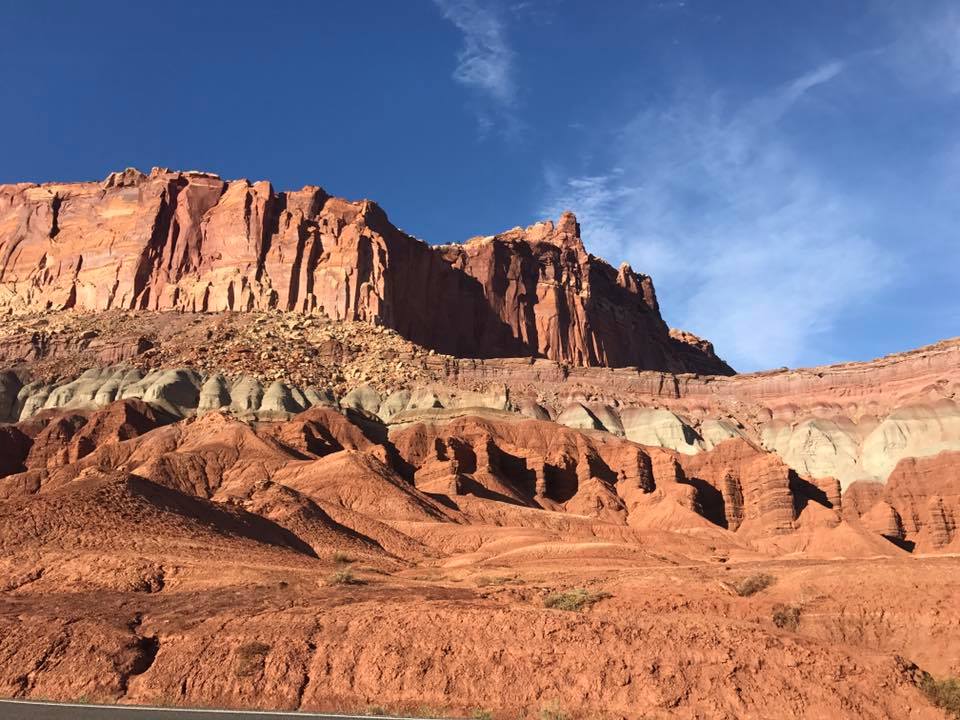
Cox discussed his work Saturday, describing the heart and soul of his minimal archival pigment print photographs, which depict a recent trip to northeast Iceland. Each image reveals the vastness, the beauty, and the fragility of what the artist terms the “vulnerability of the arctic natural world.” His work seeks not only to reveal the intricate beauty and indelible images of the region but to bring viewers’ attention to the rapid climate change in the region. He is fearful that the greatness of this environment may be lost forever.
33397506_1523140474457040_4608459299692216320_n

Images are spare, almost as if they were woodblock prints. The wide mountains, the tiny home, the fragile imprint of a tree – this is what Cox wants us to see.

Listamannabústaður-opnar-í-Gilsfirði_1

Along with his photographic art, Cox is also working to preserve the area by introducing other artists to its wonder. He’s established and officially opened GilsfjordurArts, a residency program in a wonderfully isolated part of Iceland in which he is establishing 3-week residencies starting August 26th. 

36599952_10156620692169187_5285319697133207552_n


He describes the landscape and his experience in it while working the create the residency space. “I went for a walk. Just the sound of wagtails warning me I may be straying near their nests, and the fast flowing river and falls nearly, and this odd realization that no one was observing me. Despite the vastness of the landscape it was completely devoid of humans, just the sheep giving me a once over.”

That Cox loves this land, this landscape, this earth is evident in all of his work. Snow Drawings offers a shimmering vision of the icy beauty, and the threat posed to it by global warming.

Fabrik_7819

In his exhibition talk last Saturday, Cox revealed “Wild blue berries are vanishing due to lack of snow. The grass is being over taken by moss, also due to reduced snow. Winter rain never used to happen, now it rains in winter. Autumn is changing more than Spring – it is getting warmer and longer.”

martintalkingdoughillphotos

The works themselves are riven with light, with frozen beauty. We think of the cold climate, the ice, and the snow as something temporary. It vanishes with Spring. We may even love that temporary quality. But as Cox’s glowing, moving visual poetry  shows all too clearly, that transitional quality to the cold is only welcome when the transition to Spring is natural, not when it is a permanent state of transition, erasing the very existence of cold itself.

18767767_10155380762254187_8591683711704117607_n


The artist exhibits – in the spare, sparkling quality of his work – visual haiku as it were, deep passion for this landscape and its images, and deep understanding and kindness for its fragility, and in fact, the fragility of the earth itself, and man’s existence upon it.  His tiny houses, his small farms, set against a backdrop of such amazing vastness that it is even more shocking the effect man has had on the seemingly endless scope of nature.
The other poetry structure his artwork evokes is an epic saga – each fleeting poetic vista is part of a greater, vast whole, representing all of humanity.

There is a glimpse, in Cox’s lustrous landscapes, of a grand beauty, a great possibility – hanging from a thread. It could all, literally and figuratively, melt away.

17634427_10155031372235761_3476645111274495769_n

Above, Cox’s photography by day and by night.


In the meantime, Cox will show it to us, in spare and insightful works that make the fingers tingle with the cold; he will show it to us with his residency project, introducing his love for the land in physical proximity to it. 

Fabrik-photo Kasey Taylor

Cox says “It was my mind that placing artists in the big silence would offer a place to disengage, recharge, engage.” And to connect them to this environment, and show them, gently, show us all, what is at stake. “There is an Icelandic expression þetta reddast, it means ‘it’ll all work out in the end.’ Sometimes things works out, sometimes they don’t, but we don’t stop trying.”

He will photograph the soul of the earth, and reveal it in poetry.

For more information about Cox’ Iceland Artists Residency program, visit www.gilsfjordurarts.com 

To catch the closing of Snow Drawings, visit Fabrik Gallery at 2636 La Cienega Blvd. in Culver City.

  • Genie Davis; photos courtesy of the artist