
Mike M. Mollett

Mol 3
Performance art, sculpture, and installations – Mike M. Mollett is a versatile artist who creates both living and still-form art. The founder of L.A. Mudpeople, and the sculptor of large scale pieces created from found art, shaped into balls and bundles, Mollett’s work offers a look into a different reality, one in which what look like clay statues live and breathe, and bundles of wires move in the wind and become animate themselves.

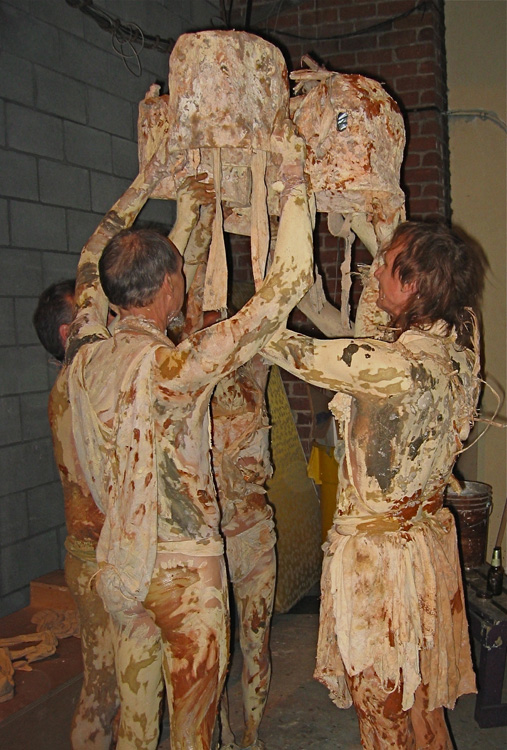
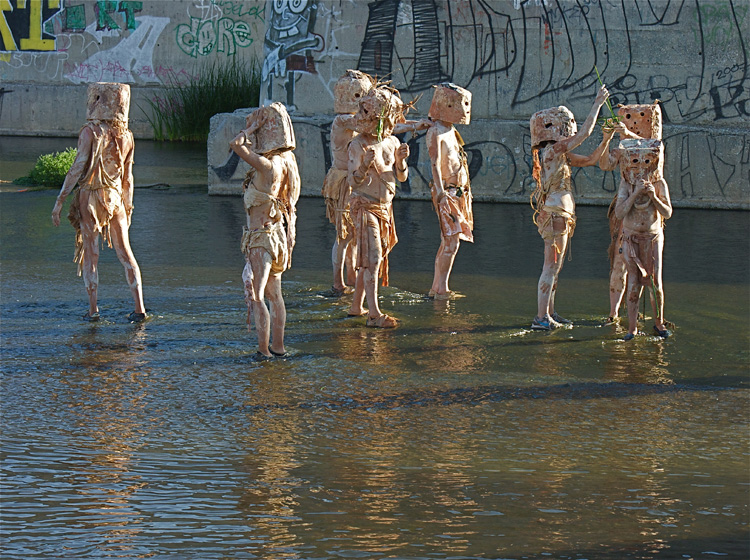
On the performance art side, Mollett considers his troupe of L.A. Mudpeople to be non-performers who function as “essentially living sculptures.” Mudpeople don’t speak, and move slowly and deliberately, almost as if lumps of clay had shaped themselves and literally come to life. The troupe gets its mud from Silver Lake, Hollywood, and northern California, as well as using commercial mud such as potter’s clay. The artist started his mud-work in 1989, booking himself and others at an African-Reggae club for a single night – and the rest is art-tribal history.
Mol 5

L.A. Mudpeople vary in number, with sometimes as many as forty members participating in events like the Doo Dah Parade, or conducting walkabouts along the L.A. River, Melrose, or Old Town Pasadena. Their work has appeared in National Geographic Magazine, and exhibitions of their attire and artifacts have been shown at both UCLA and Cal State L.A. They’ve been the subject of a film, imitated by Leonard DiCaprio, and have become an iconic part of Los Angeles’ rich street art scene. The Mudpeople wear their own simple clothing, and create full head masks made from cloth, paper, mud, and binding. Conceptually, these living sculpture performances are all about the freeing of self from time and worry, muddy yogis who, according to Mollett “don’t have to do anything. We just are.”
Mol 4

Mollett has participated in the Los Angeles art scene for forty-some years, and it’s not all about “mudding-up.” His sculptures are often created from items and forms he’s used from work as a landscape artist, found objects that he morphs into what are essentially time capsules of society and life itself.
Mol2

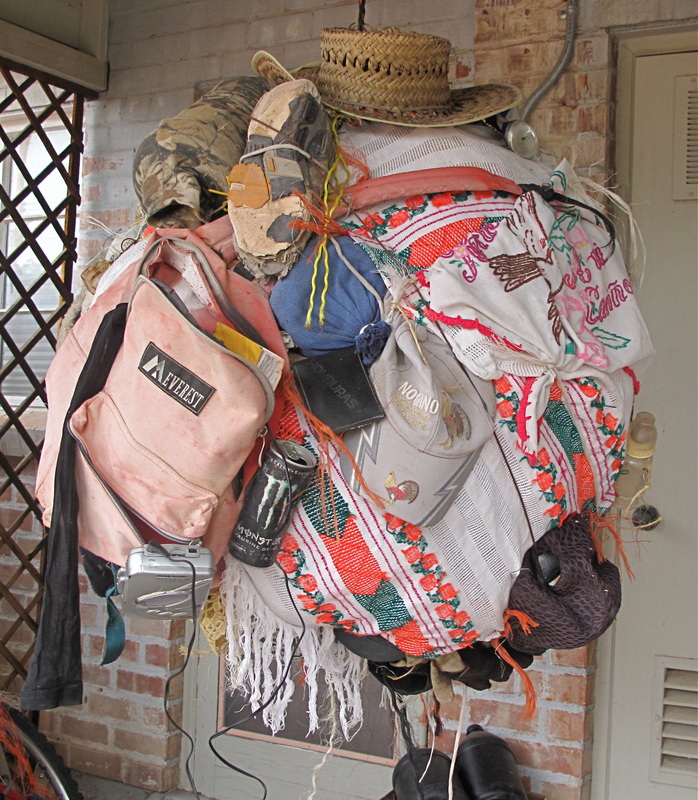
His sculpture balls include pieces like “Migrant World,” a bundle of artifacts that were gathered along the Arizona-Mexico border trails. Tied with rope and cords, viewers see a Mexican shawl, a battered pink backpack, a hat, water bottle, and baby bottle among other objects, built around an ocotillo wand armature. The over all effect is poignant – these are the belongings that people took with them as they migrated from one land, or realm, to the next. Mollett’s rope and wire bound “The Giant Ball,” features the detritus of modern society, such as milk cartons, wine bottles, paper bags, and pill containers. This, Mollett seems to be saying, is what we have allowed ourselves to be made of. The balls serve as personal sculptures that use material collected from Mollett’s life or another’s life, shaping a biography or autobiography of that person.
Mollet 6

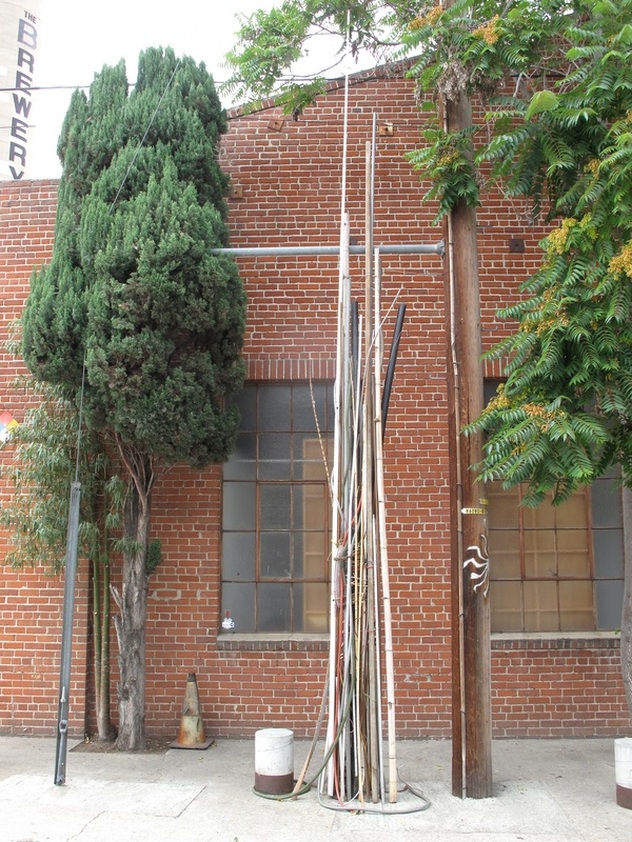
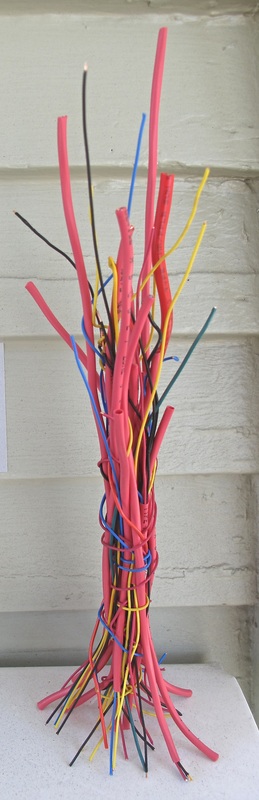
Unlike his balls, his Time-Twists of wire and wood are linear, reaching like mysterious urban plants skyward. “The Giant Bundle: A pLAyLAnd Twist” is installed indefinitely at The Brewery Artists Lofts in Los Angeles. His “Woody Bundle” includes an accordion tape measure. “Wild Red Twist” looks like shocking pink licorice has fused into corral, with blue, yellow, and black wires twisting in an invisible ocean wave. “Mostly Electric Story” incorporates rope, wires, and computer cables.

What makes both the Time-Twists and balls so compelling, is the feeling as if these entirely inanimate objects could suddenly become animate – just as Mollett’s Mudpeople do. A sinuous quality infuses the Time-Twists, making the viewer think of snakes, or strands of DNA twining and untwining. The balls are like transparent eggs filled with the stuff that life is made from, ready to hatch into human form.
Mol 1

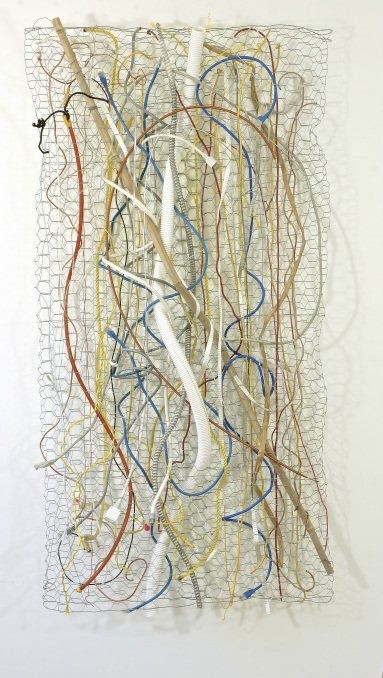
Mollett’s “Gate Series” also feels embryonic. In “The 2nd GATE,” Wire mesh is woven with wires, ropes, sticks, bamboo, Dracaena Draco leaves, and twines. Mollett’s “Mostly Friendly GATE” also features Dracaena Draco leaves, orange, wire mesh, sticks, bamboo, wires, and ropes. The flat aspect of the gates resembles a thin slice of human tissue, the wires and leaves the inner-workings of the body, or the inner-workings of technology just as fragile, just as capable of being alive in a technology-driven world.
mollet 7


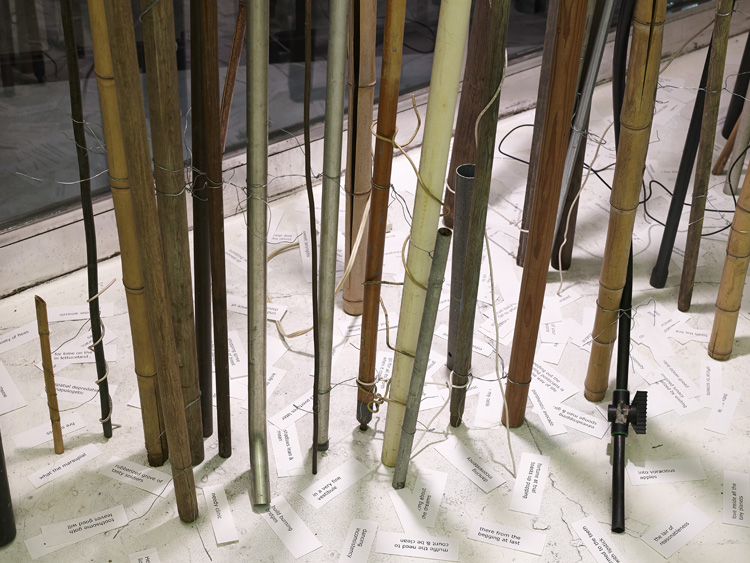
Installations like “Leaves in the Poet’s Winter Garden,” a part of Mollett’s solo show at Matters of Space in Highland Park, also use sticks, wires, and pipes to create the illusion of alive-ness. In this piece, pipe and bamboo stand tall, while at the base of these “plants” are small pieces of paper with two sets of disparate words or phrases written on them. A wonderful concept that illustrates the fluidity of creative thought, the passing “leaves” of discarded verbiage. Other installations have included a Mudcave at an Eagle Rock pop-up space, PlayLand, and The Mud Room created for the NadaDada Festival in Reno, Nev. Recently, Mollett was also a part of group exhibitions at Los Angeles Contraventions and the Los Angeles Juried Exhibition. Mudpeople have recently performed at the Highways Performance Space, as well as along the L.A. River, and at Beyond Baroque in Venice, Calif.  You can find out more about Mollett’s work here: http://www.kcet.org/arts/artbound/counties/los-angeles/mike-mollett-la-mudpeople.html

– Genie Davis
Photographer Lori Pond: “Menace”

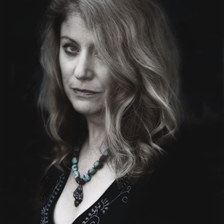
Photographer Lori Pond uses her art to blur the lines between perceived reality and her dreams. Long accustomed to vivid dreams, and questioning the parameters of the real world since childhood, Pond uses both the camera itself and her post-processing tools to paint a full range of images and emotions through color, light, movement, and texture.

Photographer Lori Pond

menace 6

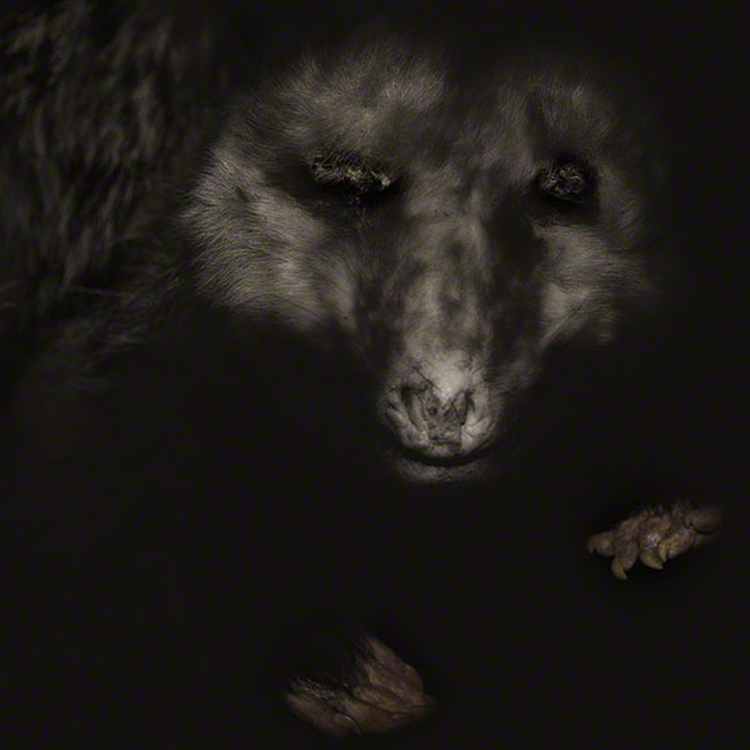
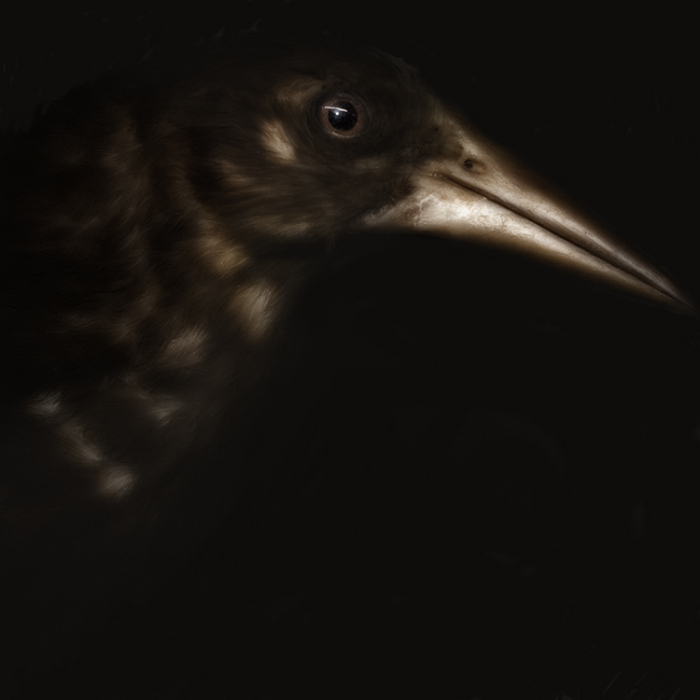
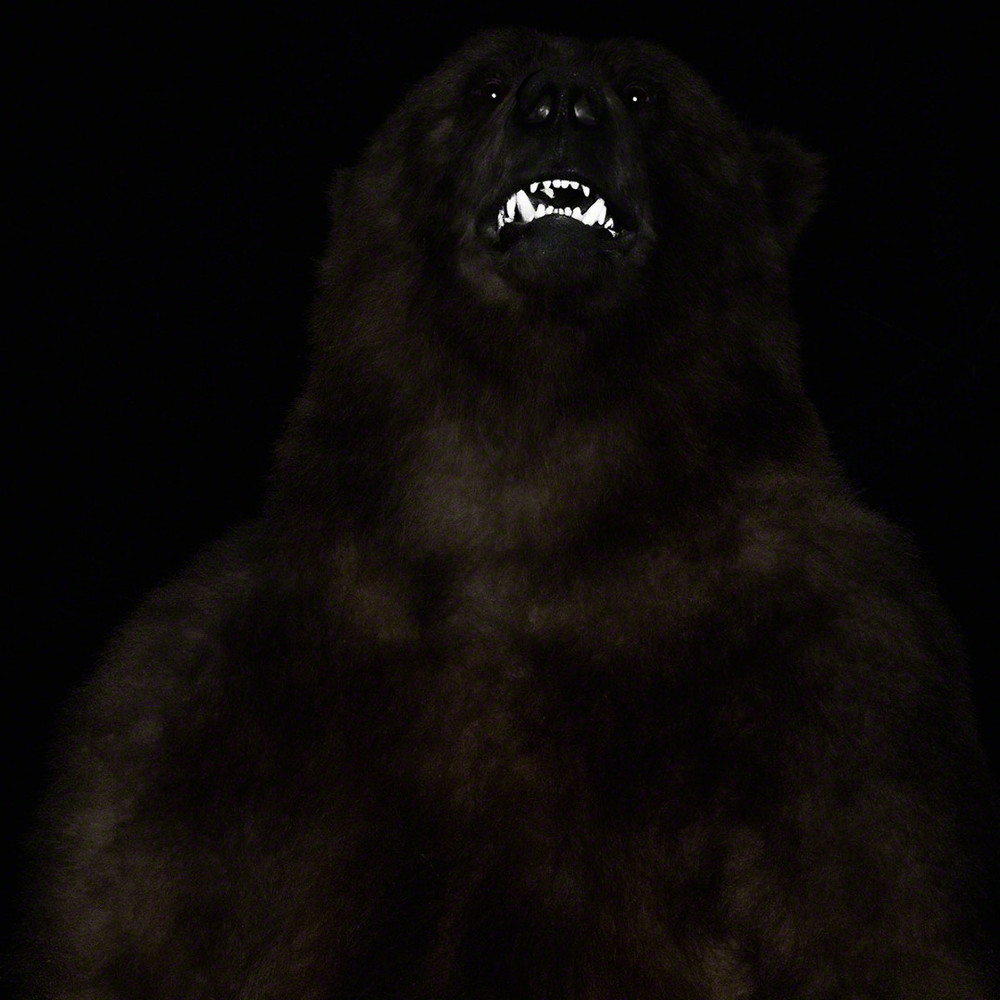
In October, just in time to greet the boogeymen of Halloween, Pond will be exhibiting a solo show at the Los Angeles Art Association based on her series, “Menace.” This series vividly depicts images of things we fear – or think we do. These are velvety, dark, and ferocious photographs of wild animals that trigger gut-instinctive responses of fear. In these photographs are shadowed images designed to heighten the fight or flight reflex of viewers’ subconscious minds, instinctive reactions that we share, that make hearts race, even as we are viewing these images in a safe space.

Opossum

Raven, tiger, boar, bear – the eyes of these creatures stare intently and wildly out from clumps of voluptuously close fur, causing our ancient instinct to run. Try holding the gaze of any of these creatures and feel the power shift between viewer and subject, with the subject winning. But before viewers hurry on, the astute observer will notice the real point of these rich, noir photographs. This point  isn’t to confront viewers with their fears. Instead, Pond is posing a challenge, manipulating viewers to take one look at these frightening, shadowy creatures, and then to look again. What is truly menacing is in the viewers’ minds. These animals are taxidermied, a danger to neither the artist or the viewer of her art. The images were taken in bright shops, altered through the artist’s craft to demonstrate a ferocity that doesn’t exist. In short, Pond tells viewers that fear itself may be false and unjustified. Perhaps, along with ingrained and visceral responses to these animals, the 21st century has also brought us fears that are merely imaginary, or created by others.

menace 4


Beautifully rendered, these fearsome images are impressive in their own startlingly heart-thumping right. The context of these photographs, that fear itself may be mostly imagination, adds depth and weight to the carefully detailed and beautifully lit images. Every bird feather, every bristling bit of animal fur is perfectly rendered. Truly the stuff of dark dreams, dreams which break apart when confronted with daylight, yet linger in the psyche throughout the day in fragments created by our own primal instincts.

menace 5

To print “Menace” and her other photographic series, Pond uses Epson Ultrachrome archival pigments on matte rag papers, which adds to the deeply detailed and dream-like quality of her subjects.

A Southern California native, Pond has worked as a graphic designer and operator for live television productions including the Academy Awards, the Emmys, and Grammys, as well as for Conan O’Brien. Her photographic art has shifted through the years from street and documentary images to macro studies of the natural world in her series “The Intimate Universe.” Her highly emotional and autobiographical “Divorce” series chronicles the impact of divorce after twenty years of marriage. Using the wet plate collodion process, Pond has also created tintype portraits in her series “Strange Paradise.”

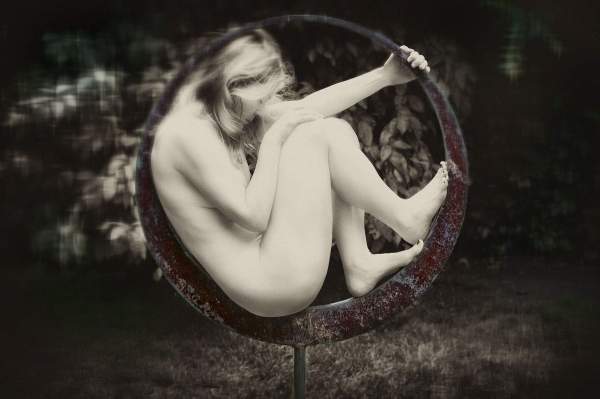
Lori Pond's Circle

Pond has won awards for her nationally and internationally exhibited work, and has been published online and in magazines, as well as in two books of her photography, “Lori Pond – Self,” and “Arboreal.” Her photos are a part of the permanent collections of the Center for Fine Art Photography in Ft. Collins, Colo., the Center for the Arts in Los Angeles, and at the New York headquarters of Morgan Stanley.

Her recent exhibits include a solo show at the University of the Arts in Philadelphia, “Nothing in the Entire Universe is Hidden.” She’s also taken part in the Artist Alliance at the Museum 2015 in Oceanside, Calif., and the 2nd Annual LACP Members’ Exhibition in Los Angeles. The artist is a member of APA, the Art Directors Guild, and the Los Angeles Art Association, among other arts organizations.


Mistress America: Sundance Next Fest 2015

sundance next

Next Fest Photos by Ben Saari

The Sundance NEXT Fest was in full swing on Friday night at the Theater at the Ace Hotel, with a screening of Noah Baumbach’s new dramatic comedy, Mistress America. Channeling the talents of his Frances Ha star Greta Gerwig along with Lola Kirke,  the film is a pleasantly acerbic slice of life about Tracy, a budding writer and college freshman (Kirke) disappointed by her first semester experience at Barnard. Gerwig is her free spirited soon-to-be stepsister, Brooke – a constant source of energy and more zany half-baked ideas than adult plans. The two quickly become close as Brooke struggles to find funds to start a restaurant. The duo’s friendship, a falling out after Tracy writes of their misadventures, and their reconciliation are the backdrop for witty gems of dialog, wonderfully wacky moments of fearless screwball comedy,  and a great score by Dean Warham and Britta Phillips. In classic Baumbach style, this is a film about the virtues and faults of being young in New York City, and about the energy of the city, impassioned if misguided youth, and a vibrant female Zeitgeist that infuses the film.

Next

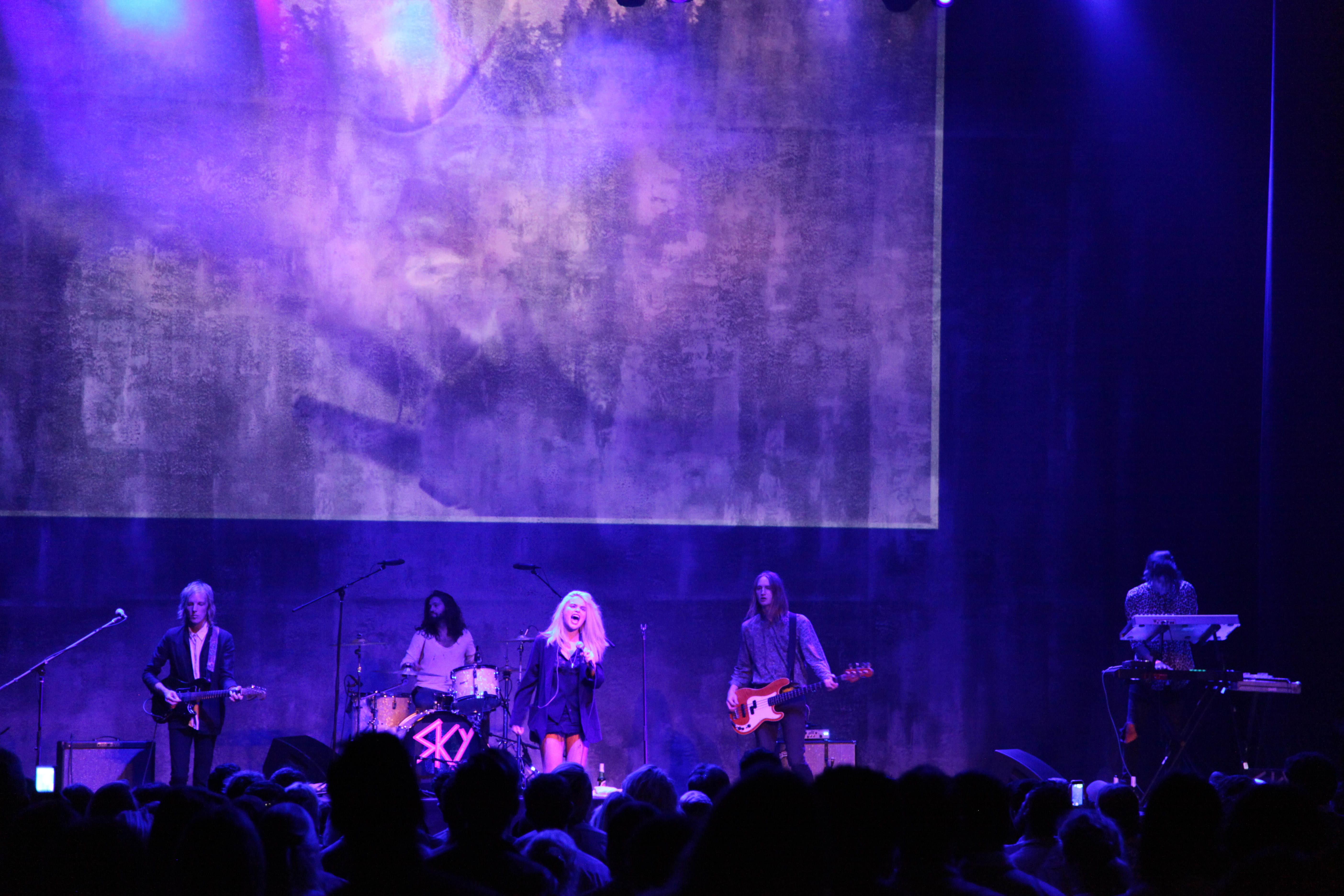
And after the film came more female energy in the form of Sky Ferreira and her strong backing band. Ferreira offered The Ace a strong set of upbeat alternative pop rock. Tight percussion and rhythm performers in addition to dreamy synth sounds created a good-time vibe which ebbed and flowed like the mood of the crowd. Standout singles such as 24 Hours and Boys set up catchy hooks worth downloading and repeating.  The pairing of music and film were seamless, both filled with upbeat energy and a certain poignant edge.

Next Fest

The Theater at the Ace itself continues to be a big player in Los Angeles’ Sundance NEXT events, with great acoustics and hip, soaring art deco architecture. Check out Baumbach’s film starting up at the Landmark this week, and hit the Ace to explore this historic venue whenever you can.

Next Fest

  • Nicole Saari, Genie Davis; all photos by Ben Saari