
Taking Wing Flew High at the Neutra

wing 6

While the exhibition Taking Wing has flown from the Neutra, the four artists that created the exhibition last spring are every bit in flight. Featuring beautiful and very different works by  Wini Johnson Brewer, Gwen Samuels, Sheri Neva, and Susan Savory, the stellar exhibition was a strong introduction to each artists’ work.

Wing4

​Wini Johnson Brewer’s art focuses on the nature of bees and how important they are to our environment. ​“I talk about their troubles, encouraging the public to plant bee gardens, refrain from pesticides, and consider having their own backyard hive,” Brewer explains.
​Wing 5

She describes the chaos found among bees as similar to that of our own society, claiming that the bees have lost their way in the world and are confused about their roles in their own hives.  Her “Artificial Light” depicts bees circling a light bulb, but unlike moths, bees are not attracted to artificial light. But she has depicted them doing just that, going toward a manmade light and dying, perhaps an analogy to humans and technology and social media. ​There is an ancient European tradition known as the “telling of the bees,”  in which a bee keeper shares with the bees important life events such as births and marriages. The belief is that if this tradition is omitted, then the bees would die. Brewer’s art is the continuation of the telling.

Wing 2

​Gwen Samuels’ art is based in an early passion for fashion and patterns. Her background as a textile designer adds strong design elements to her work. Samuels shaping and rearranging of her photos creates an additional imagery from her depiction of delicate insects. ​“My love of the handmade made the needle the natural tool to pull the pieces together. I left the threads hanging as evidence of the process. I arrange them slightly off the wall with straight pins to permit shadows to interact with the forms,” the artist relates.

wing 10
Her dedication to craft, time, and intimacy takes viewers on a journey that shows what you see may be more than what is first observed.

wing 1

Much like Samuels’ art, Sheri Neva focuses on the patterns of nature, giving the viewer an intimate look at the world around them. ​Neva’s own world view changed in 2005, when she went to the Delta College Microscopy facility. It was there that she discovered a microscopic world, a fascinating mix between science and art that reveals the intricate detail and beauty of life. She now studies the structures of the world with the help of her scanning electron microscope.

Wing 11
​“I never know what I will find when I put a sample in the microscope,” Neva says.

“Seeing the microstructure of a mosquito wing or the grooves and pits in one single grain of sand from the beach I live on still amazes me after seven years.”
​She uses science to create art, and combining the two to show the viewer what the world contains in its most minute exploration.

Wing3

While Neva’s work points toward the future, Susan Savory’s art takes viewers back in time to our past. ​A collector of vintage mementos found in flea markets and yard sales, she uses photographs, letters, and books in her mixed media works. ​“I remake these with collage and paint, listening to the ghost voices of my subjects and piecing together narratives for them as I go,” she explains. “The use of materials with existing histories enforces the awareness of a connection to the transient nature of all things.”

Her inspiration refers to ​an old Mexican adage that suggest people die three deaths. One when the body ceases to function, another when the body is lowered into the ground, and a third and final death when there is no one left alive to remember. And much like Brewer’s tradition of the “telling of the bees,” this is Savory’s way of giving back to life, preserving and creating visual stories.

wing 12
​On every one of her collages lies a moth,  a Chinese symbol of a deceased individual’s soul.  ​“As the connection with nature is imperative, the possibility for a loved one’s soul to take the form of a moth is a relatively common belief. This embodiment is rooted deep within Taoist beliefs, and offers a poetic explanation of common encounters with moths at funerals or shortly after one’s passing.”
​
​Watch for more winged things – art that soars – from each of these artists.

  • guest post by Kevin Norman along with Genie Davis
  • photos provided by the artists

Jason Ostro and Andrea LaHue: Twinned Beauty

jason 11

It would be hard not to love the lush and vibrant paintings of Jason Ostro and Andrea LaHue. The pair presented both solo works and collaborative pieces at Art on Scene in May, works that evoke stained glass.

Jason 1

Above, the pair pose by two of LaHue’s floral works.

LaHue’s florals and Ostro’s mosaic-like, geometric patterns are stunners alone and in combination; both cutting edge and traditionally beautiful at the same time. Their show at the Sunset Blvd. gallery offered an exuberant chance to see both artists’ take on the natural world physically and emotionally.

Titled Flower & Flow, the exhibition touched on both elements with grace – flowing floral paintings by LaHue, flowering patterns in Ostro’s flowy abstract patterns.

jason 3

Above, Ostro’s work captures a stunning pattern and sensibility of leaves and petals. Below, LaHue’s irises dazzle with impressionistic brush strokes that evoke the texture of the flowers themselves.

jason 2

With a rich palette that created a kind of art garden, the two artists played off of one another’s subjects, colors, and styles; the several collaborative pieces worked a visual magic with their layered approach.

jason 5

The love both artists feel for their subjects, and for working together is quite literally palpable. Such a sense of respect for and immersion in the natural world, and each other’s diverse yet complimentary styles is visually delicious and emotionally satisfying.

jason 7

Above and below, a wall of Ostro’s work is like a series of mosaics fused with stained glass.

jason 9

The collaborative work below says it all: the tiled and petaled look of Ostro’s background is a perfect compliment to LaHue’s delicate blossoms.

jason 8

In a world in which there is often these days too little that is delicate, beautiful, and blissful, the two artists both together and separately have created a body of work that resonates with the heart as well as the mind.

  • Genie Davis, photos: Genie Davis


Scott A. Trimble: A Painter of Otherwordly Grace

scott 1

He’s a mystic and poet – and a prolific artist who paints rich and complex stories every day.

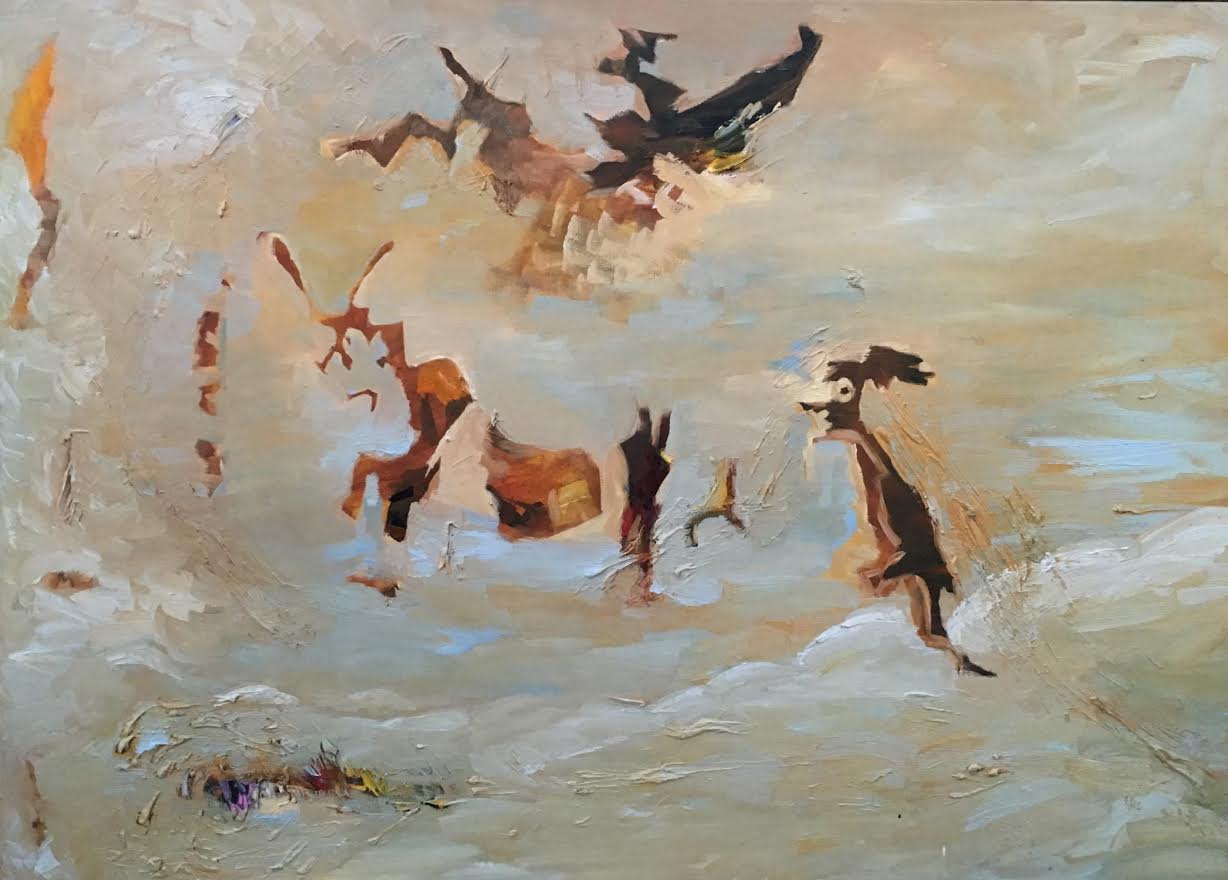
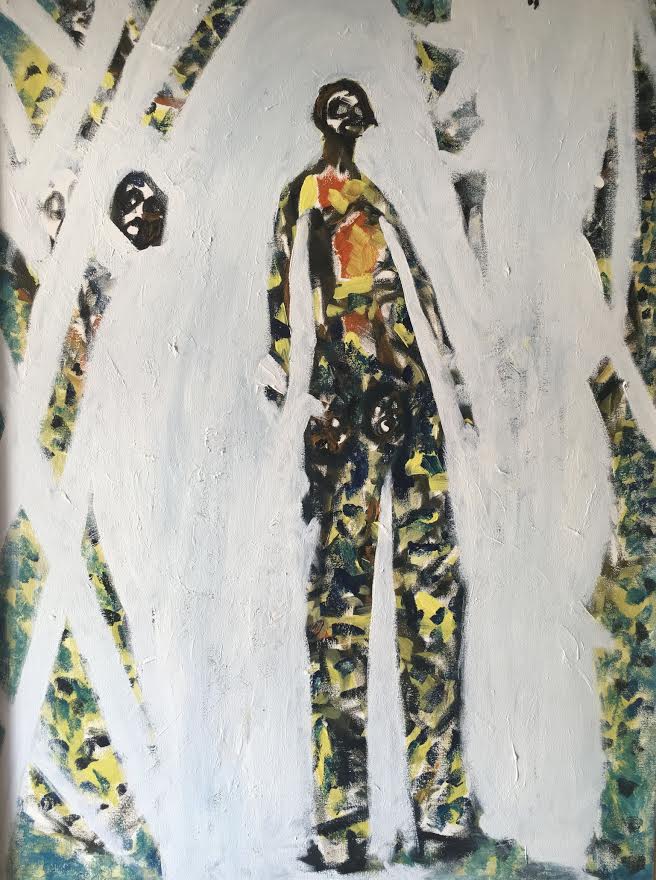
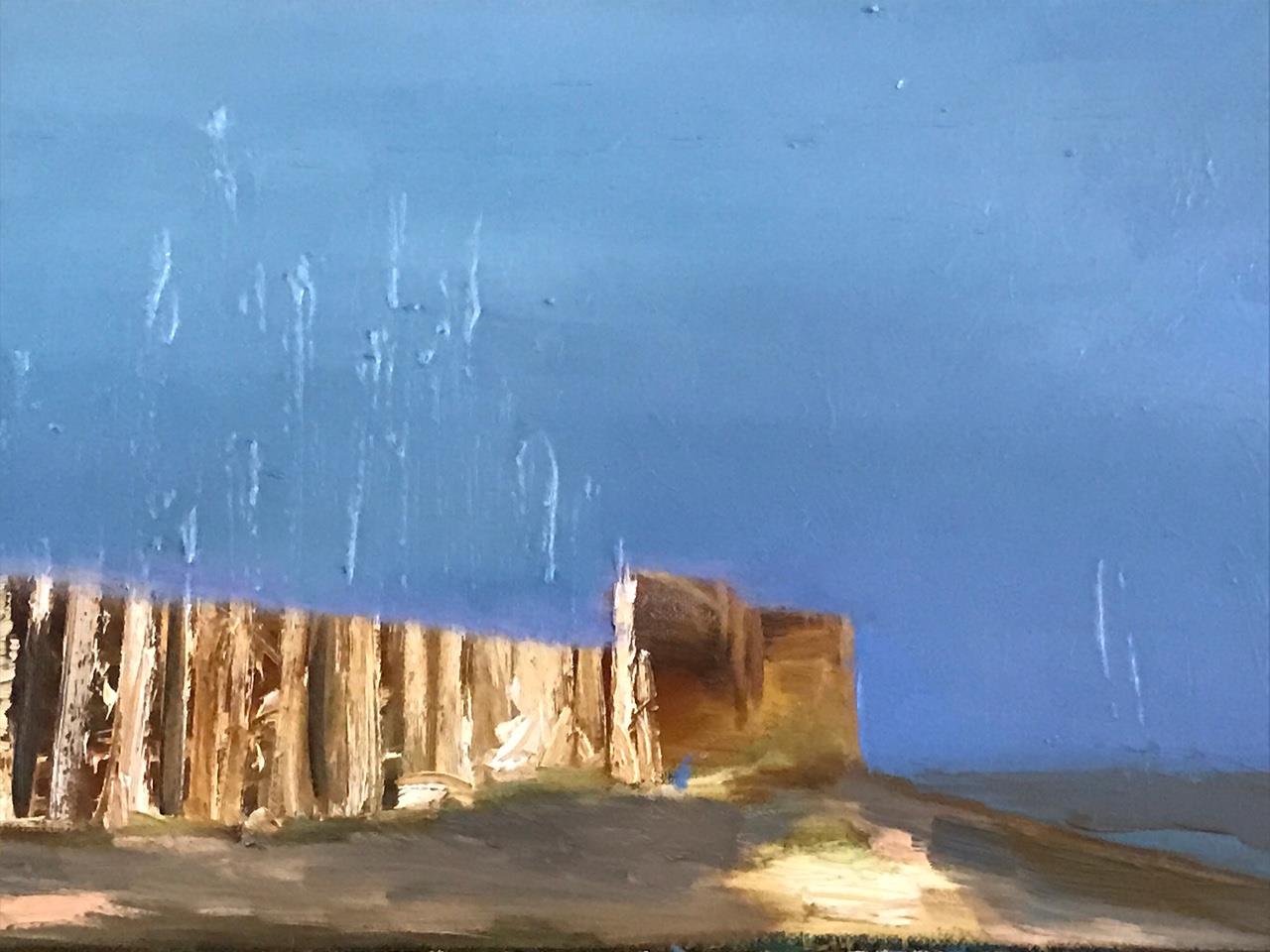
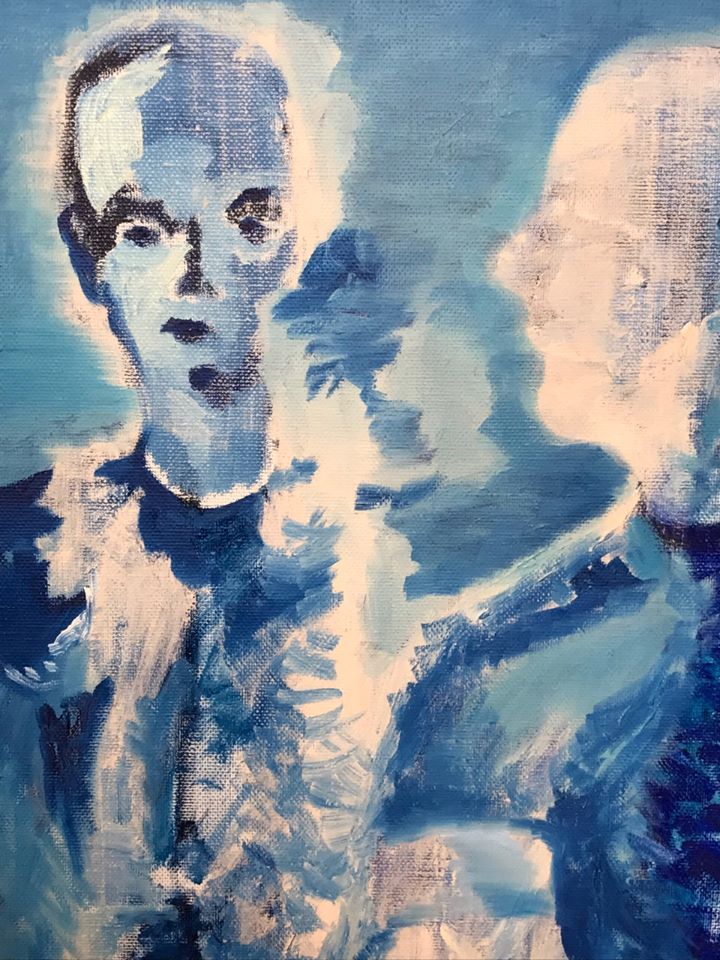
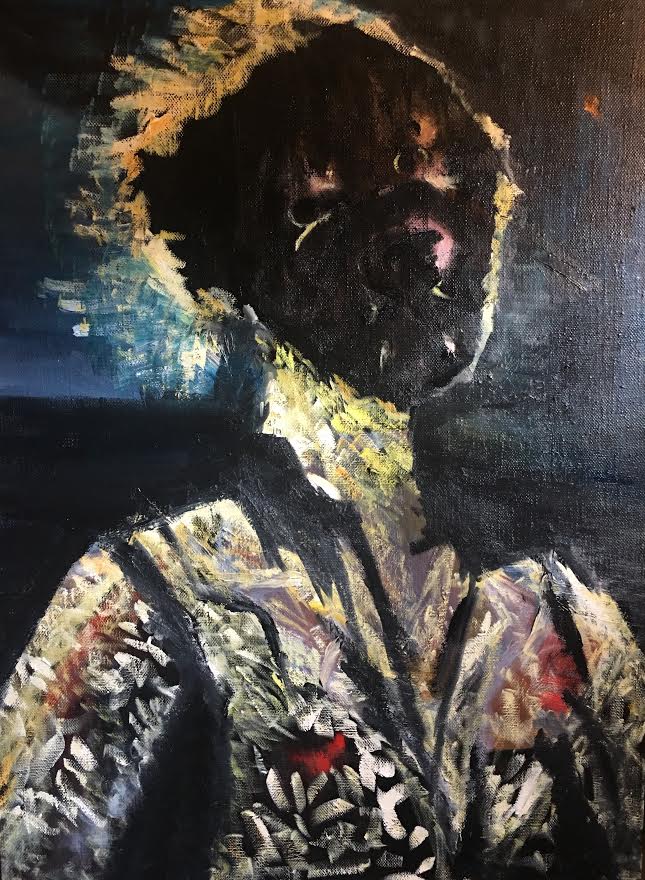
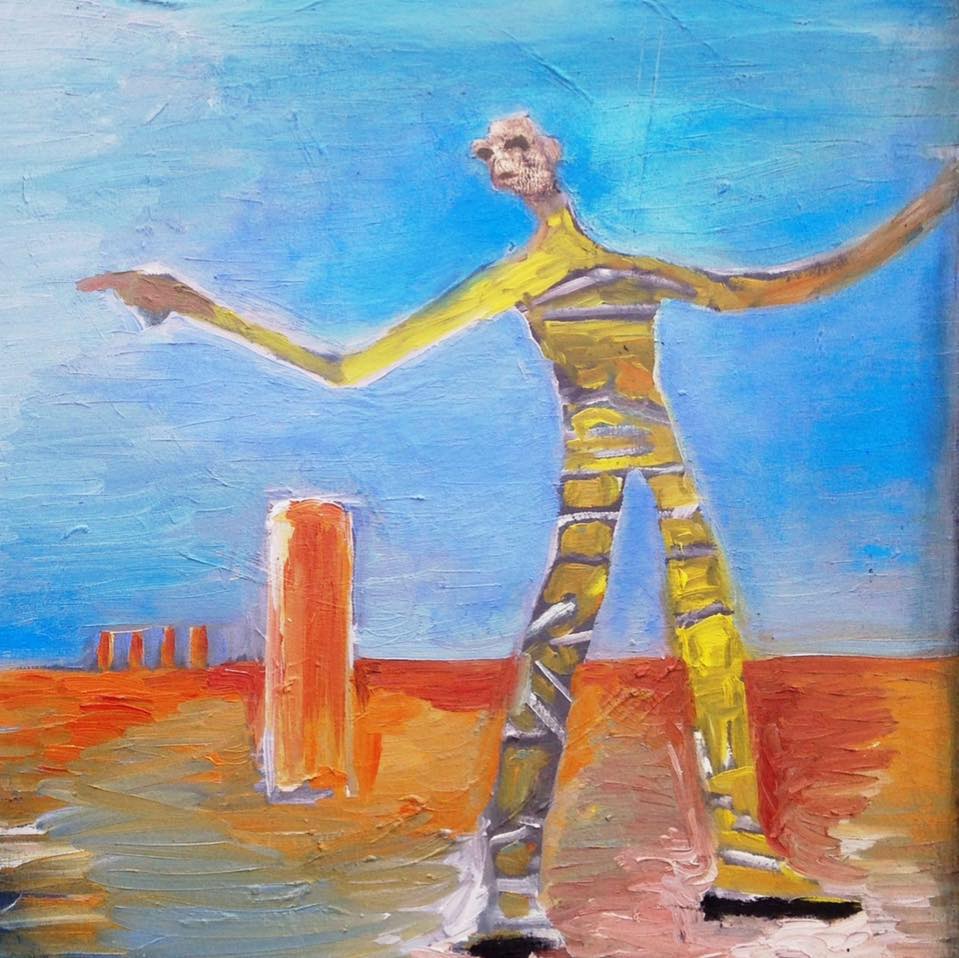
Scott A. Trimble is a painter of profound depth and grace; each work is not only visually acute but resonates with meaning both opaque and transparent. His unique, figurative yet freeform expressionistic style, captures light and motion in layers of paint, shadowy faces, and otherworldly landscapes.

scott 5

“What enables me to paint is that I found a way to not be concerned at all about what other people are going to think. I don’t engage my mind, I just try to use my eyes and enjoy myself-  it’s a real simple process,” Trimble relates.  “I don’t worry about something being particularly recognizable or anatomy being precise, I just enjoy what I’m doing.”

scott 6
Indeed, there’s an almost wild joy in his work, a thrumming sense of emotion in each piece.

Scott me 9
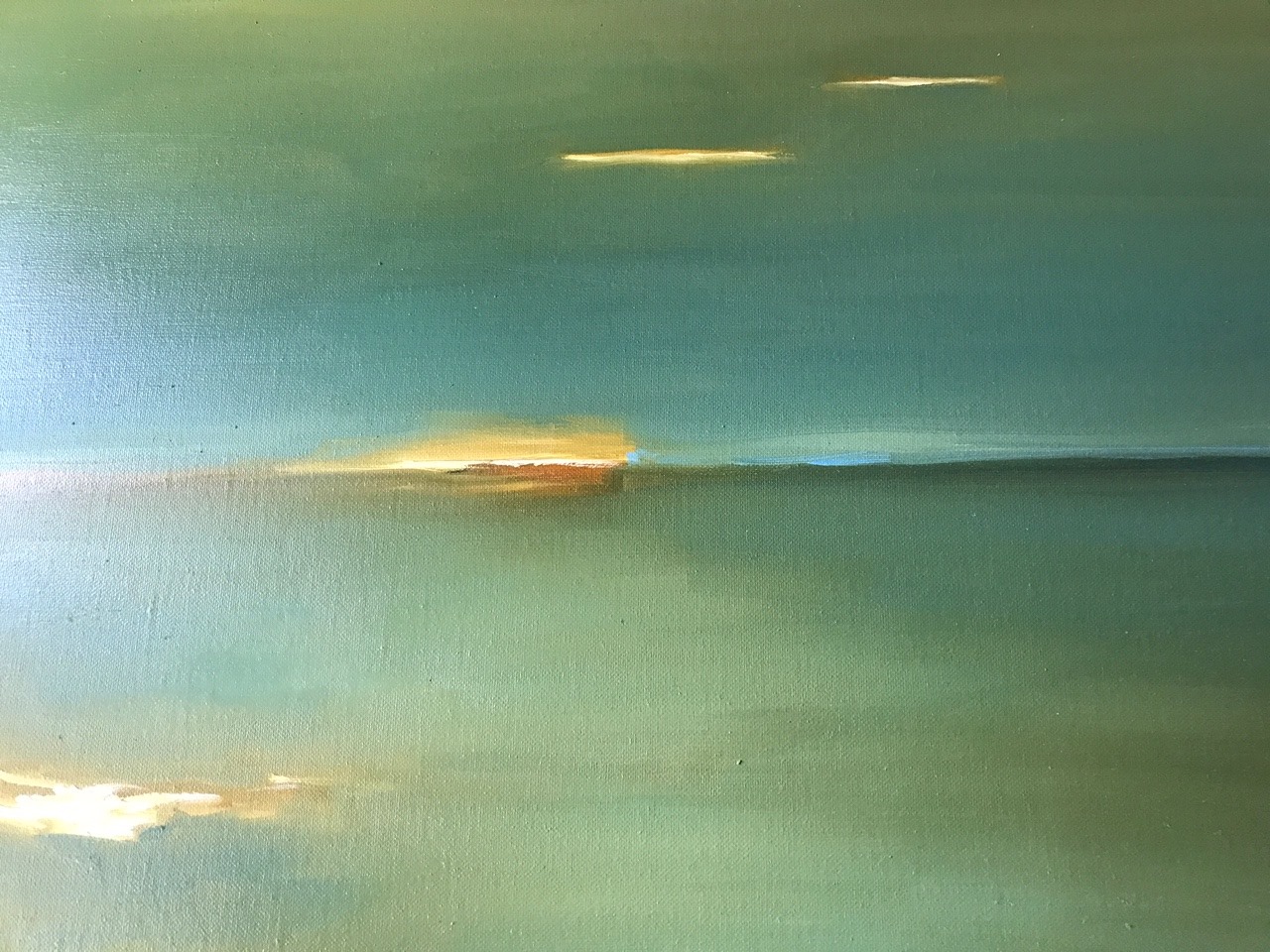
Each painting tells not just a story but a novella of emotion. One piece, “A Love of Place” was inspired as a reaction to what the artist calls a “disturbance in the essence of life’s fabric” by our current political landscape as well as by a strong love of place, according to the artist. Dealing with troubling politics and long days, Trimble painted aqua sky and sea – calm and divine. For Trimble, blue represents happiness.

“It was inspired by a time when my kids were young, and every weekend we would pick different environments in Los Angeles to explore – whatever popped up first in Google search, we would visit. What I learned and imparted to my boys, was that most people really loved where they lived no matter what we thought of the place. People who lived there, it was their home and they loved it. This is Los Angeles for me.”

The piece also features four small bars of light.  “I use that constantly – four is a reference to me, my wife, and two kids – so they always know I’m thinking of them.”

Scott me 2

He adds “In most of my paintings those groupings of four have three bars clustered together and one apart, observing or being observed.”

The observer – that’s Trimble indeed.

Scott me 3

“I’ve spent my whole life thinking the single most important thing in life is your memory. My mom had several strokes a few years ago and her memory is gone.  I’ve become interested in the way memory functions, the way it can be elusive, and memories mixed with other memories, and I wanted to replicate that process in the action of doing paintings that are physical manifestations of memory,” he explains, “and treat them with differing levels of preciousness, the way a really fond memory is nurtured and saved, where a less interesting memory is forgotten.”

With that elegiac thought in mind, Trimble has begun to paint over some works.

scott3

“I haven’t bought new canvas in five months,” he says. “Most of my paintings have been through the wash cycle more than once.”

Trimble notes that his very first paint-over was originally created in 1984, and painted over in 2014. “When my sons asked me why I had partially painted over something they had grown up with, I replied that it took me 30 years to finish it,” Trimble laughs. “It was an empowering thing to do to paint over it.”

scott 2

Although Trimble has painted for decades, he took a hiatus when day job and family life consumed his time. “I had no time at all to paint, so I started again in 2013 when my son started college.”

He painted angry portraits of unlikeable people, abstracts, shadow figures, human figures, faces, and landscapes.

scott 22

His voluminous output – art perhaps stored in his heart for years, follows an almost relentless process of nightly painting. “When I get home at 7:15, I come straight to my garage studio and work until 10:30 or midnight. I’m enjoying the moment, flashing through memories with paintings that are growing and changing.”

Older works exhibit thicker paint from paint-overs.

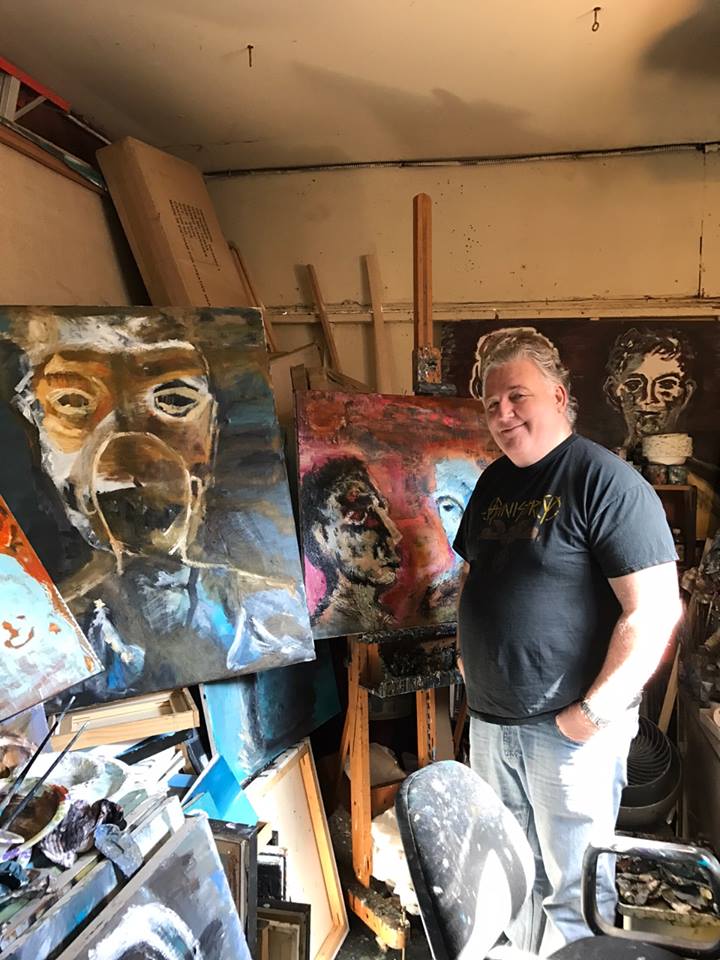
Many of his paintings have a dark and dreamlike quality, with images partly out of focus, due perhaps in part to working by a dim 60-watt bulb in a small space.

scott me 6His titles reflect his past studying screenwriting – which is the wordsmith equivalent of visual poetry.
Scott me 4

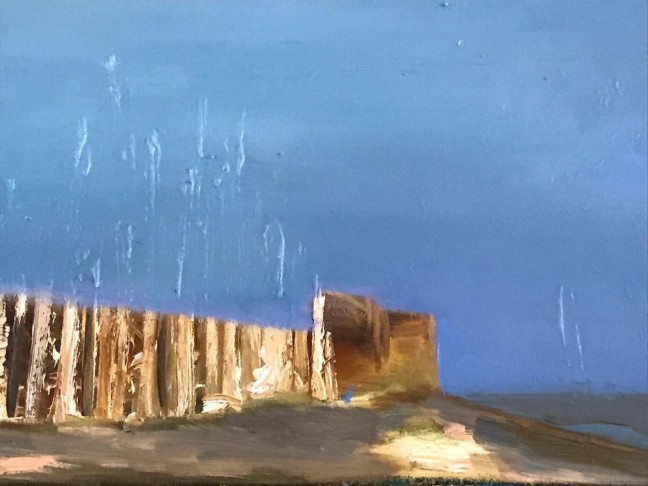
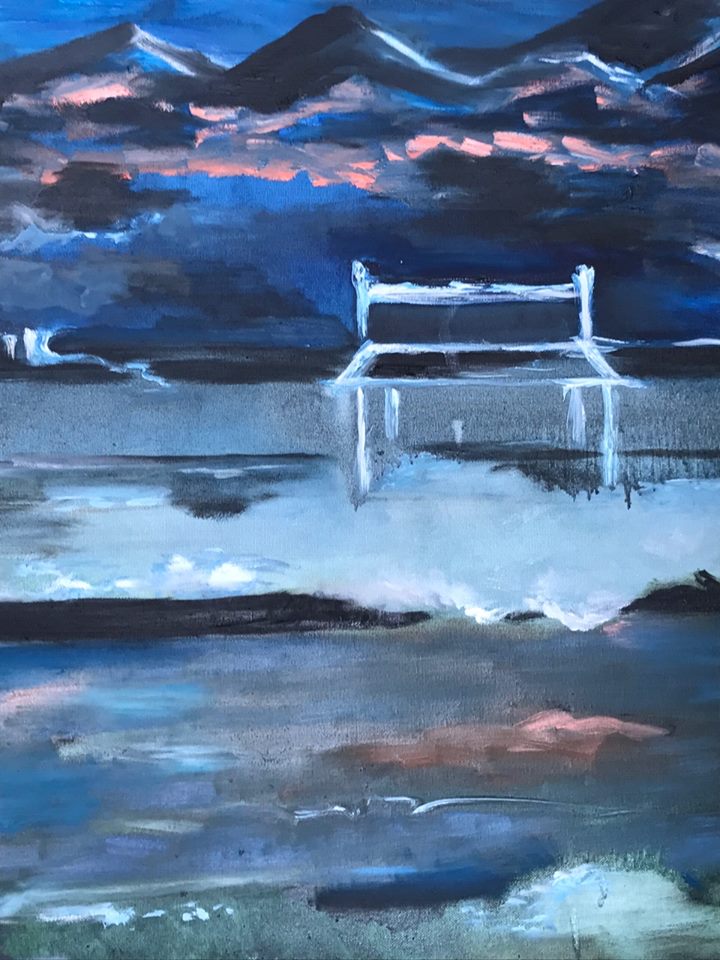
Take “I’m Pining for our Bench at Two Bunch Palms,” with a white bench, a reflection in a pond of skyline and desert mountains. The viewer immediately recognizes desert, but the intense blue is oceanic – it’s the visualization of the longing in the title, grand and inchoate.

“Ultimately in each of my paintings, I try to create pocket narratives, a short story comprised of a set of mixed up memories, emotions, and history, that are distilled down to a single sensation. It’s not something you can easily describe, but it’s meant to be felt.”

Feel what Trimble feels this month: the artist has 5 works that are a part of Satan’s Ball, the large group show currently at DTLA’s Art Share, and a collaborative piece at VS, a show which pairs artists together at Gallery 825 in West Hollywood. Sixteen other paintings are on exhibit in a stellar solo show at Laemmle’s NoHo Theater in North Hollywood.  You can see more of the artist’s work at www.scottatrimble.com

  • Genie Davis; Photos: Genie Davis and provided by artist

Steve Seleska: Environmental Artist

Seleska 2

With a rich and beautiful show at Ark Gallery through June 30th, Steve Seleska offers a window into time and space. There is no “final frontier” here, but rather a doorway into multiple frontiers, into worlds within worlds. The self-taught artist’s first solo show, Uncharted Territory,  presents environments and fantasy landscapes, evocative work that is not only visually fascinating, but morally insightful. Seleska is encouraging viewers to look at changes in the world today on what he terms a molecular level; big events that affect human existence taken on an intimate scale.

Seleska_Steve_ARK_Exhibition

This body of work has a political passion, one that speaks to the national climate that has led to March for Science rallies, and nationwide cries for real facts and analysis versus propaganda. The fragility of our world and its eco-systems is the subject of Seleska’s artistic territory here, which presents the wonders of nature, the cosmos, the layering of the scientific with the phantasmagorical, the web of life.

SeleskaSeleska says “My work focuses on environments. My Micro-Environment series focuses on human observation of microscopic environments, perhaps viewed through a microscope,” he explains.

Selesca Landscapism 4

Landescapism #4 above. “With the Landescapism series, the human becomes microscopic, observing a dystopian environment.” The viewer is deep inside the world here, beneath the shell of life as we know it.

The artist says that Unchartered Territory is representative of his current body of work, both in its intensity and its political bent. “My influences are environmental disasters. Oil spills and forest fires provided many visual references,” he relates.

Seleska Microenvironment 15

His Micro Environment #9 evokes motion, living creatures, caught and suspended, encapsulated. Micro Environment #111 appears like glossy liquid, water, oil, mutable substances.

Seleska Micro 111

Deeply dimensional, like lace spun by spiders or filaments strewn by another species, Seleska’s work at Ark literally and figuratively makes viewers want to dive inside his world. Both graceful and intense, these fantastically textural works appear ready to come alive, swirl a new universe straight off the gallery walls.

Seleska 3

In terms of his thick and dreamy medium, Seleska notes “Layering acrylic and resin allows me to create a three-dimensional effect that invites the viewer into the painting.”

Although Seleska owns Resin Floor Studios, a company that creates art-like unique flooring, Seleska likes to keep his business and his art work separate. “The only real connection is that I use epoxy resin in both.”

The medium is at least in part the message in Seleska’s artwork, as he explores human events and consciousness. “Multiple layers of epoxy resin give rise to an intricate dimensionality. Reactions between oil, acrylic, resin and other chemical compounds hold evidence of interconnectedness and reflect transformation.”

Seleska 4

Seleska says his intention is to have the viewer “consider their relationship to our mysterious, precarious existence. My subject matter combines the representational and abstract. Together these elements create a transcendent aesthetic — an environment that is there and simultaneously not there.”

While it is still “there,” catch the last days of Seleska’s Ark exhibition this week, and see Seleska again with an exhibit at Launch LA in September 2017.