
Christine Frerichs: Living Landscapes

At Klowden Mann opening March 11th, Christine Frerichs living landscapes are layered with light and darkness, textured and rich oil and acrylics that vibrate with light. In her dazzling Beacon, she creates a series of landscapes filled with the light and atmosphere of places which have emotional significance for her, including Los Angeles, Tucson, and New York.

Frierchs

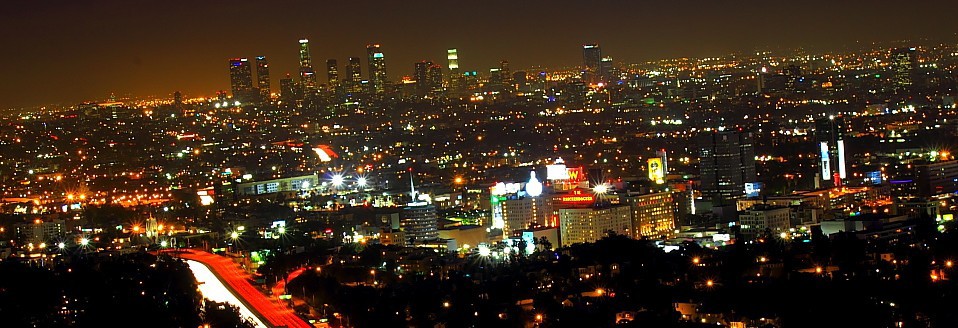
“Beacon (Los Angeles),” depicts her 7th story studio window view, sun high in the sky. “Wet Moon, Clear Path (Tucson)” leads viewers through saguaro cactus toward a large, beckoning, almost iridescent moon. Both works use “pyramidal compositions with the light source at the top, reflecting harmony and balance,” Frerichs relates.

CF 1

A sense of both stability and movement carries through her work, as does what she terms her “theme of light.” She uses light to refer to consciousness, aliveness, or a sentient state of being.

In “Bright Mist (Montauk),” low waves roll at the edge of the sea. A potent mix of blue, grey, and white, flecked with a sparkling aluminum leaf, the work offers a dynamic visual experience for the viewer. The painting took Frerichs two years to complete, and went through many different iterations. “It was as if the weather changed in the painting month after month,” she explains. “Sometimes it was clear and sunny, then I’d paint in the fog so densely that the horizon and three-quarters of the waves at bottom were lost, then it would emerge again.”

To the viewer, there is a shift in perception when viewing the work for an extended period, one which may be derived from the artist’s shifting of her own creation as she worked to complete it. “I hope it is experienced by others in the way that I experience it….in that it is a space at the edge of a calm sea, where it feels like you can stand firmly on the ground while gazing up into the beautiful bright flickering light of the sky.” The painting was inspired by a trip to Montauk, Long Island. “There were so many brilliant artists who have lived on Long Island for centuries and I could feel it in the air, see them in the trees, and thought about them while watching the calm Atlantic,” she says.

CF 6

Each of Frerichs’ works emphasize vibrate with captured motion; capturing a sense of sound in shimmering visual form.

CF3

“Some of my favorite painters, Arthur Dove and Kandinsky specifically, both had to come up with a visual language to describe something non-visual, something felt and heard, but not seen,” Frerichs says. There is the emotional quality of sound and music in her work, too. She feels that classical music functions in a similar way to abstract painting, using formal elements to create a non-narrative feeling. In her studio, she frequently listens to Bach and Chopin. “I am attracted to the complicated overlapping rhythms and themes, the rolling and relentless waves….really, it’s a lot like the ocean,” she asserts.

CF 7

Frerich captures an aliveness in her work that she hopes will speak to the aliveness in every viewer. “So whether my painting is more representational – a picture of the sea, or more abstract, like ‘Silent Night,’, which takes the title from the song, I’d like there to be a sense of movement in the material of it,” she says. “I want to give the viewer a dynamic experience, so that the paintings are appealing in a different ways when viewing them from 20 feet away, from 2 feet away, and from 2 inches away.”

CF2


Frerichs says she has been inspired by what she feels are the two most exciting moments in the history of oil painting, the Renaissance and Early Modernism. Viewers can see the influence of the Renaissance in her works, the dramatic light and dark and luminosity of the period, as well as the sense of triangular composition.

“These paintings are inspired by, and hope to recreate a feeling of awe, much like religious paintings of the Renaissance. So I am using light, whether it be the sun, moon, bright mist, or an abstract cluster of light paint in my work in a similar way that light has often been used in these types of religious or spiritual paintings,” Frerichs says. Her works evoke her own personal understanding of light, as a kind of consciousness and self-expression.

Early Modernism comes into play particularly with the artist’s palette. “In terms of color and material application, I’m most inspired by the earthy browns and blues and luminous pinks and peaches of Early Modernist painters like Arthur Dove, Georgia O’Keeffe, Courbet, Vincent Van Gogh and always, Monet.” Frerichs was also influenced by these painters’ representation of landscape.

CF4

“They each found a kind of inherent abstraction in the landscape, and brought it to our attention, whether it was Courbet’s paintings of waves, making them look more like strong static sculptures than liquid forms, or Van Gogh using the same active brushwork when painting the grass as when painting the sky, to remind us that air has life and movement too, even if we can’t always see it,” Frerichs relates.

Catch the wave of light. Klowden Mann is located at 6023 Washington Blvd. in Culver City.

Durden and Ray: New Space, Same Passion

Durden 4

Art collectives are a wonderful thing. They bring together and support groups of artists whose eclectic and powerful work deserves a showcase which it might not find with a solo approach.

Durden and Ray are one such collective, and they have recently made a move – from a loft space across the street on Santa Fe Avenue to a pristine, white-wall gallery in the same complex as CB1.

Above, left, Tom Dunn’s “Mesopotamia #36,” a marvelous mix of the abstract and figurative in oil. Alongside, to the right, the brilliantly textured acrylic on canvas of Jenny Hagar, “Roja.” Both leap off the wall, as different as they are well-matched.

Yes, the space is lovely and airy, the light dancing off the walls and works, but it is the art itself, and the passionate spirit the collective represents that shines.

Durden 5

Above left, artist Dani Dodge with curator Steven Wolkoff.

The opening exhibition in the new space, Round Won was curated by Steven Wolkoff, the show features artists: Dani Dodge, Tom Dunn, Roni Feldman, Jon Flack, Jenny Hager, Ben Jackel, David Leapman, Alanna Marcelletti, Max Presneill, David Spanbock, Jesse Standlea, and Alison Woods.

Durden 6 Durden 7

Above, Alison Woods with her “Utopia,” acrylic on canvas, we have geometric patterns and vibrating lines so intense that the canvas appears layered; there are elements that evoke a collage or puzzle pieces. Viewers see a city landscape that is exploding with flora and fauna.

Durden 3

Above, Allana Marceletti, left, near her “Daae,” a sculptural collage of found objects, acrylic, and metal on organza with seatbelt straps. Hang on for the ride. Next to her is Dani Dodge, whose installation, “Ashes,”  is comprised of glass containing the burnt ashes of articulated, written fears.  While very different conceptually, both pieces feature sheer, almost fragile visual depth, and pull the viewer into a landscape that is shimmery and mutable.

Durden 2

Durden 8

Max Presneill stands before his oil and enamel “RD 141.” Bold graphics and lines, shapes that stand entirely on their own yet coalesce into a vivid whole.  Presneill wants viewers to experience his bright, visceral work from the perspective of the “system of languages we call painting.”

Durden 9

Durden 10

David Spanbock’s candy colored acrylic on linen, “The Politics of Transformation,” is a dimensional, unique take on urban life and environment.

Durden 14

And what would an urban environment be without a few fire hydrants? Ben Jackel’s “Large headed hydrants (youth, middle age, elder) are stoneware and beeswax, and serve as a kind of ‘in memoriam’ to the vicissitudes of city life. The black color renders them tomb-like, yet the overall affect is lighthearted.

Durden 12 Durden 13

Durden 11

Jon Flack’s “Backyard Sermon,” rear wall, takes an entirely modern approach to an iconic American subject, the itinerant preacher. Juxtaposed with Marcelletti’s sculpture and Dodge’s installation, the three works make an engaging commentary on things both profound and redemptive.

Both collectively and through each artist’s work, Round Won is more than ready for prime time.

This will be a two-part opening introducing the 24 members of Durden and Ray  – Round Too, curated by Max Presneill, will open April 1st.

The show runs through March 19th. Hours are Tuesday-Saturday 10 a.m.-6 p.m.; Sunday noon-4 p.m. The new space is located at 1923 S. Santa Fe Ave. in DTLA.

  • Genie Davis; photos: Genie Davis

First Response: A Call to Artistic Action

3R1A2000

Curator Nurit Avesar created a rapid – or First Response to the 2016 election. Gathering artists with a mission, she pulled together a vibrant group show that is as lush and encompassing as it is politically potent.

The show, which just closed at Keystone Art Space,  included work by Elana Kundell, Janet Neuwalder, Kim Abeles, Bobbie Moline-Kramer, Peggy Pownall, Susan Kurland, Nicholas Coroneos, Nadege Monchera Baer, Kristine Schomaker, Scott Froschauer, Molly Segal, Kio Griffith, David Estrada, Marcus Durkheim, Sigrid Orlet and Avesar herself.

“The election hit us so hard, it was overwhelming. We feel so vulnerable and bombarded. Really, many of us couldn’t do artwork in the usual way, there was a push to do something,” Avesar says. “So I said, let’s do a group show, and it just came together. Some pieces are new for the show, and others were pieces that the artists already had which fit well thematically. For example, Nadege Monchera Baer does a lot of work about destruction, and Nicholas Coroneos work has a very cynical take on church corruption, on abuses of power in general, on the money behind it and that sort of thing.”

3R1A2006

Above, the vibrant deconstruction by Nadege Monchera Baer is composed of colored pencil and acrylic on Dura-Lar. The work pulls the viewer into the gorgeous wreckage and leaves her dangling. The title says it all “And Then…” a stunning emotional precipice.

3R1A2004

Above, the delicate, profound watercolor and gouache work of Molly Segal. The large scale of her works on paper makes the miraculous detail of her work even more exciting. A dream-like sadness touches her art, which expresses the wildness of nature –  nature that will, in the end, outlast man’s wildest foibles and strangest regimes.

3R1A1992

Above,  Scott Froschauer, whose rich sepia images are creating using gun powder of the same kind involved in the tragedies at Sandy Hook Elementary and in Memphis.

3R1A1996

3R1A1991

Above, Kristine Schomaker says “My current work is part of a new cross-platform project called “An Ode to a Lost Love” whose leitmotif addresses the de(con)struction of self in relation to society’s perception/projection/reflection of beauty. This work focuses on the complexities of gender identity, body image, and the societal privileging of women’s physical beauty over character and intellect.”

3R1A1989

Curator Avesar notes that “This show is about the current political situation and the realization that our most basic democratic ideals are being threatened, giving way to unapologetic abuse of power and special interests. As artists, we use images to articulate our first response to these uncertain times. Looking back into recent world history, we examine the use of propaganda to incite hate, blame others, spread lies and fear.”

3R1A1982

Above: Kim Abeles created a brand new interactive mixed-media piece for the exhibition.

“It felt very good to be busy having a conversation with people about what is going on every day. The exhibition is opening a conversation that’s on-going. I’m not sure if this is the only political show I will do. The artists felt sincerely compelled to do this one,” Avesar notes.

3R1A1980

Incredibly delicate and beautiful works by Susan Kurland above and below. The ethereal nature of the materials, both fabric and wax, add to the poignancy of the works.

keystone 2

3R1A1978

3R1A1975

keystone 3

Janet Neuwalder’s installation “The First 100 Days” are books which have, according to the artist, been unbound, unhinged, reformatted and made neutral by eliminating the powerful content of descriptive language. “Verbs, adjectives, and other words that shape the images we see when we read and convey information important to reader and writer, have been removed. …By limiting information for the reader, I start to control the flow of information.  This process takes time.  I found it difficult to change some of these books I cared about. They became forever changed.  I imagine, if books kept becoming ‘neutral,’ within a few generations, so much might  be lost. Perhaps, the painters would be the chosen ones to memorize the books and become the living memory banks of these books.”

3R1A1983

“This show started a momentum for us. We wanted to create a sense of empowerment from having a conversation together, and not feeling so isolated in the world,” Avesar attests. “We started the show before the Muslim ban and immigration executive order happened, but everything ended up being so appropriate,” she adds of her prescient exhibition.

3R1A1970

Above, Nicholas Coroneos. So many strings attached…

3R1A1968

Above, Avesar in the heart of her exhibition.

3R1A1965

Above, Kio Griffith’s old-fashioned dark room photos felt like an exhibition-must for Avesar to include. “The piece is done using traditional darkroom composite photography.  He created this piece using photos he shot while a recent trip to Japan. The complex nature of the black and white prints and their humanity resembles images from the 1950s, and yet the work is very contemporary. There is heaviness and beauty to them.” The title of the piece is “Who Can Say that We Can’t Live Like Dogs.”

3R1A1962

Above, Nicholas Coroneos. The sculptural piece says it well: we are cashing out.

3R1A1960

Above, left – Avesar’s own textured, raw abstracts speak of the outrage and fierceness of #resist. To the right, David Estrada.

Keystone 1

“Artists like to do things with their hands. This show is a gut-feeling show,” Avesar relates. “I started talking to artists in January, so this show was put up very quickly, some pieces were wet when we hung them.”

Perhaps this haste lends to the fresh, multi-faceted look of this exhibition.

Susan Kurland and Avesar collaborated on “The Making of America,” below, an interactive work. “People who came to the opening and visited the show put most of the ribbons up. The idea was to get everyone to participate in the making of this piece, which consists of multi-colored ribbons tied on a wire sculpture in the shape of the map of the U.S. It represents the many different cultures in America, and the nation’s multi-faceted and rich fabric,” Avesar says.

3R1A1998

“We wanted to end things on a more positive note, for people to stay informed and connected,” Avesar adds.

3R1A1984

Above, “Blaze” by Nadege Monchera Baer.

An important exhibition both visually and intellectually, First Response will not be these artists’ last word on our politics and our people.

  • Genie Davis; photos:  Jack Burke, Genie Davis

Eva Perez Artist Talk and Closing at the Neutra Gallery


We’ve written about Eva Perez before, and her stunning personal journey. Perez’ Fertile Infertility is a passion project, cathartic and visually astonishing.

Perez 13 Perez 11 Perez 3

In her closing talk, Perez addressed her complex use of materials: minute droplets of wax that drew bees into her studio…

Perez 17

The precision and delicacy of gold leaf…”There is always something beyond the suffering of the moment.”

Perez 14 Perez 1 Perez 3

The repeatable yet delicate resin sculptures…

Perez 8

the soft and subtle cellular shapes she created of cloth.

Her favorite medium may just be ink: she says she felt a peace, a zen-like pleasure in the swirling movements of her brush creating egg-like shapes as lush and meaning-dense as caligraphy.

She discussed her “obsession” with both the topic of fertility, her attempts to conceive, and her art as a conceptual process.

Perez has powerfully taken a fraught subject, laid bare her personal journey, and taken on a transcendent body of work that fascinates on a variety of levels.

Perez 10 Perez 9 Perez 6 Perez13 Perez 2

There is an inchoate longing that fills these pieces, a subtle and resonant beauty in the more abstract works that could be viewed simply on the basis of their rich patterns, their almost spiritual shapes. Her more figurative works glow with their own inner life, their own visual gestation.

Miss this show? Well don’t miss Perez. Her work will doubtlessly continue along the most fertile of creative paths.

  • Genie Davis; Photos: Genie Davis