Susan Lizotte: Mapping Out a New World

f23c1635According to artist Susan Lizotte, “A map is a lie, a beautiful lie.”

Her description, which ties together her new body of work, resonates. We map territories, we map our feelings and emotions, we look for a map of the human heart. We map political gains and losses, trips taken and planned, future goals, financial foibles. As a human species, we are driven to make maps: perhaps it goes back to drawing routes with a stick in the mud, proclaiming or claiming the best hunting trails, the best berry patches.

f23c1638

How much of what we design, whether it is as exhaustive as Thomas Brothers map books of Southern California – remember those? Before Google maps and Waze were ubiquitious? – or as scant as a sketch on the back of a cocktail napkin, how much is empirically real? And can a map ever be ‘real?’

Sure, a rock is a rock, an island an island. But what it is named for, consigned to, defined by – that is an illusion. If there were no more cars on it, would the San Diego Freeway be a nameless artifact? If it floated from the land, unmoored, and sank to the bottom of the sea, what would we call it then? Would we simply pretend it didn’t exist?

lizotte-older-1

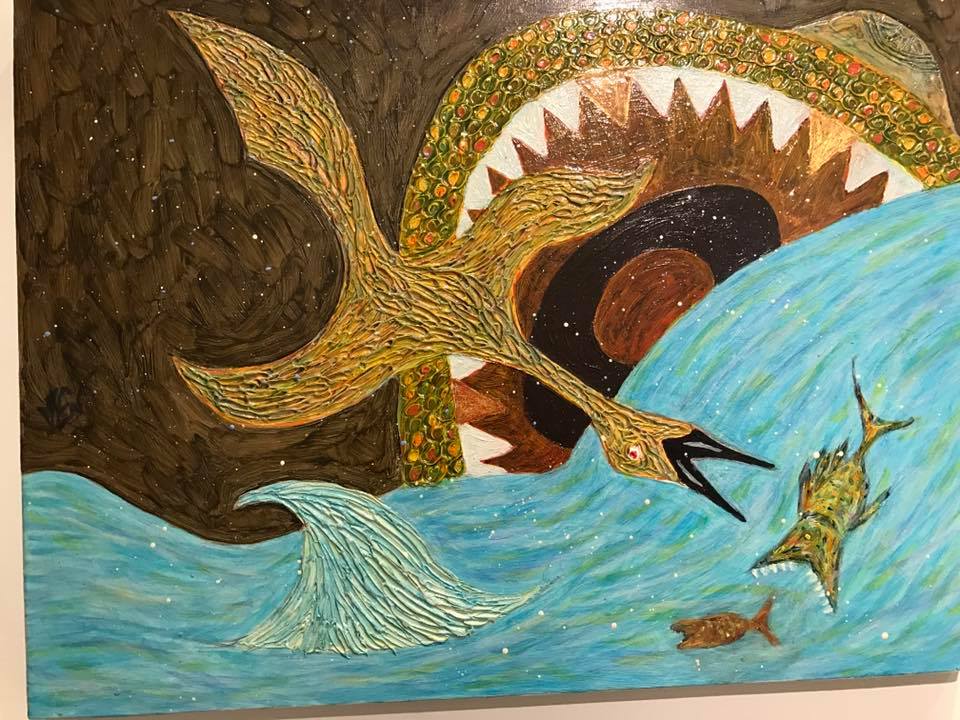
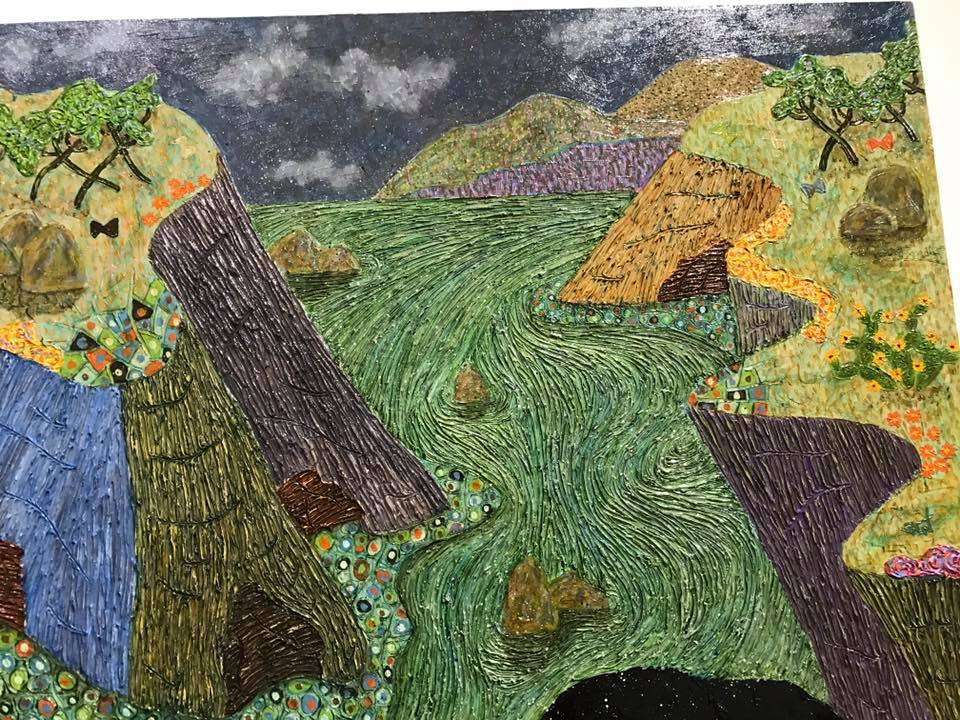
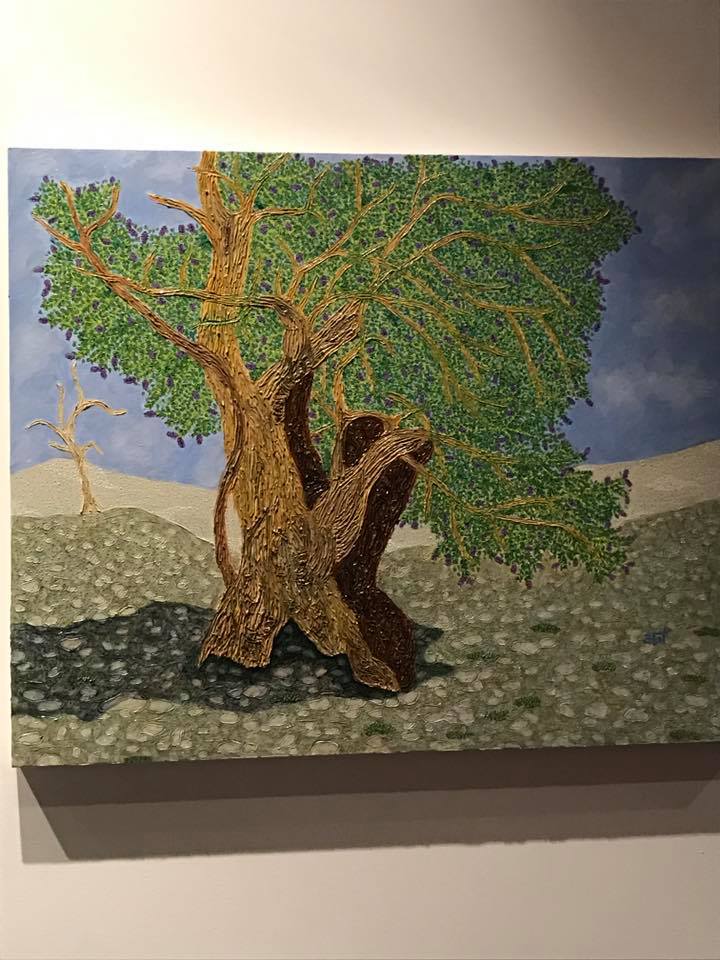
An artist and curator, born in Los Angeles, Lizotte spent her childhood on both east and west coasts, and founded her own business as a designer of bespoke custom shirts and suits; precise creative work that has perhaps found a new form in her latest series of paintings.

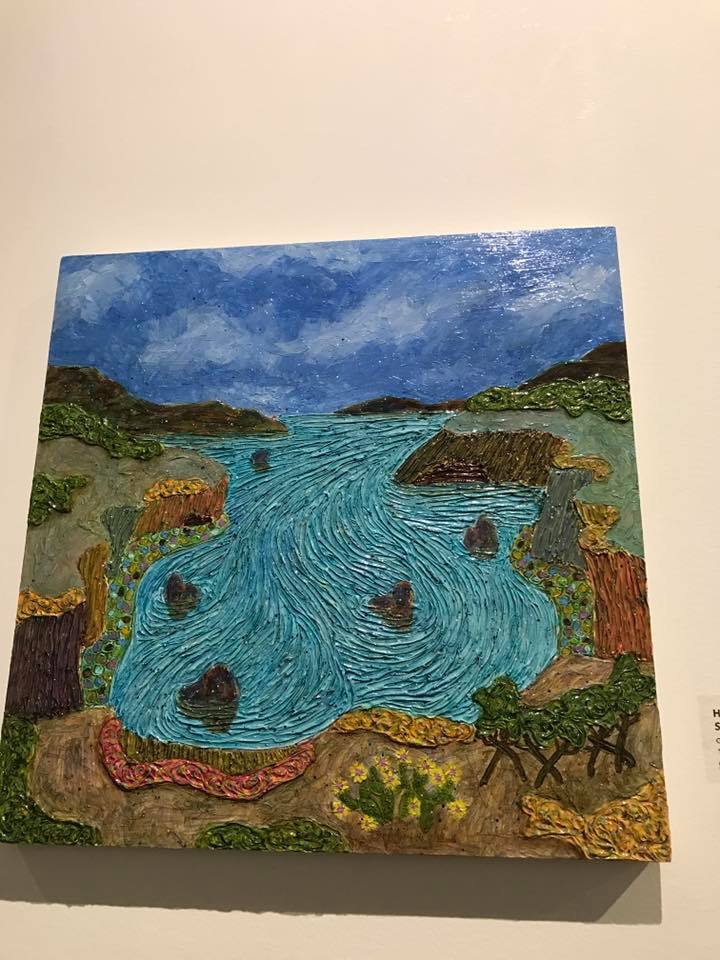
Over the years, Lizotte has created gorgeous, evocative landscapes and skylines, abstract pieces that glow with hidden light, and her recent Mercury series, a powerful body of work that revolves around the discovered and undiscovered since Columbus “found” the New World.

lizotte-older-2

His treasure hunt may have served as a stepping stone for the artist to move beyond the specifics of his annexation of a land already inhabited. For her, “Maps are one of the oldest ways of nonverbal communication and are a way to tell a story. Each map is a visual metaphor for identity, politics and propositions.”

Acknowledging that no map can be perfect through our own personal points of view and the very real physical distortion of our planet, she terms map-making a “subjective act of selection,” one which can be based on global navigation and imperialism.

Because of this subjectivity, Lizotte postulates that what is not shown on a map can be just as important as what is shown. “Above all, maps speak to emotion over reason and articulate our place in society and the world,” she notes. “For aren’t we always searching for who we really are?”

From a less weighty perspective, the artist adds “Visually, maps are really fun, a way to tell a story.”

lizotte-all-maps

She tells quite a potent one with her 12 x 12 series of oil on wood panels, New World I – VIII, which form a continuation of the work she began with her Mercury series, playing with the use of power and maps.

“The more people who decide what is included in the making of a map, the more distorted it will be, the less accurate. People decide together the things to be excluded and included.”

lizotte-new-world-viii

Seen together as one organic installation, these smaller works play off each other, they seem intense and immediate, both as visual forms and as maps.

lizotte-new-world-viii-a

As a viewer, I see a mix of islands, continents, bodies of water; the artist explains that she was led to the idea of creating a new world. “I could play with the ideas of the journey and what might be at each location,” she explains. “Visually the pieces could breathe if I introduced some space in each of them.”

These maps each stand repeated introspection as individual pieces, as well as being part of a comprehensive series, as she moves from a more realistic interpretation of map design in New World I to her most abstract in New World VIII.

lizotte-new-world-iv

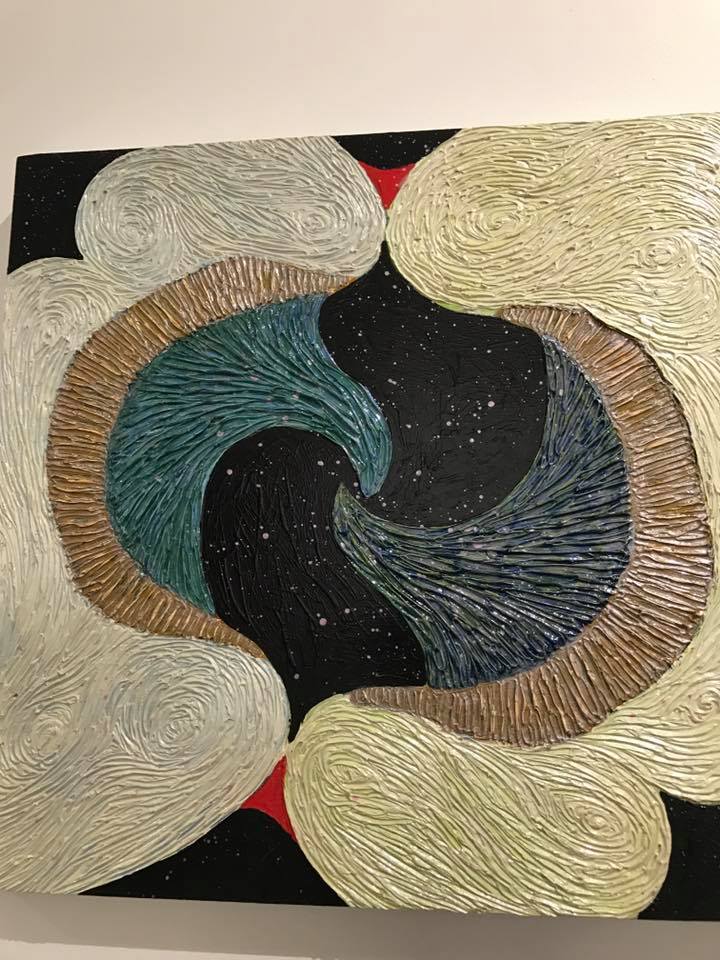
Each piece has its own specific palette, pattern, and meaning. In New World IV, above, Lizotte says “I was playing around with the idea of Columbus, his ship hitting Hispaniola, the fact that the Santa Maria sunk on Christmas day offshore in the Caribbean. The thought I’m working with here is where they might’ve come in when they were hit, who was on the island, and then an image of the ocean lurking at the bottom of the canvas.”

The artist’s mention of the holidays stands out: there are red and green elements that remind the viewer of holiday colors, and land masses in the shape of wreathes or crescents. The waves in the right corner of the painting can be viewed as either isolated or creating the whole of the background, forming an ambiguous and fluid design that ties in well with the “what-ifs” of the subject matter. What if the ship had not sunk?

lizotte-new-world-vii

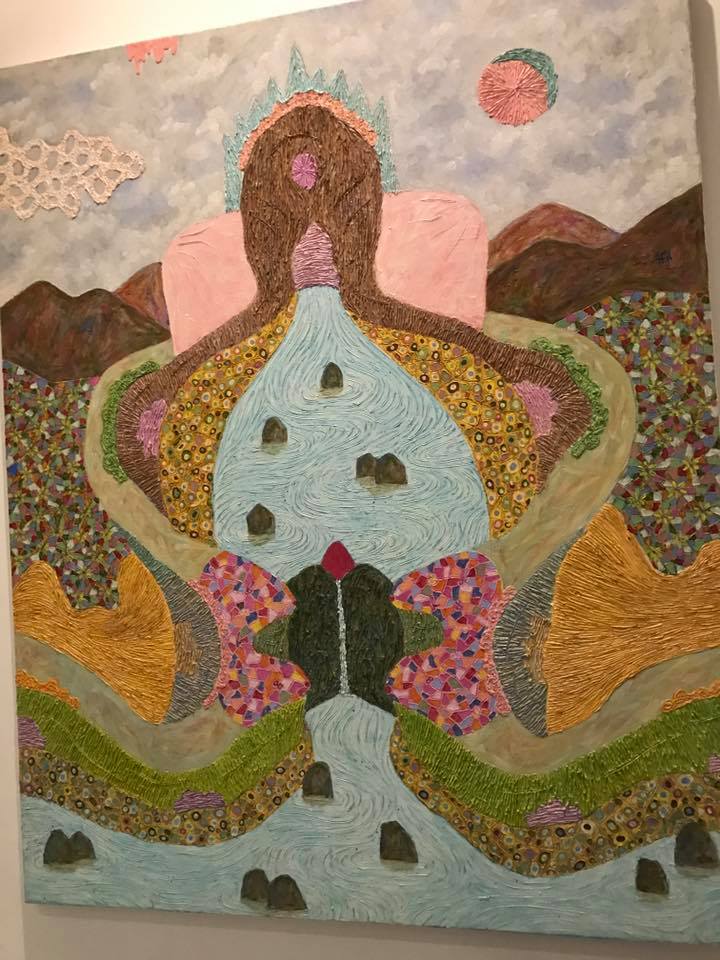
The decidedly pink palette of New World VII, above, reveals the concept of land masses grouped together yet separate. “When I was painting it, originally I’d held it in a completely different position to the way it is hung now, but there was no flow there,” she says. Changing the aspect of the wood panel, there is a very visual sensation of movement. “The yellow represents imperialism, the seeking of gold and treasure,” she relates. “The blue patterns evoke migration and motion, nothing specific.”

As a viewer, I see blue birds, pink sunset, and a pale blue water current pulsing over the solid forms. The thickness of the paint is enticing, in a piece that absolutely creates it’s own mythology of land, water, motion, and seeking.

“I layered the paint thick all summer. I was really excited that it was working, and it was humming,” the artist attests. “I wanted it to be wet on wet, flowing together, patterns, yet completely crisp, completely dry.”

lizotte-new-world-i

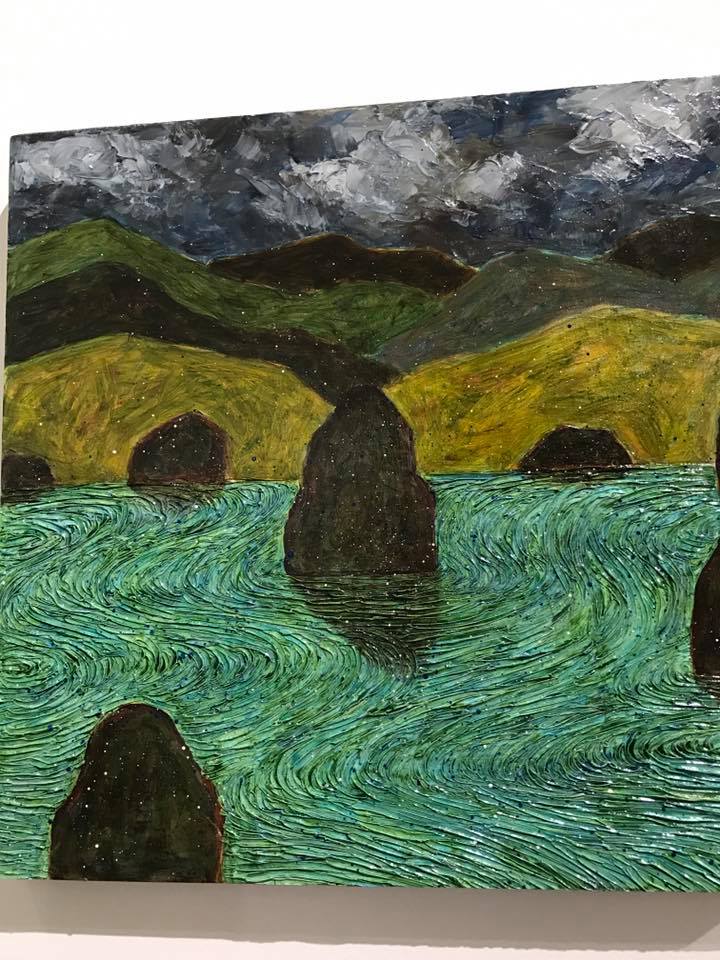
The first in her series, New World I, above, is markedly more specific in its design. “I really had the concept that I can paint a map, hold it in my hands, make up the topography, and see how that went,” she says. “Columbus and the imperialists took their journey, but I can represent that journey any way that I want. I was looking at old maps, the map keys from the Middle Ages, and not even knowing what they meant, making up my own symbols to conceptualize the journey,” she says.

lizotte-new-world-ii

With both New World I and II, above, you can tell that the background of each piece is clearly water. “It was interesting to me what happens if you take that away. To me, if it wasn’t blue or green, then the background changes and distorts the map, and you just go with that in terms of paint and point of view.”

lizotte-new-world-v

With New World V, above, for example, the background is salmon, and the green topography wildly thick, as if mountains have sprung up on the canvas. Here, she includes blue arrows that she’d originally conceived of as water and currents, but could, she says, be “air or anything that moves.” Red patterns on the painting appear to have the rough configuration of Asian lettering. “Columbus was originally trying to reach the Far East, so certainly the red patterns could unconsciously represent that,” Lizotte laughs.

lizotte-new-world-iii

Whatever the journey you’re on, take a moment to savor Lizotte’s delicately beautiful and intimate trip. Maps themselves may very well be lies, but this artist’s paintings have the poignant and beautiful ring of truth, the truth of sunsets in forgotten places, treasure sought and found, greed and indecision, magic travels to distance lands and foreign thoughts. It is the stuff of memory and imagination, which is really all one can ask of any map.

These works and others will be on display in November and December, in three shows in the SoCal area, a part of MAS Attack 13, at the Torrance Art Museum in Torrance, Oil vs. Acrylic at the Las Laguna Art Gallery in Laguna Beach, and in Portraits, at the Beyond The Lines Gallery in Santa Monica’s Bergamont Station. Come December, she’ll be exhibiting with BG Gallery at Spectrum-Miami Art Fair, as part of Art Basel.

  • Genie Davis; Photos: Jack Burke and provided by the artist
Gallery 825: Countenance Divine plus Stellar Solo Shows

oscar-lite-boxes-1

Above, from The Shrine of Stolen Identities

The Los Angeles Art Association’s Gallery 825 often hits it out of the art ballpark with their well-curated solo and group shows. Running through November 18th, the La Cienega gallery offers three solos and one group show that is definitely a home run.

In the front room, Countenance Divine is a multi-media exploration of portraiture in art. Ranging from photography to graceful watercolors, the show was juried by Rick Royale.  Participating artists include Robin Adsit, Robyn Alatorre, Susan Arena, Donna Bates, Maria Bjorkdahl, Ivan Bridges, Annie Clavel, Allan Denolo, Tina Frugoli, Rob Grad, Vicky Hoffman, Brittany Hutchinson, Lynda Keeler, Coolen M. Kelly, Gershon Kreimer, Campbell Laird, Jun jii Le, Theodosia Marchant, Lena Moross, Malka Nedivi, Julio Panisello, Justin Robinson, Ann Marie Rousseau, Sheli Silverio, Howard Steenwyk, Susan Swihart, Jane Szabo, Devin Thor, Ariel Vargassal, Iben G. Vestergaard, Peter Walker, and Diane Williams.

f23c1987

Lena Moross, whose method of working is usually to create a series on a specific subject, was captivated by the Carmine Messina after meeting him, heavily made-up and dressed in women’s clothing, on a Hollywood street corner. Through that meeting, Moross began to explore, with her subject, what it means to be transgender. Exhibited here is a piece from that series, “Red Pillows,” delicately drawn and vibrantly colored. Using watercolor and ink, Moross has created a intimate and sensual painting that respects and pays tribute to Carmine’s story.

f23c1968

According to fine arts photographer Jane Szabo, “Photographs of dresses made from familiar objects such as coffee filters and road maps, suggest a persona, and become a stand in for myself.” This is a unique version of the self-portrait, which invites viewers to form their connections and myths.  The digital photography archival pigment print displayed here is “Money,” from her series Reconstructing Self.  The money dress and money beneath it is a fascinating stand-in for that part of the artist that must, as we all must, seek renumeration for our work to thrive.

F23C8437

Robyn Alatorre’s “Canto VI,” oil and ink on canvas is a portrait of a different sort, one that is as controversial as it is riveting.  Alatorre calls her work “feminist, subversive, and obsessed with color.” The neo-surrealist here depicts a couple with fingers in their throats, attempting an antedote to gluttony.

f23c1964 f23c1967

Malka Nedivi’s “The Bride” is embelmatic of her work as a painter, sculptor, and collage artist.  Nedivi says that all of her work is inspired by her mother, and both her parents’ previously unknown past as Holocaust survivors. Nedivi’s work uses a great deal of wood and fabric. Here, the large scale mixed media on canvas work features a bride whose bountiful skirt is the color of autumn leaves, and asserts in its own passionate way a presentation on the passage of time.

f23c1971

Diane Williams photographic work, a photo from the performance of “Monsters & Aliens #2” is a look at just who we are and what we hide behind; Sheli Silverio offers a beautifully drawn watercolor and oil, “Sharing Cereal” that evokes an untold intimacy.

f23c2012

Annie Clavel’s lush watercolor on paper, “Lui,” differs from the work we’ve been familiar with that features mixed media on canvas paintings and a preference for the abstract.  Here we have a narrative figure, a profile portrait that is both haunting and pastoral.

f23c2046 f23c2039

Moving on to the solo shows on exhibit, Zeal Harris offers a series of stunning works created in dye sublimition on fabric. Home Remedies for Driving While Black is both political and poignant, an autobiographical and biographical statement that has universal reach. Dealing with the intensely pertinent subject matter of police brutality, police killings, and racial profiling, Harris approaches the weightiness of her sculpture with a delicate, light touch, one that resembles the creation of banners, tapestries, and animation cels.

f23c2043 f23c2041

Her deftly accessible style draws viewers into a world that they may not personally know, but which her incisive commentary virtually insists they become immersed in. A raw and riveting show.

f23c2008

In the middle room, Bibi Davidson’s The Girl in the Red Dress continues the artist’s use of her intense primary color scheme and an alternative universe in which her stand-in, her “girl” represents the artist herself. Davidson’s work always enthralls: for more on this stunning solo show, read the details on the artist’s movement into some incredible three dimensional works at Art and Cake.

f23c2031 f23c2032

The Shrine of Stolen Identities explores the diversity that exists far beyond our collective obsession with celebrity culture. The collaborative duo “steph ‘n snez,” artists Stephanie Sydney and Snezana Saraswati Petrovic offer an immersive multi-media installation designed to dazzle with an homage to unknown artists who made the trek to Hollywood seeking fame and fortune, and to their unique individualism.

f23c2024 f23c2023

oscarettes-2-close2

A performance component was a highlight of the opening October 15th, and will be offered again on Saturday October 29th, when at 4 pm, will enact a 15-minute performance,  a re-imagining of a Buddhist sand mandala producing a glittering replication of a Hollywood Walk of Fame star on a mirrored table. The artists wish the Buddhist ritual of impermanence to speak to the impermanence of the values that our celebrity-obsessed culture indulges.

f23c1970 f23c2016 z-gordtinski-suitcase-sm

So — go for one, go for all. Gallery 825, located at 825 S. La Cienega has a divine countenance indeed this month.

  • Genie Davis; Photos: Jack Burke


Gabba Gallery: Can’t Shake the Bunnies
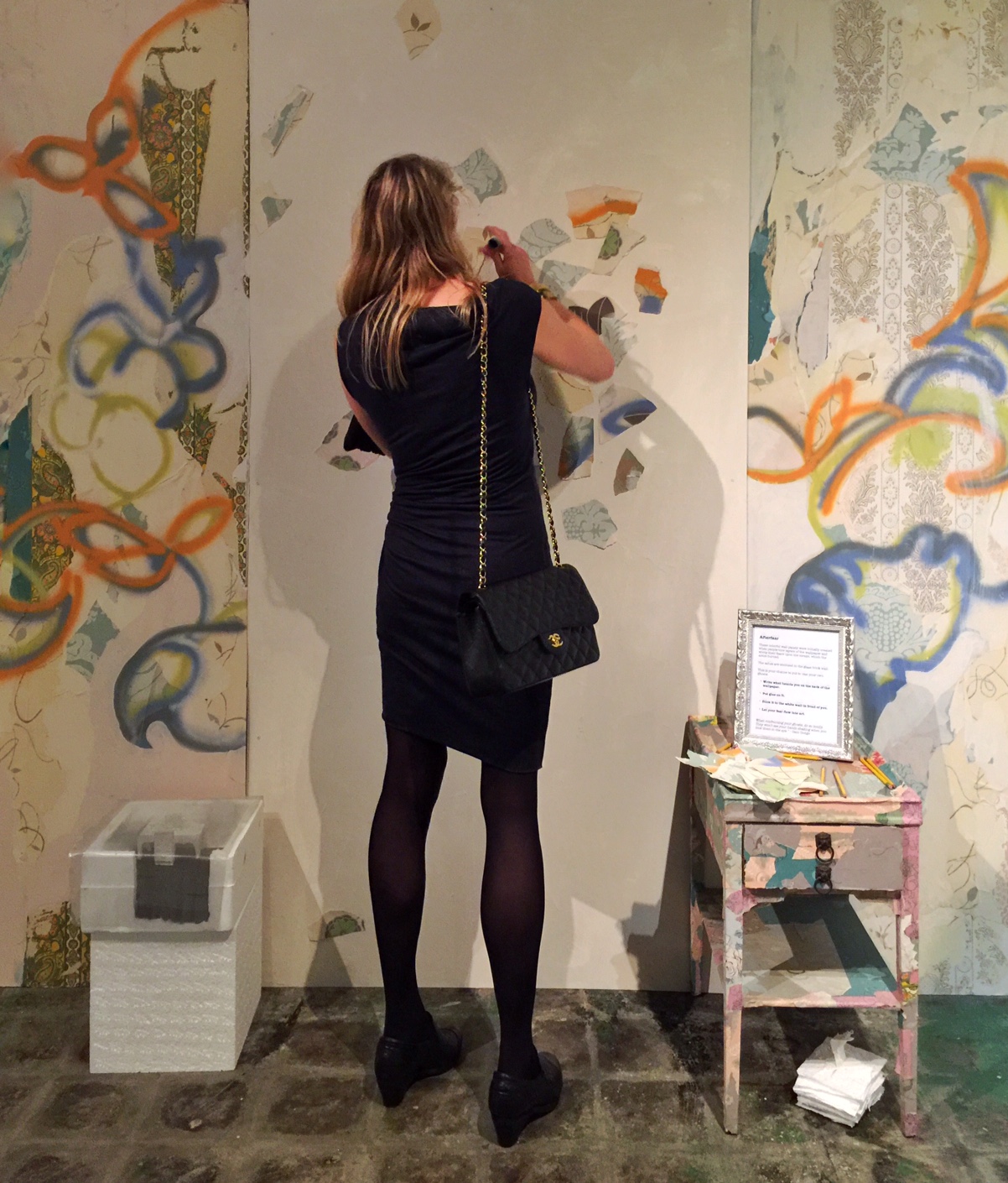
Gabba Gallery will be opening a new show, Wishlist, November 12th, and you mustn’t miss it. There is always a fresh take on art and the meaning of art as discourse at this east side location.

We hope you caught the terrific four solo exhibitions that ran late September to mid-October here – if not, these are artists you should or will know, and most have appeared at Gabba in other shows.

Shift and Fade: Ecstatic Art Adventures at BLAM


f23c1766

Above, curators Dani Dodge and Alanna Marcelletti

BLAM is always the place to be for edgy, interesting work, and that is certainly the case with the current exhibition, where the artists works are clearly their passion, filled with creative intensity palpable to viewers the moment they enter the gallery space.

Shift and Fade, the latest exhibition at the always fascinating BLAM – Brooklyn Los Angeles Meet space in DTLA is a vibrant mix of large-scale installations and 21 small sculptures. One of the most fascinating aspects of the exhibit is the fact that quite a few of the artists participating with sculptural works have worked in 2 dimensions only previously.

f23c1768 f23c1770

Above, artist Tom Dunn with a piece from his series based on a fascination with film memorabilia. The piece is titled Margot Robbie Panties Infused Vodka.

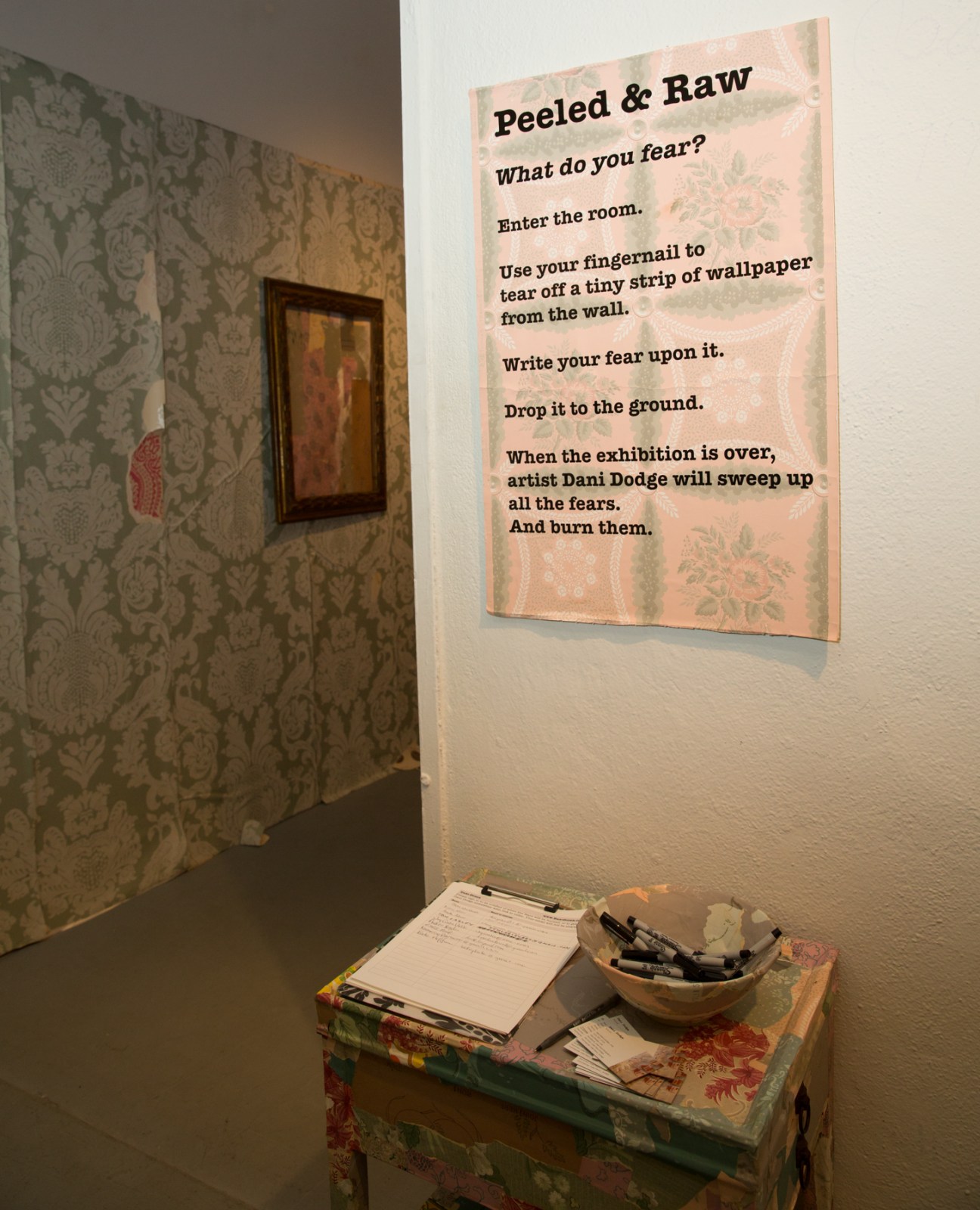
The dimensional aspects are certainly not the only part of this absorbing show that merits consideration: curated by Dani Dodge and Alanna Marcelletti, the artists here were encouraged to use their works as emblematic of their personal identities.

f23c1703

Erika Lizee dazzles with a 12 foot site-specific sculpture that is partially created on the gallery’s wall space; Fran Siegel’s woven drawings fill the back room,  Hugo Heredia Barrera works with a dazzling display of fused glass and wire. Using unusual materials and common ones, the artists present a cumulative exhibition on identity and the way in which such identity shifts with time and in the process of creation.  

Everywhere one looks, there is a different, glowing piece.

f23c1798 f23c1791 f23c1786 f23c1732 f23c1727

f23c1736 f23c1734 f23c1724

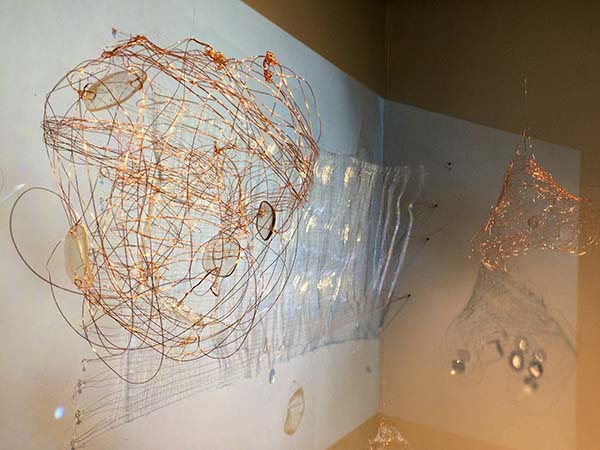
Hugo Heredia Barrera says he has worked in glass for over 25 years. “My idea is to exploit glass in very different ways fusing with wire cable. I untwist the wires and fuse them between glass inseide a furnace, shape it, drop it on the ground and hammer it. This piece is from a series called Floating Souls. I work in light and shapes.” The artist notes that whenever he is asked to do an installation he visits the space and plays with the idea of light and shape. “I hung this piece from the ceiling beam here, if I had other beams I would have expanded it differently for the space.” Heredia Barrera created his art form initially accidentally when a piece did not turn out as it had planned and he threw it in the dumpster, it fell and broke. That fortuitous accident led to the creation of his unique artworks now.

f23c1745

Alison Woods also hangs her work here from the rafters. “I’m really a painter, but Dani carried me into the show and said I had to make a three dimensional sculpture. It’s the Greek goddess Ares, the goddess of discord, and element from a painting. I used paper mache and acrylic paint. It seemed like something I could do, remembered from my childhood and lightweight enough to paint and hang from the ceiling.”

f23c1751

Kristine Schomaker cut up eighteen years worth of paintings using a box cutter to create her rich and evocative stacked work. The act of cutting and altering past works is something of a overall transition for the artist. “The paintings here were cut to be 12 x 12. My work lately has been about reconstructing beauty,  so I wanted to approach the cutting here almost like plastic surgery,  reconstructing something that was beautiful before I started.”

f23c1738

Erika Lizee painted the blue portion of her stunning sculpture in her studio, on clear artist-grade acetate. The grey portion was painted directly on the wall at BLAM. “It took two days. I start with a big drawing and cut the acetate into dual shapes,” she relates.  Titled “Seed of Life,” the piece “ties into sacred geometry…representing the time before you’re born and the tangible versus unintelligible, what happens to us before birth or after death.”  The piece appears to go inside the wall, a physical manifestation of the mysteries she is presenting thematically in this unique and beautiful piece.

f23c1761 f23c1764

Fran Siegel created her works entirely of paper. “They are all about locations and reconfiguring drawing as a way to take things apart and put it back together. There are a variety of perspectives and moods. All three pieces were created based on three different continents, with different vantage points and reconstructions.”

f23c1757 f23c1754

Alex Kritselis created a gorgeous video piece. The diminutive work is hardly small in scope, revealing the image of a snake in the roots of a tree with a “video image manipulated to look like a line drawing. Originally the video used was a close up of a filmed snake pit,” the artist explains. The piece is evocatively titled “Before the Descent. ” A revelatory piece.

f23c1747 f23c1749

Steven Wolkoff wrote a word – message – in acrylic paint and placed it inside a glass bottle. “It’s like putting a miniature ship in a a bottle, the word is a little bigger than the opening but it bends, requiring some time and patient. It needs to be wet enough to bend but not too wet.”

f23c1695 f23c1688 f23c1676 f23c1667 f23c1664

Beatrice Wolert created a live work. The Brooklyn-based artist used plastic cake decorating bags containing paint to create brilliantly colorful “living” sculptures. Puncturing the plastic, the drips on the ground covering below that will firm up in consistency over the course of the exhibition she considers to be “representing Los Angeles as the paint forms on the ground.”  Beautiful to see it as it happens and to see the end result. “I am using paint as a symbol of the artists in Brooklyn and Los Angeles.  I enjoyed filling up the bags, the process of filling. The colors are the colors of nature using the Pantone matching system. They’re memories of a sumer garden in bloom. I studied the plants in the Bartow Pell Museum,” she relates. “The color matching system is based on the colors of bird feathers.”

f23c1778 f23c1779

Nadege Monchera Baer took some of her drawings, laminted them, cut them. The resulting work resembles a sea creature. “It was in my studio, I drew it on dualar and I assembled it.”  The untitled piece inspired the artist to create other pieces in a similar fashion. “I want to do more of this, laminate different drawings. I love the possibility that the door has maybe opening to doing something else with my work.”

f23c1775 f23c1772

Jennifer Celio created a sculpture using “all of the pencils I’ve used in the last ten years. I couldn’t bear to throw away the stubs. My dad did the same thing,  he had a jar of pencil stubs. There are 360 stubs in my piece that includes a wood panel and acrlic paint to create the hexagon pattern. I’m glad I saved them all those years,  I wouldn’t get of them,  and now I’ve made art from them.”

f23c1782 f23c1785

Lena Wolek created sculptures that utilized different parts of her background. Fur which is an important survival aspect of life in her birthplace of Siberia, porcelain that “represents a porcelain factory that five generations of my family worked in.” As always, this chameleon-like artist works in materials we have not seen her create in previously. Her versatility is matched by her ability to create beauty from diverse materials.

f23c1718 f23c1799

Co-curator Alanna Marcelletti created a piece that expresses her self-transformation into a mother. “The figure is carrying sage because you become a shaman as you become a mom. It’s a full circle piece linking a period from my 20s to now.”

f23c1720

f23c1802

Kio Griffith employed blueprint film found in Japan in an area affected by the tsunami. “It’s part plastic, part paper,  treated with bleach that east away at the plastic to reveal the paper. The double image is about my heritage which is half Japanese,” he asserts. “It’s about a story I got fro my mother, in which my grandfather, in the Japanese Imperial Navy was in the same battle as my uncle in a submarine. On the same battleground, my grandfather shot at my uncle. I’m combining the different blueprints of these different ships from different nationalities, depicting an area where lines meet…” and lives intersect.

f23c1710

Co-curator Dani Dodge incorporates Tab cans and sleeping pills in her work. “The piece is talking about when I was young, and I never expected to live past age 23, and when I did, I had to make decisions about my life. I had a difficult time as a young person and a single mom, and had a lot of unexpected things happening in my life.  So many people think about chucking it all when there are so many adventures ahead. You can live through troubled times and have incredible adventures, you just have to know it’s going to get better. This is a piece saying it really does, even when you might think it won’t happen,” she attests. “As more curator than artist here, I created this using materials as a metaphor for personal history.  Everyone here had a personal stake in the show. I think that’s really what speaks to people here is something true and honest and beautiful.”

f23c1804

f23c1758

Other highlights includes a sculptural version of David Spanbock’s rainbow colored abstract work, above.

Exhibiting artists include: Nadege Monchera Baer, Hugo Heredia Barrera, April Bey, Arezoo Bharthania, Debbie Carlson, Paul Catalanotto, Jennifer Celio, Dani Dodge, Tom Dunn, Kio Griffith, Jenny Hager, Pete Hickock, Alex Kritselis, Erika Lizée, Alanna Marcelletti, Bhavna Mehta, Kristine Schomaker, Delbar Shahbaz, Fran Siegel, David Spanbock, Jesse Standlea, Camilla Taylor, Vincent Tomczyk, Joe Wolek, Lena Wolek, Beatrice Wolert, Steven Wolkoff, and Alison Woods.

Truly, honestly beautiful: that sums up Shift and Fade. Go see it before it closes October 30th. BLAM is located at 1950 S. Santa Fe Ave. #207 in DTLA’s warehouse district.

  • Genie Davis; photos: the brilliant Jack Burke