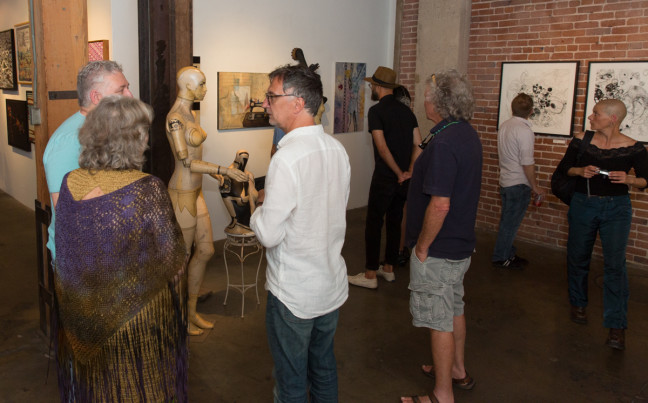
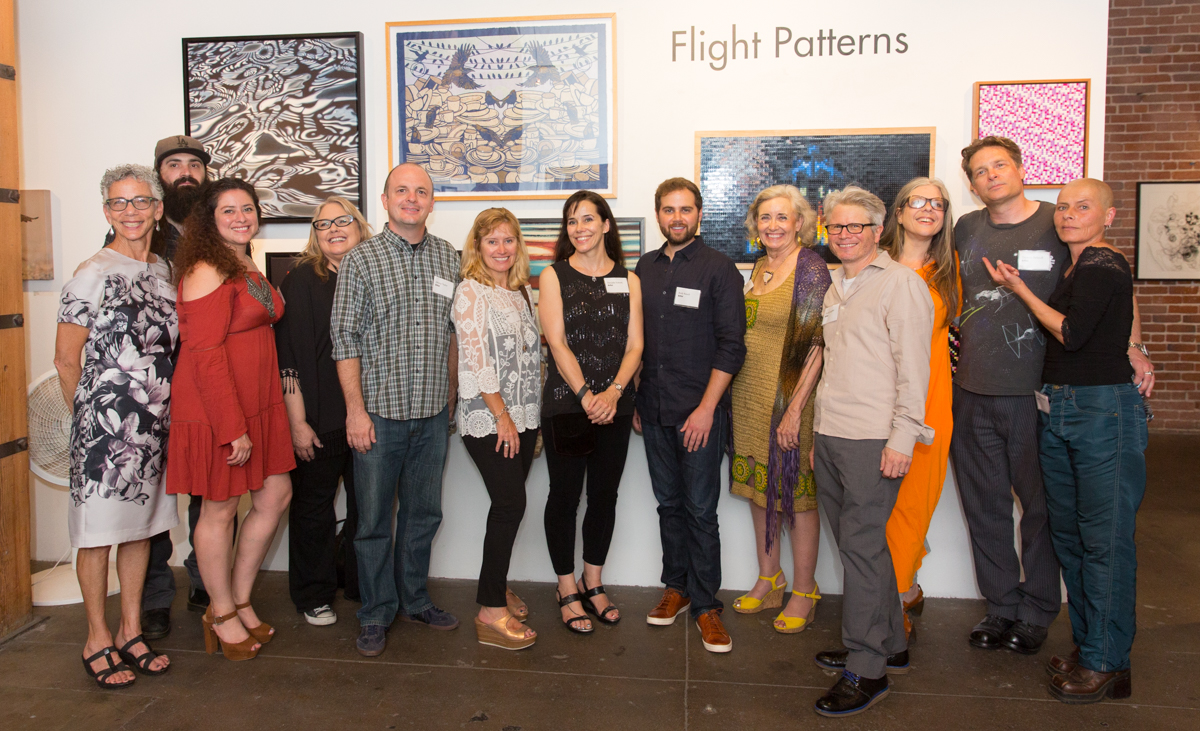
The artists are ready for take off.

This is a great show. Filled with exciting, eclectic art that fits the categories of flight or patterns or – flight patterns, you won’t need wings to feel uplifted by this truly marvelous thematic group exhibition.
The show closes July 23, so get your metaphorical boarding pass and enjoy.
“From aerial photography to the fractal trajectories of birds taking wing, the alchemical mathematics of the human genome and the majesty of sacred geometry, the symphonics of computer code and the fundamentals of design — the human mind is tireless in its quest to recognize resonance of the micro and macro principles that organize our world.” This curatorial statement sums up the varied beauty of the show. DiversionsLA had the privilege of meeting many of the artists and seeing all of the exhilarating works on exhibit.
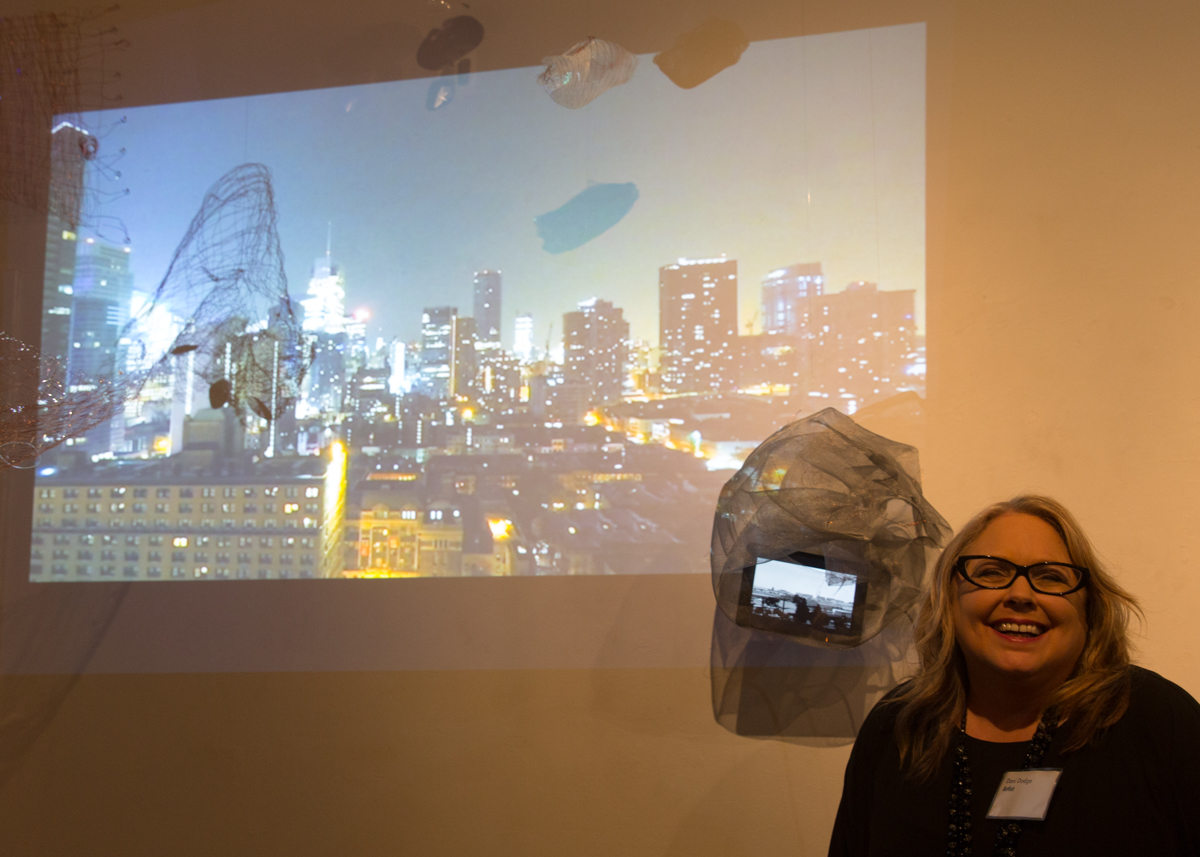
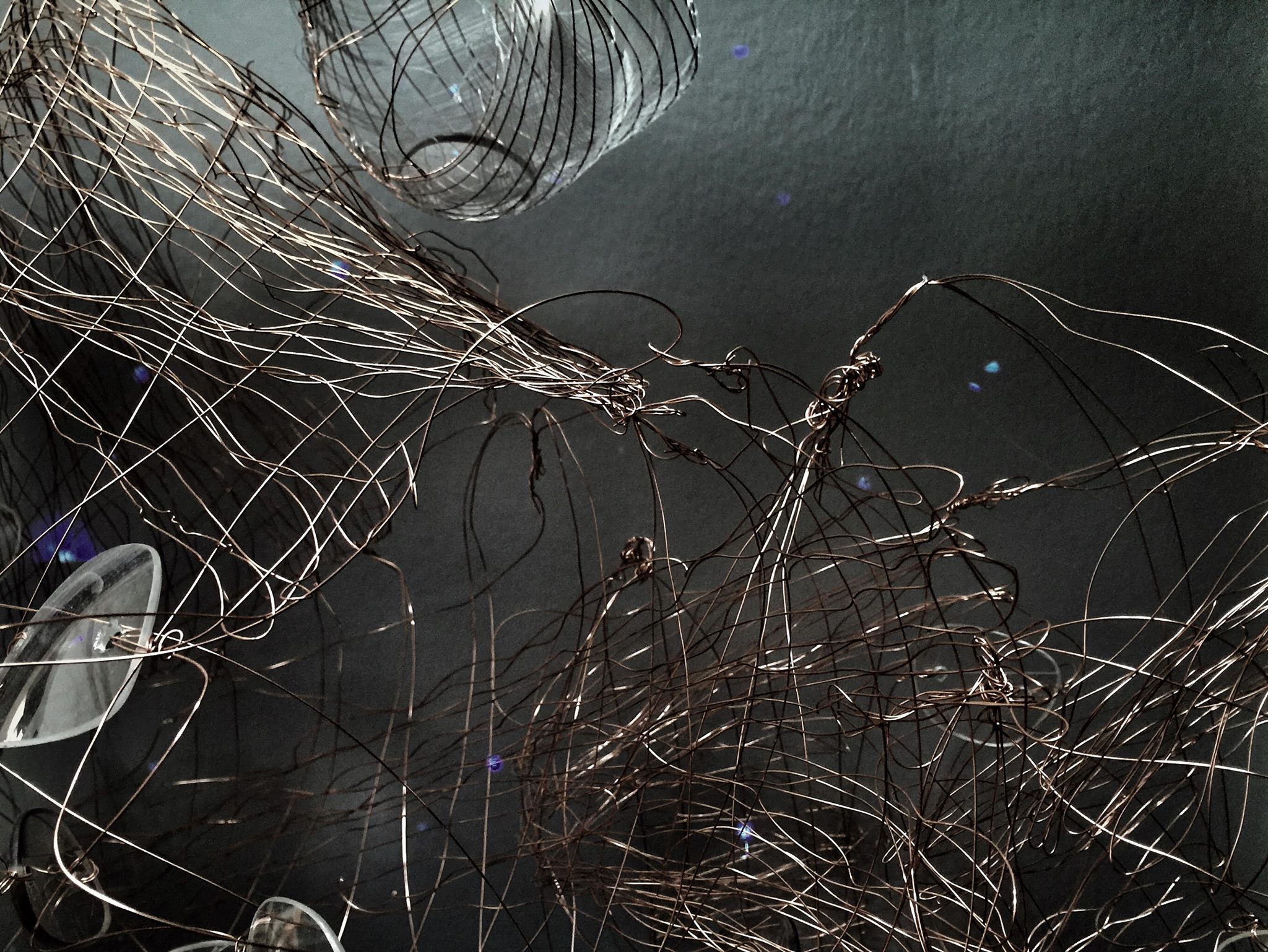
Dani Dodge, above.
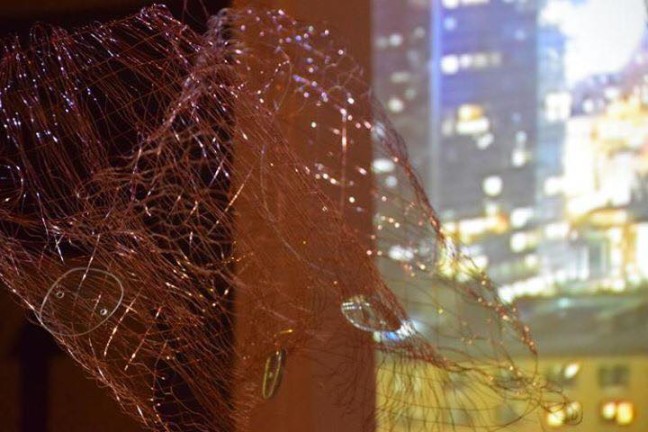
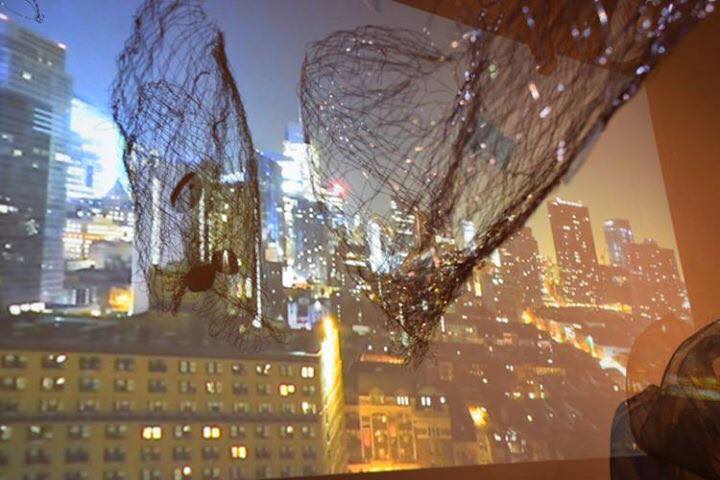
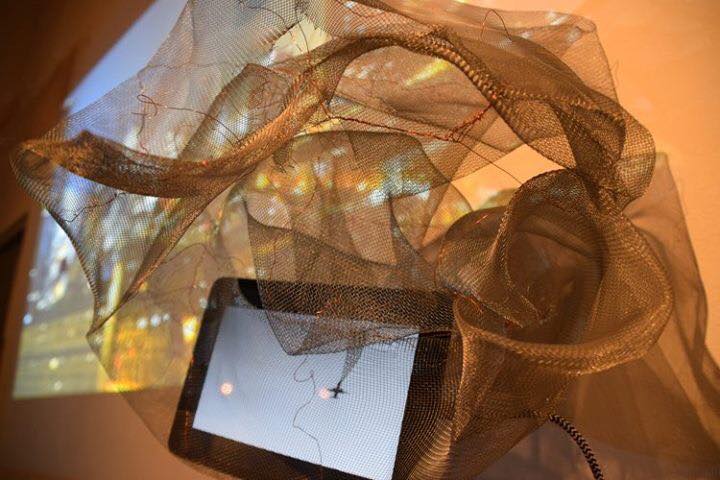
The title of this installation is Cumulus, Cirrus, Stratus. Video images of the desert, New York City, and airplanes are combined with delicate wire mesh and eyeglass lens sculptures of clouds.
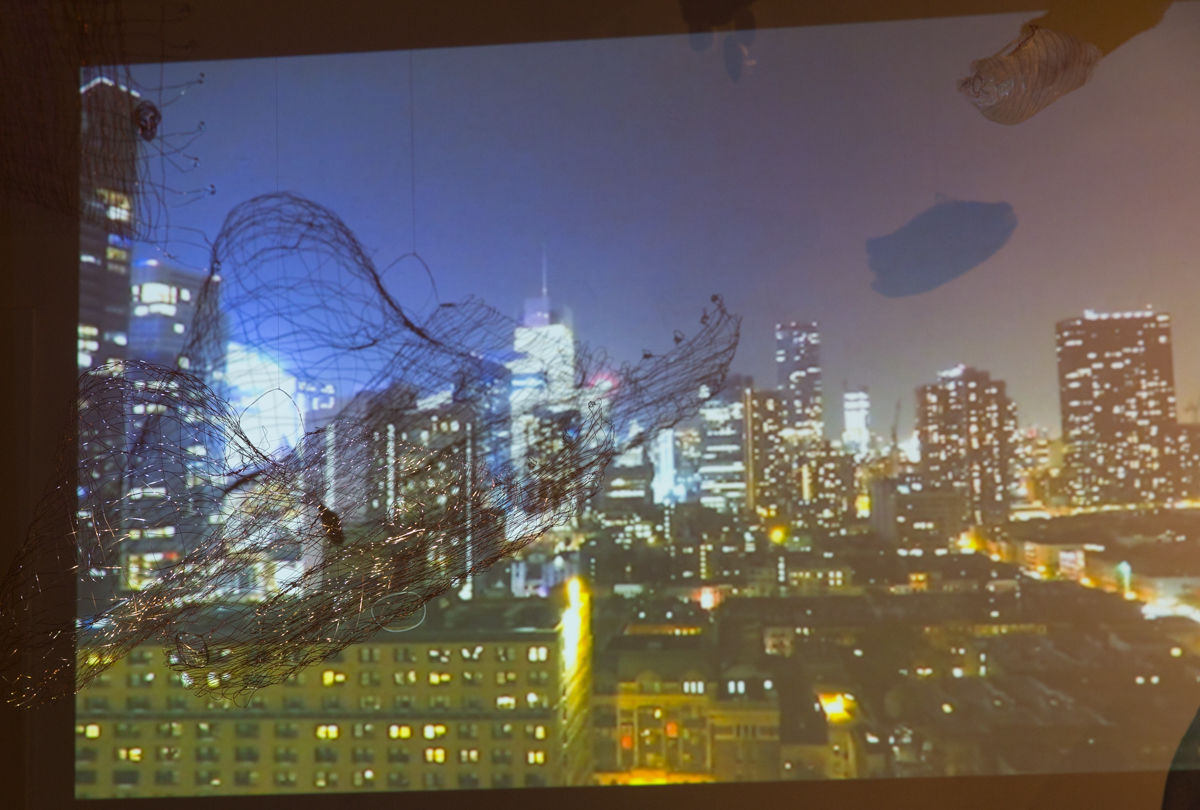
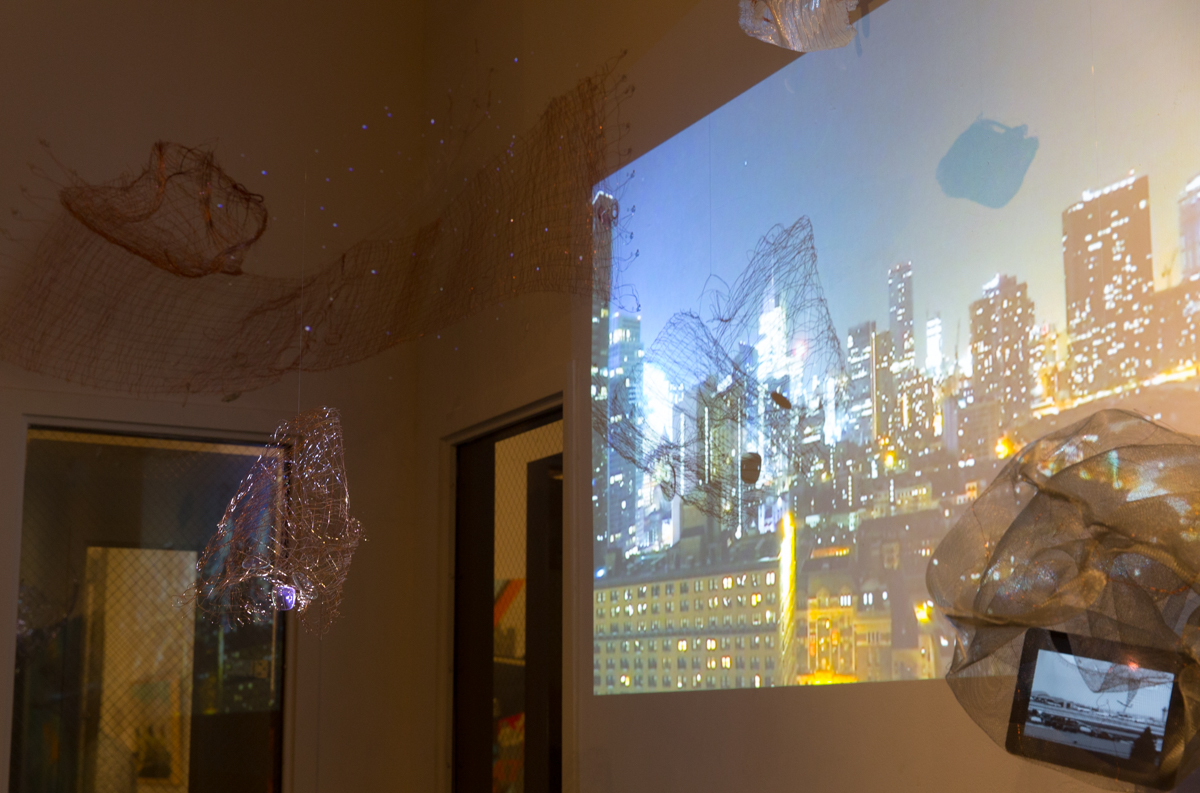
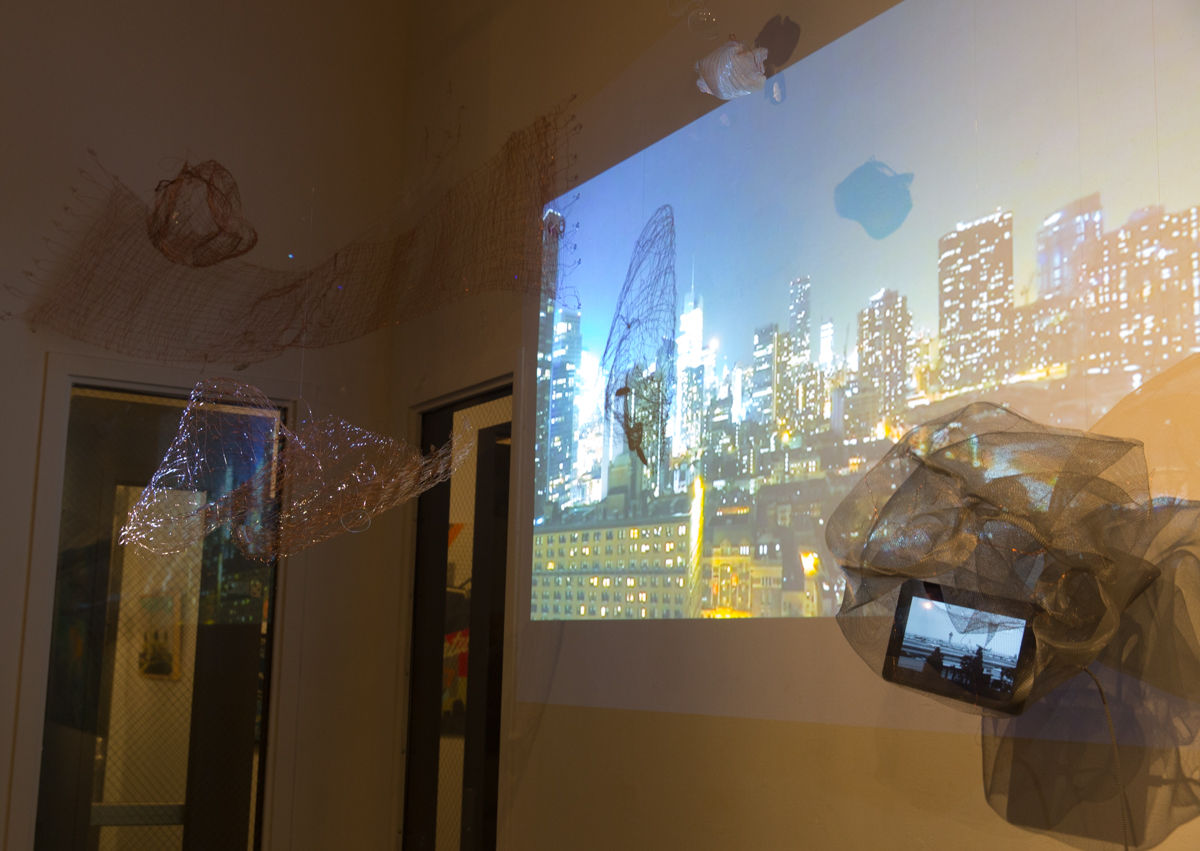
“I’ve been trying to explore place, and the effect of place in who we are, and exploring the idea of solitude vs. loneliness,” Dodge says. “You won’t have solitude in the city, for example, but you could be intensely lonely.” This stunningly poetic piece shows a time lapse of stars in the desert sky and a 25th-floor mid-town Manhattan time lapse view, images connected by her sculptures of clouds. A small TV monitor shows video footage of planes taking off from LA and San Diego, “vehicles for movement,” as Dodge describes them. “The clouds each contain lenses that are referencing the ways we see and experience the world we inhabit; the planes are how we aspire to go to different places looking for different things.” The New York footage contains pinpoints of light which are airplanes; the desert footage, shot in Borrego Springs, contains the twinkling of stars.
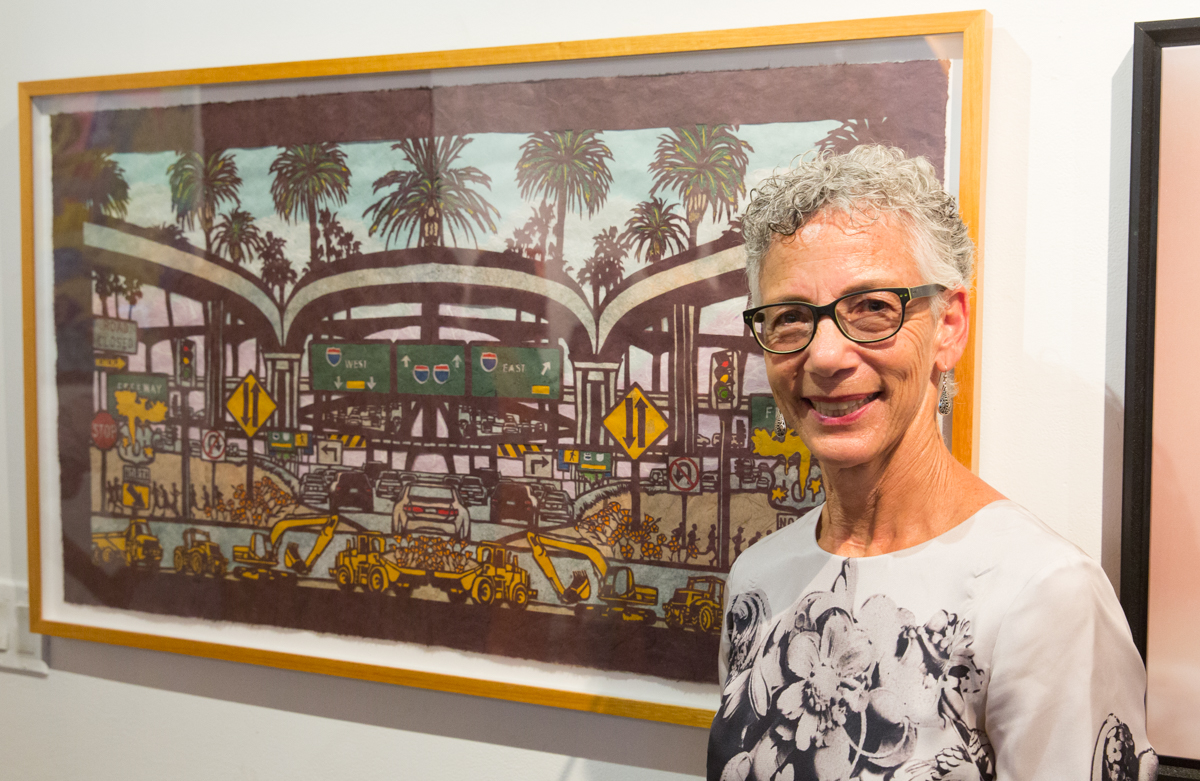
Lorraine Bubar with her paper cut No Turning Back.
Bubar does an amazing and delicate dance with her wonderful paper cut art. “I relate to the heritage of paper cutting that’s in every culture, but create in a painterly contemporary way,” she says.
Cut out with an exacto knife, the top layer is intricate lace work. This piece addresses the pattern of over-development on the West side of Los Angeles.
The story she tells uses a contemporary version of an artistic technique employed by Asian and European cultures. The detail is absolutely riveting.
“I get into the rhythm of it. Every artist has a medium. I find it fascinating honestly to watch it literally unfold before my eyes,” Bubar says. She creates 12 to 20 of these powerful artworks each year, and you’ll find more of her work in a show at TAG in Bergamot Station this October.
“This technique is really a fusion of a folk art heritage traditional art form with painterly technique. All my interests came together in this medium,” the artists says. “I used to work in watercolor, now it is paper cutting. All my art forms are very labor intensive,” she laughs.
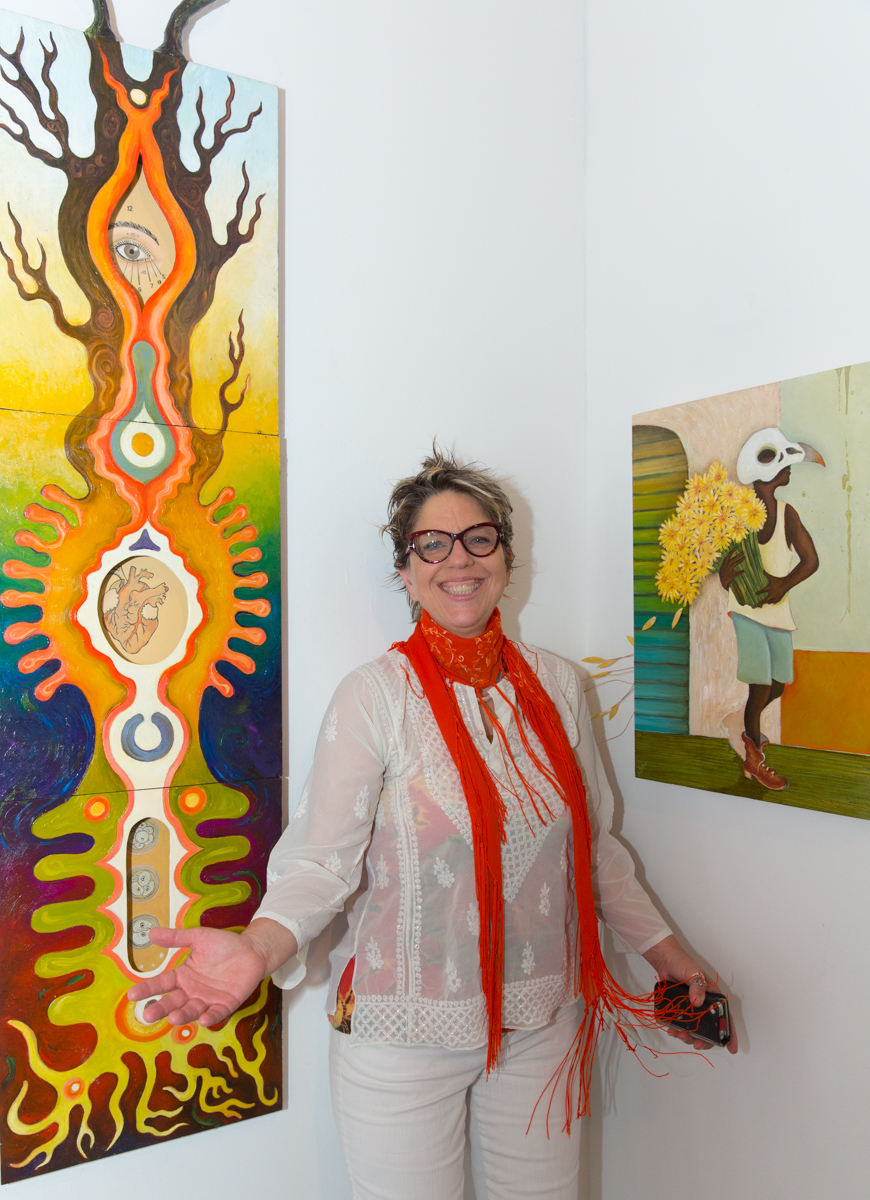
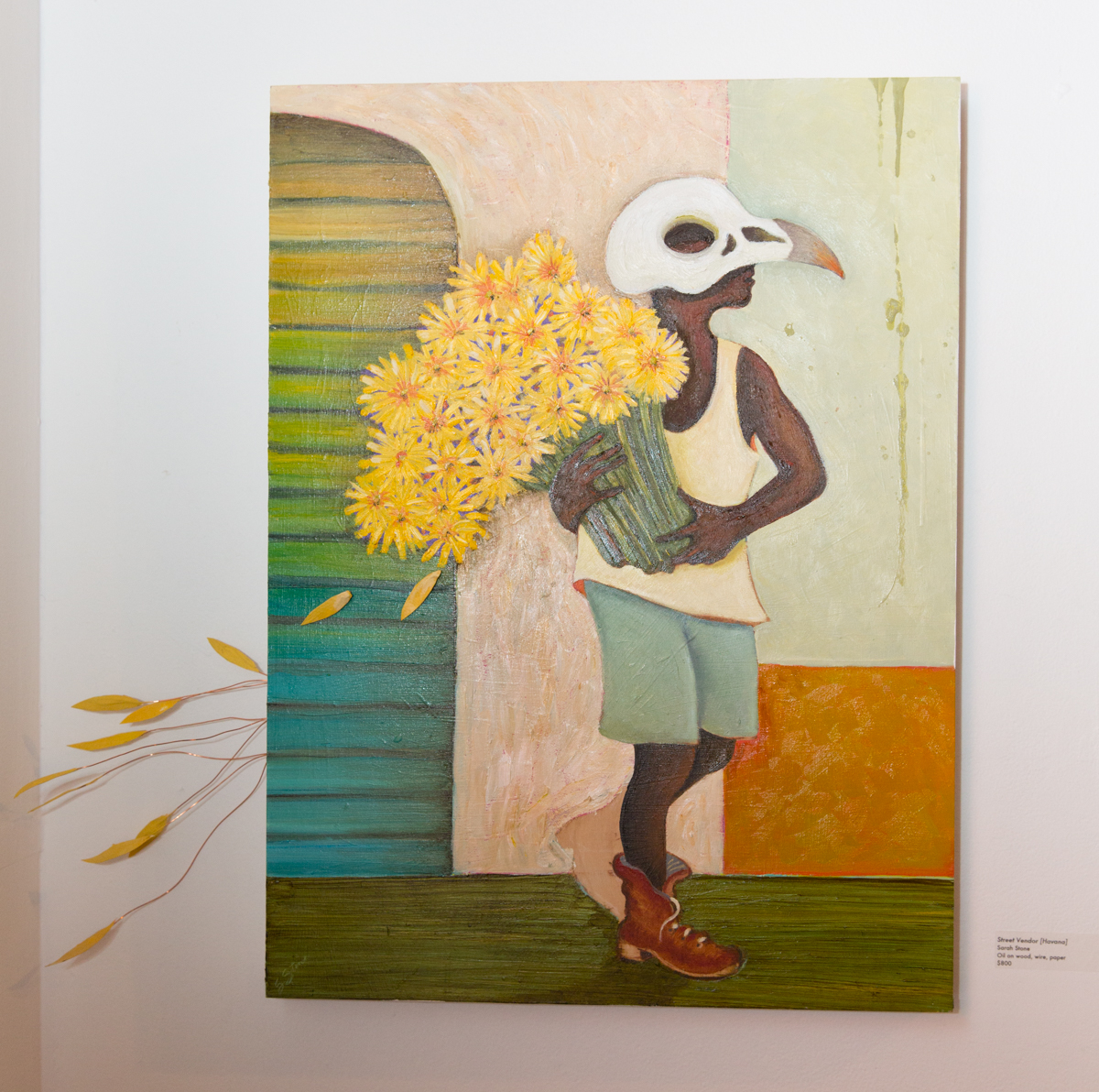
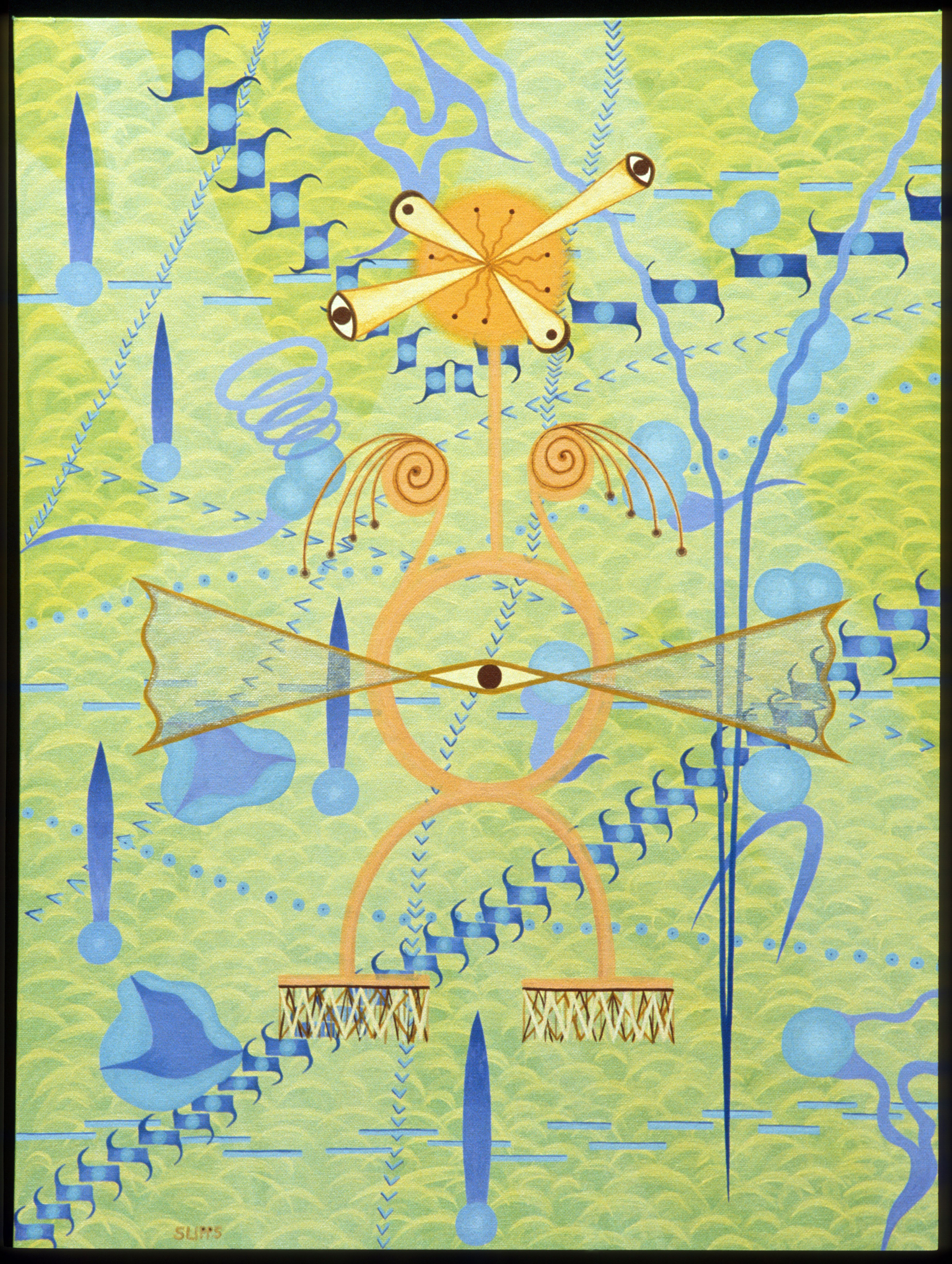
Sarah Stone, above, with her piece Flying to Summerland. Created with oil paint, polymer, and paper mache, Stone’s title and the work itself refers to 1920s era spiritualism.
“It’s basically life to death, what happens after death and coming to terms with transition. In that time period, where you go was described as ‘Summerland.’ I thought that’s a really sweet expression about the afterlife, and I used that in my imagery. A lot of my work is drawn from dreams and mythology, and creating an empathic symbolism.”

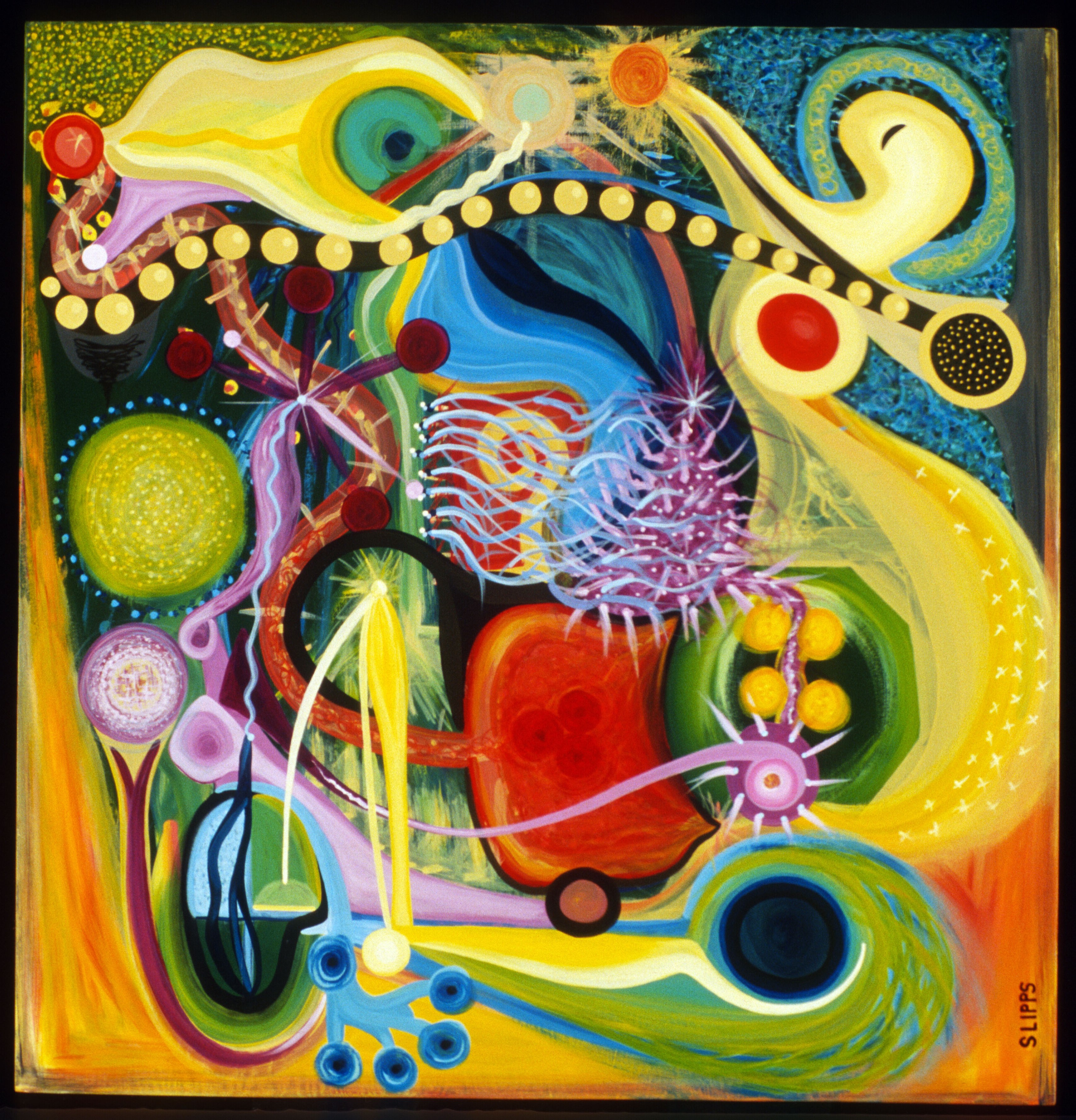
Eliza Day-Green, above.
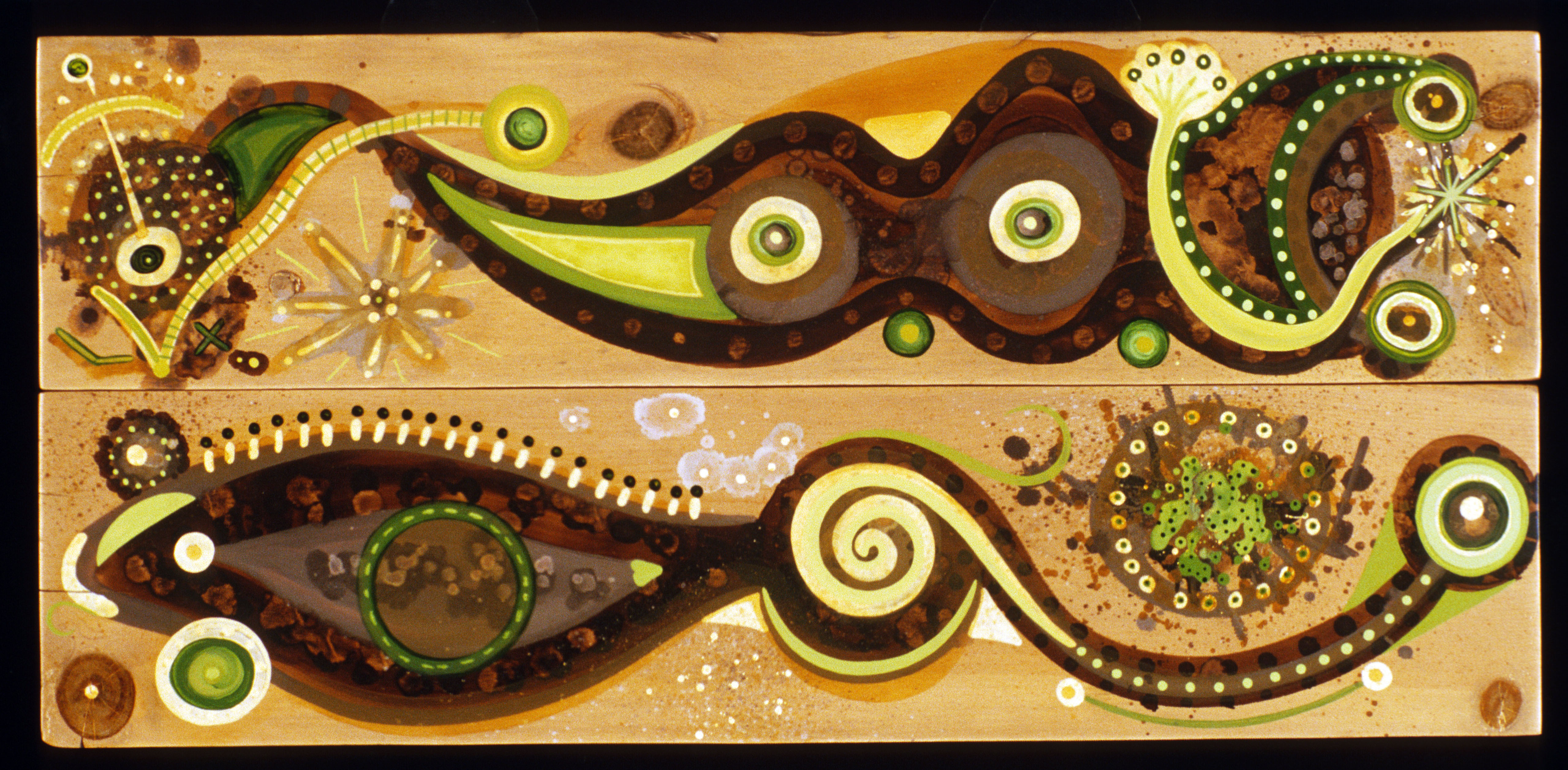
Green’s mixed media work is mostly acrylic and ink, mediums she uses to incorporate her background in textile design into her work. Rich colors and absorbing patterns create a truly textured look to her pieces here.
Originally from London, Green has created a series based on paintings, music, and wearable art. “This painting is a part of that series, and I thought it was perfect for this show. I’ve always had a feminist perspective in my work.”
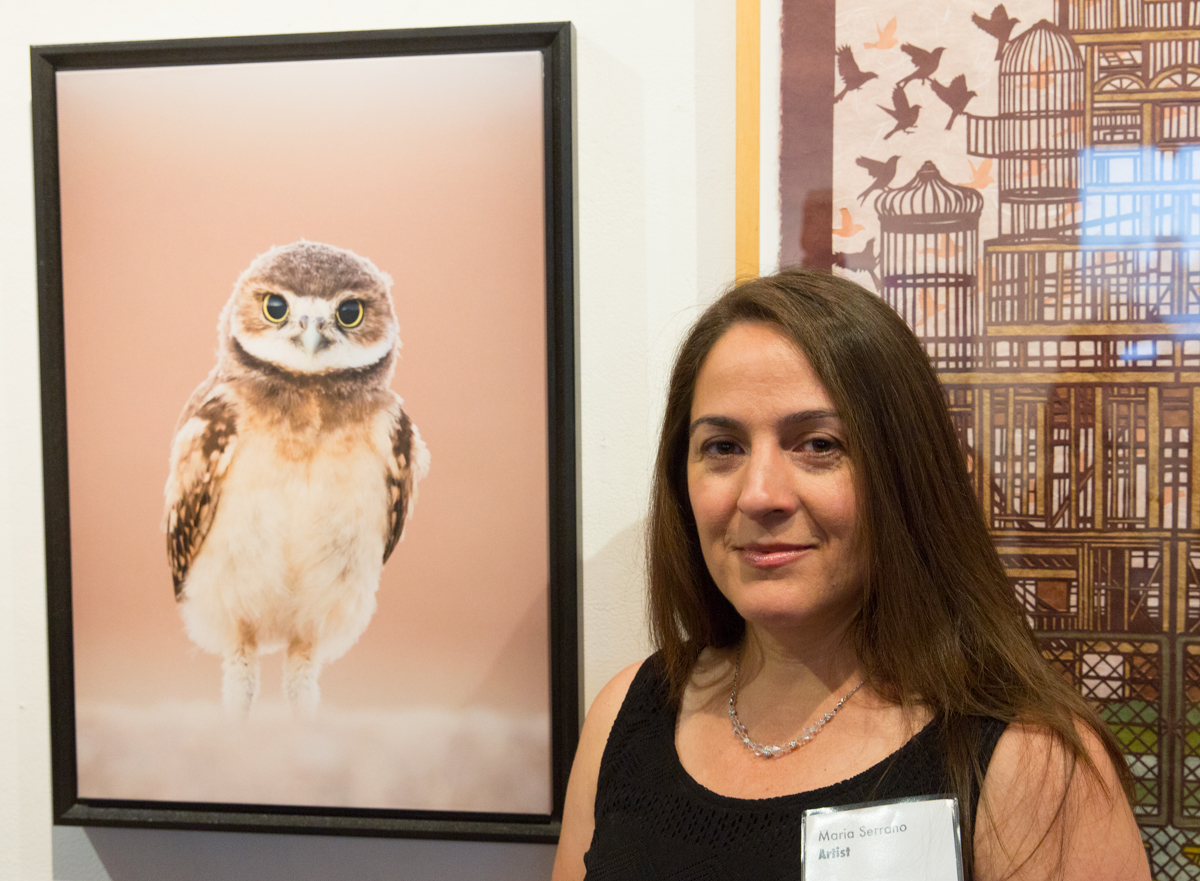
Maria Serrano, above.
“Wildlife is my passion and focus with photography. I teach my students about animals and conservation. I want to show them how beautiful these animals are, and how important it is to conserve them. Many people don’t have the opportunity to see these creatures up close and personal,” Serrano asserts.
She shoots using a 500 Prime telephoto lens, and while birds have been her primary focus – the three owls shown here were shot in the Salton Sea’s Sonny Bono Preserve, the 2nd grade teacher and fine arts photographer is planning a trip to Africa next year to photograph big mammals. Her startlingly fresh animal portraits are extraordinarily intimate.

Danielle Eubank, above, creates work in oil on linen. “Linen is more plastic and forgiving than canvas,” Eubank relates. “And it lasts hundreds of years.”
Her subject, the oceans of the world, is vast, but each piece is based on a specific place that captures her eye and spirit. “I’m painting all the oceans on the planet. Each piece is a formal reaction to a place, there’s no narrative, it’s all about shape, color, line, and texture,” she states.
With only one ocean left to paint, what comes next?
“After the oceans, it will be all the seas. So far I’ve painted 200 bodies of water. I started in 2001. I’m an expedition artist, and I’ve been on three International sailing expeditions which inspired me to do this.” She adds: “What I’m doing is painting oceans in order to show the shared preciousness of water among all people.”
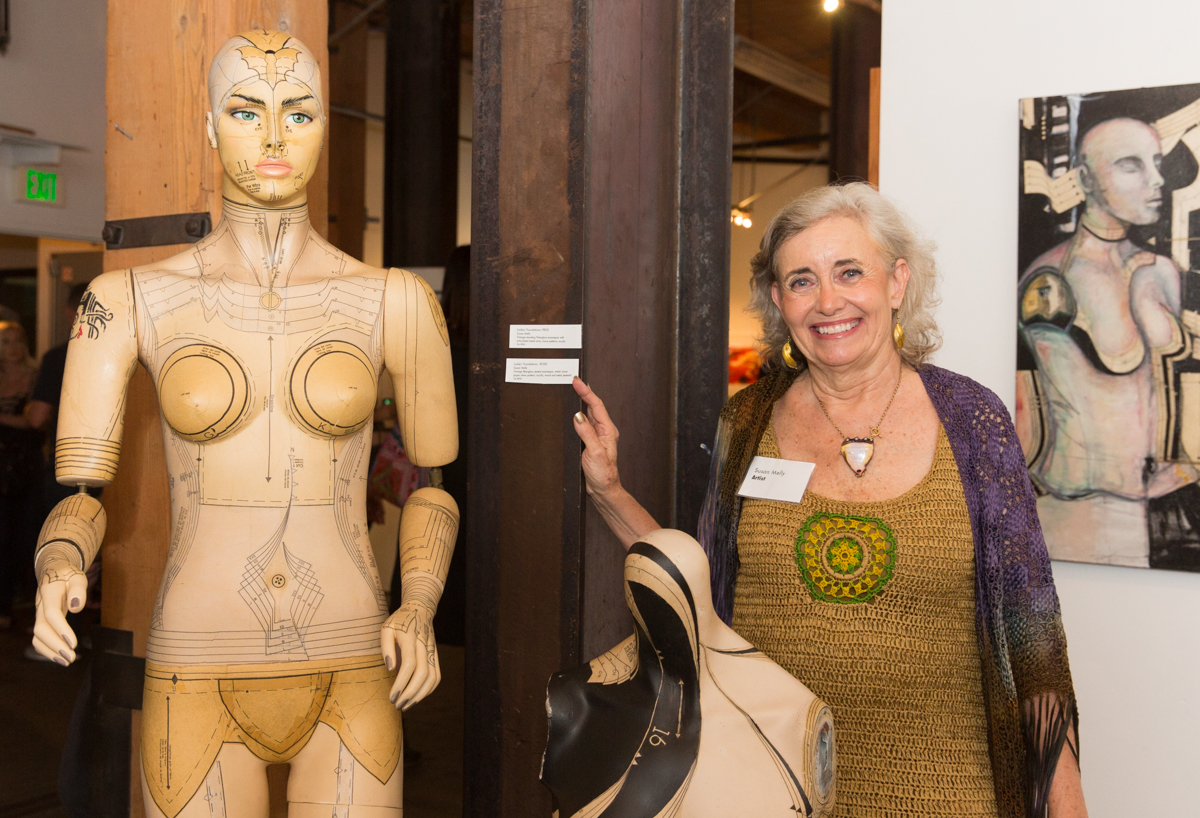
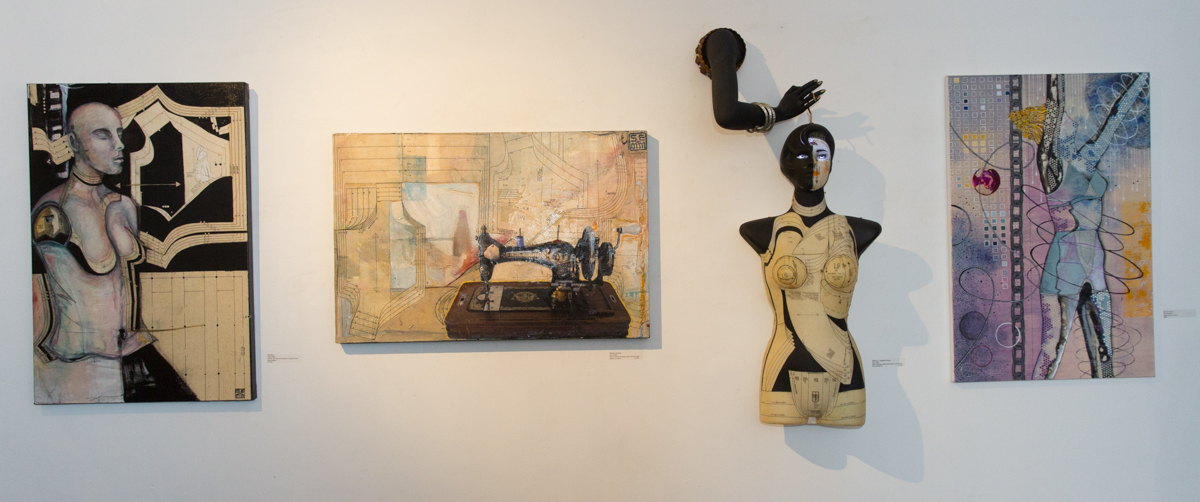
Susan Melly, above.
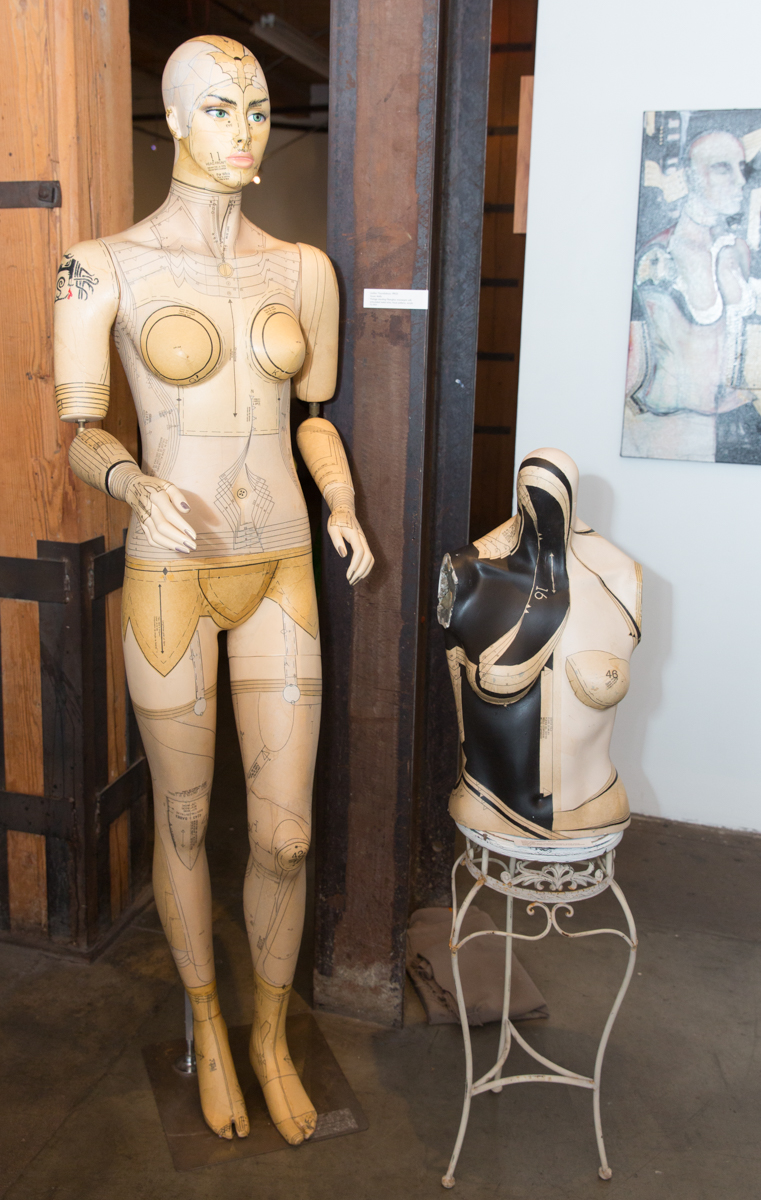
“I’m the patterns of the Flight Patterns,” artist Susan Melly jokes. “For this exhibition I purposely selected a sampling of a smaller series within the pattern series of mine. I’ve become totally obsessed with the patterns themselves, the symbols and everything. My most recent piece shows a mannequin, the torso and head, and the pattern is in black. This piece is titled Waist Line.” Using iconic female imagery, Melly creates a kind of eternal pattern for life and happiness.
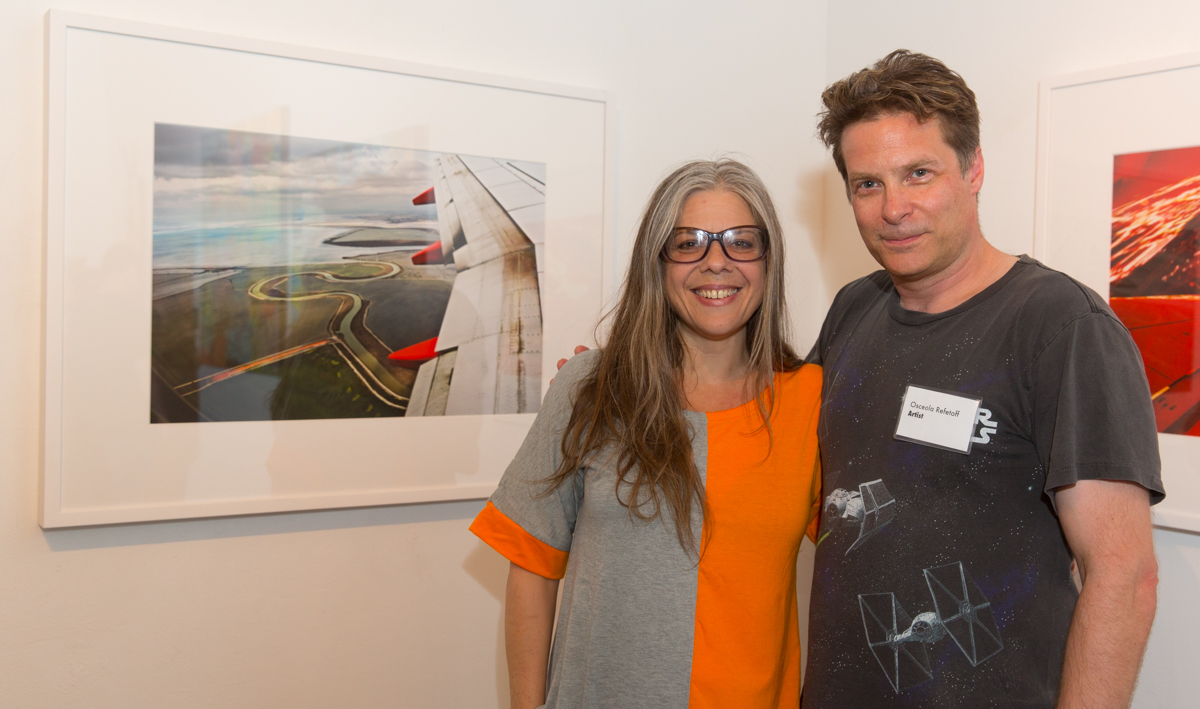
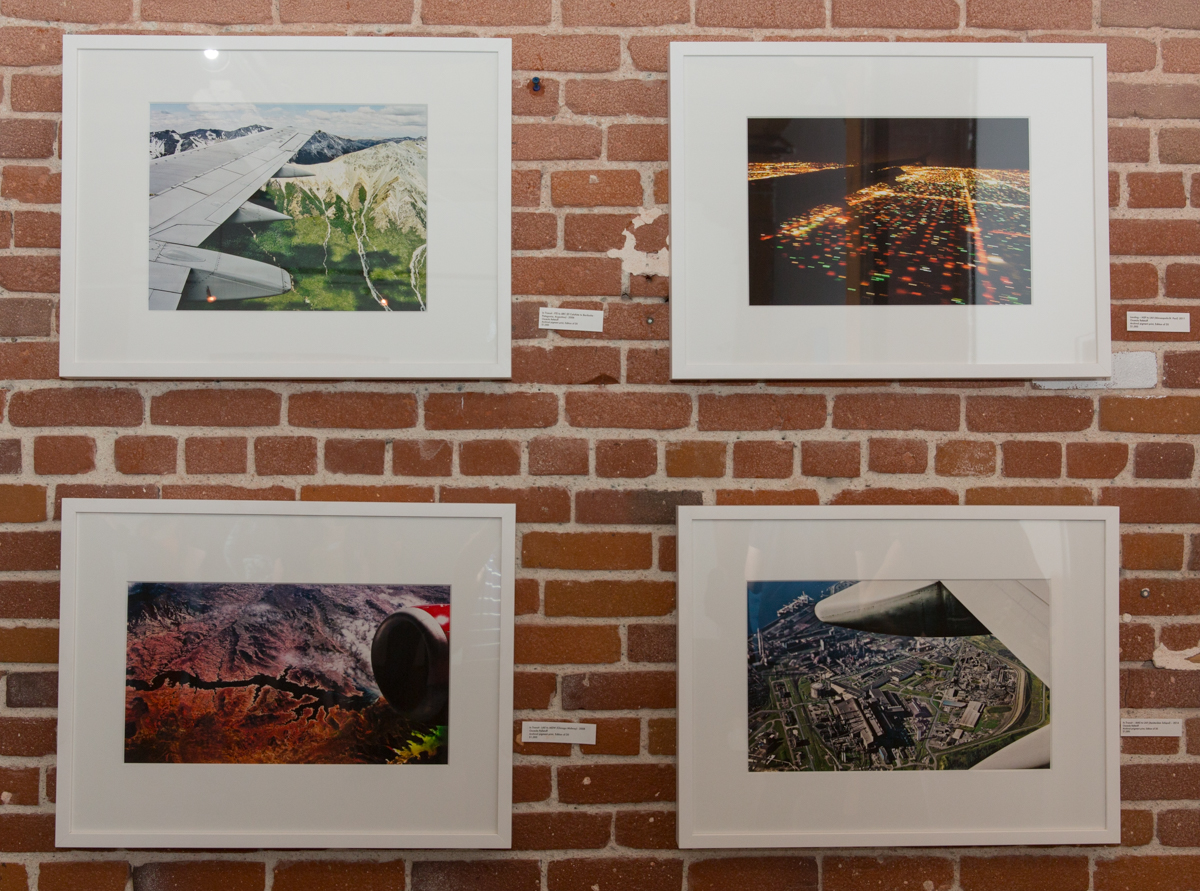
Osceola Refetoff, above, with art critic and curator Shana Nys Dambrot.
Refetoff’s series Armchair in the Sky has been in progress for 20 years. 7 of these vividly colored photographs, depicting the view from airplane windows, are on display here.
“What led me to the subject was finding this vernacular photo in a flea market shot from airplane, an early commercial aviation plane with propellers. In forty years, the wings on our jet planes will be iconic. That was the thought process that led me to this series.”
Refetoff was also drawn to the framing of these shots. “I’m always trying to find something interesting in the foreground in landscape photos, and here it’s the wing,” Refetoff explains. “To shoot this series, I always try to get the same seat in the plane. It takes awhile to shoot, there’s not always cool stuff out the window, not always the same opportunity.”
Flight Patterns marks the first time Refetoff has shown this series in public. The vivid colors shown here were standouts that the artist printed from his extensive collection. “These particular pieces stood out to me because of the color. I had hundreds of photos to choose from.”

Daniel Leighton
Artist Daniel Leighton creates truly interactive paintings. Augmented Reality is viewable via the artist’s own created app, allowing him me to create another dimension of visual, aural and emotional movement when a viewer interacts with his pieces. “When viewed through the lens of a tablet or smartphone’s camera, certain pieces will come to life with Augmented Reality. I had the interactive idea since I was 12 years old. I went to film school, and then I started painting seven years ago. My technique is a way for someone to engage with the art. We are so attached to our phones, it’s a way to have different emotional experiences and spend more time with art.”
His works truly come alive, visualizing emotions as well as motion.
His painting above, Tied Up at the Hospital is based on being five years old and hospitalized, and the association of holding emotion off from the body. “It references six surgeries I had between age 11 and 21,” Leighton relates. “I just feel like as an artist I’m always challenging myself and evolving techniques and points of view.”
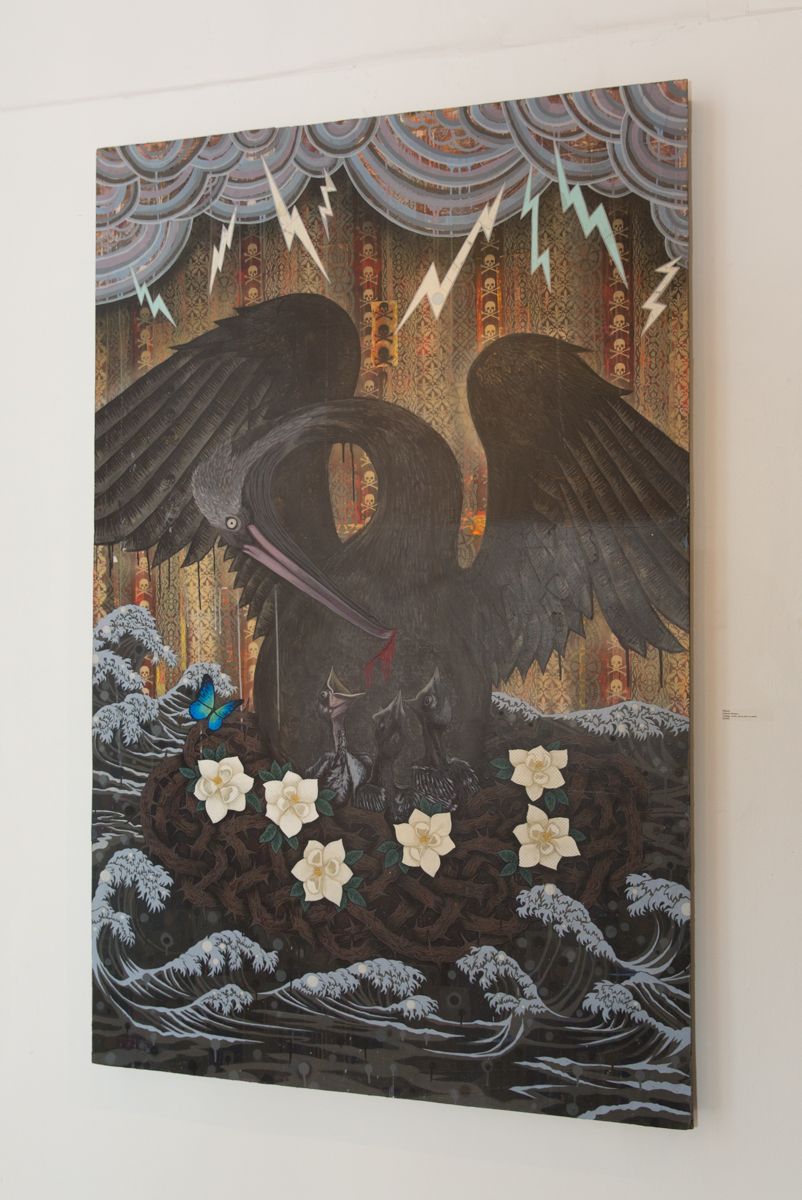
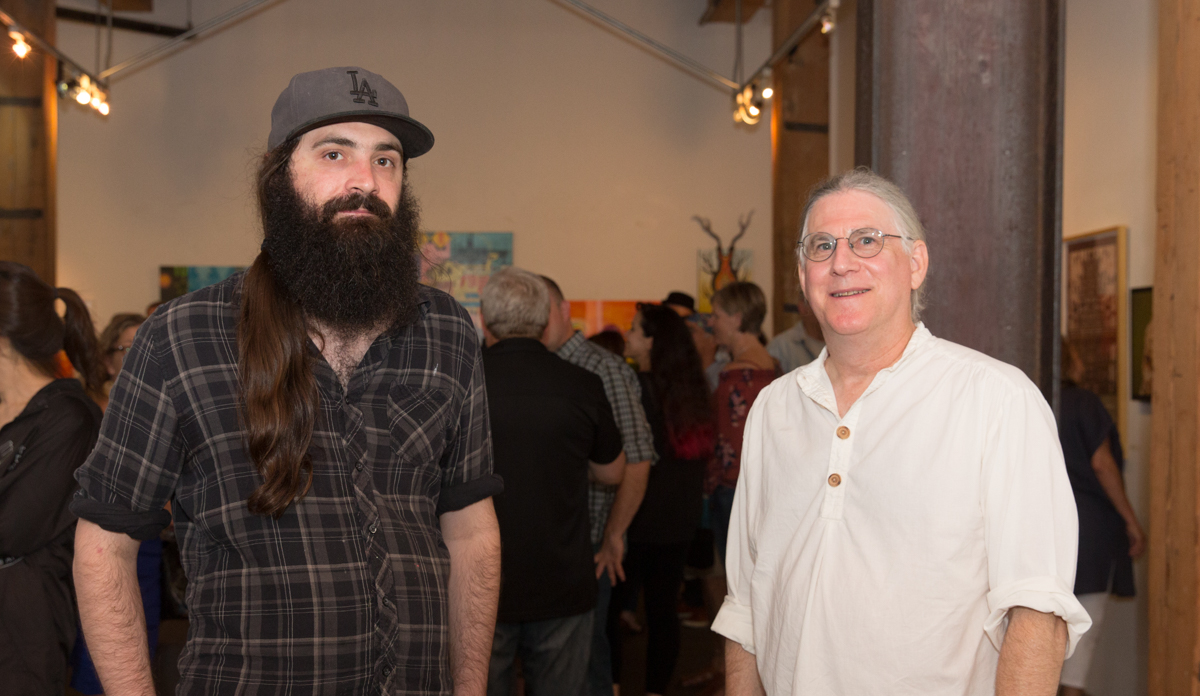
Exhibited artist Nicolas Bonamy (left) with photographer and artist Robert Rosenblum, above.
Bonamy says of his large scale works, these featuring dark and sweeping images of birds, “The collage panel comes first, that’s the first layer, and the detailed work is part of the same process, background first, then I build up the foreground. I make the pieces as beautiful as I can.”
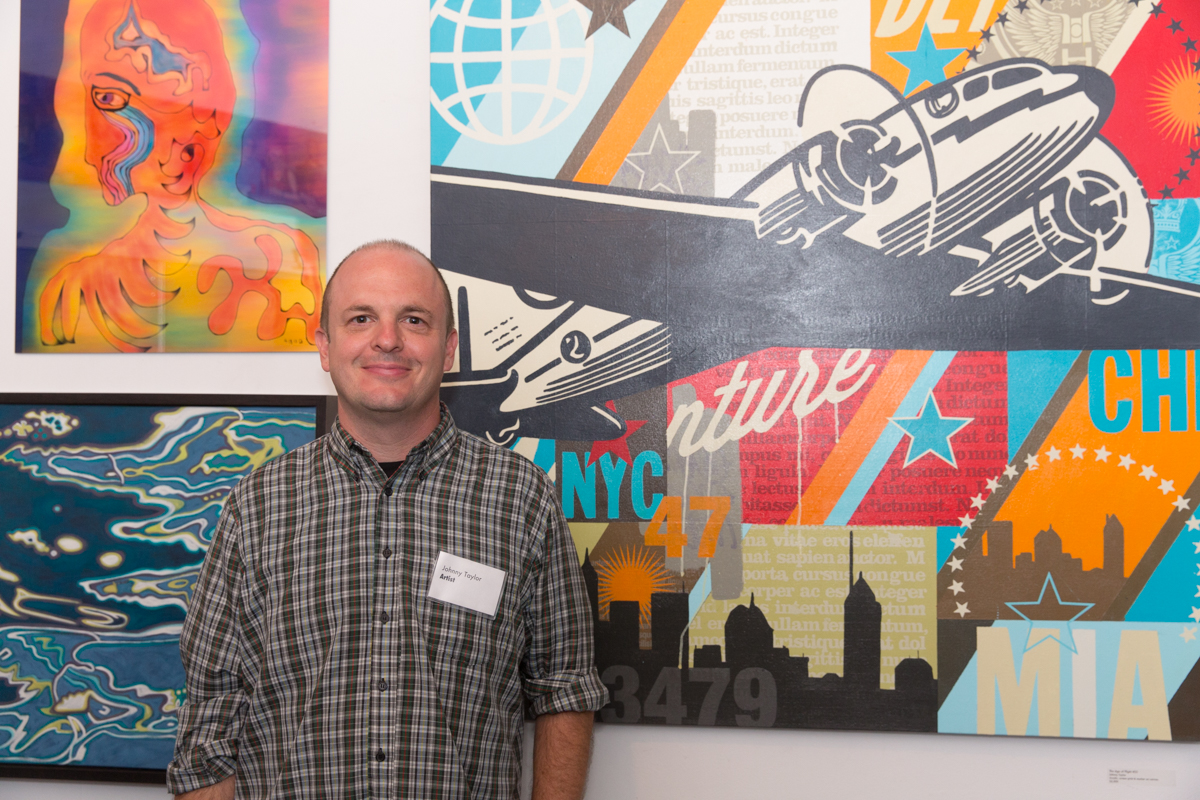
Johnny Taylor, above.
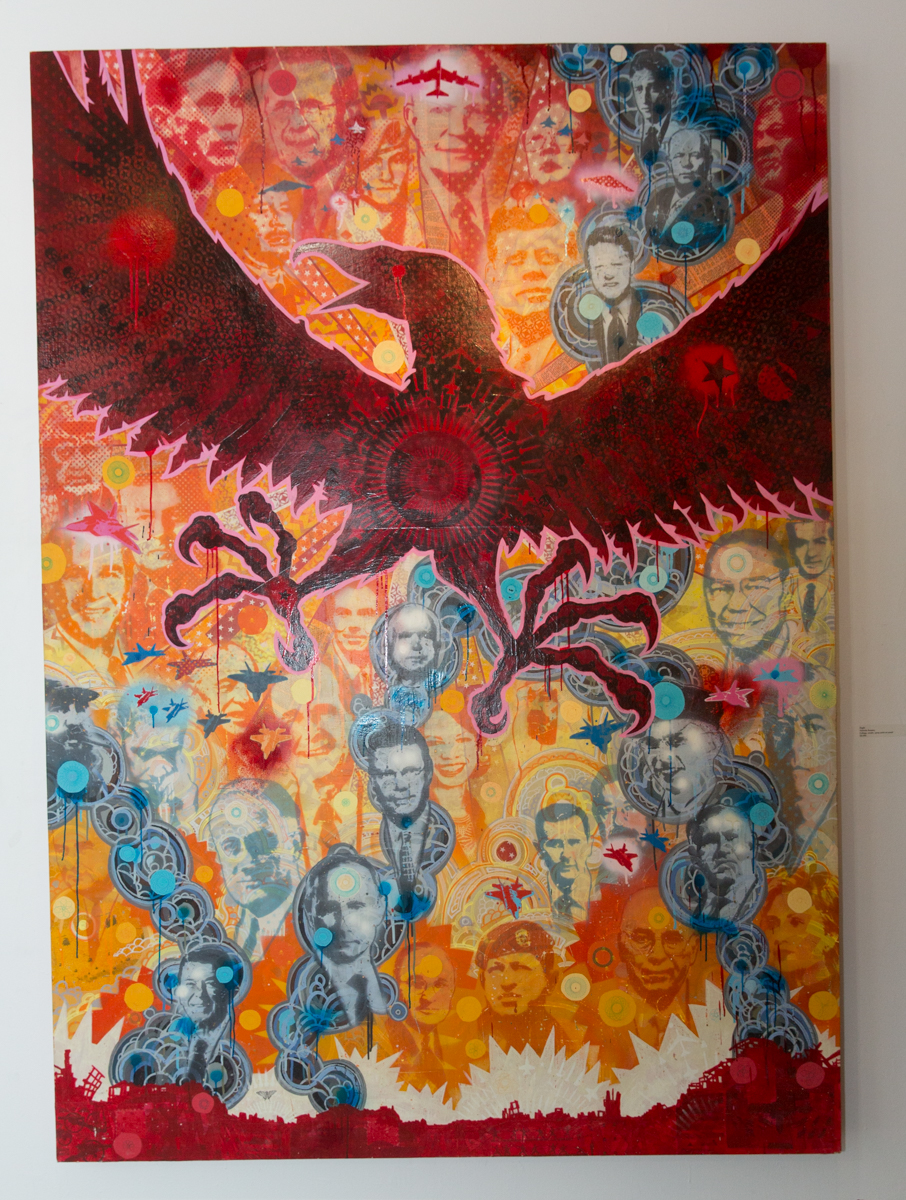
Taylor’s vivid work has a retro vibe with an intensely modern execution. Planes, helicopters, skylines dot his bright, stylized canvases. “My paintings explore the things we look at each day without seeing. Though everything is game imagery-wise, I am drawn to advertising images and glyphs, the visual shorthand of contemporary culture.”
Whether you fly, Uber, drive, or walk – don’t miss Flight Patterns.
Art Share LA is located at 801 E. 4th Place, in DTLA.
- Genie Davis; All Photos: Jack Burke