
Mike M. Mollett

Mol 3
Performance art, sculpture, and installations – Mike M. Mollett is a versatile artist who creates both living and still-form art. The founder of L.A. Mudpeople, and the sculptor of large scale pieces created from found art, shaped into balls and bundles, Mollett’s work offers a look into a different reality, one in which what look like clay statues live and breathe, and bundles of wires move in the wind and become animate themselves.

On the performance art side, Mollett considers his troupe of L.A. Mudpeople to be non-performers who function as “essentially living sculptures.” Mudpeople don’t speak, and move slowly and deliberately, almost as if lumps of clay had shaped themselves and literally come to life. The troupe gets its mud from Silver Lake, Hollywood, and northern California, as well as using commercial mud such as potter’s clay. The artist started his mud-work in 1989, booking himself and others at an African-Reggae club for a single night – and the rest is art-tribal history.

Mol 5

L.A. Mudpeople vary in number, with sometimes as many as forty members participating in events like the Doo Dah Parade, or conducting walkabouts along the L.A. River, Melrose, or Old Town Pasadena. Their work has appeared in National Geographic Magazine, and exhibitions of their attire and artifacts have been shown at both UCLA and Cal State L.A. They’ve been the subject of a film, imitated by Leonard DiCaprio, and have become an iconic part of Los Angeles’ rich street art scene. The Mudpeople wear their own simple clothing, and create full head masks made from cloth, paper, mud, and binding. Conceptually, these living sculpture performances are all about the freeing of self from time and worry, muddy yogis who, according to Mollett “don’t have to do anything. We just are.”

Mol 4

Mollett has participated in the Los Angeles art scene for forty-some years, and it’s not all about “mudding-up.” His sculptures are often created from items and forms he’s used from work as a landscape artist, found objects that he morphs into what are essentially time capsules of society and life itself.

Mol2

His sculpture balls include pieces like “Migrant World,” a bundle of artifacts that were gathered along the Arizona-Mexico border trails. Tied with rope and cords, viewers see a Mexican shawl, a battered pink backpack, a hat, water bottle, and baby bottle among other objects, built around an ocotillo wand armature. The over all effect is poignant – these are the belongings that people took with them as they migrated from one land, or realm, to the next. Mollett’s rope and wire bound “The Giant Ball,” features the detritus of modern society, such as milk cartons, wine bottles, paper bags, and pill containers. This, Mollett seems to be saying, is what we have allowed ourselves to be made of. The balls serve as personal sculptures that use material collected from Mollett’s life or another’s life, shaping a biography or autobiography of that person.

Mollet 6

Unlike his balls, his Time-Twists of wire and wood are linear, reaching like mysterious urban plants skyward. “The Giant Bundle: A pLAyLAnd Twist” is installed indefinitely at The Brewery Artists Lofts in Los Angeles. His “Woody Bundle” includes an accordion tape measure. “Wild Red Twist” looks like shocking pink licorice has fused into corral, with blue, yellow, and black wires twisting in an invisible ocean wave. “Mostly Electric Story” incorporates rope, wires, and computer cables.

What makes both the Time-Twists and balls so compelling, is the feeling as if these entirely inanimate objects could suddenly become animate – just as Mollett’s Mudpeople do. A sinuous quality infuses the Time-Twists, making the viewer think of snakes, or strands of DNA twining and untwining. The balls are like transparent eggs filled with the stuff that life is made from, ready to hatch into human form.

Mol 1

Mollett’s “Gate Series” also feels embryonic. In “The 2nd GATE,” Wire mesh is woven with wires, ropes, sticks, bamboo, Dracaena Draco leaves, and twines. Mollett’s “Mostly Friendly GATE” also features Dracaena Draco leaves, orange, wire mesh, sticks, bamboo, wires, and ropes. The flat aspect of the gates resembles a thin slice of human tissue, the wires and leaves the inner-workings of the body, or the inner-workings of technology just as fragile, just as capable of being alive in a technology-driven world.

mollet 7


Installations like “Leaves in the Poet’s Winter Garden,” a part of Mollett’s solo show at Matters of Space in Highland Park, also use sticks, wires, and pipes to create the illusion of alive-ness. In this piece, pipe and bamboo stand tall, while at the base of these “plants” are small pieces of paper with two sets of disparate words or phrases written on them. A wonderful concept that illustrates the fluidity of creative thought, the passing “leaves” of discarded verbiage. Other installations have included a Mudcave at an Eagle Rock pop-up space, PlayLand, and The Mud Room created for the NadaDada Festival in Reno, Nev. Recently, Mollett was also a part of group exhibitions at Los Angeles Contraventions and the Los Angeles Juried Exhibition. Mudpeople have recently performed at the Highways Performance Space, as well as along the L.A. River, and at Beyond Baroque in Venice, Calif.  You can find out more about Mollett’s work here: http://www.kcet.org/arts/artbound/counties/los-angeles/mike-mollett-la-mudpeople.html

– Genie Davis

Photographer Lori Pond: “Menace”

Photographer Lori Pond uses her art to blur the lines between perceived reality and her dreams. Long accustomed to vivid dreams, and questioning the parameters of the real world since childhood, Pond uses both the camera itself and her post-processing tools to paint a full range of images and emotions through color, light, movement, and texture.

Photographer Lori Pond

menace 6

In October, just in time to greet the boogeymen of Halloween, Pond will be exhibiting a solo show at the Los Angeles Art Association based on her series, “Menace.” This series vividly depicts images of things we fear – or think we do. These are velvety, dark, and ferocious photographs of wild animals that trigger gut-instinctive responses of fear. In these photographs are shadowed images designed to heighten the fight or flight reflex of viewers’ subconscious minds, instinctive reactions that we share, that make hearts race, even as we are viewing these images in a safe space.

Opossum

Raven, tiger, boar, bear – the eyes of these creatures stare intently and wildly out from clumps of voluptuously close fur, causing our ancient instinct to run. Try holding the gaze of any of these creatures and feel the power shift between viewer and subject, with the subject winning. But before viewers hurry on, the astute observer will notice the real point of these rich, noir photographs. This point  isn’t to confront viewers with their fears. Instead, Pond is posing a challenge, manipulating viewers to take one look at these frightening, shadowy creatures, and then to look again. What is truly menacing is in the viewers’ minds. These animals are taxidermied, a danger to neither the artist or the viewer of her art. The images were taken in bright shops, altered through the artist’s craft to demonstrate a ferocity that doesn’t exist. In short, Pond tells viewers that fear itself may be false and unjustified. Perhaps, along with ingrained and visceral responses to these animals, the 21st century has also brought us fears that are merely imaginary, or created by others.

menace 4


Beautifully rendered, these fearsome images are impressive in their own startlingly heart-thumping right. The context of these photographs, that fear itself may be mostly imagination, adds depth and weight to the carefully detailed and beautifully lit images. Every bird feather, every bristling bit of animal fur is perfectly rendered. Truly the stuff of dark dreams, dreams which break apart when confronted with daylight, yet linger in the psyche throughout the day in fragments created by our own primal instincts.

menace 5

To print “Menace” and her other photographic series, Pond uses Epson Ultrachrome archival pigments on matte rag papers, which adds to the deeply detailed and dream-like quality of her subjects.

A Southern California native, Pond has worked as a graphic designer and operator for live television productions including the Academy Awards, the Emmys, and Grammys, as well as for Conan O’Brien. Her photographic art has shifted through the years from street and documentary images to macro studies of the natural world in her series “The Intimate Universe.” Her highly emotional and autobiographical “Divorce” series chronicles the impact of divorce after twenty years of marriage. Using the wet plate collodion process, Pond has also created tintype portraits in her series “Strange Paradise.”

Lori Pond's Circle

Pond has won awards for her nationally and internationally exhibited work, and has been published online and in magazines, as well as in two books of her photography, “Lori Pond – Self,” and “Arboreal.” Her photos are a part of the permanent collections of the Center for Fine Art Photography in Ft. Collins, Colo., the Center for the Arts in Los Angeles, and at the New York headquarters of Morgan Stanley.

Her recent exhibits include a solo show at the University of the Arts in Philadelphia, “Nothing in the Entire Universe is Hidden.” She’s also taken part in the Artist Alliance at the Museum 2015 in Oceanside, Calif., and the 2nd Annual LACP Members’ Exhibition in Los Angeles. The artist is a member of APA, the Art Directors Guild, and the Los Angeles Art Association, among other arts organizations.


Teale Hatheway’s “Fragmented Realities”

taele 6

Artist Teale Hatheway is the creator of layered mixed media art and site-specific installations that express evocative emotional connections. Working with acrylic, ink, bleach, metal leaf, burning, and charcoal on linen, her complex work is designed to “explore the theory that we remember environments as compilations of elements with which we develop emotional connections.” Hatheway takes details of pattern, form, color, and texture from urban environments, using them to implicitly and explicitly “trigger recognition of place.”

Hatheway’s work is about memory, grounding, understanding, and experience; with beautifully detailed yet fragmented images compiling pieces on Chinatown, historic bridges over the Los Angeles River, DTLA’s Broadway, and more. With a solo show, “Fragmented Realities: City of Dreams” opening Sept 12th at the Los Angeles Art Association, Hatheway’s self-taught architectonic drawing and the ethereal nature she evokes of even the most common subjects will both be on full display. Her approach is experimental yet investigative, using the often unsung history of Los Angeles architecture to enthrall viewers and advocate for the city’s preservation.

teale

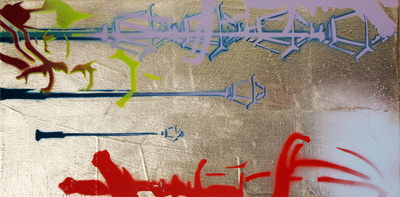
The artist describes her subject matter as “a means to ground myself in a tangible environment in which an understanding of the whole is made up of an experience of the parts.” These parts are special indeed. As a part of her “Street Lights Abstracted” series, delicately colored outlines and sections of street lights are positioned to form abstract and impressionistic depictions of what could be the ghosts, memories, or filaments of the lights themselves. Her “Detour” combines spray painted images of these lights over a background of gold leaf on canvas. Like the lights themselves, the painting illuminates, both literally glowing from the gold leaf and figuratively from the impression of streetlights. In “Self Reflection” from the same series, a mirror image of an upside down red street lamp,casts beams, also reflectively upside down, against another gold leaf background. The street light here looks almost like a character from the Chinese alphabet, or an ancient rune.

teale2

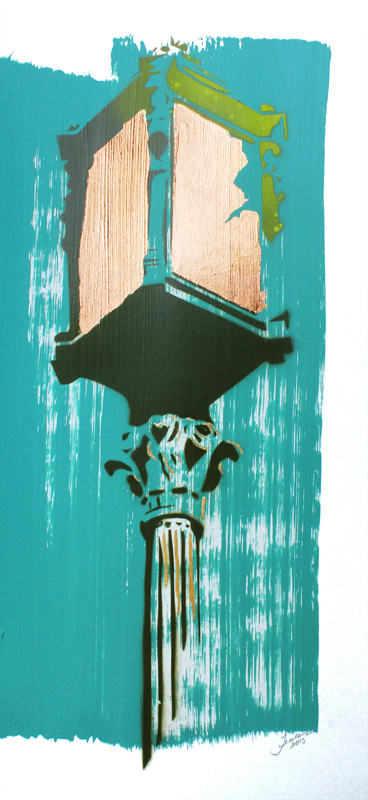
In her “Street Lights” series, gone are the abstract and symbolic shapes. Here the lights are clearly lights, some with vivid matte aqua, red, and mustard yellow colors washing over, through, and around them. The viewer sees the colors as a spectrum that the lights themselves must be illuminating.

teale 3

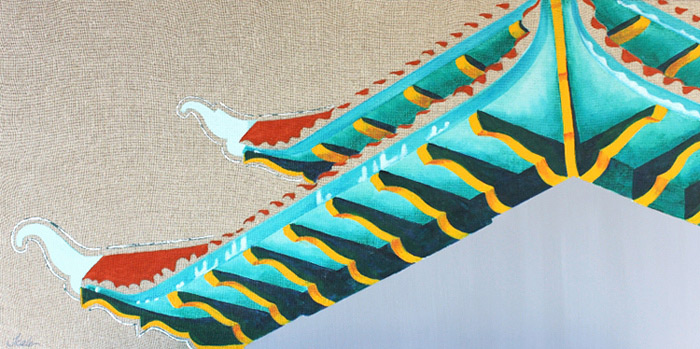
Hatheway’s “Chinatown” series offers a moody evocation of this exotic neighborhood that is nonetheless intrinsically a part of Los Angeles. East-meets-west architecture plunges viewers into another near-magical world. No prosaic impressions here. In “Success,” Hatheway employs acrylic paints and metal leaf on linen to vividly offer the winged edge of a Chinatown building in red, aqua, and gold tipped with white. These could be architectural angel’s wings, could be dragon tails, could be a temple in China – and yet with the California-bright colors, the sense of place blurs between the new West and the old East. Where do the winged edges want to fly?

taele 6

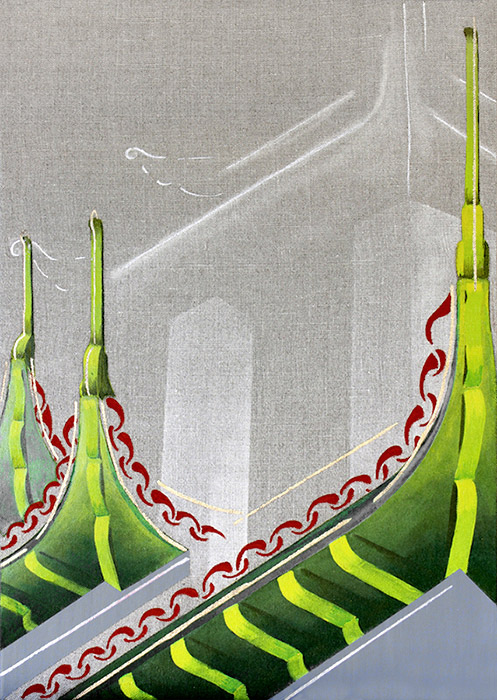
Equally vibrant color marks the clearly grounded depiction of double metal gates over the facade of a building in “Secure,” painted using ink, acrylic, bleach, and metal leaf on linen. It’s flight again, or the illusion of it that grabs the viewer in the lime and chartreuse green dominated “Vision,” which shows another curved, wing-like Chinatown roof with the looming white ghost shadow of a larger building behind it, and tiny kite-like flags billowing from the ramparts.

teale 4
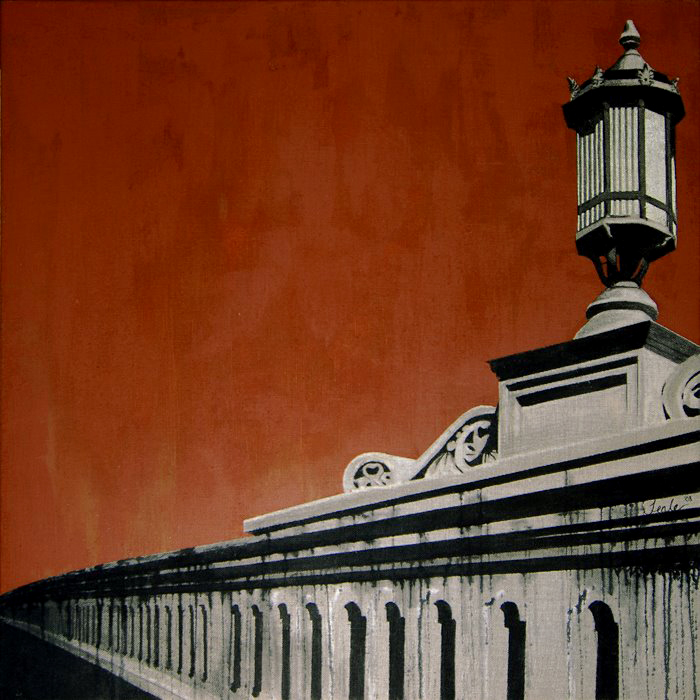
With a burnt orange sky and a carefully detailed grey and white bridge, the long perspective of “Washington Boulevard Bridge” combines ink and acrylic with bleach on gold leaf in Hatheway’s “Victory – The Historic Bridges Over The Los Angeles.” Bridges from Downtown L.A. to Griffith Park are pristinely stylized, with their location just hinted at, their appeal speaks to a universal desire to cross a bridge to other, more golden banks. These bridges are highly realistic yet as romantic and surreal in design as a fairy tale bridge. These pieces are linked through Hatheway’s exploration of the city, through a connected map of bridges stretching across the SoCal region, which allows viewers to cross into a vivid engagement with the city itself.

teale5

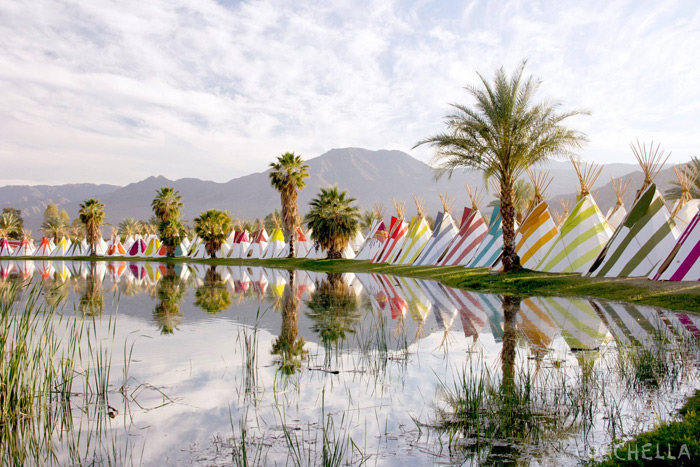
“InTentCity,” Hatheway’s installation commission for the Coachella Valley Music and Arts Festival, is a collection of 53 hand painted tipis, painted specifically for the Lake Eldorado camp ground, and reflecting in the mirrored prism of the lake itself. Hatheway created a fully immersive environment in a delicately painted three-dimensional experience. As with so many other works by the artist, there is a magical quality to the environment. We could be in the California desert or in a mysterious other-wordly land that has transformed itself here on our planet, in our state. It’s this magical and mysterious quality that transcends and enhances the images themselves throughout all of Hatheway’s work.

Internationally exhibited, Hatheway received her BA from Scripps College in Claremont, Calif., studying figurative painting at the Slade School of Fine Arts, University College London, and studying photography and architecture at Art Center College of Design, Pasadena. Upcoming exhibitions include “Fragmented Realities: City of Dreams” opening Sept 12th at the Los Angeles Art Association, and “Some of the Parts” at West Hollywood’s Gallery 825 in October. Recent shows include “InTentCity” at the Coachella Valley Music and Arts Festival in Indio, Calif., a collection of 53 hand painted tipis; group exhibitions at Red Pipe Gallery in Chinatown, the Pasadena Showcase House for the Arts, Los Angeles Contemporary Exhibitions, and the Riverside Art Museum, among many others.

  • Genie Davis

Malka Nedivi at the National Council of Jewish Women

Maka Nedivi
Malka Nedivi “Mother and Daughter” – all photos by Jack Burke

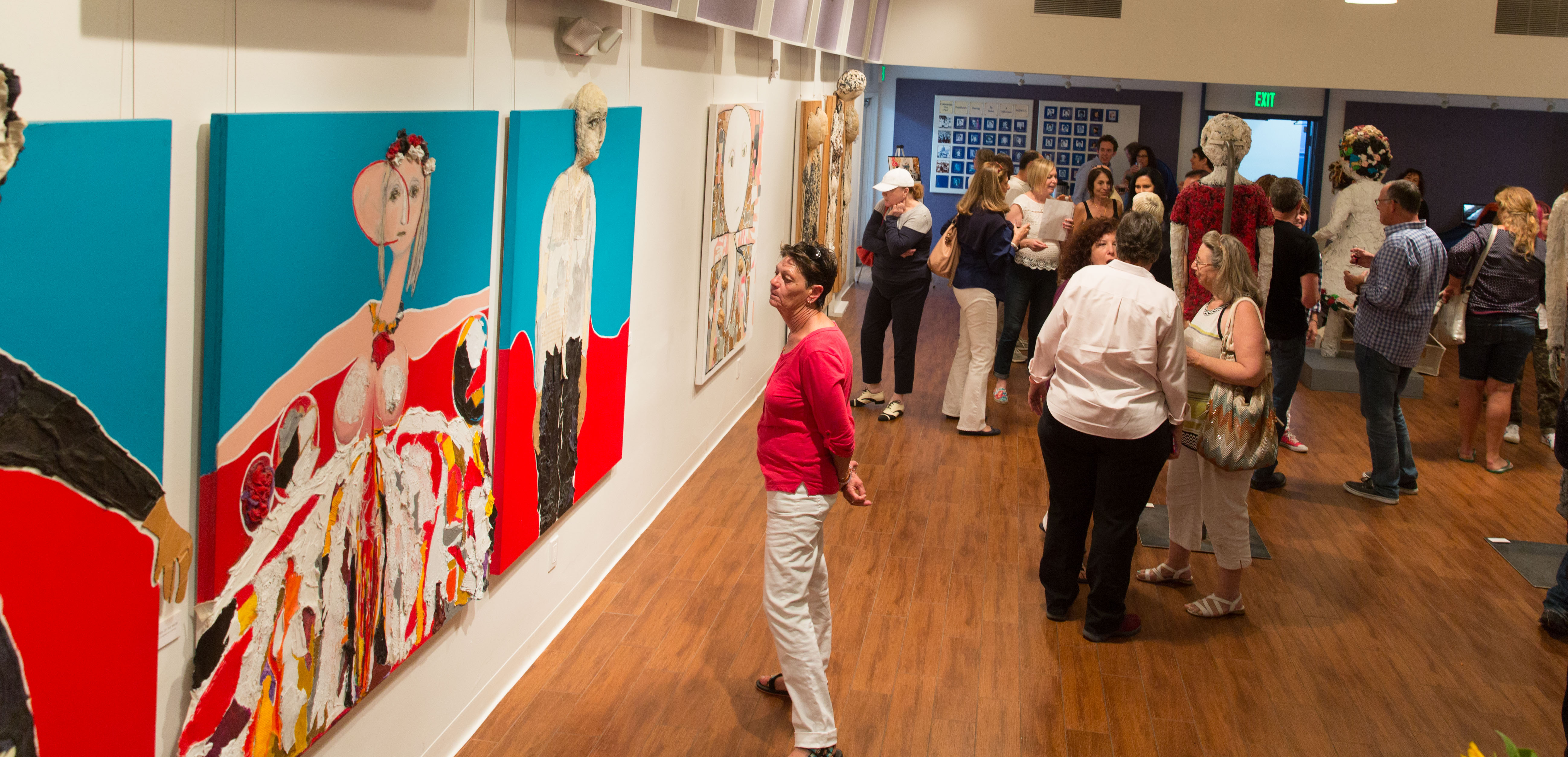
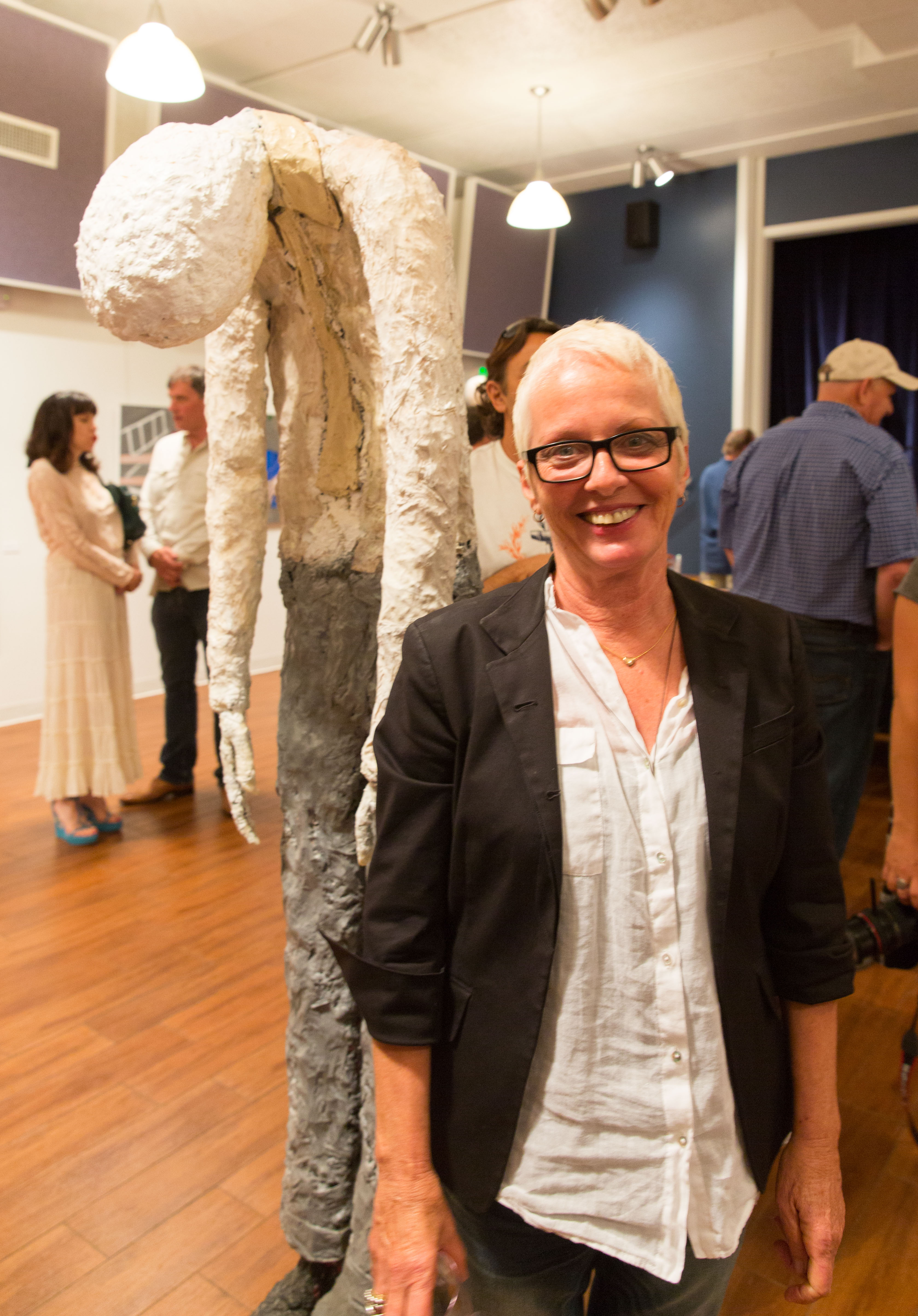
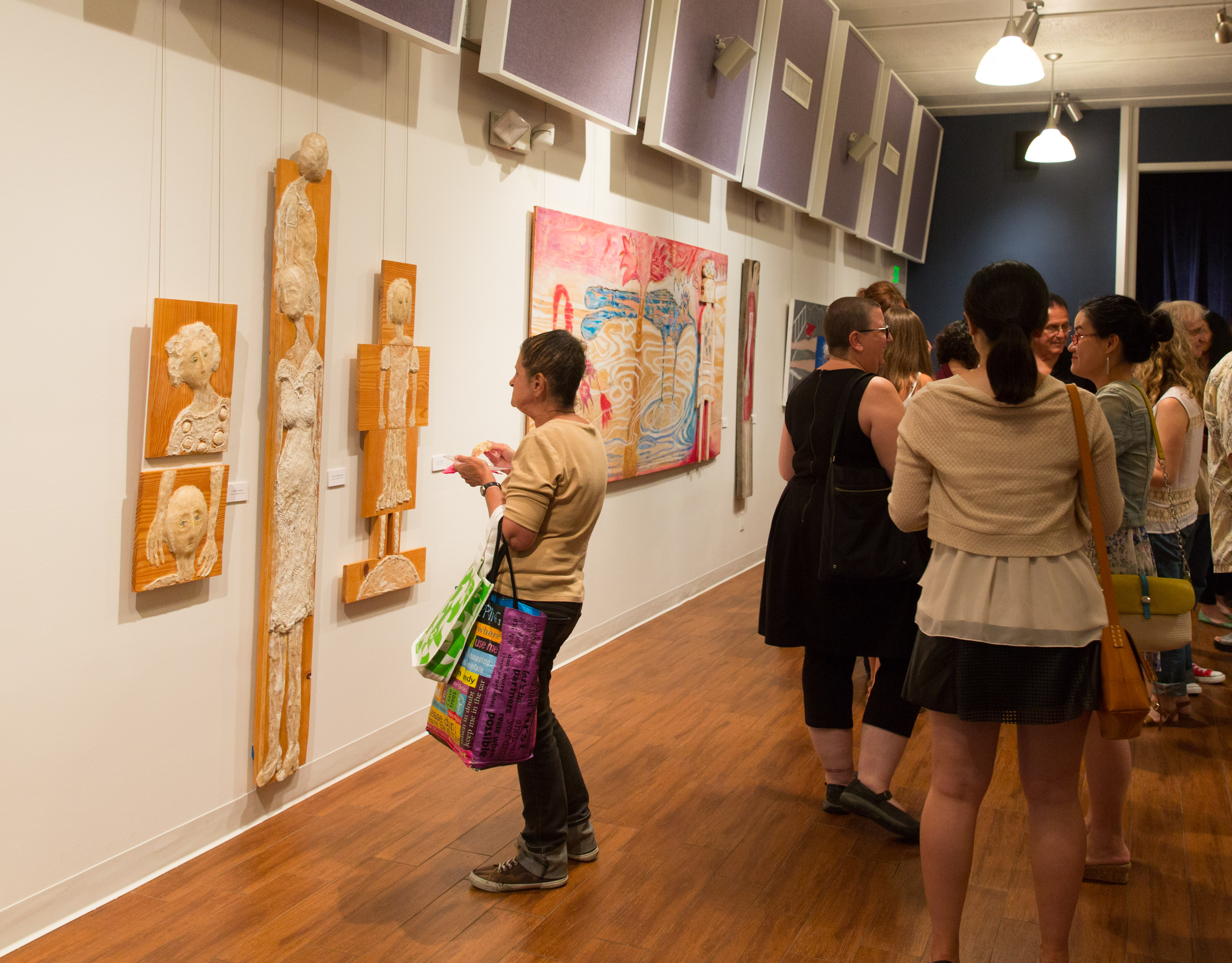
At the August 9th reception for artist Malka Nedivi’s solo show “Mother and Daughter,” Nedivi remarked “I’m overwhelmed at how big a reaction people have to this show, and what it does to people in an emotional way. I’m so moved.” Overwhelmingly beautiful and moving are definitely a part of the descriptive vernacular when it comes to Nedivi’s work. Inspired both in subject and material by the artist’s seamstress mother, this don’t-miss-show runs through September 16th at the National Council of Jewish Women in Los Angeles.

Malka Nedivi - Photo by Jack Burke
Malka Nedivi – Photo by Jack Burke

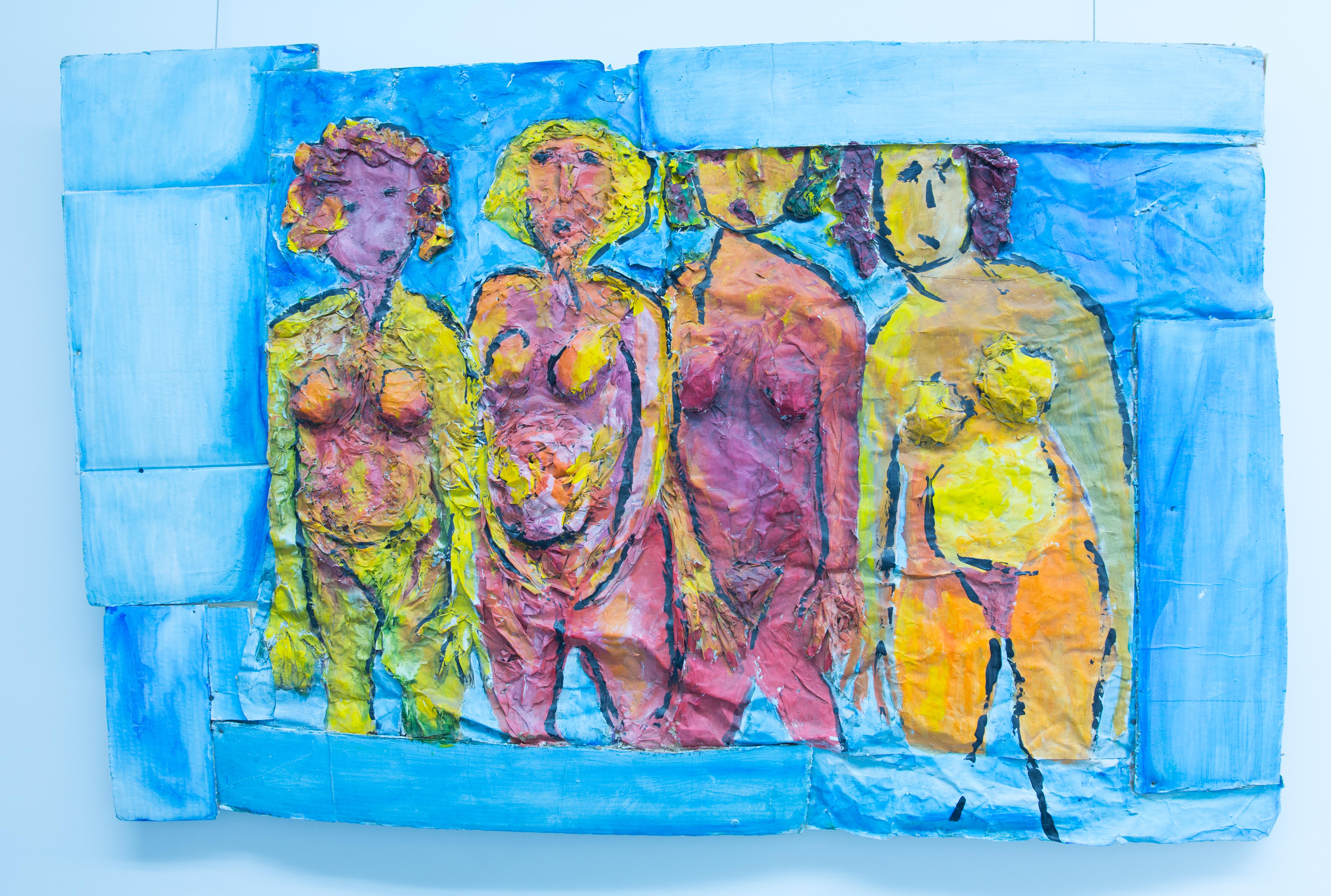
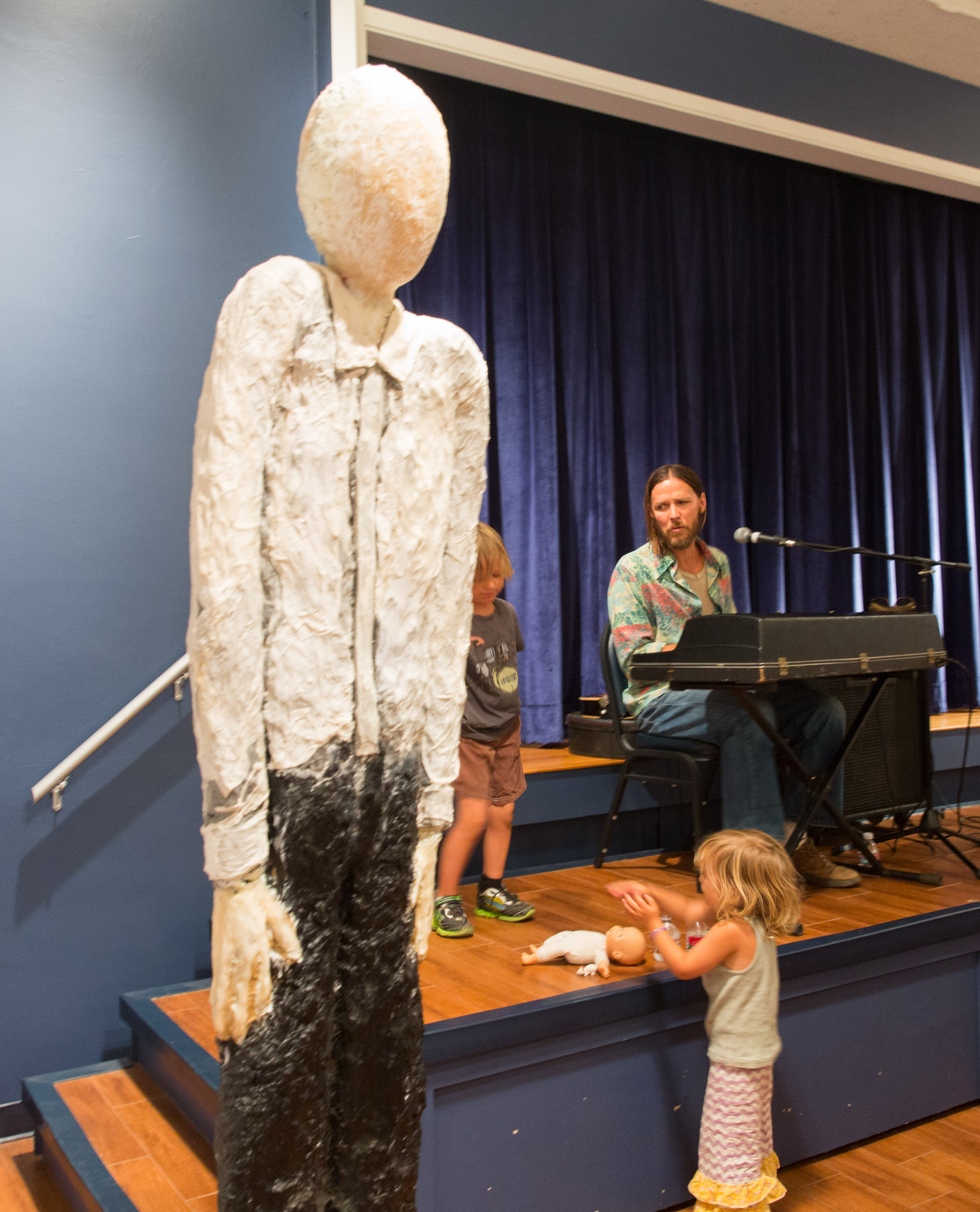
A painter, sculptor, and collage artist, Nedivi says that all of her work is inspired by her mother, and both her parents’ previously unknown past as Holocaust survivors. Nedivi’s work uses a great deal of wood and fabric. “My mom loved wood and boxes, so I chose materials that she loved,” the artist explains. The tactile nature of Nedivi’s work contributes to the feeling that each carefully layered piece is alive with emotion, visually leaping off the floor of the gallery.

Floating Woman

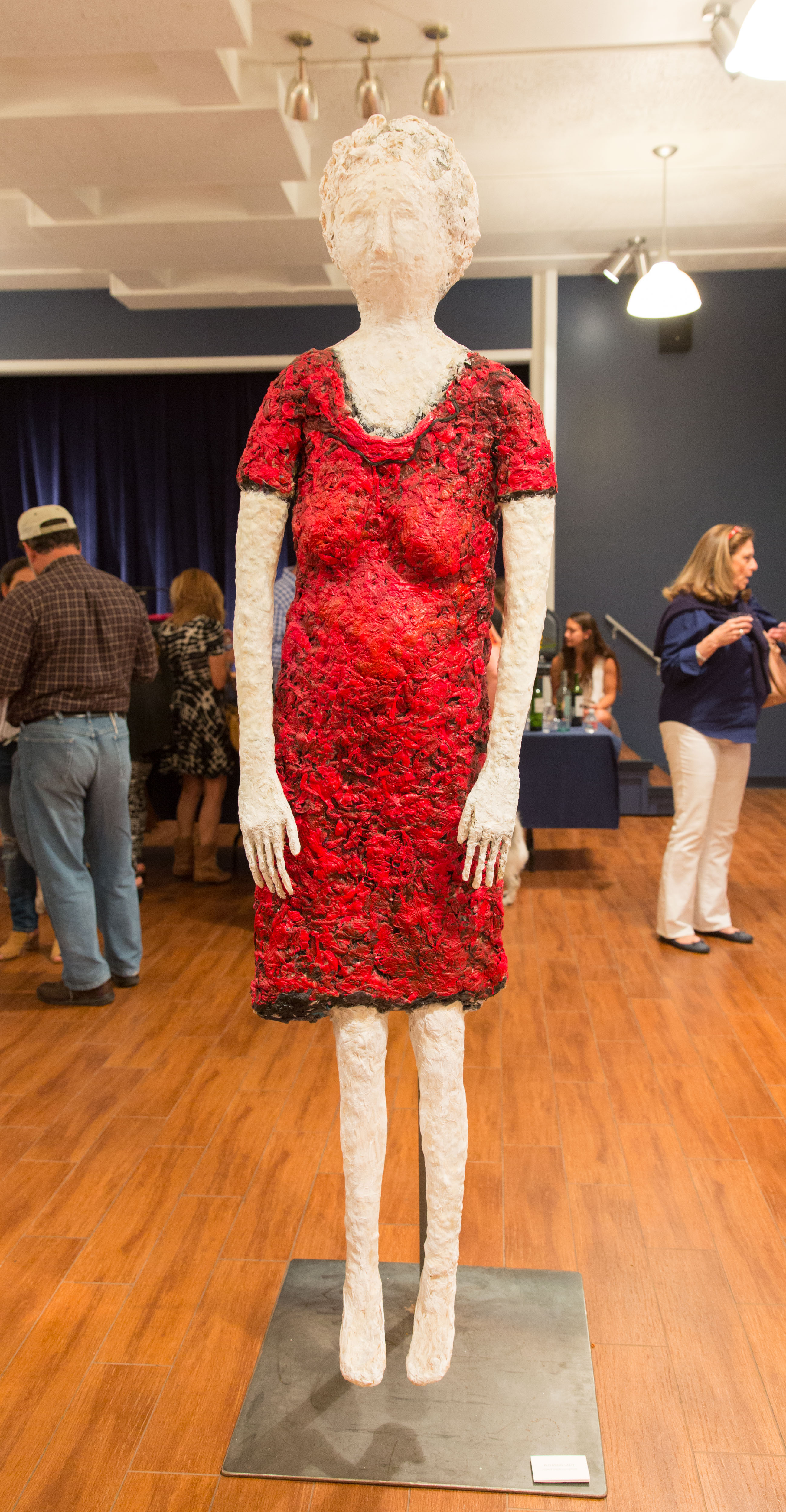
Her “Floating Woman” mixed media sculpture shows a white-bodied, ghostly woman in a vibrant red dress. The vibrancy of the dress beats like a visual heart, and expresses life, no matter how the woman, with her pale facial features, may fade. Emblematic of the artist’s bond with her mother, the piece seems to express the idea that love lives on after the body may have faded away.

Floating Doll

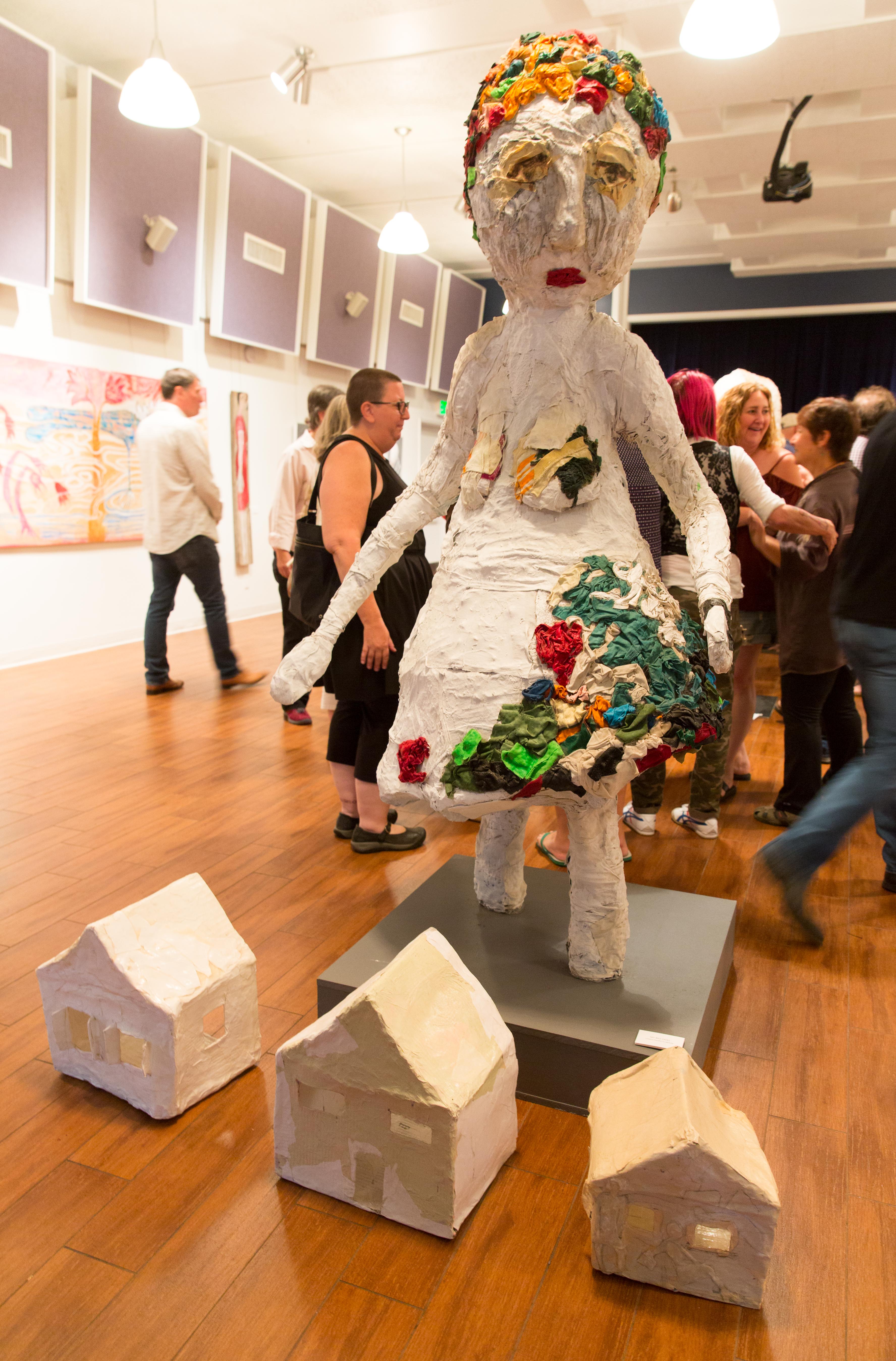
“My Big Doll” is the large scale six-and-a-half-foot mixed media sculpture that greets viewers entering Nedivi’s exhibit at the NCJW. The doll figure’s fabric hair and patterned skirt and top look like flowers. She seems to be blooming with both life and sadness, her eyes downcast, her cheerful colors ignored. With most of the sculpture white, there is the feeling of an otherworldly presence animating her figure.

Nedivi

Mixed media on wood, Nedivi’s “Memory” features a variety of figures, children, and adults, and a tree that may be the tree of knowledge, with ripe fruit upon it. A man and a woman stand at either ends of the piece, with two smaller girls, and a smaller boy and girl, backs turned to us, in the middle. Behind these smaller figures is a woman with Rapunzel-like long hair, holding her face in her hands. This figure is two-dimensional, the others are three. Viewers may take the figures on both ends of the canvas to be Nedivi’s parents, the woman with the long hair sitting beside the tree of knowledge is perhaps the artist herself, endowed with the previously unknowable about her parents, knowledge that children, perhaps her own, perhaps the child she once was, are turning toward.

Nedivi

Created on wood with paper, fabric, acrylic, and glue, the artist’s “Single Woman” is a riveting figure, her expression wise, withdrawn, palpably sad; her skin pale, her hair grey. Within this face is so much poignant life, and so much intricacy that comes with age. The wood itself that holds her visage is knotted and rough, the background to life in an imperfect world.

In each of Nedivi’s works, there is an intertwined immediacy: beauty and sorrow, cast down eyes and triumphant splashes of color, mother and daughter, past and future. The bared-soul intimacy of these pieces make them almost impossible to look away from, nor would viewers wish to do so. Rather, the pieces are made to pull viewers into a hidden world, a magical world, a world of mighty sorrows, hoarded secrets and pieces of fabric and scrap, and a world in which resilience and joy trump even the darkest past.

F23C0438 F23C0434 F23C0402

“Mother and Daughter” at the JCJW – Photos by Jack Burke

Born in Israel, Nedivi studied theater and literature at the Hebrew University in Jerusalem, and film at UCLA. She is also an accomplished film-maker. Her art is self-taught, beginning with ceramics in the 1990s. A move back to Israel inspired her current works, these large scale sculptures and collage paintings on both wood and canvas. Many of the pieces in “Mother and Daughter” use fabric and other materials found in her childhood home.

The artist has previously exhibited at the Santa Monica Fine Art Studios in Santa Monica, Calif., and was recently selected as one of ten Southern California Contemporary Artists from Israel exhibited at the Los Angeles Municipal Gallery in Los Angeles.

  • Genie Davis, All Photos: Jack Burke