Quaranta, just closed at bG Gallery in Bergamot Station, but viewable online, is a dynamic group exhibition with a powerful group of LA-based artists.
Curators
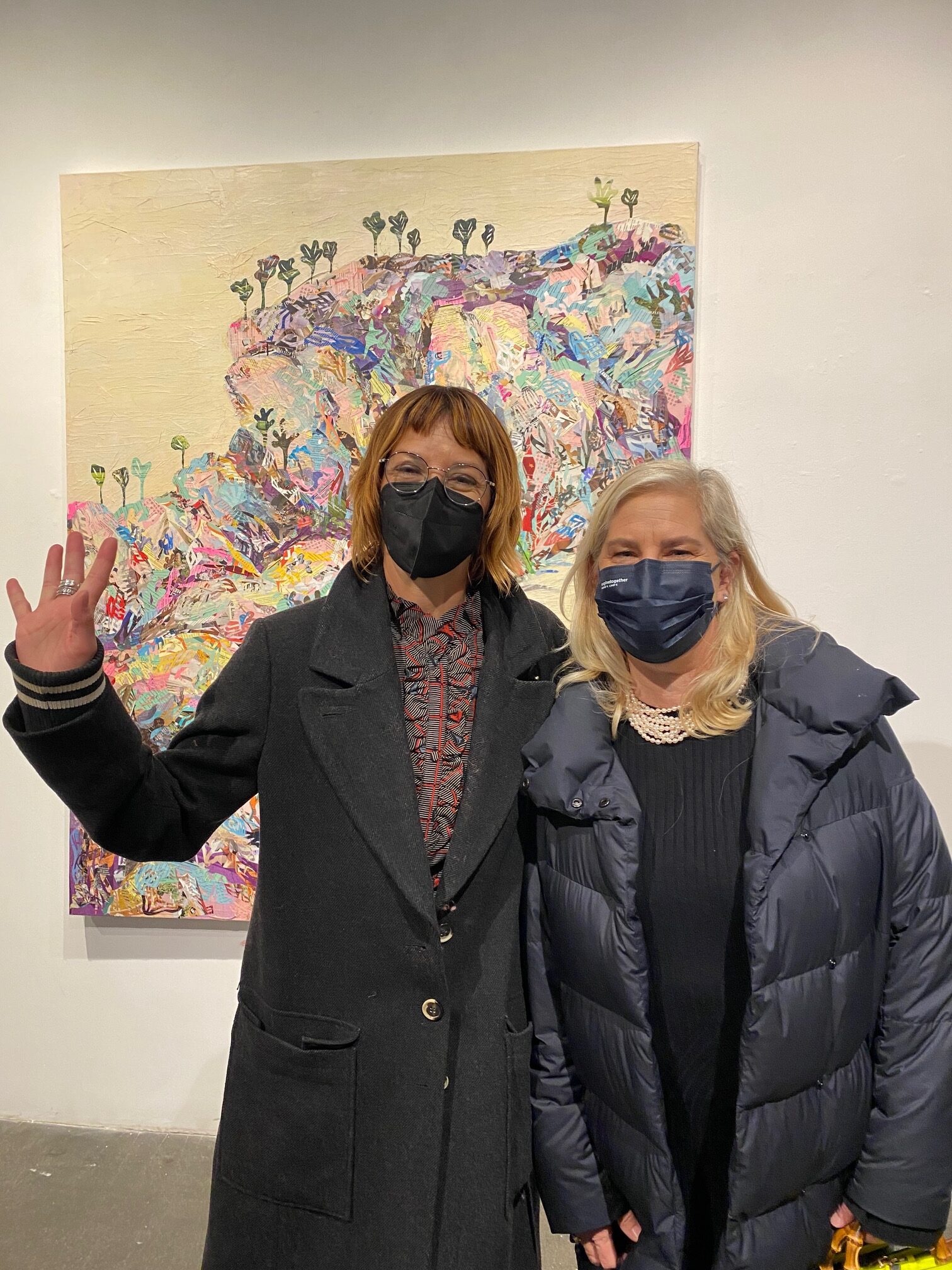
Susan Lizotte and Jenny Hager (above) co-curated a beautiful show with an inherent and wildly colorful rhythm, one of introspection and resurrection, of internal vibrance and vivid takes on the external world.
Both alluding to and inclusive of work produced during the beginning of the pandemic and quarantine times, Quaranta offers a wide range of work that reveals not only the artists’ psyches during that time period, but the diverse and experiential quality of the Los Angeles area artists who produced it.
Dani Dodge
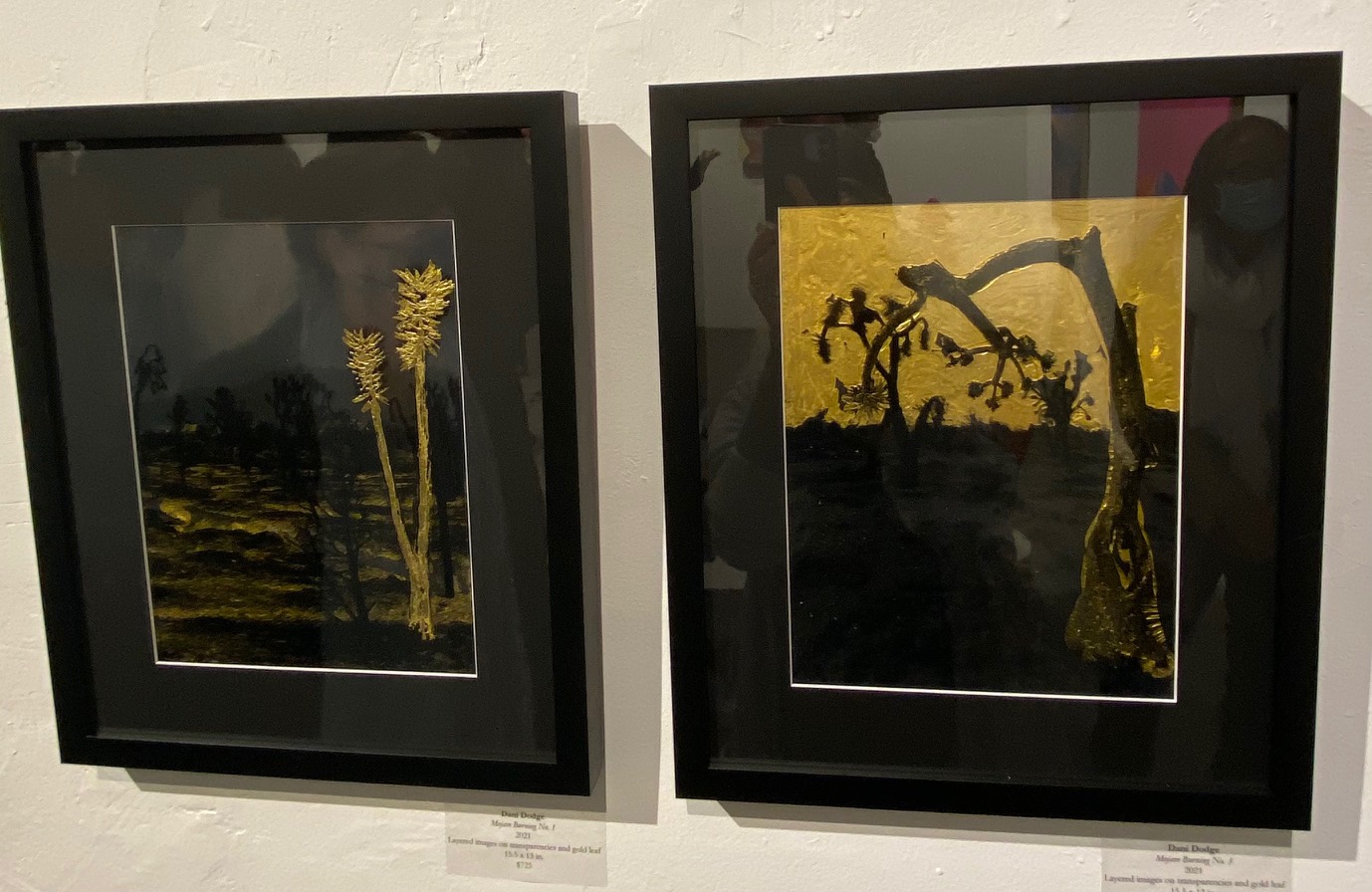
The work includes the glorious gold leaf-infused mixed media images of Dani Dodge in her tragic yet life-affirming “Mojave Burning…”
Luciana Abait
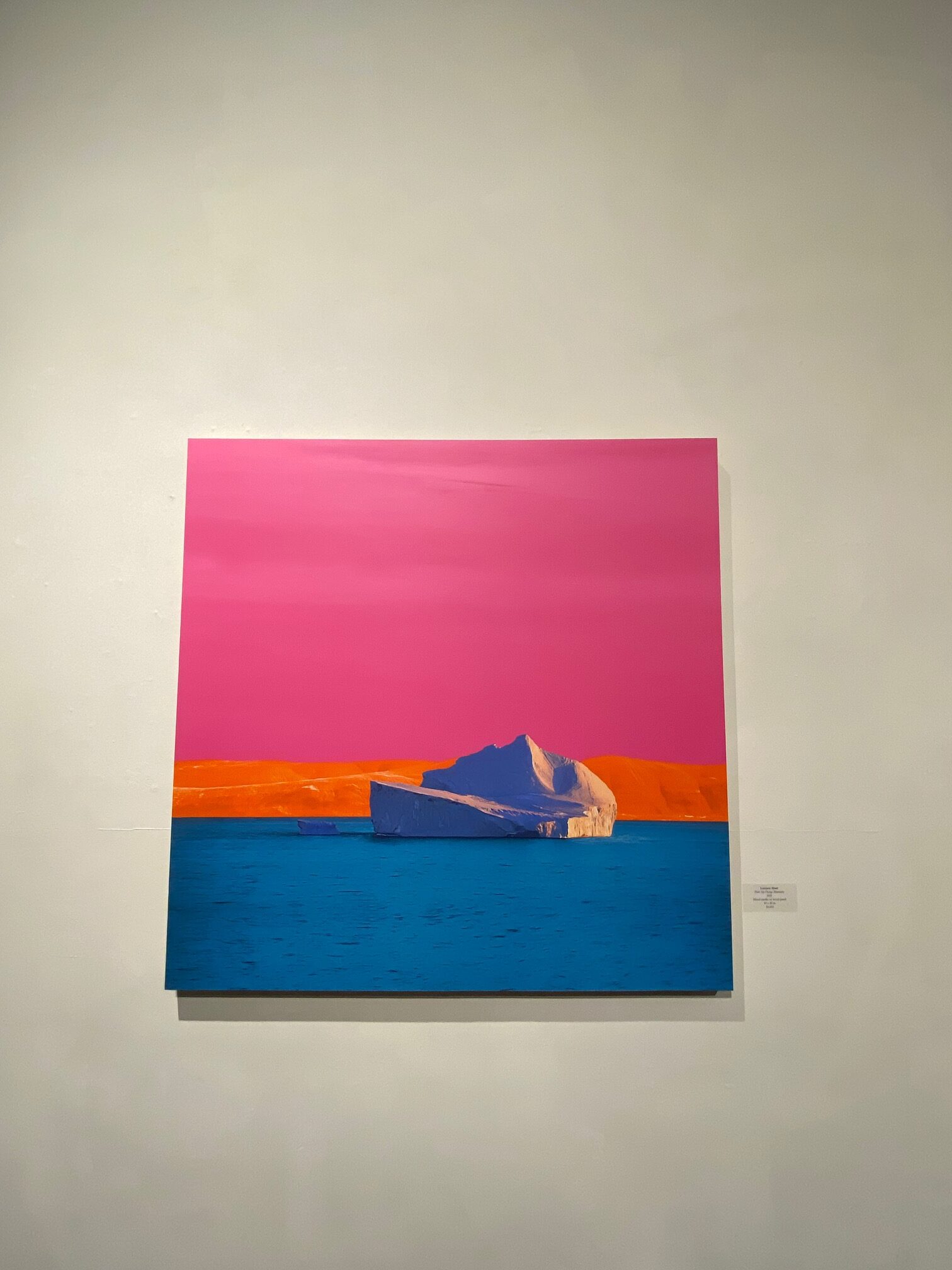
the vibrant colors of Luciana Abait in “Pink Sky-Orange Mountains,” in which a reflective body of water and an ice formation reflect these hot, bright shades…
Gay Summer Rick
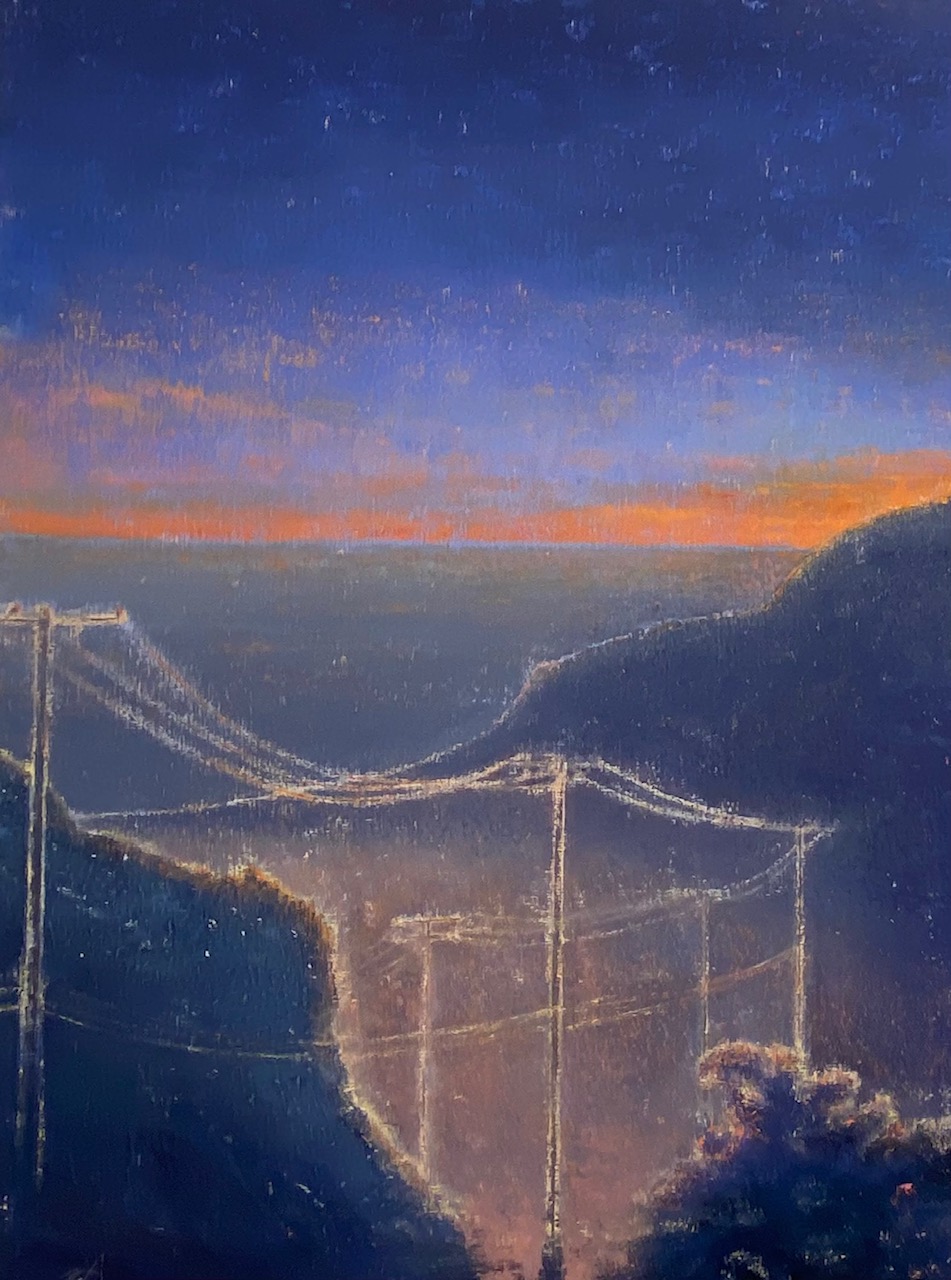
twilight drenched yet still glowing work from Gay Summer Rick…
Susan Lizotte
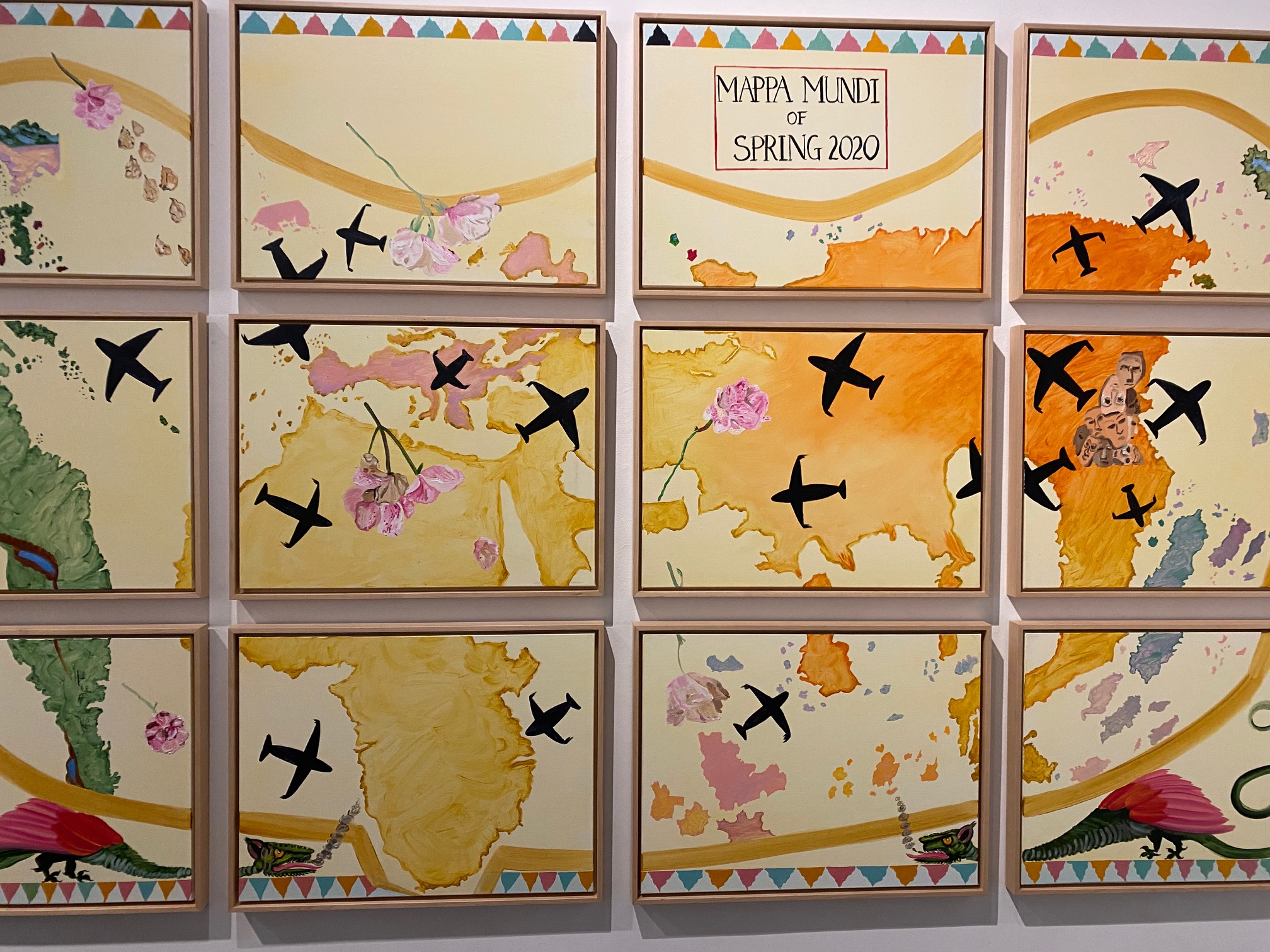
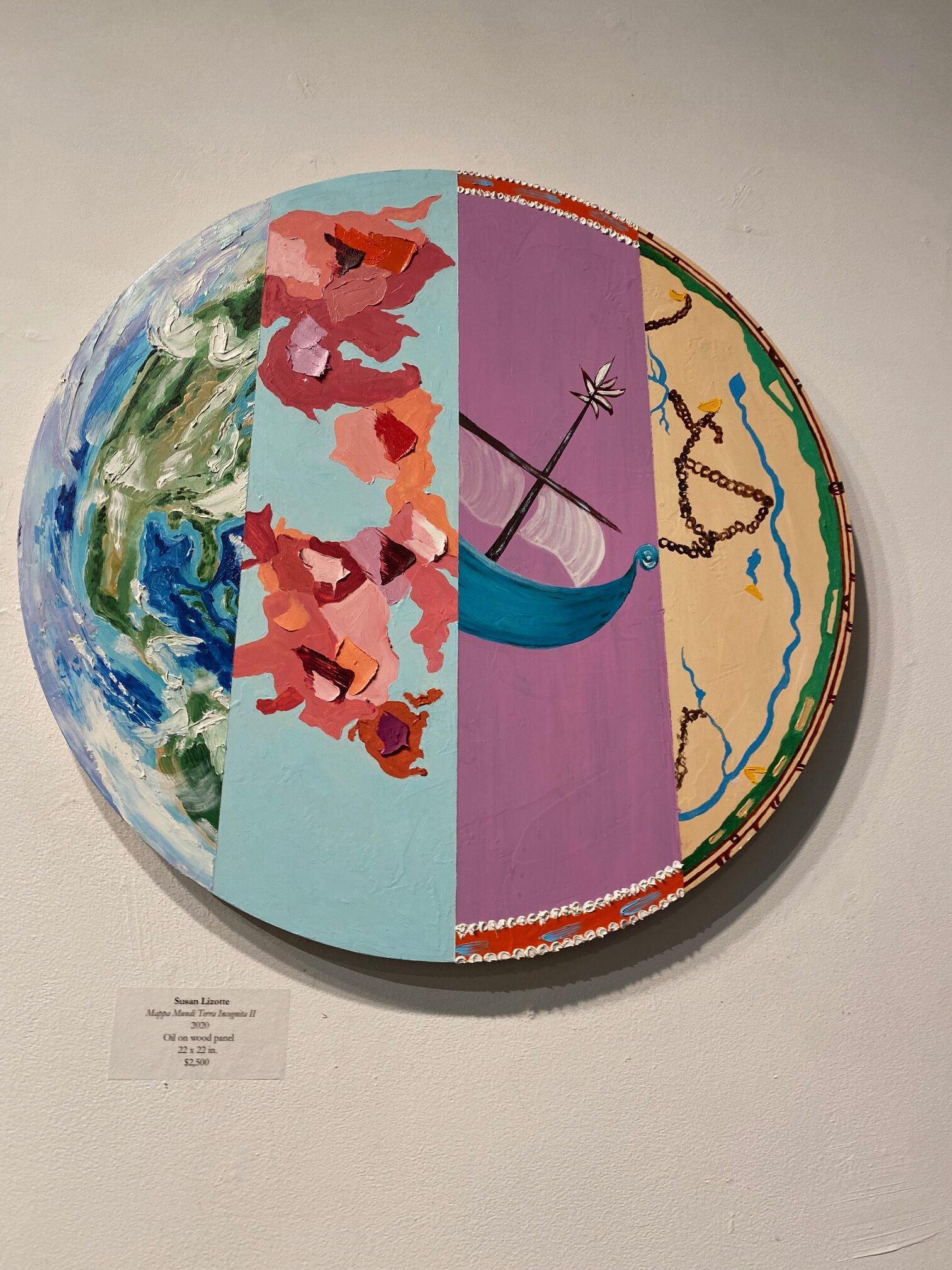
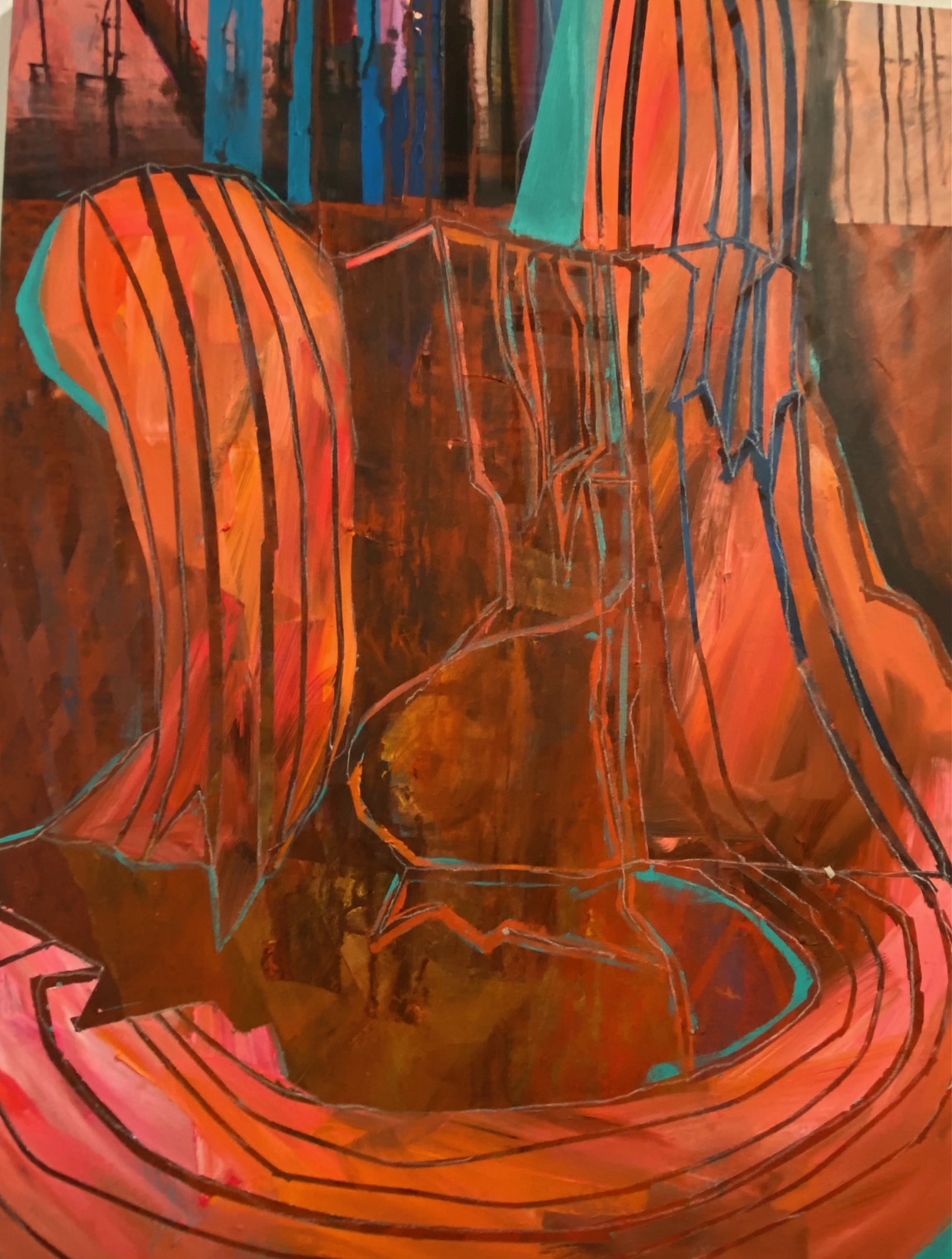
lustrous new map work from Lizotte, above; rich layered abstract from Hage, below…
Jenny Hager
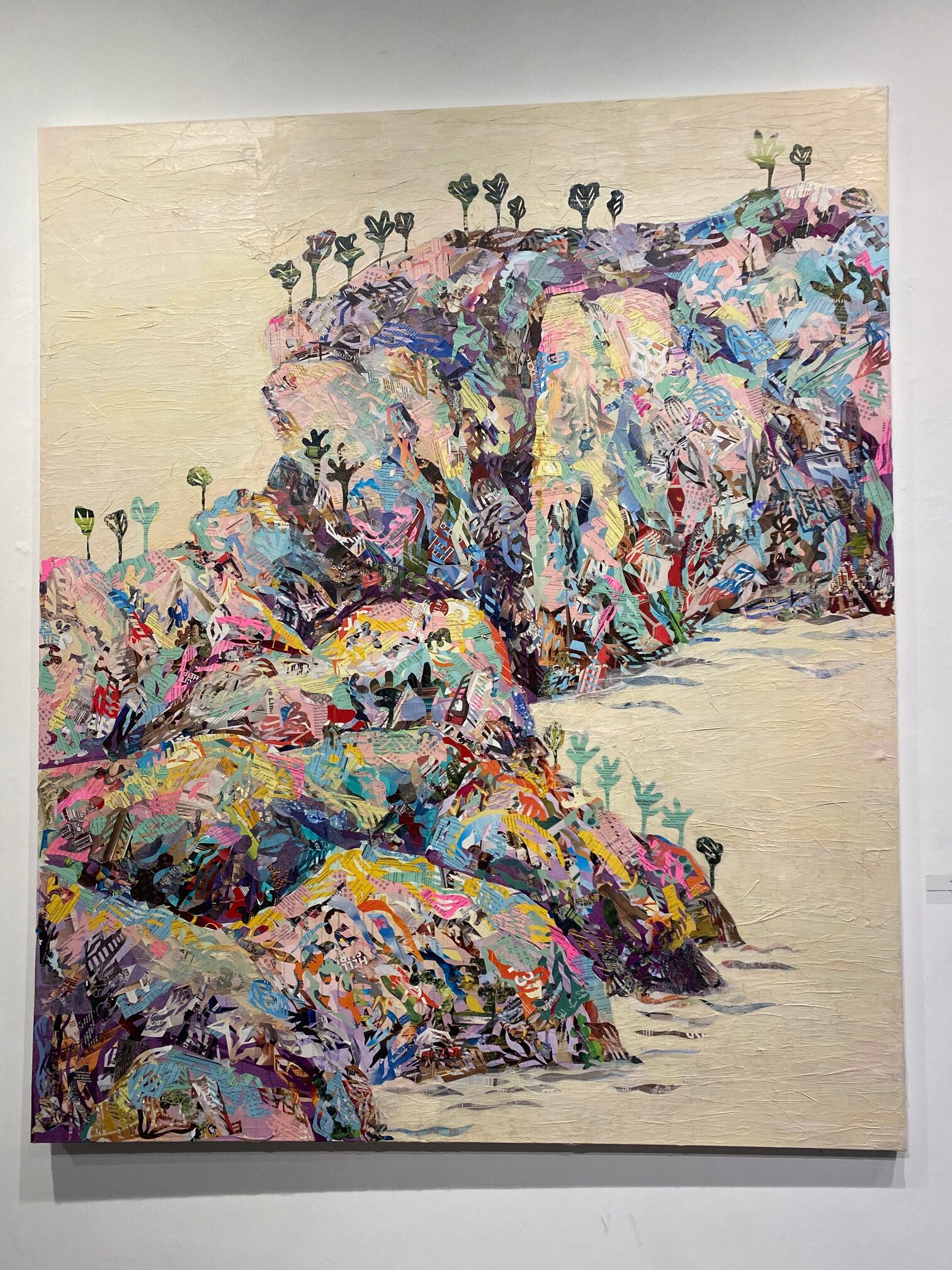
and, an intricate landscape piece from Sijia Chen that summons a sense of profound wonder in its multicolored patterns.
Sijia Chen
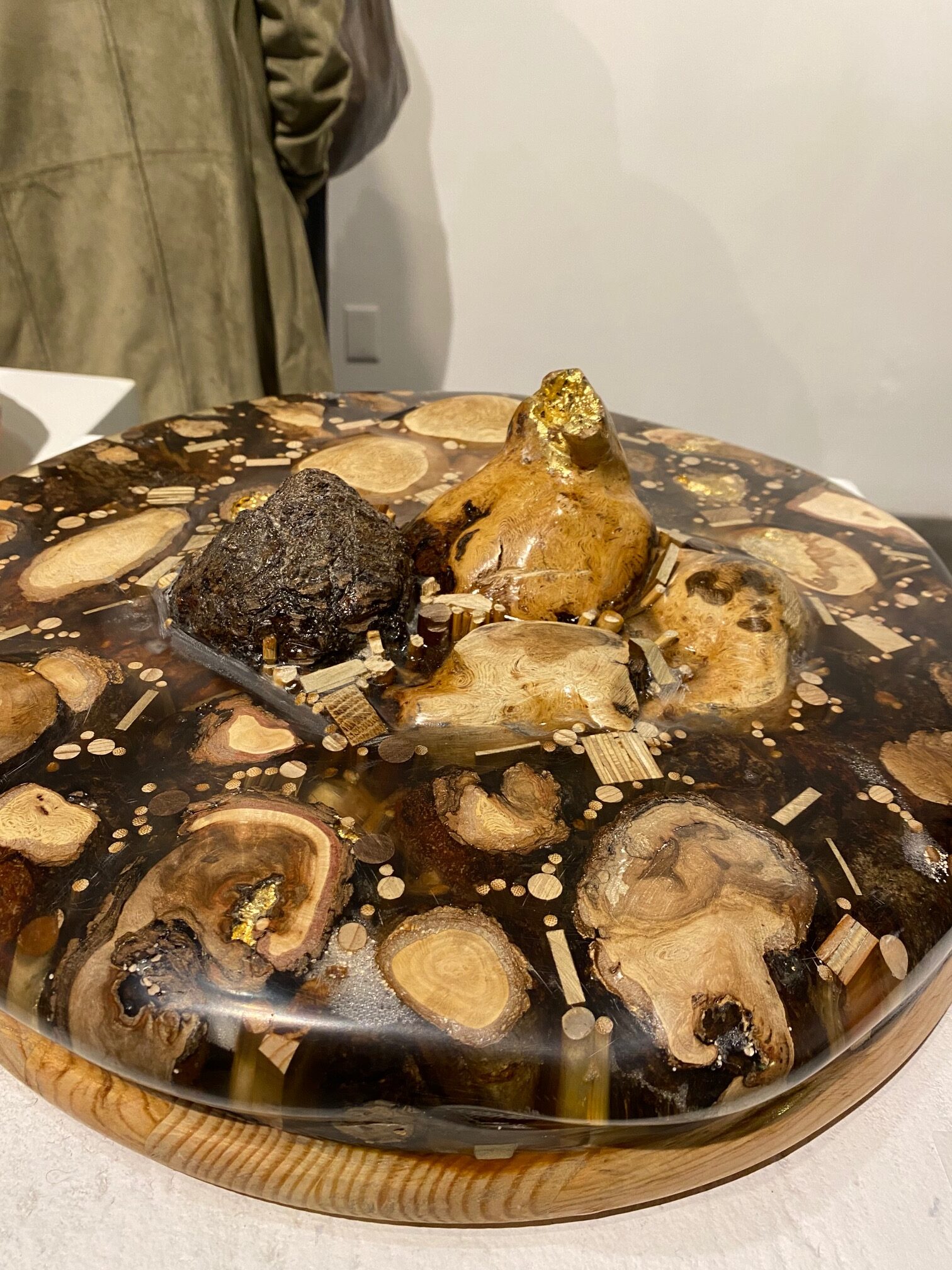
There is lush sculptural work from Steven Fujimoto in the mandala-like pattern of his “Tide Pools” …
Steven Fujimoto
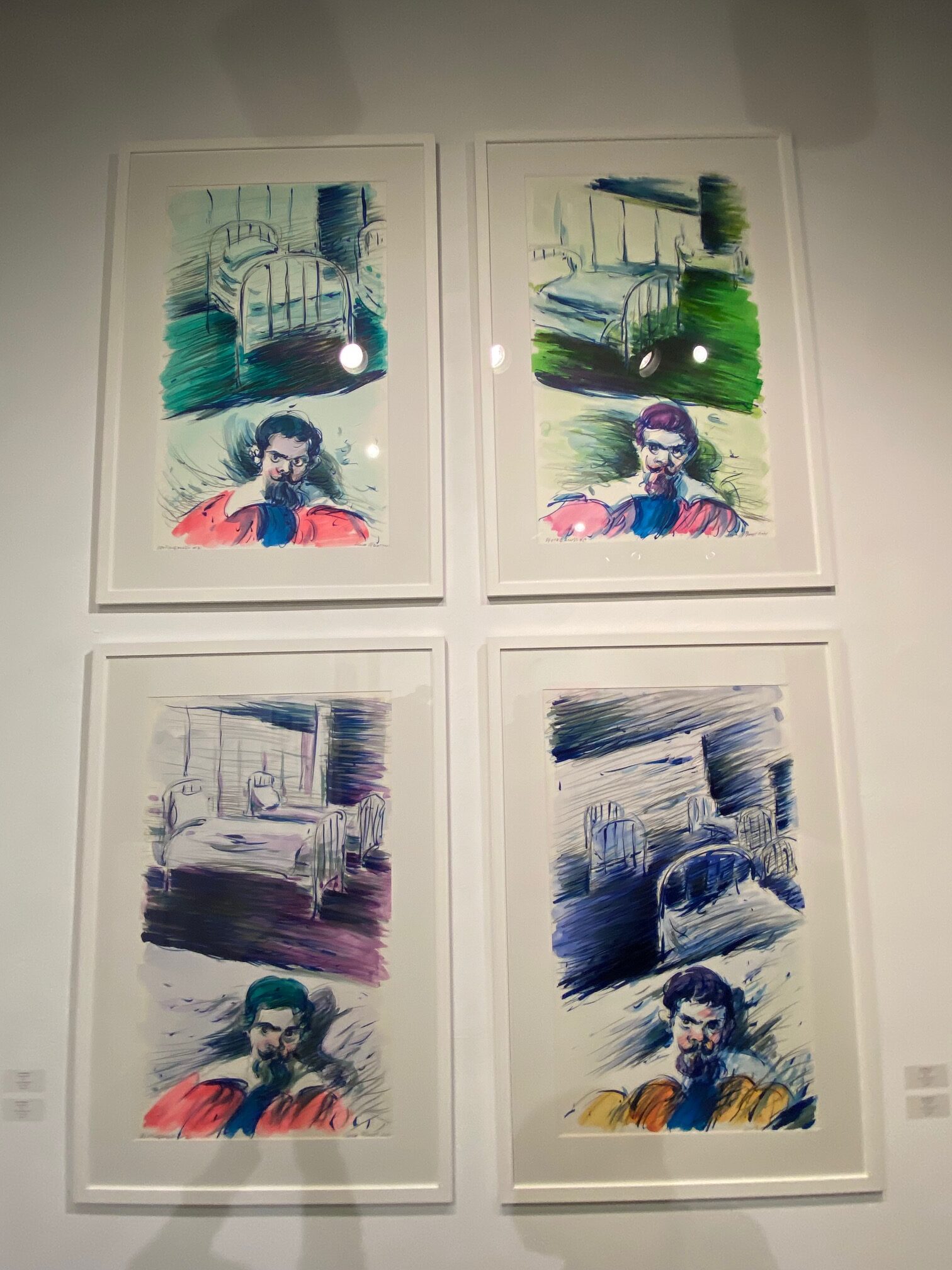
and the fascinating four-part reworking in watercolor of a classic image from Lena Moross.
Lena Moross
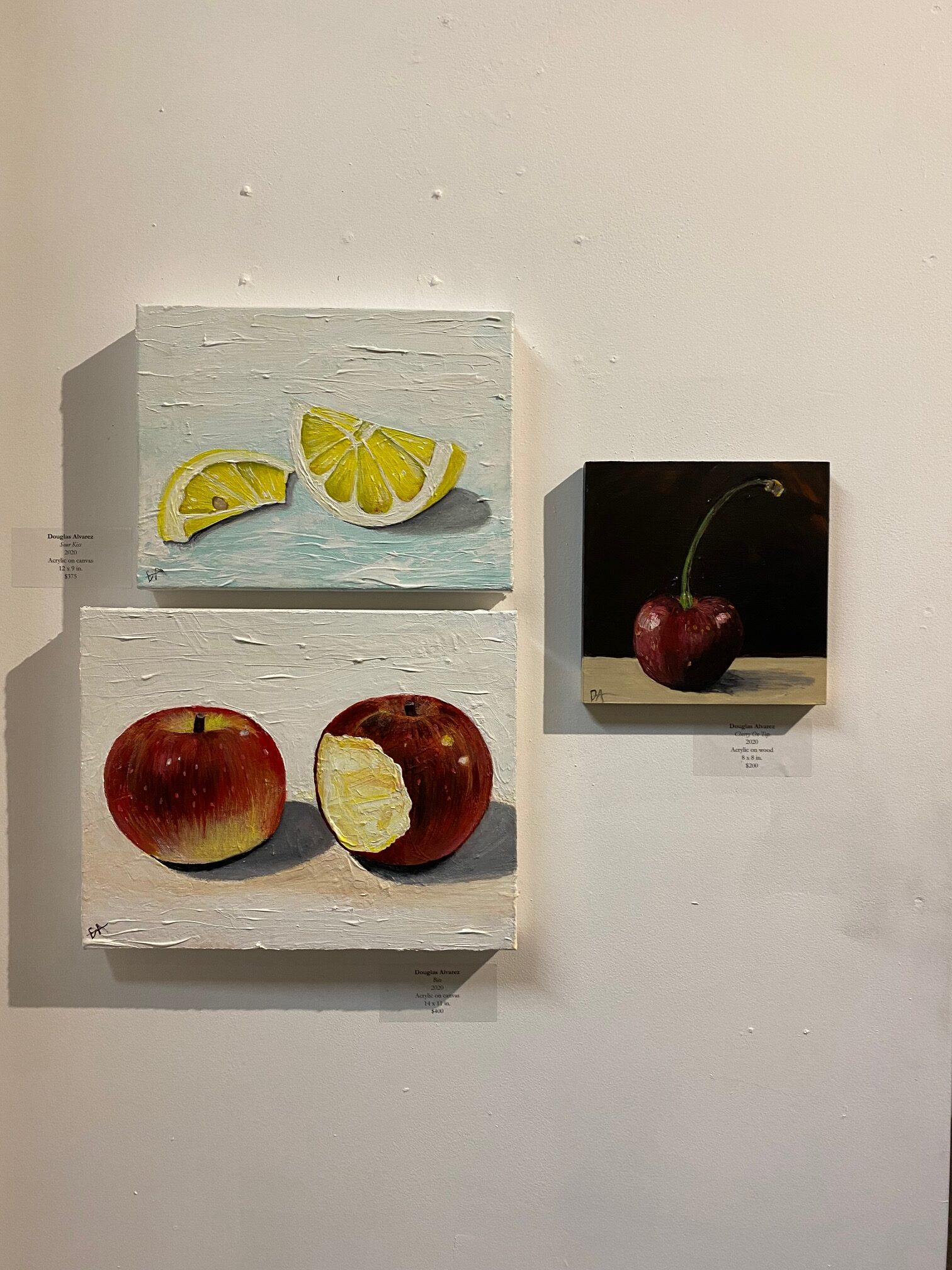
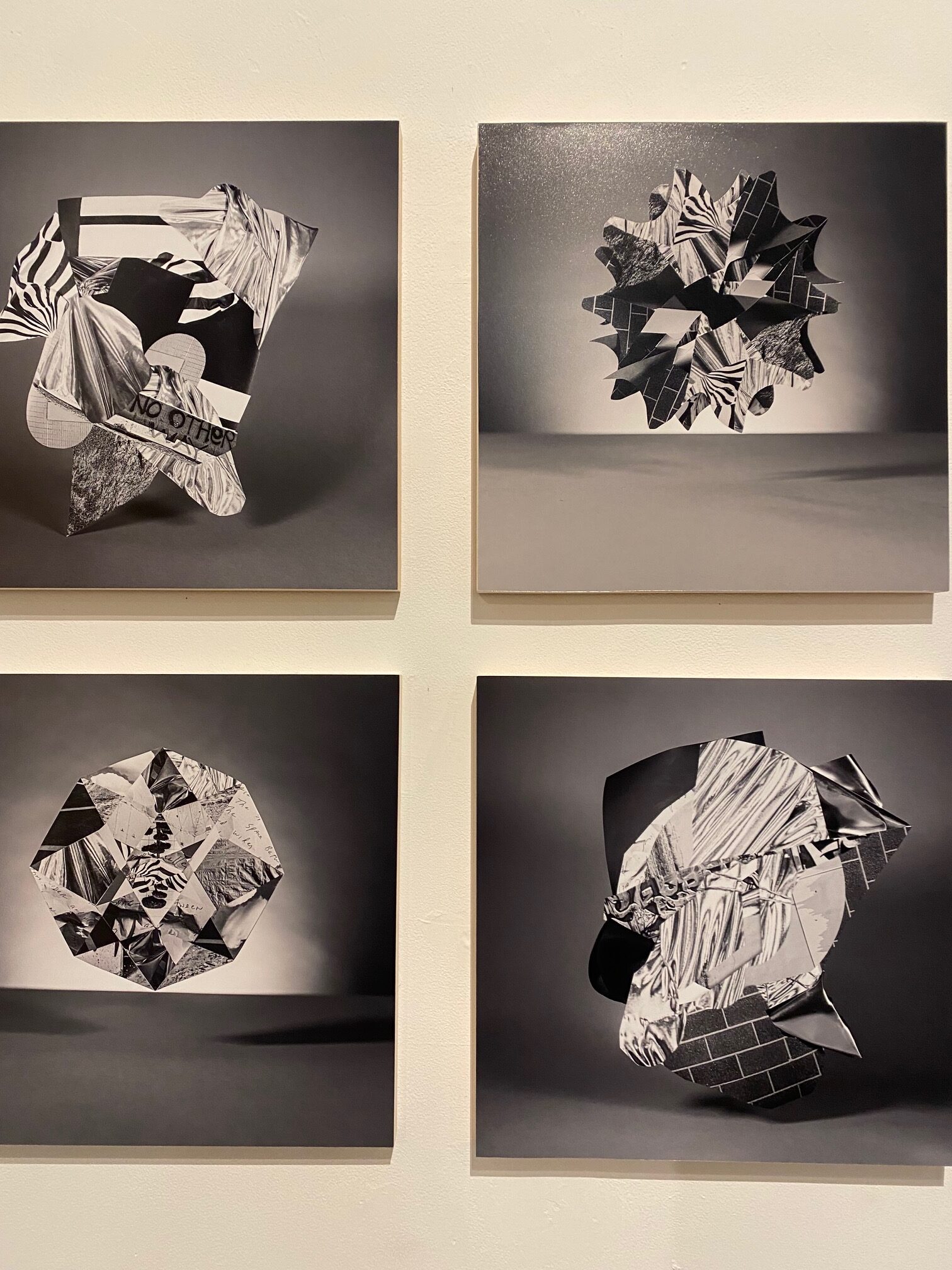
Other excellent pieces come from Douglas Alvarez, with his lovely still life depictions of fruit, and Ray Beldner’s tribal-like geometrically patterned rocks.
Douglas Alvarez
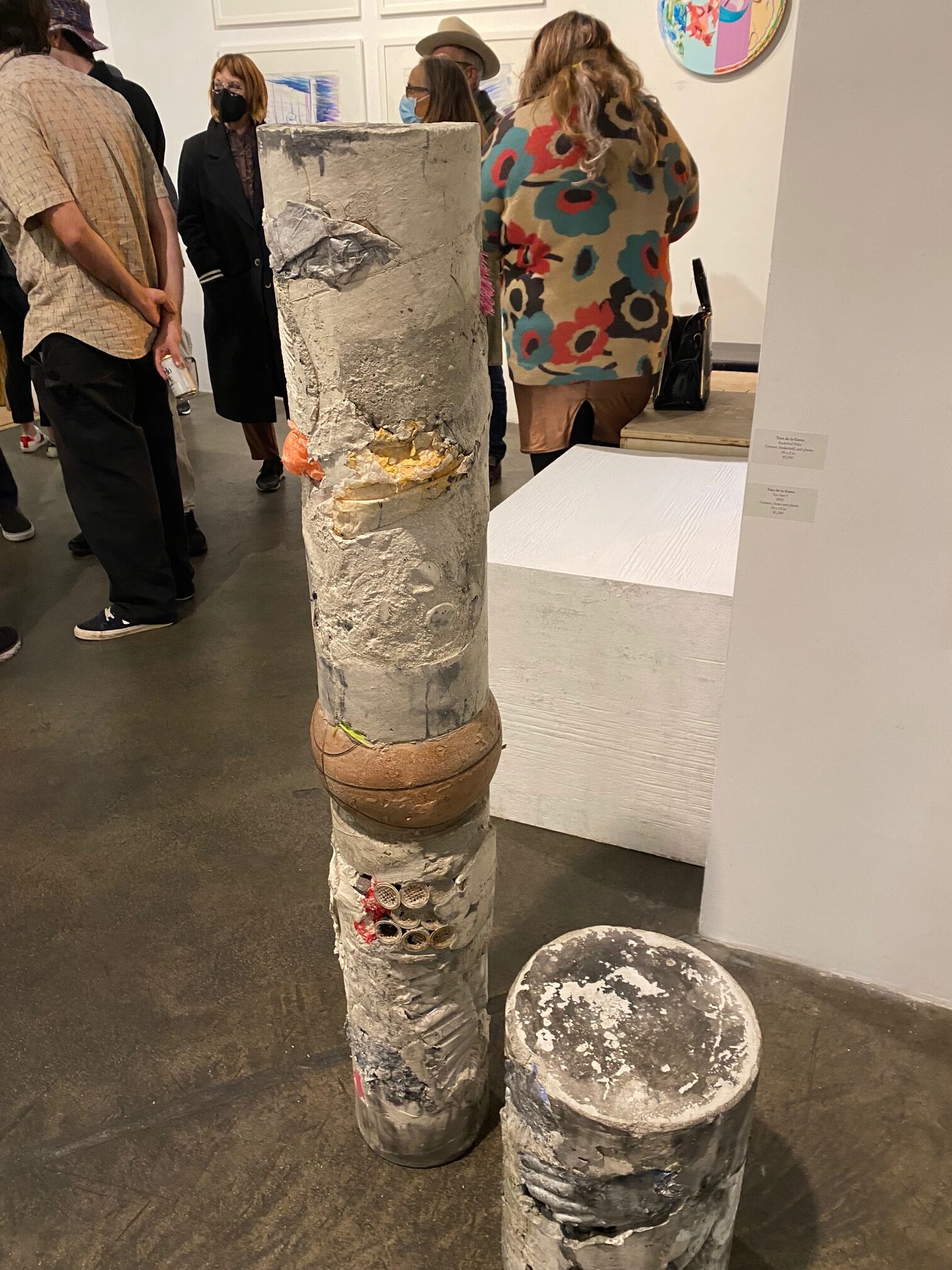
Tara de la Garza’s raw sculptures, Alex Shaffer’s perfectly lit, graffiti-filled LA street scenes, and the fascinating patterns represented in diverse pieces from Diane Meyer, Curtis Stage, and Alexandra Weisenfeld complete the exhibition.
Curtis Stage
The curators’ description reads “Work produced during the Quarantine, by nature, is a visual documentation of artists’ emotional response, either directly, or indirectly.” That response is one of vivid palette, repeated patterns, totem-like shapes and colors, an inner world of brightness, texture, contrast, and form that both mourned and celebrated an outside world. Both curators exemplify this in their own very different works – compelling in color and depth.
Tara de la Garza
As we drop our protective cocoons and become masked butterflies, it’s wise to remember the year 2020, and the time of emotional gestation, both physically limiting and emotionally draining, yet somehow as crazy perfect as dreams become art. Quaranta’s perceptive take on this period and strong mix of important, LA-based artists brings that art dream full circle to external viewers.
There was a great deal of awesome art eye candy at the LA Art Show, which ran in the South Hall of the LA Convention Center January 19th through 23rd. From glittery NFTs to a dazzling series of installations by DIVERSEArtLA, there was plenty to take in.
Opening night also saw the return of a food court and cocktails, as well as art talks held throughout the event.
Daniela Soberman
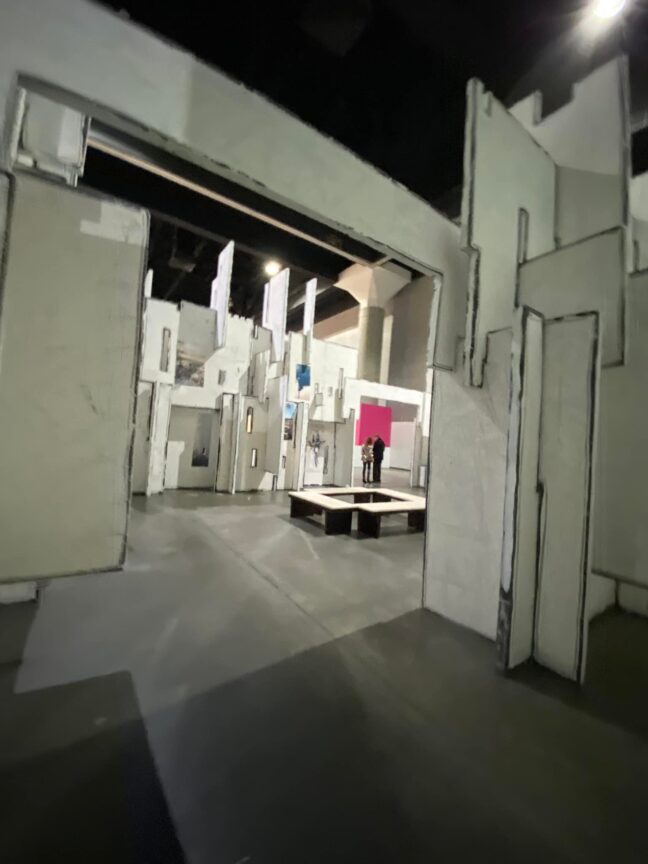
DIVERSEartLA, curated by Marisa Caichiolo, returned this year with an evocative, environmental perspective, shaping immersive experiences focusing on global warming and human relationships to nature. Each of the participants provided fascinating work, with TAM (Torrance Art Museum) presenting Memorial to the Future, a collaborative work curated by Max Presneill referencing Brutalist architecture in a large scale cityscape installation created by Daniela Soberman.
Both impressive and immersive, the structure was interspersed with photographic visual elements offering interpretations of nature, climate change, and danger in our environment. A dazzling piece.
Dox Contemporary-Prague, the Czech Center New York, and The General Consulate of The Czech Republic present “THE SIGN,” a site specific installation by Swen Leer used a mimicking of freeway signage to communicate trenchant messages that began in the entrance lobby to the South Hall. The largest and perhaps the most pointed was “Your children WILL hate you – eventually.” But, equally memorable as we all snapped photographs of art and masked but well-dressed guests posed for social media photos, was “Enjoy Your Life on Instagram or TikTok.”
Other installation pieces included work from MUSA, Museum of the Arts of the University of Guadalajara, and MCA Museum of Environmental Science presenting “THE OTHER WATERFALL & CHAPALA ALSO DROPS ITSELF” by Claudia Rodriguez, both of which reflect the contamination and lack of water that has affected the state of Jalisco, Mexico in the last decades. The result on exhibit: stunning visuals approached through a cave of netted curtains.
MUMBAT Museum of Fine Arts of Tandil and the Museum of Nature and Science Antonio Serrano of Entre Rios Argentina presented “THE EARTH’S FRUITS” by Guillermo Anselmo Vezzosi curated by Indiana Gnocchini, a scientific research project and an installation work of a specific ephemeral site, where the waste that takes on a second life is dignified. Vezzosi’s graceful trees, built into a darkened space, were beautiful.
Caichiolo curated “The Environmental Digital Experience” by A.Ordoñez delivered by Raubtier Productions & Unicus, an immersive experience revealing a range of climate phenomena, with the culmination a representation of the positive growth of new flora. The sculptural construction of the images pulled viewers into a new space.
A startling, and even tragic look at the melting Arctic was presented in the large scale video installations from The Museum of Nature of Cantabria Spain in the work “Our turn to change” by Andrea Juan and Gabriel Penedo Diego, depicting on large screens how drop by drop, large amounts of ice are lost every second as the oceans levels continue to rise. UCLA Chicano Studies Research Center’s “Mound” by María Elena González, curated by Chon A. Noriega revealed the process of attempts at restoration; while “Recognizing Skid Row As A Neighborhood:Skid Row Cooling Resources,” curated by Tom Grode highlights the neighborhood as a community, including the Skid Row Cooling Resources, a collaborative planning effort and think tank.
Debbie Korbel
But of course, there was so much more. A series of sculptures by artist Debbie Korbel; a collection of NFT art from Fabrik NFT Salon; a wide range of beautiful work at bG Gallery including stellar LA artists such as Gay Summer Rick, Susan Lizotte, Glenn Waggner, Richard Chow, Barbara Kolo, Hung Viet Nguyen, and many others. Each artist’s unique work is somehow quintessentially born of Los Angeles, and it was fitting that this exhibition space, filled with their beautiful work, was the first I explored at the exhibition hall. Arcadia Contemporary offered a fascinating collection of works, from a series of portraits to an evocative Yoda looming from a movie screen in a heartland farm field from artist Stephen Fox.
There were artistic homages to other creators from Picasso to Kerouac, as well as an actual Picasso; rich rainbows of stained glass from Judson Studios; strange mysteries of civilization, such as London underwater, from Thitz; glowing jelly fish from Mario Pasqualotto at Pigment Gallery; Jacob Gils dazzling landscapes at InTheGallery; the quilt-like images of Heimyung C. Hyun; Wyoming Working Group’s ongoing Jackson Pollock project; and at John Natsoulas Gallery, whimsical and involving sculptural works and wall art. Minoru Ohira’s forest of small sculptures has an otherworldly glow.
Alexandra DillonMatter GalleryNathie KatzoffCinq Gallery
Sponsored by bG, there was Alexandra Dillon’s portraiture on unusual objects; LA’s Matter Gallery presented the works of JonMarc Edwards; Nathie Katzoff out of Seattle exhibited a series of dazzling cast and fused art glass works and sculptural wood furnishings. Also notable were the post-apocalyptic cats and dystopian landscapes at Cinq Gallery.
Cathy ImmordinoLuciana AbaitJorge Rios
Los Angeles artist Cathy Immordino’s portrait cyanotypes haunted in blues, golds and beige at Fabrik Projects; while Luciana Abait’s startling lime green and hot pink landscapes seared at Building Bridges Art Exchange. And, one of my favorite images throughout the entire vast banquet of art on exhibit this year was Jorge Rios “This was the first reflection.”
Moberg Gallery, Des Moines, Iowa
Art tells us a story that resonates visually, emotionally, and in the soul. The LA Art Show served up a big, sprawling novel for 2022.
Snezana Saraswati Petrovic is ready to immerse viewers in her own wildly wonderful, tactile world with the opening of her solo show Collateral Damage Recall at LAAA’s Gallery 825. The exhibition will be on view from January 15 – February 18, 2022.
The exhibition will take viewers into a living room and a bedroom constructed installation, with the intention of bringing awareness to climate change, and specifically the destruction of the ocean, coral reefs, and other water resources.
While playfully constructed in a realm comprised of post-apocalyptic plastic to shape a futuristic home environment, the complexity of the work is rooted in Petrovic’s own discourse on prescient environmental issues. As compelling as it is beautiful, the installation will evoke the balance between what most frightens us about the potential destruction of the planet and the ever-present beauty of the natural world. Both ideas captivate the artist.
Petrovic notes “Our most natural human habitat is a home.” Because of that she recreates a family room that utilizes principles of sacred geometry. “The room divisions applied the golden rule principle for placements of objects. The numbers of objects are also evocative of certain symbolism, such as 30 corals in the infinity mirror, shaped as the smallest island from the Great Barrier Reef. When multiplied by mirrors, 30 3D printed corals became 300 coral reefs within the parameters of these islands.”
Her use of color also reflects the dichotomy of beauty and aching loss. “The choice of a specific blue color that the space is saturated with, is a color that exists in nature: evening sky, deep water, night forest, ocean, or distant mountains. It is calming and soothing. The sound of nature is coming from a blue marlin over the fireplace. An invitation to connect with nature is even more present in the bedroom [than the family room portion of the exhibition.] The waterbed creates a feeling of floating on the water’s surface [as one is] surrounded by video projection of the underwater world of Huatulco, Mexico.” Petrovic recorded the video images while diving in that area.
The installation is also interactive. Augmented-reality photos are designed to free bleached white corals entangled in zip ties through use of the downloadable ARTIVIVE app.
Viewers can listen to the sounds, touch, read, engage in a conversation with others, or even view a Black Carbon video that presents the spread of Covid-19 related to soot.
Petrovic notes “The post-apocalyptic overarching metaphor is the amount of the plastic in the installation space. 94% of microplastic is floating in the ocean at the Great Pacific Garbage Patch. My goal with installation was to use 94% of plastic to create the otherwise inviting space.” She adds, “The scientific projection indicates that by 2050, the ratio of fish to plastic will be 1:1. As a reflection to this predicament, I have made true to size a plastic zip tie Blue Marlin as a grim counterbalance to real taxidermized fish.”
In each aspect of the exhibition, Petrovic realizes the power of the global community. “We are all part of it, connected to and affecting each other. That makes us one family.”
The exhibition is comprised of some 136 individual art pieces, assembled into one cohesive installation. These include four video projections, four augmented-reality photos of plastic-trapped corals and the use of the ARTIVIE app to release them; forty-eight colorful 3D printed, miniature corals; a memorial wall of white corals; a family-tree mind-map showing the progression of Petrovic’s Collateral Damage project, which has grown over the years since its inaugural form at MOAH several years ago. Additional features include found objects, more than ten zip tie sculptures; printed vinyl images; and a 13-foot-long taxidermized blue marlin, along with repurposed furniture pieces and a fireplace mantel.
There is even an aromatherapy experience that can be triggered in the bedroom portion of the exhibition; viewers will get a scent of ocean breezes, in yet another component of what is a dazzling compilation of individual works, as astonishing and delightful to view as they are profoundly urgent.
The delicate, even ephemeral appearance of her materials belies their longevity, Petrovic attests “The zip tie netting feels fragile and ephemeral, and that is my intention, where the true properties are hidden, much like in our daily encounter with the plastic… we use it and discard it, but it does not go away.”
Petrovic hopes that viewers will take from the installation a sense of “Hope, empowerment to take action, and that we are not alone. We are all family. The plastic abundance is intended to make us open the eyes to our own everyday lives and plastic overuse.” She notes “I also hope that people will have fun, be engaged and intrigued to find their own answers.”
How could they not be? The gallery, refurbished and re-painted in blue with blue plastic grass as a carpet, will create an environment at once familiar, cozy, and non-traditional, one that the artist is moving and creating in just a six-day period.
The playfulness inherent in Petrovic’s work is always captivating. “Creating and sharing art is about communication and connection. My artwork is about hope and what makes me smile… A little bit of whimsy and intrigue makes any grim subject more bearable, while giving us a hope and necessary distance to see that healing or solutions are at our own disposal.”
LAAA is located at 825 N. La Cienega in Los Angeles. The opening is January 15 from 10 a.m. to 5 p.m. no reservations necessary, mask required; after the opening, through February 18th by appointment.
Prepare to get in a Scramble just in time for the New Year. At the dA Center for the Arts in Pomona through January 2nd, artist Atilio Pernisco offers a mysterious and dreamy collection of works that are as layered and edgy as they are beautiful.
According to Pernisco, the exhibition is a culmination of ten years of work that represents his response to “the strange in the familiar while living in suburban LA. These were gestural, wet on wet, very painterly.” The works he created for Scramble began during the first period of the COVID-19 pandemic and he says used limited materials. His source was “a bank of personal images and digital references of a more universal relevance in order to paint.”
The chaotic beginning of pandemic times and the charged political climate were both incorporated into this body of work. Pernisco notes “I was trying to make sense of these absurd times by contemplating a narrative from a collage of images and reorganizing thoughts to paint.”
Many of these images come from cell phone photos that the artist took, using them as some painters draw. “I consider the cell phone photograph as a way of making a sketch. I need a couple of photographs to establish some kind of association, making a collage of images…Just as in dreams, where the images have symbolic power and keep coming back, the photographs on the floor in the studio are mixed and re-contextualized with each juxtaposition…I use the initial image as a pretext to experiment formally. The image is the origin, painting is the action of matter over representation.”
Impressively, he created more than 55 works, including paintings, drawings, and monotypes as he tried to make sense of the chaos and express the inchoate thoughts of this time period. He says he was “painting by reorganizing sort of pictorial sentences by adding and subtracting paint on canvas.”
The process worked elegantly, producing rewarding, thought-provoking works that are a landscape into the mind and soul as well as the physical world. The exhibition reflects the artist’s belief that “Painting is where materiality and immateriality mix—the mind and the body, the rational and the irrational.”
In many of the works, Pernisco makes marks on the canvasses, that could appear as if they were scratches from another dimension or an underworld. He says the process of mark-making is usually a response to the last mark for him. “Usually, I start with the drawing of the image I want to make, sometimes the canvas has some strikes of colors. Later I render areas and I erase faces, arms.”
The result is something that mixes real and surreal in an evocative, immersive flow. He describes the process as that between “Memory as the image, and experience of the moment now – paint stains. The painting surface fluxes between figurative and abstraction at times. [In this] way I’m trying to create poetic associations between colors and textures using intentionality and chance.” In other words, much like in life itself, his images coalesce and shift between the unexpected and the planned. The paintings also reflect a sense of immediacy and imminent possibilities to the viewer.
Pernisco wants viewers to bring their own interpretations and connections to his work, reacting in the most personal manner possible to the paintings. But the images also have a universal, even classical feel in terms of approach, even when deep in surrealism. They exhibit a true sense of place, even if that place does not seem entirely recognizable. Pernisco says the images “delve between two places: childhood memories of Buenos Aires, Argentina and adult life living in Los Angeles.” He adds that each work juxtaposes fiction and reality and blurs the thin line between them.
In his Pomona exhibition, Pernisco exhibits several different mediums. While his painting is what he says best expresses his work as an artist, at times he needed a break, drew some larger works using charcoals as well as creating monotypes with a small press. “These monotypes influenced the later paintings and began using a monochromatic palette, a painterly execution.”
Scramble appears to represent a vital interior landscape of the mind and soul. Pernisco explains “These [paintings] are poetic gestures, a possibility of a new language perhaps…[of] the mind, the memories, the stories told. All that is the perfect brew to experience a new sensation perhaps. I’m in search of the experiential aspect of painting, its poetic distortion of a stroke, of a certain speed, an omission of a torso.”
In each of his paintings there is always a tension between something that has just occurred, is currently happening, or about to take place. Some of that visual tension arises from the fact that whatever is leading to that event, or caused it, is kept hidden from the narrative of his art. There is a sense of imminent revelation, even anticipation, but that is for each individual viewer to determine for themselves.
Pernisco’s mix of narrative, his combined use of figurative painting and abstraction/elements of the surreal take viewers into a world as rich and strange as a dream but more rooted in the collective, material consciousness. The title of the exhibition serves as its description, referring in part to the diversity of the works, mediums, the figurative characters’ states of mind, and the artist explains, his own. “Scramble can mean to construct or deconstruct… my state of mind between fiction and reality…past and present and all the untold stories in between.”
The dA Center for the Arts is located at 252-D, S. Main Street in Pomona. To schedule a visit, go to www.dacenter.org. The closing event for Scramble will be January 2nd from 3-6 p.m.
Pernisco will also have work featured in an upcoming exhibition Momentous Occasions, an exhibition of six figurative painters, at Durden and Ray at the Bendix Building, with an opening reception on January 8th. Durden and Ray is located at 1206 Maple Ave., #832 Los Angeles, CA 90015