
Five on the Rise Shimmers with Color and Light

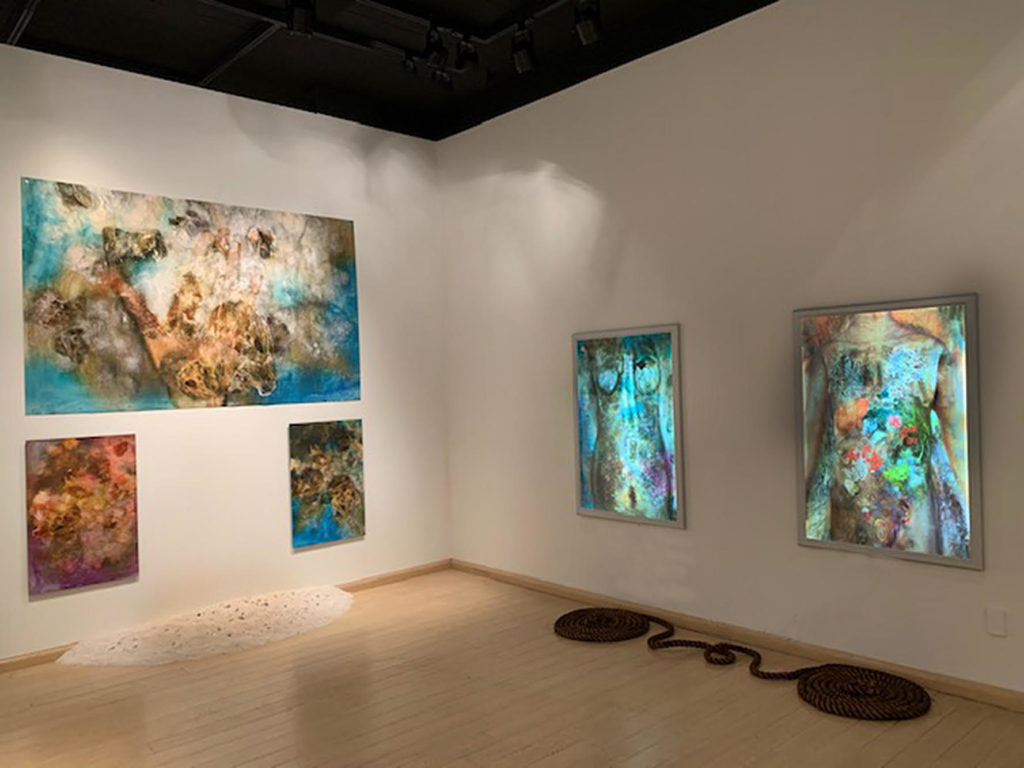
Five on the Rise is a stellar new exhibition rising up at REH Fine Art at GraySpace in Santa Barbara.

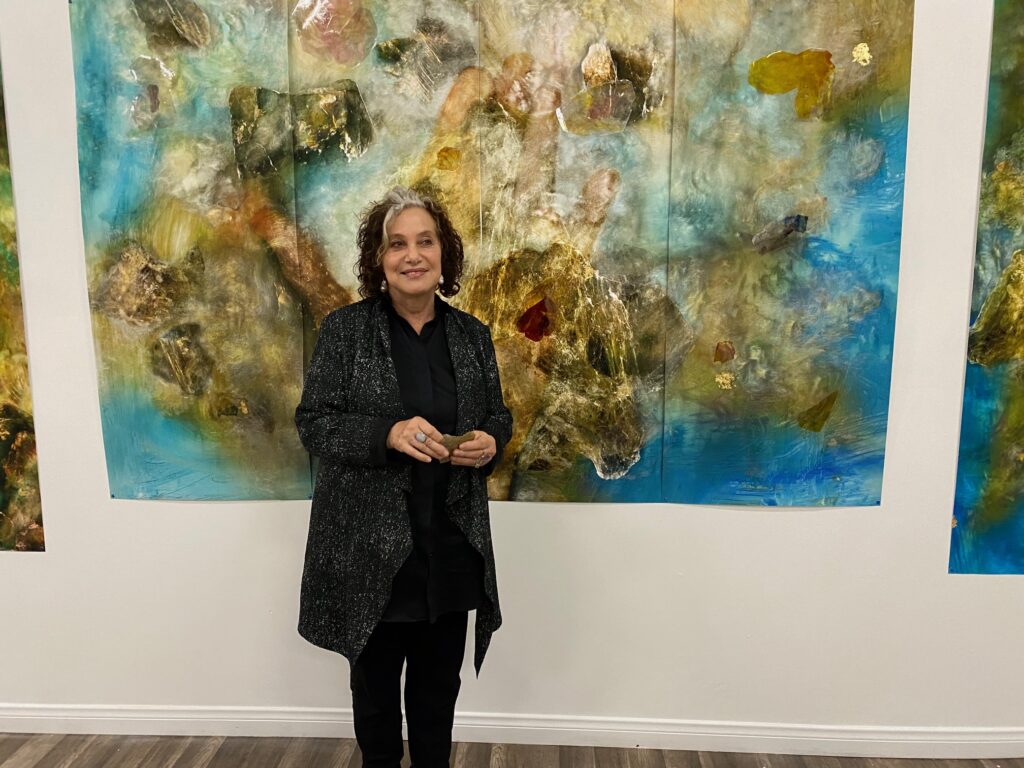
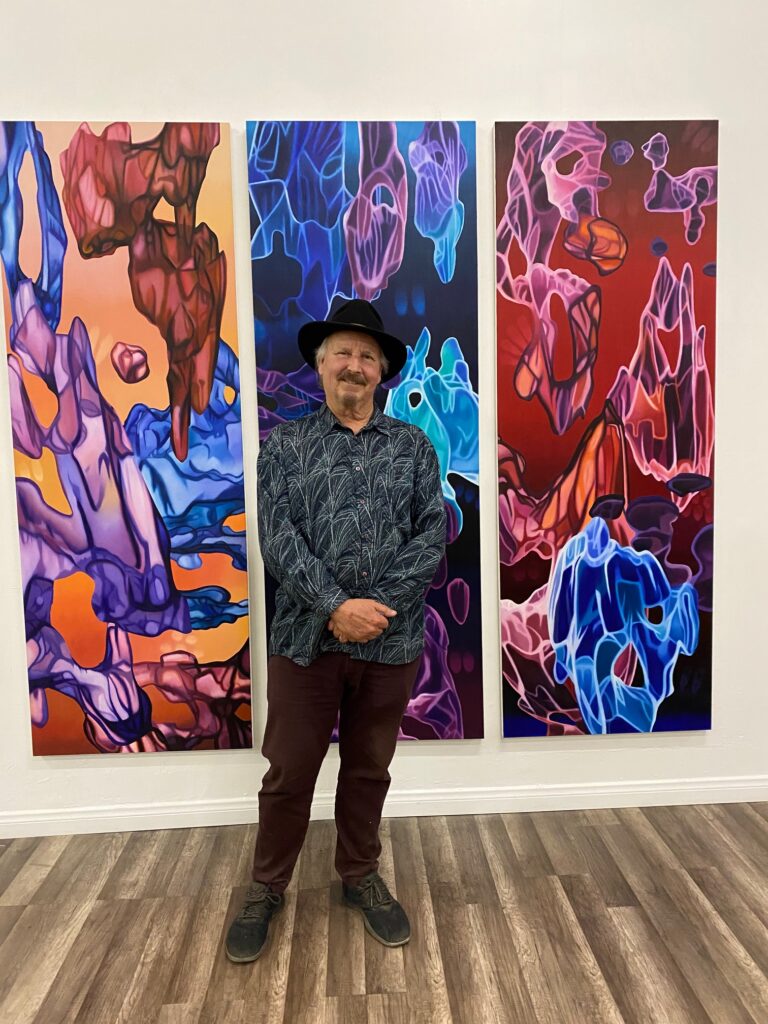
The exhibition includes the work of gallerist Ruth Ellen Hoag, as well as artists Kerrie Smith, Cynthia James, Cynthia Martin, and Dorothy Churchill-Johnson.

Cynthia Martin

The five are long-time members of the Art Salon in Santa Barbara and Santa Barbara Studio Artists. The supportive groups assist artists and worked to raise the profile of Santa Barbara itself as an art destination.

The show opens September 18th, and each artist’s work is unique, with styles ranging from the abstract to the figurative, from surrealism to contemporary realism. As different as they are, they complement each other with vivid palettes and dynamic composition.

Kerrie Smith

Smith’s work here is bright and compelling, with mesmerizing patterns and interwoven layers. She describes her work as featuring a counterbalance of symmetry and geometry with oppositional color patterns; these are deeply involving works, in which the viewer can almost viscerally feel the layers. According to Smith, her work balances and examines patterns in the environment and creates a visual conversation about the “changing intersection between place/city or nature.” More timely than ever, her work also encompasses environmental afflictions, from fires to erosion. Regardless, the work is inviting and involving, and appears to move with a shifting light.

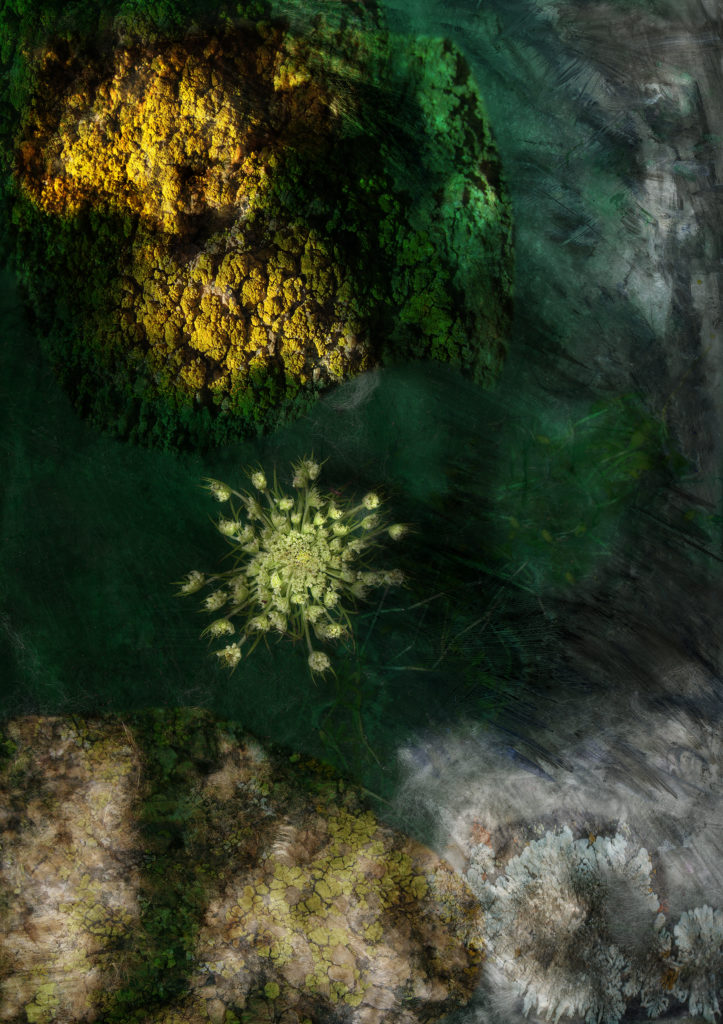
Kerrie Smith

Smith’s “Vapours 10,” above, is one such work, with images that resemble cells or tiny-living creatures appearing to float in a dark and ethereal sea.

Cynthia James

James is also concerned with nature, but for her they are “visions from an imaginary botanical record.” She paints with oil on copper, creating a sensual vision of imaginary flowers and insects. Like Smith, she has a focus on the changing natural world, with small but dramatic environments in which the flora and fauna appear to come alive. These are intimate and moving images, part of a series, Botanica, the Secret Life of Flowers. While florals as a subject can be almost clichéd if the execution is not right, there is no such issue here. Far from it: she infuses each work with a sense of mood and place; the location may be imaginary but it is also rooted in realism. Some images feature environmental mutations in plants, while others depict pollinators facing threats from every side. It is a heightened, magical version of the real, one that very much evokes the fraught state of our planet today. Yet, while this state is revealed in her work, it is lush and gorgeous, a dichotomy of beauty existing while under siege. Her soft, highly textural “Spirits of The Hive,” seen above, glows with an almost transcendent light.

Cynthia Martin

Martin’s paintings also touch on the natural world, but with a completely different way of depicting it. Using both deconstructed images and at times a “hi-tech auto finish” which she terms as being, at least in part, an homage to the car culture of Southern California, she captures an incandescent and geometric world. With the horizontal and vertical stripes of “South Coast Sunset,” for example, she gives us both deepening sky and setting sun amid the columns of a freeway overpass. The image feels dimensional and involving, as if one could step between those columns, and walk toward the sinking sun.

Ruth Ellen Hoag

In contrast, Hoag’s work is entirely figurative. Human beings are the central subject of her paintings, and she works in a variety of mediums including acrylics, watercolor, and ink. Her palette varies by piece, and at times her image lean toward abstraction. Interestingly, with a college background focused on music, many of the artist’s images seem to emit an almost harmonic vibration, as if each individual image let loose a personal, visually-revealed “score.”

Detail of “Central Bark,” Ruth Ellen Hoag

Hoag’s “Central Bark” is a wonderful depiction of city life, both human and canine. You can feel the hum of traffic, the excitement of the panting dogs. The wonderful look at a lively street scene in New York City is both urban and pastoral, with emerald park trees and furry, leashed friends paired with traffic, buildings, and busy people.

Churchill-Johnson combines realism with the abstract dramatically, examining what she terms “instant archeology” such as weeds growing in a pavement crack. She has used mirrored, kaleidoscopic techniques that remind the viewer of a galaxy, one in which the viewer is the center. Adding thin color glazes to her works, they have a shimmer that is both beautiful and surreal, or certainly hyper-realistic. In her works, too, environmental disaster looms just out of sight, indicative of climate change, and the minuteness of humankind in the greater world. One can almost feel the folds and wrinkles on the petals of her “Inner Hydrangea,” where dew drops resemble jewels or tears.

REH Fine Art at Grayspace is located at 219 Gray Avenue, in the Funk Zone of
Santa Barbara. Social distancing and face covering required, and appointments encouraged during regular gallery hours Friday-Sunday from 1 to 5 p.m. through October 11th. The in-person opening is from 5 to 8 September 18th; you can also view art works on Instagram
@Grayspacesp

High Beams: Bendix Building Galleries Durden and Ray, Track 16, TSA, and more Rock Pandemic-Smart Event

Carl Baratta

Earlier this summer, Durden and Ray offered up the fantastic We Are Here/Here We Are, a mapped exhibition which stretched all over Los Angeles with a series of online and best of all in-person drive by outdoor art exhibits. One of my favorite parts was being able to have a socially distanced visit with the artists who created some of the pieces; however, the art was fantastic. Pandemic or no pandemic, the wide-ranging exhibit of outdoor sculptures, photographs, paintings, and murals was a dazzling tour de force that embraced the spread-out grandness of Los Angeles and got me back on the road again, and finding geo-coordinates on a map.

Dani Dodge

Now, Durden and Ray joins other Bendix Building galleries — and artists from other galleries – downtown for a super cool nighttime, one-night-only drive through exhibition held on the roof of the parking garage adjacent to the gallery building. From 8 to 10 pm. on Saturday night, the themed exhibition will make you laugh and turn those High Beams on.

During the day, join the galleries in virtual exhibitions, then get in that car and head to the roof top.

The curated collection of Bendix Building art spaces drive-through art show allows viewers to see art live and in person from the safety and comfort of their cars.  

As co-organizer Carl Baratta says “Since the pandemic began, each of our spaces has been able to show art only in a limited fashion, if at all, and few people have been able to participate. We have missed our huge Bendix Building opening nights where we saw all our friends.”

While a masked group of artists were helping Dani Dodge move, the show was conceived.

The exhibition features a collection of more than two dozen lawn ornaments, lighted sculptures, furniture covered in plush animal toy fur, unscripted performance art, videos and art that recreates the idea of the traffic cone. Yes, the traffic cone isn’t a lowly orange triangle anymore.

Alanna Marcelletti and Dani Dodge

Remember, the rooftop exhibition concludes the day of virtual gallery viewing, walk-throughs, and talks. Visit the directory on the HighBeams.Art website to view virtual programming that represents the work and artists being shown at each physical location.
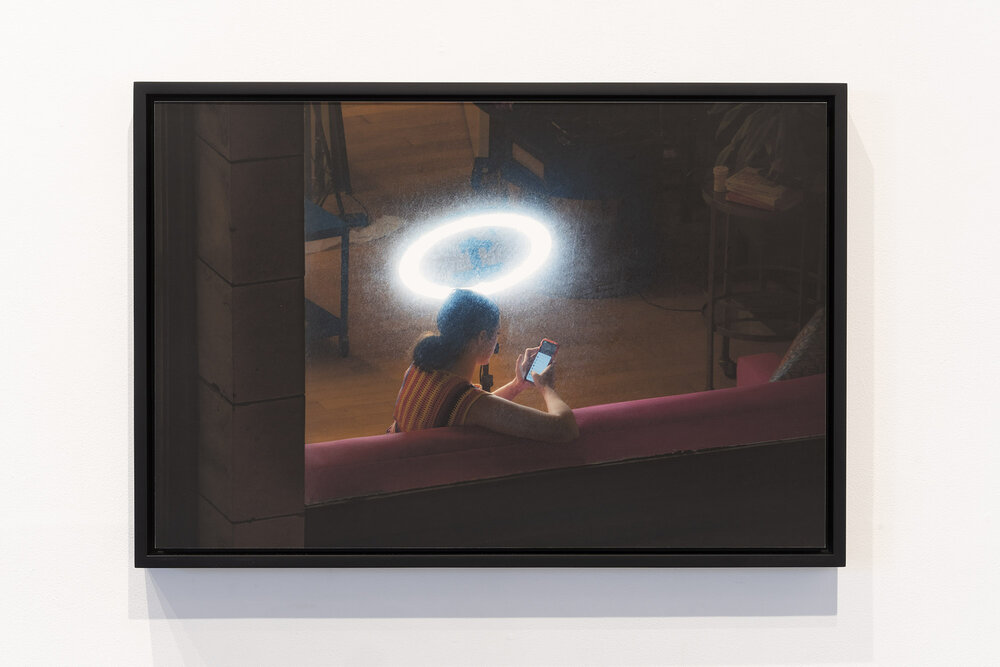
Attending High Beams at night, viewers will be guided through the exhibition as they enter the parking structure, drive through the exhibit, and then depart.

Saturday night’s exhibition serves as the first of a series of ongoing alternative exhibitions organized by a curatorial group of Bendix Building artists including Carl Baratta, Katya Usvitsky (TSALA); Debra Broz, Emily Blythe Jones (MVP); Molly Schulman (MVP and Maiden LA); Dani Dodge, Alanna Marcelletti, Sean Noyce, Max Presneill (Durden and Ray). 

Camilla Taylor

Participating art spaces include:

  • Durden and Ray
  • Gallery ALSO (hosted by TSALA)
  • Last Ditch
  • Maiden LA
  • Monte Vista Projects
  • Sea Farm City
  • Track 16 
  • TSALA
  • ViCA
  • 515
The garage roof now – just wait ’til tomorrow night!

Where and when: drive-through art show on the parking lot across from the building on Sept. 5, 2020. Address: rootop at 401 E. 12th St.

  • Genie Davis; photos provided by exhibition

From Wide View to Up-Close and Personal: Meet Photographic Artist Scott Tansey

As a photographer, Scott Tansey’s art is moving from large scale, such as the vast and glorious view of Strike Valley above, to more personal views, seen in his pearl like close-up of the salt flats in the Badwater area of Death Valley, below.

From a personal standpoint, Tansey can trace his own history within his work – and reach viewers with the same kind of rewardingly connective images.

Above, the Panamint area of Death Valley gets the intimate treatment, while below, he’s more expansive in scope.
Antarctic Peninsula, Antarctica, Below Surface Portion of Iceberg, Iceberg, Southern Ocean

From that point on, he started to focus on intimate images. “I made close-up images of coastal rocks. Later, I went to the desert. One thing that has changed over the last few years is that I am trying to take the scene out of the image and put myself in,” he explains. “What I mean is that I have traced my psychological history in my images. When I was in Joshua Tree, I noticed that I took images of small lonely trees in subdued lighting. This reflected my being on the spectrum when I was a little boy where I felt alone.” He also experienced sensory overload. “Thank goodness that I am one of the 18% who was fortunate to come out of the severe spectrum.”

Tansey describes his original work as that of “large panoramic vistas,” which he began to create in 1977. In the early 90s he added more intimate images; and in the 2010s he made the switch from film to digital, adding post-processing skills to his artwork.

Abstract, Arctic, Kongsbreen Glacier, Glacier, Haakon VII Land, Spitsbergen, Svalbard, Ice, Cold

Landscapes, sacred places – whatever he photographs image inspiration varies, he relates. “It depends. If I go to a location, I want to gather the basic images. This is how I did images of Patagonia, Svalbard, Israel and Antarctica. In those trips, I started different projects as they came up. From Patagonia, I started my interest in glaciers. That was picked up in Svalbard and Antarctica.”

Antarctica, Iceberg, Antarctic Peninsula, Southern Ocean

Even locally, Tansey finds new themes for his work. “I was walking in my neighborhood, and I saw some beautiful roses, so I started a rose project.” The images are often tender, and delicately close-up.

Going abroad, he took images of synagogues and churches. “I continued the project in Israel, where I included mosques, and in my home town,” he says.

Cavernas de Marmol, Catedral de Marmol, Marble Caves, Lago General Carrera, Aisen Region, Aysen Region, Patagonia, Chile

Then came coastal rock images which began in Maine after seeing an interesting rock pile, and continued everywhere from throughout California to Newfoundland, Ireland and Svalbard.”

From Tansey’s Urban Surfaces project

And while in Israel, Tansey started a desert project that continued in Joshua Tree and Death Valley. “In Death Valley, I saw cracks in the parking lot that mimicked some of the patterns I saw in nature. That was the beginning of my Urban Surfaces project that I worked on for eighteen months. It seems that something grabs my attention and interest, and then I run with it.”

Chile, Glaciers, Grey Glacier, Lago Gray, Magellanes Region, Torres del Paine

Regardless of the project or the image, one thing is consistent throughout his work, which he describes as “the sense of wonder that I have when I make each image, whether it is a broad view of the scenery or close-up images.”

After dealing with some health issues for the past 18 months, Tansey is currently socially isolating, working on images he took in Death Valley, and Big Sur. 

California, Central California, Monterrey County, Point Lobos, Point Lobos State Reserve, Rocks, Water

While he is passionate about both locations, his favorite spot to shoot, at least as far as the number of photographs he takes and the number of visits he’s taken, is Point Lobos Reserve, which he describes as “my favorite place in the world to take photographs. Point Lobos has been called the greatest place where land meets the sea,” he says, and obviously concurs. “I have been taking photos there since the 1980s. My most recent trip was last November series of images shot along the shore there for the past six years. “These images are all intimate images.”

As to what’s ahead – along with undoubtedly another trip to this favorite spot, “If I am able to travel to Alaska, I will continue my series of glacier images.”

More from the Urban Surfaces project

Perhaps, given his inclination to go with close-range subjects, he will make the large small, and the small universally grand, as he continues his series.

  • Genie Davis; photos provided by the artist

The Scent of a Flowered World

Flower are like stars to artist Karen Hochman Brown in her lush and literally blossoming installation Vexilla Florum, first shown at LAAA’s Gallery 825 in the early fall of 2019, and then in a smaller grouping through early March 2020 at TAG Gallery.

With this installation, Hochman Brown delves deeper into her signature kaleidoscopic floral mandala work in a dazzling tour de force of eye-popping images.

Based in photography and digitally manipulated, the artist’s riveting work sometimes reminds the viewer of a kind of dimensional, exotic stained-glass. She distorts and reflects her single-subject photographic images to highlight both color, shapes, and patterns, and has described her work as “rooted in nature and geometry.” Much like stained glass, the images also have an inward glow, an almost visible translucence.

If a flower serves as the “seed” of her work, it’s fruition is something richer and more compelling. She uses mixed media and multi-media to combine several different processes, all rooted in the fantastic, even magical, evocation of floral blooms. Using handcrafted and digital photo-manipulation, she pulls the viewer into a world that is both alchemic and amazing. Here, her digital practice is paired with precise and rather glorious laser-cut patterns.

The images begin with a photograph of a single-subject flower, chosen from one of many around the world. Distorted and reimaged in a kind of new realism, each piece becomes a precious jewel of nature transformed by specialized software.

Datura

This exhibition also involves intricate laser cut headpieces. To create them, she used a Glowforge laser printer to make the wood cuts that top each of her suspended works: six at LAAA, two at TAG. Banners are hand-sewing and assembled, in a fascinating mix of traditional textile techniques and the hyper-modern computer software-based world.

Mounted on slanted poles, each floral banner appears suspended in space. A shadow image spills behind each piece. The elaborate and graceful laser-cut “crown” from which the banner is hung features perfect leaves spreading out from and surrounding a central laser-cut version of the floral image centered on the banner itself.

The complex interwoven patterns of each banner’s background reflect the central image itself as well, and the color behind this pattern reflects that of the main floral element imprinted upon it.

Centered in the lower third of each mounted banner, the primary image is a full, mesmerizingly bisected kaleidoscopic flower. It is both a star, a snowflake, and an extraordinary blossom, or all three.

At LAAA, Hochman Brown’s banners, with backgrounds ranging from pink to brown to green to purple, were mounted in sets of three on either side of the galley, as if hung in a royal hall leading up to the ultimate throne. Here, replacing such a throne is a video installation in which realistic, intensely close images of actual flowers pop up, recede, and form a stunning, lush visual bouquet before dancing off again. These photographic images in turn evolve into stylized, star and snow flake-like digital blooms that spin and dance in a hypnotic and wonderful motion.

It is an immersive and deeply meditative experience that pulls the eye into the universe within a flower. One of the great skills in Hochman Brown’s work is that she introduces the viewer to the concept of the eternal and infinite contained in small but potent package.

Homepage slideshow-Vexilla Florum at 825

Her use of photography as a medium heightens both the realism and the fantasy inherent in all her work; and she combines graphic art with her photo images in precise and revealing focus.

In short, she takes natural beauty and shapes of it an entire soothing and magnificent world.

Both at LAAA, and in a smaller grouping of two banners accompanying her digital animation at TAG Gallery, Vexilla Florum is like no other installation or exhibition. The viewer finds a rose is a rose that’s an entirely different and compelling hybrid in Hochman Brown’s hands.

Watch for future exhibitions of this installation.

  • Genie Davis; photos provided by the artist