Mammoth Lakes Film Festival Day 4: Sierra Spirit Award Recipient John Sayles and More

3R1A3854

With a triumphant screening of John Sayles’ Baby It’s You, an extended q & a with director Sayles, star Vincent Spano, and Sayles’ life and creative partner Maggie Renzi, day 4 of the Mammoth Lakes Film Festival was packed with film pleasure.  Day 4 also brought  the documentary Olancho and the narrative dark comedy Neighborhood Food Drive.

Olancho tells the story of talented Honduran musicians who perform and record songs for members of a local drug cartel, and songwriter Manuel’s escape to the U.S. Involving footage of life in the Honduran region of Olancho, terrific portraits of Manuel, his band, and his family all make for a fascinating look at a relatively isolated portion of Honduras, as well as its music. First time filmmakers Chris Valdes and Ted Griswold taught school in the region in 2010. According to Griswold, “We taught for over two years, and some of the children we were teaching were kids of the narcos. We knew enough people that when we came back to film, people knew our intentions were good. At first we didn’t realize how important the connections we made were to keeping us safe, such as Manuel’s father  – but these relationships helped us a lot and got us out of situations that would have otherwise been dangerous.” Valdes adds “In Olancho, death is a part of everyday life. I taught 6th graders, and not a day went by without someone saying who they’d found dead on the street. You don’t think about it until you come home, and your mom at Thanksgiving says ‘that’s hairy.'”  Following the travails of Los Plebes de Olancho lead singer Manuel, as well as the wild exploits of accordian player Orlin,  viewers get an insightful look at Olancho’s world.  An elegaic short about life in Havana, Paloma, preceded the film.

3R1A3846

The witty short Crown Prince directed by Samy Burch and Alex Mechanik opened for the narrative Neighborhood Food Drive. Crown Prince played with the concept of a prince from Luxembourg set loose in New York City. Burch notes that the cast was “all comedians” and she wrote “character bios but then let the actors do improv based on that.” Shot in a glossy black and white, the piece was a fun crowd-pleaser. The directors are currently working on a feature project. Neighborhood Food Drive, directed by Jerzy Rose and co-written by Rose, Mike Lopez, and Halle Butler, is an exceedingly dry dark comedy about a struggling Chicago restaurant, its deluded owners, a naive intern,  her waiter boyfriend, and their professor/couples counselor hosting a fundraiser.  What comes together is less a charitable event than a disaster. Peppered with in-jokes, a fun/scary synth horror score,  and “hall of mirrors strangeness,” as writer Butler attests,  the film lives up to Rose’s hope that it would be “like nothing anyone would ever have seen before.”

3R1A3876

3R1A3909

The screening of John Sayles’ classic Baby It’s You was as enjoyable as it was still cutting-edge after all these years. The film was made in 1983, but its strong performances and tight, smart, emotionally real script by Sayles are still fresh. The high school to college love affair is deftly portrayed, and the direction is emblematic of Sayles as a true “actors director.”  After the screening, co-star Vincent Spano presented the Sierra Spirit Award to Sayles. “John Sayles exemplifies the spirit and dedication of remaining independent. He has a dedication to getting films done his way,” Spano says. In graciously accepting the award, Sayles added “You don’t do these things alone. I write, direct, and edit most of my movies, but you are working with so many talented people – my favorite part of the job.”  Producing partner Maggie Renzi has worked on 14 of Sayles’ 18 features.  “We were very lucky,” Renzi says. “There used to be an art house audience and our movies fit into that niche, and then VHS happened, and you could fund anything. It was a very lively independent marketplace; you could get money for $3-million movies. Now you cant get money for $1 million movies.  It’s much harder for filmmakers today.” Sayles notes that on the positive side, access to filmmaking equipment and skilled filmmaking personnel is much easier today.  As to Baby It’s You,  which was the only film Sayles has ever done screen-tests for “”When Vincent came in, I said that’s the guy. He was just right for the part. A week before we started shooting, Paramount wasn’t sure about their actors and wanted people of their own. But I held my ground.” He also held his ground in regard to story, rejecting a studio re-edit and ending up with the film he’d wanted to make, albeit one that received limited release at the time. Spano  points out “He has a lot of faith in his actors. The character, the story, it’s there on the page, and it was pretty certain who the characters were. He gives you everything you need.” Likewise, Sayles was impressed with the work of cinematographer Michael Ballhaus, who recently passed away.  “He was the best operator I ever worked with…I never had to look in the camera after the third day, he got what I wanted.”
3R1A3929

3R1A3931

3R1A3934

3R1A3938

3R1A3942

3R1A3952

With an after-party at the local nightspot Rafters – and live music by Jelly Bread,  day four of the fest that rocks the Sierras drew to a close, promising more fine films tomorrow.

3R1A3956

  • Genie Davis; Photos: Jack Burke


Mammoth Film Fest Does It ‘Strad Style’

3R1A3669

In case you haven’t yet heard of the truly terrific doc Strad Style, you will. The funny, sweet, suspenseful story of believe-it-or-not a self-taught violin maker is the perfect example of the eclectic programming and wonderful filmmaking you can spot at MLFF.

At what marks the first full day of films at the festival, we took in Shorts Block 1, the doc The Challenge, the aforementioned Strad Style, and the visually wild narrative film Space Detective. 

Shorts Block 1 included the fascinating, sinuous claymation of Adam, the spooky dystopian nightmare of Ape Sodom, and the visually beautiful abstract Serpentine, whose creator Bronwyn Maloney notes that “part of the aesthetic of the film came from technical limitations and just embracing them. It began as a narrative film, but I became less interested in that as I went along.” One of the short’s central images, a crocodile with arms and legs, comes from a metaphor she herself embraces as a symbol for self-identity and “feeling fierce.” More abstract cinema:  Fault Lines, an exploration of spatial forms, and Coacinae, the title of which refers to the name of the Roman goddess of the first sewer of modern civilization. This visually lush piece carried a somewhat narrative throughline connecting money and the sewer – the ultimate in filthy lucre. My Gay Sister is a lovely slice-of-life that is both a coming of age story and a tender look at a ten year old’s burgeoning sexuality. Director Lia Hltala shot in the north of Norway and did intimacy exercises with cast and small crew to create the realistic, intimate feel of the film.  “I cast the main character, the ten year old, through street casting. I found her outside a 7-11.” The film employed a great deal of improv; rainy weather kept the cast and crew close.  Boys offers an American coming of age tale. Director Eyal Resh presents a sensitive depiction of the friendship between two adolescent boys and their sexuality. Producer Stephanie O’Neil says their film’s crew also did a lot of work “to get them comfortable with each other. it was a lot about building a relationship with each other, a friendship. Our film was very scripted, but we let our actors riff on it, and we filmed everything they did.”

3R1A3655

3R1A3661

3R1A3667

The Challenge was a somewhat surprisingly verbiage free documentary filled with strikingly beautiful visuals and a lush score. A dreamy invocation of life in Quatar, the world’s richest nation, viewers see images of a Lamborghini, a gold motorcycle, falconry competition, and SUV races across red sand dunes.  Accompanying the feature length film was the short Hairat. Director Jessica Beshir used a mysterious poem to evoke the mood surrounding her depiction of a man who trains wild hyenas outside the walled city of Harar in Ethiopia.  “It was going to be part of a longer documentary,” Beshir attests, “but it became something eles entirely. I shot on two different nights, the farmer has a real relationship with the hyenas, they have a trust to enter the space he commands.”

3R1A3673

Strad Style is a brilliant piece of filmmaking by director Stefan Avalos, intimately portraying the life of violin maker Daniel Houck, who sets out to make a perfect copy of a famous violin for impressario Razvan Stoica, whom he met over the Internet. Houck, who lived on an isolated farm in Ohio,  had created other violins, but nothing like this. “I was making another documentary about violins,” director Avalos explains, “when I heard about this guy, that he was really crazy and obsessed, and I thought that might be a fun five minutes. But I met him, and even though I already had a lot of footage shot, I made the right decision to go in a completely different direction.” Houck adds,”He had no idea about me, he only saw a few YouTube videos, but I think it was not a coincidence that we formed a trust, that we made this film. It’s not a coincidence when things like this happen.” Since the film came out, there have been many changes in Houck’s life, which is no longer isolated on a remote property. “The house really was in the middle of nowhere, with bad electricity and no heat, it was like going on safari,” Avalos laughs. “It was just the crew of me, I shot it, lit it. It was fun, like going back to film school,  it wasn’t hard to make although there was a lot of stress, cold in winter, hot in the summer.” Avalos says the hardest part of making the story was that he’d shot 70 hours of film and his first cut was “3.5 hours, and it was good. It was painful to chop it.” Houck, who is also an artist and low-rider enthusiast as well as a master craftsman of famous replica violins, says the film, which won best doc at Slamdance earlier this year, was a “once in a lifetime experience. I’m not a filmmaker, it won’t happen again. I’m taking advantage of this. I love and appreciate the opportunity to be here – it gets me out of Ohio.”  Avalos will be showing the film in more festivals, and is currently looking at several distribution possibilities for a film that deserves to be widely seen. An accompanying short, Sleep with Me, is Summre Garber’s sweet portrait of a podcast creator who helps the sleepless find rest.

3R1A3685

3R1A3697

3R1A3677

Space Detective, the narrative feature we viewed today is zany and inventive, the story of an exiled Terran space detective replete with a femme fatale and space goons galore. Writer and star Matt Sjafiroeddin  says the film took “about a decade” to make with director Antionio Llapur. “We started as a short, and suddenly we thought we had a feature.” The sci fi film which employs live action imagery in surreal fantasy style and uses a palette of vibrant colors as well as black and white, is an homage to everything from Las Vegas – where the filmmakers are from – to Star Trek, yet wholly original.

3R1A3721

3R1A3724

Still haven’t made it to Mammoth? It might be time to “head for the hills” and see what’s next at this always surprising, always interesting fest.

  • Genie Davis; Photos: Jack Burke

Art Gone Wild with Book Club: Going Native at Durden and Ray

durd 1

Stephen Wright’s post-modern novel Going Native is a wild ride of literary fiction fused with pop culture.  When an art exhibition is based around the book, and includes performance pieces and cocktails made with absinthe, then art lovers can expect a wild ride when it comes to the exhibition, too.

Durd 6

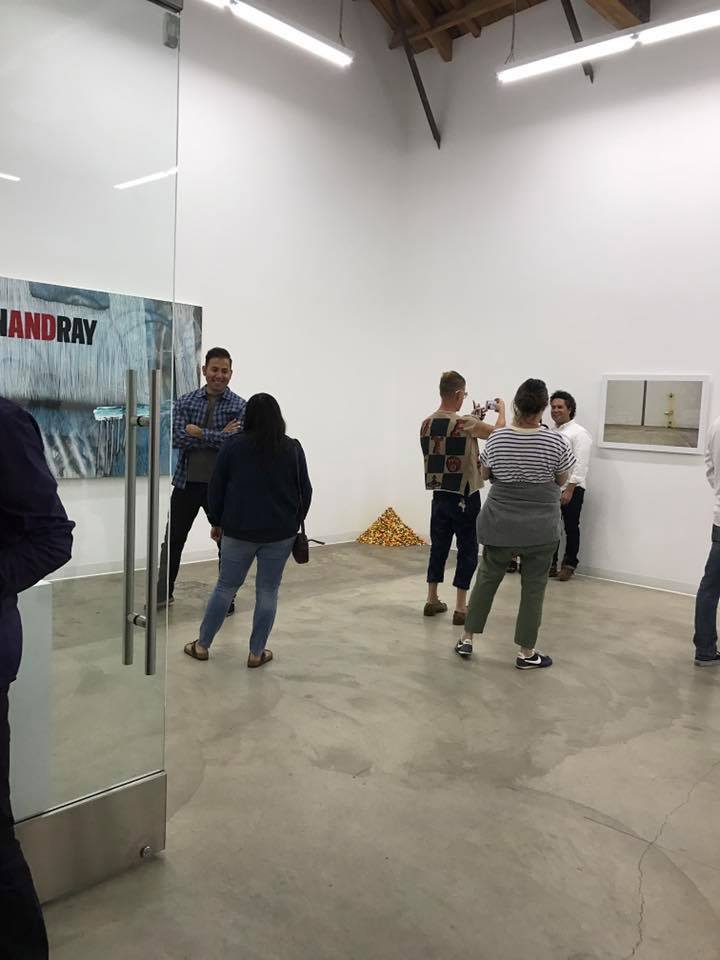
Durden and Ray’s delightful and provocative “Book Club: Going Native” is indeed wild – wildly inventive and conceptually clever. Curator Steven Wolkoff assembled a cadre of visual artists, a mixologist, hair stylists, dancers, and a choreographer to create an opening that fused art with performance plus an excerpted book reading.

Durd 8

Durd 5

While I’d only read a few chapters of the novel when the opening rolled around, it did not dim my pleasure in the experiential evening, which included the work of: Ania Catherine – choreographer, Ben Jackel – visual artist, Constance Mallinson – visual artist, Dani Dodge – visual artist, Dave Bondi – toy designer, David Leapman – visual artist, Kate Kelton – actress/artist, Gavin Bunner – visual artist, Jayna Zweiman – architect and co-founder of the Pussyhat Project, Jenny Hager – visual artist, Jon Flack – visual artist, Kio Griffith – visual artist, Liza Ryan – visual artist, Michael Webster – composer, Robin Jackson – best bartender/mixologist in LA (per LA Weekly), Steven Wolkoff – visual artist, Tom Dunn – visual artist, Traci Sakosits – Creative Director of Vidal Sassoon, North America, and Matthew Kazarian – Vidal Sassoon.

Durd 4

durd 3

Dancers with their hair knotted to each other spun in a circle. Mixologist Robin Jackson poured sapphire, saline solution, absinthe, and oleosaccharum into cups and candy-colored water pistols for guests to shoot into their and other’s throats. The guns themselves were crafted by toy designer David Bondi, whose design, packaged and labeled as “Durden n’ Ray” also hung from a display rack on a wall.

durd 7

Artist Dani Dodge offered up a compelling, layered painting “Previously Unthinkable Patterns.”

Durden 20

Durden 19

The painting, a mixed-media fusion of paint, duct tape, party favors, a piece of a wedding dress and the ashes of papers that contained burned fears dripped off the canvas literally with a 72″ tulle train puddling on the ground. The ghostly shape of the car that figures large in the novel emerges from the layers like a ship through thick fog, the canvas begs to be touched, but one doesn’t touch; still the almost physiological impression of being touched by the artwork persists.

Durd 17

Above, artists Dani Dodge and Kio Griffith.

Durd 14

Kio Griffith’s “Whichever Wolf You Feed,” a mixed media piece of wood, sheet metal, paint, sandpaper, and a ventilation duct, oozes mystery; the mood abetted by a dancer positioned against the corner wall next to the piece.

Durd 16

David Leapman’s “Salt hungry butterflies,” gold ink on black paper, has an elegaic feel that evokes calligraphy and Japanese woodblock prints. The artist contributed three similar works in all to the exhibition. Jenny Hager’s abstract “Bedlamite,” acrylic and marker on canvas, is bold and heated; Tom Dunn’s detailed, fascinating “Mesopotamia Drawing Series” functions as a kind of adjunct to the book’s chapters which are themselves a series of connected yet separate stories.

Durd 13

Curator Wolkoff  created a series of “wedding rings” crafted of acrylic paint without support, they are as warped as the book’s belief system. The spacey stop-motion video of Traci Sakosits and Matthew Kazarian, “Basic Space,” compels repeated viewing, as does Dodge’s second piece in the show, the haunting “Evidence,” a video shown wall mounted on a mini-iPad.

Durd 10

All eyes were turned to Jayna Zweiman’s “It considered other facts, other views,” a dark green kaleidoscope-like sculpture which guests peered through and took IG-worthy semi-selfies through.

Durd 11

Constructed with mirror, plywood, and oil-based paint, the work was fabricated by Paul Guillemette and suspended from the gallery’s ceiling. The architect and co-founder of the Pussyhat Project has created a wonderful, changing fractured image that reflects both the quality of the book and a reader’s perception of it. It’s a fun house mirror take on art, life, and novel. The work’s green exterior represents the color of the stolen car driven by the novel’s protagonist.

Durd 12

While seeing the exhibition without the dancers, drink, and electronic soundtrack hum is a different experience than the opening night, it is a worthy one. The art stands alone, and one could know nothing of the book and have heard nothing of the opening’s vastly entertaining art circus and still enjoy it.

Durd 9 bunner

Above, a pop art distillation of the book, “Helter Skelter” by Gavin Bunner, goache and ink on paper.

Like many of Durden and Ray’s shows, this one is edgy and thought-provoking; the gallery and the art collective are building a reputation as a must-see in the crowded field of LA art.

  • Genie Davis; Photos: Genie Davis


Mountains of Movies: The Mammoth Lakes Film Festival Returns

MLF 1

Just in time to help film fans celebrate Memorial Day, the third annual Mammoth Lakes Film Festival runs May 24-28th. The fest screens narrative and documentary features and shorts.  MLFF was named one of the “Top 50 Festivals Worth Your Entry Fee” by Movie Maker Magazine in 2016. Having attended last year, we look forward to another full schedule of eclectic entries which we’ll be covering daily during the festival run.

Festival founder Shira Dubrovner notes that the third year brings expanded programming to the festival, doubling the number of filmmakers attending the festival and bringing more spotlight events and featured artists to the festival.

MLF 3
“This year our opening night screening is Up In Smoke with Tommy Chong in person; later in the festival we will honor John Sayles with the Sierra Spirit Award, presented to him by Vincent Spano; and for our Saturday Morning Indie Cartoons event, the Bum Family will fly in from Calgary, Canada to give a presentation to kids on how to make paper cut-out animation,” Dubrovner notes.
MLF 8
Above, festival founder Dubrovner, center, at the closing awards ceremonies in 2016.
While the festival continues to expand, the intimate nature of the festival will not change, Dubrovner attests. “We will always keep our commitment to filmmakers by making Mammoth Lakes a filmmakers-first festival. That has been our vision and commitment since day one. We continue to help each filmmaker with the expense of attending the festival by offering travel stipends and housing. We create a fun, intimate and accessible experience for everyone that attends—filmmakers, audiences, industry professionals, press and our local volunteers.”
MLF 6
The festival is very different from others throughout California, and different too than well-known behemoths like Sundance and Telluride. We found attending the event last year to be a special experience, one in which we could spend time with filmmakers, and uncover international as well as local films that were extremely fresh in terms of subject and style. From smart comedies to awe inspiring documentaries, the festival doesn’t hold back when it comes to presenting intimate stories.
MLF 4
“We take our time to create a program with a specific vision; we champion personal, innovative storytelling. We showcase filmmakers who are unafraid to dig deep into themselves and bring their work to life with sensitivity, playfulness and a depth of vision,” Dubrovner attests.
Of course the beauty of the fest’s Sierra setting is also first class.
“We give a platform to these artists in a nurturing and awe-inspiring setting in the Eastern Sierra. Our primary commitment is to the talented, maverick artists that we bring together every year in May.”
MLF 7
And to creating a stellar line-up of films that will have audience’s talking for the rest of 2017.
– Genie Davis; Photos: Courtesy of MLFF and Jack Burke
MLF 1