Art as Medicine at Torrance Art Museum

If medicine is an art – can art be medicine? The answer is a resounding yes at Torrance Art Museum where two exhibitions are also about medicine.

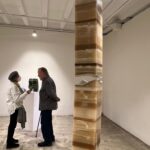
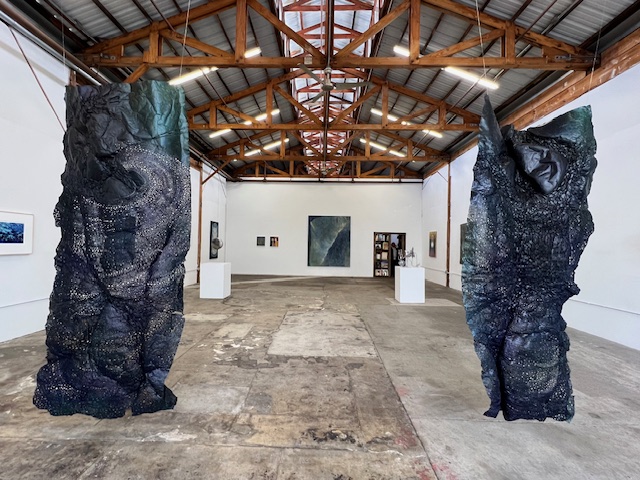
Provocative, healing and thoughtful both the museum’s galleries feature art that literally and figuratively dissects medical intervention and practice, the body’s capacity to heal and be healed , chronic illness, pain and acceptance, and the state of American medical care.

Gallery Two presents a vivid, compelling exhibition created by patient artists in Art and Med.

Curated by Ted Meyer, the show features work by Ellen Cantor, Ayin Es, Rose-Lynn Fisher, Siobhan Hebron, Cathy Immordino, Rachael Jablo, Daniel Leighton,  Krista Machovina, J. Fredric May, Bhanva Mehta, Dylan Mortimer, Kathy Nida, Alice Marie Perreault, Jane Szabo, Susan Trachman, James T. Walker, and Meyer himself.

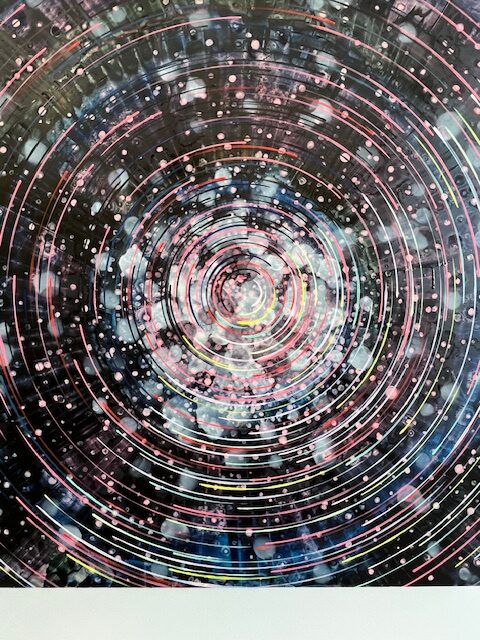
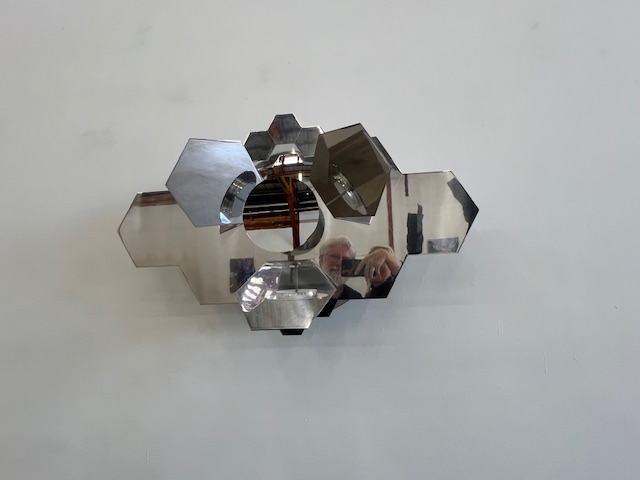
Intense and beautiful, viewers see beautiful, heart wrenching and beautiful photographic images of a complicated pregnancy from Cathy Immordino in “Cry for Help;” “Two Mirrors,” a wall sculpture offering a look inside Alice Marie Perreault’s role as advocate and caregiver; and Daniel Leighton’s vivid iPad painting radiating pain and healing – and the admission of same – in “Opening Up.”

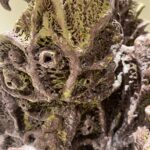
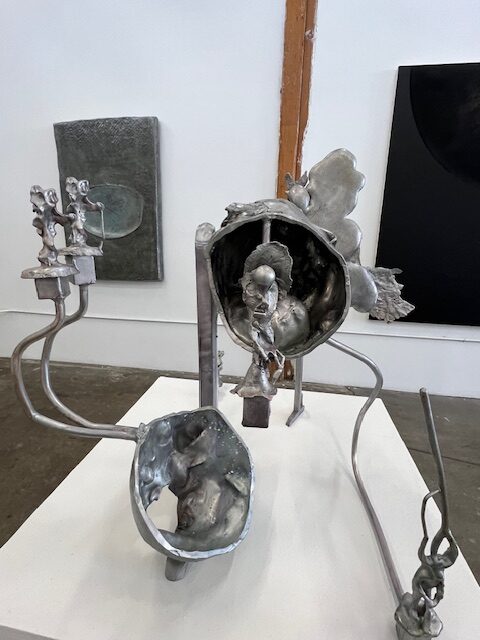
Also on exhibit is the delicate mix of Ayin Es’ “Inherited Shock,” a woven wonder of oil, pencil, embroidery, thread, wire, paper, and pins on canvas; Dylan Mortimer’s zen garden and glitter reimagining of an ambulance ride in “Gates in Proximity to Paradise;” and Meyer’s own sinuous skeleton figure in “Structural Abnormalities” among so many other fine works, including dream-like photography from Jane Szabo, and terrific sculptural work from Krista Machovina among more.

For over a decade Ted Meyer had curated art shows focusing on artworks by patient-artists as a means of teaching future doctors and current medical workers about the lived experience of chronic pain and illness.

These patient-artists create work that depicts the myriad of ways their illnesses affect day-to-day living, physical health and mental well-being.  Like all important art, patient artwork makes strong statements about the human condition.  These works are personal in their creation yet universal in their scope. They make up some of Meyer’s favorites from his times as Artist-in-Residence at the Keck School of Medicine of USC.  Over 10 years he has curated some 40 different exhibits tied to the school’s core curriculum, producing beautiful exhibits that are also both compelling and informational ones.

In Gallery One, the medical world is both personal and more political in Body Politics. Curated by Max Presneill and Sue-Na Gay, this potent exhibition examines not only the disabled body, but how it is seen both socially and politically. The presenting artists include Panteha Abareshi, Emily Barker, Yadira Dockstader, Mari Katayama, Katherine Sherwood, and Liz Young.

Emily Barker’s witty and scathing “Good Medicine is Bitter to the Mouth” offers pithy commentary on health in the U.S.

There are heartbreaking installations dealing with medical billing, how the physical body is treated,  specimens and body parts, and the general treatment of those with disabilities or infirmities. It’s an achingly strong show.

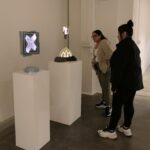
View these two powerful exhibitions through September 9th, along with videos in the museums screening room, featuring Surrealist Vacations In The Subconscious 2023— a video art exhibition, curated by Wilfried Agricola de Cologne / The New Museum of Networked Art, inspired by the Manifesto of Surrealism by Andre Breton.

TAM is located at 3320 Civic Center Drive in Torrance, Calif.

  • Genie Davis;  photos: Genie Davis

A Fond Farewell to California 101

Work by Flora Kao, above

California 101, the art exhibition that took place annually – with the excepetion of pandemic closure years 2020 and 2021 – ran for ten years in iconic South Bay locations such as Redondo Beach’s AES Power Plant, empty store space in the South Bay Galleria mall, the former Gold’s Gym spot overlooking Harbor Drive, and for it’s final two years, in the Redondo Beach Historic Library near the pier.

Helmed by curator and founder Nina Zak Laddon, this was a monumental undertaking, focusing on Southern California artists, including but not limited to those in the South Bay itself. The beachfront community has been underserved when it comes to art, with the Torrance Art Museum, Hermosa Beach’s Shockboxx gallery, and the Palos Verdes Arts Center pretty much the only venues in these beach towns.

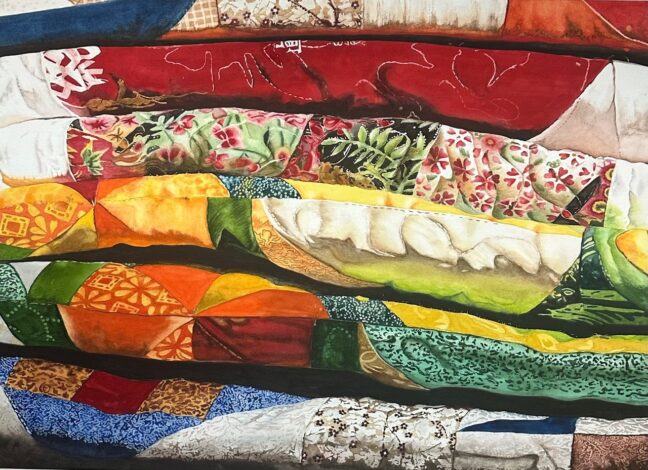
Laddon’s art brainchild offered expansive installations – such as this year’s radiant gold fabric and projected images from Flora Kao, and the delightful exsculpating food sculptures of Eileen Oda, among other works positioned in the former library’s kitchen. There was also a rainbow room of participatory twine from Peggy Sivert, who also presented an incredible quilt-like textile work featuring a white horse.

The exhibition spaces, quirky, unique, and some more easily availing themselves of moutning exhibitions than others, were always filled with a delightfully varied mix of photographic art, paintings and mixed media, sculptures, and projected works.  The vast display of art was likewise accompanied by programming that drew community members and a range of art lovers from across the region, with this year’s entries including an art salon conducted by Kristine Shoemaker, director of Shoebox Arts, a Sound Healing, and live figure drawing with Timothy Kitz, among others. The gift shop, with it’s Last Banquet kitchen adjunct, offered a wide array of art choices at reasonable prices.

Among the other highlights this year:

Jane Szabo’s haunting photographic images; delicate paper cut outs from Lorraine Bubar; repurposed objects in sculptural art from Ben Zask; Pam Douglas’s figurative installation honoring refugees; stunning black and white images from both father and son Richard Chow and Caden Chow; the lustrous light in the urban landscapes of Gay Summer Rick; Gina M.’s poignant and harrowing installation about gun violence in our schools, “Hate the New Normal.”

Also exceptional: Eileen Oda’s gorgeous large scale painting “Pilgrammage to Concentration Camp Where our Parents Were Imprisoned During WWII;” Scott Trimble’s haunting figures; Ann Bridge‘s exotic look at Southern California sky; Susan Else’s multiple, whimsical cloth sculptures; Karena Massingill‘s lustrous sculpture; Janet Johnson‘s felted fish; and of course, Jason Jenn‘s spectacularly spiritual ” a hundred and one dreams and stories,” utilizing poetically repurposed found and upscycled materials cast in sacred shapes.

Beanie Kamen‘s vibrant fabric work; Erika Snow Robinson’s dramatic palms; Michael Stearn’s motion-filled work in wood – all terrific, each unique.

Also powerful: colorful combos of paint and old dress forms forms Susan Melly; Aimee Mandala’s black and white, hypnotic “Heart Opener;” the soft rose of Beth Shibata’s “Petals Falling,” Mike Collin‘s sharp and witty “The Inventory of Scoldings;” the sparkling stars of Vojislav Radovanovic‘s mixed media “New Constellation,” and the interactive possibilities of a third-floor installation asking attendees to create their own rock stack.

The pandemic closures were a difficult recovery in terms of the volunteerism and donations upon which California 101 depends in part, and while this may or may not have been behind Laddon’s decision to conclude the annual exhibition this year, she also has new and exciting plans ahead, including a 2025 art exhibition that will include international artists.

So while we bid a fond farewell to 2023’s final California 101, it doesn’t mean this road has come to an end. Think of it more as a freeway interchange, a new highway toward art to be established, hopefully, in the near future.

And in the meantime, through September 10th, enjoy visiting and viewing Friday-Sundays from noon to 7 p.m.  Offer up your own 101 salutes to an ever changing and awe inspiring collection of diverse art – by the sea.

The Redondo Beach Historic Library is located at 309 Esplanade in Redondo Beach. Street and hourly pay lot parking both available.

  • Genie Davis; photos by Genie Davis

California Art Here We Come

In California: Now & Then, on view at bG Gallery, curator Juri Koll takes viewers on a tour de force exhibition of California culture, environment, and of course, art. Moving from the early 20th century to 2023, among the exhibiting artists are Sam Francis, Bradford Salamon, Barbara Kolo, Catherine Ruane, Hung Viet Nguyen, Charles White, Sam Francis, Lilly Fenichel, Ulysses Jenkins, Betye Saar, May Sun, Peter Alexander, Gloriane Harris, Edmund Teske, Lyn Foulkes and more than 30 more, including work by Koll himself.

Much of the art was culled from Koll’s personal collection, while others were lent to the exhibition by the artists themselves, collectors owning the works, or museum collections. To see such a mix of stellar artworks all in one salon-style presentation at bG Gallery is a kaleidoscopic experience, a mix of abstract works with the figurative.
We see seascapes and city views, faces and geometric forms, the whimsical, the magical, and the inchoate voids. Traveling through generations of work, we see the evolution of form and color, the trends and traditions, the willingness to change, each of which characterizes California itself.

Through it all, we follow the light.  One of the most fascinating finds in the exhibition is from 1904, Lockwood De Forest’s “Santa Barbara Marsh.” Suffused in gold and peach radiance, it shines like a beacon of promise, a stillness, a quiet kind of gold rush as memorable today as it was when curated. Entirely different is the abstract landscape of curator Koll’s 2023 “Käepigistus Ukraine 60,” a startlingly bright petri dish of geometric shapes seemingly swimming under an art microscope.
Gloriane Harris’ 1973 “Evening Shade” resembles a surreal moon hovering just above and just below dark periwinkle water. This is a different form of the geometric, both entirely of and transcending the period in which it was created. Evoking the same era – the quality of moving beyond the traditionally representational, reflecting the multitude of changes and restless emotion of the Vietnam years is David Alfaro Siqueiros 1972-73 color lithograph “Reclining Nude,” exuding pathos and perhaps a few bad dreams in its rhythmic brush strokes and discreet representation of body.

Beautifully current are the white lilies in Imogen Cunningham’s 1929 “Two Callas,” their fluidity and luster perfectly captured. Also cutting edge is Wynn Bullock’s 1951 gelatin silver print, “Child in the Forest,” a lush and surreal look at a child lying face down in a fecund fern-filled grove of trees. In aches with a sense of loss and wonder, a fairy tale and a cautionary tale both at once. There’s light here, too, shafting down between the trees, still and silvery. From the same year comes Hans Burkhardt’s “Untitled,” conjoins rectangles and squares dominated in golden yellows.

Sea views have always drawn me as a viewer, and there are plentiful examples here. Hank Pitcher’s 2005 “Solstice Swell at Government Point” offers lavenders and blues in a rising wave infused with a white, opalescent light. Osceola Refetoff’s radiant pink archival pigment print, created this year, is an alchemic look at “Tiny Island, Antarctica.” Hung Viet Ngyuen’s “Sacred Landscape III #18” is a fanta-sea if you will, a small 2017 oil on board work that is magical in its vibrating brush strokes, featuring both the edge of a sea or lake and a rushing river descending from dark mountains. Ruth Weisberg’s 2005 “Darkship,” a monochromatic monoprint gives viewers a ship loosed upon dark waves.

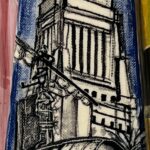
Also compelling are cityscapes such as Gay Summer Rich’s mix of headlights, lit high rise windows, and the iconic neon of the El Rey theater in her 2023 “Ready For a Night Out – El Rey.” Her carefully rendered oil on canvas, created entirely with palette knife is somehow both impressionistic and realistic at the same time, and again, the light. And, it’s also about the light – red swirling clouds above what could either be a sprawling city of dotted lights or a massive airport runway – in Peter Alexander’s 1992 “The Locus,” a surreal and absorbing mix of ink and acrylic on paper.

There could be nothing more bursting with light than May Sun’s 2023 “Datura (Yellow) Offering,” a diptych of acrylic on two wood panels featuring both a brilliant lily held high and the chartreuse like wave of land against with three farmworkers in yellow straw hats work, framed against a fierce orange sky. Diminutive but also exuding a burning orange is Ralph Allen Massey’s “Eight,” the letters casting deep shadows in the foreground against that sun on fire.

And what happens if you stand too long in the sun? The clean, stylized look of Barbara Carrasco’s sweet “Burnt Girl,” a child whose sunscreen application was sadly lacking.

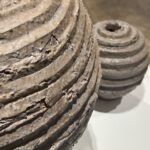
There are sculptural works as well, such as Stuart Rapeport’s 2015 “Minimal Brush,” a bronze artist’s proof that resembles a magician’s wand. The sculptural stand-out in the exhibition is Sonja Schenk’s 2023 “Light for the Sun,” a floor work that combines California sandstone with stripes of 24K gold, an homage to the rich veins struck in the Gold Rush, and again, the light, the light that draws so many California transplants and dreamers, artists and writers. Comprised of three separate pieces it is a glorious work, positioned as if calling to the vast array of wall art surrounding it. Very different is the mysterious, even ominous “Studio in Dorking,” Gordon Wagner’s 1974 mixed media box, that include legs clad in hoof-like shoes and no upper half to the body attached to them. Cosimo Cavallaro’s mysterious “Black Arrow,” a 2023 work in stainless steel, absorbs and reflects the light – the antithesis to Schenk’s piece. There is also Timothy Washington’s sparkly “Many Faces, One Race” from 2019.
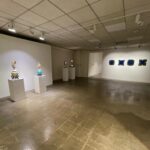
Some included works were startling for being so far from the same artist’s current oeuvre. This includes Catherine Ruane’s 1974 “Untitled,” her delicacy and precision of line remains the same, but this muted and intimate abstract is quite different from her charcoal and graphite roses, oak and Joshua Trees created in more recent years. Speaking of abstracts, there are a wide range to view:  Larry Bell’s  1988 “Untitled,” a black orb depicted in profile against a white background, a bit reminiscent of a black hole or nuclear blast, or perhaps the emptiness of Reagan-era politics. Then there is the dancing, music-evoking 1957 “Color Sinfony,” from Oskar Fischinger; Emil Bisttram’s 1950 “Abstract,” of a plant and a beehive, everything a fluid supple motion of line; and Sam Francis’ 1976 monochrome “Untitled,” which resembles sail boats buffeted by sea spray. Max Presneil’s vibrant 2020 “MiT #149” radiates pink, red, and chartreuse persisting despite a black hole at the center left, indicative of how many felt during that year. The surreal is well represented, too, including a 2018 work by Robert Nelson, “Self-Fulfilling Prophecy.”

Bradford J. Salamon’s 2023 “Silver Spoon” gives the viewer a gold and white striped dessert confection one can almost taste, dancing in elegant light that glistens off the eponymous spoon. Its intimacy is placed comfortingly near another source of the intimate, the powerful and intimidating 2023 “Self Portrait,” from Don Bachardy,  streaks of white light representing facial lines and shadows.

And while there are many other worthy works in the exhibition, perhaps it’s best to close with Barbara Kolo’s 2023 “Escape Into Amber,” with both the title and the minute Pointillism of her approach drawing the viewer into a vibrating flower of gold, orange, purple and red, almost as if the corona of the California sun were waiting to pull both artist and viewer deep among these unfolding petals.

The exhibition is on display at bG Gallery through August 15th. bG is located in Bergamot Station at 2525 Michigan Ave. #A2 in Santa Monica. Don’t miss.
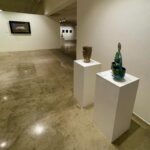
  • Genie Davis; photos: by Genie Davis and as provided by curator

The Cheech Celebrates Art and Starts a Second Year

Cheech Marin was there. But that’s not a surprise, given that the art celebration in mid-June was both to open three new exhibitions and commemorate a super successful first year at The Cheech Marin Center for Chicano Art & Culture of the Riverside Art Museum in downtown Riverside.

Last year’s opening show was stunning, and this year offered a new bevy of treasures to mark the anniversary. And what an anniversary it is: the museum far surprassed predicted attendance by 30%, and provided a much needed home for Chicano art in Southern California.

The museum was developed as a public-private partnership between the City of Riverside, Riverside Art Museum, and Marin. As such the museum also received Marin’s prolific collection of major artworks – over 500 stellar works in all.

In helping to establish The Cheech, the Riverside Art Museum received the 2023 National Medal for Museum and Library Service, the nation’s highest honor given to museums and libraries due to the significant contribution The Cheech made to the region. Marin is justifiably proud and pleased at both the response to the museum, and the exhibitions held there. The gloriously airy, modern space is equipped with comfortable, open galleries that showcase the work, and provide the room for large scale pieces and wall art alike.

Present at the celebration – which included make your own tacos, craft brews, ceviche, and Mexican pastries for desert – Marin stated his purpose. “Riverside Art Museum’s work in the community, its educational mission, and its broad support of Chicano art is why I decided to gift my collection and work with them to create a national center.” He cited the impact the museum has had on the community, and the ways in which the museum is providing the space to show Chicano art and educate viewers about it.

As honestly enormous of a cultural success as the museum is, it’s also a bastion of innovative, beautiful, and often profound art, revealing and passionately exploring political and social issues while presenting wall art and sculptural works that not only defy expectations but go beyond them.

The anniverary introduced three new exhibitions. On the first floor, there’s a new grouping of Marin’s personally collected works in Cheech Collects, an exhibition that included a few beauties viewed last year, but a lot of new pieces as well. The art is steeped in images of Southern California and family life, as well as in the social struggles, work, community, and protest that are a part of the rich Chicano community. Curated by Maria Esther Fernandez, Marin’s collection sings with color and light, and features many works by the always impressive Frank Romero, among 40 other artists. Romero’s “City of Night” is a vision of emerald green freeways.
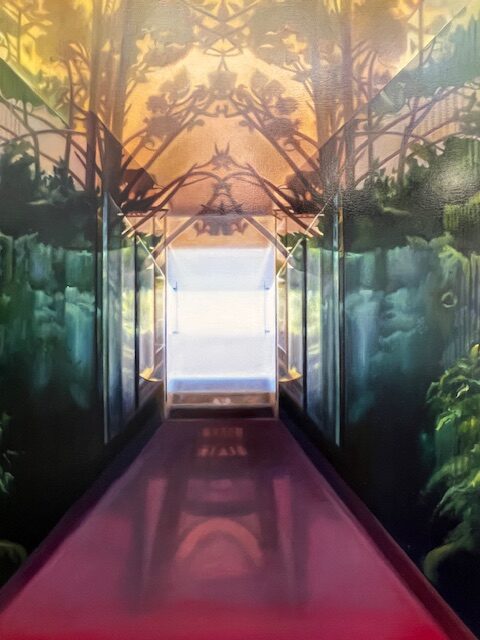
Throughout the collection we see images such as Carlos Almaraz’ splendid “Mystery in the Park” diptych, and Eloy Torrez’  appropriate and beautifuly rendered “It’s a Brown World After All.” These works will be on display through next May.

In the upstairs galleries, Xican-a.o.x. Body intimately explores and celebrates the ways in which Chicanx artists have placed their physical and emotional bodies within these works, establishing their presence and also indicating a necessary willingness for protest and resistance. This exhibition was created by The American Federation of Arts, and features over 125 works ranging from photography to to sculptures – the visual grabber perhaps being a hot pink low rider, Justin Favela’s “Gypsy Rose Pinata (II) is a visual confection, an enormous and vibrant sculpture.  
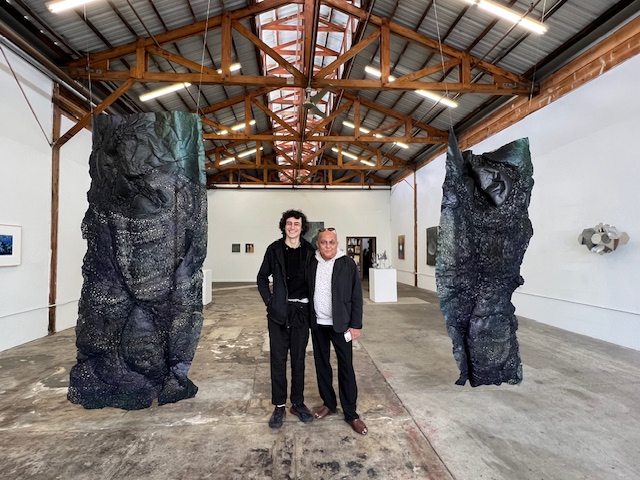
Narsiso Martinez’ truly stunning “Magic Harvest,” is a dimensional, sculptural painting of a migrant worker created on boxes of the produce gathered, and is wonderful from all angles, bringing the depicted worker both physically and emotionally present and fully realized.  Linda Vallejo’s heartbreaking colored pencil and photographic “23.9% of Sex Trafficking Vicimes in the US were Latino in 2010” is both sharp in color and message. These works will be on view through early January of 2024.

Last but definitely not least, there are works of emerging and local artists curated by Cosmé Cordova. Among them are Man One, Andrew J. Castillo, Carlos Beltran Arechiga, Richie Velazquez, Martin Sanchez, Denise Silva, and Jacqueline Valenzuela. This one requires you to use a bit of alacrity in visiting The Cheech – it will close October 1st. Among the many fresh and riveting works, a massive geometrically abstract work from Carlos Beltran Arechiga, “Border Field State Park,” is a particular favorite, as woven as a tapestry, as complex as memory. Arechiga also has a smaller “Self Portrait” in the mix.

Yes, the 91E is a slog from LA to Riverside, but you’ll find a true oasis of art, culture, and meaning at The Cheech, and all you Los Angelenos owe it to yourself to make a visit.

The Cheech is located at 3581 Mission Avenue in Riverside.
  • Genie Davis; photos by Genie Davis