The Park to Playa Trail: Stellar Views, Art, and a Perfect Place to Get Fit

Los Angeles is awash in arts and culture, fine dining, and sunny skies – the latter makes it all the better to enjoy some time outdoors. And the wide range of spots to experience nature close to home may surprise you no matter how long you’ve lived in SoCal.

Credit: Wikimedia Commons

One of the best ways to experience the outdoors is along the Park to Playa Trail. This 13-mile regional trail connects a vast network of trails, parks, and open spaces for hiking, biking, dog walking – you name it. While some of sections of the trail have been around for decades, the entire trail wasn’t completed until 2020. It now makes an ideal destination for iconic views along with great exercise.

Credit: Genie Davis

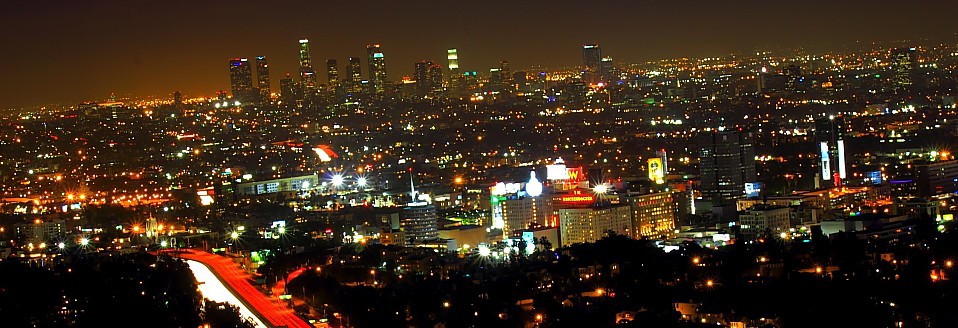
The Park to Playa Trail stretches from city to ocean. It starts with the Stocker Corridor, where you can make your way through greenspace and neighborhoods before entering the Kenneth Hahn State Recreation Area,  a 400-acre park known for its stunning city views of LA.

After you cross the La Cienega Pedestrian Bridge, spend a peaceful moment at at the Baldwin Hills Scenic Overlook. Next up: Culver City Park, rife with native plants and wildlife and a set of steep railroad tie stairs that take you down to ground level and back should you want to indulge in some particularly vigorous exercise. Staying on the trail, the Ballona Creek Bike Path is your next stop; from there, you can head straight to Playa del Rey to take in those Pacific blue waves and welcoming ocean breeze.

Credit: Wikimedia Commons

Kim Abeles Citizen Seeds, photo credit Ken Marchiono

On the way, you can enjoy sculptural art along with those views. Kim Abeles created seven beautiful, immersive sculptures on the Park to Playa Trail route. Her ecologically rich artworks first appear along the Stocker Corridor and Kenneth Hahn Park starting from the east, with the final piece located near the Stoneview Overlook to the west. The sculptures celebrate the flora of the trail, representing the seed pods of trees located along it. Created from concrete, terrazo, and metal, the lovely, highly tactile works reveal maps of locations, viewpoints and activities on the trail revealed in the interior of the pods.

Photo credit: Genie Davis

Besides the sweeping views of city skyline and sea and the delightfully textural sculptures by Abeles, the Park to Playa Trail offers numerous opportunities for hiking, cycling, running and just exploring. The trail provides the perfect urban fitness journey, too, with the long but pleasure-filled path a terrific starting point to lose weight naturally After all, movement is a big part of wellness and weight loss, and even by walking just a mile or so,  the trail is a pretty wonderful way to benefit your health.

Photo credit: Wikimedia Commons

Of course, the health benefits of walking the trail are more than physical. Despite its easily accessible proximity to the city, the trail provides plenty of areas to escape the tumult of urban life and just relax. Both exercise and time spent in nature can improve overall well-being, and combining the two can definitely increase the advantages.  Brain function is boosted by physical activities outdoors, as well as by the spiritual health boost of nature.

All in all, the Park to Playa Trail is an excellent trail for anyone who loves the outdoors, is looking out for their health, or simply seeking a little respite from urban life.  And best of all, you don’t even have to leave town to find it. That said, if you’re looking for a quick escape with a mountain vibe, Big Bear Lake is just two hours away.

High Octane, High Altitude: Adventure Parks in Sky Forest and Big Bear, California

When you’re looking for some thrills, family fun, and high powered amusement, look higher – ascend from Interstate 10 up Highway 18 to Skyforest and then Big Bear Lake.

That’s right, it’s not all about skiing, snowboarding, and summer boating – it’s about wildly unique zip lines and coasters, adventures on outdoor climbing walls, archery, go karts and pedal cars.

If you’re wondering where to find these thrills, read on.

SkyPark at Santa’s Village

Located in Skyforest,  SkyPark at Santa’s Village takes an iconic attraction (the original Santa’s Village) and makes it new again – and packed with thrills.

Perhaps the most thrilling is the Adventure Zipline. Soaring 30 feet above the floor of the forest, and bringing riders excitingly – but safely – close to tree tops, riders are harnessed in to fly over the park, landing via another locked-in zipline to ground level again.  Our rider loved it, and felt what he described as “total delight” while skimming over the wooded landscape.

It’s a much tamer but equally charming ride through the forest at ground level on the Northwoods Express, a modernized version of a ride that kids and adults both loved at the original Santa’s Village. Electric powered and manned by the friendliest conductor around, the train takes guests on a leisurely ride through the meadowlands.

But back to those thrills: I’d never experienced archery before a visit to Princess Evergreen ‘s Archery Range. After a quick but smart lesson from one of the park’s Adventure Team members, guests retreat with a bow and set of arrows to individual outdoor booths to take aim at targets. While I wasn’t very good at reaching a bulls eye, it was a lot of fun tor try.  In close proximity to the archery range was the NorthWoods Sharpshooter Gallery, where again after a brief but knowledeable lesson, I took aim at a target or two and proved to msyelf I was better with my safety glasses and a BB than with a bow and arrow.  Both adventures are available for kids age 9 and above on their own, or ages 3-8 if accompanied by an adult at the shooting gallery, age 5 and up at the archery range.

Kids 12 and up are welcome to test out their throwing skills at King Celwyn’s Ax Challenge, where a small, light ax can be aimed at a target. While I mostly whacked into the wall below it, I was impressed with the safe caged throwing areas and my own ability to wield the ax.

All three of these attractions are a part of the Royal Games area located at the top of the park, near the zip line.

Any guest able to pedal and don the provided safety helmet is welcome to embark upon Arrow’s Adventure in a pedal car that zips on a lightly hilly route through an ice cave and over a wooden bridge. The leg pumping action boosted my adrenaline, as did a climb in the Magic Tree Bouldering Room.

It was time to take a delightfully serene break in the Chapel of the Little Shepherd, a charming, restored location originally built in 1955. With stained glass windows and quiet benches for contemplation, the diminuitive spot is also avilable for weddings.

SkyPark’s location is well known for it’s bike park and beautifully wooded trails which take riders on mountain bikes (available to rent, or bring your own) beneath pines on well-marked trails. Young riders can enjoy pump tracks; the trails are carefully groomed every day.

And while older kids and adults alike took the trails, little kids were also literally diggin’ the child-size Moutain Movers dirt excavators as well as frolicking over the Discovery Playscape playground.

When we visited, a Renaissance Fair was taking place at the park, with costumed vendors and a variety of arts, crafts, and clothing. The park frequently offers these kinds of “bonus” experiences, such as summer concerts, or the opportunity to experience fly fishing on the property.

Coming soon to Santa’s neck of the woods: the updated return of a classic aerial ride, the Bumble Bee.  Unlike the old motorized attraction, SkyPark has repurposed the monorail track to transport a bicycle pedal car allowing guests to travel a suspended 1,000-foot curving course from above.

And, if you visit as the SoCal winter season approaches, you’ll find more classics in Santa’s Village, whose candy-cane and gingerbread house structures offer food and beverages as well as a Santa’s Exploratorium workshop for kids all year ’round. Come the holidays, guests will experience live North Pole entertainment, and of course, a visit with Santa.  Holiday lights also sparkle twice nightly in Santa’s Village from mid-November through January 7th.

Summing up: SkyPark at Santa’s Village is terrific, experiential update of an historic location (yes, they kept the candy cane at the entrance.) The adventures are oriented toward nature and physical action that just about everyone in the family can enjoy in a natural setting.  According to owners Bill and Michelle Johnson, their reimagining of the park – which originally opened in 1955 -includes both the holiday seasonal magic and these spring-summer-early fall adventures from ziplining to mountain biking to an Outdoor Education and Enviornmental Education program.  Hours and dates vary by season, with day passes, three-day passes, and three levels of year-round passes available starting at $149. Day passes are $69 (ages 13+) and $59 (children ages 4-12/seniors.)

Alpine Slide at Magic Mountain

Alpine Slide Park, located at Big Bear’s Magic Mountain Recreation Area, is another classic, having celebrated its 40th year this July. Over the course of the park’s 40 years of mountain fun, multiple attractions were added according to Alpine Slide rep Lisa Orabuena, including a water slide in the summer and snow tubing in the winter,  the latter offering a “magic carpet”-like function that takes riders to the top of the tubing hill with no hiking.

The park provides Southern California’s only “authentic bobsled” experience in the eponymous Alpine Slide. A scenic chairlift ride begins the adventure, taking riders to the top for a view of Big Bear Lake, where they’re seated in their own, individually controlled sleds. The two quarter-mile long cement tracks feature both high banked turns and straightaways.  Because riders can control their own speed – with their own individual control handle braking – the fun is suitable for all ages. A five-ride pass is $40; individual rides are $9.

The park also offers its own zip line experience – a unique rocketing adventure called the Soaring Eagle. The ride is a two person, seated zip – which by no means makes it tame (the ride is for those 42″ or taller and is $12 per experience). Riders are mechanically pulled very rapidly backwards up some 100 vertical feet and 500 feet in length to reach the launch tower, from which they are then catapulted forward to reach the base platform at a windy 28 miles per hour.  Our rider loved the “total surprise” of the backwards thrust and the pulsing push forward again.
For those of us more attuned to ground level fun, the Go-Karts offer a delightfully long spin, a zooming mini-race car attraction featuring 5.5-horsepower Honda-motored racers.  The vroom-vroom excitement can be packaged along with my favorite adventure of all – mini-golf.

The 18 hole course includes several risky water traps, an appropriate (for the location) bear statue hazard, and many amusingly challenging curves and turns.  Admission for both is $22, but guests can also enjoy both attractions singly.

But the biggest and most unusual attraction of all is the Mineshaft Coaster.  Like the Alpine Slide, the experience is rider- controlled as to speed on the descent, but it is still a fast and furiously fun ride at any pace. The newest park attraction propels you past mountain greenery heading up the incline, and then you’re off on a descent that includes hairpin turns, tunnels and even a 360-degree corkscrew on your way down. The mountain coaster is the first and only one of its kind in the Golden State. So exciting is the ride – which can reach 30 m.p.h. as a top speed – that guests’ cars are equipped with video cameras to film riders’ reactions to the hurtling fun, providing a memory available for purchase after the screams and laughs reach the boarding station again.  Adults can ride for $20, and kids, with some height restrictions, for $10.

Alpine Slide at Magic Mountain also offers a snack bar with best sellers like ice cream, chicken fingers, and cheeseburgers. There are also a bevy of arcade games indoors for guests to decompress on after the thrills and winter chills or summer splashes of the great outdoors.

Summing up: There’s nothing quite like Alpine Slide at Magic Mountain. With two rider-controlled thrill rides, a sunny mountain setting, and the pure adrenaline rush of what must be the fastest moving zipline in the U.S., this amusement venue offers plenty of family fun that can be enjoyed for an entire day, or one ride at a time, any time.

Dank Donuts

In need of sustenance before or after the thrills? We discovered Dank Donuts, where delicious, airy vegan and/or gluten-free donuts are on hand for breakfast along with the more traditional variety of sweet doughy treats. There are maple bars, giant cinnamon buns, and cronuts, too. However, it’s not just the thrills and mountain air that makes these treats taste possibly superior to every other donut you’ve ever tasted – it is literally the altitude, according to owners. At close to 7000-feet high, Big Bear’s thinner air makes Dank’s donuts fluffier. They’re also hand cut, and come in a dazzling variety from sprinkles to glazed to chocolate to filled. There’s even a selection of doggie donuts for your best four-legged friend.

But it’s not all about the donuts and pastries. Breakfast and lunch sandwiches are served all day, and they are hearty, ample, and packed with both flavor and fresh ingredients. We sampled two different choices from the lunch menu: the Herbivore, my choice, was a juicy mix of hummus and avocado spread along with the vibrant punch of sundried tomatoes, marinated artichokes, cucumber, lettuces and microgreens on wheatberry bread. My partner enjoyed the spicy Wild Turkey, which offered chipotle dressing along with the tender turkey, capicola, and spicy Jack cheese on a Hoagie roll with mayo and salad fixings.

Dank Donuts offers shaded tables, a pink and aqua color scheme, and fast to-go service. It’s a great first stop before heading out to the thrills of Alpine Slide at Magic Mountain and the wild adventures of SkyPark at Santa’s Village.

We stayed at the delightful Sessions Retreat and Hotel, a completely revamped and reimagined resort located in Big Bear Lake, with fire pits, cool shared spaces, and funky but elegant design in a variety of rooms.

Think of the decor and charm as a reasonably priced luxury retreat combined with the aesthetic of the Meow Wolf art amusement collective. Don’t stay anywhere else.

  • Genie Davis, photos by Genie Davis


Suddenly It’s Not Summer – Recalling Art From Our Warm Months – Sasse Museum of Art and Studio Channel Islands Both Allowed a Look at Beautifully Memorable Landscapes

Two exceptional exhibitions, both closed earlier this summer, offered revealing looks at personal landscapes.

Lori Markman‘s Magical Landscapes at the Sasse Museum of Art in Pomona, Calif. closed in mid-August, but certainly you’ll see more of her vistas again. Her mixed media collage, inspired by Japanese landscape art created beautifully crafted, unique scenes that defied expectations.  Works such as “Moon, Stars, Mountains, Water in Blue,” shown above, created a vision of deep perspective, a slice of earth and sea. Similarly, her “The Reflection of Fuji” dances on the horizon and against the mysterious surface of the water below.

Some works are purely peaceful, such as “Overlooking the Lake in White;” others convey a vast sense of movement and color, yet anchored in place by her use of minute text.

Drawing viewers into her intricate detail, as she does with “River of Roses at Cherry Blossom Time,” Markman makes each separate image within each work precise and graceful, creating a splendid, peaceful riff on traditional Japanese art, whether inspired by photographs or classic drawings.

The layered composition of her art adds to the sense of calm and rest. Taking so much care and shaping such delicate work evokes a sense of peace that no external chaos or challenges can shatter.

Back in May, the summer began with the radiant works below.

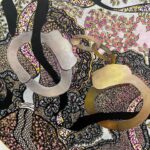
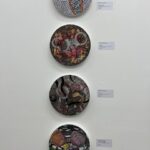
Dis Connection, curated by artist Elana Kundell, offered a similarly beautiful and heart opening exhibition at Studio Channel Islands located in Camarillo. The group show featured eight female artists each exploring the human need for home and connection as well as the wound of forced displacement.  Like Markman, each of these bountifully talented artists offered layered works packed with meaning and rife for reflection and meditation. Many of the works are abstract, leaving room for interpreting what is intimately personal to each artist equally so for each viewer as well.

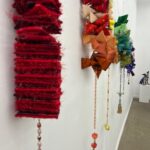
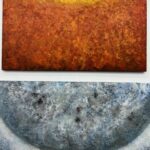
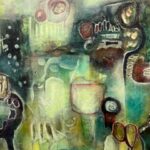
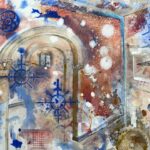
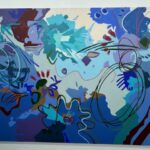
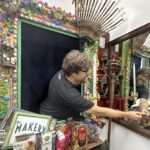
Exhibiting artists included that of performance artist Maria Adela Diaz, the rich large-scale oil and mixed media painting of Fatameh Burnes, towering sculptural work from Alicia Piller, immersive, world-building clay art from Janet Neuwalder, and lush mixed media works involving varied material, including emotionally deep painted images, from Nurit Avesar.  Marthe Aponte‘s unique, delicate wall sculptures  shape protective shields, while Sigrid Orlet‘s varied media work is powerful, evoking strength and wisdom.  The layered instalaltions of Arezoo Bharthania use gauzy material that floats with color and light.

Neuwalder’s vast expanse of clay shapes (above) blossom with supple, subtle color.

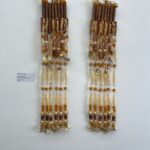
Aponte’s beaded shields feel both entirely of the moment and eternally protective.

Avesar’s use of vivid color and texture evokes a visceral response.

Diaz takes us to the sea and paints her body the color of its foam.

Each artist shapes an immersive and lush world that bears intimate consideration and creates enormous pleasure from seeing these powerful, wild, pristine images. Kundell’s curation is perfect, drawing viewers into an exhibition in which one piece builds upon or converses with the next until the viewer also feels spoken to.

Above, Fatameh Burnes “Fools Paradise”; below “Remberance” from Janet Neuwalder.

If you missed either Kundell’s lovingly curated Dis Connection or Markman’s Magical Landscapes, remember their beauty, and look for each of these artists to share their profoundly wise and heartfelt visions with you again, soon. Their landscapes – internal and external, spiritual and passionate, each map new and resonating territory.

  • Genie Davis; photos provided by the artists and galleries

Punk and Money – A Double Dose of Fascinating Photography Coming to Leica Gallery

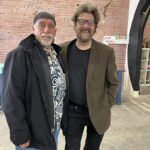
Sometimes it takes two to create disparate yet connected photographic art.  Photographic artists Michael Grecco (first image, above) and Elizabeth Waterman (second image, above) each offer completely different bodies of work, that both reveal and celebrate intimate looks at two very different subcultures. The married photographers will be opening two paired solo exhibitions at Leica Gallery in mid-September.

Grecco’s exhibition, Days of Punk, features punk music performers backstage, on-stage, and just playing around. The punk term is used loosely, as some of the images include other musicians from the same era, in the years 1978-1991.  Along with punk icons like the Ramones and Dead Kennedys, and their predecessor, the iconic Lou Reed, viewers will find powerful images of Joan Jett, The Talking Heads, and more. Many, but not all of the works are taken in a beautifully evocative black and white. Grecco’s approach is at times that of a street photographer or journalist, capturing subjects off-guard or in the middle of a mosh pit, on the fly; others are more perfectly framed stage performances, or a composed image of a group.  Whether a quick capture or a well-realized depiction of a performance, these photos are often bold, and always involving.

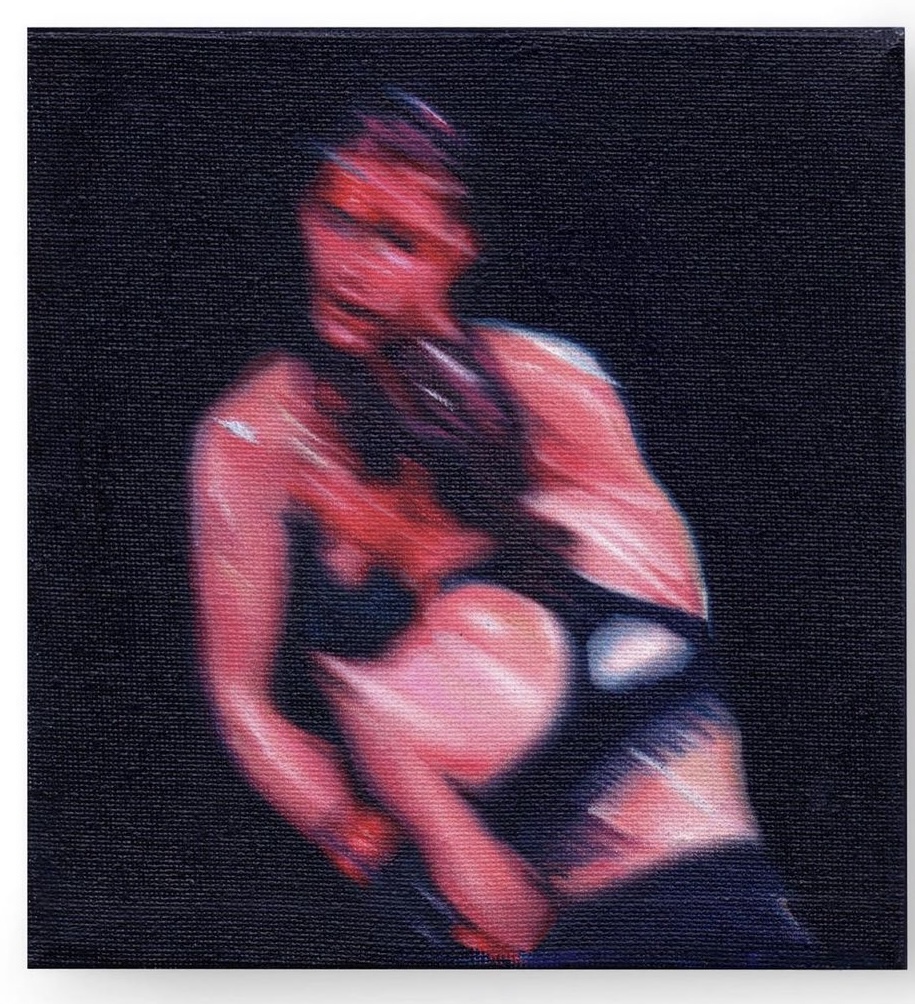
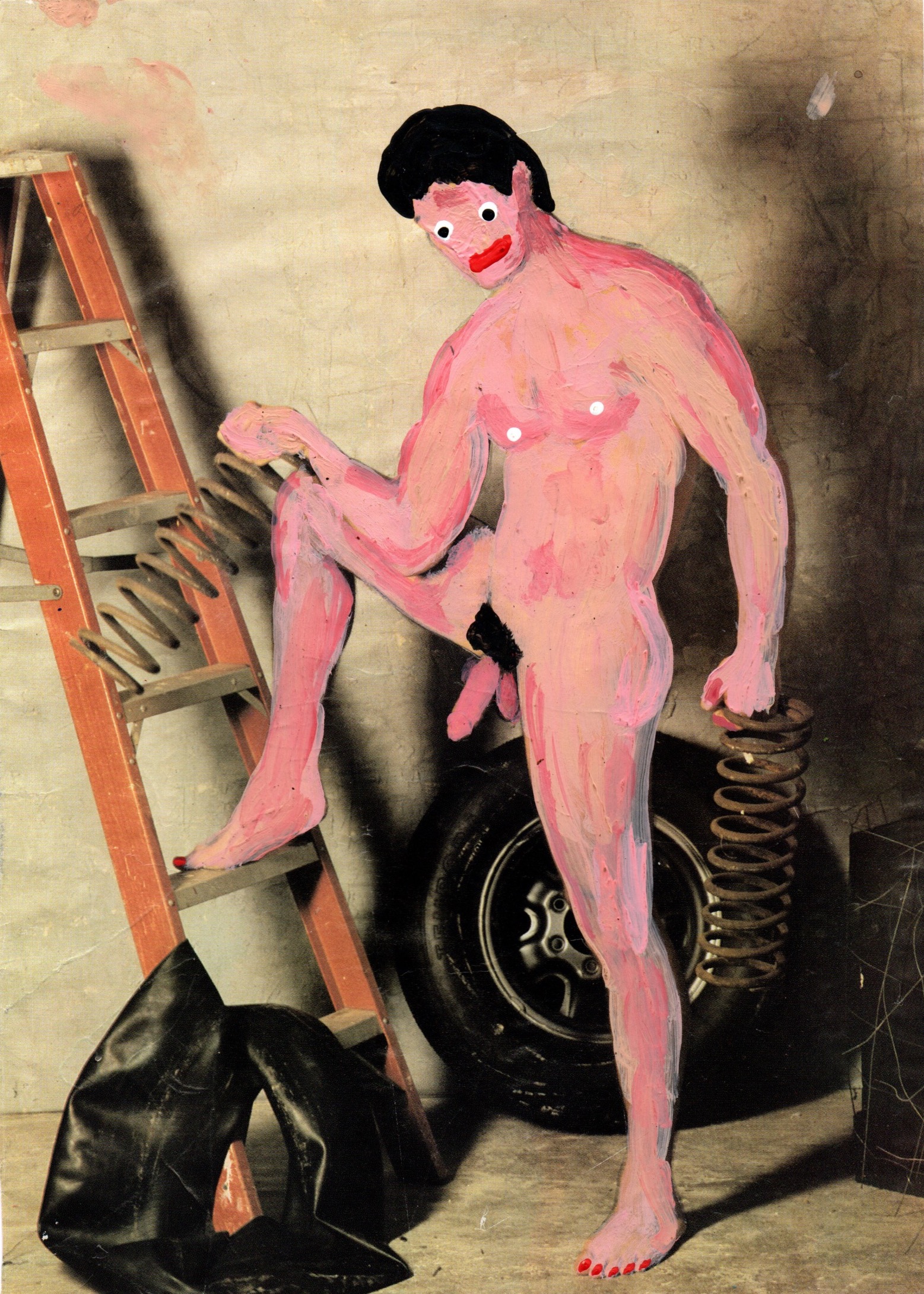
Moneygame,  Waterman’s exhibition, is about an entirely different culture indeed, that of strippers in five different American cities and in Bangkok. Some of her work is in a lustrous noir black and white, but the majority of the images are shot in super-saturated color – red and golds and greens that vibrate and pulse like the neon surrounding these women. Some of the Bangkok images, shot earlier this year, have never been exhibited before.  While Waterman frequently shoots subtle, suggestive images of these performers’ daily work, some images are deliberately blurred, almost surreal – and combined with their fierce color, they remind the viewer of the emotional stress – and the physical demands – of this profession.

Both Los Angeles-based photographers immerse themselves in the worlds they’ve chosen to depict. Grecco describes himself as a club kid who became both a chronicler and participant in the Boston club scene. While working as both an Associated Press and Boston Herald photojournalist, he also covered Boston’s punk music scene for Boston Rock magazine and WBCN-FM, capturing that scene’s rhythm and heart, it’s wild energy and as he describes it, “infectious freedom.”

Viewers will enter that era and that world not only through Grecco’s passionate visuals but through related soundscapes that were produced as a collaboration with Mission of Burma band members. These works are also featured in the artist’s recent best-selling book, Punk, Post Punk, New Wave: Onstage, Backstage, In Your Face 1978-1991.

Waterman’s work, too, was first presented in a book, her Moneygame. The trust Waterman needed to establish with the stripper performers to create her photographs is the indelible heart of her images.  She showed her work to the ladies, helped them collect the dollar bills tossed at them, and was generally and genuinely present in their lives, until they became comfortable with posing for her, as well as allowing her to capture views of their daily milleau. While this is a charged and challenging world, Waterman was able to capture not only lush performance photographs, but images of them at rest, having meals, applying their make-up. In the process, she has created a relatable work environment, exploring the way in which her subjects are, just like any other performer in any other sort of job, using their money to pay off debts, start an enterprise, or provide for their families. Her recent Bangkok images have a slightly different sense of both coloration and subject, including stripping performance sub-groups such as trans and plus-size strippers, while exploring use of a shallow depth of field at open aperature.

Based on her photographic experience, Waterman is currently developing a documentary series on this world, including the changing workscape for these women, from unionization to supportive communities looking for greater visibility and acceptance. She relates that she is exploring what the life of the modern stripper looks like.

This compelling paired exhibition offers a profound look into lives lived in very specific worlds – and the innate humanity and power of performance among both today’s strip performers and recently-past-era punk musical artists.

Leica Gallery is located at 8783 Beverly Blvd, West Hollywood, CA 90048. Grecco and Waterman will hold an artists’ reception on Thursday, September 14,  from 6-8 p.m.; the exhibition runs through November 5th.
  • Genie Davis; photos provided by the artists.