

It’s Always Tiki Time Somewhere at the Catalina Museum for Art and History

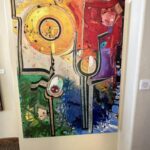
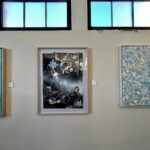
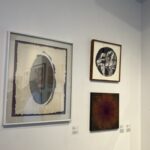
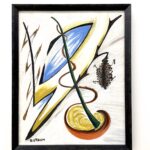
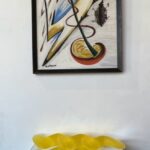
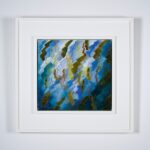
Serving as a truly beautiful adjunct to the Catalina Museum for Art and History’s permanent collection, now through September 3rd, visitors to Catalina Island can enjoy the transporting exhibition Tall Tiki Tales. Curated by author, tiki scholar, and cinematographer Sven Kirsten, the widely encompassing show includes artifacts from films shot on the island, dining spots, and resorts, as well as and original books and artwork that enhance the understanding of a cultural phenomenae that shaped tastes and traditions – as well as wildly fun beverages – both on and off Catalina.

Frequently serving as a film set that helped to popularize tiki as an art form, Catalina has a rich history in the development of America’s happy obsession with all things tiki, including the bars and restaurants that grew nationwide during the 1930s.

A highlight of the well-curated exhibition is an interactive one – visitors can sit down at a cozy table in a replica tiki bar to experience a unique design by master tiki bar designer Bamboo Ben. Viewers are transported to a blissful paradise with the sound of pattering rain upon sitting down. The only thing missing is a classic beverage.

According to Johnny Sampson, the museum’s Deputy Director and Chief Curator, Catalina Island served as a major film set for movie adaptations of works such as Nordhoff and Hall’s Bounty Trilogy and The Hurricane, W. Somerset Maugham’s short story “Rain” and The Ebb Tide by Robert Louis Stephenson. “Hollywood quickly adapted these and other stories into movies, using Catalina Island as an accessible backlot for far away South Seas locales…we had Christian’s Hut from the set of Mutiny on the Bounty, the Chi Chi Club at the Isthmus and in Avalon, Hotel Waikiki, and Hurricane Cove—which even had lighting effects and fans to recreate the thrill of Hurricane for its patrons.”

The fascinating mix of photographs, original art, and collector’s items – as well as the one-of-a-kind tiki hut immersive experience, beautifully support another look at the island’s past, a stellar permanent historical collection touching on other areas of Catalina life, including other film shoots, Chicago Cubs memorabilia, a wide ranging survey of Catalina pottery and tile, and a collection of photographs, negatives, and films documenting island life from the early 1880s to the present.

Viewers will also observe early phone switchboards, the evolution of transportation from the mainland, sport fishing items, and a wonderful collection of Tongva and Gabrielino artifacts. The fine art collection includes photography, plein air painting, contemporary sculpture, and examples of architectural and graphic design.

Combined with Tiki Tales, viewers will find an absolute treasure trove of art and history, as the museum continues to live up to its name with deep dives into island life and vibrant, intelligent art exhibitions.

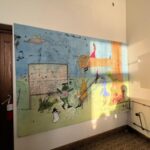
And, if Tiki Tales made you thirsty or hungry, there’s a quick solution for that. Walk on down Crescent street to Luau Larry’s. The indoor  thatched roof hut and bamboo walls and delightfully kitschy ocean-themed paintings and murals here are even joined by an historic tiki wood carving, hanging above the booth we choose to sit in, a happy coincidence.

We enjoyed  vibrantly colored Polynesian- style cocktails – a bright Blue Hawaiian and the bar’s signature tiki drink, a Wiki Wacker with Cruzan aged light rum, Parrott brand, pineapple/orange juice and grenadine. The latter comes with imbibers’ choice of straw hat or bumper sticker. The food was fine too –  fresh, savory popcorn scallops and shrimp, a well-seasoned, fresh poke, and a first-rate seared ahi platter served with ginger, wasabi, soy sauce, and a nicely sweet, crisp cole slaw.

Currently, the Catalina Island Company is offering a terrific getaway – the Tall Tiki Tales package, that combines a hotel stay at the beautifully updated Hotel Atwater and a boat ride to Catalina – we had the pleasure of traveling from Long Beach via Catalina Express,  a safe, swift, and beautiful passage across the blue Pacific, arriving with a great view of the historic Casino building upon arrival in Avalon Harbor. We experienced the journey two ways – indoors in the comfortable Commodore Lounge, replete with a glass of Brut Chandon, and outdoors, with the wind whipping our hair and an eye trained on pelicans on a long flight.

In an upcoming article, our stay at the Hotel Atwater, a look at the in-depth Behind the Scenes casino tour, and additional dining experiences. For now, go experience a few Tiki Tales at the Catalina Museum for Art and History – and then raise a toast to the exhibition at Luau Larry’s.

  • Genie Davis; photos by Genie Davis and provided from the museum’s collection


Hyde Park Gallery LA Opens March 4th with Stunning Glass Art from Nao Yamamoto

Glass and sculptural artist Scott Slagerman is opening the new Hyde Park Gallery LA, an exciting addition to the Los Angeles art scene and one he calls “spontaneous…I had no intention of making a gallery when I bought this building,” he explains. “I was renovating the space for my studio, and realized the front area was the perfect space for a gallery and showroom.” Slagerman says Los Angeles has  a dearth of new spaces for young, talented artists, and a lack of exhibition locations for glass artists in particular. Slagerman works in metal, wood, and glass, and has sculpture in the permanent collection of the Decorative Arts Museum in Paris.

For the first exhibition at his new gallery, Slagerman is presenting a solo show from glass artist Nao Yamamoto, titled The Altar. The artist appeared on season 2 of the Netflix series Blown Away.  At Hyde Park Gallery LA, her exhibition is highly pertinent for the space: the renovated building was once a church, and Yamamoto’s work is placed where a religious altar once stood.

“Nao represents a very major part of the LA glass scene, so it is exciting to have her here. She’s never shown in Los Angeles before,” Slagerman relates. “Her art fits the location perfectly.”


Yamamoto says her work for The Altar is comprised of three major wall installations with multiple pieces involved in each. “I have been shifting my ideas to think about the function of art, and why it exists. I am here to create an experience where the viewer is a real part of the show, where the viewer completes the show.” She adds, “I was really focused on creating a whole new coherent space, making new work made just for the gallery.”  The artist encourages viewers to experience their sixth sense, and engage a connection with inner peace. Works include lustrous lotus flowers, emerald leaves, natural crystals, and representations of candle flame, as well as geometric pieces that evoke representations of the “third-eye” and cosmic intuition.

While subsequent exhibitions will focus on the Los Angeles area glass art scene, the gallery will also feature exhibitions that include other mediums and artists as well, according to Slagerman. The LA-native asserts that glass art has a history in the city, and that the form is part of a burgeoning community. But with glass galleries of the past such as the Kurland-Summers Gallery long gone, it’s more than time for a new exhibition space.

“Our plan is to help people rediscover this under-represented and under-appreciated art form for both established and up-and-coming artists,” he says. The gallery will host artist receptions, art talks, special opening weekends, and tours of Slagerman’s own glass studio.

Born in Japan and working in the U.S., Yamamoto creates artwork that’s inspired by both the beauty of glass itself and the artist’s passion for nature. Her rich, colorful, and varied textures offer a resonating beauty that goes beyond the material of glass, creating inspirational works that soar with varied patterns and glowing light. For this exhibition, her works inhabit an almost ethereal, spiritual approach to glass work.

The Altar will open March 4th, with gallery hours from 11 a.m. to 9 p.m.; e 1-7 p.m. Sunday, March 5th, and 11-5 Tuesday-Friday. On Saturday, March 11th, hours are 11- 7, and a closing reception for Yamamoto’s work will be held from 5 – 9 p.m. on Sunday, March 12th.

Hyde Park Gallery LA is located at 2618 W Florence Ave, LA, CA 90043 in mid-city. For more information visit https://www.hydeparkgalleryla.com or call (310) 413-6493.

Gina Herrera’s Sculptures Survive War with Art

Artist Gina Herrera has fought many battles in her life, having served a tour of duty in Iraq. But she transforms war into art, as she does with her three new sculptures on display in the exhibition Surviving the Long Wars.


While the triennial itself is just three days in March, the art exhibition will run March 4th to June 4th in the Chicago Cultural Center, Hyde Park Art Center, and the Newberry Library. Surviving the Long Wars focuses on the histories that shape our understanding of warfare as well as visions of peace, healing, and justice.

Herrera’s work here is a continuation of her signature sculptural line of metal and found materials. Drawn to using mixed media, she says “We have an abundance of discarded materials we throw away daily. I feel everything has some kind of history or message.” In her piece “The Liberty Master,” above, Herrera creates a beautiful metal work blossoming in vivid color, curling like a flower whose bud is shaped like a heart.

The message of the Chicago exhibition overall is to explore the alternatives to and repercussions from war, and Herrera’s work certainly fits that exploration. Kinetic energy fills every line of her metal work, as if the sculptures were captured and briefly frozen in mid-motion. They also express Herrera’s native ideology and beliefs, envisioned through her consistent art style and practice.


The Whimsical Diva, above

She welds her recycled materials into sinewy, almost hieroglyphic shapes, wrapping them fabric and discarded jewelry and buttons. She goes treasure hunting for society’s discards, transforming them into jubilant, lively creations that encompass a vast array of tossed-aside items, from lost property to plastic bubble wrap. “I look at everything as a possibility,” Herrera says. “We throw so much trash out, plastic stuff, which lands in the oceans, hurting the earth. It’s almost a sin to buy new things.”

Herrera describes found items as having character and energy, and adds that she is “partial to stuffed animals, [there’s a] living entity in them,” yet all the same they’re discarded. She gives used items the “opportunity to have a new life, continue the energy of the item.”

The artist feels that our discard of objects is like the way in which we discard people, and the lack of respect we have both for older, used items and our own elders. “Once you get to a certain age, you are useless, a burden to society.” This attitude discounts knowledge, including oracle language, and native culture, which is then forgotten, Herrera attests. “People don’t have a desire to look into their own history, [they] want to avoid history.”

As a Native American artist, she takes her current Native experience and uses that to make “commentary on the planet and future. We are still very contemporary, we are still fighting for the land, the soil, the earth.”  Thematically, Herrera work with time, the past, present, and future, and a connection to the earth.


A Virtuous Warrior, above

For the three sculptures the artist is displaying at the Chicago exhibition, she wanted to make sculptures with mannequin parts, and found a mannequin for use at a flea market.

“I want my viewers to think about the sacrifices that the U.S. armed forces have endured to uphold democracy. Maybe I subconsciously decided to use a mannequin [to] represent the masses of veterans who returned back home without limbs,” Herrera says. She also wants viewers to consider how fortunate they are to live in a country where they’re not afraid of losing their lives. “Many people in this country take for granted all the privileges we have…. How can anyone who served this country want to overthrow democracy?” She notes, “We…uphold the values and sacrifices of their brothers and sisters before them. This is the reason why we stand at attention when we are raising and lowering the flag.”

Along with a strong belief in upholding these freedoms, Herrera seeks to present, through her art, a focus on Native American history and its role in the present, for contemporary artists.  Her art presents the issue of discarding items, and infiltrating “our land, rivers, oceans, sea, forest, mountains, and air with our negligent behavior. We take and destroy our world but never give back with respect to all the gifts of Mother Earth.”
Herrera’s use of color and form is visceral, created through what she terms as a “very intuitive” process. “I do not pre-plan… I let the items or materials speak to me. As I am wrapping yarn, string, underwear, or fabric, I am conscious of my materials and do my best to use different patterns, textures, [and] materials so there is no repetition. I want each sculpture to look different from one another, to have their own identity and feeling,” she explains. “I go with the flow and make it a playtime – like when I was a child. I like to create voices, especially if I am using toys or stuffed animals, as I feel they still have a soul.”
Herrera’s sculptural approach is rooted in what she describes as “the aesthetics of the everyday.” Having served 25 years in the Armed Forces, she experienced, amid the devastation of combat, “the global impact of the systematic destruction of the planet…the long-term effects of conflict/war, including the exploitative, unsustainable, careless discarding of trash by the United States Military.”

These experiences led her to question her own artistic practices, and the desire to lessen her environmental impact. Beginning by photographing “the vastness of neglected detritus that could be seen for miles,” she soon extended her art practice to the creation of her 3- dimensional forms, using discarded objects and natural resources.

Serving both as a powerful response to the military industrial complex and the often-careless approach to the environment embedded in American life, Herrera infuses her work with the spiritual, the historic, and a uniquely bold vision. Her sculptures are both a call to action, to respect the past, and the gift of motion and mobility, while also offering a rich insight into the poignance and necessity of freedom and reinvention.

  • Genie Davis; photos provided by the artist

Spring Break Goes for Broke

Brittany Ryan

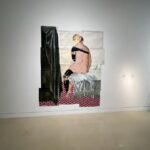
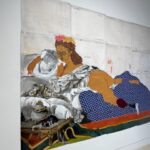
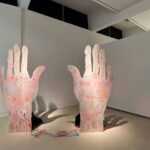
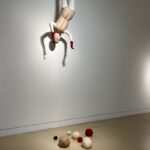
Spring/Break Art Fair is always THE most inventive and unique of the art fairs in Los Angeles, and this year is no exception. Charming, eclectic, witty, and strange – that can sum up any number of the different specifically curated cubicles of art at the 2023 edition, held in a former warehouse space at Adams Blvd. and La Cienega. Now in its 12th year, the fair calls itself a “curator driven” art show, and it is: each of the spaces is immersive once you take a step inside.

Take a look:

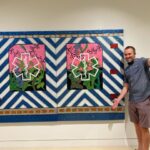
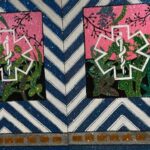
Emily Silver (below) thinks in pink…

There was also a textural desert from Nina K. Ekman and other artists …

Paintings and Sculptures by Brooke McGowen make up a “Rave Wave” …

Greg Haberny made wooden portraits…

Kathleen Henderson’s “Gummed Reverse” is a fine exhibition of evocative oil stick drawings at Los Angeles-based galleryTrack 16’s space, while curated yby Rokhsane Hovaida,  Yasmine K. Kasem creates large scale woven tapestries.

A relatively new art scene is growing in Boston, including the Abigail Ogilvy Gallery, (above) who offers “In Mother’s Arms,” featuring the work of Alex MClay and Cassandra C. Jones.

Brittany Ryan’s lush, classic scultpural works were softly hued; news leadlines were the subject of Max Rippon’s smart “Save the Date.”


Both Dave Alexander and David Bazanova as well as Marianna Peragallow and Thomas Martinez Pilnik offered fresh and amusing, smart, engaging works.


Taylor Lee Nicholson’s “Yard Sale” curated by Jonell Logan and Janet Loren Hill was among my favorite exhibition spaces, fanciful, fun, and of-the-moment all at once.

“The Hidden Influence of a Rebirth”  used electrical components to create art that evoked sea life.

Spencer Gilbert took viewers “Far From Home.”

The exhibition space “Simulations of the Sacred” brought outstanding neon figurative work to the fair.

And “Connoissseurs of the Street” created a vibrant environment.

Another of my favorite spaces made me laugh out loud – meet Mark Zuckerberg holding forth, our “Beloved Leader” by artist David Howe, curated by Jac Lahav.

If you want original, reasonably priced art, fanciful settings, and the occasional scatological creation, look no farther than Spring Break. Featuring exhibitors primarily from LA, San Francisco, New York, and even one gallery from a newly burgeoning Boston scene, take a look at the vibrant colors, immersive installations. and clever, entertaining artworks here. It’s an original – and that’s worth taking a break for.


  • Genie Davis, Photos: Genie Davis