
Frieze is Hot on Art

Jam packed with art from galleries that focus primarily on New York and Los Angeles, Frieze Art Fair, now located at two locations within the Barker Hangar Complex at Santa Monica Airport, is an exciting art event.

Shuttles ferry visitors from the “west” to “east” complexes, with the east end being the far larger venue. Along the way there are large-scale sculptures – an airplane, a “loot” bag, and some extremely cool 3-D holograms with fans, “Hologram Phantom Limbs” from Jennifer West that shift and spin differently in person and when photographed. Sculptural forms are in fact everywhere, from fabric to mirrored pieces to neon to resin; booths are extremely well curated, offering the experience of visiting the actual gallery displaying work, just a capsule-sized version.

Doug Aiken

The main building and the largest collection of galleries is located on the east end of the complex; a smaller satellite exhibition is on the west end. Both house a mix of primarily contemporary, cutting-edge art – but make no mistake, this is highly polished work featuring names you’re bound to know, from Damien Hirst to Doug Aiken.

There were many works featuring miniature items, many involving mirrors and other shiny sparkly materials, lots of dimensional works, political works, humorous works, and vibrantly colored abstract and modern expressionist art. So, in short, there is a lot of art from impressive galleries in breathable spaces allowing viewers to take the works in without feeling crowded or rushed – although the fair itself is certainly busy.

It’s a literal cornucopia of art, and while it would be virtually impossible to name every favorite piece and gallery, here are some of the most memorable.

At London-based Maureen Paley Gallery, a terrific series of mini bottles, from Max Hooper Schneider, “Prism Atoll, ” which uses fiberglass and pigmented urethane to shape the delightful work.

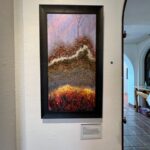
At LA’s always inventive Baert Gallery, a series of ceramic lights in colors from light blue to turquoise glow transcendently (above); at Various Small Fires, textile work is highlighted, including a lush piece from Dyani White Hawk, the “Untitled (Purple and Iridescent)” made with glass bugle beads. At the same space, Diedrick Brackens weaves magic with cotton nylon and acrylic yarn in a series of figurative works using a limited palette (below).

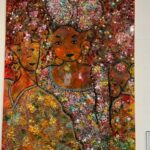
Roberts Projects also offers a work featuring glass beads, a sculptural work from Jeffrey Gibson, “One of My Kind,” an elaborate bird. A vibrant work from the gallery’s Kehinde Wiley, and a mixed media work from Betye Saar also stood out.

LA Louver Gallery focused on the political with several large scale mixed-media sculptures from Edward and Nancy Reddin Kienholz, including “My Country ‘Tis Of Thee,” and “Still Dead End Dead II.”

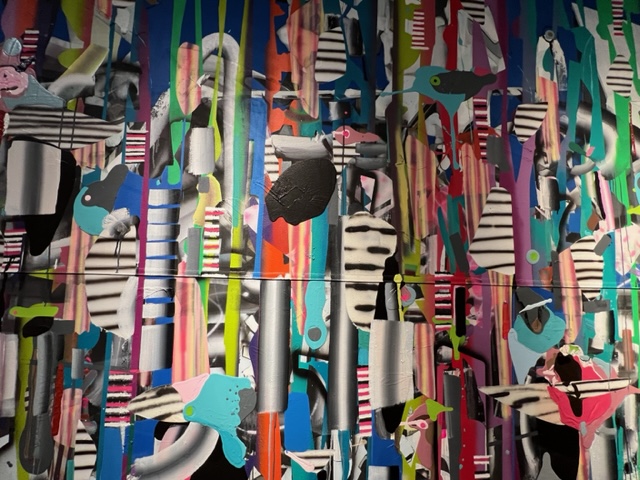
Abstract works also dazzled, including Peybak’s “Abrakan,” a mix of gesso, acrylic, and oil pastel. Mark Handforth’s “Amber Shadows” used a different kind of mix, aluminum, fluorescent and LED light fixtures, Rosco color foils, chromate primer and enamel paint to create a stripped down bouquet. Marwa Abdul-Rahman created a large mixed media wall sculpture with vibrant elements of hot pink, in “Consecrating Earth and Skies.” Doron Langberg merges abstract and impressionist in the vibrant shades of works such as “Lovers at Night,” the latter at the Victoria Miro Gallery.

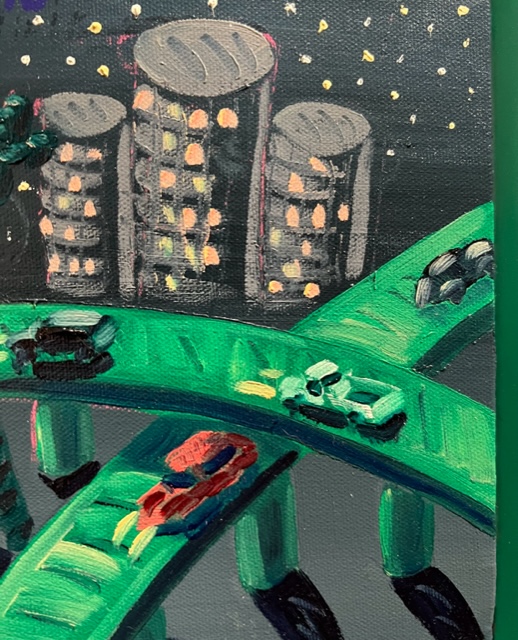
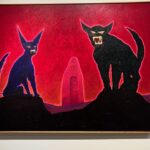
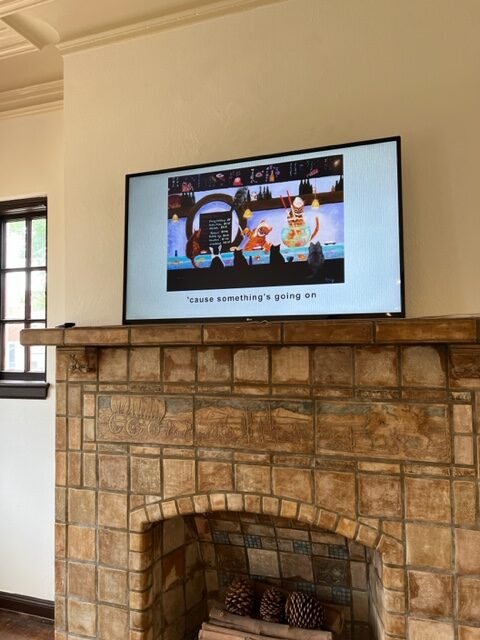
There were oil on linen works from Yun-Hee Toh at Gallery Hyundai while at Tokyo-based Taro Nasu, charming blue and gold racoons fuse painted images with the electronic, asking “How much was your face?” and black and white cats and pigeons tower over a scale city in another work.

Hauser and Wirth exhibited both wall art and sculptures from a roster of well-known artists; while at Commonwealth and Council crushed-looking shiny silver sculpture reflected the eager crowd. New York’s Paul Cooper Gallery exhibited a work that asked the viewer to consider this advice: “You are alone – Slow Down – There is No One to Please but Your…” Elsewhere, Peter Shire’s circus-colored Living Room Theater vibrated.

There were resin filled martini glasses and mini race cars on silver pedestals; massive black tea pot and scissor sculptures; Anat Egbi went to the butterflies; Tanya Bokadar Gallery provided its own unique shiny, dimensional artworks.

Along with all the art, viewers were invited to visit “Dr. Barbara Sturm” an exhibit space offering no-charge infrared stimulating facials and free orange turmeric bottle drinks among other products.

Here’s a look at a wide range of other artworks as well and one caveat: wear comfortable shoes. Frieze is an art fair as large as it is “hot” in the LA art scene.

  • Genie Davis; photos: Genie Davis
LA Art Show: Stunning Video Art and International Galleries

The LA Art Show is the oldest art fair to occupy Los Angeles’ burgeoning fair season, and it is still a vital presence. This year, the 28th iteration of the fair, produced by Kassandra Voyagis, offers abundant highlights including works from six Japanese galleries, a variety of work from 14 South Korean galleries and artists, and the return of the European Pavilion.

The work in DIVERSEartLA, curated by Marisa Caichiolo provides a variety of haunting video installations that are as lush and captivating as they are prescient social commentary on global climate change. In conjunction, the Mueum of Latin American Art offers work from Judy Baca; AMA showcases the work of Mexican photographic artist Alfredo De Stefano.

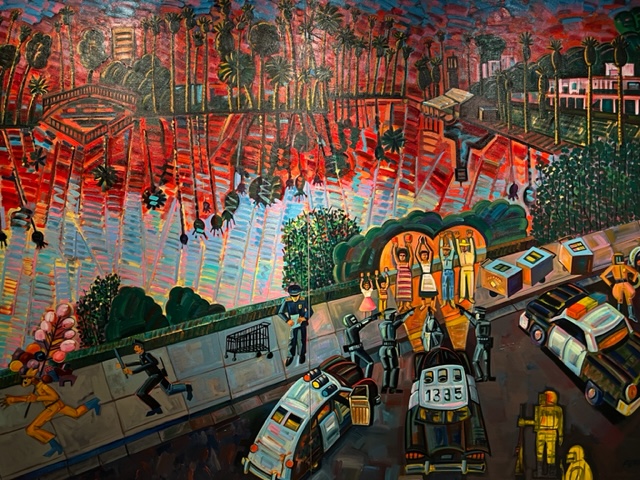
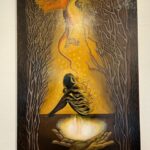
Baca’s double-sided triptych “Thirteen Women in the Volcanic Eruption” (Side 1) created on acyrlic on wood panels, a part of MOLAA’s permanent collection explores the worship of a female goddess. The second side, on display as we visited, is a visionary look at Mother Earth, “The Birth of the Vision of the Heart,” above.

Immigration policies and the heartbreak of border crossings is the topic of an exhibition that combines video images with the clothes worn by immigrants in “Uninhabited,” an installation from Carmen Isasi.

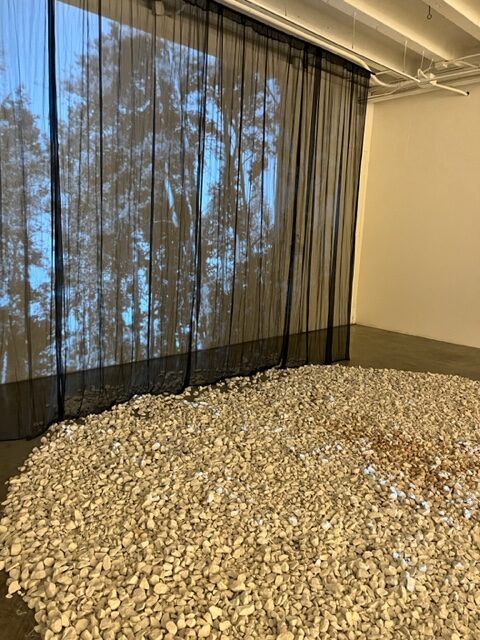
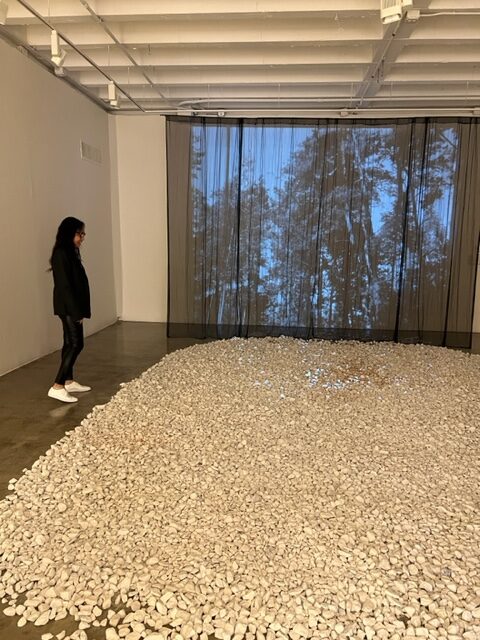
With a sand covered floor and gorgeous images and sound, De Stefano’s “The Pulse of Silence (El Pulso del silencio)” is an absolute must-see exploring our planet, its future, and the terrible poetry of its possible demise.

Davis Birk’s work is equally fascinating, nature through a surveillance camera in “Project: Rendevous: Esta tierra es Mi Tierra.”

Petro Eiko’s riveting 3D sculptures are also rooted in an exploration of climate change and fragile state of water; she uses six 3D sculptures and video to create a mysterious and involving installation.

Curated by Beate Dusterberg, viewers can walk through a series of cylindrical metal sculptures containing images of eyes and bodies, illuminated by an eerie, glowing white light. Both futuristic and cautionary, the experience is otherworldly.

Artist Robert Vargas created a mural on site opening night, expressing the plight of missing indigenous women.

“IL GIARDINO PLANETARIO (The Planetary Garden)” from artist Pietro Rufflo collaborating with Noruwei, provides a prescient look at earth as a garden with haunting visual images.

At Building Bridges Art Exchange, an amazing cocoon of softly falling fabric provides a walk-in experience that evokes memories of a visit to Antelope Canyon. Other sculptural pieces are also on exhibit from the miraculous hand of artist Carmen Mardónez.

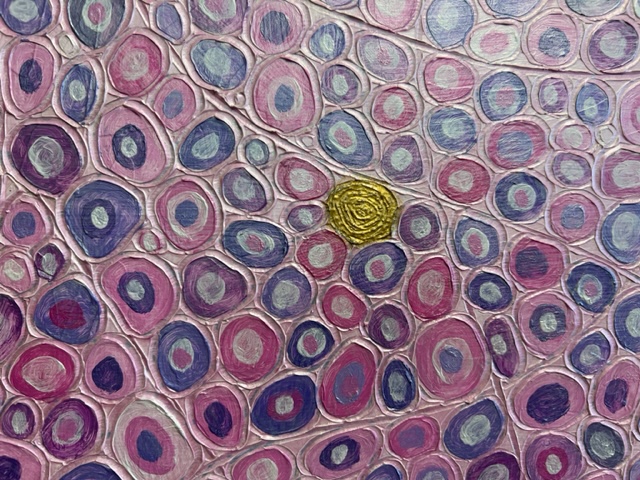
At the Rebecca Hossack Gallery, hauntingly luminous paintings by Laurence Jones were standouts, evocative of Los Angeles life both remote and glamorous. Luminous in an entirely different way, the works at Taguchi Fine Art by artist Regine Schumann utilize glowing flurorescent acrylic glass. Hayoon Jay Lee offers fascinatingly textile work that looks like feathers but is actually crated using rice, modeling paste, and acrylic on wood panel. The works were featured at Artego Gallery. More locally, Melissa Morgan shows off the futuristic glass, LED, and steel work of Anthony James among its sculptural offerings.

At the Los Angeles Center for Photography space, a bevy of fine work shines, including poignant, hauntingly delicate cynotypes from artist Cathy Immordino; works by Carolee Friday and Sarah Hadley were also lovely.

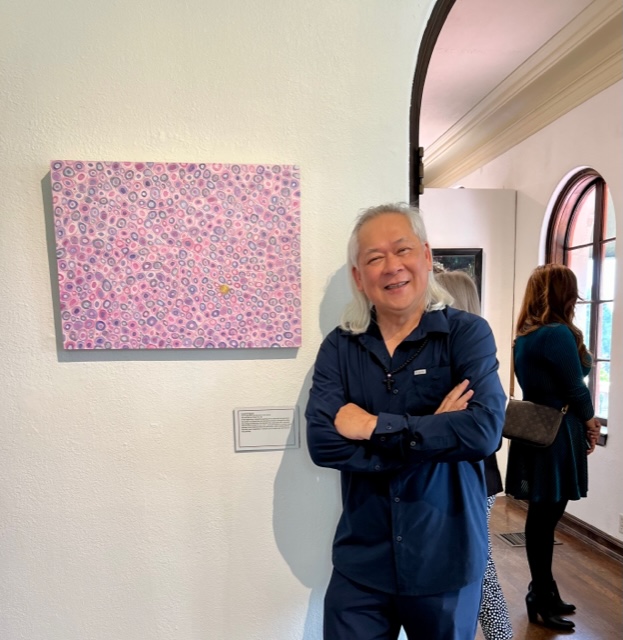
Hung Viet Nguyen at bG, above

At bG Gallery, a series of lush works with a lavendar edged palette from Susan Lizotte were joined by a wide variety of works including the charming dog sculptures from Alessandra Pierelli, witty ceramic cats and dogs from Linda Smith, and masterful California seascapes and skyscapes from Gay Summer Rick. Hung Viet Nguyen’s splendid, deeply textural Sacred Landscape series was also included in the exhibition space, along with abstract cyanotypes from Richard S. Chow, among many other outstanding works.

Over at Fabrik Projects, Nancy’s Wise’s oil on aluminum flowers bloomed vividly; the gallery is also showing works from actor and artist Val Kilmer. Fabrik is also behind the massive sculptural work, “Launch Intention” a mega metal paper airplane in design, from  artist Griffin Loop, seen above. Thematically, the work stands as a call to action; visually it is an inventive geometric stunner.

At Art in Bloom, astonishing works from Britney Penouilh and Angela Izzo include the Mystical Creatures Tarot Deck,  Penoullh’s exceptional clay sculpture cast in resin, “Gothic Altarpiece,” (above) and more.

EK Gallery, features the work of Chuni Park, (above) with perfect and precise images of nature.Ukrainian artist Denis Sarazhin offers beautifully crafted work at Arcadia Contemporary, whose gallerist, Steve Diamant, was able to secure the artist a safe place to work in the U.S. as the war wages between Ukraine and Russia.

The Maria Elena Kravitz gallery shone with bright and gorgeous images from Adeola Davies-Aiyeloja, Peter Zelle, and Mark Davis among the artworks that compel with textures and patterns. Touchon Gallery’s evocative underwater photographic works from Alex Sher were a rewarding deep dive.

Throughout the exhibition, viewers will find a variety of awesome surprises such as whimsical and delightful plexiglass image-shaped letters hanging from the ceiling in the wonderful “Raintype: Lorenzo Marini” (above) presented by Bruce Lurie Gallery, which also exhibits the work of painter Michael Gorman.

Around one corner, “Shai Kremer: The Edge of Knowledge, ” a photographic lightbox; around another, hyperrealistic scultpural works from Carole A. Feuerman startle and delight at Markowicz Fin Arts; in other spots, viewers will find sinuous metalic figures prance while brightly colored strongmen and super heroes flex their muscles.  Red aliens, sardine can sculptures with video installations, Chagall reinterpreted on fabric, a deconstructed typewriter: it’s all there, and it’s all well worth seeing.

Tickets to the event, running Thursday through Sunday are available for purchase here. Don’t miss. LA Art Show is the longest running art fair in the region for a reason – it’s good.

  • Genie Davis; photos – Genie Davis
 

Photographic Artist Safi Alia Shabaik Opens Highly Personal Exhibition in Partnership with the Parkinson’s Foundation

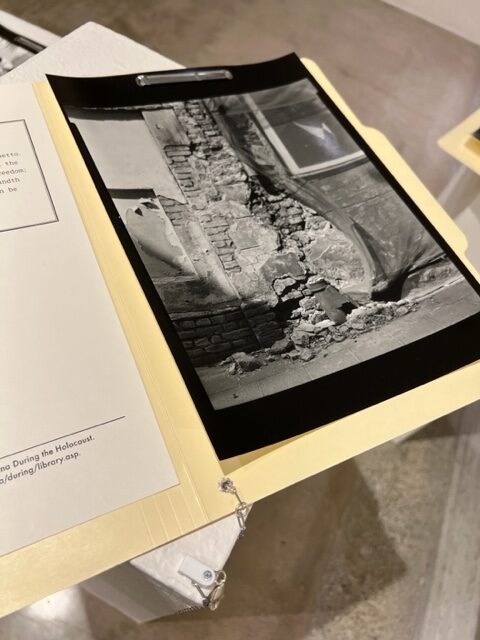
Safi Alia Shabaik’s photographic series, Personality Crash: Portraits of My Father Who Suffered from Advanced Stages of Parkinson’s Disease, Dementia, and Sundowner’s Syndrome opens February 18th at Open Mind Art Space in Los Angeles.

It’s a compelling and intimately collaborative body of work that explores the human condition in a series of intense, beautiful black and white images. Shabaik describes her work as being about identity and the humanity of all people, but this visual story is a deeply personal one.
What began as a series on her father’s immigration from Egypt and life as an educator became instead images based around his survival with Parkinson’s. They decided to embark on the project together, knowing it could help not just themselves as they struggled to cope with this situation, but could help others as well.

The Los Angeles-based Shabaik reveals the difficulty of her father’s struggle and the growing constraints of deterioration in his mind and body. The images are filled with compassion and love, as well as a collaborative exploration of his disease, and his loss of health both physically and mentally.

Throughout the collaboration, she reveals that she gained new understanding about the disease itself and mental illness; viewing the ongoing project her father hoped most of all that others could learn from his experience, a hope that Shabaik herself is honoring.

Presented in Partnership with the Parkinson’s Foundation and made possible with a National Endowment for the Arts Grant, along with the exhibition of these powerful photographs, an afternoon of special programming will take place February 25th, Personality Crash: The Intersection of Art and Science in Parkinson’s Disease. Along with a presentation by the artist, there will also be a moderated conversation covering topics such as Parkinson’s and Creativity, Family Caregiving, Patient Advocacy, End-of-Life Care, and Dying with Dignity.

Serving both as caregiver and confidante to her father created profound artistic work. The images in this exhibition focus on the last year of her father’s life, on a journey she began documenting in 2014. The title comes from her father himself, who remained intensely aware of what was happening to him, and even used the phrase “personality crashes” to his daughter, providing the title for their collaboration.

Shabaik says that she is honored to partner with the Parkinson’s Foundation on this exhibition, and knows that her father would be “proud to know that his struggle with the disease will now become something life-affirming.”

The artist discovered art and photography itself at a young age, and has worked as a photographic documentarian, a fashion stylist, has work in performer Grace Jones’ book I’ll Never Write my Memoirs, as well as in Artillery, CameraCraft, and on Upworthy.com. An interdisciplinary artist, her work continues to focus on identity and transformation as well as daily life, and the humanity of all. She’s worked in photography, mixed-media collage, assemblage, printmaking, sculpture, and experimental video, has exhibited nationally, and and has been featured in publications including The New York TimesBlack+White PhotographyLenscratchAlta JournalCatalyst: InterviewsCameraCraft and The Advocate, as well.

The exhibition opening takes place February 18 from 3-8 p.m.; the special programming presentation on the 25th will be live-streamed as a webinar starting at 1 p.m., with the gallery open to the public from 4-7:30 that evening for a meet and greet with the artist. The exhibition runs until March 4th.  Registration for the event on the 25th is required; to do so, visit Parkinson.org/ArtandScience or call (312) 786-4653.

  • Genie Davis; photography provided by the artist


Powerful Energy Coming Up from Caron Rand at Wonzimer

Caron Rand is serving up some radiant – yet black as the night sky – images in Dark Energy, a powerful exhibition showing at Wonzimer Gallery February 22-26th.

She describes the show as related to her “obsession with brain functions, clouds, space, and the perception of black/dark as dark energy, [making up] 68% of the universes. 27% is dark matter, and only 5% is light that we myopically see here on earth. There is an aspect of brokenness, anxiety, fear, worry that are a part of my personal path, the concept of deity and mysterious forces of good vs. evil, the unseen vs. the seen that we don’t often ponder or explore the complexity of their energy.”

These works are intrinsically deep, delicate, and mysterious. Each fluctuates in the mind’s eye as they are observed, strange and illuminative, like stardust in space. Patterned and perfect, Rand’s work is also haunting, ephemeral – and immersive.

While many of the images may appear similar at first glance, dive deeper – they’re each unique. exhibition features 10 pieces of unbleached white acrylic on black 48”x36” canvas. Rand paints using water-based acrylic. She began creating the work by enlarging her own photographic images of dark clouds, using those images as a catalyst to create each individual piece. Currently, she’s working on a motorized rotation of two of the works, so that the viewer can see how her art changes with vertical rotation from top to bottom at five-minute intervals.

Rand relates that she was drawn to her subject for a variety of reasons, including the fact that religion, art, and literature often describe evil as dark or black. Conversely, she notes that “Nighttime is taken for granted as a time to reenergize, rejuvenate, and heal in a resting, sleeping state. So, darkness is a positive energy we don’t think much about.”

The artist’s fascination with darkness began as a child, when she says, “I often couldn’t sleep thinking about eternity, where darkness dwells,  trying to wrap my mind around it.”

Along with the color of darkness itself, she views dark energy as a kind of magnet, a musical story, a portent of language and hidden visuals, she says. “There are references to language in the sense that some of the gestural strokes may look [like] Kanji, Herbrew or Arabic and the forces that they bring to the work that the dark energizes. There is a rhythm that I am tapping into for each piece as if a musical score.”

She creates her visuals suggestively, so that the mind can explore what it sees. Each numerically identified work features a dotted gold line running down the center, with images then painted in quarters left to right, before being flipped midsection, repeating. “They are not exactly the same on either side of the canvas, though they appear to be similar, and when flipped upside down new images appear. This also appeals to my humorous side, thinking about how modern art can be hung ‘wrong,’” she explains.

The gold lines she uses also refers to the Japanese art of Kintsugi, gold pigment and lacquer utilized to repair a broken pottery piece and make it even more beautiful and unique. This also reflects Rand’s idea of making “something beautiful out of betrayal, pain, illness, death, the unexpected crashing and splintering ourselves all over the floor to be picked up in some form and reconstructed by divine gold into something new… from powerless to powerful.”

Along with her interest in the concepts of reimagining, rebirth, and darkness as good vs. evil and the eternal, in creating these works Rand was also affected by her mother’s dementia and Alzheimer’s. Brain scans revealed dark areas infecting her mother’s brain from dementia, creating dark designs the artist viewed as “ornate in their purest form,  also proving the complexity of the brain as it changes.” She describes her own brain as also having a few black areas, due to oxygen depletion following a recovery from carbon monoxide and gas poisoning.

Dark Energy marks a definite departure from Rand’s prior work, and has an intensely personal aspect, which she describes as “the absorbing of the presence of other human energy forces close to me and how they have impacted me. As artists we are sponges, and so our environment deeply affects us. I have done abstract works in the past, but these are a combination of abstraction alluding to the figurative, and eerie suggestions of horned, fanged, clawed elements as well as the ornamental.” Together these elements help Rand achieve what she terms “a lyrical balance,” that includes “the ‘evil eye’ that is also a source of protection, but here it is both protector and aggressor.”

She hopes viewers will become involved in the perception and observation of her work as a meditative experience. “There is a loss in how technology has taken us away from nature and made us so dependent on it with our time and concentration. With my art, I am bringing the viewer back into a contemplative state outside of technology…The beauty of monochrome is timeless.”

Along with her upcoming show at Wonzimer, she will have a solo exhibition in June, at the Tokyo Metropolitan Art Museum in Japan.

  • Genie Davis; photos provided by the artist