
Photographic Artist Safi Alia Shabaik Opens Highly Personal Exhibition in Partnership with the Parkinson’s Foundation

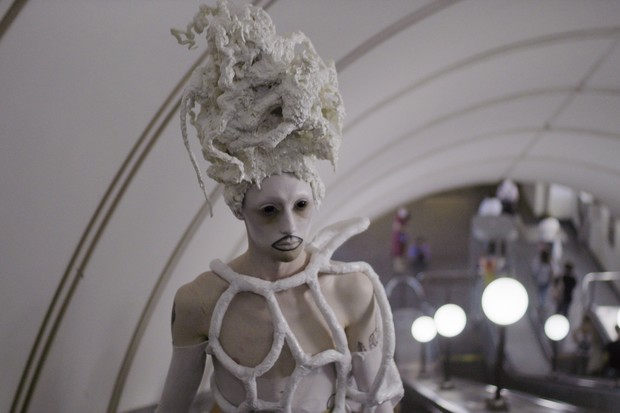
Safi Alia Shabaik’s photographic series, Personality Crash: Portraits of My Father Who Suffered from Advanced Stages of Parkinson’s Disease, Dementia, and Sundowner’s Syndrome opens February 18th at Open Mind Art Space in Los Angeles.

It’s a compelling and intimately collaborative body of work that explores the human condition in a series of intense, beautiful black and white images. Shabaik describes her work as being about identity and the humanity of all people, but this visual story is a deeply personal one.

What began as a series on her father’s immigration from Egypt and life as an educator became instead images based around his survival with Parkinson’s. They decided to embark on the project together, knowing it could help not just themselves as they struggled to cope with this situation, but could help others as well.
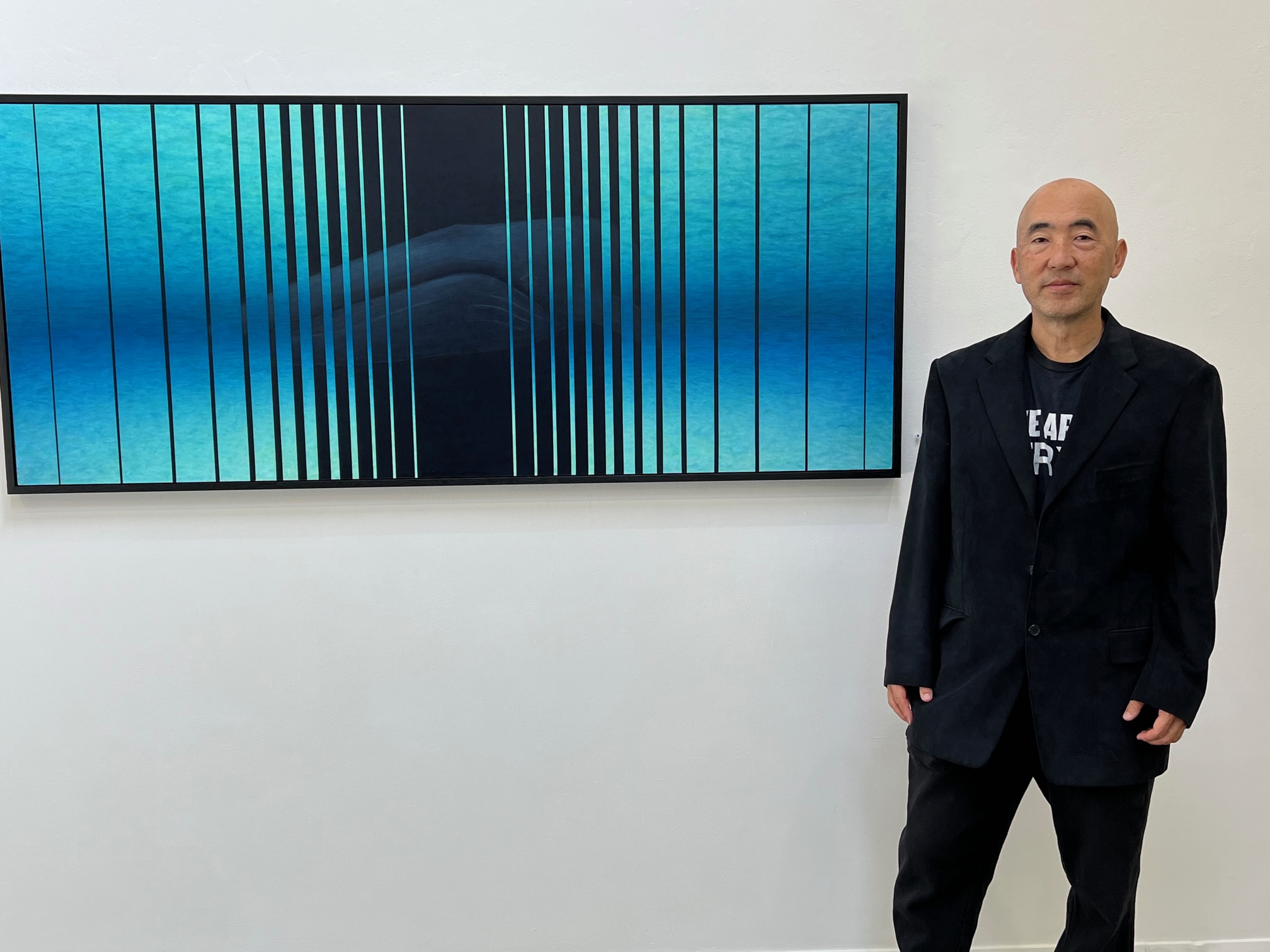
The Los Angeles-based Shabaik reveals the difficulty of her father’s struggle and the growing constraints of deterioration in his mind and body. The images are filled with compassion and love, as well as a collaborative exploration of his disease, and his loss of health both physically and mentally.

Throughout the collaboration, she reveals that she gained new understanding about the disease itself and mental illness; viewing the ongoing project her father hoped most of all that others could learn from his experience, a hope that Shabaik herself is honoring.
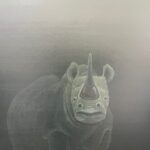
Presented in Partnership with the Parkinson’s Foundation and made possible with a National Endowment for the Arts Grant, along with the exhibition of these powerful photographs, an afternoon of special programming will take place February 25th, Personality Crash: The Intersection of Art and Science in Parkinson’s Disease. Along with a presentation by the artist, there will also be a moderated conversation covering topics such as Parkinson’s and Creativity, Family Caregiving, Patient Advocacy, End-of-Life Care, and Dying with Dignity.

Serving both as caregiver and confidante to her father created profound artistic work. The images in this exhibition focus on the last year of her father’s life, on a journey she began documenting in 2014. The title comes from her father himself, who remained intensely aware of what was happening to him, and even used the phrase “personality crashes” to his daughter, providing the title for their collaboration.

Shabaik says that she is honored to partner with the Parkinson’s Foundation on this exhibition, and knows that her father would be “proud to know that his struggle with the disease will now become something life-affirming.”

The artist discovered art and photography itself at a young age, and has worked as a photographic documentarian, a fashion stylist, has work in performer Grace Jones’ book I’ll Never Write my Memoirs, as well as in Artillery, CameraCraft, and on Upworthy.com. An interdisciplinary artist, her work continues to focus on identity and transformation as well as daily life, and the humanity of all. She’s worked in photography, mixed-media collage, assemblage, printmaking, sculpture, and experimental video, has exhibited nationally, and and has been featured in publications including The New York TimesBlack+White PhotographyLenscratchAlta JournalCatalyst: InterviewsCameraCraft and The Advocate, as well.

The exhibition opening takes place February 18 from 3-8 p.m.; the special programming presentation on the 25th will be live-streamed as a webinar starting at 1 p.m., with the gallery open to the public from 4-7:30 that evening for a meet and greet with the artist. The exhibition runs until March 4th.  Registration for the event on the 25th is required; to do so, visit Parkinson.org/ArtandScience or call (312) 786-4653.

  • Genie Davis; photography provided by the artist


Powerful Energy Coming Up from Caron Rand at Wonzimer

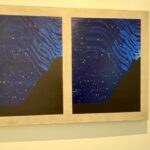
Caron Rand is serving up some radiant – yet black as the night sky – images in Dark Energy, a powerful exhibition showing at Wonzimer Gallery February 22-26th.

She describes the show as related to her “obsession with brain functions, clouds, space, and the perception of black/dark as dark energy, [making up] 68% of the universes. 27% is dark matter, and only 5% is light that we myopically see here on earth. There is an aspect of brokenness, anxiety, fear, worry that are a part of my personal path, the concept of deity and mysterious forces of good vs. evil, the unseen vs. the seen that we don’t often ponder or explore the complexity of their energy.”

These works are intrinsically deep, delicate, and mysterious. Each fluctuates in the mind’s eye as they are observed, strange and illuminative, like stardust in space. Patterned and perfect, Rand’s work is also haunting, ephemeral – and immersive.

While many of the images may appear similar at first glance, dive deeper – they’re each unique. exhibition features 10 pieces of unbleached white acrylic on black 48”x36” canvas. Rand paints using water-based acrylic. She began creating the work by enlarging her own photographic images of dark clouds, using those images as a catalyst to create each individual piece. Currently, she’s working on a motorized rotation of two of the works, so that the viewer can see how her art changes with vertical rotation from top to bottom at five-minute intervals.

Rand relates that she was drawn to her subject for a variety of reasons, including the fact that religion, art, and literature often describe evil as dark or black. Conversely, she notes that “Nighttime is taken for granted as a time to reenergize, rejuvenate, and heal in a resting, sleeping state. So, darkness is a positive energy we don’t think much about.”

The artist’s fascination with darkness began as a child, when she says, “I often couldn’t sleep thinking about eternity, where darkness dwells,  trying to wrap my mind around it.”

Along with the color of darkness itself, she views dark energy as a kind of magnet, a musical story, a portent of language and hidden visuals, she says. “There are references to language in the sense that some of the gestural strokes may look [like] Kanji, Herbrew or Arabic and the forces that they bring to the work that the dark energizes. There is a rhythm that I am tapping into for each piece as if a musical score.”

She creates her visuals suggestively, so that the mind can explore what it sees. Each numerically identified work features a dotted gold line running down the center, with images then painted in quarters left to right, before being flipped midsection, repeating. “They are not exactly the same on either side of the canvas, though they appear to be similar, and when flipped upside down new images appear. This also appeals to my humorous side, thinking about how modern art can be hung ‘wrong,’” she explains.

The gold lines she uses also refers to the Japanese art of Kintsugi, gold pigment and lacquer utilized to repair a broken pottery piece and make it even more beautiful and unique. This also reflects Rand’s idea of making “something beautiful out of betrayal, pain, illness, death, the unexpected crashing and splintering ourselves all over the floor to be picked up in some form and reconstructed by divine gold into something new… from powerless to powerful.”

Along with her interest in the concepts of reimagining, rebirth, and darkness as good vs. evil and the eternal, in creating these works Rand was also affected by her mother’s dementia and Alzheimer’s. Brain scans revealed dark areas infecting her mother’s brain from dementia, creating dark designs the artist viewed as “ornate in their purest form,  also proving the complexity of the brain as it changes.” She describes her own brain as also having a few black areas, due to oxygen depletion following a recovery from carbon monoxide and gas poisoning.

Dark Energy marks a definite departure from Rand’s prior work, and has an intensely personal aspect, which she describes as “the absorbing of the presence of other human energy forces close to me and how they have impacted me. As artists we are sponges, and so our environment deeply affects us. I have done abstract works in the past, but these are a combination of abstraction alluding to the figurative, and eerie suggestions of horned, fanged, clawed elements as well as the ornamental.” Together these elements help Rand achieve what she terms “a lyrical balance,” that includes “the ‘evil eye’ that is also a source of protection, but here it is both protector and aggressor.”

She hopes viewers will become involved in the perception and observation of her work as a meditative experience. “There is a loss in how technology has taken us away from nature and made us so dependent on it with our time and concentration. With my art, I am bringing the viewer back into a contemplative state outside of technology…The beauty of monochrome is timeless.”

Along with her upcoming show at Wonzimer, she will have a solo exhibition in June, at the Tokyo Metropolitan Art Museum in Japan.

  • Genie Davis; photos provided by the artist


Artist Aazam Irilian Offers a Stunning Look at Memory and Loss

At the Main Theater in Santa Clarita last month, artist Aazam Irilian presented a sensitive, impactful, and beautiful exploration of memory – and how fragile and meaningful our memories are in human life. Preserved Memories, her exhibition on the impact and progression of dementia,  packed a powerful and poignant punch.

Consisting of five different major sections, Irilian’s work depicted personal and moving stories through a varied and immersive mix of mediums including sculptural assemblages and recorded stories. The exhibition also allowed space for visitors to write their own stories.

In the exhibition’s “Traditional Bodies,” a series of delicately rendered graphite drawings of brain cells, neurons and more are intricately revealed in stylized bodies on panels of white fabric.

A series of “Shredded Mind Panels,” created on canvas panels in richly colored red darkening to shades of brick, are used to depict the loss of memory. Holes in the panels represent the losses caused by dementia,  as the canvases gradually turn into trailing, shredded surfaces.

Perhaps the most compelling element of the exhibition is the titular “Preserved Memories,” a series of sculptural assemblages created out of personal memorabilia and preserved in salt. Stories that relate to the sculptures are a part of the recorded messages and memories section of the show. The sculptures themselves are haunting and nuanced, puzzle pieces of a life, the meaning of each piece transitory.

The haunting sculptural assemblages are, Irilian says, the focal points of the exhibition, which is not surprising to hear given the intensity and complexity of these works. Each represents an individual’s stories. According to the artist, “The soccer player piece is made of my husband’s soccer gears as referee. He was an engineer and played soccer most of his life. He also had coached and was a referee for the last 20 plus years.”

Using a variety of salts and mineral solutions as a part of her creative process, Irilian created a layered depth to her sculptures which arose from painted work. “The textures you see on my paintings are results of interaction of mineral solutions with paint. With each series, I aim to push the use of mineral solutions to a different level. With this installation, I pushed myself to see how I can grow and use these crystals off the canvas, onto the objects.” She notes that “Salt has been used as a preserving agent over the ages. The point here was to use the salt as the metaphor—preserving memories that are fading away.”

And in the series “Fading Family Portraits,” photographs printed on Duralar clear paper depict families of different cultural backgrounds who have suffered from dementia, revealing that the disease is not discriminatory and can strike any family, regardless of heritage. In a succession of photos, each face appears less and less clear, with ghostlike faces gradually fading away altogether, emblematic of how recognizability fades for a person with Alzheimer’s.

Each of these exhibition sections are evocative and sensorial, creating in the viewer a sensation of loss and legacy, of both the joy and pain of remembering.

Irilian does not approach her subject uninformed. She was both wife and caregiver to a husband who suffered from dementia. Dealing with both her own and his sense of loss keenly, her work movingly stresses that despite fading memory and a loss of identity itself, the afflicted person will not fade from our own memories and hearts.

The exhibition is important not just to Irilian personally but to so many, with the strong possibility that by the year 2050, those 65 and older suffering from Alzheimer’s are estimated to reach the daunting number of 12.7 million affected individuals.

This is not Irilian’s first installation work. The artist created the exhibition “Dare to be a Woman” at CSUN in 2004, and “Stoning” in 2005. Both employed a variety of mediums in their representation of violence against women in Iran. In “Stoning,” part of a 5-woman exhibition, she used a plaster cast of her daughter’s body. In short, the artist is no stranger to using the personal to represent a more universal situation.

Preserved Memories very much expands on these and other past work of the artist, who terms herself “a curious person…[who] wants to learn as much as possible, and that includes learning about how things are made and work. I feel installation is just another way, another tool in my bag of tricks that I can use to bring an idea into form.” Irilian never prefers one medium over another, she says. “It is about what medium can help me to bring in to form the idea or the concept.”

She strives to tell a story through her art, as well as to “create an experience or evoke an emotion. I want the viewer to bring her/his experience into each piece and find or form his own story viewing the work.” With Preserved Memories, she relates that most of all, she wanted to bring attention to the devastating disease, and impress a human face upon it, while “communicating the fact that the person we love is still there.”

Irilian plans to grow Preserved Memories as an exhibition, expanding the sculptural assemblages representing shared stories, and presenting the show in as many different venues as possible with her goal to improve understanding of Alzheimer’s and elevate compassion for both those suffering from the disease, as well as for those caring for their loved ones.

To do so, she’s seeking more stories on which to base her assemblages. “The stories told by loved ones are the most meaningful part of this project. I collected these stories through a Google number I set up (661) 347-6849. People can call and leave their stories without having to talk to anyone.” She encourages others now to call and share, and explains “The purpose of the stories is to honor and remember a memory that brings joy to the heart and a smile to the face. Like the woman who at the end of her life, opened her eyes and told her daughter, ‘I love you.”’Or my husband, who [when] seeing soccer games on TV, would light up… it was something he could still remember.”

The more people share their stories, she says, the more such projects are seen, and the more attention that will be brought to the disease.  “And maybe at some point, we find a cure for it,” she says. “To put a human face on this disease, honor memory of our loved ones…I can only do that by people being courageous and willing to share their stories.”

Following this tenet, Irilian has created a brave exhibition that reveals the face of the disease and its impact on those afflicted as well as on the people who love them. Viewers will feel the pain, but also life – and memory’s – impactful, aching, beauty.

  • Genie Davis; photos provided by the artist and by LA Art Documents

Leaving Eden: Samuelle Richardson and Snezana Saraswati Petrovic

Climate change has made the idea of leaving Eden, our planet earth, all too real a prospect.  What happens to the flora and fauna, the animal life – including the human animal – if we allow the continued environmental apocalypse to continue? Art has often stood in the forefront of calling attention to and presenting an action call for salient issues. It has awakened viewers to the necessity for change, to the beauty of the world around us, and provided a sense of hope for the future. So, too, does Leaving Eden, coming February 11th to Keystone Gallery in Lincoln Heights.

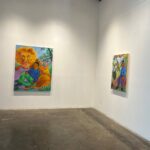
The collaborative exhibition between Samuelle Richardson and Snezana Saraswati Petrovic will fill viewers with the joy of Richardson’s expressive textile animals and Petrovic’s immersive flowers, trees, and glistening waters. Gallery visitors will move – as the flourishing creatures and landscape in this art world do – from their lush, green, and blue Eden to a dry, desert world, where all life must struggle for food and water — with hope that they can return to Eden again.

Divided into two rooms: an Edenic garden and a desert filled with Joshua Trees and cacti, the two artists have combined their gifts to create a vision to cherish and consider, one that expresses the beauty of nature and our vital need to protect it.

Richardson describes the journey viewers will take as a circular one, revealing what it is like to live in and leave our Eden and then try to create a more “pristine world…a circular journey back to square one [where] flora and fauna prevail.”

Petrovic says “As an immigrant, I am in search for an idyllic version of the home that I have lost due to war. My realization was that the real home for all of us is the Earth, and for me, it represents Eden, the most diverse and idyllic garden of all.” To prepare for the exhibition, she began to draw studies of plants in Huntington Gardens, Joshua Tree, the Salton Sea, and Oahu, Hawaii. She adds that mythologically the “idea of Eden is connected to the human need for a place of immortality,  an ideal place for human habitation with lush beauty, and it exists not just in Christianity but… is [expressed as] Jannāt ʿAdni in the Quran or [as] Pure Lands in Buddhism…in all of these gardens, there are always references to infinity and transformation.”

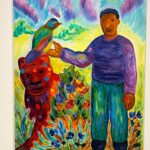
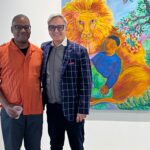
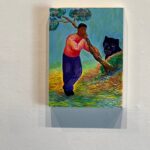
Both artists express that sense of transformation in their work. For Richardson, “New work begins with a mental picture of the subject, then I research pictures that express the type of character I want.  I build up each figure in stages to achieve gesture and expression, working with the pictures as a bridge to discovery.”  Here you will see lions, birds, wild dogs, and even a few humans created by the artist.

Petrovic was in part inspired to create her mixed media sculptures of zip ties and dry natural plants from references to the Byzantine traditional blue depictions of Eden, with video installation elements culled from her Oahu and Big Island residencies, while the desert installation was inspired by the Salton Sea and it’s “white shore with fish skeletons turned into mineral dust,” and uses a white, orange, and blue palette – skeletons, sun and sky – in her work in the Desert room.

Visitors to the exhibition will also be able to interact with some of Petrovic’s work through AR and the use of iPads in the exhibition or through their own smart phones. The AR depictions reveal dry dirt transforming with a live, growing seedling, what she calls a “symbolic shift of the wheel of fortune from global catastrophe to renewal and healing.”

Richardson and Petrovic greatly enjoyed working together on this project. “It’s uncanny how much Snezana and I have in common regarding our worldview and how we have advanced as artists.  Our collaboration also included outings to Huntington Gardens to observe and compare our impressions on nature,” Richardson says.

Petrovic relates that “We would immerse ourselves in different parts of the gardens, and have conversations related to the nature of different environments, desert versus rain forest. We were looking at the shapes and relationships between flora and negative spaces…we shared some images of our previous works and investigated the works of Henri Rousseau and Hieronymus Bosch.”

She adds that “Sam’s dogs, tigers and birds are bringing my environments and sculptural installations to life. I cannot wait to see all of them being brought together into this unique project!”

Richardson brought to the exhibition new ideas inspired from a recent residency in Rome, and a fascination with the Etruscan culture, which Petrovic also finds compelling.  “We both agree that our creations are coming from the ‘same world’ of connectedness to feminine history as well as our own past design experiences. Sam’s fashion industry experiences brought a deep understanding of patterning, fabric and thread use into her sculptures. My interest in the relationship between space versus object is from professional experience as a production/set and costume designer,” Petrovic relates.

Richardson has added to her wire, foam, and fabric sculptures – with the “fabric covering my work emulating glaze on ceramic” with a new artistic expression – in woodwork. “I am building shapes that resemble boats, joining and cutting pine lumber [for the exhibition.]”

Petrovic has included her latest experiments in organic bioplastic, also using dry plants and palm leaves in the exhibition. She says taht she has long been driven toward reimagining the future, beginning with a residency at the Pomona Art Colony under Judy Chicago examining the “current and future scientific predicament of global ecological catastrophe…if we do not protect our home, there will be nowhere to go. Leaving Eden was a natural progression of my exploration of gardens and homes within the looming danger of climate change and plastic overuse.  It added another layer to my imagined world of the future. I see this whole experience as a love poem to the Earth, our own impermanence and existence that might have a chance for a replay.”

Richardson, Petrovic, and I, as conceptualizing curator, all encourage you to visit our Eden and its aftermath and look toward that replay, one which our world all too dearly needs.

Leaving Eden holds its opening Saturday, February 11th from 6 to 9 p.m.; an artist’s talk and closing event will be held Saturday, February 25th at 4 p.m. Additional gallery hours Thursday-Sunday by appointment.

Keystone Gallery is located at 338 S Avenue 16, Los Angeles, CA 90031

  • Genie Davis; photos by Genie Davis and Samuelle Richardson