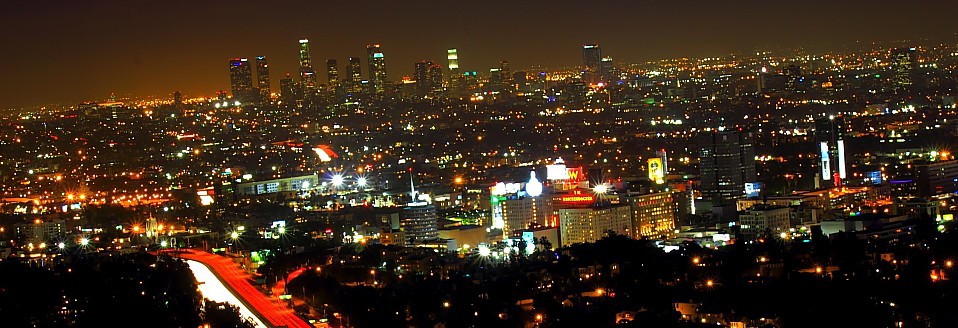

Prime Territory at MOAH Cedar

Through January 22nd at MOAH Cedar in Lancaster, Dani Dodge holds forth with an installation that soars as widely and wildly as a desert sky. Prime, like many of the artist’s exhibitions, is immersive. So much so here, in fact, that viewers might almost catch a whiff of desert sage andthe fragrance of a Joshua Tree in bloom.

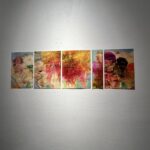
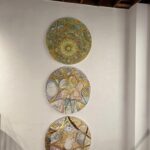
The exhibition, which fills all three galleries at Cedar, is comprised of three parts.  The main room is layered with translucent panels, on which Dodge has created gold leaf and delicately painted acrylic work depicting an ephermeral, mirage-like shimmer of desert images. The experience is a walk-through installation, with viewers able to walk behind and within the panels. Adding to the experiential nature is a soundtrack of cello music the artist created herself and recorded sounds of desert animals at dawn.

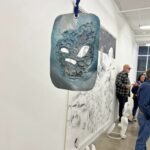
Along with the gauzy painted panels, a sculptural form created from a twisted mattress spring hangs in the center of the gallery, with the panels waverying around it. It stands as a kind of monument to how human inhabitants intrude on the quiet grace of the desert, and how the desert itself may banish that habitation in its own good time. 

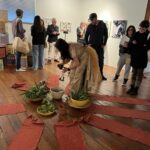
The artist has provided pencils and slips of paper on which to write what types of places bring them peace – as the desert brings piece to Dodge. Safety pins are also provided so that viewers can pin what they’ve written, adding them to their thoughts to the exhibition itself.


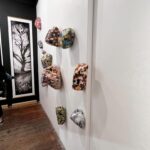
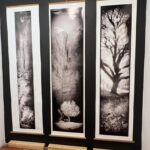
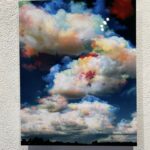
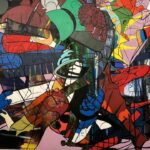
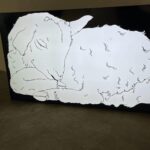
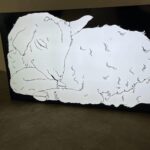
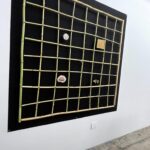
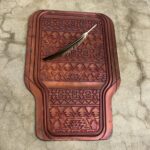
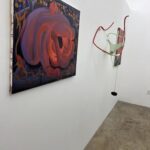
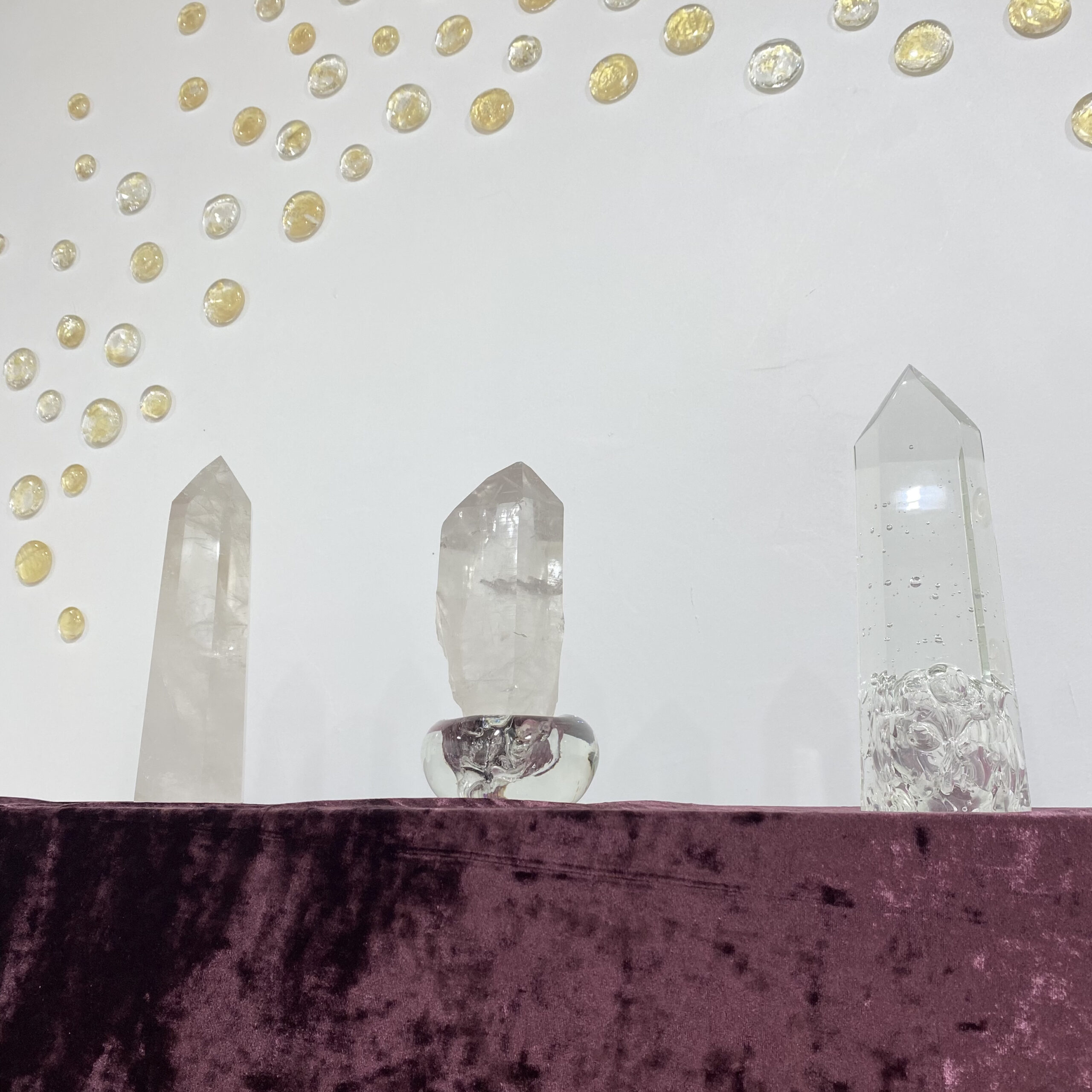
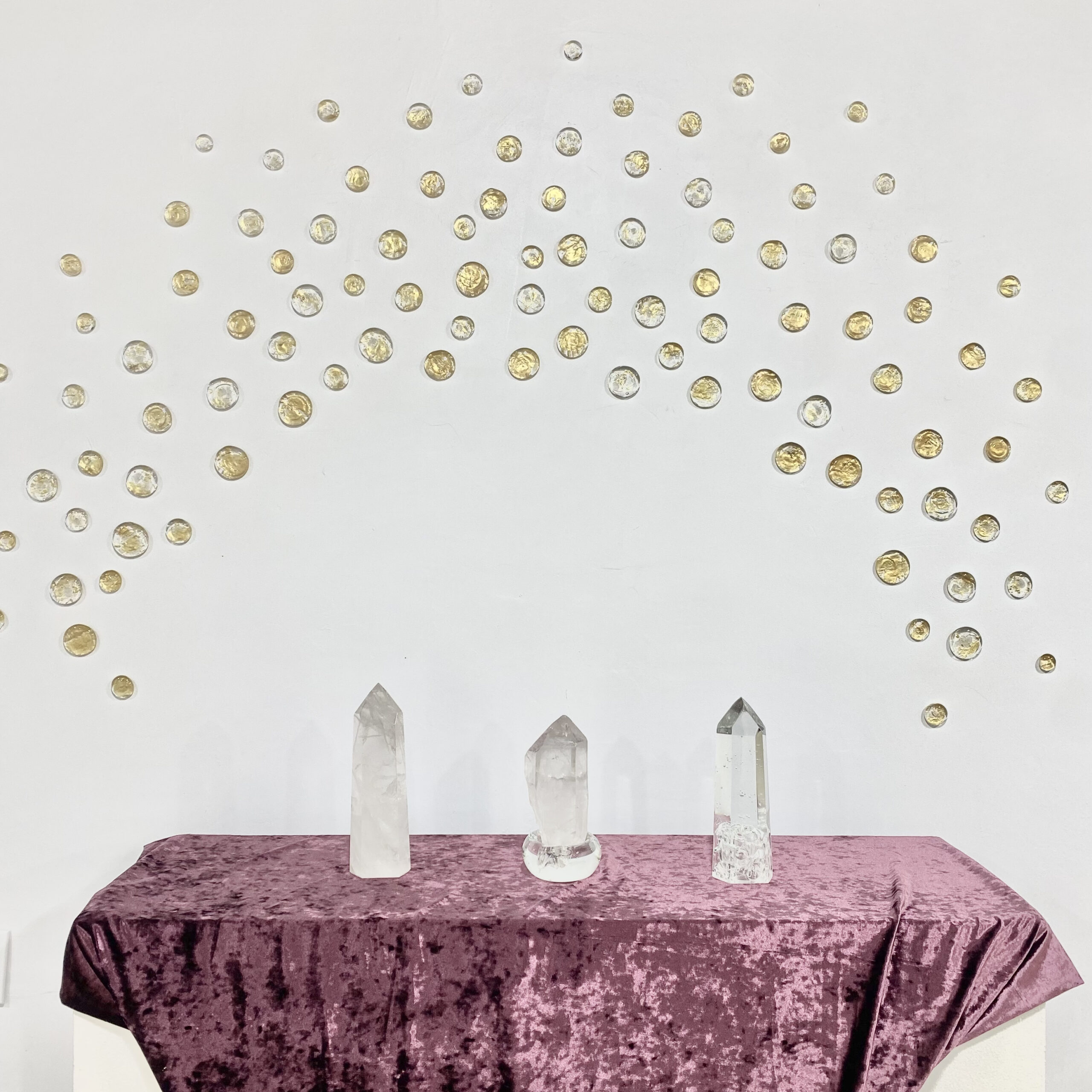
Across the hall,  Dodge displays images from three separate bodies of work, as seen above. These include a quite wonderful video installation of desert animals captured during her 2019 artist-in-residence stay at the Prime Desert Woodland Preserve in Lancaster. Here we see animals from jackrabbits to coyotes and desert mice as they come and go during the night.  Also on display is a wonderful, glowing collection of painted gold leaf and photography that was part of an earlier exhibition held at Black Rock Gallery in Joshua Tree.

The artist’s love for the shape, form, and fragility of the Joshua Tree is resurrecting. Dodge is intent on helping to preserve the land, creating a sense of hope that with her passion directed at preserving them, these wonderful living flora can survive man’s worst intentions. There is also a second recovered metal mattress spring displayed in this gallery, its form twisted by nature and time after being discarded in the desert.  

If you love the desert, love immersive finely wrought art, or simply want to experience desert wonder without trudging through the sand, Dodge’s exhibition is a must-see. The fine spiritual sense of her work here is both uplifting and poignant, speaking to the ruthlessness of human contact on the desert, the fragility of the desert itself, and the ways in which we can help to preserve it, if we love those aqua skies and golden sands, those brown hills and small brown creatures that inhabit them, those glorious, uplifted arms of the Joshua, and the land’s spectacular, raw sunrises and sunsets.

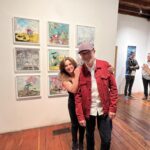
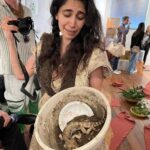
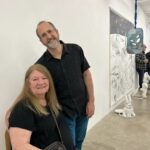
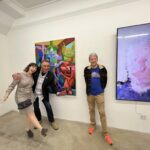
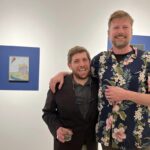
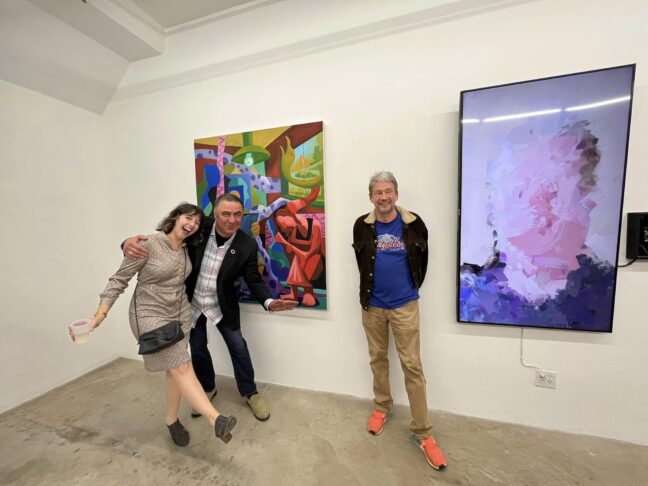
Above, Dodge with MOAH’s Robert Benitez (left), and Jason Jenn (right).

Like the artist does herself, we can come visit the desert every  January and pay tribute to it, and this year, we can also head to the Cedar galleries to see how Dodge has done so. The exhibition runs through January 22nd.

It also includes a series of lovely desert images created by children participating in activation classes the artist provided at the Preserve throughout her residency.

MOAH: CEDAR Center for the Arts

44857 Cedar Avenue, Lancaster, CA 93534

Open Tuesday and  Wednesday  |   11 AM  – 6 PM

Open Thursday – Sunday   |    11 AM  –  8  PM

  • Genie Davis; photos, Genie Davis

Casper Brindle Radiates Light and Color at Luckman Fine Arts Complex

If you were to pass from our universe to the next in a sudden flash of light and time, perhaps undergoing this passage through a wormhole, a dream state, or as they used to say on the bridge of the starship Enterprise, at “warp speed,”  you might emerge transcendent, with a strange glow suffusing your vision. Such is the experience of viewing Casper Brindle’s mysteriously sensory art.

In a bravura exhibition at the Luckman Fine Arts Complex at CSULA, curated by Mika Cho, Brindle’s own passage through time, light, and space was on full and radiant display. Ranging from some works earlier in the artist’s career to a full focus on images created in 2021 and largely in 2022, Hypermodality provided a beautifully complete experience of Brindle’s work.

Dimensional images that pulse with color and light and play with perception are the core of Brindle’s work. His aesthetic moves the eye and the mind, vibrating with barely contained motion, hovering like a UFO just outside our peripheral vision. Both galvanizing and meditative, varying in color from vibrant shades to cloud like monochromatic shadows of varying hues, these works create emotional and cognitive leaps for viewers, bounding between shades and shadows, running into the sharp edges of horizon lines or disappearing like the taillights of an interstellar ship traveling an incomprehensible speed into a thick, floating tube.

Beautifully curated across two connected, open, large gallery spaces, wandering through the Hypermodality exhibition, which closed at the Luckman in November, was like floating on a life raft of light. Seeing these images in this serene space, it was possible to take in both the meticulously applied airbrushed layers of paint, the hypnotic quality of Brindle’s use of gradated color and shadow, and the enigmatic glow of the art.

The artist’s most recent work is so luminous that it appears to use external lighting, while in reality using color and texture to create an aura of soft, regenerative light.

Some works seem to bathe the viewer in bioluminescence, pulling the eye into a softly opaque sea or into the center of a soft cloud. Just as a bioluminescent sea shines when disturbed by a breaking wave, these works shimmer as the viewer moves closer or farther from them, whether they are viewed from the side or the center.

Other paintings recall the opalescent glow of a pearl, or the shifting colors and light flares of a fire opal. Indeed, each of these works could be pulled from the sea or the sky, or within a long-buried geode, cracked by time to reveal the shining gems within.

Uniformly, Brindle’s work is a perfect haiku of light, as well as an epic study of how color contains or expresses that light. Each piece tells a story of transformation, of how our vision of the world changes that world; how our eye creates the place in which our hearts and minds dwell, not just geographically but emotionally.

All this in works that are formal and made with careful attention to line, geometric principles, and a cool intensity of mannered shapes and patterns.

With titles that describe light glyphs and portals, it is no wonder that Brindle’s art evokes time travel, the speed of light, powerful entities and spiritual understandings, worlds that exist within or beyond our own comprehension.

An almost-holy simplicity infuses each work, whether created from pigmented formed acrylic or with layered automotive paint and gold leaf on linen. The impressiveness of Brindle’s technique rests in its quiet power, much as does the beauty of a sunset or the flare of a meteor. His art burns with the fire of color, and yet has an icy perfection that evokes a glass prism, capturing color and encapsulating it, allowing it to shift but not fade to black.

Some of the colors are startling: “Light Glyph VF 11” is the fierce cerulean blue of the hydrothermal Sapphire Pool in Yellowstone Natural Park. “Light Glyph VF 13” is the luscious tangerine of a citrus fruit on acid. Just as startling is the softly opalescent gold – with a layered burnt sienna orange bar at the center, or “Light Glyph VF 8.” The artist’s “Light Glyph VF 23” is no less riveting, an orange sun or a work with a softer, blurred orange bar at its center.

While each of these works are created using thick pigmented acrylic, Brindle’s works on linen are no less startling and rich, just differently textured. “Portal Glyph Painting X,” a massive 120 x 120 work using gold leaf and automotive paint on linen is an aqua sea and gilded sunrise with a glowing gold door cracked open just enough to see and allow passage if we dare.

A pair of sensual curves in hot pink wait succulently behind a wider passage in “Portal Glyph Painting III.” In this work, a radiant, slender rectangle of blue and gold light features a dark gold bar at its center, a portal within a portal, perhaps.

Regardless of format, Brindle’s work is above all else alive. It is alive with light, alive with line, holding within its serene and pristine depths a seething, swimming, sensorial swarm of color. If the images deliberately create a sense of the possibility of passage, or entering an “other” realm or experience, then that passage is as the viewer wishes to shape it, leading where the viewer wishes to enter. The artist offers the portal to enter, or the light to step through, but it is up to the viewer to take that step.

One of the finest exhibitions of 2022, Hypermodality commands viewers to take action, to truly see what lies beneath the surface of art, and perhaps, life itself.

– Genie Davis; photos by Rob Brander provided by Luckman Gallery/Mika Cho; additional photos, Genie Davis

Come to Lake LA with Daniela Garcia Hamilton

Offering a rich and evocative, deeply personal look at life in Antelope Valley’s Lake Los Angeles, Daniela Garcia Hamilton takes viewers with her on a visit to Sundays in Lake LA.

The exhibition is a warm, visually lovely body of work which focuses on Garcia Hamilton’s childhood, as well as on the idea of what makes the idea of “home “- a home. The images seem bathed in a sunny, Southern California light, one washed with a soft patina from the dusty high desert landscape of the town.

Paintings depict the artist’s extended family at gatherings, and the nature of her family home as a safe space for children and other family members when first arrived from Mexico.

Infused in color, a brightness that is resonant and uncompromising, this is narrative painting at its finest, infused with the refined story telling of memory. Because of that infusion, these works are galvanizing. While the art itself is graceful, even languid and dream-like, the depictions of everyday life and the profound meaning those small, perfect slices of existence make are quite visceral. Poignant, hopeful, and masterfully painted, in a lush style that is nonetheless vividly realistic,  Garcia Hamilton takes us on a journey in which we are all travellers through the intimate migration that is life itself.

In “Hasta aqui llegamos, gracias a tí pa (Thank you dad, we made it this far), we see the artist’s father looking slightly upward, as if toward dreams for the future – the future of the child in his arms and the child seated next to him.

“In Between” takes viewer and artist on a more fraught journey toward the future, with a young child kneeling on a serape, a toy truck by her side, a dog in front of her. She is clearly a traveller, undoubtably crossing the border from Mexico to the U.S., but also crossing a different sort of border, from childhood to adulthood. The toy truck she plays with has become a real truck containing her on her journey north.

“Ofrendas de fronteras” or “Border offerings” seems an even harder journey, as wrapped in a serape, a boy lies sprawled over what could be a field of flowers and plants; a woman curled at his side, discarded toys beneath and behind him, as if this passage –  with the image of a wall at the left bottom of the canvas – was particularly difficult, a passage in which the innocence of childhood was left behind in a quest for survival beyond that wall.

Repeated subjects appear in various works, such as dogs, children, colorful serapes and cloths; while each are unique, they shape a connected story of childish innocence and joy, growth, and a vision of a brighter future despite the difficult journeys in which the subjects arrived in Lake LA. Now that they are here, they were seemingly born to move into the dry high desert light and infuse it with their own bright hopes.

Also repeated throughout the exhibition are elaborate, colorful patterns as backdrop for these works.  The patterns are used as wall paper, shadows, floor tiles, carpet patterns, all an intricate and delicate lace that recalls papel picado or perforated paper, the traditional decorative craft banenrs created by cutting precise designs into thin paper sheets. The decoration is often used for parties and celebrations such as birthdays, Christmas, and Dia de los Muertos.

In this art, the celebration is based on homecoming, and the formation of a home, a family, a life in a new land. Forged in the fire of difficulties, Garcia Hamilton’s family shapes a solid, lasting bond between past and future, Mexico and America, the old and the new. That bond is as eternal as an unshakable faith in a better future, a child’s promise, familial love.

Visit Garcia Hamilton’s rewarding family of art at Luna Anais at the IVAN Gallery, located at 2709 S Robertson Blvd. In the back, the studio work of resident artist Barbara Mendes should also captivate.

Garcia Hamilton will be conducting an Artist Walkthrough at noon on Saturday, 11/12; the exhibition closes on November 18th. Don’t miss.

  • Genie Davis; photos by Genie Davis and provided by the Luna Anais.
A Cosmic and Richly Colorful “Cosme”

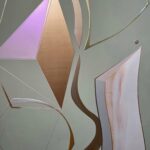
Bettina Weiß’s Cosme, exhibited at Edward Cella Art + Architecture at the Himalaya Club in Inglewood, dazzled with color and shape. Using geometric abstract forms, she shapes her own unique view of nature, one as bold as it is vivid. Using both oils and acrylics on panel, bringing in metallic elements to add an extra sense of dimension to both her neon and opaque shades, her work explodes passionately on the wall.
Like florals spun out on an abacus, she combines an almost mathetmatical precision with a joyous universe packed with energy and dynamic color.

Soleil, above

Whether creating circular, visually spin-worthy works such as “Etern #1: or a triumphant, crowded series of triangular lines that compel the eye to not-look-away, as with “Rio #2,” or her pinwheel-perfect blue “Lunium” paired with a vibratingly golden hued “Soleil,” she rivets viewers with her masterful use of line and color.

Lunium, above.

This series of paintings is as lush as it is deep; the viewer feels its energy and passion,  as well as the perfection of form that barely contains both, immediately upon entering the gallery space. While Cosme has closed, it is viewable online, here –and expect to see more from this potent artist in exhibitions to come.

You can also view several of her images in a group show at Cella’s other exhibition space, Pattern | Nature now at the Edward Cella Gallery @ The Thomas Lavin Showroom in West Hollywood’s Design Center.  Weiß’s work stood as a powerful first exhibition in a series of three solo shows  at Himalya Space through Edward Cella, with the overall trio of shows titled Berliner Fokus intended as an annual series of exhibitions. Up next at the Himalya Club is Moritz Neuhoff in his first U.S. solo show.

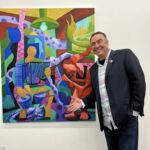
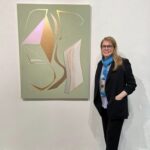
Above, the artist with Edward Cella

  • Genie Davis; images, Genie Davis