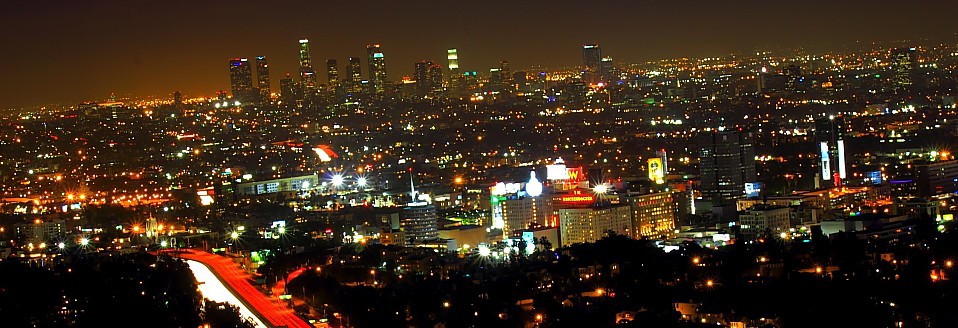
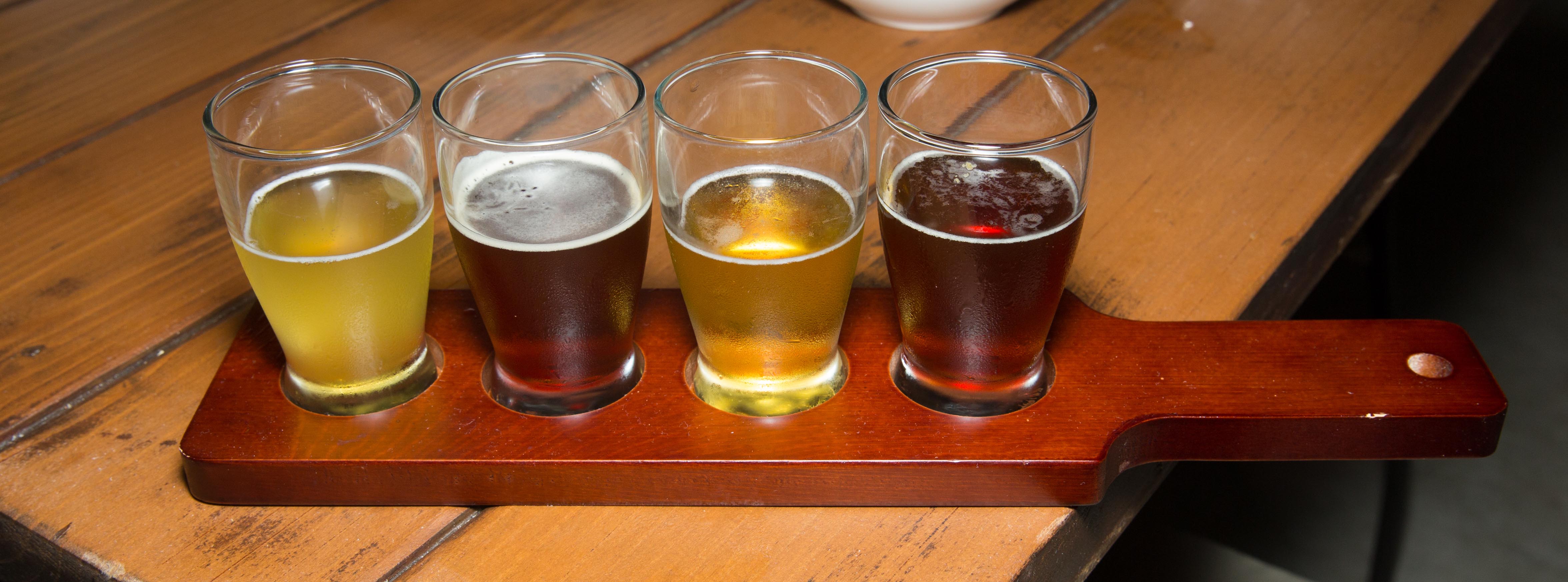
Craft brewing is getting to be a real thing in Los Angeles. Breweries are scattered throughout the city from Pasadena to DTLA to Torrance. With a high concentration of stellar micro-brews in the South Bay, start there for a day’s leisurely sipping and snacking.
Absolution Brewery
Torrance
Seats are made of church pews and beers feature monikers like Cardinal Sin Crimson and Purgatory Hefeweizen. Add a bowl of pretzels from behind the bar, or check out the food trucks in the parking lot.
Phantom Carriage
Carson
Taking its name from a 1921-era horror film, with beers named for classic horror performers, sour beers are the order of the day. Try the Lugosi or Rathbone, served in stemmed tasting glasses. A screening room runs old horror classics and soccer matches. On-site, the cafe offers small plates and organic choices.
The Dudes
Torrance
Picnic tables, board games, and Big Lebowski quotes, along with intense flavors from brews like Grandma’s Pecan brown ale and the Blood Orange Amber Ale with cocoa and citrus notes.
Smog City Brewery
Torrance
Smog City was among the first brewers to stake a claim in town. Along with its wide selection of beers ready for tasting flights in a comfortable warehouse setting, the brewers offers some experimental choices like a wine and beer hybrid.
King Harbor – Redondo Beach
Cozy ambiance, high top tables, and a low key strip mall location. Try the Abel Brown cold brew coffee brown ale.
In a well deserved extended run at the Brand Library & Art Center in Glendale, the mixed-media exhibition “thread/bare” features a stunning collection of work by six women artists.
An expansion of an exhibition with the same name held in Camarillo last year, the show combines traditional mixed media style with sculpture and two large-scale installation pieces.The exhibition includes work by artists Nurit Avesar, Elana Kundell, Susan Kurland, Janet Neuwalder, Sigrid Orlet, and Peggy Pownall.
Each artist’s style is unique, but the six are all thematically joined in an exploration that lays “bare” the power of creativity.
Peggy Pownall’s work uses circular patterns, collage, and photographs in a study of self-reflection. Pownall says “To me, the special nature of this exhibit lies in its strong thread of continuity based in the artists’ similar perceptions. My work draws its content and character from internal sources, personal memories and an almost compulsive need to sort through life’s chaos to create order and clarity. My methods and materials are born out of the need to find an expression of my themes, and as with all the artists in this show, they are unique to my work.”
Susan Kurland creates plexiglass pieces and sculptures that pay tribute to detailed needlework, a traditional female art. “I’ve come to realize and embrace the materials I now use and draw from my training and practice as a seamstress which continues to influence my practice as an artist.” Kurland combines conventional and domestic materials in her art. “To a certain degree being an artist does change how I see things. In training to be an artist, one learns to look at art with a discerning eye, comparing and evaluating; but all humans perceive our world differently even given the same situation.”
Sigrid Orlet uses burlap, dried plants, and traditional painting to convey a deeply dimensional quality in her art. Orlet notes “As a human being, I discovered that I could visually express that which I can’t ‘language’ in any other way. Creative process is the exploration of a pathless land. This exhibit is unique in that a group of women committed to a process of honest creative inquiry. Acting individually, we returned a body of work that vibrates with the colors, textures, and forms of living life on familial, societal, and global levels.” To Orlet, being an artist is “all about committing to the creative process. And, just like any other serious commitment, this relationship challenges us on many different levels. Art-making is one big life lesson, a lesson that fills me with wonder and humility.”
Elana Kundell creates stunning abstract landscapes that are rooted in the concrete. “My work stems from a fascination with color – its luminosity, instability and relationships, and especially its emotional immediacy. In recent work, I’ve been thinking about the nature of experience, memory, and creativity. These paintings are a sort of meditation in which layers of experience form a visceral and sensual new reality.” Working in oil paint and charcoal, Kundell says her work “alludes to the threading of experience, emotion, relationships and memory, and to the process of making the imaginary real.”
Nurit Avesar creates patterned figurative paintings and portraits, layering mixed media. She describes her work as being “about migration and the effect of cultural legacies. I start each piece by painting on paper. Next I paste the painting onto a canvas, sand it, tear apart some of it and than collage over the stressed surface fragments of old paintings. I also apply rust, thread, cheese- cloth, paint, and graphite. I use destruction as a means of creativity. The final image is very different than the original painting.” She essentially recycles her painting into new images.
“I express the ideas of the interaction of history with the present, as well as my experience as an immigrant, piecing together a multilayer new identity.”
Artist Janet Neuwalder uses clay and mixed media in her pieces. “I see my contribution to the exhibition as showing how the specific media of clay combined with mixed media materials, parallels nature’s and our own growth and transformation.” She says that her art “allows me to take in every part, every moment of the world we live in on all different levels, engaging all senses. For me all of the sights, sounds, smells become potential seeds, or stars, beacons that at any time may co-mingle.”
Curator Yoram Gil, describes “thread/bare” as “maybe the best collection of mature raw and new talent to emerge into the LA art scene in recent years. The diversity and uniqueness of each artist is profound and stunning. You can really sense the friendship, care, and affection of all the participating artists. There is something very special about this show.”
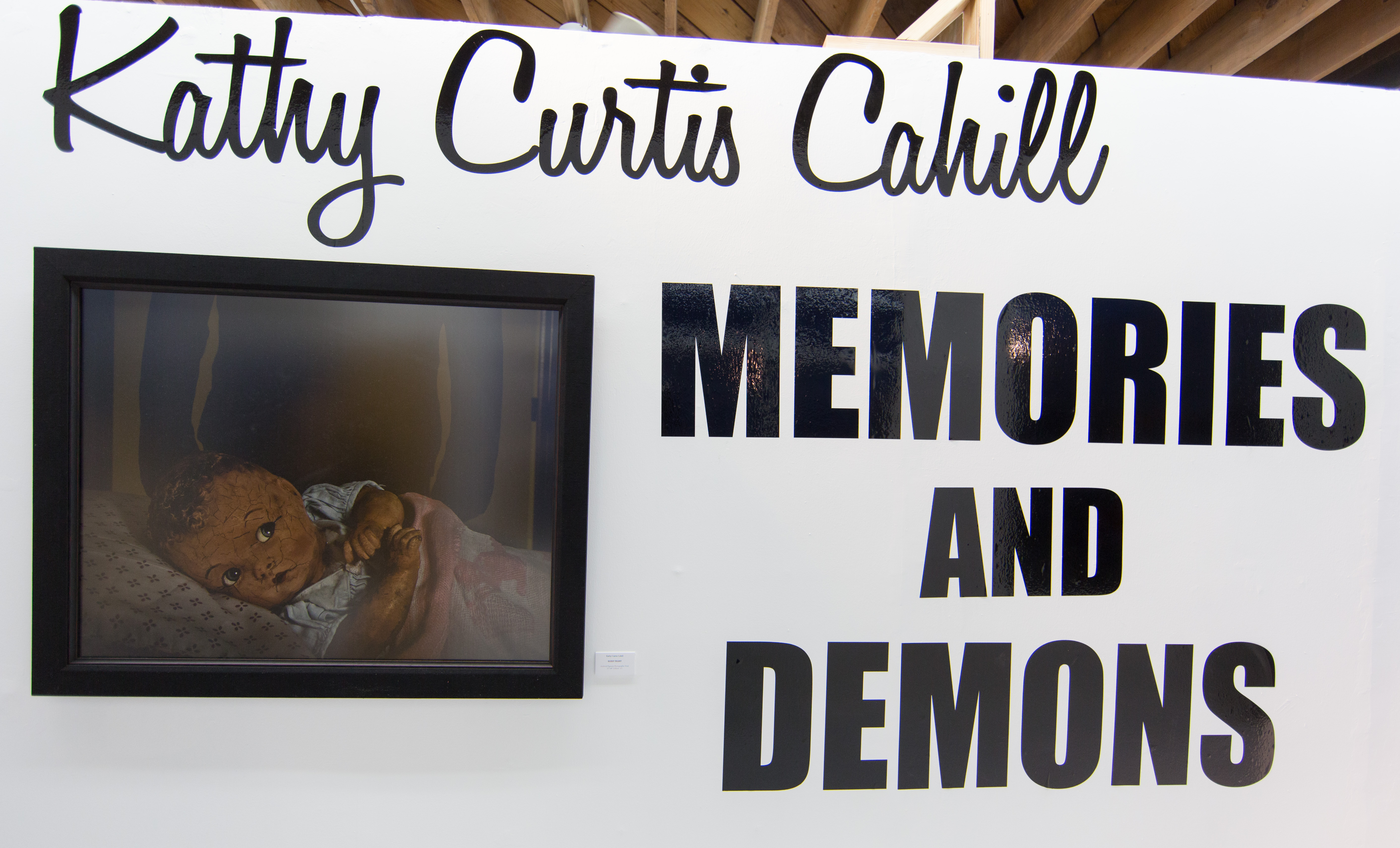
Mysterious, wonderful, frightening, inspiring. That’s the childhood world that photographer Kathy Curtis Cahill presents in her riveting exhibition “Memories and Demons” at the Artists Corner Gallery in Hollywood.
The photographs Cahill creates feature eerily realistic antique dolls, positioned so that they, like her luminous photography, come startlingly alive. Cahill describes the pieces as inspired by her childhood. “It was difficult,” she relates. “My parents were blue collar workers, and we moved around a lot. My father gambled and drank, and abused my mother. My brother was boarded out. I’ve spent a long time getting over being angry.”
But Cahill’s work offers her closure, and the viewer an insight into a world of childhood both vivid and insightful. “This project was cathartic for me,” Cahill says. “My parents divorced, but ended up back together, in a toxic relationship they couldn’t live without.”
What Cahill can’t live without is her art. “I’ve always been involved in art and photography. I took photography classes. I worked in film. I have been inspired greatly by Diane Arbus and Sally Mann.” She started “Memories and Demons” utilizing another long time passion, collecting antique dolls. The dolls are her subjects, and their haunting expressions and positions are profoundly alive. ow does she create her dolls’ life-like positions? “Through trial and error,” Cahill attests. “I use paint cans, sticks, props. I work with them, and create an environment for them.”
Cahill has been creating her unique vision for just under a year. She works without assistance, using a variety of natural light sources in many pieces. “My ‘Please Help’ was shot by porch light,” she explains. The naturalism of her settings, lighting, and interactions contributes to the surreal/real style of her work.
The poignant images show loss, longing, fear, and wonder, all in a very personal way that grabs the viewer by the heart and throat. Her first piece, “Small Comforts” was directly inspired by her mother. “I make these pieces for all the children who were traumatized, for children who are still affected as adults by what has happened in the past. I tell stories in images that children may not be able to tell in words.”
To learn more about Cahill’s dynamic work, visit Artist’s Corner, located at 6585 Santa Monica Boulevard in Hollywood. A closing night reception and artist’s talk takes place Saturday, August 8th from 7 to 10 pm and should fall in your “do not miss” category.
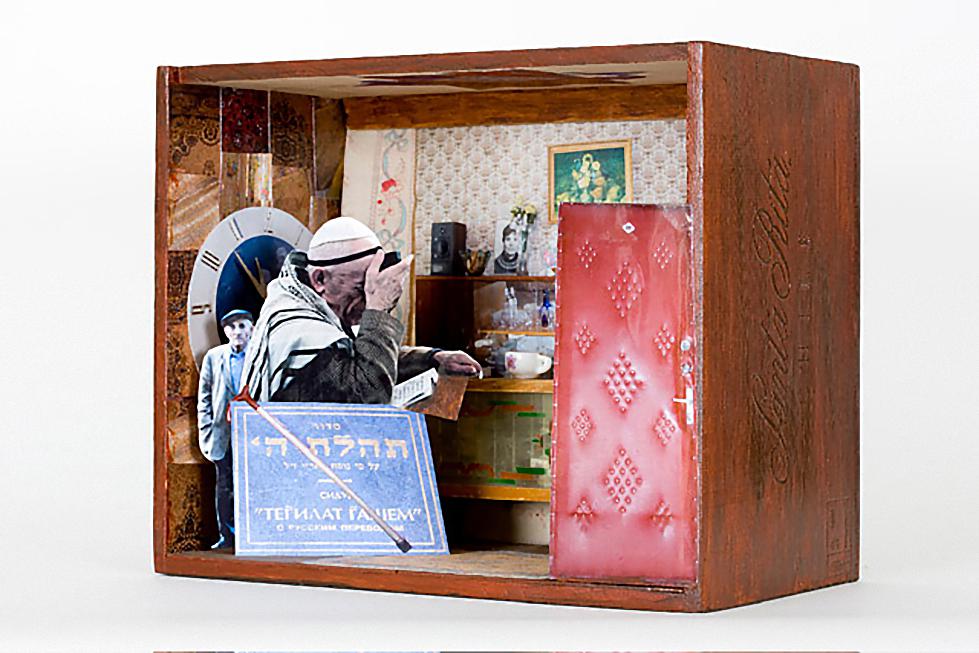
Dwora Fried may create miniature tableaux, but her subjects and themes are far from small. Working with tiny figures and photographs to create spectacularly detailed worlds inside glass-topped wood boxes, Fried suggests rather than specifies her narratives. Then, in accompanying texts, she lets viewers see that these boxes contain searing representations of voyeurism, spectacle, and entrapment. Fried describes these pieces as depicting “a collection of climates, where even the most liberated are confined.” Her “Living Imprint” boxes depict the biographical stories of ten different survivors of the Holocaust in Lithuania, a country where ninety-five percent of the pre-WWII Jewish population – some 240,000 residents – were annihilated. Fried was one of three artists commissioned to memorialize the survivors.
Stunningly detailed, each box not only evokes a story but a visceral response in the viewer, who is pulled into the small, intricate world a box contains. Fried finds many of the small furnishings used in her boxes in flea markets around Europe, with many pieces hailing from the 1940s and 1950s.
Her box “Ai Weiwei” is both a tribute to the Chinese artist and activist and a depiction of the constraints that the repressive Chinese regime has levied on him, through house arrest, jailing, and the destruction of his studio. The “Blue Vanity” in the box of that title is a very feminine doll house furnishing, juxtaposed with a collection of black and white photos of female actresses, and a man in a blue sweater watching a Western on a television. What has become of the owner of that vanity? The sadness and loss in the piece is palpable. Fried’s “Anne Frank” includes a miniature kitchen, a well-known photo of Frank, and books dropped before a refrigerator. A baby doll and a replica statue memorializing Frank make the piece both reverential and haunting. Fried expresses the fact that Frank is memorialized now, a lighting rod evocation of the Holocaust, but often not remembered as the vulnerable child she was as well.
A native Austrian, Fried is an international traveler, mother of four children, and the daughter of a Holocaust survivor.“I keep re-creating the feeling of what it was like growing up,” the artist says, “the box captures the claustrophobic feeling a painting can’t.” Her layered collages and complex boxes tell stories with sweeping implications, stories that through their profound meaning to the artist, have the ability to create a ripple effect of deep connection with the viewer.
Born in Vienna and now residing in Los Angeles, Fried has exhibited worldwide, including solo exhibits last year in Venice, Italy at the Museo Ebraico and Vienna, Austria. Fried has recently shown work at Chicago’s Woman Made Gallery, El Pueblo de Los Angeles Historical Monument and at SPARC Gallery in Venice California.
She currently has five pieces in the permanent collection at the Museum Startgalerie Artotheck in Vienna, and has exhibited at the Women’s Museum of California in San Diego, as well as at Viridian Artists in New York. The artist has also shown in numerous group exhibitions at the Los Angeles Art Association where she is a member.
From Los Angeles to London to Ojai, Fried takes her evocative and startling miniatures to a wide variety of locations where they paint a very big picture indeed.