
LA Art Show’s 2026 Edition Includes New Latin American Pavilion

The LA Art Show returns to the Los Angeles Convention Center January 7–11, 2026, marking its 31st edition as the city’s largest and longest-running art fair. Privately owned and independently operated, the fair has long been a major part of Los Angeles’s cultural calendar, both due to its curatorially passion and its international scope, which is even more in play this year with the addition of the show’s new Latin American Pavilion.
The event is led once again by director and producer Kassandra Voyagis, and will present over 100 global exhibitors for this year’s event.  Tickets are available at www.laartshow.com, with 15 percent of all proceeds benefiting the American Heart Association’s Life is Why™ campaign.
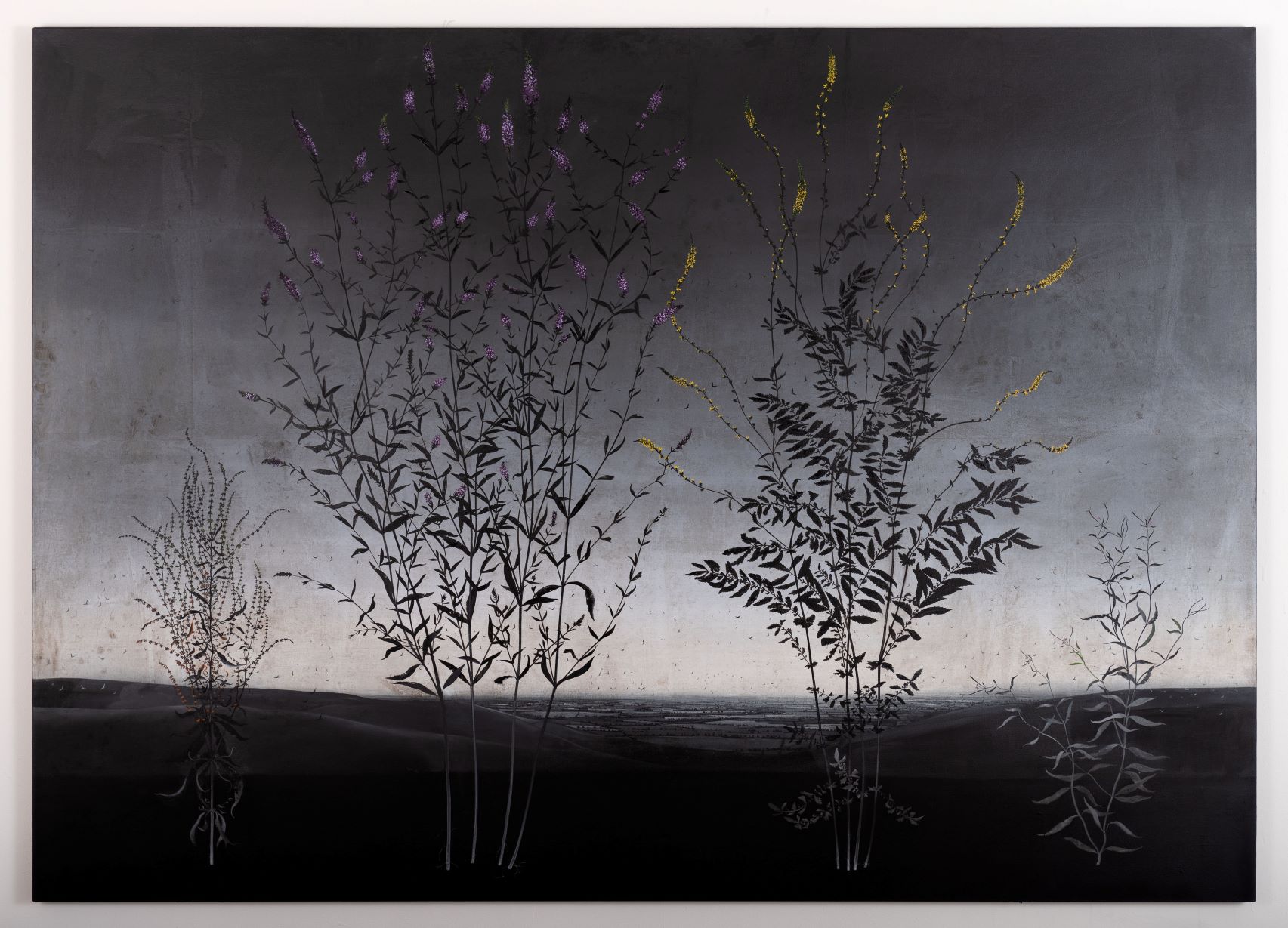
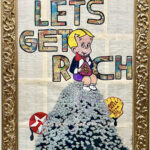
Always an adventure in art, this year’s fair introduces a number of firsts.  Dublin’s Oliver Sears Gallery becomes the first gallery from Ireland to participate in the fair, while fresh fFrom London’s West End, Pontone Gallery will showcase works by self-taught Manchester artist and former professional rock drummer Chris Rivers, an artist whose vivid and surreal paintings and hand-gilded editions include elements of astronomy, mythology, and celestial mapping.

Also new on the exhibitor list are first-time participants including Gefen Gallery (San Francisco), Steidel Contemporary (Lake Worth), and Corridor Contemporary (Tel Aviv). Also present will be ten plus South Korean galleries, and longtime participant Rehs Galleries of New York, which has exhibited at the fair since 1994.
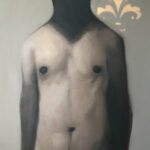
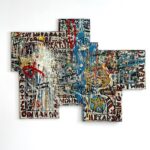
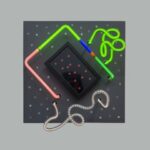
Other galleries include Switzerland’s LICHT FELD Gallery, presenting the first public showing in over four decades of Karl A. Meyer’s 1980s woodcut prints, and Corridor Contemporary, which is offering a major presentation of cinematic figurative works by Israeli artist Yigal Ozeri. Korean gallery J&J Art will feature Elegant Freedom, a presentation of Hanji-based works by Jinny Suh which reinterpret Korean tradition through a contemporary lens. Artifact NYC will be showing a wide range of art, including abstract neon by Los Angeles artist Linda Sue Price; at ALOV Gallery, work will include that of LA’s Gay Summer Rick.
 

And of course, this year’s fair has a must-see in the debut of an invitation-only Latin American Pavilion, curated by Marisa Caichiolo, long-time and continued curator of the LA Art Show’s signature non-commerical platform DIVERSEartLA. Recently selected to co-curate Chile’s pavilion at the 2026 Venice Biennale, Caichiolo brings her usual nuanced perspective here, focusing on themes of memory, migration, identity, and provenance. The the pavilion includes work by both emerging and established artists from across Latin America, exemplifying this extremely charged moment in time internationally and nationally. The pavilion focuses on the geography and resilience of the Latin American culture and art grounded within the discource of contemporary art.
“At a moment when immigration issues continue to disproportionately impact Latin American communities, it is especially important to provide a platform for these artists,” Caichiolo asserts.

The 2026 edition of the curator’s DIVERSEartLA is equally timely, titled The Biennials, Art Institutions and Museums in the Contemporary Art Ecosystem. Offering a living examination of how contemporary art circulates and evolves through global biennials and institutional frameworks, on exhibit will be work by the Gwangju Biennial (Korea), Cuenca Biennial (Ecuador), NYLAAT Triennial (New York), SACO Biennial (Chile), and NoMade Biennial, among others, all exploring the productive tensions of these events and institutions.

Biennials, with their experimental and time-sensitive nature, often act as laboratories for new ideas and social critique, while museums and institutions provide a focus on more long-term stewardship. Both help to sustain both public engagement with art, and artistic innovation – which are also both served well by the LA Art Show itself.
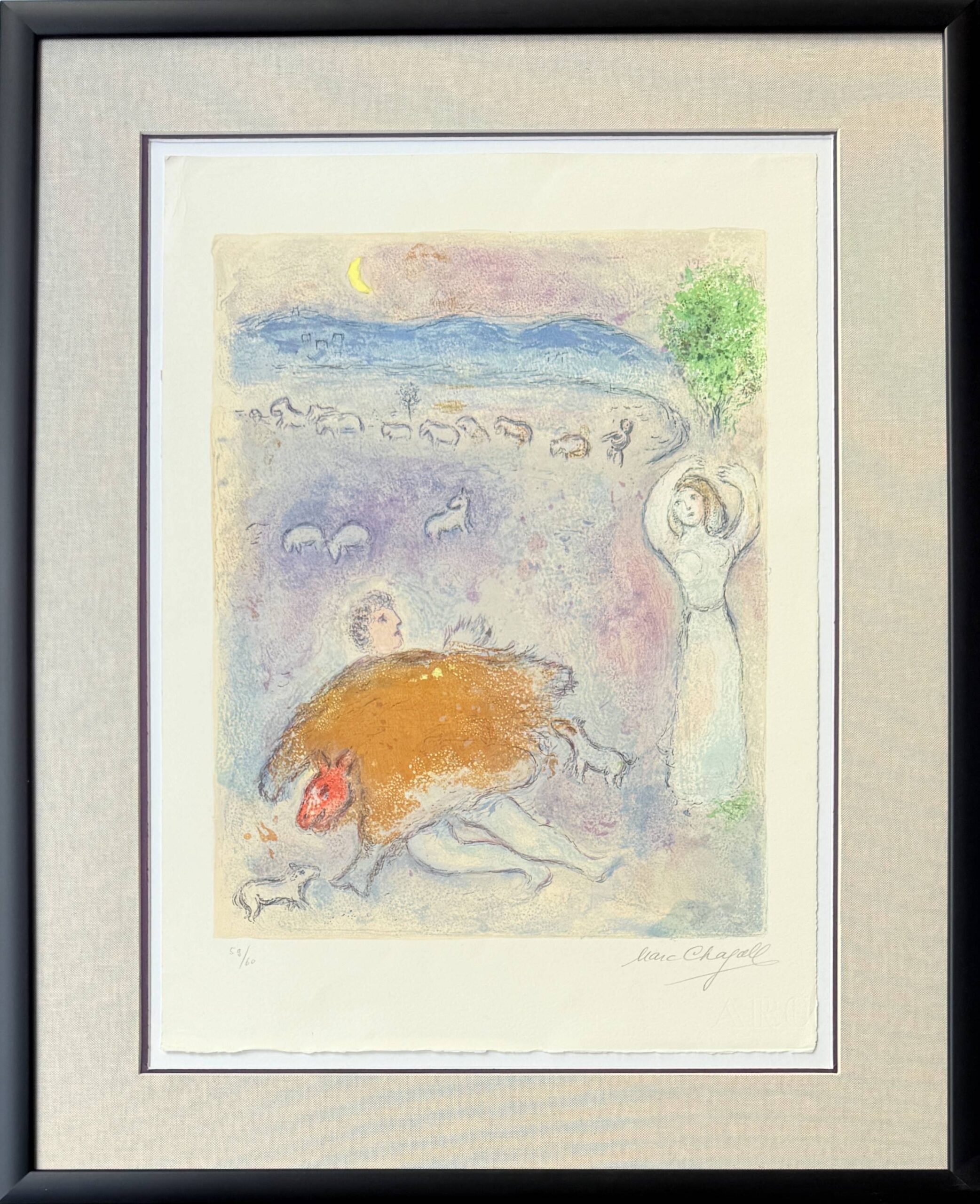
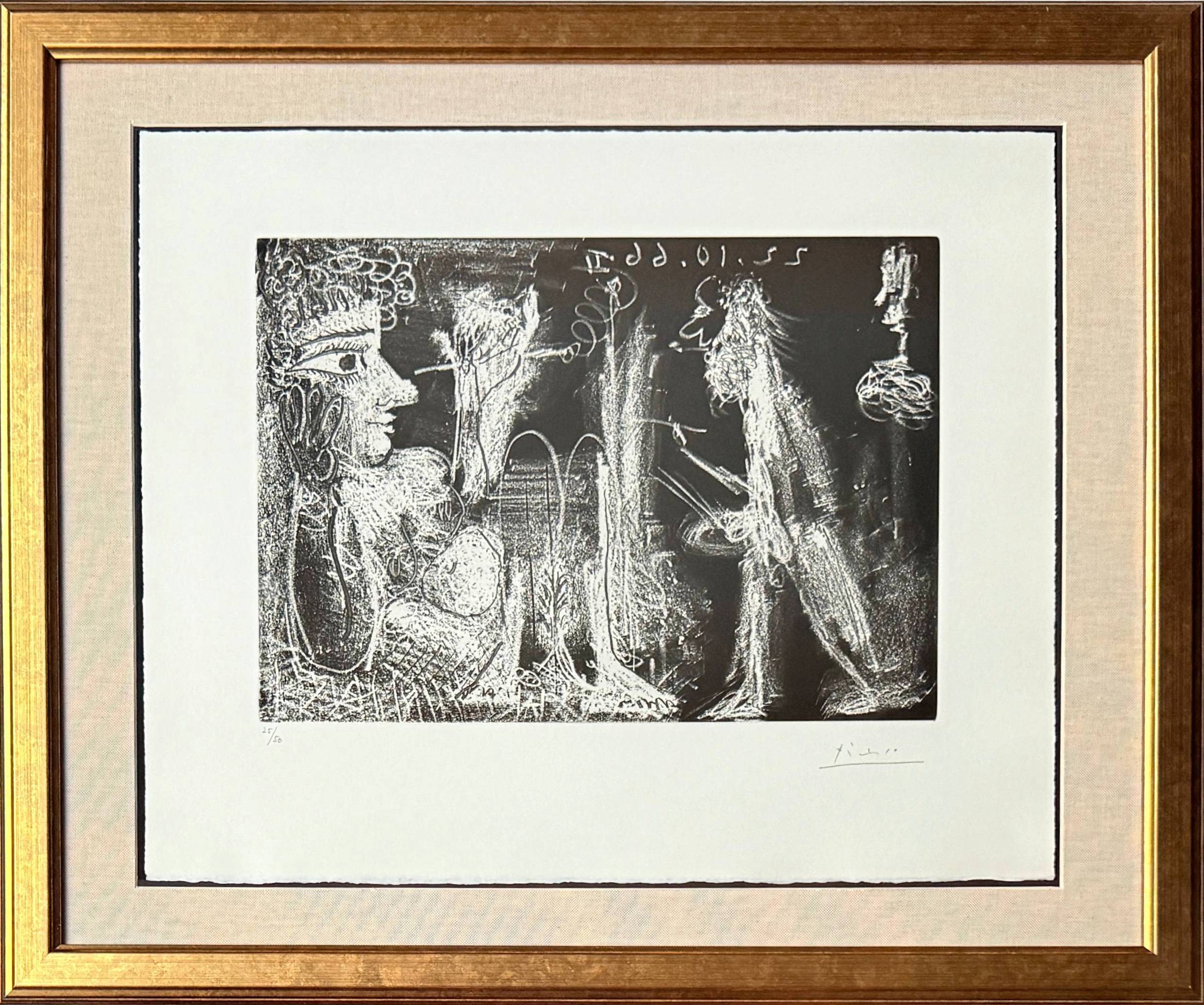
This year there is a special focus on the ways in which geography, local communities, and site-specific conditions shape artistic production and curatorial strategies. Along with exciting new art and the opportunity to view works by art masters such as Chagall and Picasso, visitors will experience unique projects that emphasize care and sustainable, collective action, and are tied directly to contemporary social and political realities.
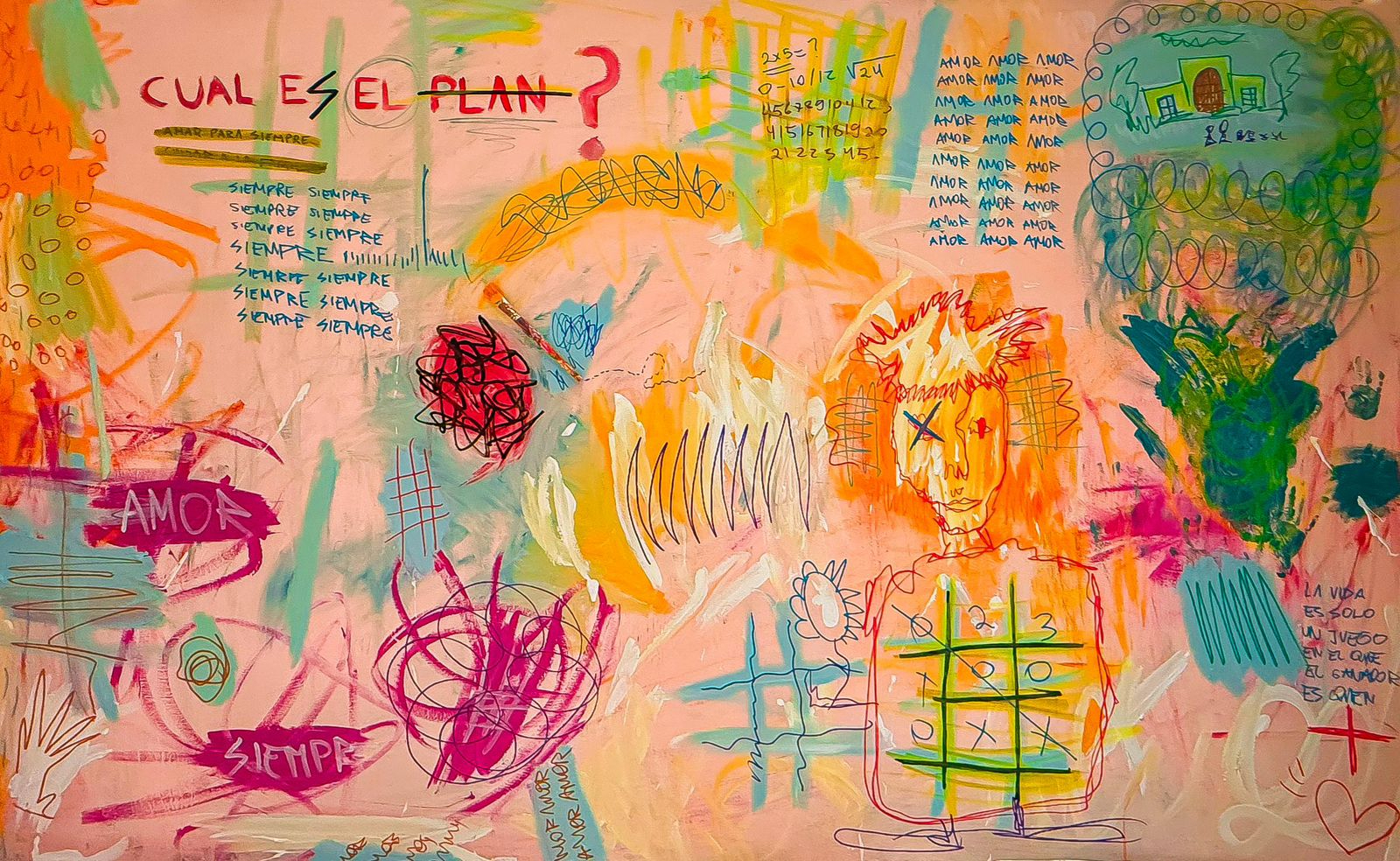
In short, this is an important and vital exhibition, promising new visions and fresh, exciting art, as well as a great venue for art buying and browsing.

LA Art Show 2026 takes place at the Los Angeles Convention Center, 1201 S. Figueroa Street, Los Angeles. Tickets start at $40.

  • Genie Davis; photos provided by LA Art Show 2026


Monuments: A Monumental Exhibition

Monuments by Nancy Kay Turner

The most terrible thing about war, I am convinced, is its monuments – the awful  things we are compelled to build in order to remember the victims…

W.W.B.Du Bois, The Perfect Vacation, in The Crisis, 1931

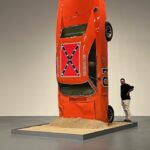
Monuments, the startling, chilling, thought provoking exhibition now at MOCA Geffen and The Brick is a must- see show. This exhibition is co-curated by Hamza Walker, Director of The Brick; Bennett Simpson, Senior Curator at MOCA; and artist Kara Walker (along with Hannah Burstein and Paula Kroll). It brings together 10 decommissioned monuments which honored the Confederacy alongside 19 contemporary artworks commissioned to be in conversation with the enormous debased statues. These works examine a particular and fraught time in our nation’s past while illuminating our present as well. We now live in a “post-truth” world that is populated by “alternative facts” and filled with competing views on our shared history. This timely exhibition requires the viewer to consider who writes history (traditionally the victor) and what, after all, is remembrance? What should or could be erased, debunked or forgotten and what are the consequences of these decisions and omissions?

The museum wall text is incisive and extremely helpful in explaining the historical background of these epic-sized sculptures. Most of these monuments were commissioned almost 60 years after the end of the Civil War to foster the idea of the” lost cause.” The Lost Cause of the Confederacy theory is a post-Civil War concept that postulates that the war was essentially to protect states’ rights and that slavery was a helpful institution that benefited the enslaved people.

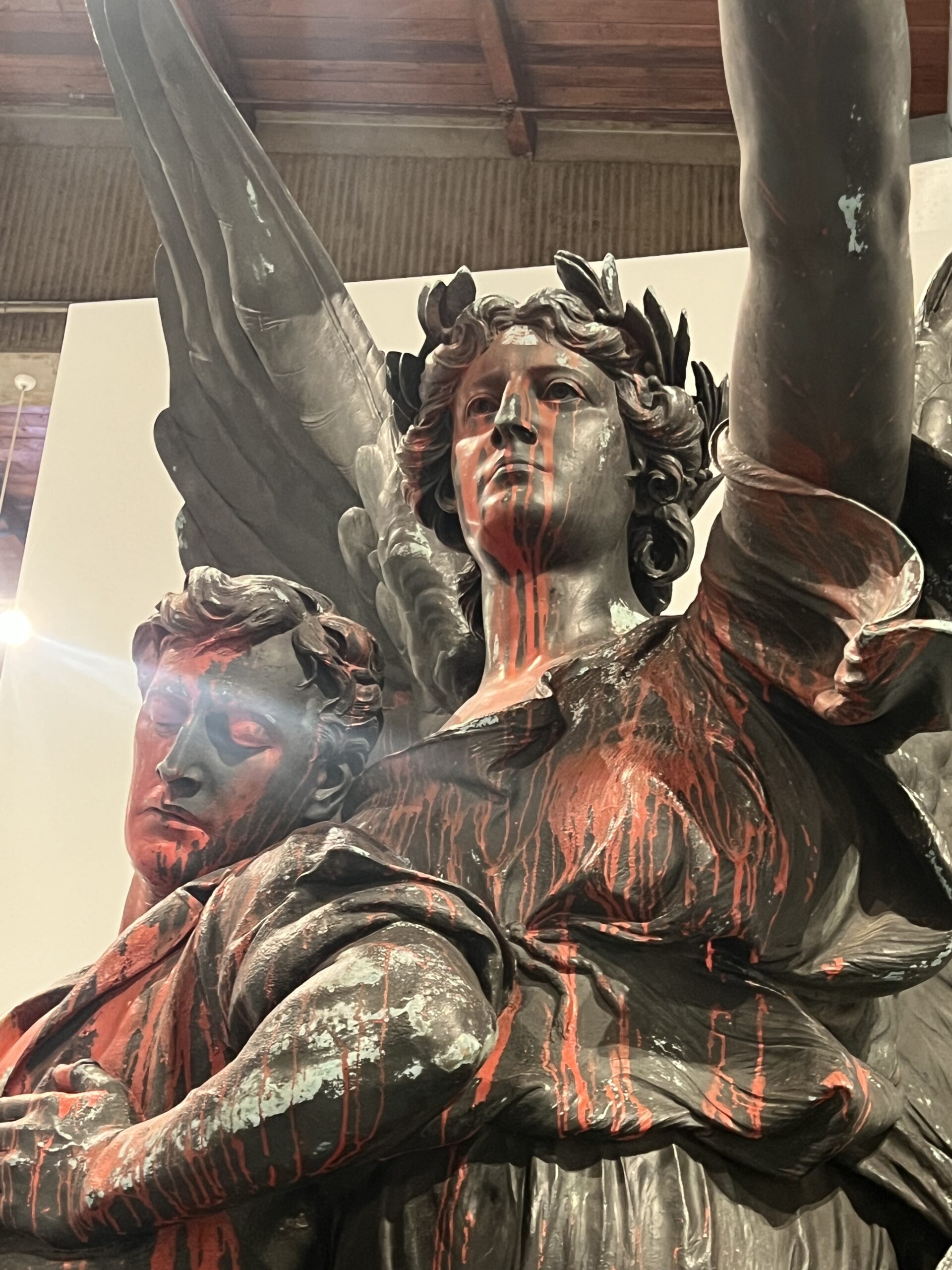
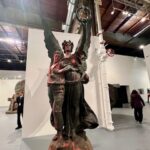
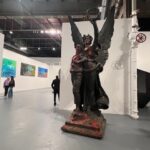
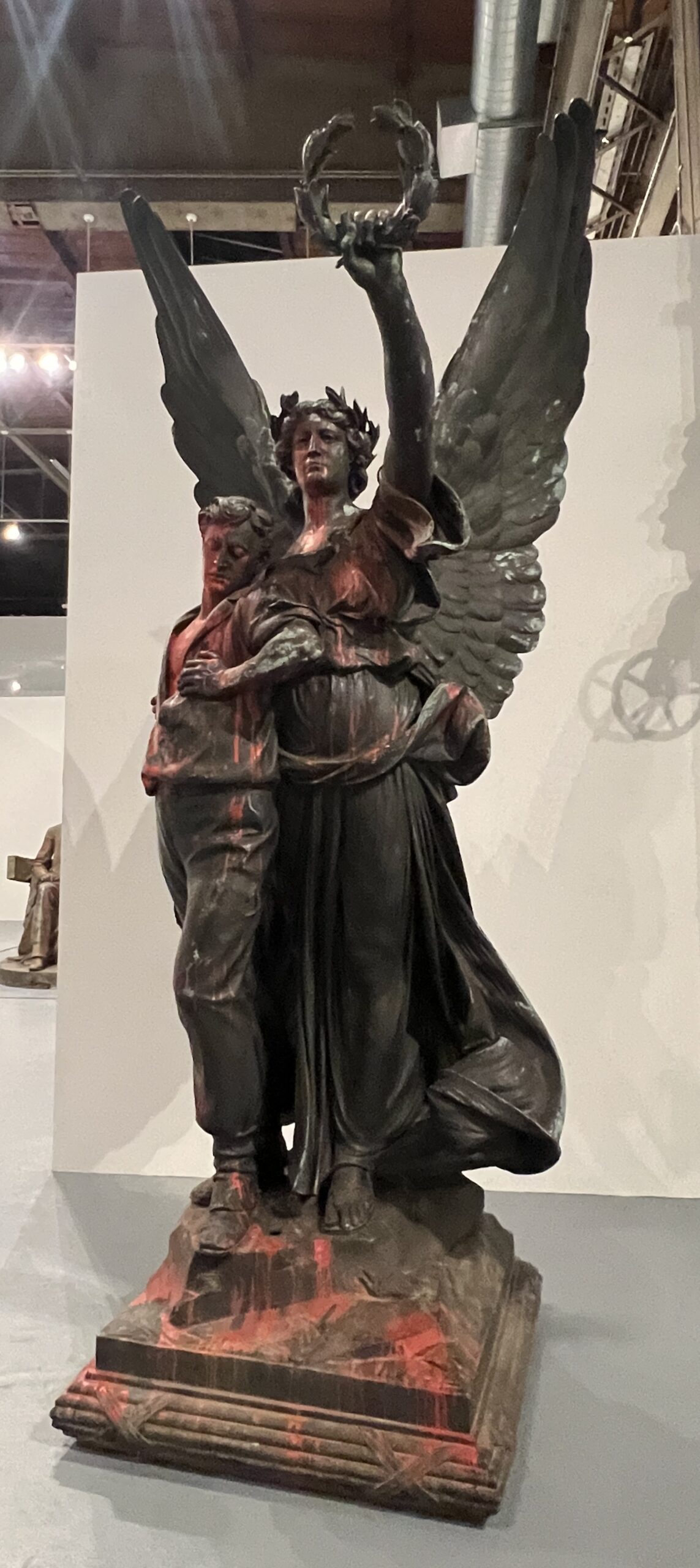
Confederate Soldiers and Sailors, 1903, by Frederick Wellington Ruckstuhl, sets the tone of the exhibition. A winged female figure, looking very mythic and somewhat Greco-Roman, is meant to personify glory. Arm aloft in a triumphant or defiant gesture, she is holding a wreath crown meant for the wounded youth she supports. Red paint was flung on this statue and other by those protesting the 2017 “Unite the Right” rallies In Charlottesville, Virgina.  Subsequently it was decommissioned along with about 200 other Confederate statues. The red paint splashed on the statue is reminiscent of dried blood and is quite disturbing. It’s instructive to remember that Richmond, Virginia was the capitol of the Confederacy from 1861-1865. The historical ramifications of the Confederacy still echo today.

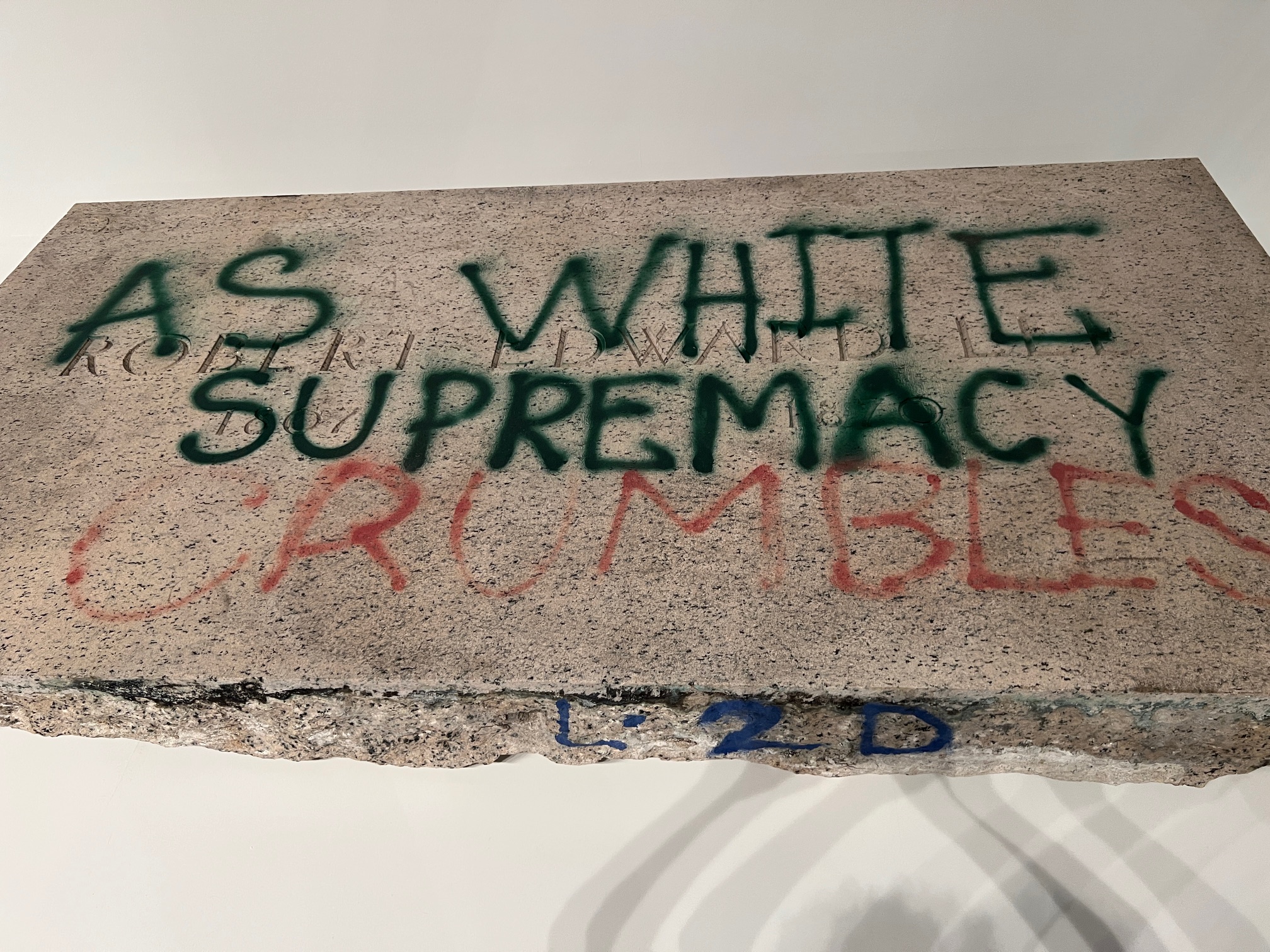
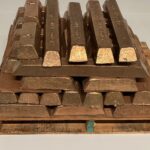
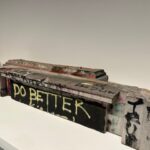
Just outside this gallery are many of the spray-painted bases that these monuments once stood on. One especially poignant one reads “AS WHITE SUPREMACY CRUMBLES….” In light of recent reversals by the current administration, this becomes a still unmet goal for those awaiting equality. Also in this first gallery are the remains of a Robert E. Lee Monument that has been melted down into bronze ingots. Stacked here like gold ingots, they are intended for a future new work of public art.

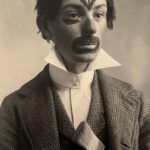
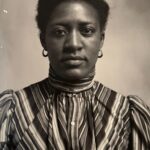
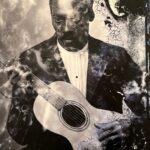
Many but not all of the contemporary works are videos and narrative photographs. My favorite of these is the work by the largely unknown white photographer Hugh Mangum, whose negatives were found in the family’s barn only in 1972.  Using the techniques of the time, he photographed black and white sitters equally, charging only pennies for their portraits. He reused the glass negative over time resulting in occasional and accidental superimpositions. Time and weather have further degraded some negatives and when printed digitally they are especially beautiful and haunting. That Mangum photographed both black and white people equally is what is remarkable about these images which look startlingly contemporary.

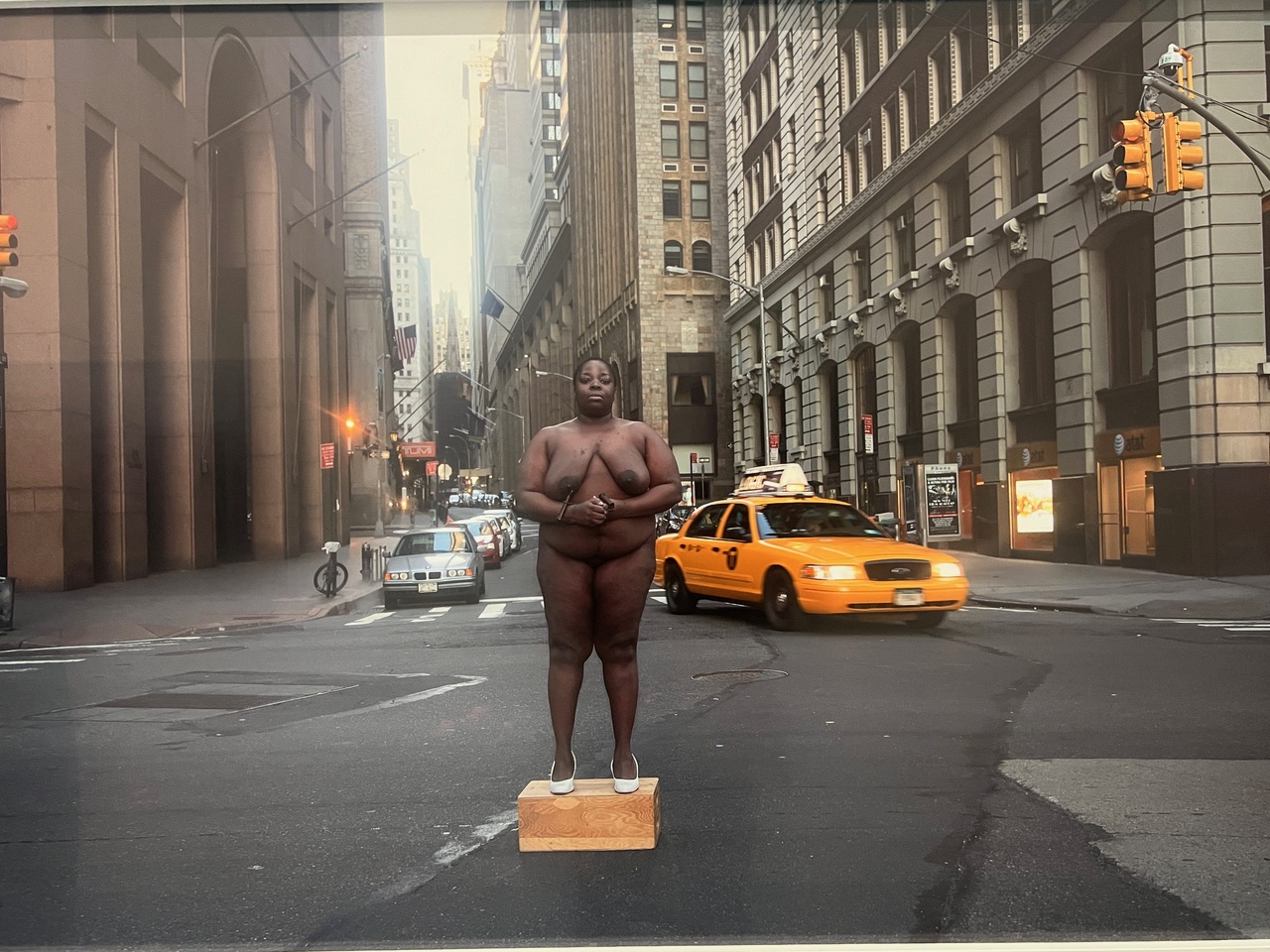
Nona Faustine’s powerful black and white self -portraits of herself naked and vulnerable clad only in white shoes or white skirt, standing alone on empty New York City streets are both brave and sad. Taken from 2013-2018, each location she picked has a particular meaning -one is where slaves were auctioned off or another is where a now unmarked burial ground for enslaved people was located.  With this series, she defiantly shines a light on the history of slavery in the North as New York’s harbor was a point of entry in the slave trade.

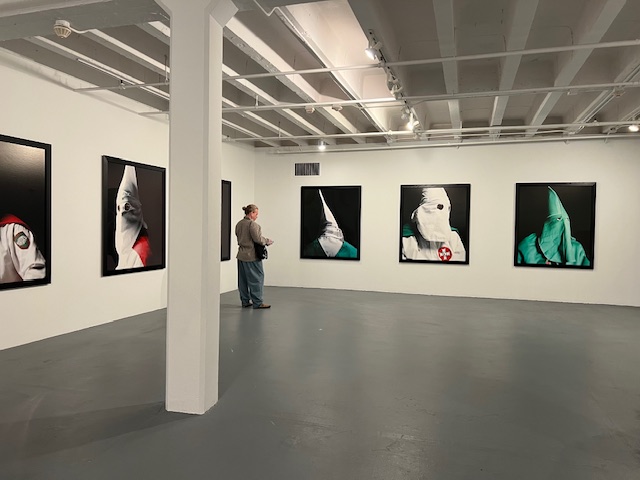
In 1990, Andres Serrano, known for picking particularly difficult subjects (such as blood, urine and other bodily secretions) photographed Ku Klux Klan members in Georgia. These images reminded me of Philip Guston’s satirical Klansman – silly in their white sheets, eyes peering out. They looked like defanged animals- all puffery, no bite. The Klan itself was founded right after the Civil War when the members suited up and ferociously attacked and killed newly freed slaves. The organization still exists but Serrano believes his photographs show that the Klan as a symbol is more potent and significant than these actual members in their white hoods.

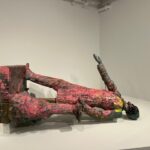
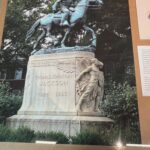
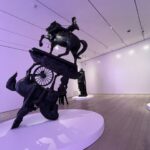
In 1921, Charlie Keck created a statue of “Stonewall” Jackson upon his trusty steed known as “Little Sorrel” heading into battle, sword raised. Exactly one hundred years later, the artist Kara Walker was deeded this decommissioned statue and was allowed to deconstruct and reconfigure it. Walker’s “Unmanned Drone” is displayed at The Brick alongside incisive text, her collages and drawing, and process pictures of the complicated dismembering of the original statue. The resulting sculpture, an amalgam of disjointed elements, is like a three-dimensional collage. Instead of being epic, though it is quite impressive in scale, Walker’s version uses the elements to tell a story of defeat, tiredness and destruction evident by the general’s arm and sword now dragging forlornly on the ground. Cut into these pieces, the viewer can see the hollow inner core of legs, arms, bodies which seems like a timely metaphor – hard metal outside but hollow inside like a rotten apple. Walker’s shockingly contemporary title instantly conjures up the current war in Ukraine that is fought by hundreds of unmanned drones daily, raining down destruction on largely civilian populations. Perhaps this is a nod to the drumbeat of endless wars, that while automated still results in ruin.

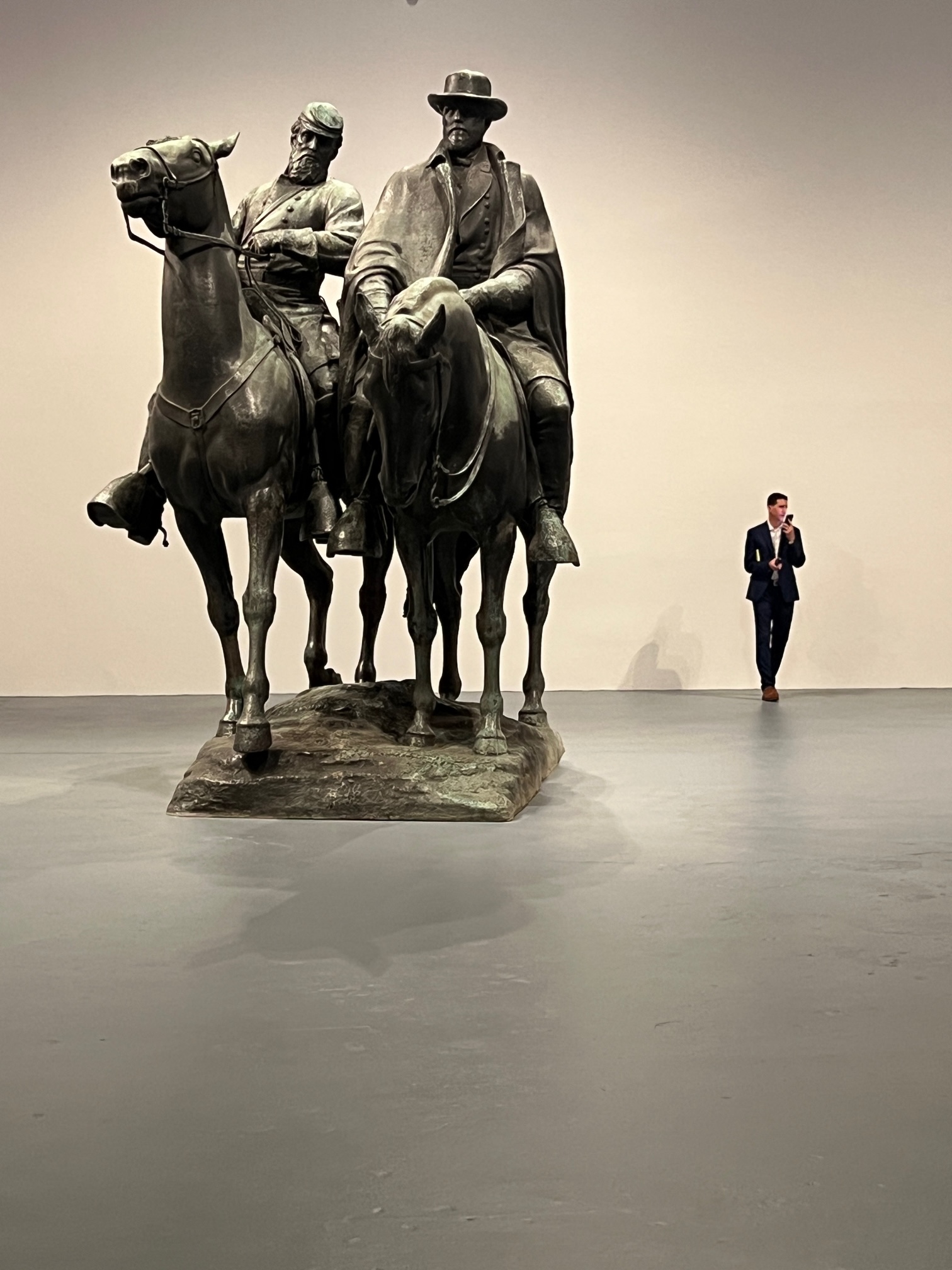
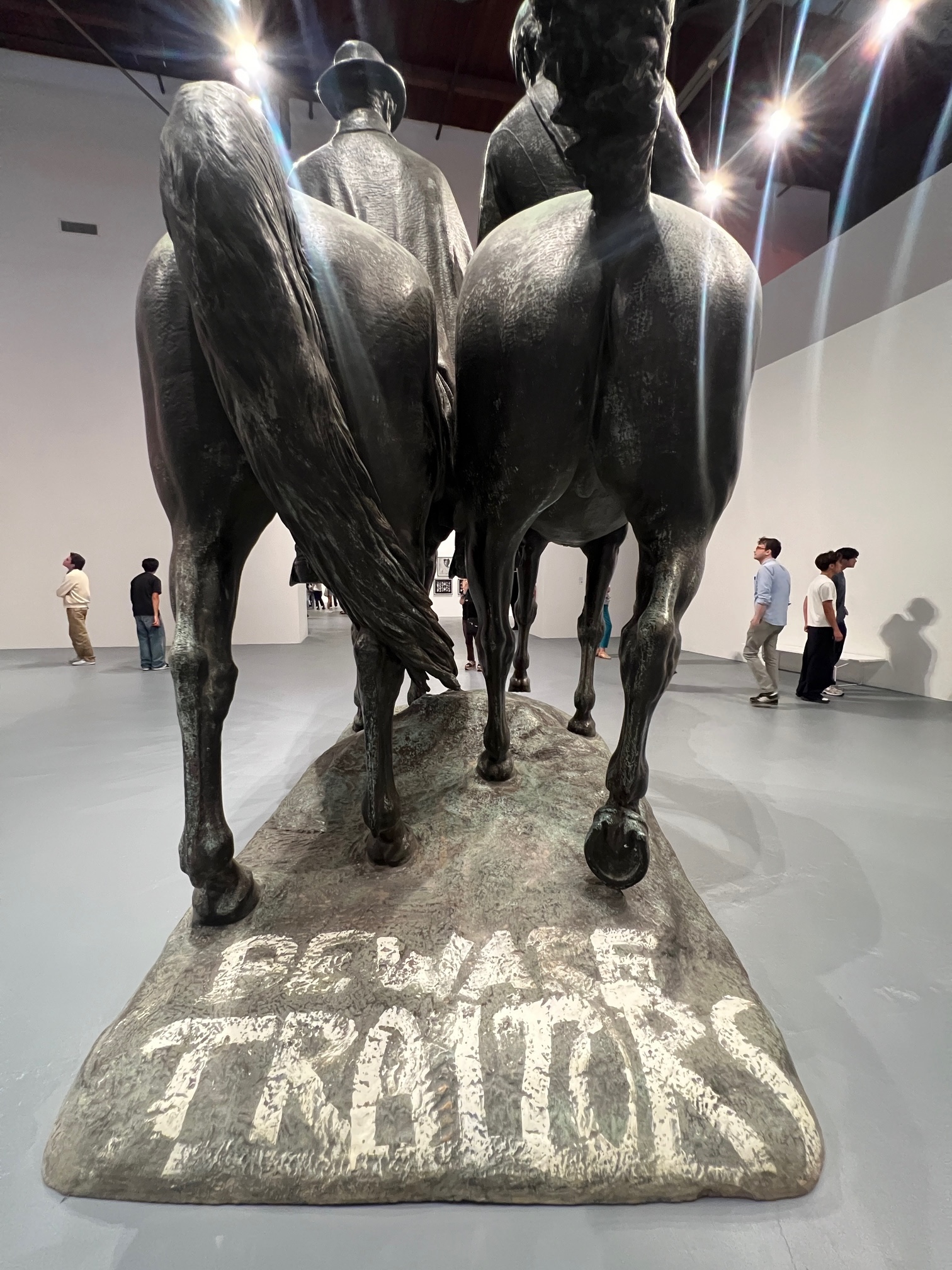
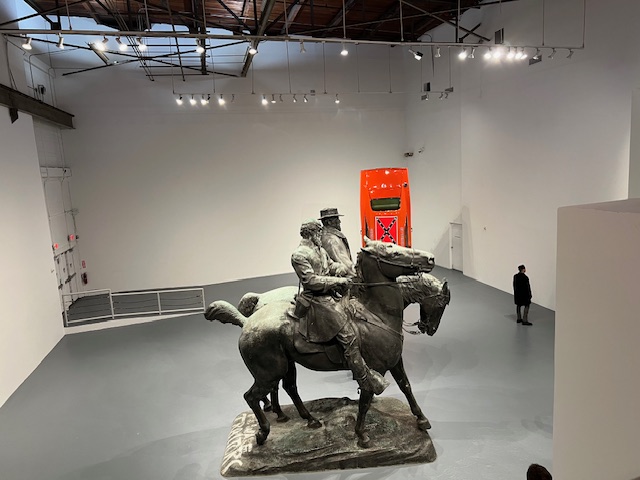
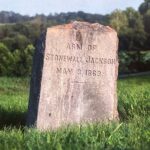
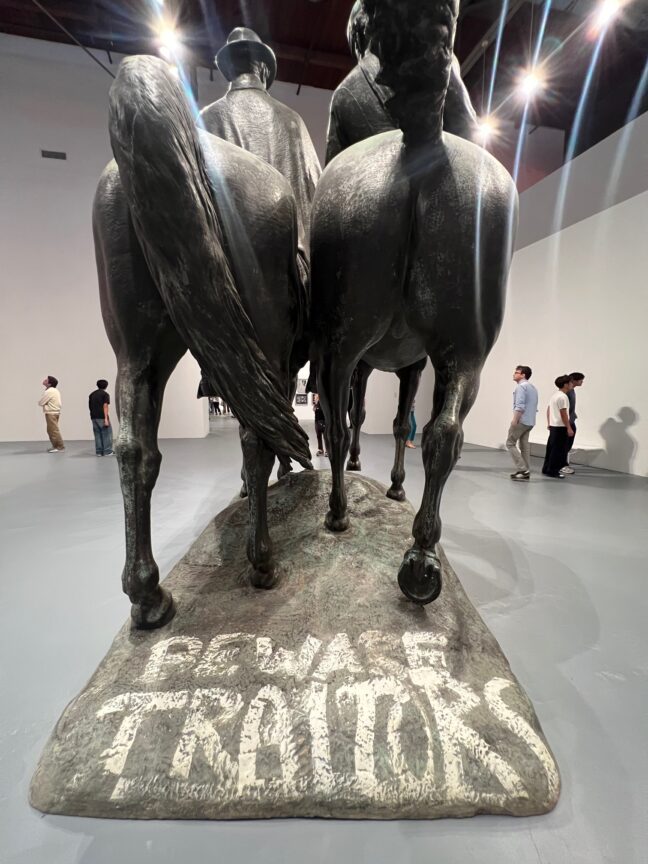
On May 1, 1948, in the city of Baltimore, an epic statue by Laura Gardin Fraser, depicting Robert E. Lee and “Stonewall” Jackson astride their horses was unveiled to commemorate their meeting before The Battle of Chancellorsville. Jackson was wounded there by friendly fire and died 8 days later after having his arm amputated. Weirdly, his arm was buried separately and has its own tombstone, demonstrating a deep hero worship.  Eighty-three years after the Civil War ended, the mayor of Baltimore hailed these two generals as “paragons of American strength,” according to the detailed wall text. Heroes who remind us to be “resolute and determined in preserving sacred institutions…” It is slavery that is the institution that they wanted preserved.

It is fitting that this striking monument which dwarfs the viewer commands the space that the curators have intentionally afforded it. Looking untouched from the front, it is only when the viewer moves behind the statues that the jarring words – ”BEWARE TRAITORS” becomes visible. This clearly encapsulates the warring ideologies presented here. Who are the traitors?

In Ken Burns’ amazing documentary on the Revolutionary War, the viewer comes to see that war as the first civil war – as the rebels or patriots fought their neighbors and family who were loyalists. The scars from that war have never healed and we are reminded by this excellent, but difficult exhibition that we must strive to fulfill the Declaration of Independence that all men are created equal. The American experiment is fragile and attention must be paid. Extensively researched, the curators here have fashioned an unusual exhibition that provokes, educates and enlightens the viewer as well as stirring up uncomfortable feelings and truths. It is not to be missed.

  • Nancy Kay Turner; photos by Nancy Kay Turner and by Genie Davis 

Living Matter: Adeola Davies-Aiyeloja is Fully Alive at Matter Gallery

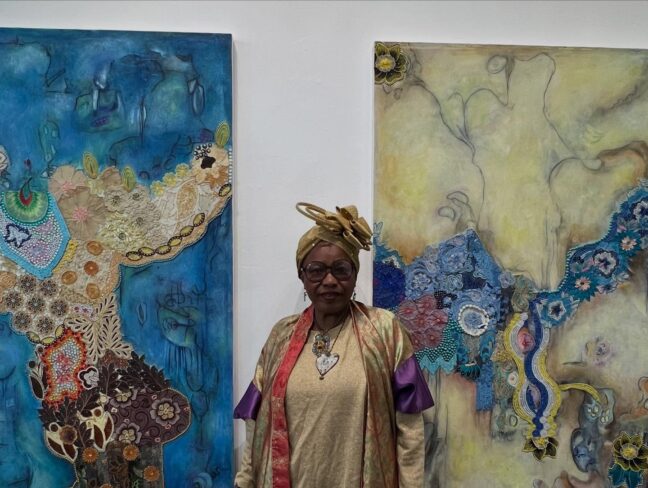
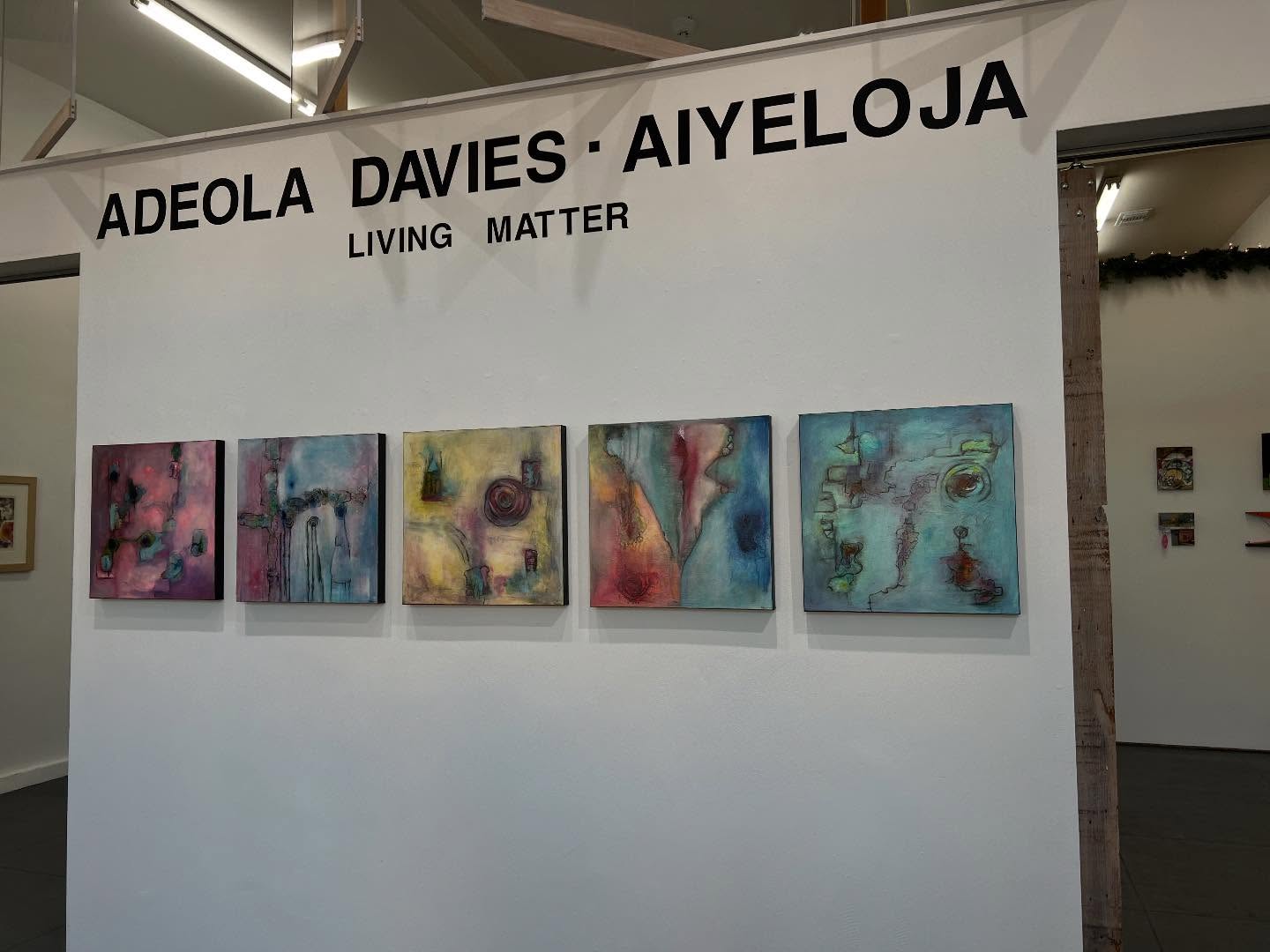
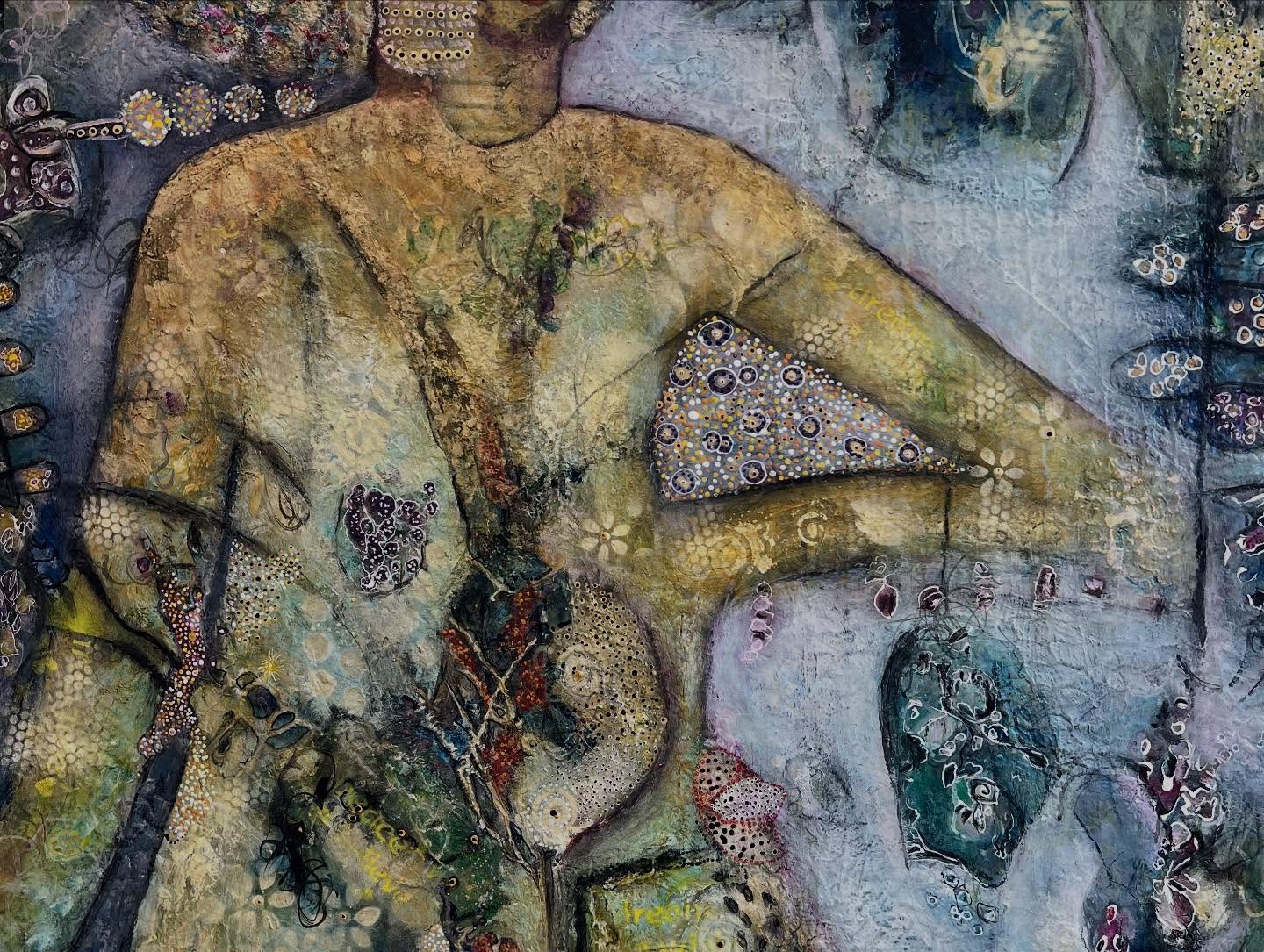
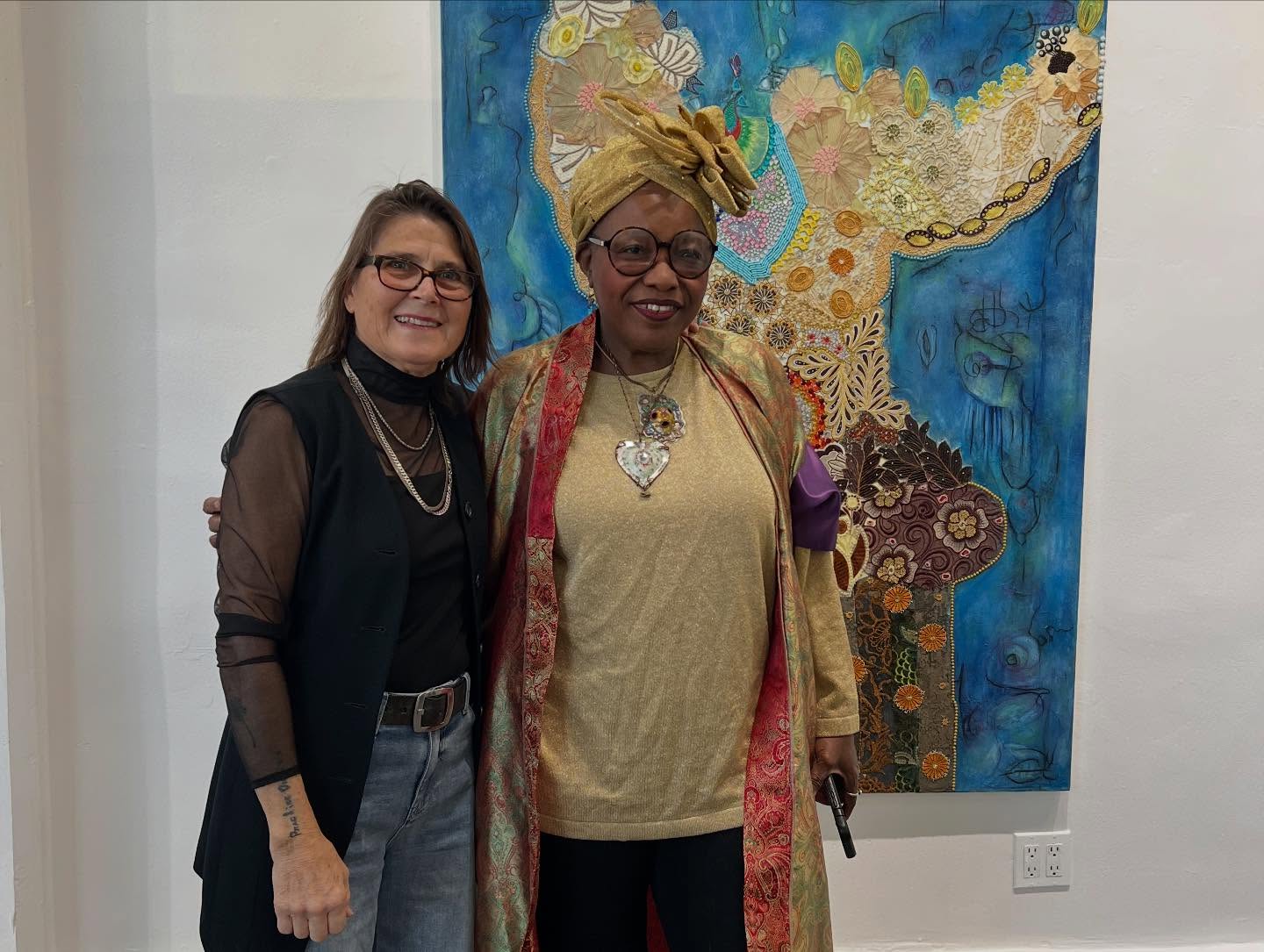
Multi-media artist Adeola Davies-Aiyeloja has a radiant new solo exhibition now at Matter Gallery in mid-city. Mystical, mythical, and wildly imaginative, her Living Matter is a full and rich investigation of her own personal story, one that both incorporates and leads to the symbols and rituals of her ancestors and their traditions.

The exhibition was created during the artist’s recent residence in Jamaica, and as such includes a vibrant color palette that seems infused with a sense of lush tropical light. She draws on the vivid landscapes and magical cloud formations of the island, as well as on what she describes as the energy of the island’s residents and the land itself.  Honoring the inspiration she received there, Davies-Aiyeloja is donating a percentage of sales from this exhibition to supporting those affected by Hurricane Melissa.

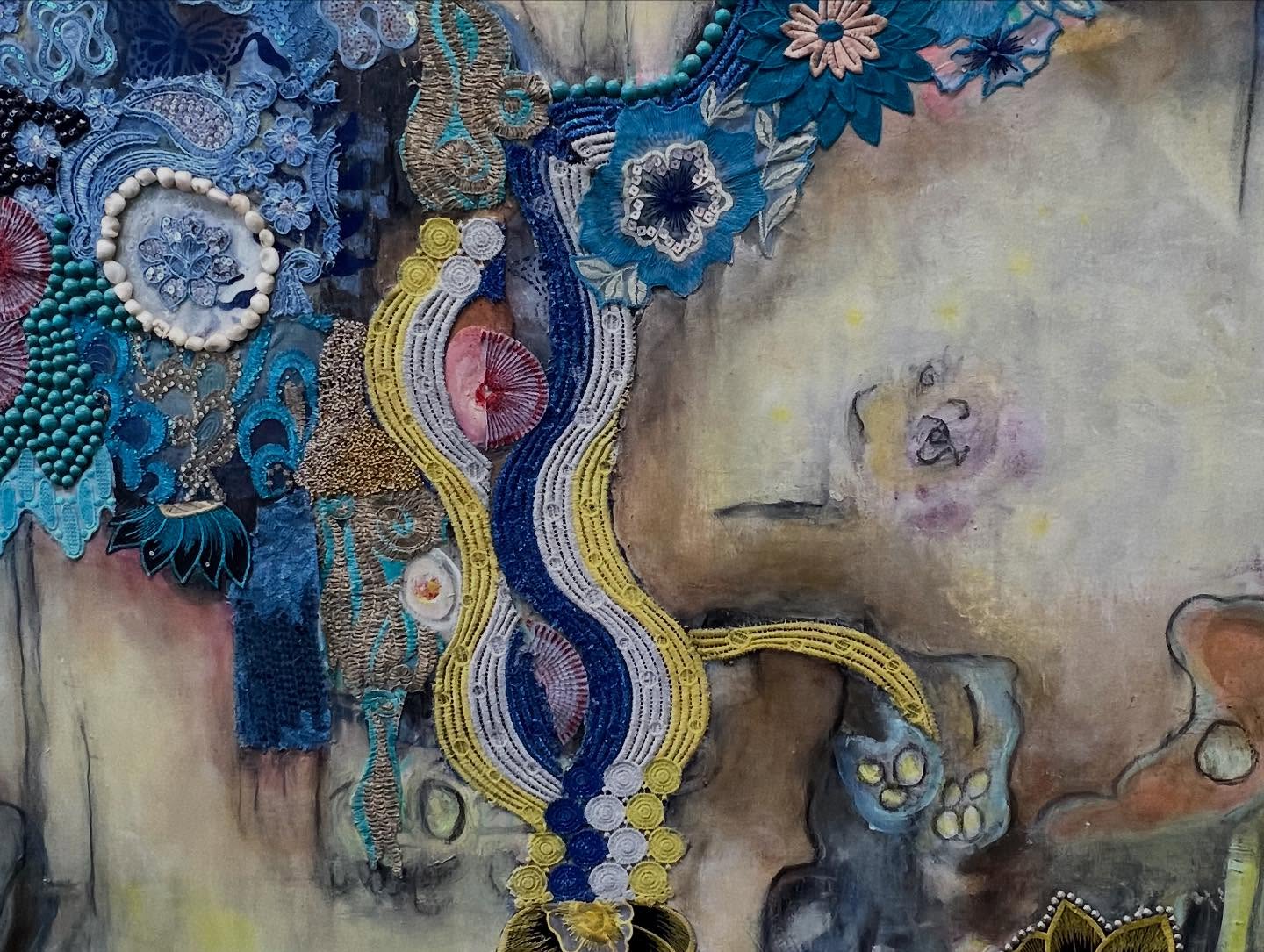
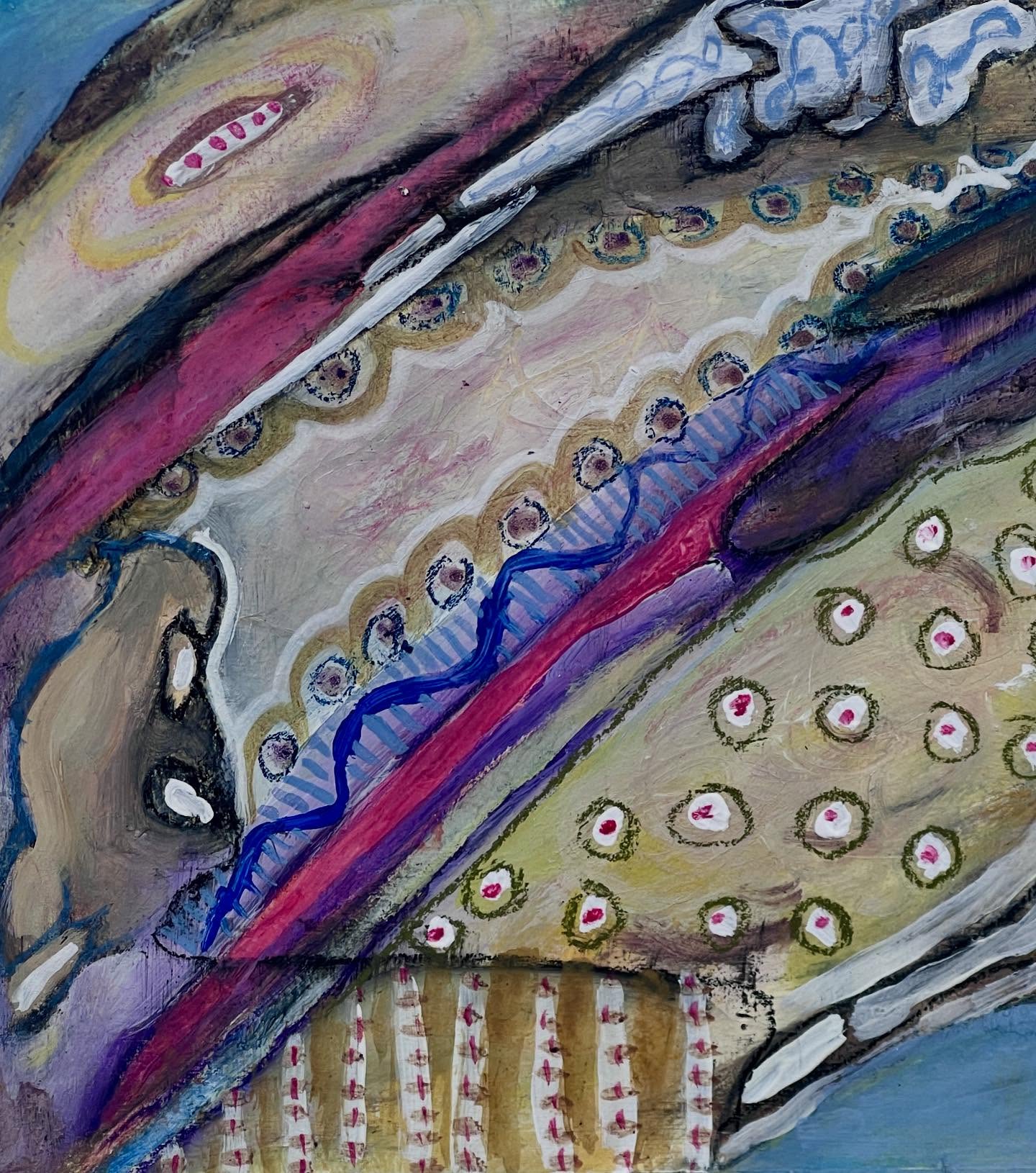
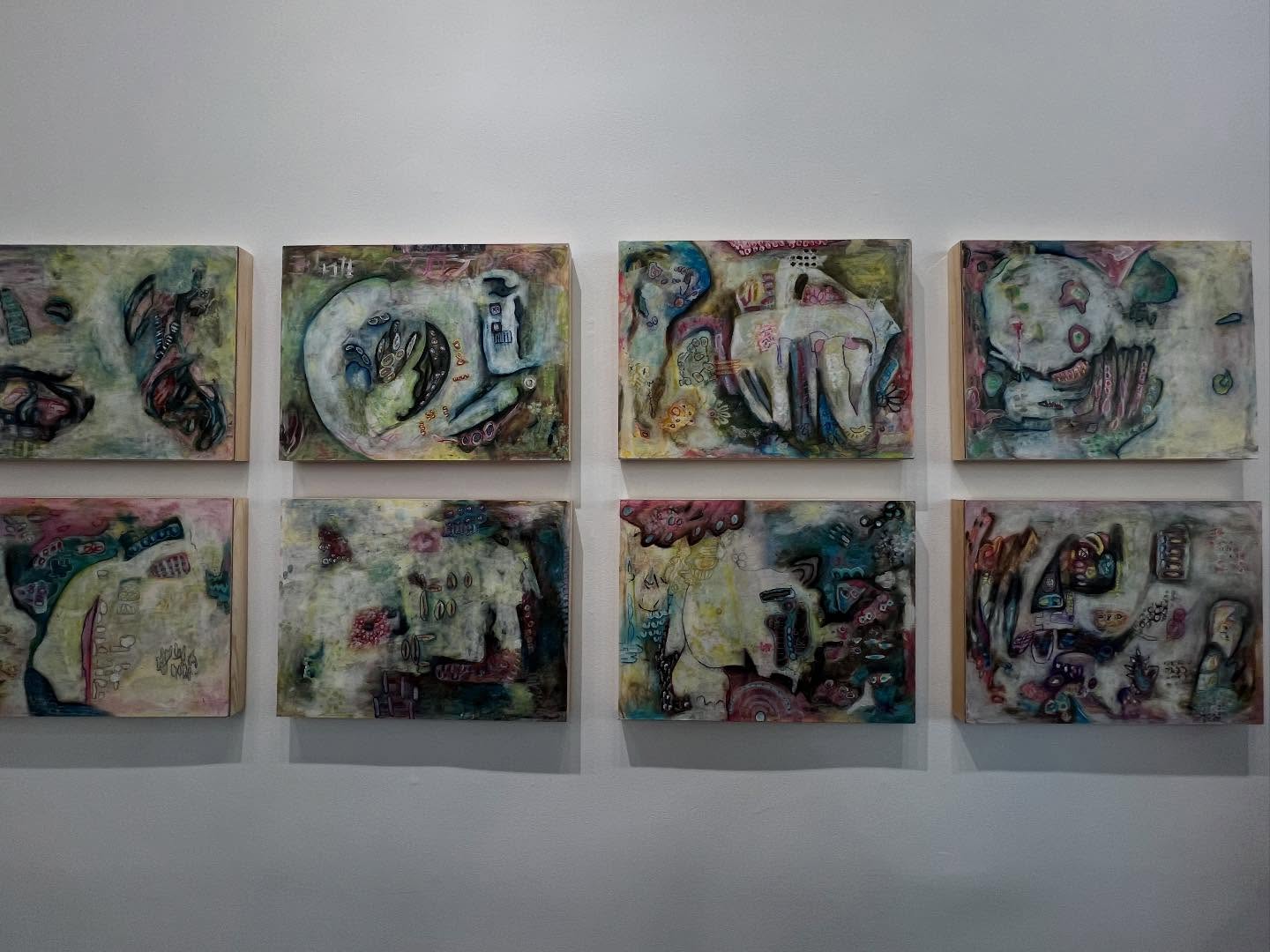
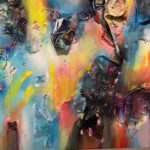
This is dazzlingly inventive work, in the flow of color and the the patterns that evoke flora and fauna, nature’s blooms and the flowering of dreams and dances. Her images here are mesmerizing in their use of color and light; look at a piece long enough and like sunlight dazzling the ocean waves or dew-encased leaves, there is a shifting and motion to the colors that each work contains.

Her work seethes with a sense of a mystery and the alchemical, from fierce blues to siwrling purples and magenta shades, the artist manifests her own unique vision of the island.


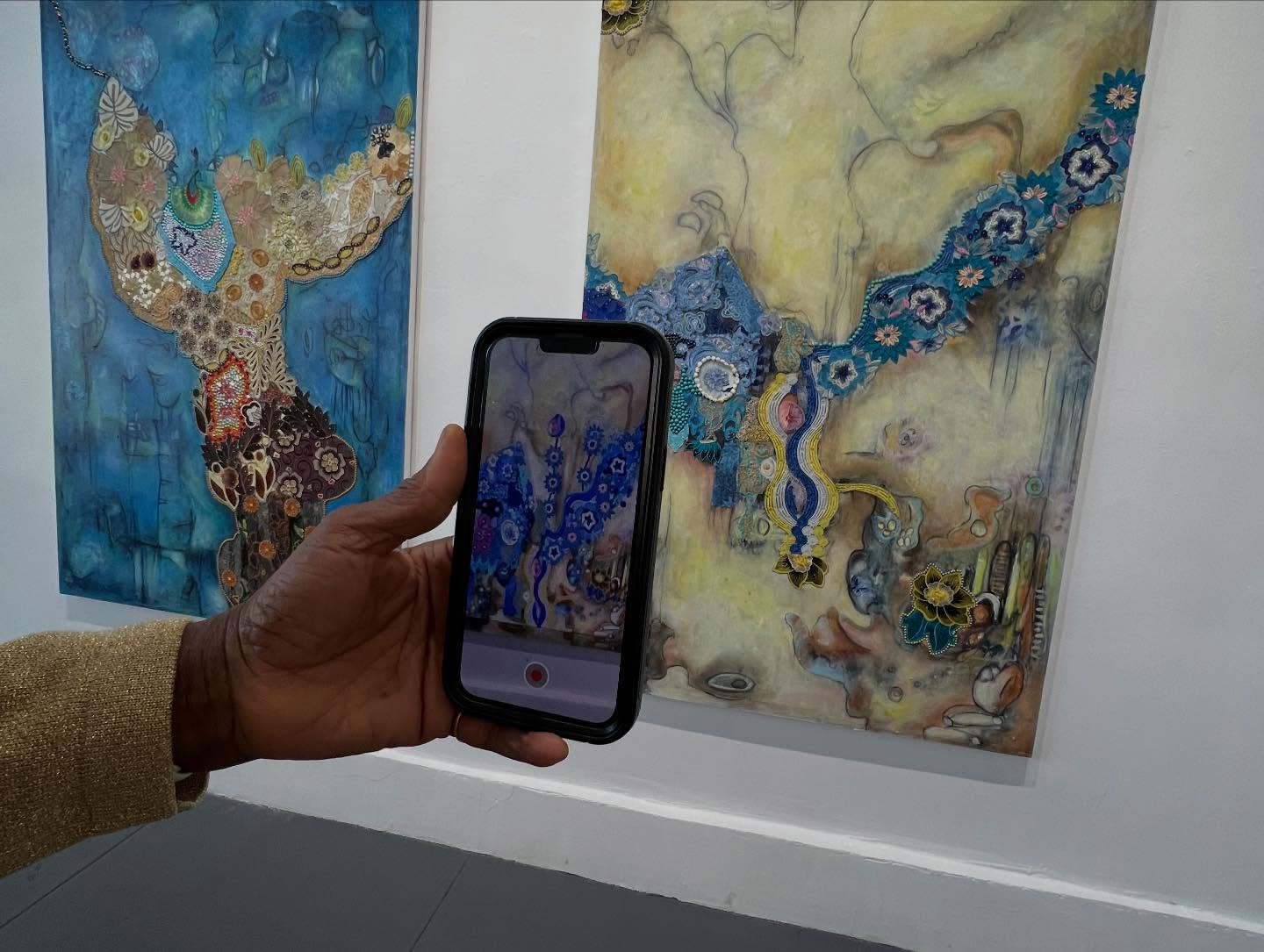
Working with acrylic paint, collage, ink, lace and other fabrics as well as beads, cabochon, and aquerelle, Davies-Aiyeloja’s “Generate Excitement” does just that with its layers and swirling lines and colors. She seems to be asking what wondrous, below-the-surface mechanisms allow the earth itself to bring this beauty forth.

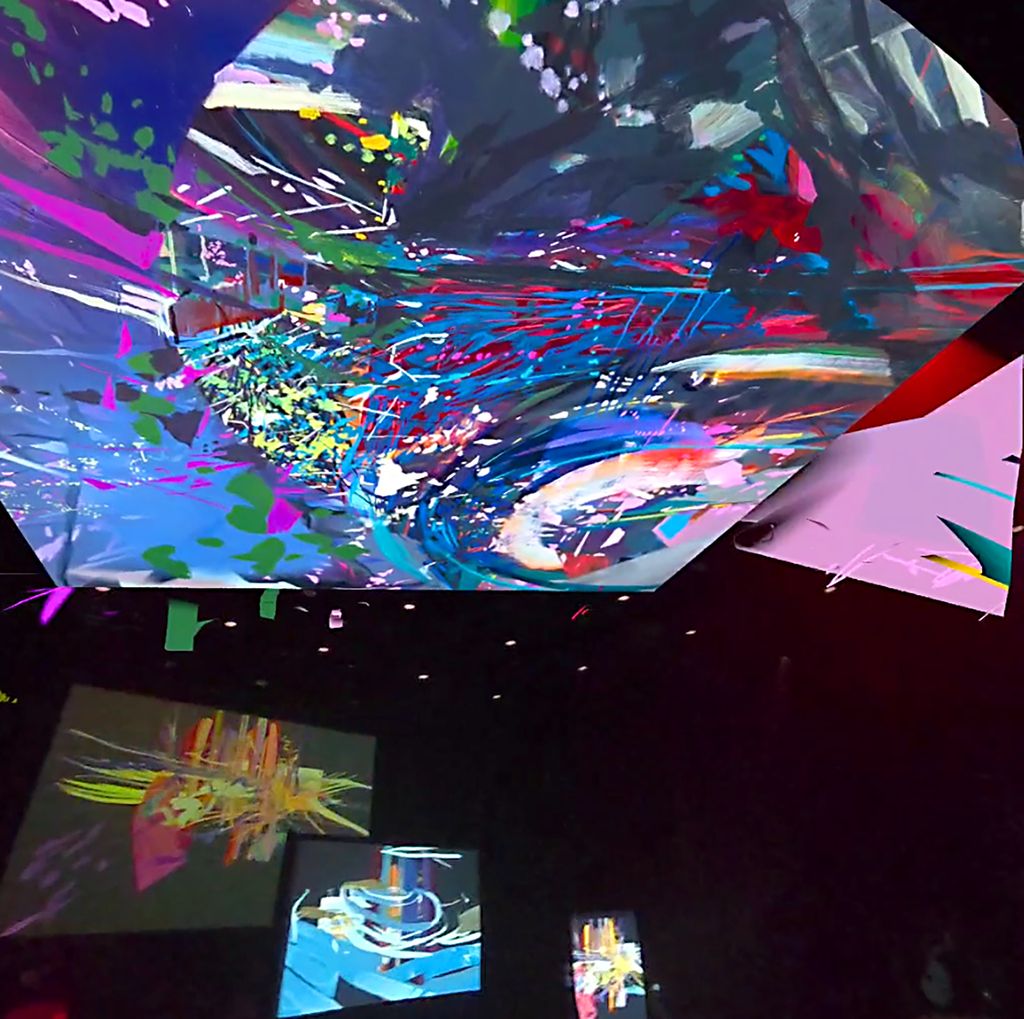
In “Rhythm to My Soul,” the artist’s work unfolds through the inclusion of AR, turning this already motion-filled large work into one that literally moves and shifts and breathes and ripples beneath the surface of canvas and paint. This animated addition creates a truly immersive experience that brings the sensations of water and rain forest that find root in this painting fully to life.

Joyous human figures form the subjects of “Golden Elegance I” and “Golden Elegance II,” created from a mix of collage, pencil shavings, meixed media, acrylic and ink as well as collage. Recalling religious icons with the use of gold leaf, these figurative works are shiny, flowing depictions of happiness.

Both her “Hues of the Island” and “Island Glow” series embody patterns that resemble both sea life and flowers, as well as the shapes of rocks and other land formations. “Island Glow” offers the brighter palette; both boides of work are geometric, abstract, and layered, and have the grace and flow of the sea and the myriad of colors the waters themselves contain.

Highly sensorial and sinuous, the artist’s images are awash with atmosphere, reshaping and recreating the land and sea of  Jamaica itself, filled with energy and the wistful longing of memory. They are fragmented and dream-like, smooth and wavering, creating the same visual sensation of looking through astonishingly clear water to the multi-colored stones, shells, fish, and plants undulating below the surface. Or in less literal terms, Davies-Aiyeloja refers to the kaleidoscopic images of our pasts, our dreams, our roots.

The exhibition closes with an artist talk on January 4th, do start the New Year right with a visit to this shining, colorful island reverie.

Matter Gallery is located at 5080 W. Pico Blvd., Los Angeles

  • Genie Davis; photos by Genie Davis


LACMA Hits Two Out of the Art Ballpark: The Day Tomorrow Began and Grounded Are Home Runs

LACMA Hits Two Out of the Art Ballpark –  Genie Davis

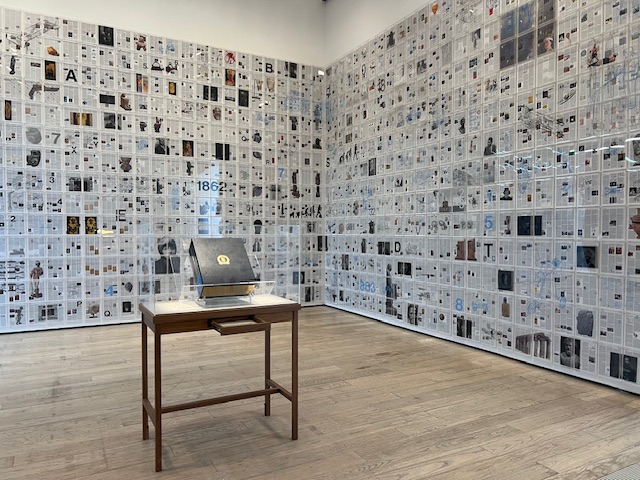
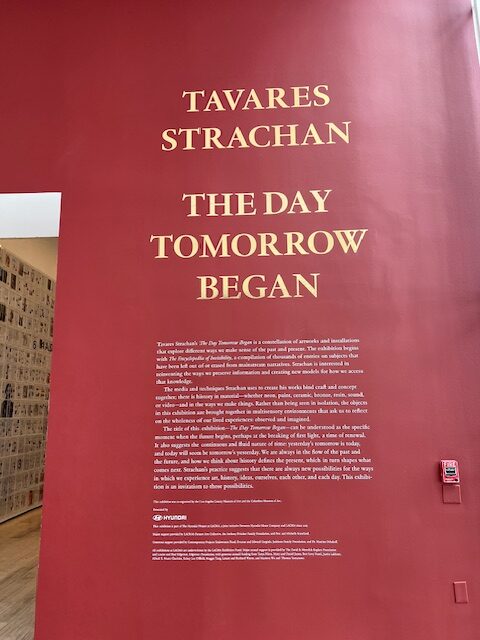
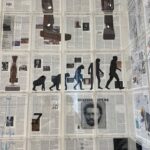
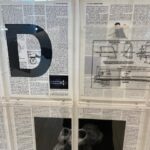
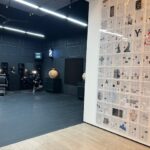
Tavares Strachan: The Day Tomorrow Began, is an impressive, immersive series of installations which connect the viewer with the subject of the Black diaspora through resonant, experiential settings. Spread through seven galleries, the exhibition begins with the Encyclopedia Room, a wall to wall, 2,000-page Encyclopedia of Invisibility that riffs on the Encyclopedia Britannica. Illustrating information that has been rendered either invisible or obscured, it covers subjects as diverse as mechanical devices and the music of Billie Holiday. With over 17,000 entries, the information is eye-openeing, both overwhelming and exciting.

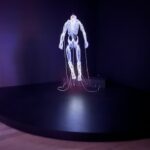
The Barbershop, a startlingly monochrome installation depicting a Black barber shop, is bold and involving. Here the viewer enters a complete world, both informational and personal. The installation has black walls,  black furniture, black implements, with the occasional pop of color. Even the barber pole is black and white rather than the traditional red and white. The room references  cultural icons, styling elements, and the importance of Black hair both culturally and personally.  The limited color palette somehow manages to sing with an internal burst of color.

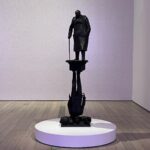
Then, as if feeding off this energy, the viewer next observes a wall of rainbow-colored neon, with paired quotes from James Baldwin and Mark Twain as mirror images. Mounted on a floating wall, behind this singular, stand-on-your-head to read it all image, is The Monument Hall. Here monolithic works capture images such as Henri Christophe, a figurehead of the Haitian Revolution, positioned on top of Napoleon Bonaparte, while a powerful Nina Simone stands over Queen Victoria. Each of these works is a part of the artist’s series In Praise of Midnight, acknowledging and subverting colonialism and repression.

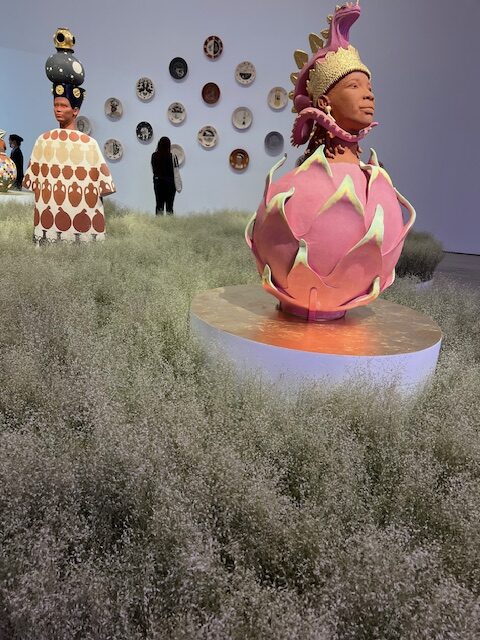
In the next gallery, the alluring odor of sweet grass rises from Rice Grass Meadow, in which actual growing rice grass surrounds beautiful ceramic sculptures and oval plates of renowned Black women, including diver Andrea Crabtree.

The final room revels in a different monochrome immersion than the sleek black contours of The Barbershop —The Wash House is all gray. This laundromat installation, fitted out with moving washers and dryers, and signs admonishing, advising, and exposing common idioms, is a cocoon of sorts, from which one might emerge with new information, new friendships and alliances formed while the laundry tumbles. Here the viewer also sees direct reference to what was witnessed in The Encyclopedia Room, the removal/whitewashing of history. A bleach bottle label reads “Kills 99.9% of truths, archives, and inconvenient voices.”

This is powerful, even thrilling work,  a fierce and fresh tomorrow created entirely by Strachen. Adding even more depth to the work are periodic performances throughout the exhibition by costumed characters inhabiting each room, performing in both spoken word and song. Riveting.

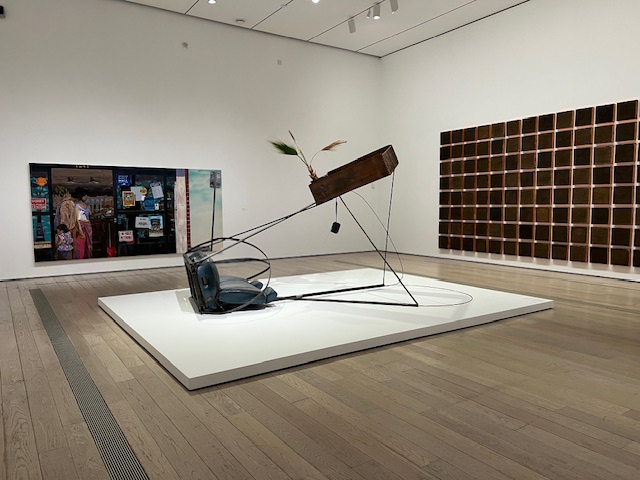
Also now open at LACMA, Grounded is a group show of 35 artists that look at the ground we inhabit as an exploration of memories, homelands, exploration, and purpose. There are so many terrific artists here, and their work dovetails to some extent with that of Strachen in regard to an exploration of colonialism and imperialism and it’s attempt to compromise or control indigenous cultures.

Nowhere is that more evident than in the absolutely mesmerizing 90-minute video installation In Pursuit of Venus by Maori artist Lisa Reihana, a mindblowing series of perfectly realized, 180-degree images that dazzle and define the impact of colonialism.

Touching upon just about any medium you can think of, from photography to painting to sculpture, the exhibiting artists offer passionate, insightful portrayal of their own experiences and a universal truth about homecoming and one’s place in the world. Along with Reihana, artists include Laura Aguilar, Clarissa Tossin, Ana Mendieta, Eamon Ore-Girón, Courtney M. Leonard, Rose B. Simpson, Leslie Martinez, Abraham Cruzvillegas, Siah Armajani, Patrick Martinez, Jackie Amézquita, Narsiso Martinez, Michael Alvarez, Nery Gabriel Lemus, Guadalupe Rosales, Guillermo Bert, Mercedes Dorame, Connie Samaras, Beatriz Cortez, and Carmen Argote.

The Day Tomorrow Began runs through March 29, 2026; Grounded through June 21th.  Both are must-sees, and highly pertinent to this moment in time.

  • Genie Davis, photos by Genie Davis