
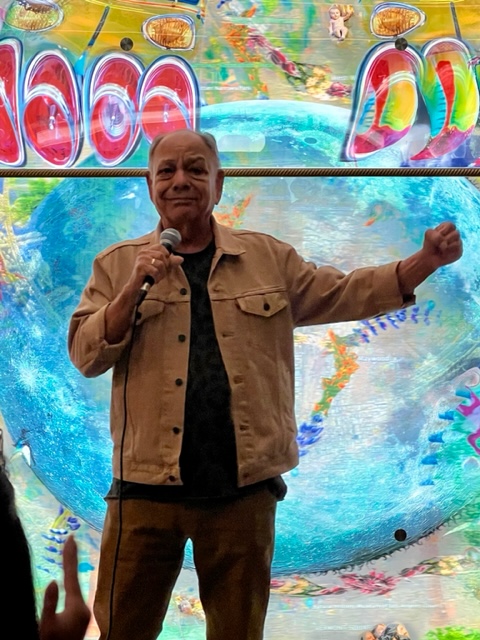
Zimmer Frei at Wonzimer: Journey to Home

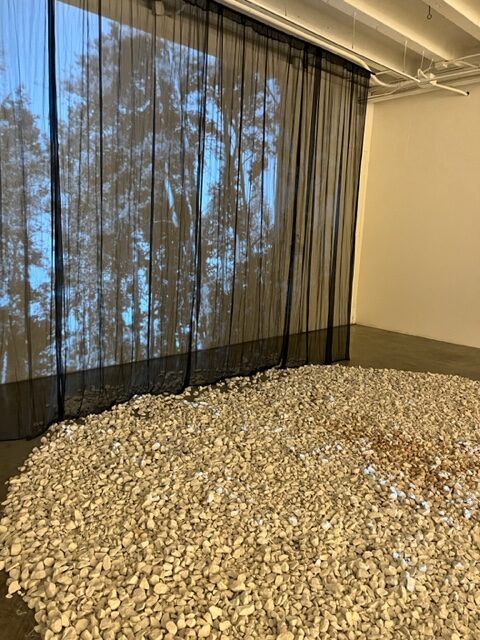
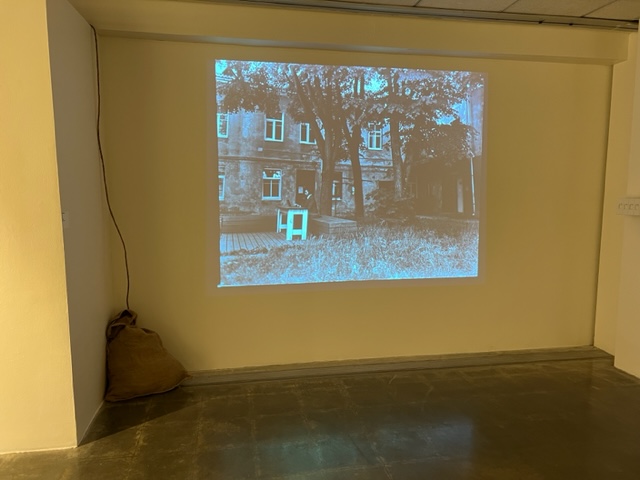
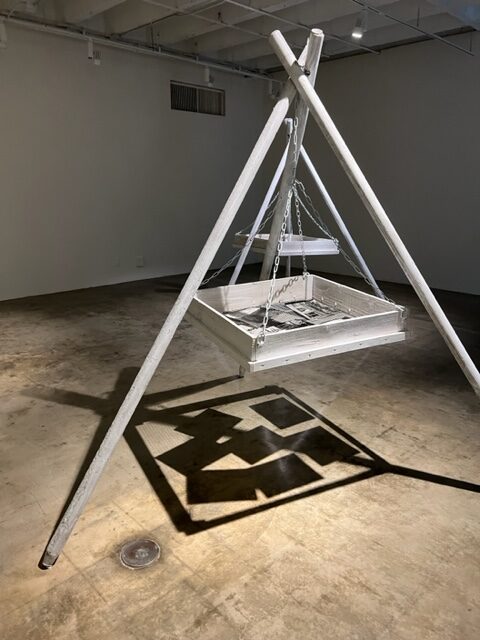
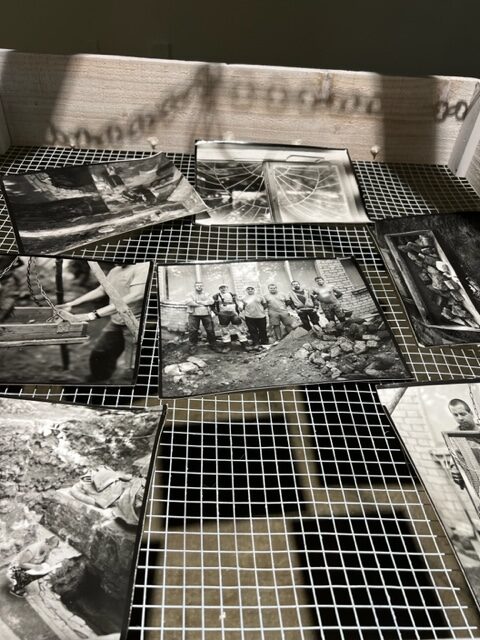
Can an exhibition offer something warm, welcoming, and cutting-edge immersive? Well, yes it can. Curated by Snezana Saraswati Petrovic, Zimmer Frei, now at Wonzimer Gallery brings together a cohesive, fascinating group of artists who explore what home means to them, as well as expressing a rich panoply of the experience of emigrating to the U.S. from a different country.

The word diversity has been too often misused, twisted to mean divisive. Here, its expression is just the opposite: the sum of our many different parts, of the blending of cultures and the unique individuality of each, forms the springboard for relationships, art, love, and hope.

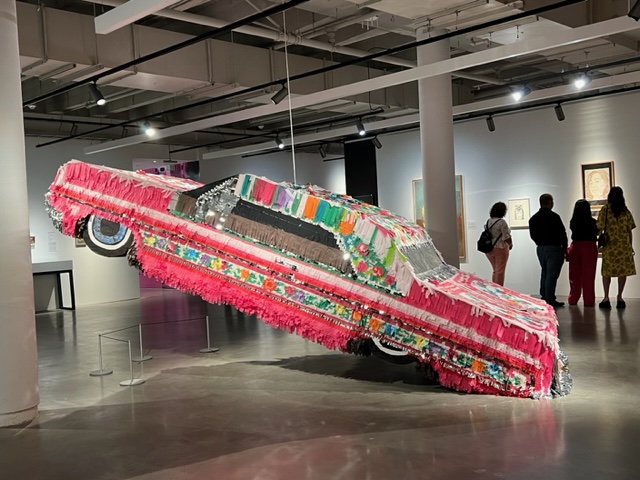
The international creators on display have made Los Angeles their home, but still managed to maintain their sharp, insightful voices as they explore the country and city in which they now live, form connections, retain roots in their heritage, and find a place to set those roots down in the new culture of our polyglot country. There are sculptures and dimensional experiential works, paintings and video art,  and performances.  Every piece is tactile and resonant. The curation also makes good use of Wonzimer’s cavernous new space, including it’s towering ceilings.

Exhibiting artists and their original homelands include:

Adeola Davies-Aiyeloja, Nigeria
Alaia Parhizi, Switzerland
Amanda Maciel Antunes, Brazil
Arezoo Bharthania, Iran
Carsten Bund, Germany
Chenhung Chen, Taiwan
Kalpana Vadnagara, India
Katya Usvitsky, Belarus
Marisa Caichiolo, Argentina
Max Presneill, United Kingdom
Nadir G Gergis, Egypt
Snezana Saraswati Petrovic, Yugoslavia
Tom Dunn, Australia


Dunn’s black and white video art pulses with energy, humor, and joy; Presneil’s vivid abstract canvas exudes power and light.

Petrovic’s own vine enclosed haven – replete with a “magic” AI mirror that also forms a terrific selfie spot, is rich and green, while Usvitsky’s fabric sculptures are presented here partially suspended, soft and fecund, like a nest on a cloud.

Gergis offers a dark and deep riff on the Coptic icon that speaks to the inner workings of the soul. Parhizi provides richly colored narrative painting that pairs beautifully next to Gergis work.

Vadnagara, working in a variety of mediums including fabric, gives viewers a vibrant palette and involving textures. On opening night, the artist also gracefully demonstrated the creation of nan bread with the gestures of a potter at a wheel.

Chen’s delicate hanging mesh sculptures contrast beautifully to her more solid metal and parts floor sculpture that recalls the shape of a volcano in form.

Bund’s video work is a resonant, shifting piece that moves, flower like, between face and abstract form.

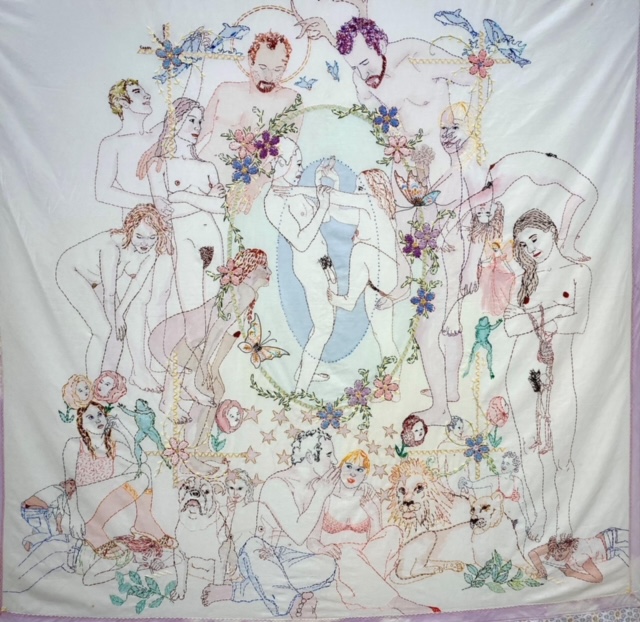
In the foreground, above, is a scroll, hand embroidered by Antunes.

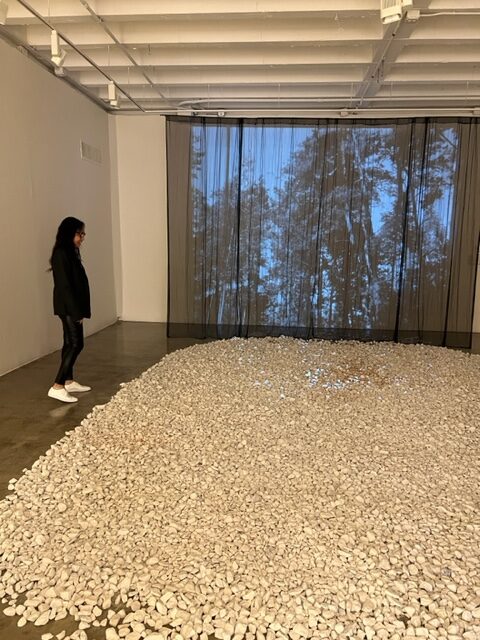
Caicholo creates a grass and earth miniature landscape along with a video installation that interacts nicely with Petrovic’s Edenic recylable plastic zip tie and fresh hanging orchid garden across the room. Also on view from Caicholo is a collection of silver, an assemblage provocatively filled with and using hair, Caicholo’s commentary on heritage, borders, and their transitory, arbitrary nature.

Antune’s textile sculpture and hanging wall scroll both lend an air of profound mystery and magic to her own travelers story. Antunes also created a tour-de-force performance piece, Memoryhouse, which she presented this past weekend.

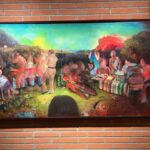
Davies-Aiyeloja gives us a haunting, purple-hued image of women travelers in a lustrous painting.

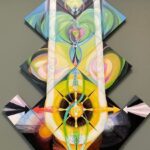
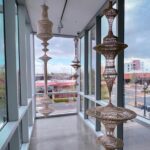
Bharthania has a floor to ceiling stunner as delicate and intricate as the wings of a butterfly or a space kite, seen above.

There is also a singular “collage” of sorts in Zimmer Frei, with objects of signficance to each artist laid out in a mandala-like circle around a robe once worn by Usvitsky’s grandmother.

The exhibition title referes to a German phrase for vacancy, evoking that “welcome” or “vacancy” sign and fond memories of travels during Petrovic’s childhood with stays at private homes or B&Bs. This collection of works allows viewers to explore and move similarly with nomadic joy, being equally welcomed as we recall what we have, had, and want in a home, both physically and metaphorically, through art.

The exhibition runs through April 7th, with an artist dinner March 31st from 5:30 to 7:30 at the gallery, followed by short film screenings of works never before seen in the U.S. by Petrovic, Vojislav Radovanovic, and Neša Paripović.

Go get yourself welcomed!

  • Genie Davis; photos by Genie Davis


Some Matters are Sacred – Hung Viet Nguyen at Matter Gallery

How to describe the work of artist Hung Viet Nguyen? It exudes peace and yet it’s vibrant; it’s meditative and exciting; it pulses with color and texture while exploring natural beauty; it’s resonant of place, yet reminiscent of a world beyond and within our own.

Watching Nguyen’s work over the last decade, he’s evolved into an ever more masterful artist, while maintaining his sense of innocent wonder and sheer delight. Of course, there are darker moments in his work as well, but on the whole, this current body of work, Sacred Matter, now at Matter Gallery in mid-city, is an expression of pure joy. You cannot experience one of his highly detailed landscapes without feeling uplifted.

His latest two series, Sacred Landscape V and Sacred Landscape VI are filled with depth and longing, a pure and transformative travel to a location Nguyen has experienced and wishes to keep present in his heart – as well as that of the viewer.

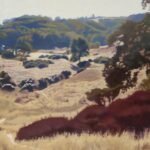
The show is rich with lovely, fresh work, with pieces culled from Sacred Landscapes III and IV along with the more predominant, recent series. Among my favorites in this exhibition are “Sacred Landscape V #63,” in which a field of golden flowers in the foreground is balanced by what look like glacial mountains across an aqua body of water – a landscape that reminds me of Iceland; and the desert hills landscape behind another field of flowers, these in orange and dark red of “Sacred Landscape VI #5.”

Both may be favorites because they recall locations special to me, or it may be the contrast between floral blooms and rugged mountains.

The vast expanse of “Sacred Landscape V #57” dazzles with waterfalls, volcanos, ocean waters, glaciers, icy bays, flowering trees, a mysterious orange sky, and floating bits of pink clouds.

This is a painting a viewer could study for days, immersing themselves in landscape and form, in the depths of the sea and waterfalls, finding the small, happy figures of swimming humans, watching the small ice masses bobbing on the more distant, obviously colder sea.

There are a number of “Gate” paintings within the works on display. The mosaic-like cavern entrance under a glowing, molten sky in “Gate #1, Sacred Landscape VI #7” in one such work; a diminutive but powerful 12” by 12.”  “Gate #3 Sacred Landscape VI #11” is a considerably larger canvas, with the moon rising behind the gate against a blue-black night sky, and the hills around the gate revealing ribbons of streams and rivers traversing their sides. “Gate #2, Sacred Landscape VI #10, “with the large, scored boulders on either side of it, feels most like a portal, to another dimension, or a new view of our own, or perhaps, a celestial paradise. The gate may be narrow, but strive to enter here.

Newer among Nguyen’s subject matter are night skies, and one stellar example here is the star-speckled navy-black sky reflecting into a far lighter blue, crystalline pool in (first of two images, below) “Sacred Landscape V #22.” Both the stars and a large rock in the center of the water reflect into the clear depths, while the land around it looks like a quilted or mosaic landscape of plants or farms or colorful homes as if viewed from a great distance above. It is easy to sense a grand and peaceful view of our world as seen floating above it in the profound stillness – and yes, sacredness of Nguyen’s art.

Using a palette knife to build up and manipulate his use of oil paint into textures and patterns, Nguyen works spontaneously he says, and while his subjects – his sacred landscapes – may stay the same over time, the colors and compositions vary from bright to pastel, to grays and saturated. His movements and special techniques are evolving as does his palette.

And whatever direction his art may take, whether depicting drifting bits of fog, narrow crevices, or the pink downward curves of a vulvic-like volcano, Nguyen amazes and enchants with a thrillingly original universe comprised of strange yet recognizable beauty.

The exhibition runs through April 2nd; artist talk at the gallery March 19, 2-4.

  • Genie Davis; photos by Genie Davis
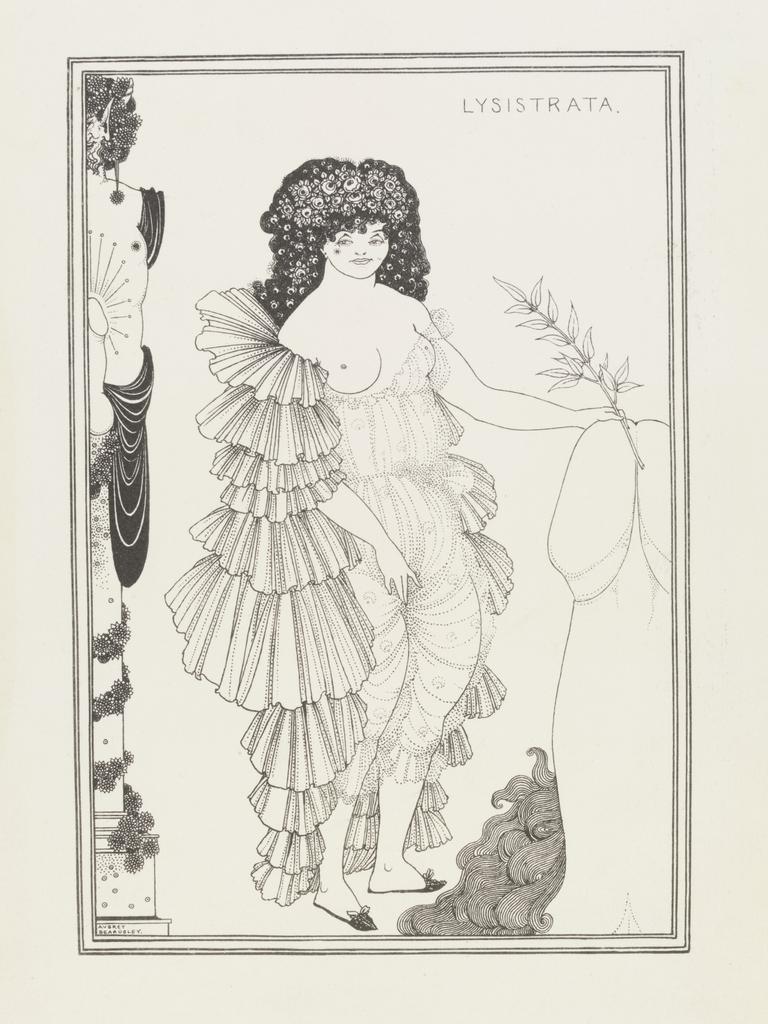
 

AstrotheBaptist Takes Us Radiantly Home in Space

The first solo exhibition by astrothebaptist, a.k.a. LJ Kim, Home in Space, is a dazzling, metaphysical wonder.  The artist’s chosen name is appropriate – he is leading his viewers, literally and figuratively to see the light. Creating rainbows and patterns using glass and light, astrothebaptist transforms image into something both transcendent and empowering, creating a new way of seeing color and light that uplifts and resonates.

Exhibited in a Glassell Park pop-up gallery space through March 19th, seeing this radiant work lifts the viewer into an entirely different place. Having transformed the gallery space into a black box experience, he shows visitors how he interacts with and transforms a single source of white light using dichroic beam splitters. In this way he reflects different parts of the color spectrum against a canvas, creating a dimensional wall sculpture presented with painterly skill from beams of light and the special positioning of the glass he uses.

The works are both vibrant and mysterious. During Home in Space, astrothebaptist not only shows his dimensional light paintings, he demonstrates his process, and how he can change a work by manipulating the position of glass pieces and light beams. Just as watching an involving movie lifts the audience out of the prosaic space of the theater and into another world entirely, so too does this artist’s brilliant rainbow of work.

As astrothebaptist’s first solo exhibition, the exhibition’s beauty and unusual materials are perhaps closest to a kind of floating neon in appearance, more than any other form. He describes the exhibition as one in which viewers are invited to join on a journey to the “far reaches of the cosmos, where the details of everyday life fade away.” Such a description in other hands might be considered hyperbole, but not here.

Manipulating different wavelengths of light, the artist shapes the colors and patterns almost as if he is sculpting a less ephemeral material. It’s a zen-like experience for both the artist and the viewer, one which the artist hopes will expand a personal view to one that is connected to “the wide world around us.”  It also connects us with a true sense of home, and what that means for each person.

The New Jersey-born artist himself says he felt estranged from the concept of a permanent, structured home, raised abroad in a variety of very different locales by his Korean immigrant parents, returning to the U.S. after many years. According to the artist, “Through my study/play and exploration of light, I have found a different perspective on what home can mean. When I look at light and the way it behaves, from its reflections and refractions to its absorption and mixing of different hues to create new colors, I see a metaphor for the way cultures and perspectives interact and evolve over time.” He adds that “Light is constantly traveling and connecting everything in the universe, just as our experiences and identities are constantly evolving and shaping one another. It’s this idea of home as a dynamic and interconnected concept, rather than a static place.”

In short, his sense of belonging has found a center from a cosmic distance, a perspective born of color and light, providing a mind altering and heart-opening window to the world that is perhaps as resonant and all-encompassing as a NASA astronaut’s view of Earth from distant space.

“For me, the concept of ‘home’ has always been a complex and evolving one. As someone who has lived in different places around the world, I never felt like I had a fixed home in the traditional sense,” he asserts. By playing with light and color, I hope to convey a sense of belonging and wonder that transcends physical boundaries and celebrates the unity of all things in the cosmos. For me, this is what makes working with light such a powerful and transformative experience.”

The eleven astonishing permanent, wall-mounted artworks in the artist’s first exhibition provides viewers with the same perspective of wonder and joy, innocence and power.

He explains that “As an artist, what draws me to working with light is the multifaceted nature of this intangible medium. On one level, light has a deep spiritual significance, with many cultures and religions using it as a symbol of life or a higher power.” He adds that the unique qualities of light, its capability for movement, reflection, refraction, and ability to change color through the introduction of filters or layers has created a vast, exciting, and playful medium for him. “Working with light is like exploring and discovering something new each time, with endless possibilities for creation and animation. In a way, it is a metaphor for the mixing of cultures and experiences, just as light mixes and blends to create new colors and shades.” In short, using light as his medium, astrothebaptist explores something deep and vibrating at the heart of human nature, or perhaps of nature itself.  “I tap into this sense of discovery and wonder and create a space where people can connect with the natural beauty of the world around them.”

The artist had a flourishing career as a filmmaker and working in film production, for over 15 years.  Both his film career and the pandemic shutdown in part led him to create this whole new box of light “crayons,” as he describes his material.

“In my various roles on film sets, I’ve always been attentive to the quality and nuances of lighting…I’ve spent many years color grading, which plays into my strong interest into color science,” astrothebaptist notes.

This attention to technical elements has, he says “heightened my sensitivity and receptivity to the intricate details of light manipulation.” When COVID-19 brought the film industry to a halt, he finally had the time to dive deeply into the way he was experimenting and playing with dichroic optical filters, a passion he’d discovered only about 6 months before the lockdown, allowing him to fully journey from discovery and exploration into craft and form.

“Finding my original four ‘crayons’ of optical dichroic filters was a natural part of my exploration phase. I scoured the internet for all types of affordable dichroic filters, including cubes, vinyl, glass, and more. However, it wasn’t until I began working on my solo show that I realized just how difficult it was to get a hold of the specific type of optical dichroic filters I was using,” he says. Because he needed to commit materials to permanent pieces, he searched long and hard for an optics lab that could manufacture filters to his exact specifications. Despite the challenge and financial risks, he obtained three new filters that provided him with new options with which to create his art.


And what an art it is. There are flowers and geometric forms and mysterious orbs within his work, which he describes as “a celebration of the intersection between art and science. Through my light art installations and space-inspired pieces, I hope to inspire curiosity and wonder about the cosmos, while also exploring themes of human connection and our place in the universe.”

While that’s no small feat, astrothebaptist pulls it all off. The patterns and colors that emerge and the colors that explode are entirely unique and exceptionally, even spiritually, involving for the viewer. It is the kind of art that whether placed in a gallery, home, or museum, it can be viewed many times, and each time the viewer will be compelled to go deeper into its meaning and beauty.

“Kandinsky, one of my biggest inspirations, said it best in Concerning the Spiritual, ‘Color is the keyboard, the eyes are the harmonies, the soul is the piano with many strings. The artist is the hand that plays, touching one key or another, to cause vibrations in the soul,’” astrothebaptist asserts. “Playing with the animation, shapes, and colors has become the way I feel ‘vibrations in my soul.’ He believed that art should move beyond simply depicting the physical world and should instead evoke emotions and spiritual experiences through the use of color, form, and composition.” Kadinsky also didn’t start his art career until the age of 30, the same age astrothebaptist discovered optical dichroic filters, he notes, adding to the sense of connection. Stephen Knapp, who created light paintings with dichroic filters and French conceptual artist Daniel Buren, who works using colored vinyl over windows to create shadows of color using shifting sunlight, are additional inspirations.

Hoping to create both a public art installation and a musical light show in the near future, astrothebaptist says Home in Space “represents a significant moment in my artistic journey…my first showcase of any work featuring dichroic glass and light. The result is a journey through the darkness of the cosmos, where each piece of art is revealed one by one, through the interplay of light.”

As he illuminates each piece one by on, explaining both his process and journey he allows viewers to discover something new with each image, watching the transformation of glass and canvas into alchemic color and visual magic.

“As the finale, I added a live light show to music, followed by a casual monologue…[sharing] my personal story of discovering my love for playing with light and color.” He says he had three key aims for the exhibition “to educate, inspire, and connect viewers with the power of light.”  But, he may have left out the part of the exhibition that most spoke to me: he has created a world within or beyond our own, and an artistic journey like no other witnessed in my viewing of hundreds of art exhibitions. To say astrothebaptist’s work is special is far too small a summary.

With Home in Space about to close, the artist’s next show will be at the Brewery Art Walk this coming April 29th and 30th. While he will not be able to provide a full guided experience there, he will be exhibiting many of the same mind-blowingly lovely pieces, and perhaps including once again his personal collection of vintage tin space toys, inspirations, and digital photographs of previous works.

To learn more and experience astrothebaptist’s art, visit him at: www.astrothebaptist.space

  • Genie Davis; photos by Genie Davis and Megan Johnson 
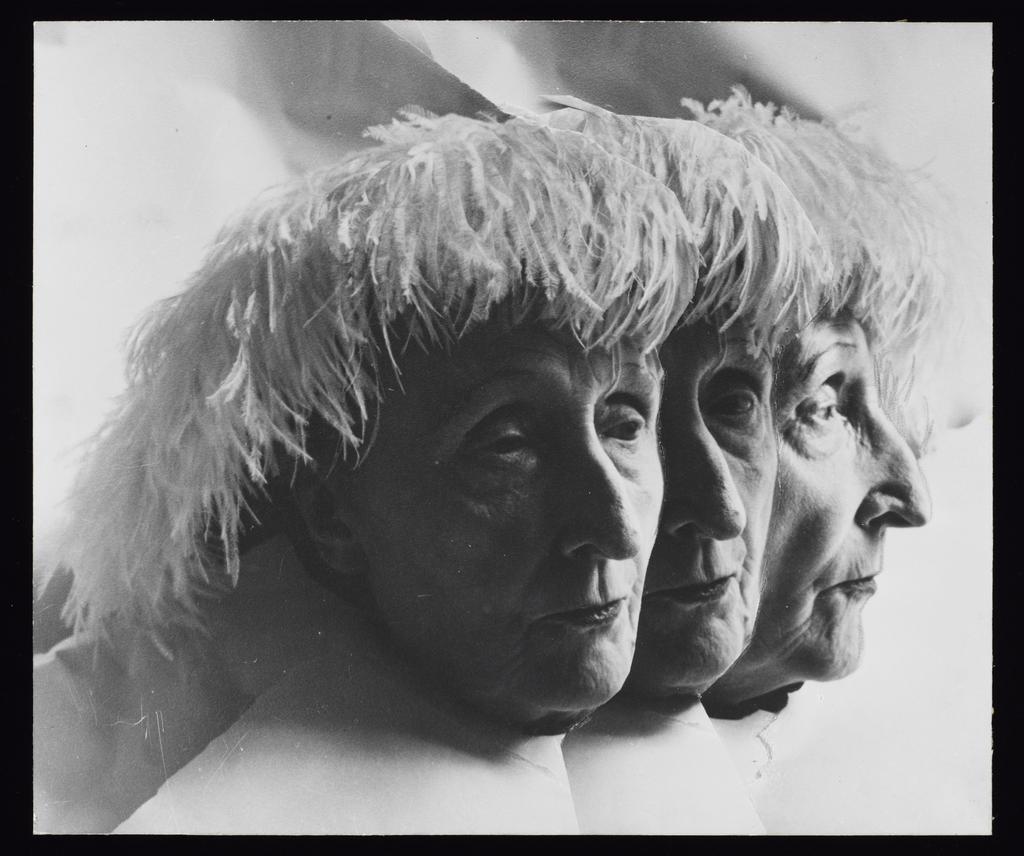
Hyde Park Gallery LA Opens March 4th with Stunning Glass Art from Nao Yamamoto

Glass and sculptural artist Scott Slagerman is opening the new Hyde Park Gallery LA, an exciting addition to the Los Angeles art scene and one he calls “spontaneous…I had no intention of making a gallery when I bought this building,” he explains. “I was renovating the space for my studio, and realized the front area was the perfect space for a gallery and showroom.” Slagerman says Los Angeles has  a dearth of new spaces for young, talented artists, and a lack of exhibition locations for glass artists in particular. Slagerman works in metal, wood, and glass, and has sculpture in the permanent collection of the Decorative Arts Museum in Paris.
For the first exhibition at his new gallery, Slagerman is presenting a solo show from glass artist Nao Yamamoto, titled The Altar. The artist appeared on season 2 of the Netflix series Blown Away.  At Hyde Park Gallery LA, her exhibition is highly pertinent for the space: the renovated building was once a church, and Yamamoto’s work is placed where a religious altar once stood.

“Nao represents a very major part of the LA glass scene, so it is exciting to have her here. She’s never shown in Los Angeles before,” Slagerman relates. “Her art fits the location perfectly.”


Yamamoto says her work for The Altar is comprised of three major wall installations with multiple pieces involved in each. “I have been shifting my ideas to think about the function of art, and why it exists. I am here to create an experience where the viewer is a real part of the show, where the viewer completes the show.” She adds, “I was really focused on creating a whole new coherent space, making new work made just for the gallery.”  The artist encourages viewers to experience their sixth sense, and engage a connection with inner peace. Works include lustrous lotus flowers, emerald leaves, natural crystals, and representations of candle flame, as well as geometric pieces that evoke representations of the “third-eye” and cosmic intuition.

While subsequent exhibitions will focus on the Los Angeles area glass art scene, the gallery will also feature exhibitions that include other mediums and artists as well, according to Slagerman. The LA-native asserts that glass art has a history in the city, and that the form is part of a burgeoning community. But with glass galleries of the past such as the Kurland-Summers Gallery long gone, it’s more than time for a new exhibition space.

“Our plan is to help people rediscover this under-represented and under-appreciated art form for both established and up-and-coming artists,” he says. The gallery will host artist receptions, art talks, special opening weekends, and tours of Slagerman’s own glass studio.

Born in Japan and working in the U.S., Yamamoto creates artwork that’s inspired by both the beauty of glass itself and the artist’s passion for nature. Her rich, colorful, and varied textures offer a resonating beauty that goes beyond the material of glass, creating inspirational works that soar with varied patterns and glowing light. For this exhibition, her works inhabit an almost ethereal, spiritual approach to glass work.

The Altar will open March 4th, with gallery hours from 11 a.m. to 9 p.m.; e 1-7 p.m. Sunday, March 5th, and 11-5 Tuesday-Friday. On Saturday, March 11th, hours are 11- 7, and a closing reception for Yamamoto’s work will be held from 5 – 9 p.m. on Sunday, March 12th.

Hyde Park Gallery LA is located at 2618 W Florence Ave, LA, CA 90043 in mid-city. For more information visit https://www.hydeparkgalleryla.com or call (310) 413-6493.