
AstrotheBaptist Takes Us Radiantly Home in Space

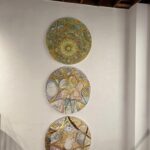
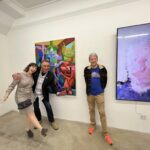
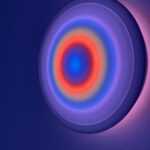
The first solo exhibition by astrothebaptist, a.k.a. LJ Kim, Home in Space, is a dazzling, metaphysical wonder.  The artist’s chosen name is appropriate – he is leading his viewers, literally and figuratively to see the light. Creating rainbows and patterns using glass and light, astrothebaptist transforms image into something both transcendent and empowering, creating a new way of seeing color and light that uplifts and resonates.

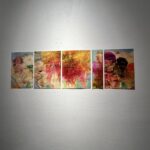
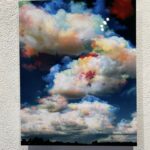
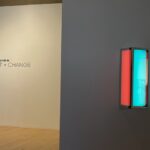
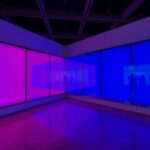
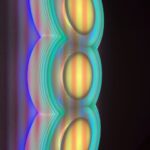
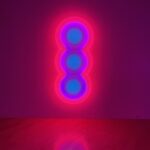
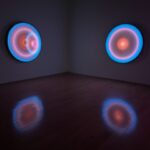
Exhibited in a Glassell Park pop-up gallery space through March 19th, seeing this radiant work lifts the viewer into an entirely different place. Having transformed the gallery space into a black box experience, he shows visitors how he interacts with and transforms a single source of white light using dichroic beam splitters. In this way he reflects different parts of the color spectrum against a canvas, creating a dimensional wall sculpture presented with painterly skill from beams of light and the special positioning of the glass he uses.

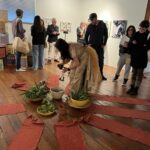
The works are both vibrant and mysterious. During Home in Space, astrothebaptist not only shows his dimensional light paintings, he demonstrates his process, and how he can change a work by manipulating the position of glass pieces and light beams. Just as watching an involving movie lifts the audience out of the prosaic space of the theater and into another world entirely, so too does this artist’s brilliant rainbow of work.

As astrothebaptist’s first solo exhibition, the exhibition’s beauty and unusual materials are perhaps closest to a kind of floating neon in appearance, more than any other form. He describes the exhibition as one in which viewers are invited to join on a journey to the “far reaches of the cosmos, where the details of everyday life fade away.” Such a description in other hands might be considered hyperbole, but not here.

Manipulating different wavelengths of light, the artist shapes the colors and patterns almost as if he is sculpting a less ephemeral material. It’s a zen-like experience for both the artist and the viewer, one which the artist hopes will expand a personal view to one that is connected to “the wide world around us.”  It also connects us with a true sense of home, and what that means for each person.

The New Jersey-born artist himself says he felt estranged from the concept of a permanent, structured home, raised abroad in a variety of very different locales by his Korean immigrant parents, returning to the U.S. after many years. According to the artist, “Through my study/play and exploration of light, I have found a different perspective on what home can mean. When I look at light and the way it behaves, from its reflections and refractions to its absorption and mixing of different hues to create new colors, I see a metaphor for the way cultures and perspectives interact and evolve over time.” He adds that “Light is constantly traveling and connecting everything in the universe, just as our experiences and identities are constantly evolving and shaping one another. It’s this idea of home as a dynamic and interconnected concept, rather than a static place.”

In short, his sense of belonging has found a center from a cosmic distance, a perspective born of color and light, providing a mind altering and heart-opening window to the world that is perhaps as resonant and all-encompassing as a NASA astronaut’s view of Earth from distant space.

“For me, the concept of ‘home’ has always been a complex and evolving one. As someone who has lived in different places around the world, I never felt like I had a fixed home in the traditional sense,” he asserts. By playing with light and color, I hope to convey a sense of belonging and wonder that transcends physical boundaries and celebrates the unity of all things in the cosmos. For me, this is what makes working with light such a powerful and transformative experience.”

The eleven astonishing permanent, wall-mounted artworks in the artist’s first exhibition provides viewers with the same perspective of wonder and joy, innocence and power.

He explains that “As an artist, what draws me to working with light is the multifaceted nature of this intangible medium. On one level, light has a deep spiritual significance, with many cultures and religions using it as a symbol of life or a higher power.” He adds that the unique qualities of light, its capability for movement, reflection, refraction, and ability to change color through the introduction of filters or layers has created a vast, exciting, and playful medium for him. “Working with light is like exploring and discovering something new each time, with endless possibilities for creation and animation. In a way, it is a metaphor for the mixing of cultures and experiences, just as light mixes and blends to create new colors and shades.” In short, using light as his medium, astrothebaptist explores something deep and vibrating at the heart of human nature, or perhaps of nature itself.  “I tap into this sense of discovery and wonder and create a space where people can connect with the natural beauty of the world around them.”

The artist had a flourishing career as a filmmaker and working in film production, for over 15 years.  Both his film career and the pandemic shutdown in part led him to create this whole new box of light “crayons,” as he describes his material.

“In my various roles on film sets, I’ve always been attentive to the quality and nuances of lighting…I’ve spent many years color grading, which plays into my strong interest into color science,” astrothebaptist notes.

This attention to technical elements has, he says “heightened my sensitivity and receptivity to the intricate details of light manipulation.” When COVID-19 brought the film industry to a halt, he finally had the time to dive deeply into the way he was experimenting and playing with dichroic optical filters, a passion he’d discovered only about 6 months before the lockdown, allowing him to fully journey from discovery and exploration into craft and form.

“Finding my original four ‘crayons’ of optical dichroic filters was a natural part of my exploration phase. I scoured the internet for all types of affordable dichroic filters, including cubes, vinyl, glass, and more. However, it wasn’t until I began working on my solo show that I realized just how difficult it was to get a hold of the specific type of optical dichroic filters I was using,” he says. Because he needed to commit materials to permanent pieces, he searched long and hard for an optics lab that could manufacture filters to his exact specifications. Despite the challenge and financial risks, he obtained three new filters that provided him with new options with which to create his art.


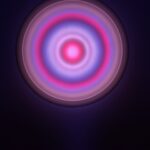
And what an art it is. There are flowers and geometric forms and mysterious orbs within his work, which he describes as “a celebration of the intersection between art and science. Through my light art installations and space-inspired pieces, I hope to inspire curiosity and wonder about the cosmos, while also exploring themes of human connection and our place in the universe.”

While that’s no small feat, astrothebaptist pulls it all off. The patterns and colors that emerge and the colors that explode are entirely unique and exceptionally, even spiritually, involving for the viewer. It is the kind of art that whether placed in a gallery, home, or museum, it can be viewed many times, and each time the viewer will be compelled to go deeper into its meaning and beauty.

“Kandinsky, one of my biggest inspirations, said it best in Concerning the Spiritual, ‘Color is the keyboard, the eyes are the harmonies, the soul is the piano with many strings. The artist is the hand that plays, touching one key or another, to cause vibrations in the soul,’” astrothebaptist asserts. “Playing with the animation, shapes, and colors has become the way I feel ‘vibrations in my soul.’ He believed that art should move beyond simply depicting the physical world and should instead evoke emotions and spiritual experiences through the use of color, form, and composition.” Kadinsky also didn’t start his art career until the age of 30, the same age astrothebaptist discovered optical dichroic filters, he notes, adding to the sense of connection. Stephen Knapp, who created light paintings with dichroic filters and French conceptual artist Daniel Buren, who works using colored vinyl over windows to create shadows of color using shifting sunlight, are additional inspirations.

Hoping to create both a public art installation and a musical light show in the near future, astrothebaptist says Home in Space “represents a significant moment in my artistic journey…my first showcase of any work featuring dichroic glass and light. The result is a journey through the darkness of the cosmos, where each piece of art is revealed one by one, through the interplay of light.”

As he illuminates each piece one by on, explaining both his process and journey he allows viewers to discover something new with each image, watching the transformation of glass and canvas into alchemic color and visual magic.

“As the finale, I added a live light show to music, followed by a casual monologue…[sharing] my personal story of discovering my love for playing with light and color.” He says he had three key aims for the exhibition “to educate, inspire, and connect viewers with the power of light.”  But, he may have left out the part of the exhibition that most spoke to me: he has created a world within or beyond our own, and an artistic journey like no other witnessed in my viewing of hundreds of art exhibitions. To say astrothebaptist’s work is special is far too small a summary.

With Home in Space about to close, the artist’s next show will be at the Brewery Art Walk this coming April 29th and 30th. While he will not be able to provide a full guided experience there, he will be exhibiting many of the same mind-blowingly lovely pieces, and perhaps including once again his personal collection of vintage tin space toys, inspirations, and digital photographs of previous works.

To learn more and experience astrothebaptist’s art, visit him at: www.astrothebaptist.space

  • Genie Davis; photos by Genie Davis and Megan Johnson 

Hyde Park Gallery LA Opens March 4th with Stunning Glass Art from Nao Yamamoto

Glass and sculptural artist Scott Slagerman is opening the new Hyde Park Gallery LA, an exciting addition to the Los Angeles art scene and one he calls “spontaneous…I had no intention of making a gallery when I bought this building,” he explains. “I was renovating the space for my studio, and realized the front area was the perfect space for a gallery and showroom.” Slagerman says Los Angeles has  a dearth of new spaces for young, talented artists, and a lack of exhibition locations for glass artists in particular. Slagerman works in metal, wood, and glass, and has sculpture in the permanent collection of the Decorative Arts Museum in Paris.

For the first exhibition at his new gallery, Slagerman is presenting a solo show from glass artist Nao Yamamoto, titled The Altar. The artist appeared on season 2 of the Netflix series Blown Away.  At Hyde Park Gallery LA, her exhibition is highly pertinent for the space: the renovated building was once a church, and Yamamoto’s work is placed where a religious altar once stood.

“Nao represents a very major part of the LA glass scene, so it is exciting to have her here. She’s never shown in Los Angeles before,” Slagerman relates. “Her art fits the location perfectly.”


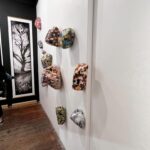
Yamamoto says her work for The Altar is comprised of three major wall installations with multiple pieces involved in each. “I have been shifting my ideas to think about the function of art, and why it exists. I am here to create an experience where the viewer is a real part of the show, where the viewer completes the show.” She adds, “I was really focused on creating a whole new coherent space, making new work made just for the gallery.”  The artist encourages viewers to experience their sixth sense, and engage a connection with inner peace. Works include lustrous lotus flowers, emerald leaves, natural crystals, and representations of candle flame, as well as geometric pieces that evoke representations of the “third-eye” and cosmic intuition.

While subsequent exhibitions will focus on the Los Angeles area glass art scene, the gallery will also feature exhibitions that include other mediums and artists as well, according to Slagerman. The LA-native asserts that glass art has a history in the city, and that the form is part of a burgeoning community. But with glass galleries of the past such as the Kurland-Summers Gallery long gone, it’s more than time for a new exhibition space.

“Our plan is to help people rediscover this under-represented and under-appreciated art form for both established and up-and-coming artists,” he says. The gallery will host artist receptions, art talks, special opening weekends, and tours of Slagerman’s own glass studio.

Born in Japan and working in the U.S., Yamamoto creates artwork that’s inspired by both the beauty of glass itself and the artist’s passion for nature. Her rich, colorful, and varied textures offer a resonating beauty that goes beyond the material of glass, creating inspirational works that soar with varied patterns and glowing light. For this exhibition, her works inhabit an almost ethereal, spiritual approach to glass work.

The Altar will open March 4th, with gallery hours from 11 a.m. to 9 p.m.; e 1-7 p.m. Sunday, March 5th, and 11-5 Tuesday-Friday. On Saturday, March 11th, hours are 11- 7, and a closing reception for Yamamoto’s work will be held from 5 – 9 p.m. on Sunday, March 12th.

Hyde Park Gallery LA is located at 2618 W Florence Ave, LA, CA 90043 in mid-city. For more information visit https://www.hydeparkgalleryla.com or call (310) 413-6493.

Gina Herrera’s Sculptures Survive War with Art

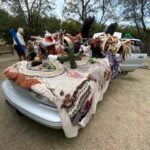
Artist Gina Herrera has fought many battles in her life, having served a tour of duty in Iraq. But she transforms war into art, as she does with her three new sculptures on display in the exhibition Surviving the Long Wars.


While the triennial itself is just three days in March, the art exhibition will run March 4th to June 4th in the Chicago Cultural Center, Hyde Park Art Center, and the Newberry Library. Surviving the Long Wars focuses on the histories that shape our understanding of warfare as well as visions of peace, healing, and justice.

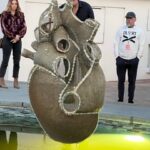
Herrera’s work here is a continuation of her signature sculptural line of metal and found materials. Drawn to using mixed media, she says “We have an abundance of discarded materials we throw away daily. I feel everything has some kind of history or message.” In her piece “The Liberty Master,” above, Herrera creates a beautiful metal work blossoming in vivid color, curling like a flower whose bud is shaped like a heart.

The message of the Chicago exhibition overall is to explore the alternatives to and repercussions from war, and Herrera’s work certainly fits that exploration. Kinetic energy fills every line of her metal work, as if the sculptures were captured and briefly frozen in mid-motion. They also express Herrera’s native ideology and beliefs, envisioned through her consistent art style and practice.


The Whimsical Diva, above

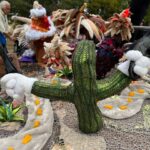
She welds her recycled materials into sinewy, almost hieroglyphic shapes, wrapping them fabric and discarded jewelry and buttons. She goes treasure hunting for society’s discards, transforming them into jubilant, lively creations that encompass a vast array of tossed-aside items, from lost property to plastic bubble wrap. “I look at everything as a possibility,” Herrera says. “We throw so much trash out, plastic stuff, which lands in the oceans, hurting the earth. It’s almost a sin to buy new things.”

Herrera describes found items as having character and energy, and adds that she is “partial to stuffed animals, [there’s a] living entity in them,” yet all the same they’re discarded. She gives used items the “opportunity to have a new life, continue the energy of the item.”

The artist feels that our discard of objects is like the way in which we discard people, and the lack of respect we have both for older, used items and our own elders. “Once you get to a certain age, you are useless, a burden to society.” This attitude discounts knowledge, including oracle language, and native culture, which is then forgotten, Herrera attests. “People don’t have a desire to look into their own history, [they] want to avoid history.”

As a Native American artist, she takes her current Native experience and uses that to make “commentary on the planet and future. We are still very contemporary, we are still fighting for the land, the soil, the earth.”  Thematically, Herrera work with time, the past, present, and future, and a connection to the earth.


A Virtuous Warrior, above

For the three sculptures the artist is displaying at the Chicago exhibition, she wanted to make sculptures with mannequin parts, and found a mannequin for use at a flea market.

“I want my viewers to think about the sacrifices that the U.S. armed forces have endured to uphold democracy. Maybe I subconsciously decided to use a mannequin [to] represent the masses of veterans who returned back home without limbs,” Herrera says. She also wants viewers to consider how fortunate they are to live in a country where they’re not afraid of losing their lives. “Many people in this country take for granted all the privileges we have…. How can anyone who served this country want to overthrow democracy?” She notes, “We…uphold the values and sacrifices of their brothers and sisters before them. This is the reason why we stand at attention when we are raising and lowering the flag.”

Along with a strong belief in upholding these freedoms, Herrera seeks to present, through her art, a focus on Native American history and its role in the present, for contemporary artists.  Her art presents the issue of discarding items, and infiltrating “our land, rivers, oceans, sea, forest, mountains, and air with our negligent behavior. We take and destroy our world but never give back with respect to all the gifts of Mother Earth.”

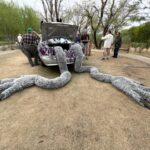
Herrera’s use of color and form is visceral, created through what she terms as a “very intuitive” process. “I do not pre-plan… I let the items or materials speak to me. As I am wrapping yarn, string, underwear, or fabric, I am conscious of my materials and do my best to use different patterns, textures, [and] materials so there is no repetition. I want each sculpture to look different from one another, to have their own identity and feeling,” she explains. “I go with the flow and make it a playtime – like when I was a child. I like to create voices, especially if I am using toys or stuffed animals, as I feel they still have a soul.”

Herrera’s sculptural approach is rooted in what she describes as “the aesthetics of the everyday.” Having served 25 years in the Armed Forces, she experienced, amid the devastation of combat, “the global impact of the systematic destruction of the planet…the long-term effects of conflict/war, including the exploitative, unsustainable, careless discarding of trash by the United States Military.”

These experiences led her to question her own artistic practices, and the desire to lessen her environmental impact. Beginning by photographing “the vastness of neglected detritus that could be seen for miles,” she soon extended her art practice to the creation of her 3- dimensional forms, using discarded objects and natural resources.

Serving both as a powerful response to the military industrial complex and the often-careless approach to the environment embedded in American life, Herrera infuses her work with the spiritual, the historic, and a uniquely bold vision. Her sculptures are both a call to action, to respect the past, and the gift of motion and mobility, while also offering a rich insight into the poignance and necessity of freedom and reinvention.

  • Genie Davis; photos provided by the artist

Crossing Waters Takes Viewers on a Luminous Journey

Crossing Waters: Contemporary Tongva Artists Carrying Pimugna, now at the Catalina Museum for Art and History in Avalon, is an exhibition filled with awe and wonder, exploring a rich cultural heritage too long unseen.

The art is a beautiful expression of the placement and interconnectedness of Pimugna, and its relationship to the greater world of Tovaangar and its people, the Tongva, as viewed through the alchemic lens of three contemporary Tongva artists.

First some background: Tovaangar is the Tongva name for whole or middle world – land, water, and the Original People. That world includes the Southern Channel Islands, including the island of Pimugna, often shortened to Pimu, or as you may commonly know it, Catalina Island. The islands, separated by the sea from each other and from the mainland are yet connected to both through paths on the water, with the underlying message being that the world and its people exist, and are still here.

The art in this exhibition has a rich palette of blues, reds, blacks, and browns. The walls themselves are painted blue, allowing a sense of immersion to occur almost immediately. It is as if one has taken a dive into the deep blue sea of the Tovaangar. The exhibiting three artists, Weshoyot Alvitre, Mercedes Dorame, and River Garza have created a stellar beginning to a partnership between the Catalina Museum of Art and History and the Tongva Community, recognizing the Tongva people as the first islanders of Santa Catalina. Creating the exhibit, under the auspices of the museum’s deputy director and chief curator Johnny Sampson, the artists had not worked together previously, but have nonetheless formed a cohesive, and highly spiritual body of work that dances with light and magic.

In the center of the semi-circular exhibition space, Dorame’s site specific installation “We Dance Across the Water – Yakeenaxre Naamkomokre Paar, 2022,” grabs the viewer’s attention upon entering the gallery space.

The installation rests on a series of six platforms that seem to hover above the floor. On the ceiling above it, surrounding a small skylight with a view of the clouds and sky, are a series of acrylic on canvas paintings that depict stars, islands, and other petroglyph-like patterns. They are suspended so that they billow outward, like sails on the ships carrying the Original People between the islands.

Sections of the same canvas materials, with less specific patterns, are spread across the low platforms aligned on the floor. On these platforms rest a variety of beautiful objects, as well as cinnamon – standing in as a substitute for the ochre with which the Tongva people created art works in earlier times; salt crystals – which are allowed to congeal and come apart again, forming new crystal patterns, and which here remind the viewer of fallen stars or snow flakes; and patterns created in red thread that serve as maps connecting the world of the past with today’s world.


There are also feathers, shells, stones, and a series of steatite carved objects from the museum’s collection, woven baskets from the museum’s collection, the artist’s cast- concrete star stones, abalone, and personal items from artists Weshoyot Alvitre and River Garza.

Dorame’s patterned pathways and billowing sails reveal the intricate pathways and knowledge of her Tongva ancestors, guided by the sky, the sea, and a knowledge of nature and spiritual life infinite and profound.

On the wall positioned to either side of Dorame’s installation, hang a galvanizing series of works by Weshoyot Alvitre, “Hi mo-yok’ mok: po-koo (No, He is not dead: #1 – #4).” The two acrylic on canvas works, #1 and #2, depict a man within a bird’s brilliantly red body. #3 and #4 are ink on board, black and white with an ochre-like circular halo of sorts behind the head of the birdman. The story behind these works refers to an incident that occurred in the 16th Century. Two large crows, alighted on rocks, having flown from a patio where sacred rituals were performed, were shot by soldiers for Spanish missionary Father Antonio de la Ascension. The birds were killed, and the people mourned them. These works are a response to that carnage and to the sacred nature of the birds that had rested on the patio. The artist focuses on a reinterpretation of this traditional western-culture narrative, successfully resurrecting and representing her heritage, and that heritage’s role in the present and future as well.


River Garza gives us the trickster and protector – Coyote, who fills both roles. His acrylic, marker, and spray paint  “Coyote in Red” wears dark glasses and carries one paddle; the mixed media color pencil, paint, and marker  drawing “Coyote Paddles” also explores the artist’s connection to Tongva seafaring culture, as does his human “Paddler with Hair Blowing the Wind,” and both his “Untitled (CA Indian Dreams), and “Red Basket” acrylic works, which evoke the patterns on heirloom woven baskets. The artist’s “Mo’omat (Ocean),” combines a thick and deep brown and black acrylic paint with elements of dentalium, abalone, mother of pearl, olivella shells. Here, the viewer also finds a woven pattern, as well as a face, as compelling as it is mysterious and fierce. Three smaller figures and a document regarding a voyage are a part of this stunning, layered piece. In each work, Garva uses his ancestral history and iconography, combining both with the contemporary in a recreation and preservation of the Tongva past.

Above, entrance to the exhibition; Deputy Director of External Affairs Gail Fornasiere and Deputy Director / Chief Curator Johnny Sampson

Together, artists and curator have shaped a beautiful, welcoming, and revitalizing series of images that speak to the epic past of the Tongva, respect for history of the native peoples, and the spiritual, cultural, and creative through line of Pimu. It is an exhibition of grace and wonder, of which the Catalina Museum for Art and History can be proud. Expect to see more exhibitions relating to Tongva culture and island history in the future.

Next Friday, March 3rd, the exhibition will be featured in the museum’s First Fridays presentation, Culture between Cocktails. From 5-7 pm the museum offers light bites and drinks while guests enjoy one of the last opportunities to view the Crossing Waters: Contemporary Tongva Artists Carrying Pimugna. The free event requires advance registration; a specialty cocktail, wine, beer and other beverages are available for purchase.

To visit the museum, you’ll want to catch one of the comfortable, fast Catalina Express Boats from Long Beach, San Pedro, or Newport Beach. For an even more relaxing experience, you can upgrade and enjoy a beverage and snack in the spacious Commodore Lounge. It takes approximately one pleasant hour to reach the island from the mainland; the museum is just a short and lovely stroll from the docks. Getting there to see this stellar exhibition isn’t just simple – it’s fun.

  • Genie Davis; Photos by Genie Davis and provided by the museum from James Kao Foto