


Antidote Through Art: The Work of Gregg Fleishman – Genie Davis
Los Angeles-based architect and designer Gregg Fleishman is exhibiting Antidote, a dazzling collection of functional art, collectible design, and large geometric installations just in time for LA Climate Week. The exhibition, curated by Jojo Abot, opens Thursday April 9th, presenting four decades of Fleishman’s work in geometric innovation in architecture, sculpture, and functional design.
The exhibition serves as an entry point to Fleishman’s structural research, work he began in 1972.
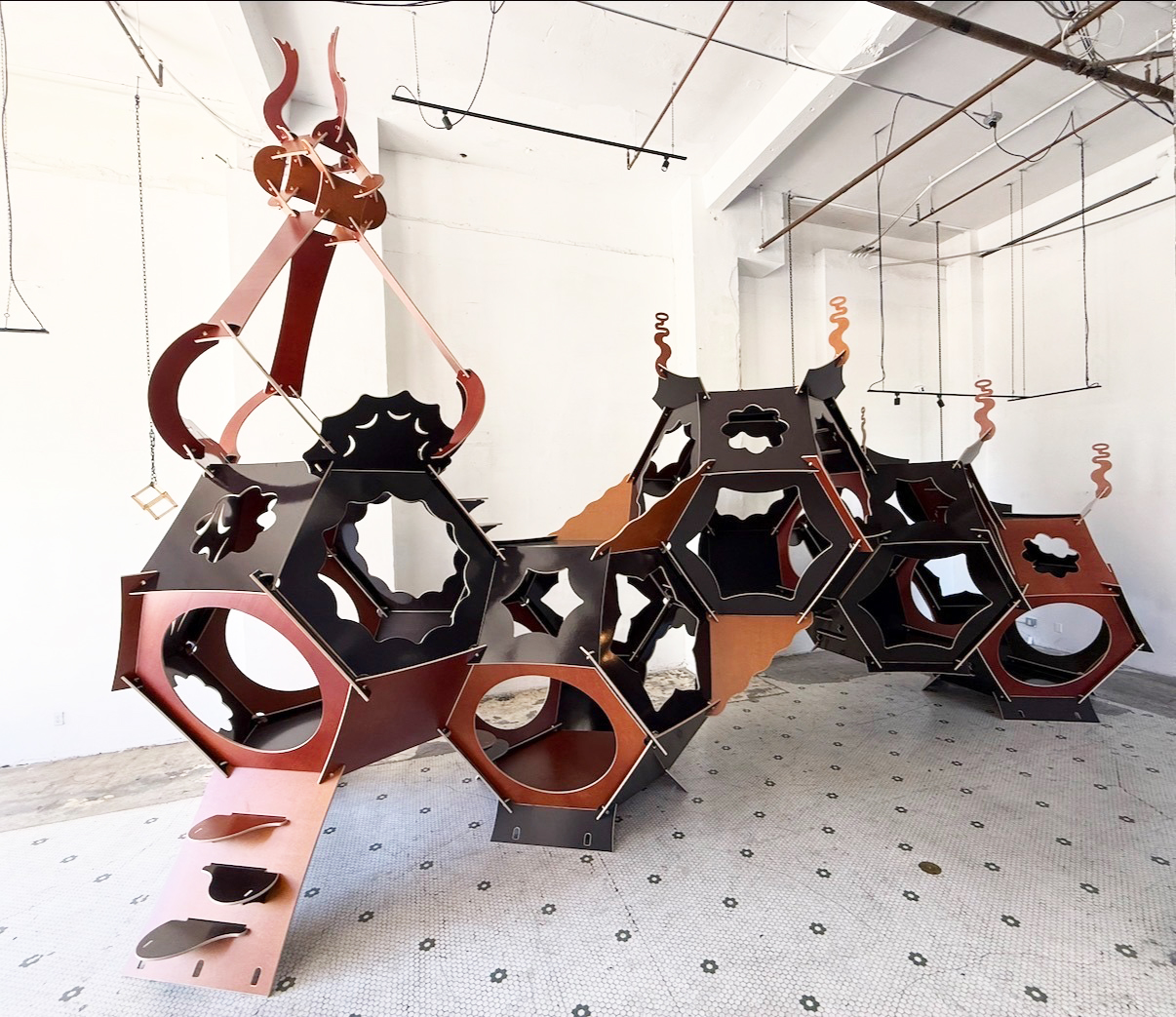
According to Fleishman, “I spent a long time studying how to build with geometry. We have a lot to show in that area,” he says of his work. “The last few years I’ve simplified some of my methods. I’ve been able to come with a whole range, a whole new series of avenues of exploration. We are showing different geometric worlds here in this exhibition.”
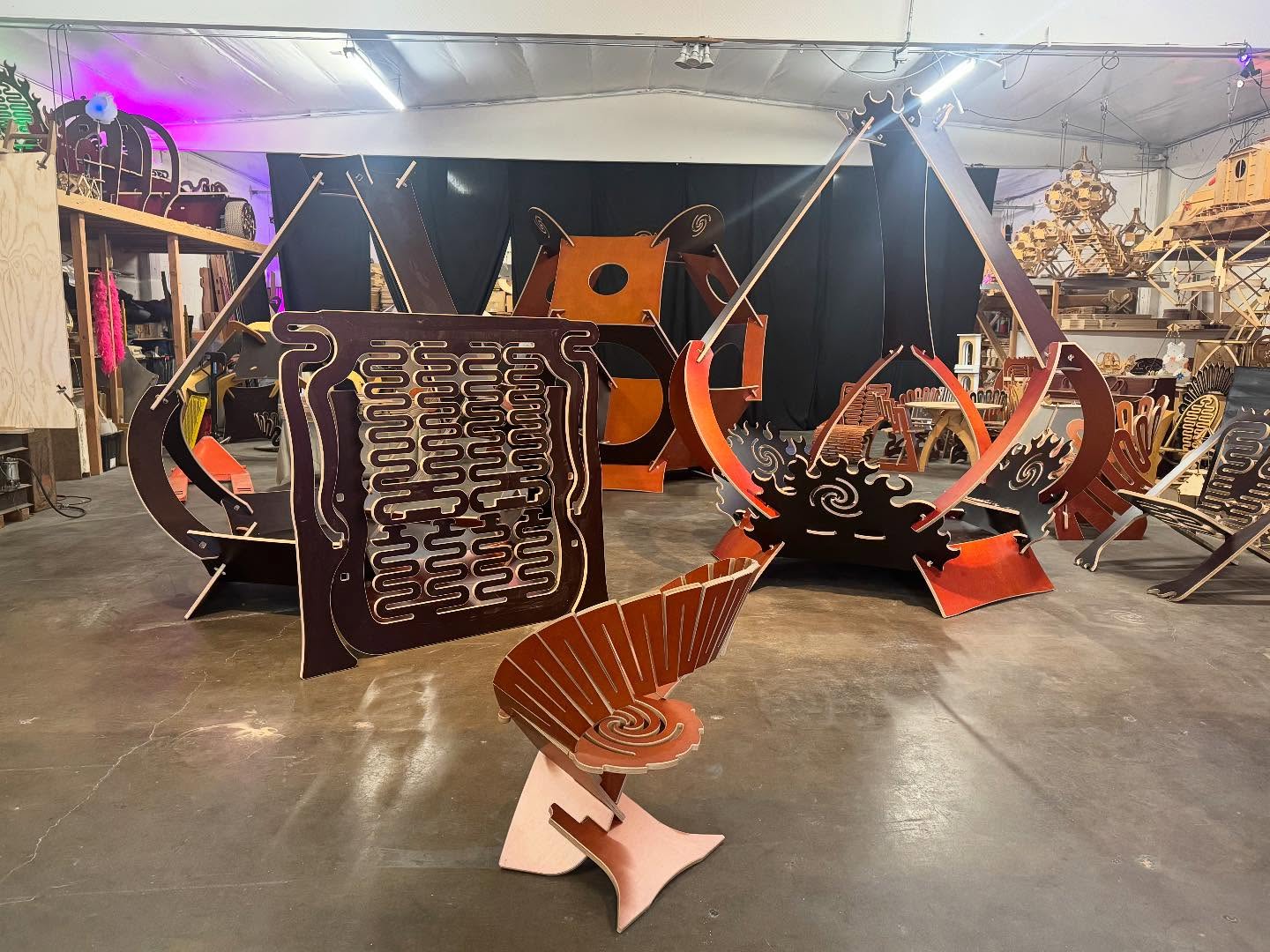
Asked to describe those worlds, he notes “One is based upon a truncated octahedron, another is a cube, and a third is a rhombic dodecahedron.” He asserts that while each is designed to fill a space, his true inspiration is “seeing how to do more with less, how to make sense of and to make the best output of geometry.”
Fleishman describes all geometric forms, and indeed, all geometry itself as “considered sacred geometry in a way, determined by how you use it and relating to it as something to be inspired by.” He relates that “There is very little work done in the 3D realm with geometry. There is a lot of 2D work, but in a building sense, sacred geometry has not been used, not in the sense that it is used to construct things in that area.”
All the same, Fleishman is using it. “We have the potential to build with these forms and I want to import these to people. What I am working on, what I am showing, these are a framework for further building and exploration, furthering the ways of working in this world.”
As a designer and architect, he says that he’s “made great strides in the past few years. My purpose is to elevate our consciousness in this new framework. It seems like with [the current] state of the world we perhaps need to do as much as we can as soon as we can in that area.”

He specifically desires to bring the world of sacred geometry “into our present reality.” Fleishman wants the viewers of his exhibition to “come away with an appreciate of the ability to create these geometric objects. There are so many uses for them, major uses.” He points out that “so far they are used as temporary structures in the festival world, but these forms have potential for housing as well. Their art and beauty in the festival world is basically designed as an adult playground, but that play can be transferred into a living environment.” He adds that “This kind of playfulness would improve the state of world. It would be an antidote to the poisons all around you in the world today.”
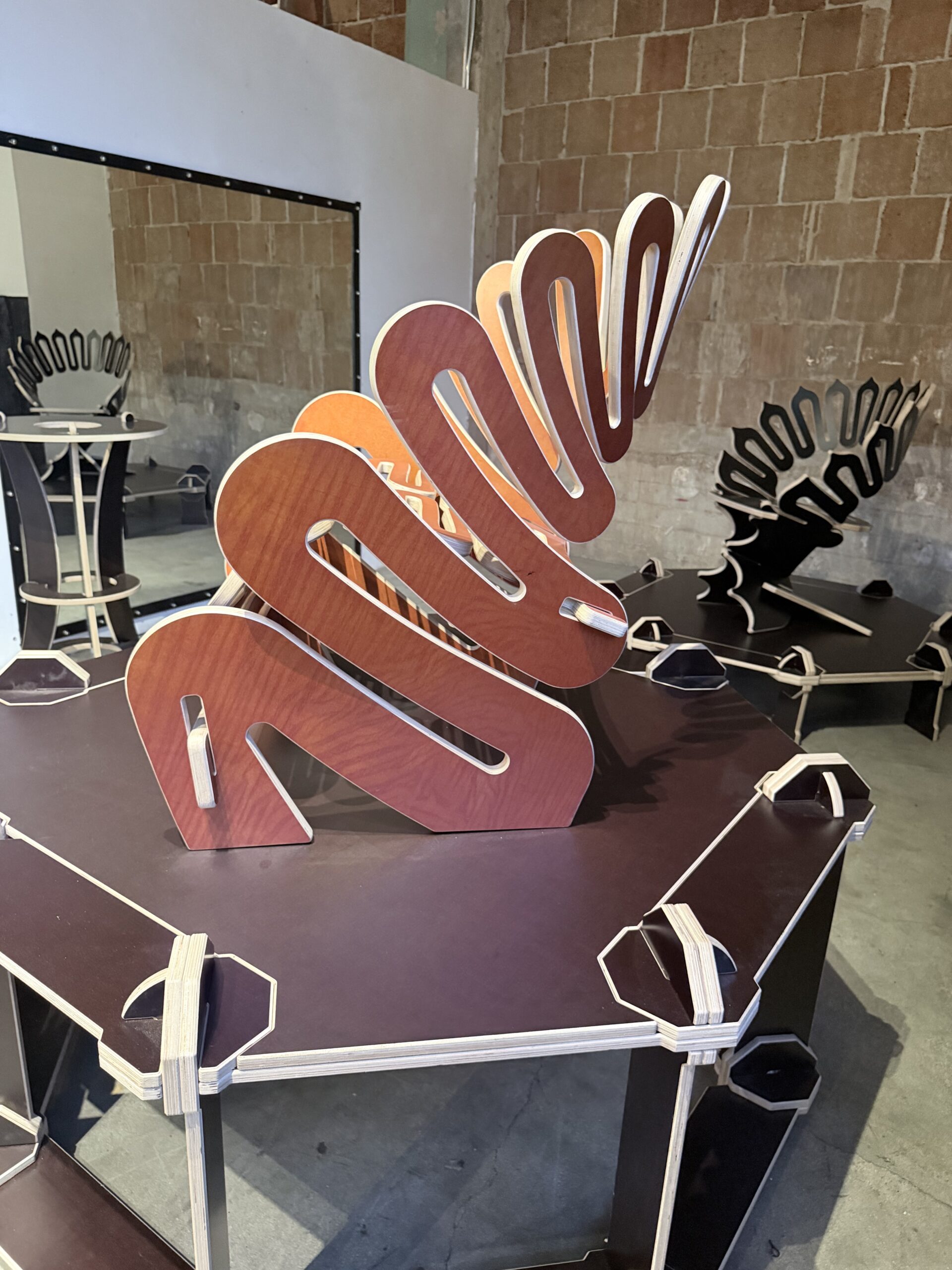
Along with these structures, Fleishman is also exhibiting furniture as an “early demonstration of what is possible using these forms. I have been doing this kind of work forty years and longer, creating work” that ranges from functional furniture to inhabitable structures.
Antidote activates the gallery space as an immersive environment using geometric thinking. The exhibition introduces Fleishman’s groundbreaking structural research to a new generation, highlighting the continued evolution of his practice.
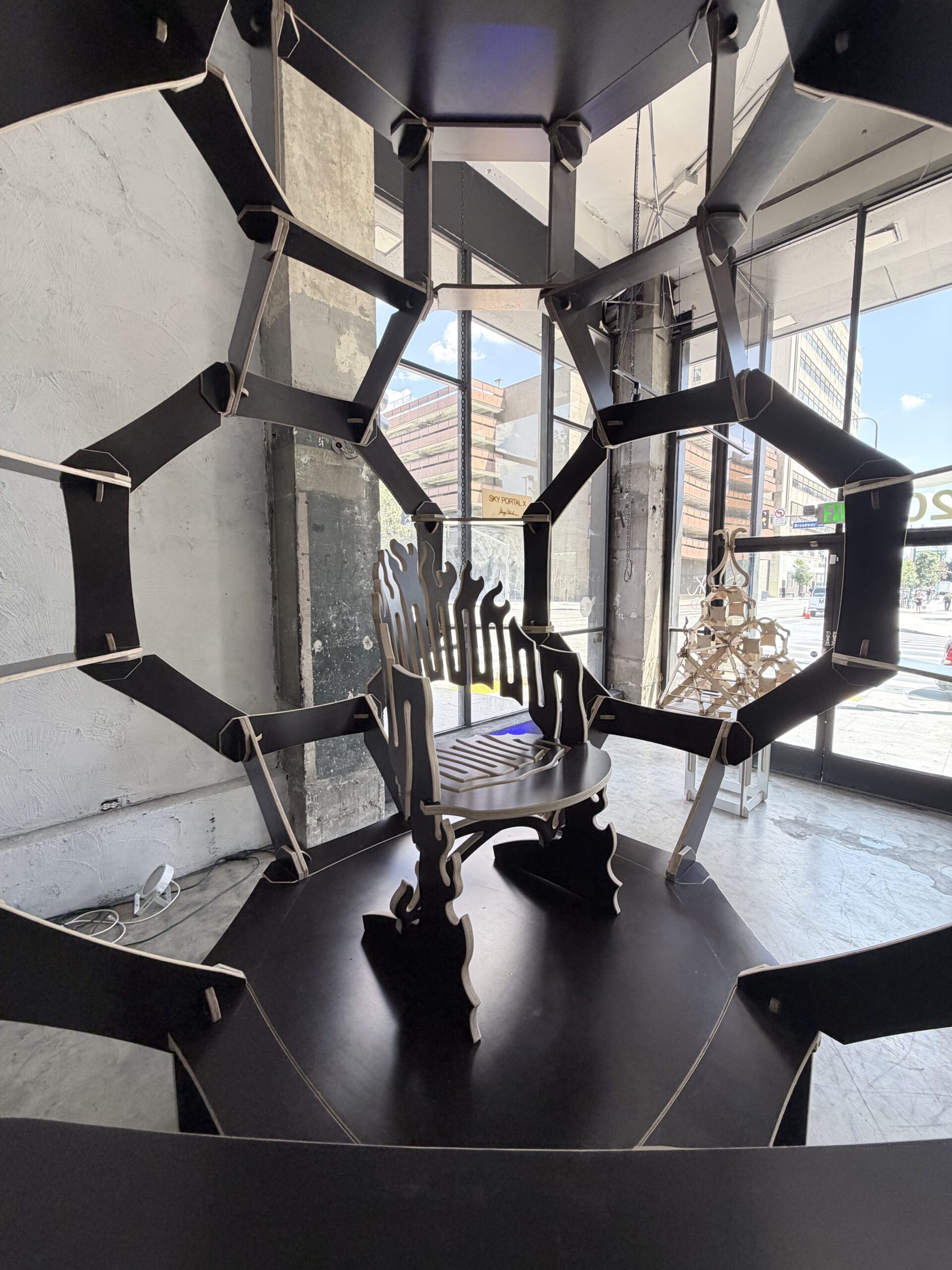
He sees the exhibition as a “spark, a glimpse into what geometry makes possible,” Fleishman enthuses.
He describes the chairs on exhibit as “studies in invention that led to larger structural work…There’s something inherently mysterious about polyhedral geometry, whether through sacred proportion or simply the complexity of understanding space in three dimensions. For me, the goal has always been to create work that is both playful and functional—structures that grow out of a long evolution of methods and that have the potential to change how we experience space and how we live.”
The exhibition features three works from Fleishman’s Otic Series, a group of pioneering modular assemblies such as “Otic Oasis,” “Man Base Pistil,” and “Pomo-Paradise,” each of which explore space-filling construction systems. Central to the exhibition are structural installations that reveal Fleishman’s long-term investigation into modular building systems and spatial environments, such as his. “Return of the Caterpillar,” which is a modular structure composed of interlocking geometric segments, that demonstrates Fleishman’s belief that architecture itself can behave as a living system that’s capable of growth, transformation, and adaptation.
“Mayan Tower (Junior)” is a vertically stacked geometric structure, that examines human-scale construction through interlocking modular components that are efficient, transportable, and can be capably assembled without complex tools or specialized labor.
Fleishman’s “Octo II” is a faceted geometric environment constructed using repeating octagonal elements. The work demonstrates structural repetition that creates both spatial rhythm and architectural strength.
Combined, each of these works serves as an exploration of modular construction versus standard building systems.
His sculptural furniture work with chairs presented as a design challenge using the artist’s “panel puzzle” system of precision cut plywood components. They are assembled without nails, screws, or glue to produce lightweight but structurally resilient furniture. Works such as the “Skyrocker” and “Broadway” are crafted from Baltic and European birch plywood.
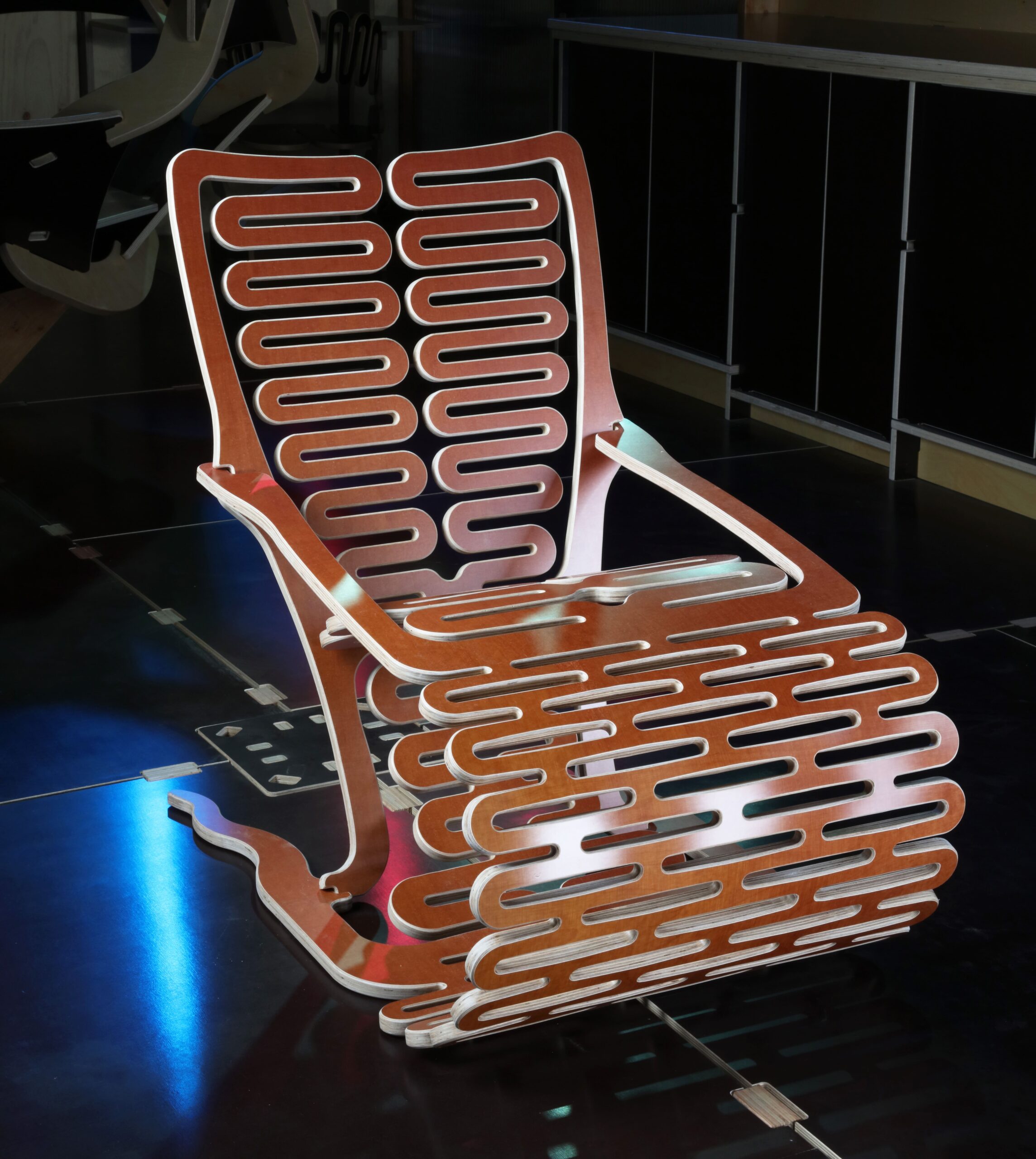
As part of Los Angeles Climate Week, Fleishman’s installation at Sky Portal X will be included in the city’s cultural programming. Antidote opens Thursday, April 9, 2026, from 6:00–9:00 pm at Sky Portal X in Downtown Los Angeles and will remain on view through Spring 2026, along with public programming and conversations exploring the intersections of design, architecture, and technology.
Sky Portal X is located at 201 S Broadway in DTLA.
- Genie Davis, photos provided by the artist and Evolution Media