
Monday and Tuesday in the Land of Film – Sundance Film Festival Heads to a Close

Monday, Monday – and Tuesday – I managed to take in ten films, including an outstanding documentary and an ultra-low-budget tale of teen angst.

Misha and the Wolves is nothing if not fascinating, particularly when you poise this story of delusion/deception against the last four years of American politics. Yes, there’s a sucker born every minute, particularly alluring for those who listen to a story the teller obviously believes is completely true. Misha Defonseca tells a winningly tall tale of living with wolves while on the run from Nazis, one she told in a book published by a small publisher who longed for more attention, and got it – but not in the way she imagined. With the help of genealogists and a journalist, the truth comes out – one I won’t reveal here, but suffice to say Misha’s story is just as unbelievable as it appears to be. They hype and the hoax is just one element in a compelling film.

Carlson Young directs and stars in The Blazing World, a stunning visual achievement dealing with the trauma of loss, the potency of the mind to control the narrative of the soul, and peripherally, the acceptance of a dysfunctional family leading to but not actually to blame for a horrific tragedy. In a search for her sister – lost to death by drowning or sucked into a black portal of demons, take your pick – Margaret traverses a series of dream worlds that leads to her own ultimate redemption. An exceptional film even more so considering its low-budget inclusion in the NEXT portion of the festival, it’s also a thought-provoking one, and one that thoroughly burrows into the viewer’s own psyche.

Eight for Silver is an elegant, much more vast production, a werewolf story also hinging on family guilt, but in a very different fashion. Writer-director Sean Ellis spins a classic Victorian take on the werewolf legend, with Boyd Holbrook doing a strong turn as a pathologist called in to uncover just what is going on in a dank English forest where slaughters of gypsies and guttings by werewolf are visceral and bloody. Curses and silver bullets and settings work well, but the pace was a bit slow given the subject; and the unexplored sexual frustration in the Laurent family between younger, pretty Isabelle and harsh older husband Seamus sat unresolved to the side. For the genre, it’s in need of a bit more sex appeal and less slowly paced acts of evisceration.

I loved Jockey – heartfelt, warm, small but shining character study. I note that this is the type of film I love to see and see too little of – a man has given his life to his passion, literally and emotionally. What does it feel like when that life is about to fade away? A gem of a film focused on the racetrack’s surrogate “family life,” versus the act of winning a race, it’s moving and graceful. Writer-director Clint Bentley is himself the son of a jockey, and he knows his setting as well as a carefully-fitted pair of riding boots. Clifton Collins Jr. and Molly Parker as long-time friends and jockey/trainer are riveting, as is Moises Arias as the younger man at the track. Already purchased by Sony, this is a film well-worth viewing.

As to Mayday – hmm. Quite a tour de force of a fever dream of feminism, director Karen Cinnore’s film ultimately backs away from what it spent most of its running time espousing, a kind of benevolent Lord of the Flies crossed with Peter Pan and World War II be tween the sexes all mashed up with perhaps the Odyssey, as female “sirens” lure men to their island to slaughter them. Ana (Mia Goth), a waitress often victimized at work and put-upon by life, but with a loving boyfriend and friendly pastry chef in her corner, is sucked through a portal of sorts into some sort of after-life or maybe just a dream about another world. The mind-altering event occurs after a weather-induced crisis causes a major electric shock that temporarily pulls her in to this women’s-world afterlife. As the ending skews conventionally on, the film hasn’t really anywhere interesting to go after all, but between underwater choreography and female takes on male-wartime archetypes, it has visual fun circling back, anyhow.

Tuesday served up a fun First Date – an action comedy that includes plenty of mayhem on sweet Mike’s (Tyson Brown) first date with his crush Kelsey (Shelby Duclos). The crazy comedic chaos is all due to the last minute purchase of an ancient car with more of a history than he could possibly imagine. While one unnecessary bystander’s death seems a step too far, for the most part this is a super fun ride that has laughs and gun play and happy kisses. Directing/writing team Manuel Crosby and Darren Knapp have crafted a fully enjoyable film that Jean Luc Goddard would enjoy, as it follows his cinematic advice that “All you need for a movie is a gun and a girl.” First Date has both.

What to make of We’re All Going to the World’s Fair? Well, I’m not entirely sure. Pre-film, the director warns viewers to put their phones in another room not to be tempted to browse them during the film’s slower sections, unfortunately his advice and the film itself made me think the unthinkable – should I turn my phone back on? What are my friends up to? Can I get the vaccine yet? You really don’t want to suggest this to audiences about to see this film. I hate to dunk on something so heartfelt too hard, and it does contain some nice visuals on a micro-budget, in an essential one-hander of a coming-of-age story (Anna Cobb plays Casey with intensity) which switches to another viewpoint only for its after-thought of an ending, and a twist that seems to be saying that what is most real is really in your mind. Maybe. Jane Schoenbrun’s highly personal film was just not something I found engaging, although its semi-referral to “creepy pasta” online events, and trans identity – a unique combination – have merit.

And in Taming the Garden, Salome Jashi’s documentary depicts the systematic uprooting and transport of ancient trees from small communities in rural Georgia to a wealthy buyer’s private gardens. A visceral and intensely visual example of the casual cruelty of those who can afford to literally buy Eden, this quiet film speaks for itself about the greed that most devastates this planet.

Hive, winner of both audience and jury prize, as well as directorial award for World Dramatic film, tells a true story packed with poignant emotion. While I would’ve selected a different film in this category (The Pink Cloud from Brazil, and One for the Road, from Thailand, which received a special jury prize for Creative Vision, would’ve certainly been my top picks here) it’s undeniably a powerful film. Based on the true story of the Fahrije Hoti, Blerta Basholli’s quietly passionate film examines the life of a woman overcoming extreme sexism as well as the tragic aftermath of the loss of her husband and home to the Yugoslavian civil war. Offering both an intimate look at a rural community in Kosovo and a widow’s life and need for financial survival, the film reveals Fahrije Hoti’s (Yllka Gashi) struggle to rise above enormous odds and create a burgeoning business making homemade avjar, a roasted red pepper chutney, with the help of other women she rallies in her community.

Life in a Day 2020 is the current iteration of documentary director Kevin Macdonald’s crowd-sourced project of personal experiences. A compilation of some 320,000 video clips sent from 192 countries, this year’s project depicts life on July 25th, 2020. I wanted to love this, but I found it unsatisfying; perhaps my joy at the 2010 version, viewed at the Sundance festival live, was in part fueled by a crowd experience, just as the film’s components were crowdsourced. Or perhaps it was a better-told tale. At any rate, this felt strangely lacking in both cohesion and variety – where was Rome, New York, Hawaii, Hong Kong, the Saharan desert? It spent a lot of time in and around Los Angeles (easily recognizable to a resident), and in various parts of Asia. And in those settings – where were gig workers delivering weed and Amazon packages; closed small businesses; doctors and nurses battling the pandemic? While some of the more compelling extended clips were moving stories, as a whole, it just felt disjointed.

Tomorrow we’ll pick up some of the prize winners this year that were missed, and coming up in the weeks ahead will be a summary of highlights from and comparisons and contrasts in the Sundance Film Festival, Dances with Films, and the Mammoth Lakes Film Festival, all of which I attended virtually rather than IRL this year.

  • Genie Davis; photos courtesy of Sundance Institute

Virtual Weekend at Sundance

So in the real world, there were bus rides and snowy car windows to clean and pizza slices and bottled water from The Library Theater, while waiting in line in the snow, or scrounging for tickets for the bigger premieres at the largest venue, Eccles. Not to mention driving back and forth from lot to condo, making sandwiches at 2 am for the next day of films which started at 8 a.m. There were in other words, interruptions from the dreamworld of cinema to the real negotiations of traversing the film festival, grocery store runs, a party or two thrown in. Sometimes we would see 5 or 6 films each day, but there was always that necessary connection outside the screen.

Viewing at home – particularly with the welcome three-hour grace time to start a premiere, and the ability to watch the Q & A following a film on Zoom on my phone while I made a sandwich or a hot chocolate in my kitchen, the dream state continues unabated. Instead of moving from theater to theater, I move between one of our two TVs or switch between iPhone and laptop – that’s my four venues this year.

So I have managed to catch 13 movies Saturday and Sunday, and live entirely in the waking dream that is film – without getting quite literal “cold feet.”

My favorite film viewed this weekend was One for the Road. It’s a beautiful love poem of a film with a rich, highly narrative story line. The love is that of friends, lovers, landscape, cocktails, and family, in a lush visual tour de force. Structured in dreamy flashbacks around a road trip across Thailand, director Nattawut Poonpiriya’s film is an emotional and magical drama with steady injections of both humor and pathos. The two main characters are New York bar owner Boss (Thanapob Leeratanakajorn) and his long-time friend Aood, played by Natara Nopparatayapon. An epic mosaic of a story, this is one of those films that makes watching movies somewhat of a miracle.

Another favorite was The Pink Cloud, a Brazilian film presciently written in 2017, shot in 2019, and yet somehow plugged into the zeitgeist of the current pandemic and at-home quarantine. This is an intimate relationship story inside a larger story of human relationships and connection. Iuli Gerbase’s first feature as a director is sleek and gorgeous, with stellar performances by Renata de Lélis and Eduardo Mendonça. The two begin the film as a couple forced to quarantine together after a one night stand, and ends in the culmination of a ten-year relationship, now with their own child, all while a death-bringing gaseous pink cloud hovers overhead. Eerie and poetic.

More conventional but nonetheless delightful was Marvelous and the Black Hole (Q and A above). A contemporary coming of age story rife with literal and figurative magic tricks, the tale is as old as time but nonetheless made fresh with elements of animation, and a winning young Mia Cech as 13-year-old Sammy.

Kate Tsang’s moving dramedy is maybe a bit predictable, but it nonetheless drew tears and smiles. The charming addition of Rhea Perlman as magician Margot is key to the heart of the film.

Together Together could likewise be termed somewhat predictable – surrogate mom bonds with the baby’s daddy, in a warmhearted platonic friendship. The somewhat open-ended conclusion was a bit unsatisfying, but I’m being picky. This film, too was a mix of laugh and tear-inducing, as loving as Ed Helms’ baby daddy Matt, whose biological clock is ticking. Surrogate Anna (Patti Harrison) is 26 and using her fee to pay for a planned college program in Vermont. Director Nikole Beckwith conveys a lot of love between the pair; in a smart script that did remind me of a favorite film viewed in September at the virtual Dances with Films Festival, Milkwater.

Passing (Q and A above), with the astonishing Ruth Negga and Tess Thompson as childhood friends meeting again in New York City in the 1920s is a lustrous black and white film under a sure directorial hand. Rebecca Hall’s film is based on Nella Larsen’s 1929 novel, about pretense in every sense of the word.

Passing

Chiefly dealing with the pretense between two black women – one pretending to be white, one to be happily married — but also women pretending to want heterosexual-only relationships, the film walks a delicate line well. Hall and her exceptional cast walk it perfectly.

Filmed in lo-fi 16mm with a vivid, 80s slasher-film vibe, what’s passing for happiness in Superior is barely happy at all. A seemingly harmless deception between estranged, barely reunited twins turns deadly in a continuation of characters first presented in a short by director Erin Vassilopoulos in an earlier Sundance incarnation. Casting twins Alessandra and Ani Mesa (Alessandra also co-wrote the film) in the leads adds to the level of heightened realism turned surrealism; dark comic touches add levity; a chilly Halloween-setting adds to the camp. Didn’t quite work for me in a story that ultimately could have used a little more meat on its twisted bones.

At the beginning of Robin Wright’s deeply felt Land, the beauty of the raw Western frontier led me in to a story of a woman recovering from and/or wishing to annihilate herself because of a terrible loss. At first Edie, as played by Wright, seemed like a walking cliche, willfully and frustratingly bent on self-destruction. But her life-saving and burgeoning friendship with a salt-of-the-earth hunter/rescuer (Demián Bichir) also rescues the film, making it into a solid heart-warming weepy by the end of the third act. Shot lushly in Calgary, Land has already has secured distribution through Focus Films.

The tragic circumstances of Mass also deals with profound loss, in a limited setting four-hander carried by brilliant acting and incisive directing. Dark and sad, this tragedy too felt overly familiar, evoking memories of a Sundance film I saw in 2014, Rudderless, which dealt with a similar topic in a more surprising way. However this is nonetheless a solid film with vital performances from Jason Isaacs, Reed Birney, Martha Plimpton, and Ann Dowd.

The winner of this year’s 2021 Alfred P. Sloan Feature Film Prize is Son of Monarchs, a film as interesting to dissect as the butterflies studied by the film’s protagonist, Mendel (Tenoch Huerta). The mythology as well as the science of the butterflies, and their symbolic presence as souls of the dead visiting on Dia de las Muertes, gives this film a haunting resonance. Director Alexis Gambis’ presents the dichotomy of Mendel’s own metamorphosis, from orphaned boy to scientist, ably traversing territory between rural Mexico and the heart of New York City. If the story ultimately feels not quite fully realized, the soul of the film nonetheless soars, giving flight to the philosophical questions within it.

James Ashcroft’s Coming Home in the Dark might just exemplify the difference between an American versus New Zealand worldview. An American film would’ve erupted in a violent fight from the get-go, a gory revenge, whereas this taut, terribly grim thriller about a family attacked by two violent men, goes for the psychological pain as much as the physical. Chilling and tense, the film had a sense of terrifying loss woven into the script from the first shot of a stunning if barren landscape. But I kept rooting for something that never happened, and while recognizing the power of the bleak film unfolding on my screen, I never got the visceral resolution I craved.

Japanese director Sion Sono takes bleakness to an entirely new level of the surreal in Prisoners of Ghostland. The film stars Nicholas Cage as a robber unjustly accused of murder and locked in a leather suit wired to cause his testicles to explode (yes, you read that right). Cage must rescue a girl named Bernice, a faux “granddaughter” of an evil pimp “governor” (the always fine Bill Mosley) in a futuristic world. This world mashes up Mad Max rip-offs, spaghetti Westerns, samurai action films, and sci-fi schlock in a visually arresting but nonsensical apocalyptic fairytale. If this had run 80 minutes instead of 2 hours and 15 minutes, it might’ve been more fun; as it is, its a bloated meandering slog redeemed only but its pop-art visual aesthetic.

Prisoners made a good companion piece to another overly-long slog through the surreal, the virtual reality of A Glitch in the Matrix. I wanted to like this documentary about proof that we are living in a simulation (if so, I would prefer not to live in one created by Sion Sono), but ultimately it went nowhere except into troubled minds hovering on the verge of schizophrenia. Rodney Ascher, who helmed the provocative Sundance doc Room 237 (a riff on The Shining) ably tries to shed some light on the idea that we are all part of some greater intelligence’s big video game, or living in one of several alternative universes, but unfortunately only seemed to prove the great influence of The Matrix on certain beleaguered individuals.

And finally, the visually inventive Strawberry Mansion jumped the shark into viewing oblivion for me, with an arch, surreal story and sets that seemed lifted from art installations at the Bombay Beach Biennial, 2019. A tax man who taxes memories on VHS tapes in an analog futuristic weird world meets a cosmically sweet old lady. Big points for visual style on a mini-budget; 0 points for story, substance, or reason to be longer than 10-minutes (which it was.)

Summing up: some amazing viewing experiences this weekend of spectacular films – The Pink Cloud, One for the Road; deeply enjoyable ones, including Passing, Magnificent and the Black Hole, Sons of Monarchs, and Together Together; and some definite misses for me such as Prisoners of Ghostland — but even the misses were part of an overall cinematic feast.

  • Genie Davis

First Full Day at Virtual Sundance

We viewed four films today including three enlightening Q & A’s. Tomorrow will mark the first time we try the “second run” feature, each of these were premieres.

Starting with my favorite film, this evening’s premiere of the Swedish psychological thriller, Knocking, was a succinct, riveting portrayal with a terrifically fulfilling conclusion. Director Frida Kempff gives us a compact, beautifully shot film in which protagonist Molly, upon emerging from a stay in a psychiatric facility, is thrust into a real-or-imagined rescue. Played with intense focus by Cecilia Milocco, both character and film are haunting and haunted, leading to a deeply suspenseful film under 80 minutes. According to Kempff, the taut film was shot in an equally succinct 18 days, but the visual style is nonetheless riveting.

So too are the images from the surreal-tinged In the Earth, a horror thriller set in an English wilderness. Already acquired by Neon, director Ben Wheatley’s tale of magic, madness, and terror shifts gears with ease throughout, aided by lush visuals and an ominous score. Scientist Martin (Joel Fry) and ranger Alma (Ellora Torchia) are beset by the dark magic of a rogue scientist and her mad husband, played by Hayley Squires and Reece Shearsmith. If the film runs on a bit long and devolves a bit into the psychedelic, that can be forgiven; it’s a gorgeous film that does not ignore the current pandemic but nor does it pander to it.

The fine international production of Human Factors, from sophomore German writer-director Ronny Trocker, is a Roshomon-like story with weaving perspectives from son, daughter, husband, wife, and even a pet rat, peripherally revolving around a would-be robbery, but more pointedly around a disintegrating marriage between two advertising professionals. It also examines political extremism, and how that can come into play in a crumbling personal relationship as well as a socio-political one. Trocker embraces his ambiguous ending, revealing in a Q & A that it was “up to the viewer” to interpret and dissect; it fits the tense, threatening ambiguity throughout the film. Fascinating and discussable.

At the bottom of my viewing barrel was a film I wanted to love but simply could not, the comic end-of-the-world-by-comet fable, “How It Ends.” Set in LA and filmed during the pandemic, it’s comically beleaguered heroine, along with her “metaphysical younger self” traverse the streets of the Hollywood Hills along with a few other random Los Angeles locales looking for closure from parents, lovers, and friends. Zoe Lister-Jones and Daryl Wein’s film gives the protagonist (Lister-Jones) an on-foot to-do list of reconciliation that regrettably doesn’t do all that much. Some “high” comic moments – particularly a cameo by Nick Kroll – aside, this just didn’t click for me despite its whimsical nature.

Looking forward to a long cinematic weekend.

  • Genie Davis, photos courtesy of Sundance.

Shockboxx Rocks

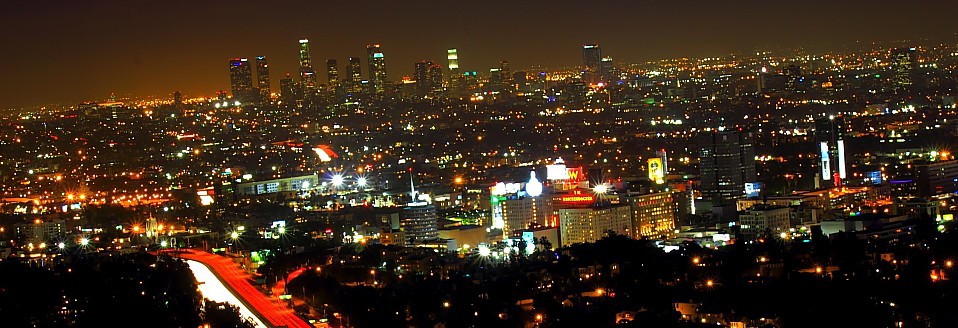
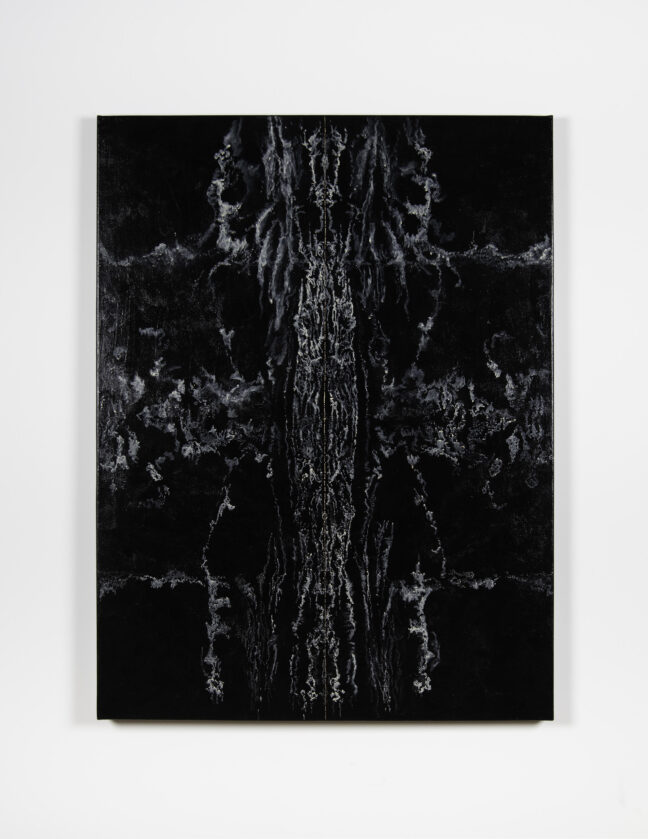
Shockboxx Gallery, Minimalism exhibition; featured image “Freeway” is by Alison Corteen.

Pandemic or no pandemic, the show must go on. The art show that is. Shockboxx has been providing exciting new shows for by-appointment viewing in the gallery’s airy space, as well as offering virtual opening and closing events and artists’ talks since the pandemic first began. If establishing a community is more important to the art world than ever before, then this Hermosa Beach gallery is upholding that important mandate big time.

As we face a new wave of both viruses and restrictions, we would do well to visit gallerist Mike Collins’ “shockingly” good space in the South Bay whether virtually or with a visit IRL.

I am remiss in my coverage: I have seen two virtual and two live exhibitions here, and they have all been fantastic. Living in the Beach Cities myself, where there is a dearth of excellent art spaces (Torrance Art Museum aside), Shockboxx is all the more vital a space.

Let’s take a look around:

First up for me online this summer was a solo show by Brazillian-born, Hermosa Beach-local artist Drica Lobo, whose swooping, lush, brilliantly vibrant paintings were placed in a custom setting as awash with the sea and moon and female energy as you can get. The lovely, peaceful look of the exhibition was matched by a powerful sense of color and urgent motion.
It would be impossible to take in this truly gorgeous solo show without feeling as if you were swept up by the sea, enveloped by the aura of mermaids, magic, and moonlight — but in an entirely fresh and original way. Iconic local images were approached in gracious and brand new way, offering a new way of seeing familiar landscapes that rendered them as an entirely different world.

Transcendent use of color and light created a pattern that mesmerizes the viewer; Lobo’s lovely use of the gallery space made a visit a respite for pandemic-wearing souls and eyes.

Next up for me was the semi-response to Lobo’s astute, pastel-driven, meditative aura: the rowdy, darker, prankster-laden visuals of the all-male group show Swordfight. Described more as a distaff companion to the all-female artists of the gallery’s earlier Powerhouse show, it nonetheless was a wonderful counterpoint to Lobo’s solo as well.

Jack George

Here there was a rich counter-play of images that expressed a wonderful energy, one that was also tinged with angst, anger, fun, and an edge of frustration infused with hope.

Online – the opening included performance art

Terrific curation and a great conversation between artworks fueled a show both fast and furious – for an adrenaline boost to the eye and the spirit that was not without its darker, introspective moments.
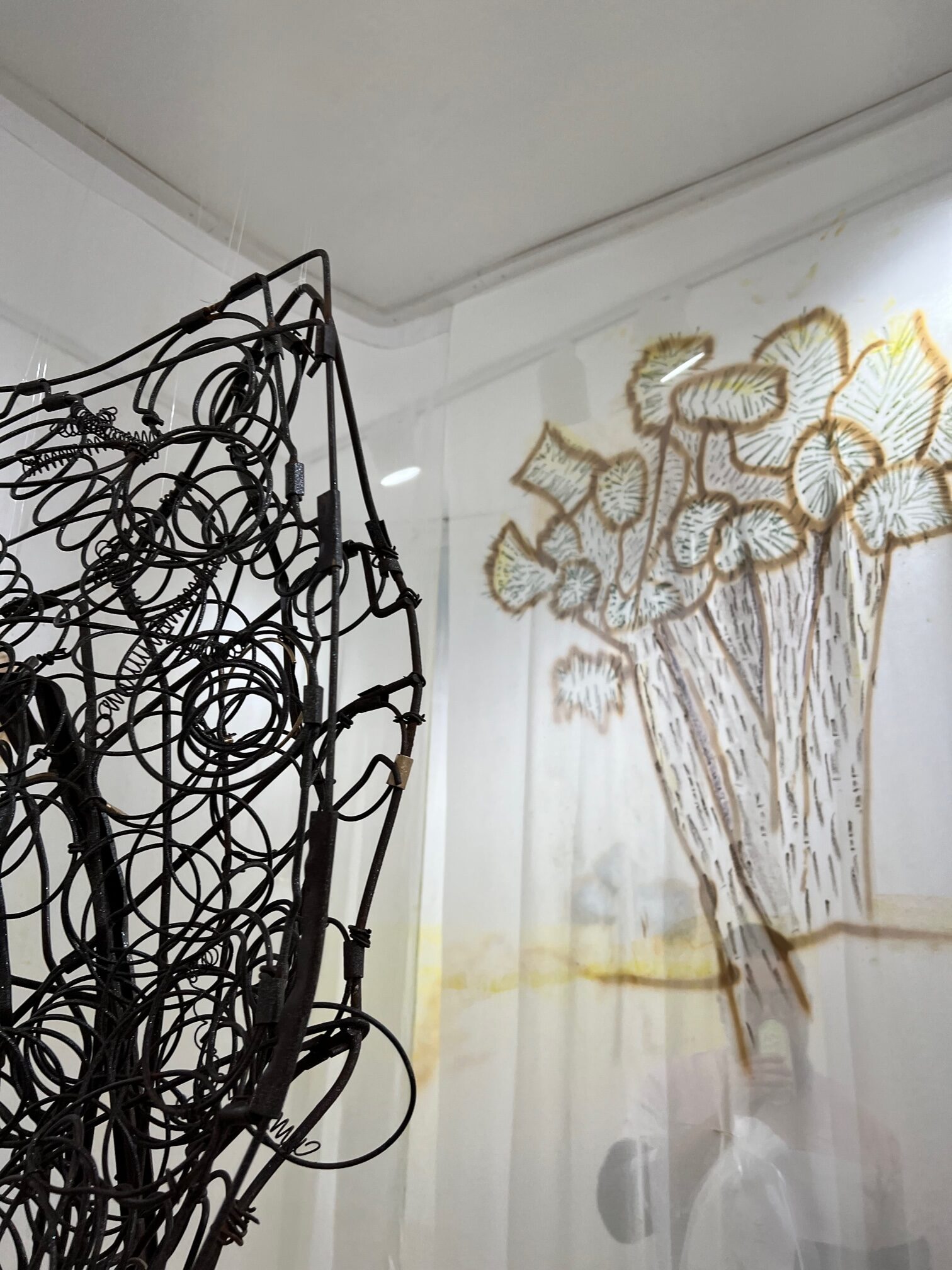
Scott Meskill has art in and curated the splendid Swordfight
Mike Collins
“Le tournoi des meurtres,” Mike Collins
Glitter Shark – Paul Roustan
Scott Meskill
Preston Smith

Following the passionate Swordfight came the group open show, 2021? – an overflowing feast of art, with a wide range of mediums, perceptions, and textures.

Tanya Britkina, “Eve and Her Cat”
Karrie Ross
Justin Prough
Chloe Allred

As inclusive as it was cutting edge, there were not only a broad selection of tastes and palettes, but a sense of connection and intimacy between the works and viewers. Some group shows seem haphazardly curated, but not this one: works were positioned to truly interact – from Aimee Mandala’s giant boot to MUKA’s fabulous teddy bear.

Routine Traffic Stop by Jonathan Crowart

Glancing from side to side or traversing back to front in the gallery space, it had an immersive, museum-quality aesthetic that actually took viewers on a journey from the more realism driven to the more fanciful and back again – as if the exhibit itself represented time spent in our own heads, planning for the future, regretting the past, working through the ongoing roadblocks of the present. In short, the ultimate group show for pandemic times.

Monica Marks

Like a palette cleanser if you will, the current Shockboxx exhibition, Minimalism, is just that – subtle and suspended, allowing the windows and doors of the mind to open and travel through these powerfully limited landscapes.

Mark Eisendrath
Joy Ray
Young Shin
Frederika Roeder – “Whiteout – Whiteout”

Mimialism will close physically this coming weekend, but you can continue to view works online.

But here’s the thing: whatever is next on the walls at Shockboxx, go get electrified by it – whether you’re Zooming in or stopping by after a brisk walk on the beach, you can bet that this gallery will get you plugged in.

The gallery is located at 636 Cypress Ave. in Hermosa Beach; visit online at Shockboxprojects.com

Genie Davis; photos: Genie Davis, and courtesy of Shockboxx/exhibiting artists. Note: Featured image is by Alison Corteen