
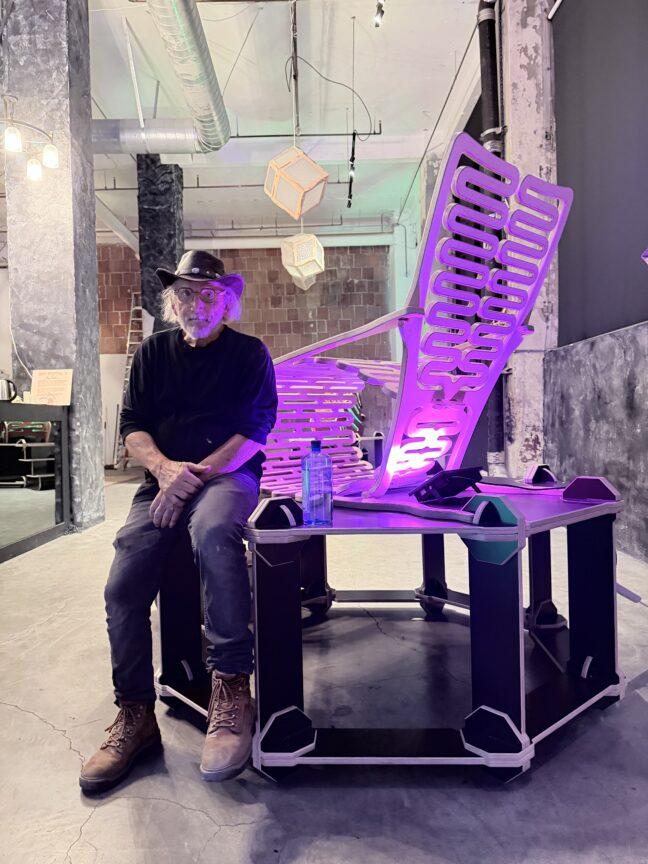
Antidote Through Art: The Work of Gregg Fleishman

Antidote Through Art: The Work of Gregg Fleishman – Genie Davis

Los Angeles-based architect and designer Gregg Fleishman is exhibiting Antidote, a dazzling collection of functional art, collectible design, and large geometric installations just in time for LA Climate Week. The exhibition, curated by Jojo Abot, opens Thursday April 9th, presenting four decades of Fleishman’s work in geometric innovation in architecture, sculpture, and functional design.

The exhibition serves as an entry point to Fleishman’s structural research, work he began in 1972.
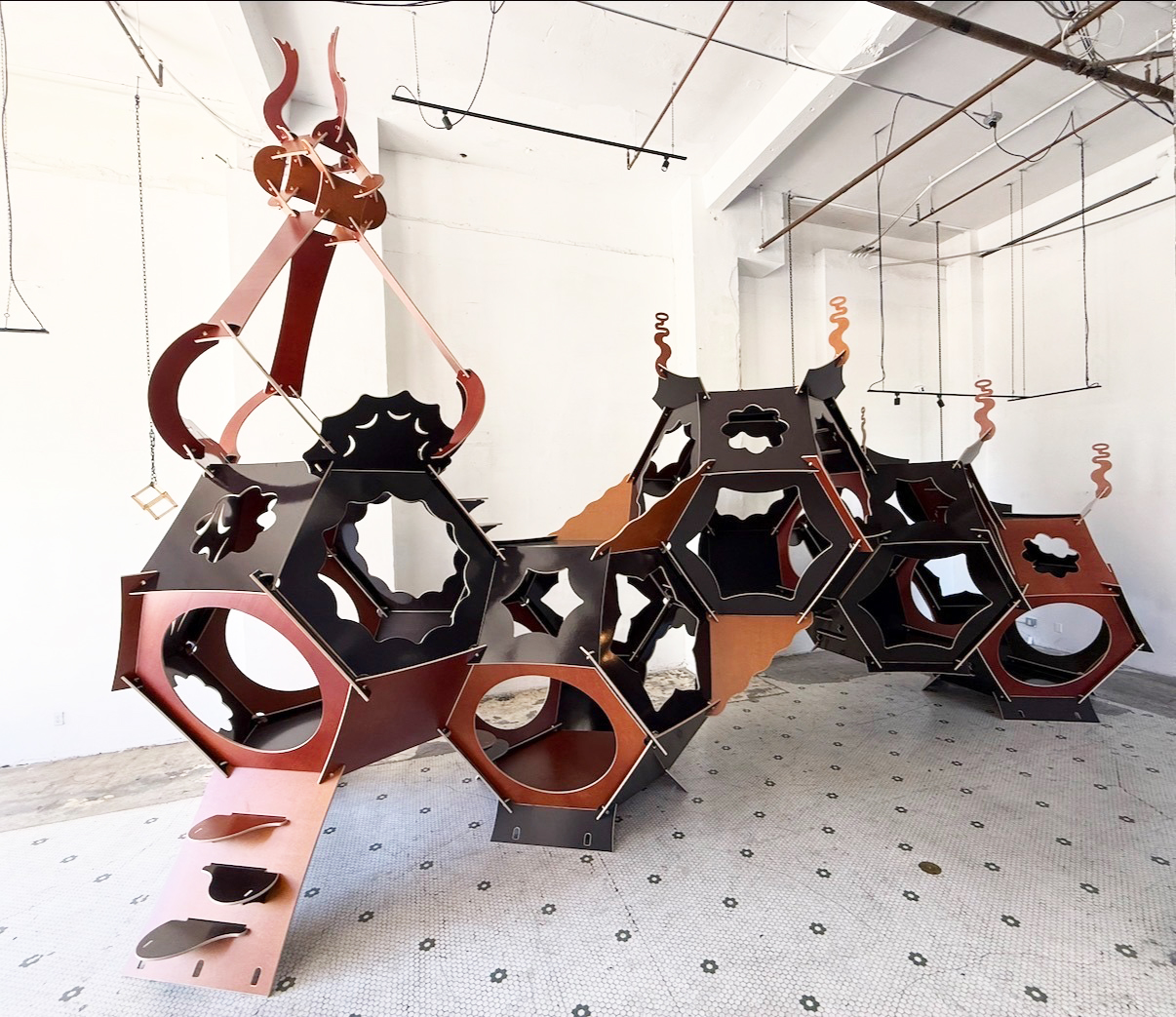
According to Fleishman, “I spent a long time studying how to build with geometry. We have a lot to show in that area,” he says of his work. “The last few years I’ve simplified some of my methods. I’ve been able to come with a whole range, a whole new series of avenues of exploration. We are showing different geometric worlds here in this exhibition.”
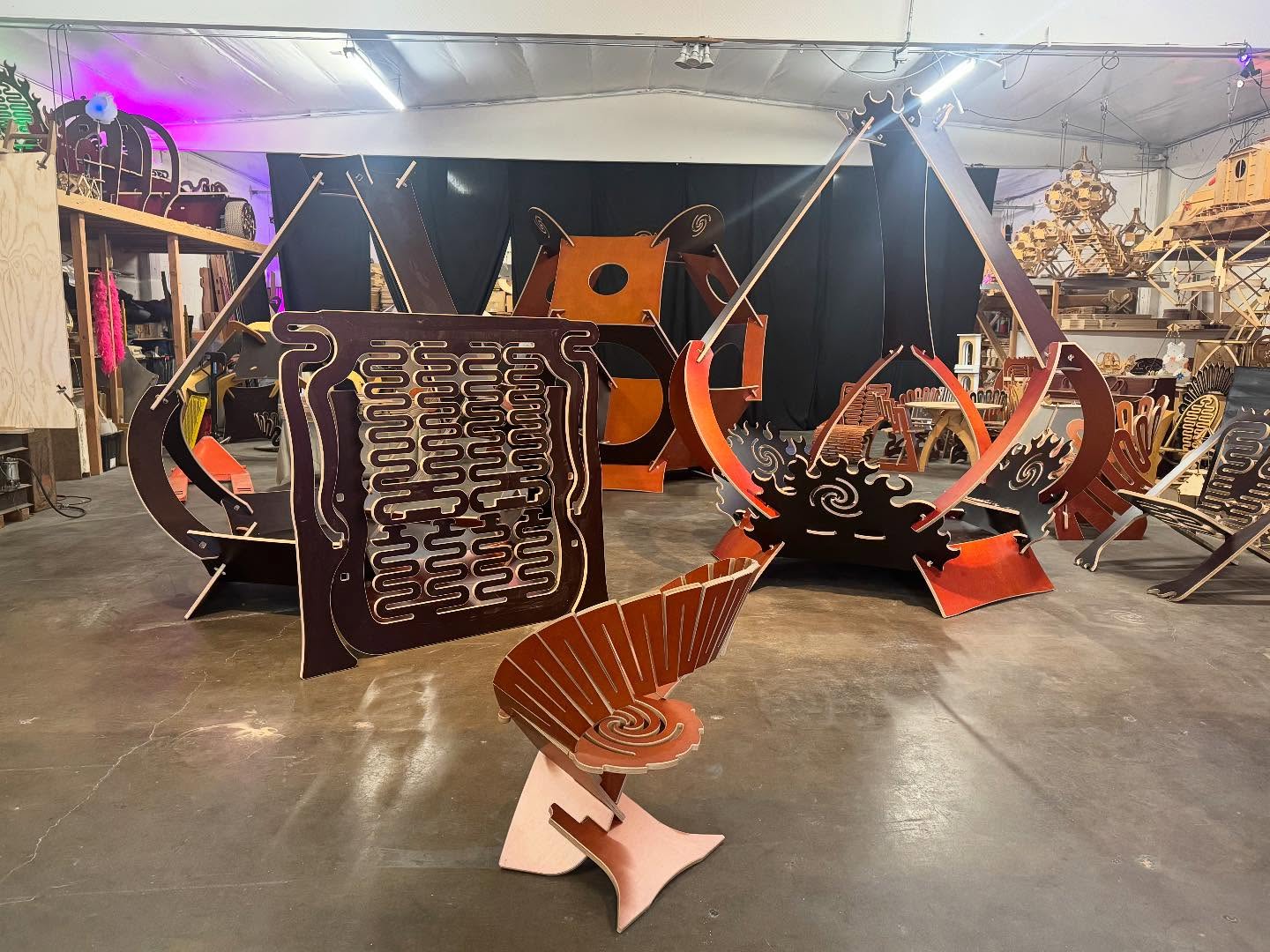
Asked to describe those worlds, he notes “One is based upon a truncated octahedron, another is a cube, and a third is a rhombic dodecahedron.” He asserts that while each is designed to fill a space, his true inspiration is “seeing how to do more with less, how to make sense of and to make the best output of geometry.”

Fleishman describes all geometric forms, and indeed, all geometry itself as “considered sacred geometry in a way, determined by how you use it and relating to it as something to be inspired by.” He relates that “There is very little work done in the 3D realm with geometry. There is a lot of 2D work, but in a building sense, sacred geometry has not been used, not in the sense that it is used to construct things in that area.”

All the same, Fleishman is using it. “We have the potential to build with these forms and I want to import these to people.  What I am working on, what I am showing, these are a framework for further building and exploration, furthering the ways of working in this world.”

As a designer and architect, he says that he’s “made great strides in the past few years. My purpose is to elevate our consciousness in this new framework. It seems like with [the current] state of the world we perhaps need to do as much as we can as soon as we can in that area.”
He specifically desires to bring the world of sacred geometry “into our present reality.” Fleishman wants the viewers of his exhibition to “come away with an appreciate of the ability to create these geometric objects. There are so many uses for them, major uses.” He points out that “so far they are used as temporary structures in the festival world, but these forms have potential for housing as well.  Their art and beauty in the festival world is basically designed as an adult playground, but that play can be transferred into a living environment.” He adds that “This kind of playfulness would improve the state of world. It would be an antidote to the poisons all around you in the world today.”
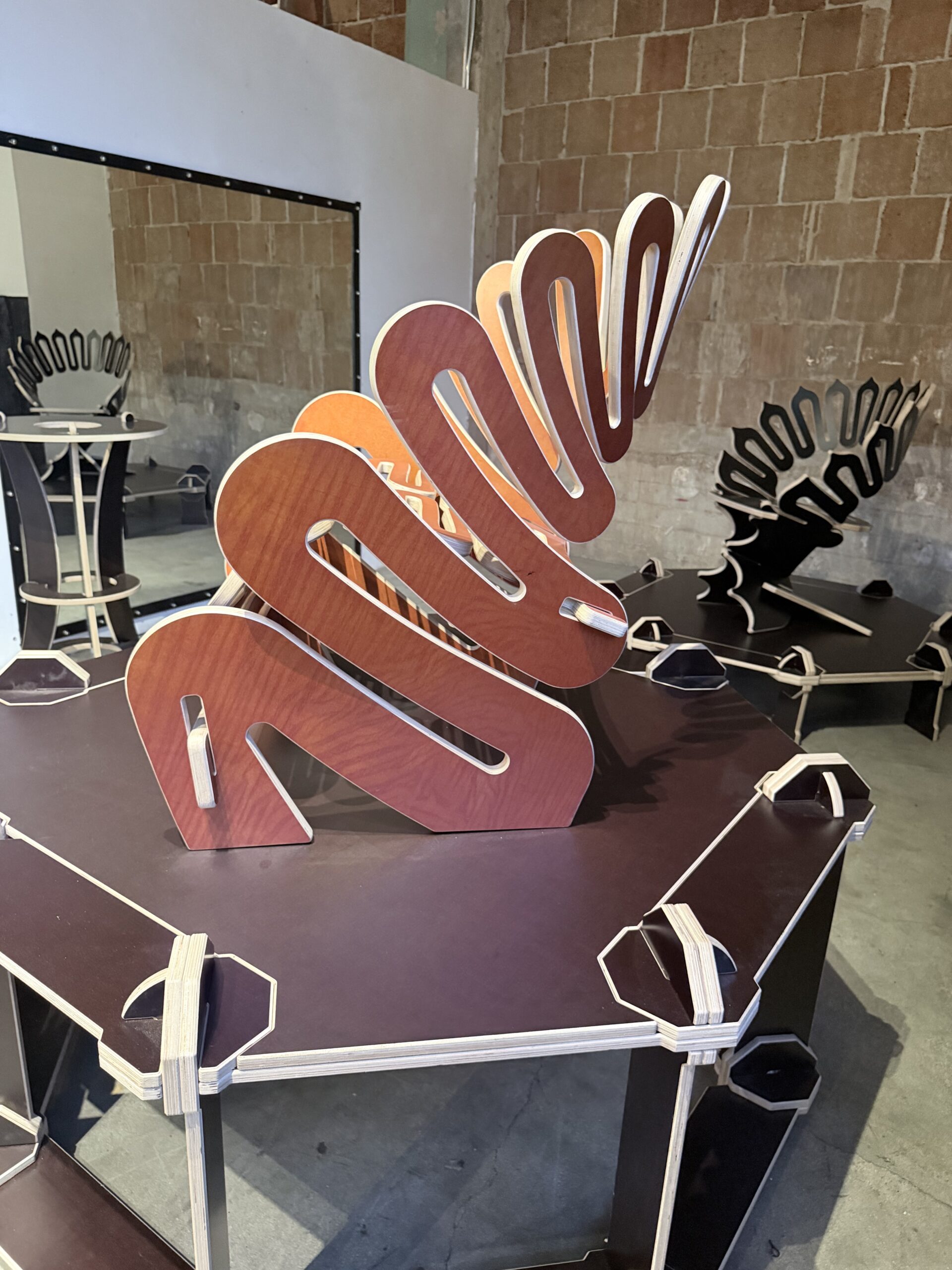
Along with these structures, Fleishman is also exhibiting furniture as an “early demonstration of what is possible using these forms.  I have been doing this kind of work forty years and longer, creating work” that ranges from functional furniture to inhabitable structures.

Antidote activates the gallery space as an immersive environment using geometric thinking.  The exhibition introduces Fleishman’s groundbreaking structural research to a new generation, highlighting the continued evolution of his practice.
He sees the exhibition as a “spark, a glimpse into what geometry makes possible,” Fleishman enthuses.

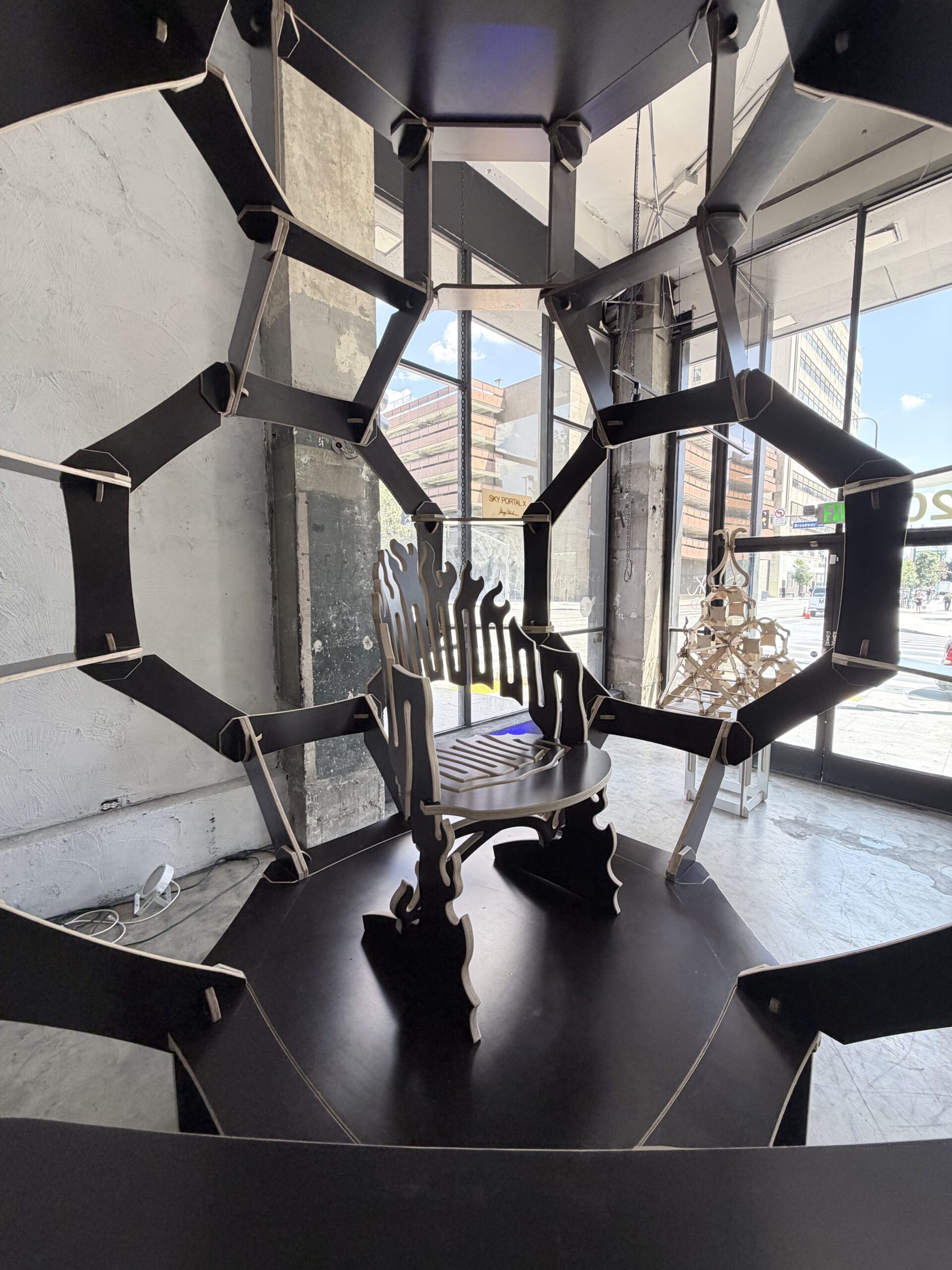
He describes the chairs on exhibit as “studies in invention that led to larger structural work…There’s something inherently mysterious about polyhedral geometry, whether through sacred proportion or simply the complexity of understanding space in three dimensions. For me, the goal has always been to create work that is both playful and functional—structures that grow out of a long evolution of methods and that have the potential to change how we experience space and how we live.”

The exhibition features three works from Fleishman’s Otic Series, a group of pioneering modular assemblies such as “Otic Oasis,” “Man Base Pistil,” and “Pomo-Paradise,” each of which explore space-filling construction systems. Central to the exhibition are structural installations that reveal Fleishman’s long-term investigation into modular building systems and spatial environments, such as his. “Return of the Caterpillar,” which is a modular structure composed of interlocking geometric segments, that demonstrates Fleishman’s belief that architecture itself can behave as a living system that’s capable of growth, transformation, and adaptation.

“Mayan Tower (Junior)” is a vertically stacked geometric structure, that examines human-scale construction through interlocking modular components that are efficient, transportable, and can be capably assembled without complex tools or specialized labor.

Fleishman’s “Octo II” is a faceted geometric environment constructed using repeating octagonal elements. The work demonstrates structural repetition that creates both spatial rhythm and architectural strength.

Combined, each of these works serves as an exploration of modular construction versus standard building systems.

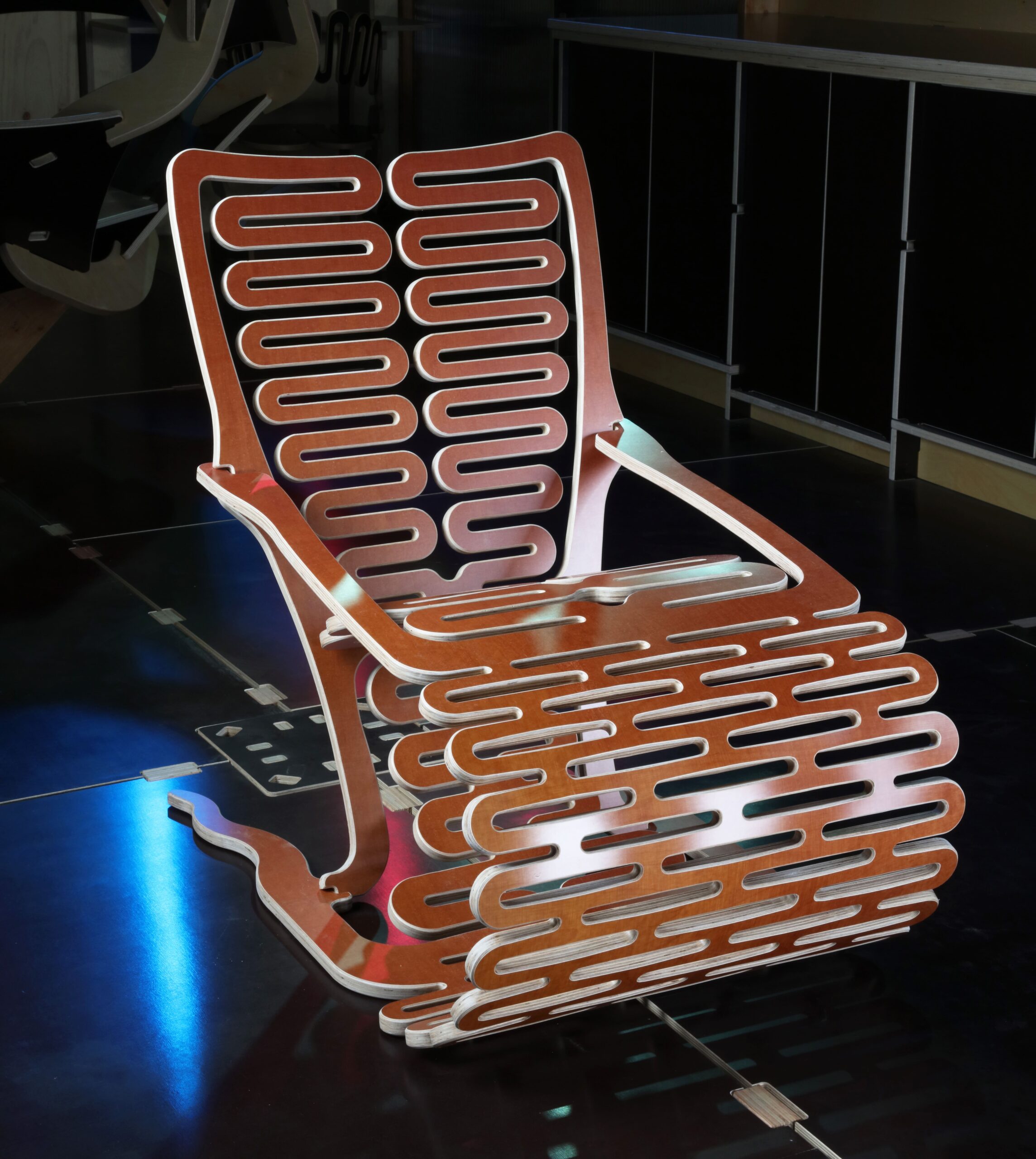
His sculptural furniture work with chairs presented as a design challenge using the artist’s “panel puzzle” system of precision cut plywood components. They are assembled without nails, screws, or glue to produce lightweight but structurally resilient furniture. Works such as the “Skyrocker” and “Broadway” are crafted from Baltic and European birch plywood.
As part of Los Angeles Climate Week, Fleishman’s installation at Sky Portal X will be included in the city’s cultural programming. Antidote opens Thursday, April 9, 2026, from 6:00–9:00 pm at Sky Portal X in Downtown Los Angeles and will remain on view through Spring 2026, along with public programming and conversations exploring the intersections of design, architecture, and technology.

Sky Portal X is located at 201 S Broadway in DTLA.

  • Genie Davis, photos provided by the artist and Evolution Media


The Debut of Diversions Fine Arts Welcomes the Springtide

The Debut of Diversions Fine Arts Welcomes the Springtide – by Juri Koll 

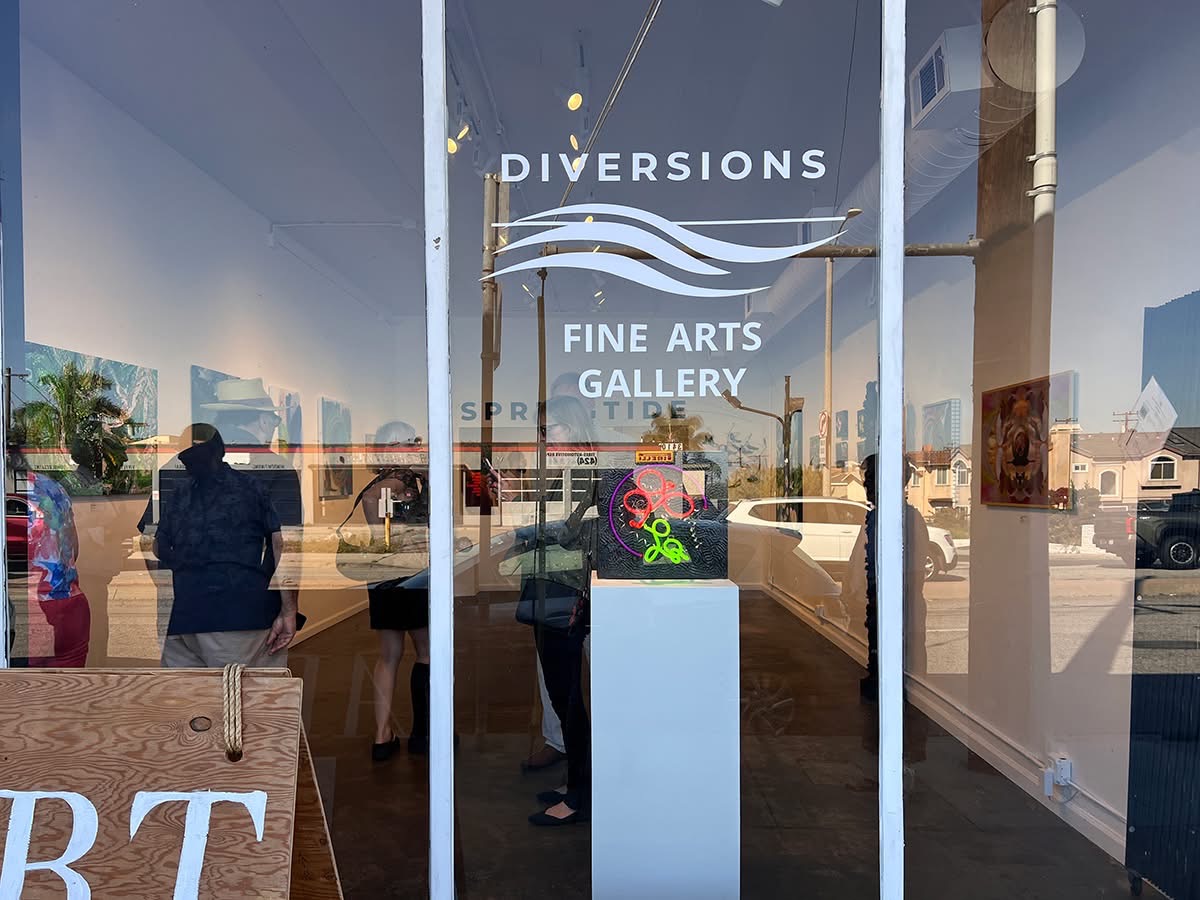
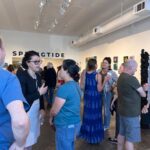
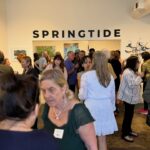
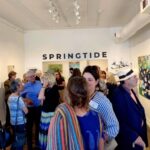
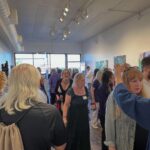
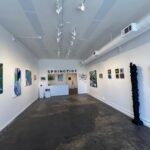
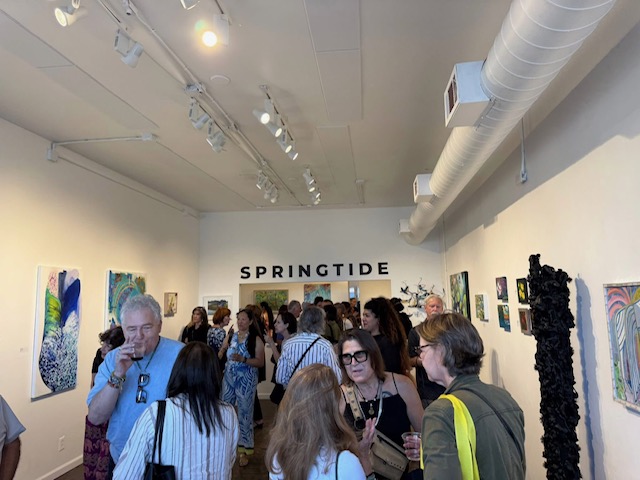
On the sunny afternoon of March 14th,  Diversions Fine Arts Gallery made its debut in Manhattan Beach.

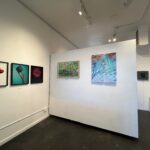
Springtide, curated and hung beautifully by Genie Davis, is the gallery’s opening exhibition, and opening day spilled the packed, engaged, smiling audience out onto the front and back entrances of the three-room space. The gallery is a welcome addition to the art world, and to Davis’ reputation as an astute, keenly observant, eloquent writer for the arts community and beyond.

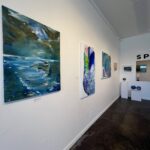
26 artists graced the rooms with consistently exuberant color and depth, whether extroverted or introspective. We’ve had the good fortune of knowing many of them and supporting their work, so it was a pleasure to see artist friends and neighbors back together and meet new creators.

Artists showing are:
Linda Sue Price, Dave Clark, Jeffrey Sklan, Kaye Freeman, Danielle Eubank,  Scott Trimble, Bernard Fallon, Karen Doyle, Jennifer Chan, Rebecca Hamm, Glenn Waggner, Michael Stearns, Karen Hochman Brown ,Stephanie Sydney, Judy Herman, Nurit Avesar, Dellis Frank, Nancy Mooslin, Skye Amber Sweet, Esperanza Deese, Linda Stelling, Annie Marini-Genzon,  Beth Elliott, Caron G Rand, Lydia Nakashima Degarrod, Christina Shurts, Oana Gamlowski.

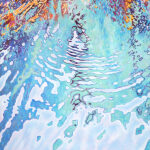
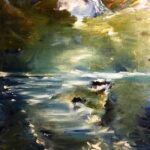
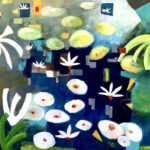
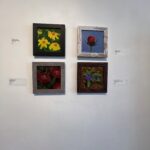
The theme of Springtide reflects it’s author – optimistic, insightful, looking forward to the blossoming of new original things. From crisp blue green ocean, (Danielle Eubank, Scott Trimble, Esperanza Deese) to butterflies on the wing (Karen Hochman Brown)…

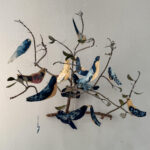
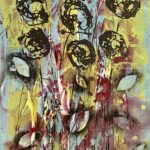
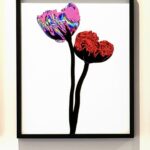
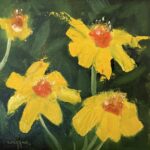
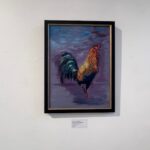
…to gorgeous flowers (Jeffrey Sklan, Annie Marini-Genzon, Linda Stelling,  Glenn Waggner, Sky Amber Sweet, Nancy Mooslin), birds (Beth Elliott), a colorfully uniquely fresh portrait of a rooster from Hawaii (Oana Gamlowski), and what could be lush bird nest sculptures (Lydia Nakashima Degarood). In short,  there is something vivid and compelling on every wall.

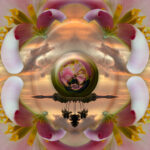
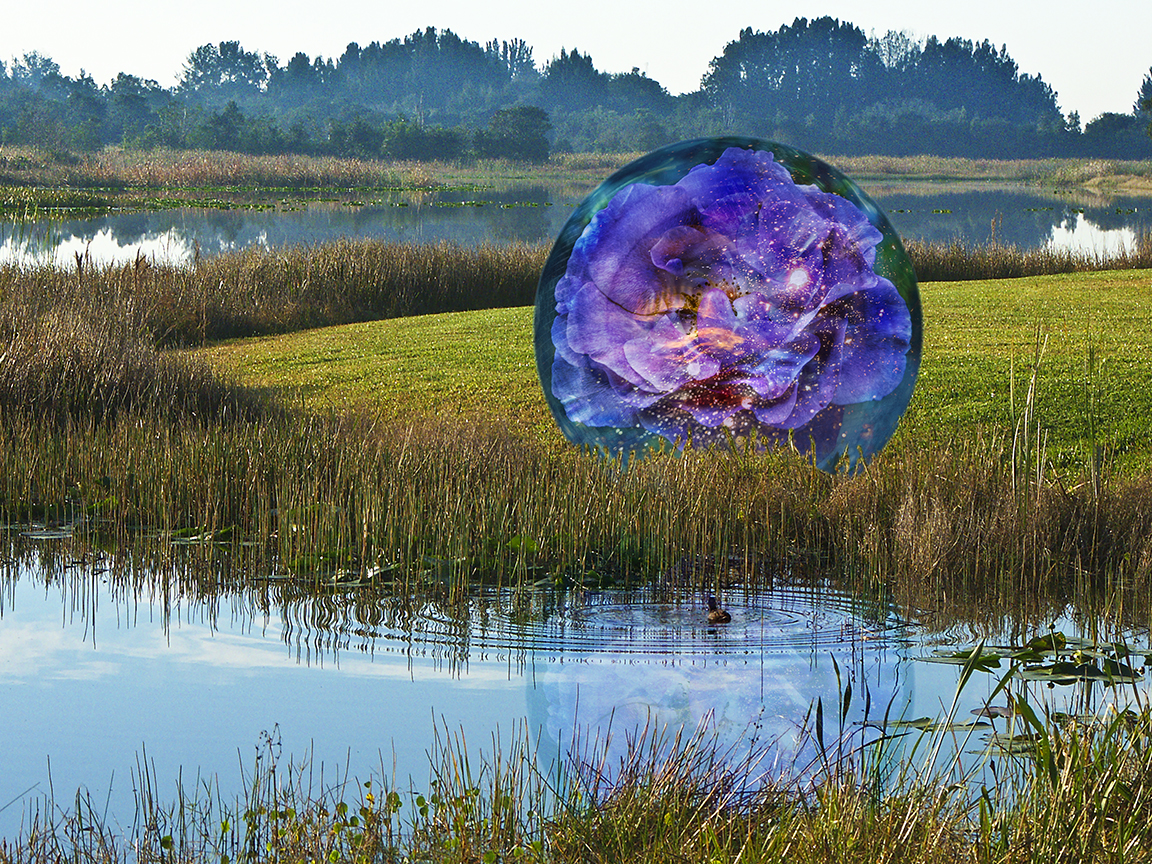
There is another gem from Stephanie Sydney, a photographic composite in the grand tradition of Edmund Teske, Jerry Uelsmann, and other ground-breaking artists …

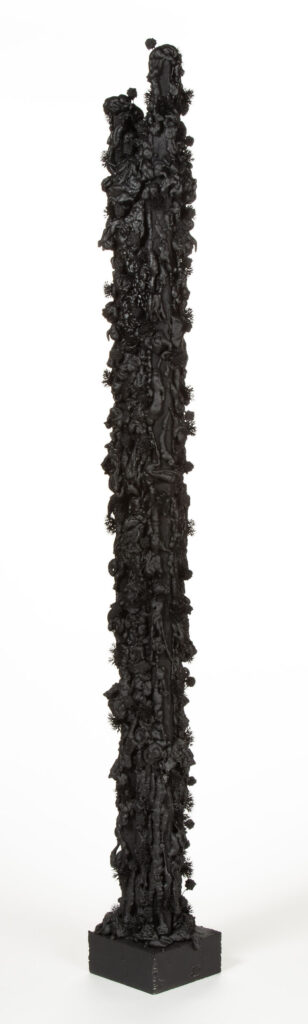
…and a Dave Clark totem freshly carved and polished in his unique, lyric style.

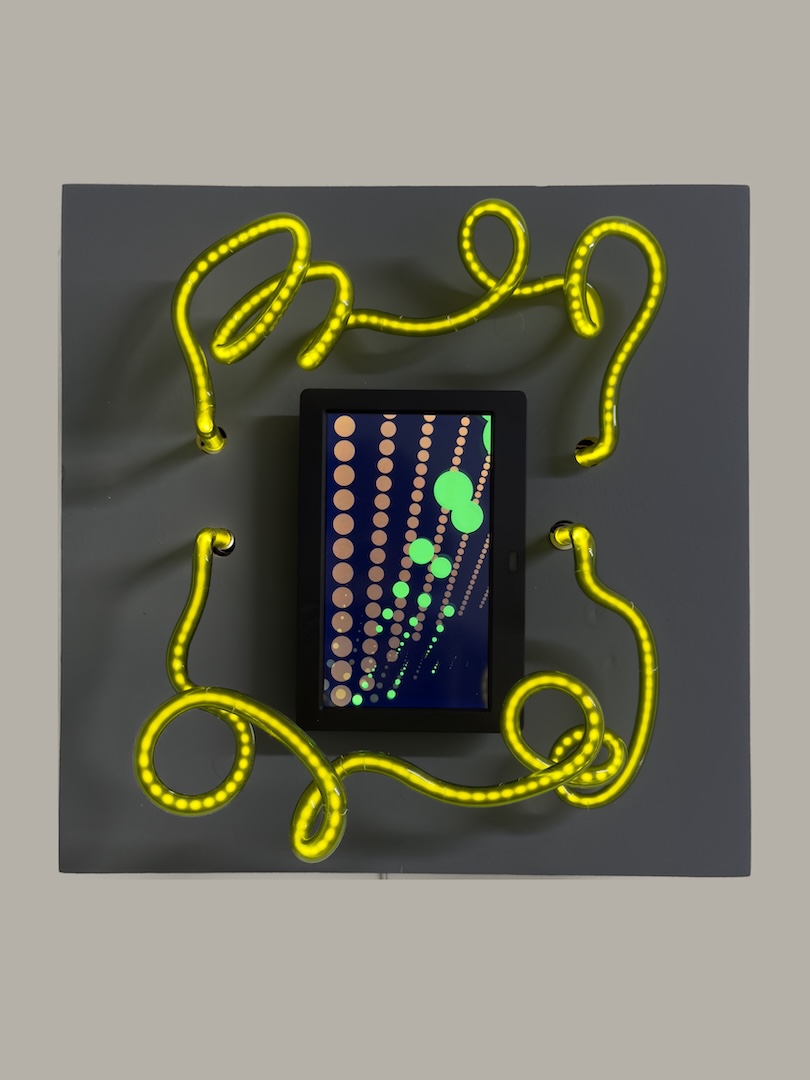
Abstract neon artist Linda Sue Price’s cheer opens the show at the front window, beckoning us inside; another motion filled piece welcomes viewers toward the gallery’s second room.

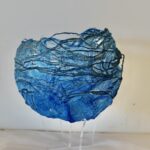
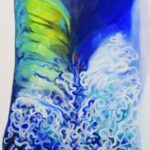
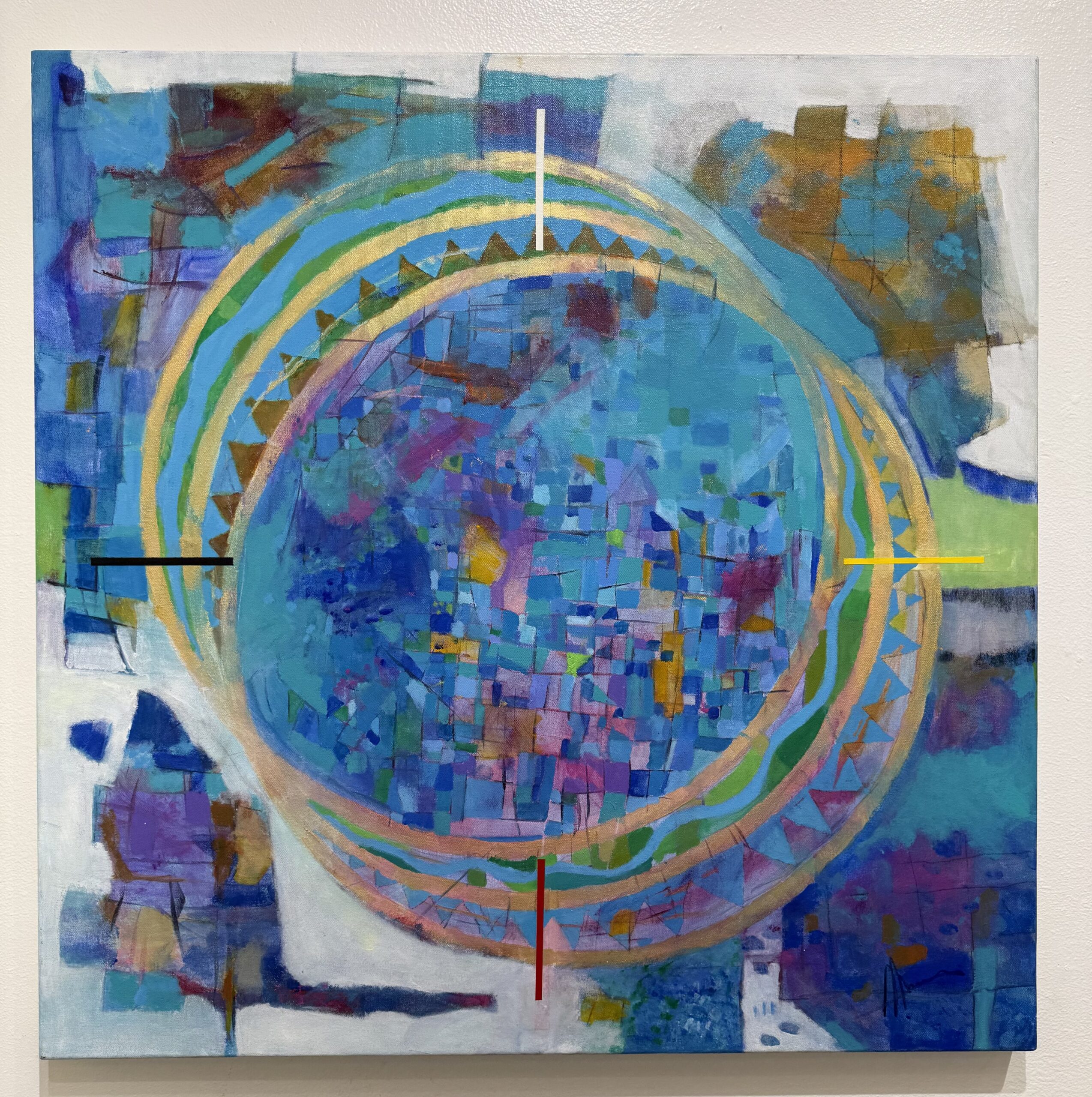
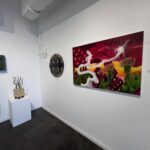
Michael Stearns has often combined the spherical with the liquid, the ethereal, the elemental. In his work here, comprised of luminous blues, sharp rotational accents of yellows, greens and reds, the blues hover and swirl out of a special place – earth, air, fire, water. He continuously excels at his gift of guiding us to our real soul.

Springtide is a show you must see if you’re anywhere near So Cal from now until April 4,  when the show closes with an artist talk from 1-3 p.m.

Visit Diversions Fine Arts Gallery, 1069 N. Aviation Blvd. just off the 405 in Manahttan Beach, 12-4 p.m. Thursday through Sunday or by appt: info@diversionsfineart.com or Diversionsfineart.com.

  • Juri Koll
    Director/Curator, Venice Institute of Contemporary Art (ViCA)

The Venice Institute of Contemporary Art (ViCA) is devoted to identifying, protecting and sustaining the unique stories, history and culture of one of the most important centers of American independent artistic expression, presenting the art world from the perspective of its artists, writers, curators, collectors, and the art viewing public.

A Stirring Story of the American West from Lynette K. Kenderson

A Stirring Story of the American West from Lynette K. Kenderson by Genie Davis

Lynette K. Henderson’s deeply moving multimedia exhibition Stories From The American West: Death and Life At The Edge Of The Great Basin captures life in the Great Basin, a region many never visit. This western region stretches some 190,000-square-miles throughout Nevada and half of Utah, as well as into areas of California, Oregon, Idaho, and Wyoming. Speaking personally, I have experienced the vast and empty wonder of a small corner of it in Nevada near Great Basin National Park, making this stunning exhibition even more resonant.
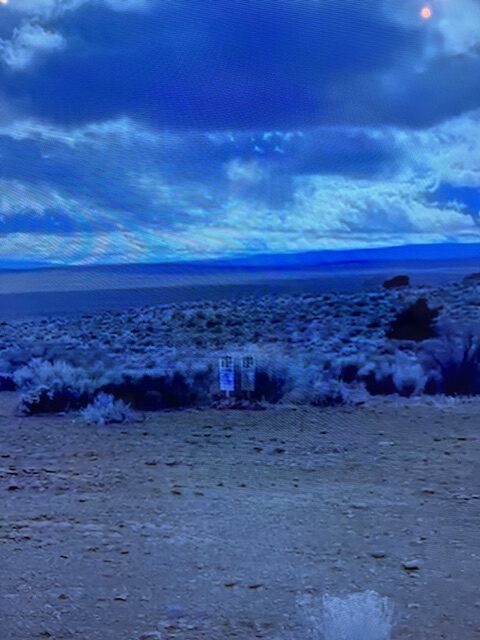
Bordered by the Sierra Nevada to the west, the Wasatch Mountains to the east, the region is its own world of flora and fauna, one which Henderson lived within during an art residency last spring at Playa Summer Lake in the Oregon Outback at the western edge of the Great Basin.

She was inspired to produce this exceptional body of work with her keen eye seemingly focused on every detail of this remote high desert region with its vast, uninhabited – at least by humans – plains. Awash in the smell of sagebrush and the dust of arid basins, the geometric precision of the fault-block mountains like Abert Rim, are ghostly in their emptiness. But Henderson saw these mountains, these plains as something far different than empty. She saw them as the home to dramatically pristine plant and animal life. At least until you look more closely, as Henderson has, to view the plant and animal life

Contained by surrounding mountains, Summer Lake itself serves as a vital habitat for migratory birds, which form one element of the artist’s remarkable interpretation of the region and its living creatures.

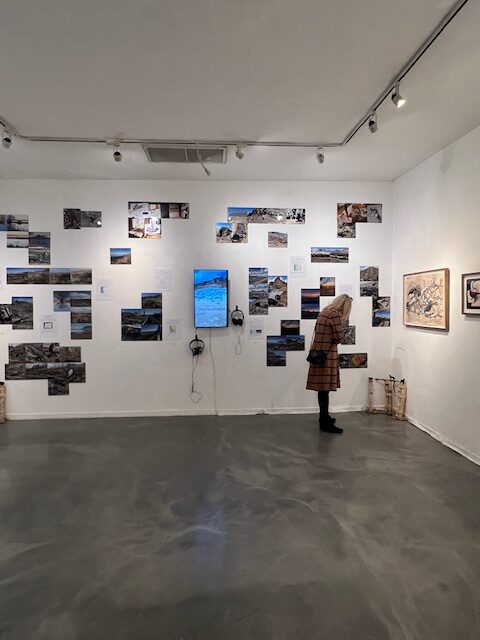
The exhibition is a wide-ranging one, featuring a potent mix of her beautifully alive animal and landscape paintings, drawings, and totems, as well as her photography, a video, and a soundscape which recreates the environment for viewers quiet enough to listen to the sounds of wind and wild bird calls.


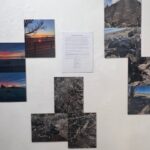
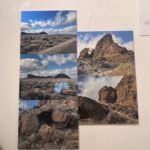
Completing the gallery space are panels with maps and information about deforestation, climate change, human activity and development, and the effects of natural disasters. The informative material, photographs, and video installation comprise one end of the gallery; around it in a U-like display are Henderson’s paintings, collage and ink and acrylic drawings, and sculptural totems.

Her personal image-journal of photographs takes us as viewers with her as she finds her subjects. The video, equipped with headphones, tbrings to life the call of a bird, the rush of the wind, the calming moments of pristine silence broken by the humming existence of this land.  Like the audio soundscape, the video serves as a soft undercurrent of memory as viewers explore the gallery just as Henderson herself explored the region she depicts.

The artist also offers small maps and written background about humans in the Great Basin, and the tuff ring of lava and water that is Fort Rock, Oregon, as well as a map and description of the Paisley Caves that inspired one body of Henderson’s work here.

This is a powerful and poetic exhibition, one that transports the viewer to a different, more raw, wild, and wonderful environment. The artist’s work is both visceral and seductive, luring the viewer into a private yet vast new space, one that reflects both her personal experience and the universal allure of nature and the call of wild creatures to a wild spirit.

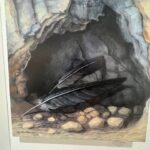
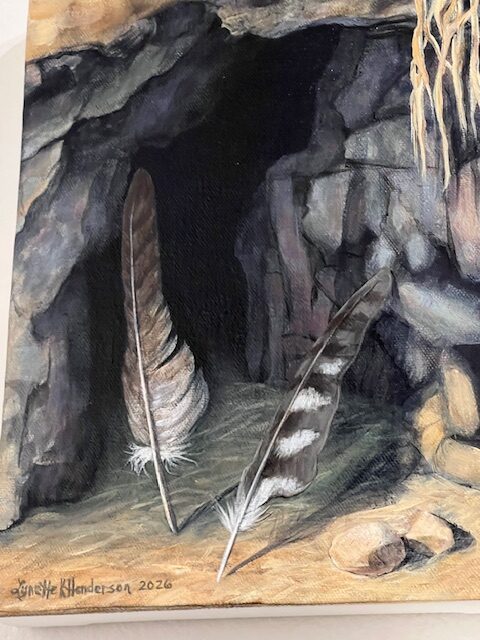
The desolate region is far from desolate in Henderson’s work. Rather, it is intimately alive through the artist’s images, each almost achingly invoking a sense of both longing and belonging in this distant place. Her vividly realistic images of crows, pigeons, robins, coyotes, and feathers outside the mouth of a cave, are each sublimely rendered, and create a sense of immediacy for and with her viewers.

The audio landscape gently leads each visitor deep into the exhibition, augmenting the sense of sacredness that permeates both the artist’s experience at her residency and a viewer’s experience in seeing her work.

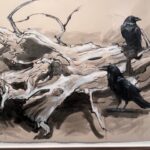
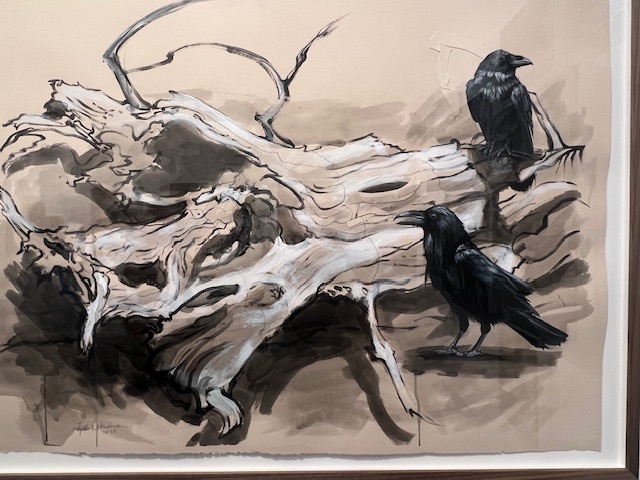
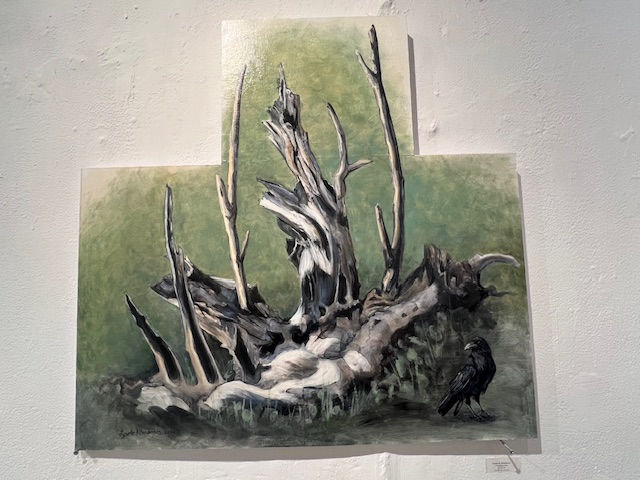
Some images are monochrome, or close to it, such as the ink and acrylic “Decomposing Tree with Ravens.” The muted tones of black, brown, white, and beige create a dream-like experience of and appreciation for the desert and plains, as the artist explores the delicate nuance of decaying wood, the life it still sustains, and its loss.

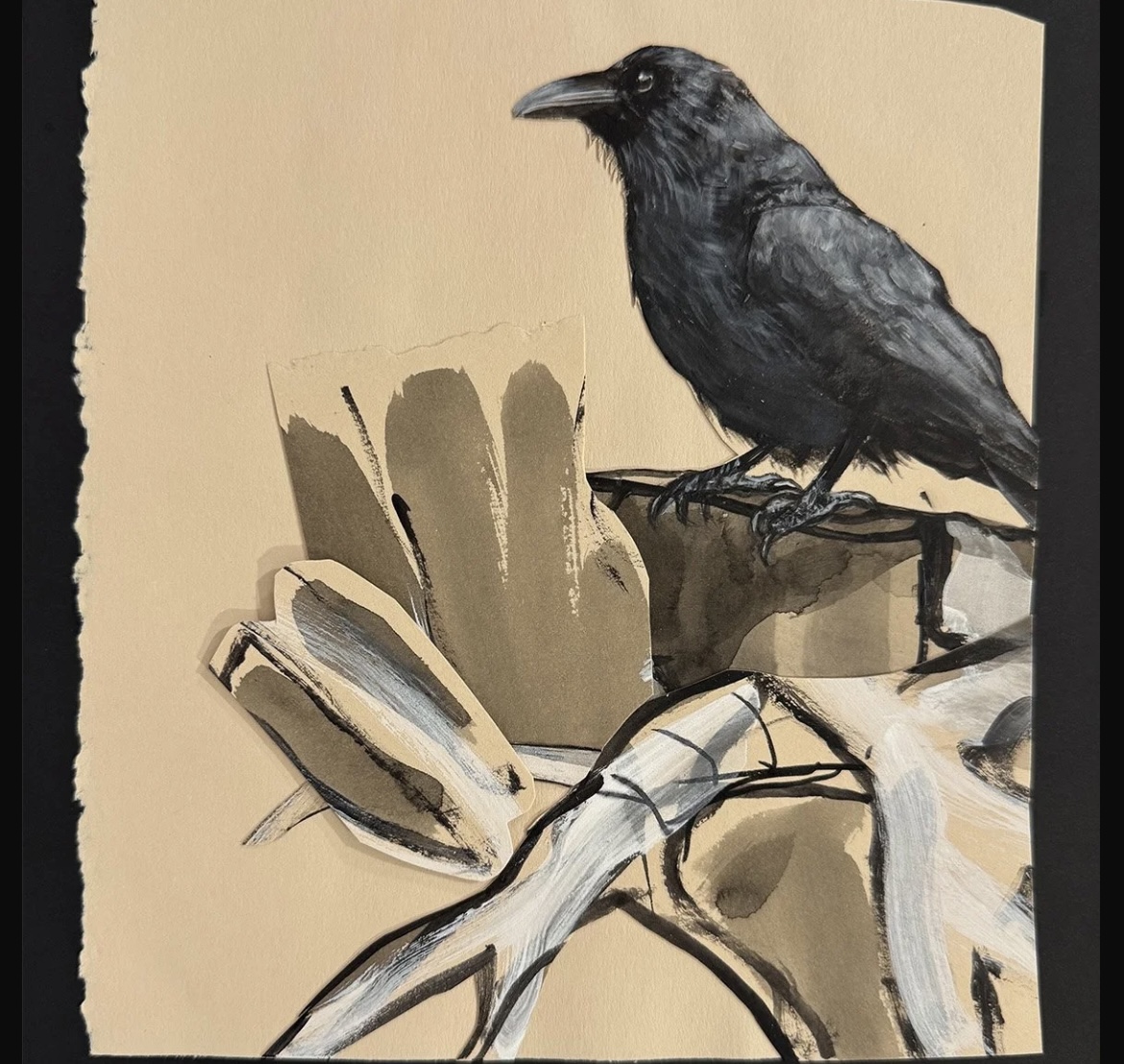
In a smaller acrylic and ink on paper with collage, “Crow with Leaves,” the bird is a sentinel, a watcher, turned in profile, his eye is bright and ready, scanning the environment for food, for prey, for predator.

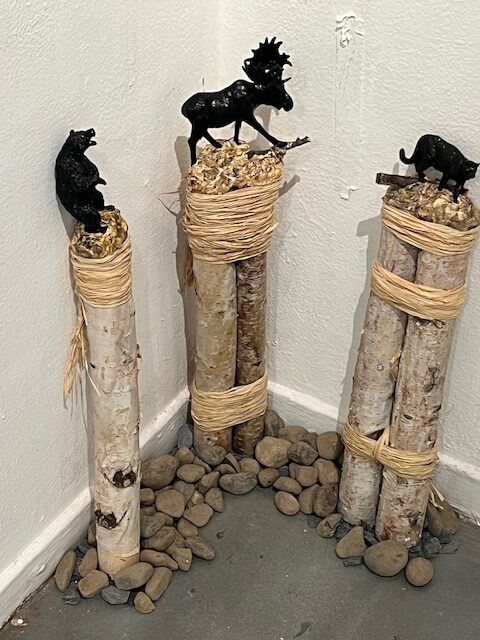
Placed in the corners of the gallery are the totems that artist shaped, conjoining wood with a wrap of dried grass and adding small plastic figures of regionally appropriate animals such as an antelope, a bear, or a red deer to this natural material.

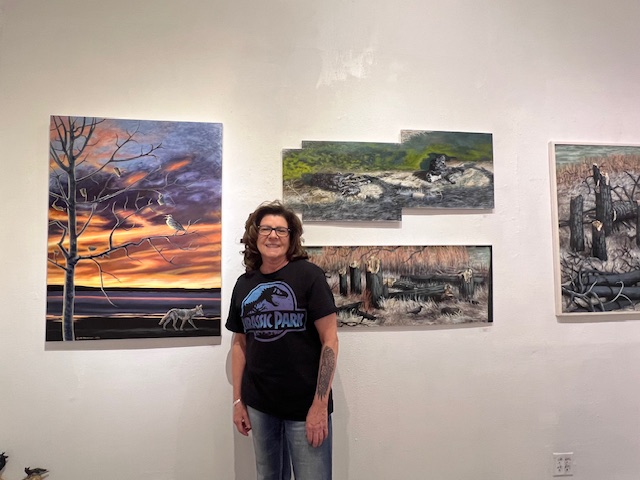
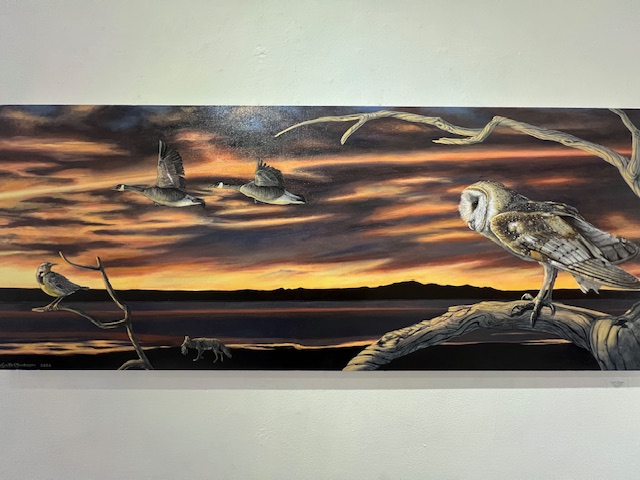
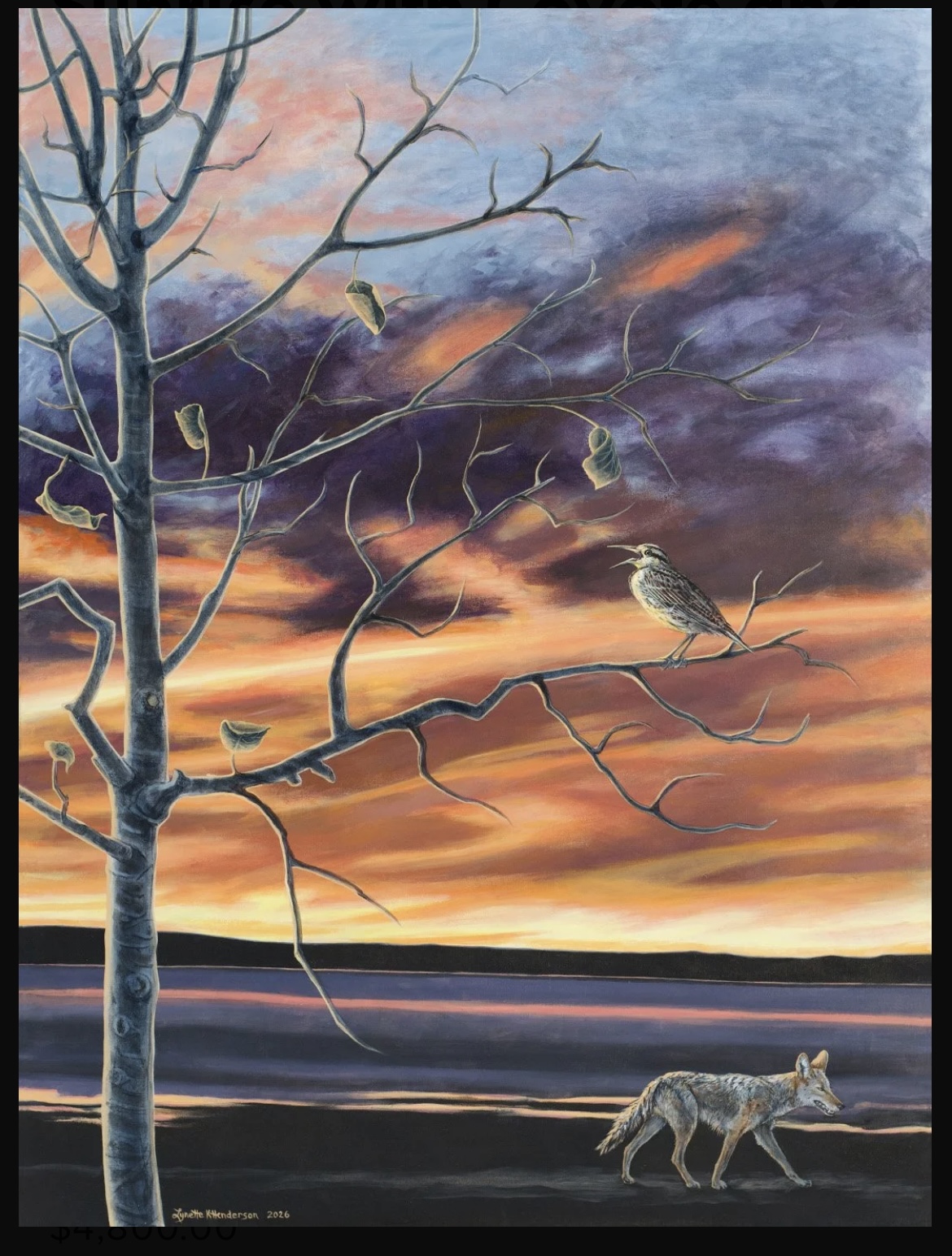
Henderson’s glorious, large scale, full color acrylic-on-canvas works are as always a standout. “Sunrise with Coyote and Meadowlark” dazzles with a backdrop of peach and lemon colored sky, against which a meadowlark sings a greeting to the morning from the branches of a tree, while a coyote walks past at its base as if going home after a long night. While the bird jubilantly greets the day, the coyote faces in the other direction, perhaps walking toward the safety of his den.

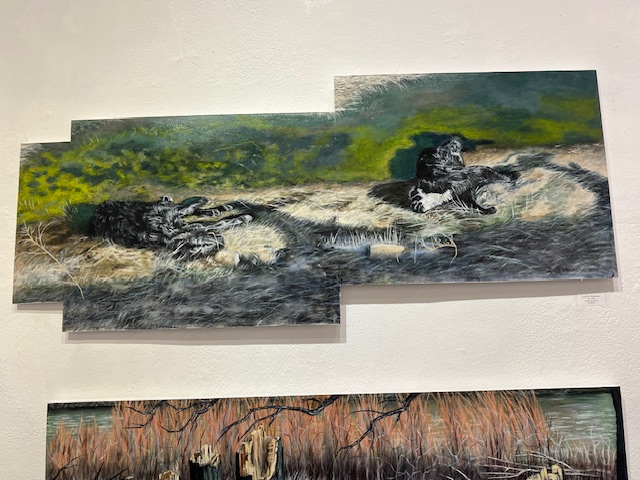
Her poignant canvas painting “Two Calves” reveals two deceased young cattle discarded in the wilderness, perhaps killed elsewhere and dumped. Life and death coincide here. They are intense and startling opposites each rooted in a sense of belonging to this place, and inextricably linked, just as life and death is within all of us. The truth of life’s tenuous nature is simply more clearly seen in the Great Basin.

Henderson’s work here is wide ranging and encompassing, succeeding in presenting both the minutia and the long view of the region. There are highly textured paintings of a burnt forest so carefully created that one could almost breathe the scent of charred wood, touch the scarred and ashy remains of the trees, absorb the sense of tender loss experienced by a red-tailed hawk perched on the now-fragile branches.
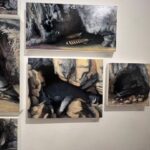
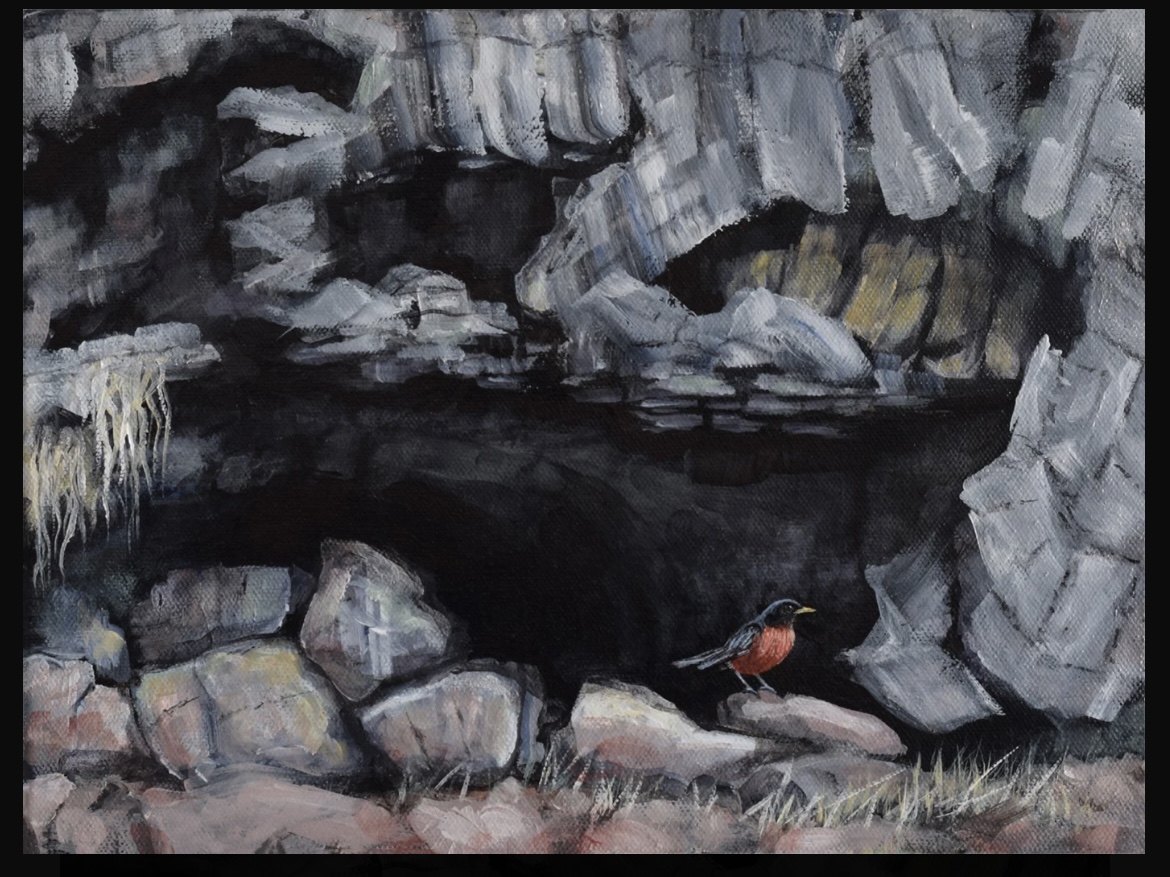
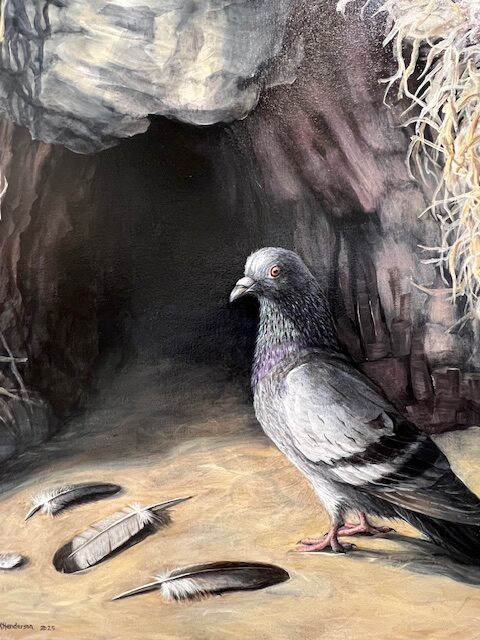
Paisley Cave drew the artist to create multiple acrylic-on-canvas images. She paints its evocative rocks and mysterious craigs and openings; or she has juxtaposed perfectly rendered feathers belonging to a raven and a crow, a Cooper’s hawk, or a red-tailed hawk, in this place of sanctuary. She also paints this location with a pigeon far from an urban home in one work, and a bright red-chested robin hopping securely toward the cave’s entrance in another.

As curated by Kristine Schomaker, Henderson’s work is a perfect sensory experience, from vivid paintings to simpler ink and acrylic renderings, and photographic images, too. The artist’s immersion becomes that of the viewers. We see the landscape observed in a variety of mediums, from photographs to carefully witnessed and painted still-so-perfect feathers, marking the migratory passages of birds.

Henderson’s work gives us a fully absorbed and reimagined landscape of land, sky, living creatures, and those that have passed away. It is glorious to share her journey.

The exhibition concludes 3/27 at LAAA Gallery 825 at 825 N. La Cienega in West Hollywood.

  • Genie Davis; photos by Genie Davis


Debbie Korbel is Living the Dream

Debbie Korbel is Living the Dream by Genie Davis

Debbie Korbel‘s mystical, marvelous solo exhibition Living the Dream, now at Riverside College Quad Gallery in Riverside, is an exciting, enchanting sculptural show filled with wit, poetry, and a profound sense of grace.

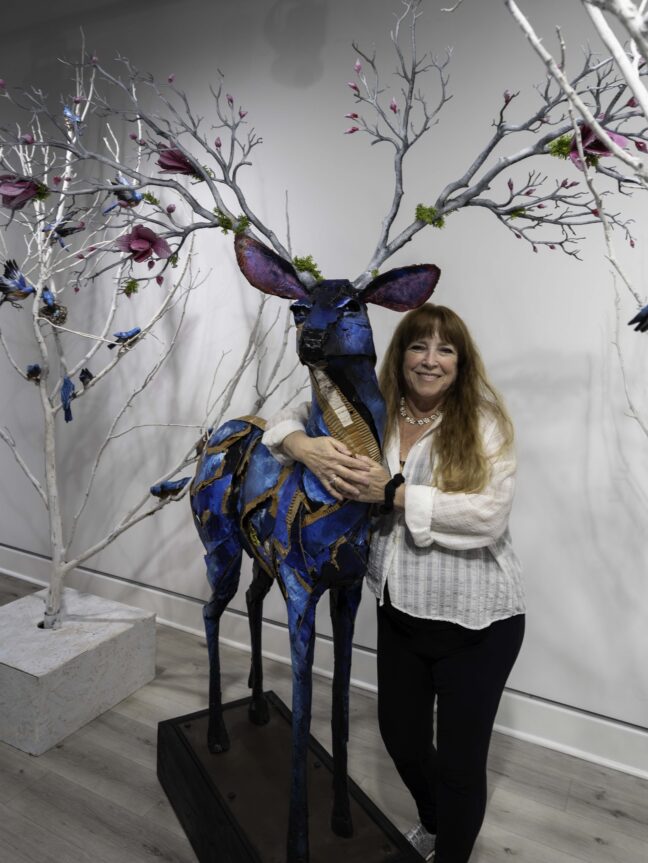
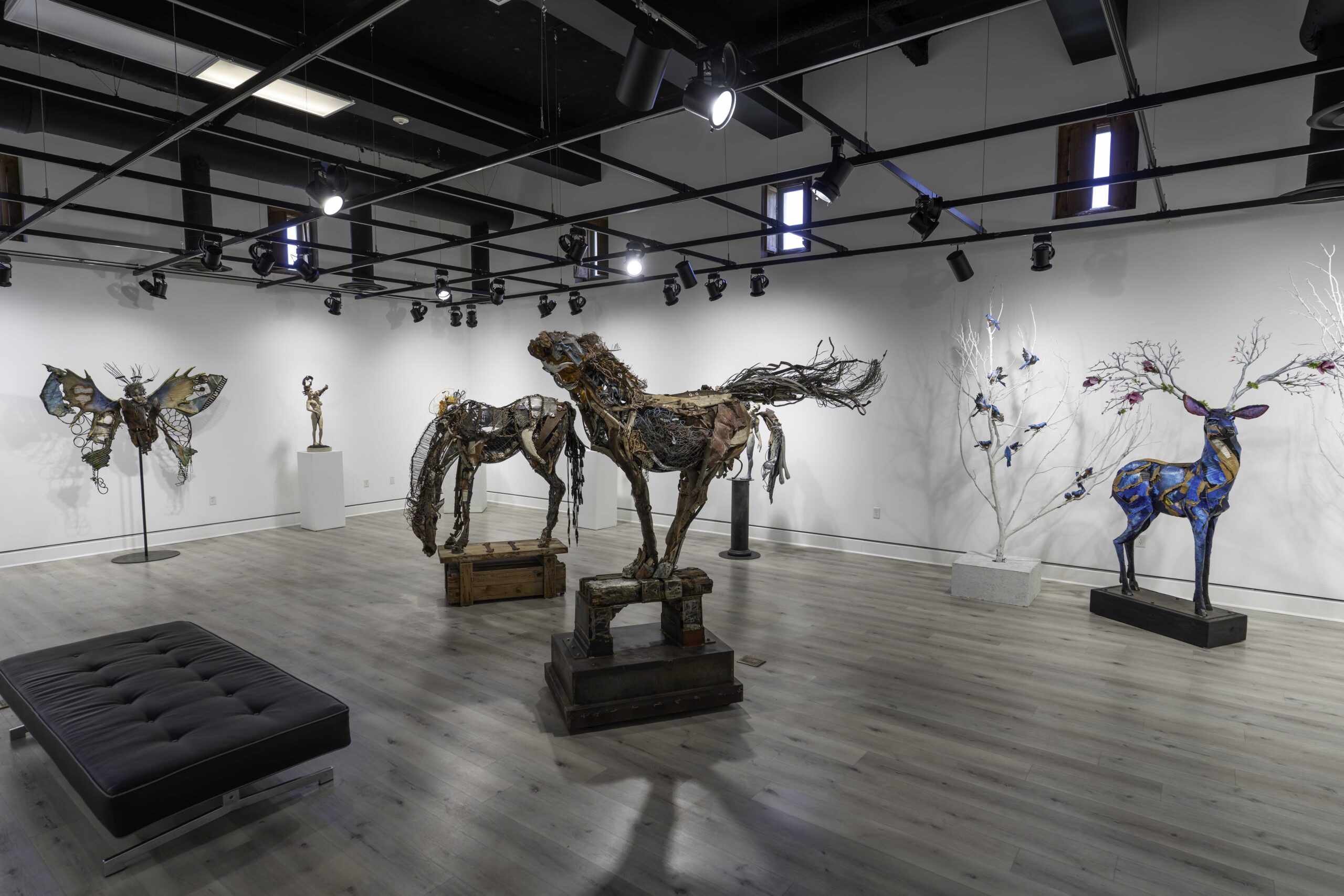
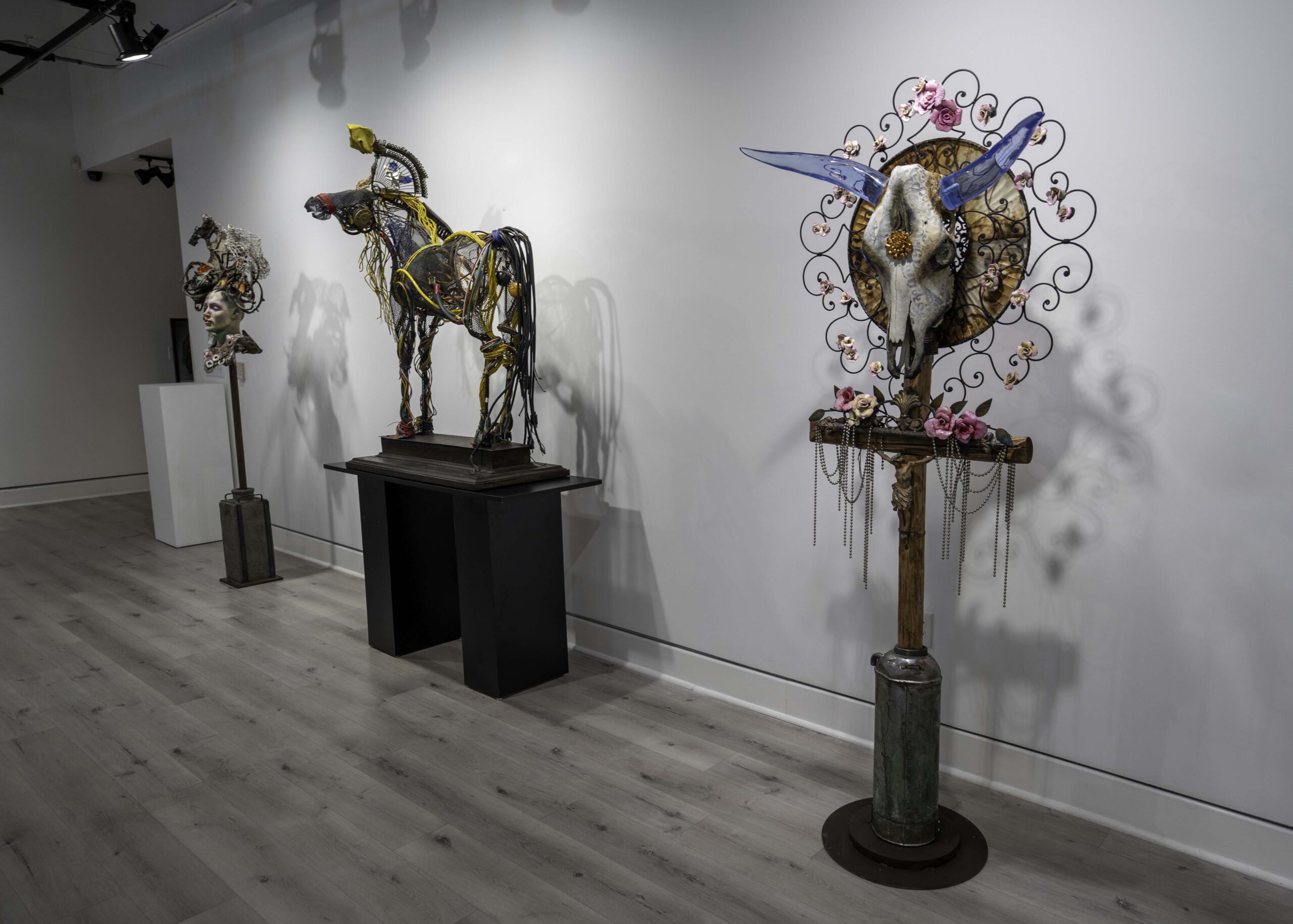
Entering Korbel’s world is like taking a walk through both the artist’s dreams and your own. Horses made of wire and found metal parts are ready to gallop across a wild prairie; Frankenstein and Jesus are merged into one suffering and ecstatic image; flowers burst from an elegiac “Indian Summer,” and an electric blue deer conjures up a vision of beauty and delight.

The artist’s use of unusual materials is exciting and inventive, but it is her sense of motion, through both joy and pain, that is the most unique.

Living the Dream is an apt title for an exhibition that is both dream-like and packed with abundant life. Each work in its own way conveys a sense of yearning, a longing for the dream to continue or shift, for reality to bend. And if anyone could actually bend it, that would be Korbel, whose gift for creation is magically, marvelously slightly off kilter.

Taken as a whole, the exhibition weaves a complex spell of alternative reality, one both intimately recognizable and strangely alien. Individually, each piece has a powerful emotional resonance, a kind of ache to be set free, find happiness, achieve a transformation that might provide both, or neither.

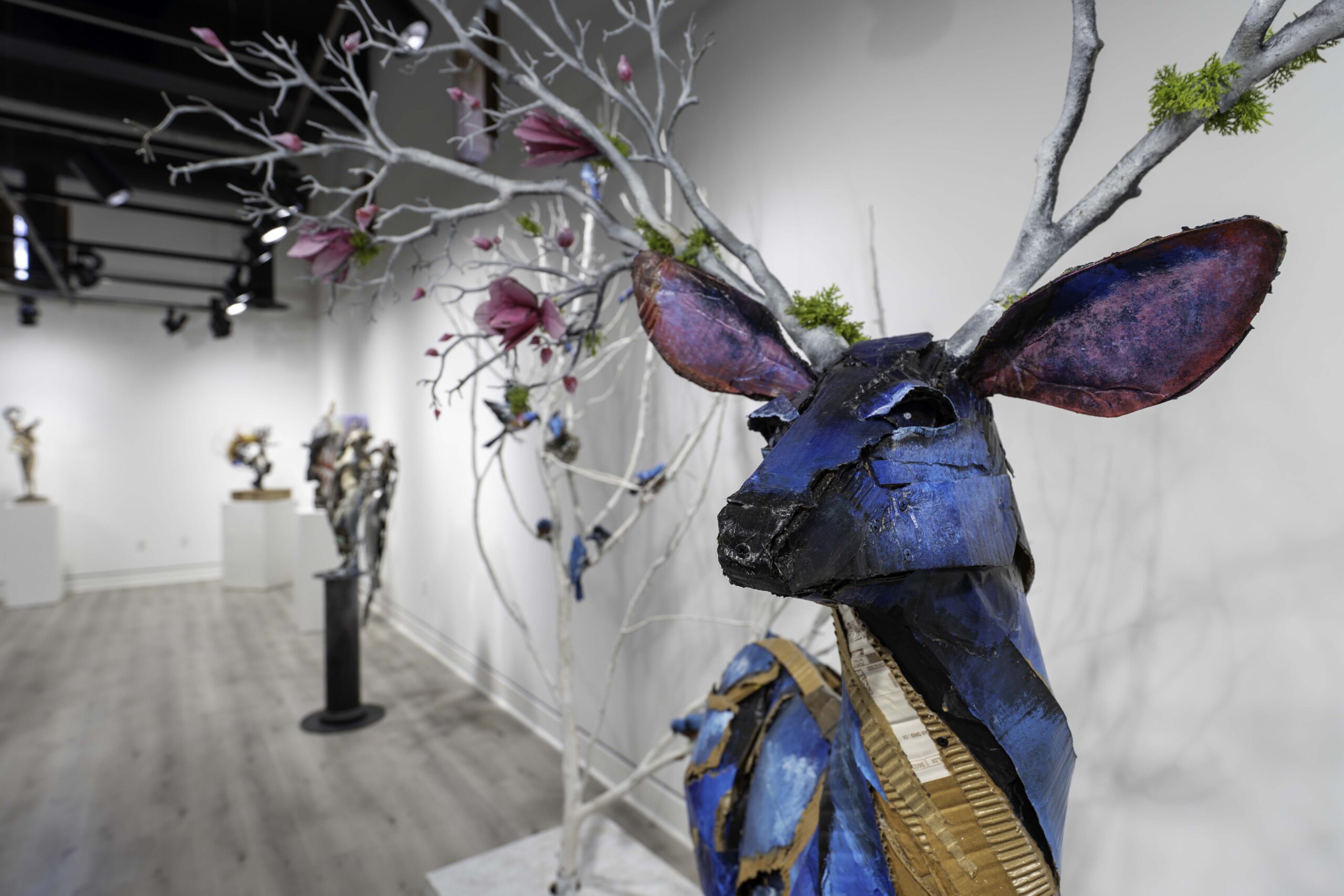
“Night Dreaming” is a glorious image, a deer that is mutant indigo, with patterns of black and beige a part of his painted coat. With purple ears and tree branch antlers from which lustrous pink flowers spring, this lovely young deer is the bringer of spring and hope.

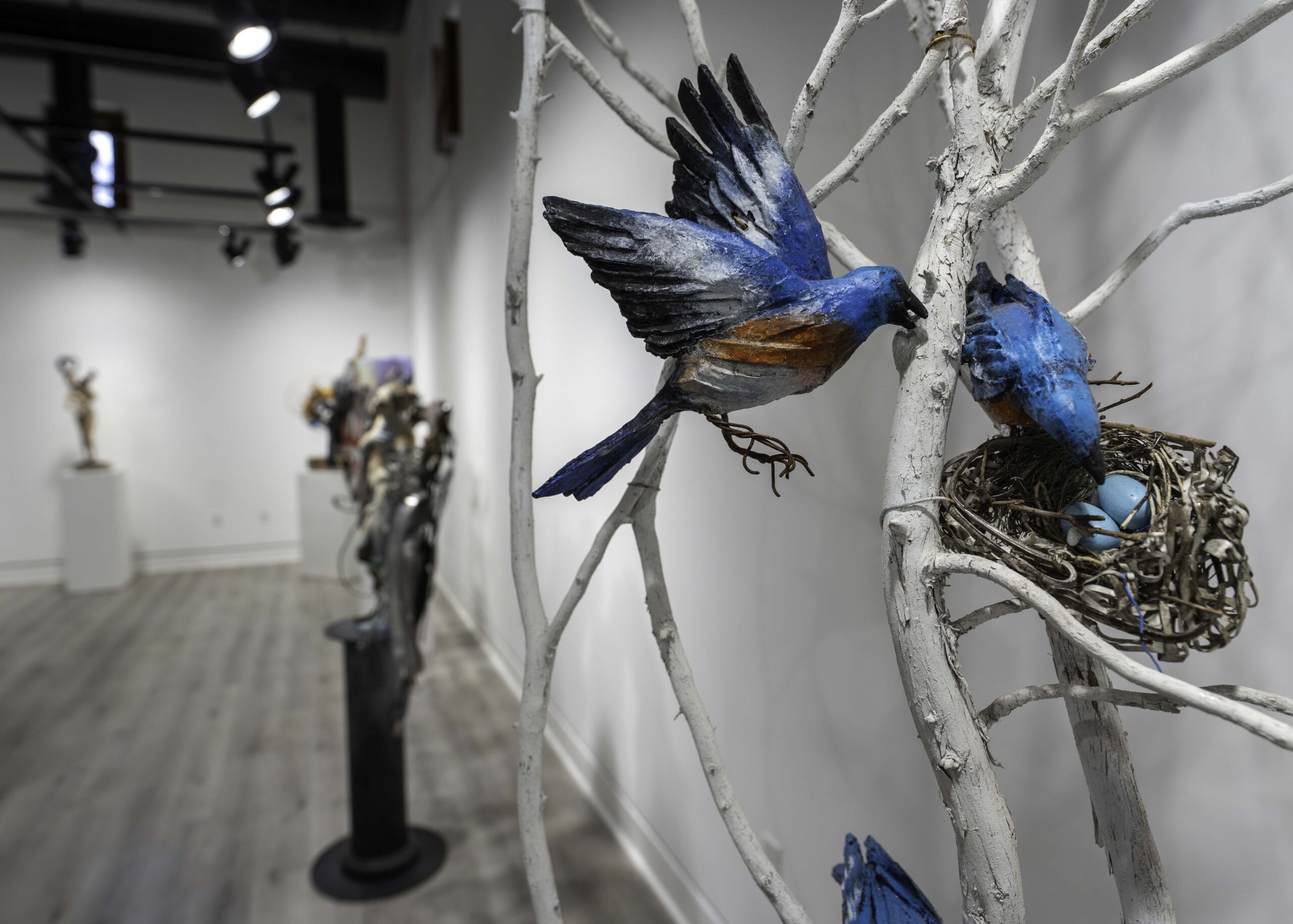
Positioned beside him in the gallery are white-painted trees abloom in their own right with vibrant nesting bluebirds, in a delicate work simply titled “Birds in Trees.”

From this light, joyous focal point along the center wall of the gallery, weightier titles, topics, and materials spread out. Positioned in the middle of the gallery,  “The Call” is exuberant, wild, and brilliantly free. Wire tail flung outward like a flag, head raised, back arched, this is the call to run, to feel the wind, to carry it home.

Next to this beauty stands “Small Talk,” head bowed as if grazing, his perfect dangling tail created from found electrical conduits. Both these fine beasts are sinew and muscle made from a steampunk reality of metal and wire that, once conjoined, becomes more alive than flesh and bone. They stand on bases that are intrinsically created by Korbel to be of one piece with the sculptures themselves, not merely a base but the place on which these mythical creatures could stand. “Small Talk” is poised on what could be the wooden floor of a barn; “The Call” is balanced on what could be part of a road or rail ties.

There is a rich nuance to these horses, each intricate component, whether a factory discard, automotive part, mesh, or metal wire all come together in a kinetic rush to form a coherent, tough, yet delicate whole. “Small Talk” also embodies a poem written by the artist, “Quasimodo Love,” which reads in part “I don’t know how to be more.” And which of us do? And, which of us don’t make ourselves smaller in our own self-talk, sure that love will leave us if we cannot perfect our flaws.

Another equine, “Wired,” proudly poses on a pedestal wearing a crown shaped from a part of a fan, his muscular torso lined with bright yellow wire, a sunshine brightness so galvanizing his title can only speak to it. Encased in a mesh-fleshed body, this young stallion has pool balls as a part of his genitalia.

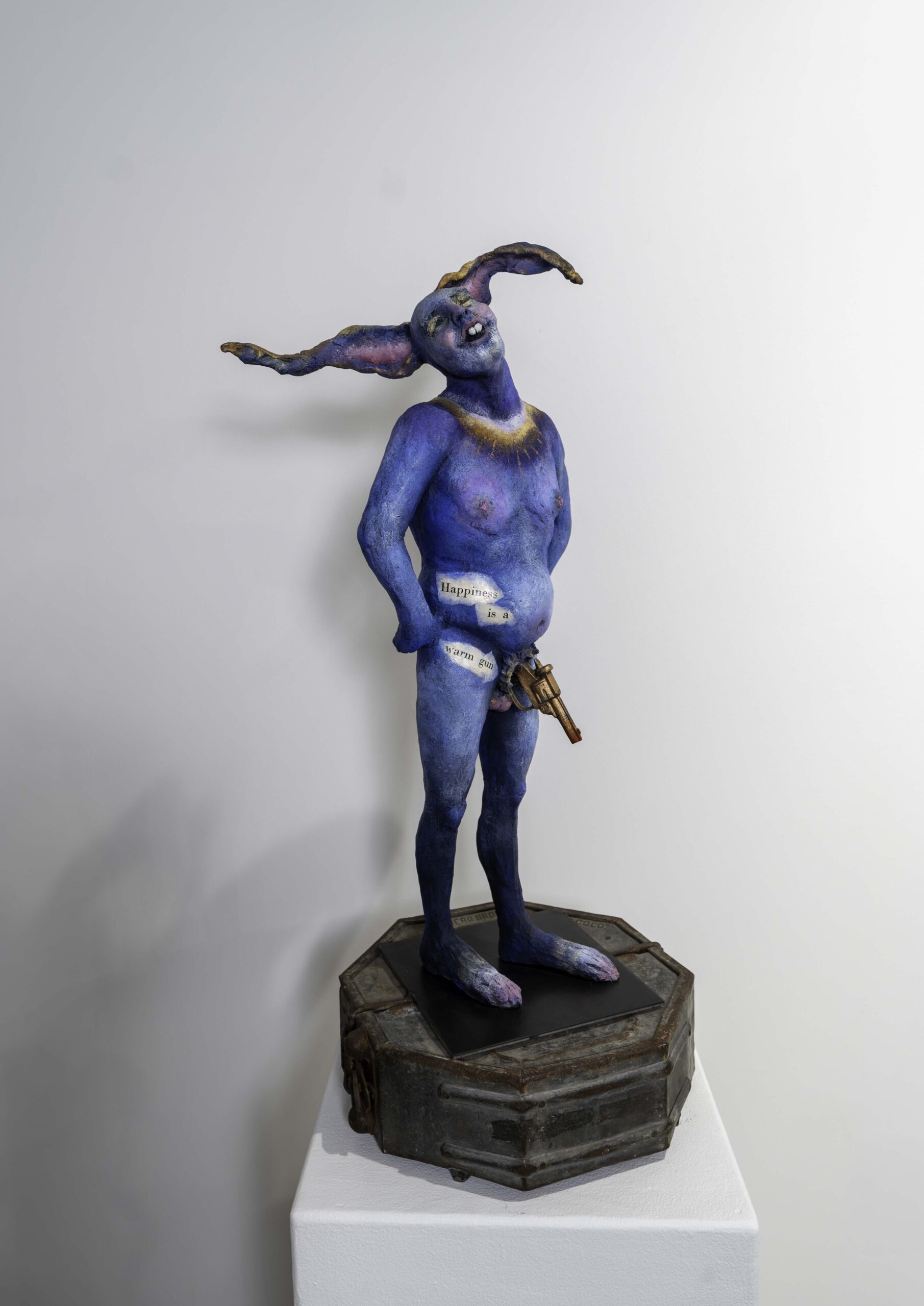
A different sort of ballsy humor is embodied by “Happiness is a Warm Gun” in which a bright blue man/rabbit throws back his head, quite pleased with himself and his scatologically placed firearm, his title is transcribed on his thigh. While recognizably human, his long rabbit ears and rabbit-hoof feet make his tough-guy posturing as comical as it is deadly.

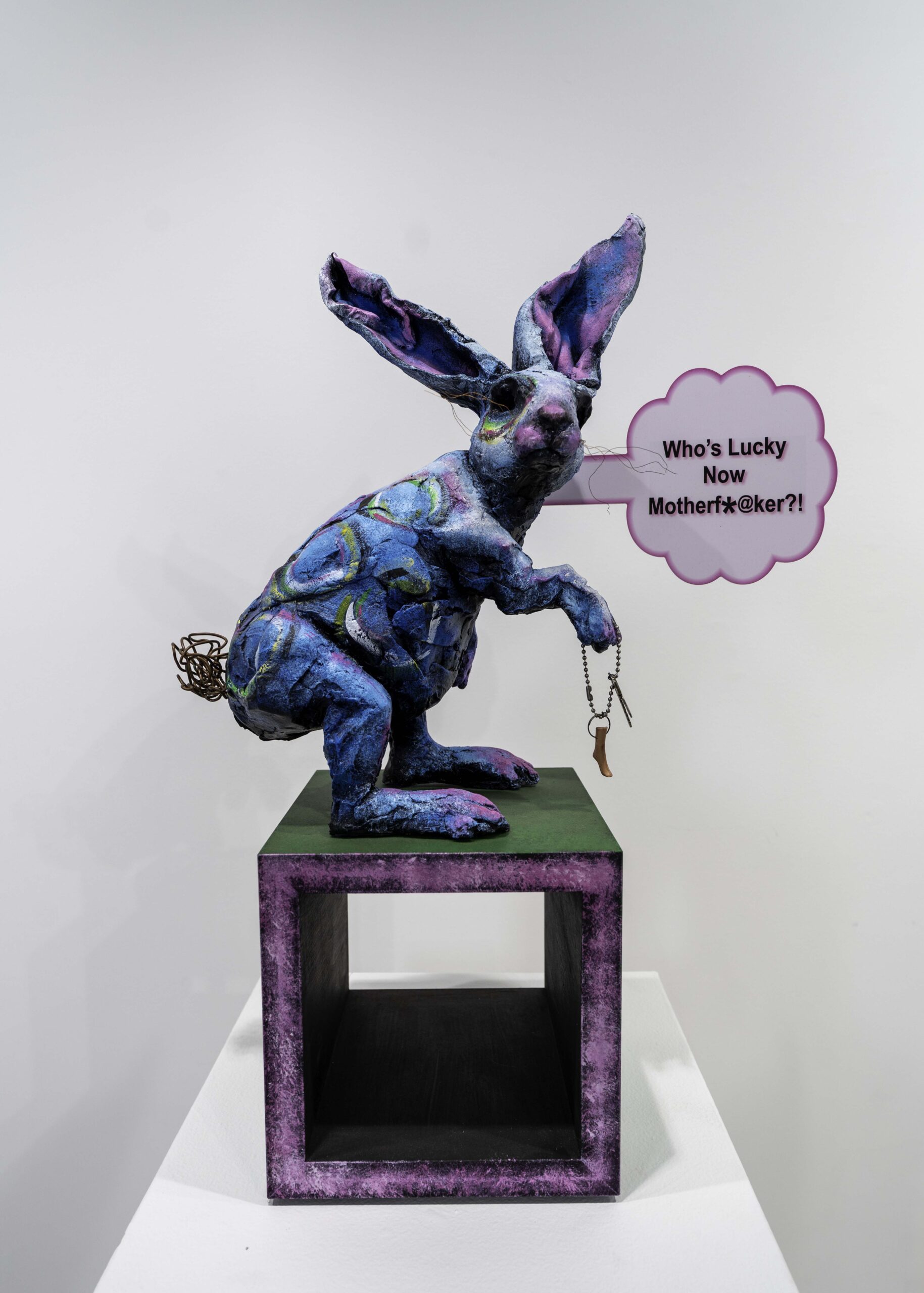
A full rabbit is the subject of “Who’s Lucky Now, Motherf*@ker?!” Here, positioned on a square open box that could be a rabbit hutch, this is definitely “somebunny” as he dangles a human leg on a key ring, just as once upon a time we might have carried an actual small rabbit’s foot for “good luck.” His slightly psychedelic purple, green, and white patterning and cute wire tail belies an expressive face that’s seen some things. And acted on others.

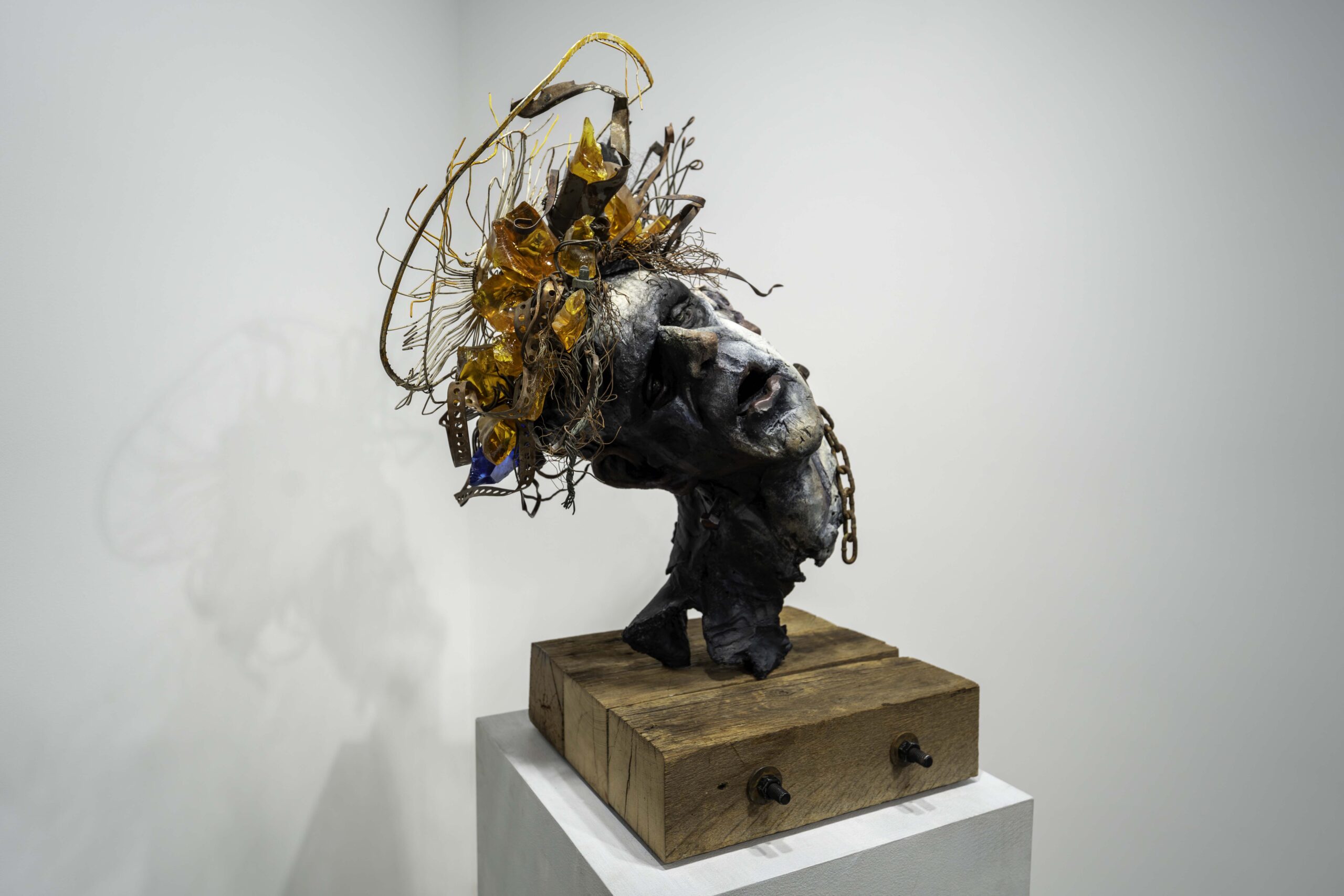
Turning more seriously toward the human and inhuman condition, “Forsaken” gives us a Christ-like Frankenstein, his halo constructed of amber glass and a part of a fan, his face drawn back in a rictus of both suffering and ecstasy. With a chain dangling against one cheek, this man has suffered as all humans suffer, and perhaps for us as well.

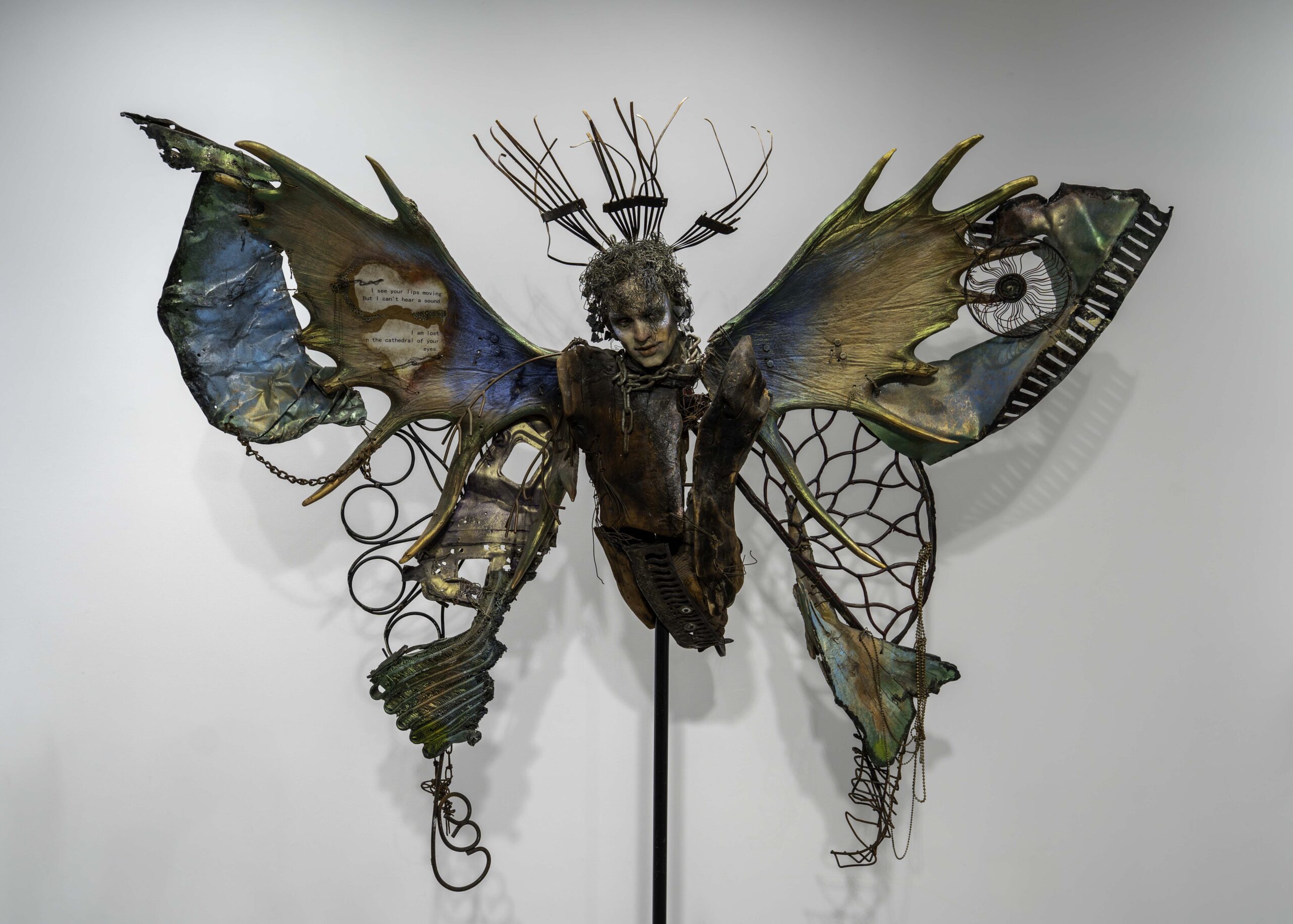
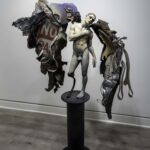
There is a quiet transcendence in the suffering of “Metamorphosis,” as a human man, his face deep in thought, riven with both a cocky boldness and regret, merges into a ragged butterfly. One wing is imprinted with poetry written by Korbel, “I see your lips moving but I can’t hear a sound/I am lost in the cathedral of your eyes.” Is this the kind of terrible, ecstatic morphing of love, or  an ache that hopes to achieve it?

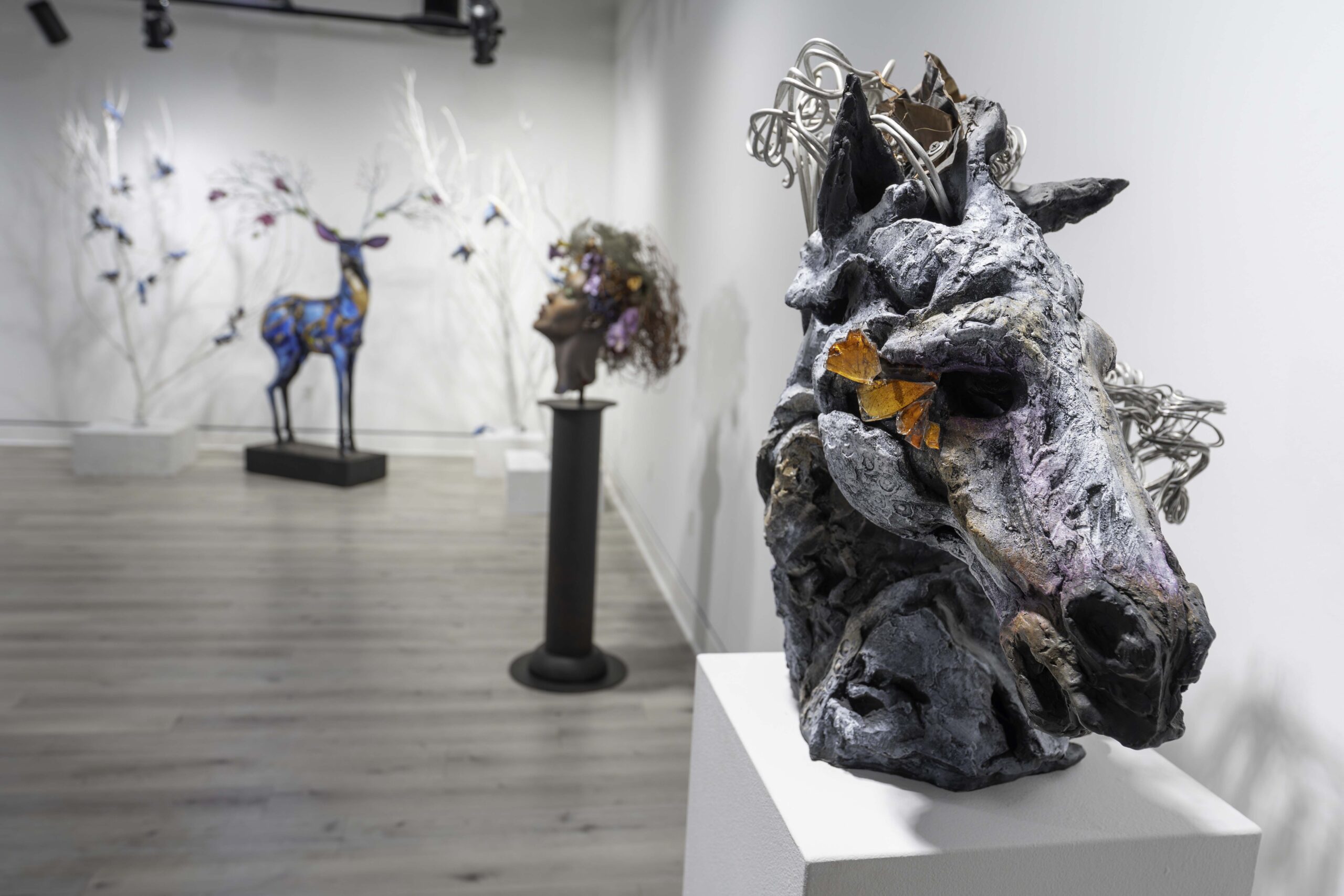
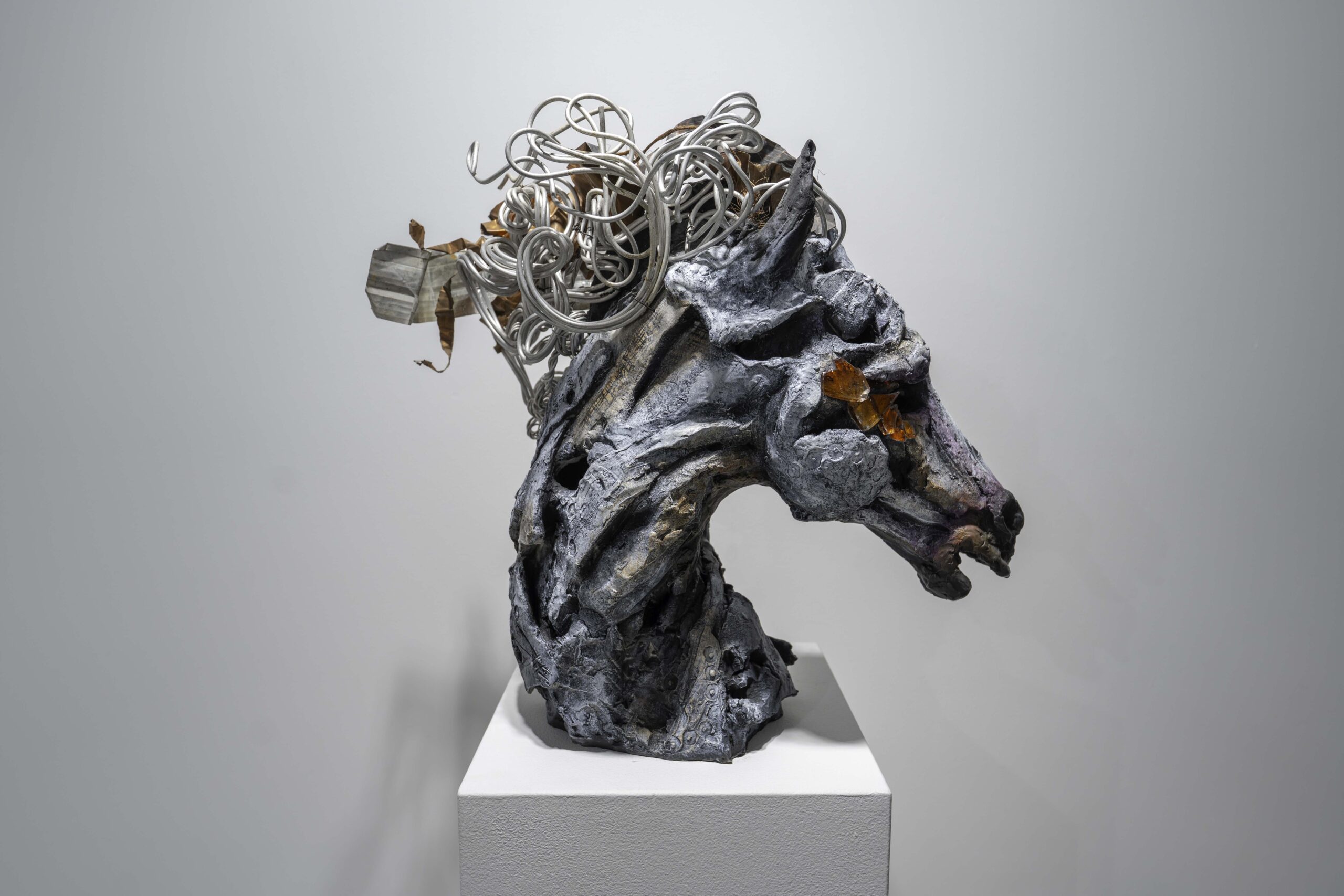
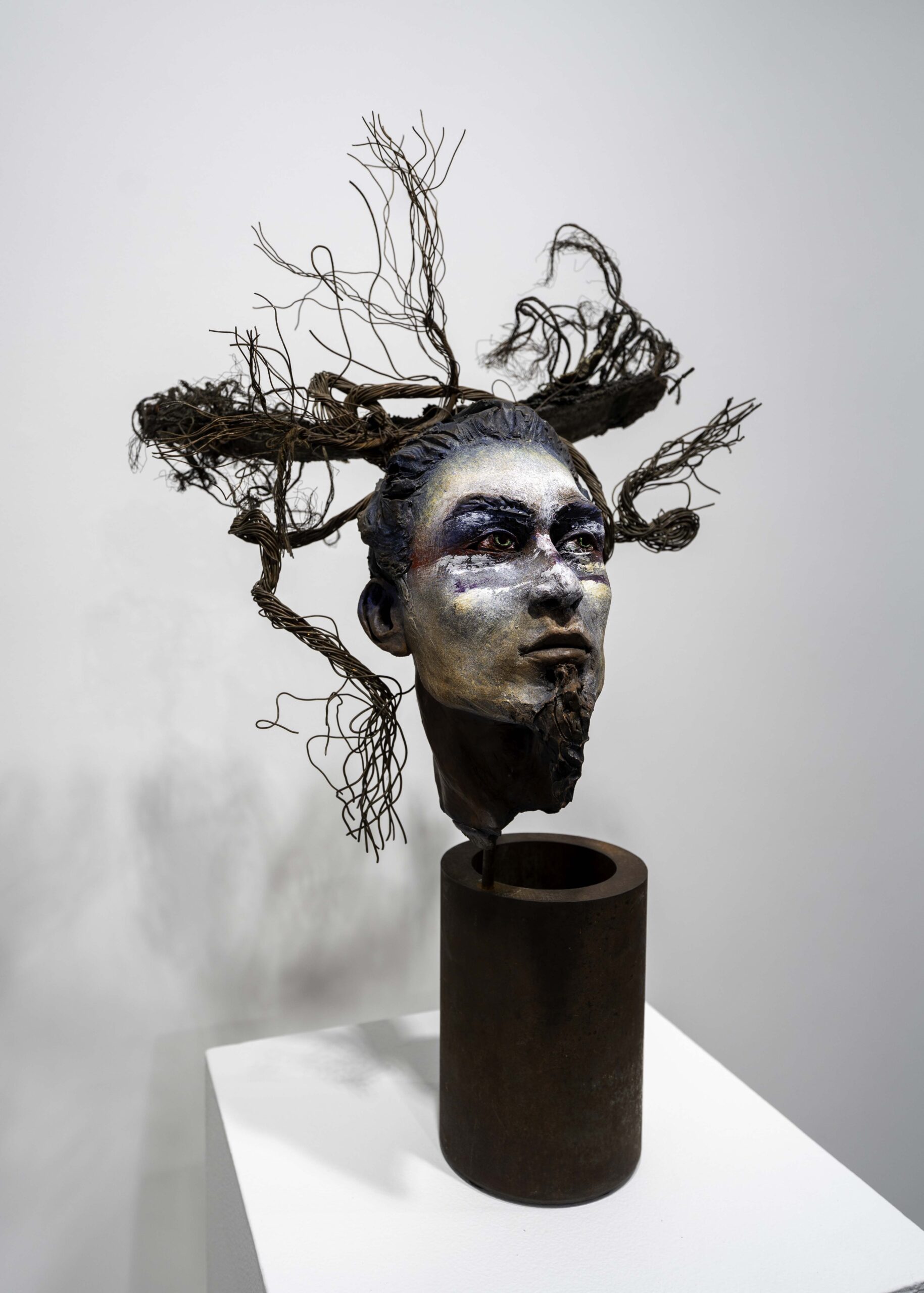
“Wild is My Heart” is the head of an elegant horse, partially turned, with amber glass sparkling near his eyes and a tangled aluminum wire mane. His nostrils flare, his elegant, fiery spirit awaits a freedom he cannot yet achieve.

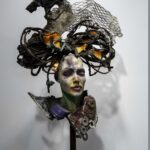
Other works are just as lovely and inchoate with hope and loss: “The Kiss” gives us conjoined sisters, as restricted as they are, they express a deep tenderness; “Dreaming” gives us a beautiful man growing his ragged angel’s wings; “Flirt” is a teasing woman with an impossible headdress.

Above, “Michael,” is another tender, insightful work.

Regardless of title, whether human, deer, horse, rabbit, or a mythical mix, each of these wonderful, wondrous sculptures glows with a fierce lifeforce that the artist herself embodies. Never losing their sense of humor or their hope for a better world, the dream they live, along with that of their creator, is simply marvelous.

Living the Dream runs through April 6th; Riverside College Quad Gallery is located at 4800 Magnolia Ave. in Riverside.

  • Genie Davis; photographs by LA Art Documents